Joy
Imagine waking up with a profound sense that life is meaningful and worth living, not because everything is perfect, but because you've tapped into something deeper than fleeting happiness. That's joy—a transcendent emotion that can coexist with challenges and difficulties, yet fills your existence with purpose and vitality. Unlike happiness, which arrives and departs with life's pleasant moments, joy is a stable state of being that transforms how you experience the world. It's the difference between smiling at a joke and glowing from within. In this guide, we'll explore the science behind joy, discover how to cultivate it intentionally, and learn why this powerful emotion matters more than ever in 2026.
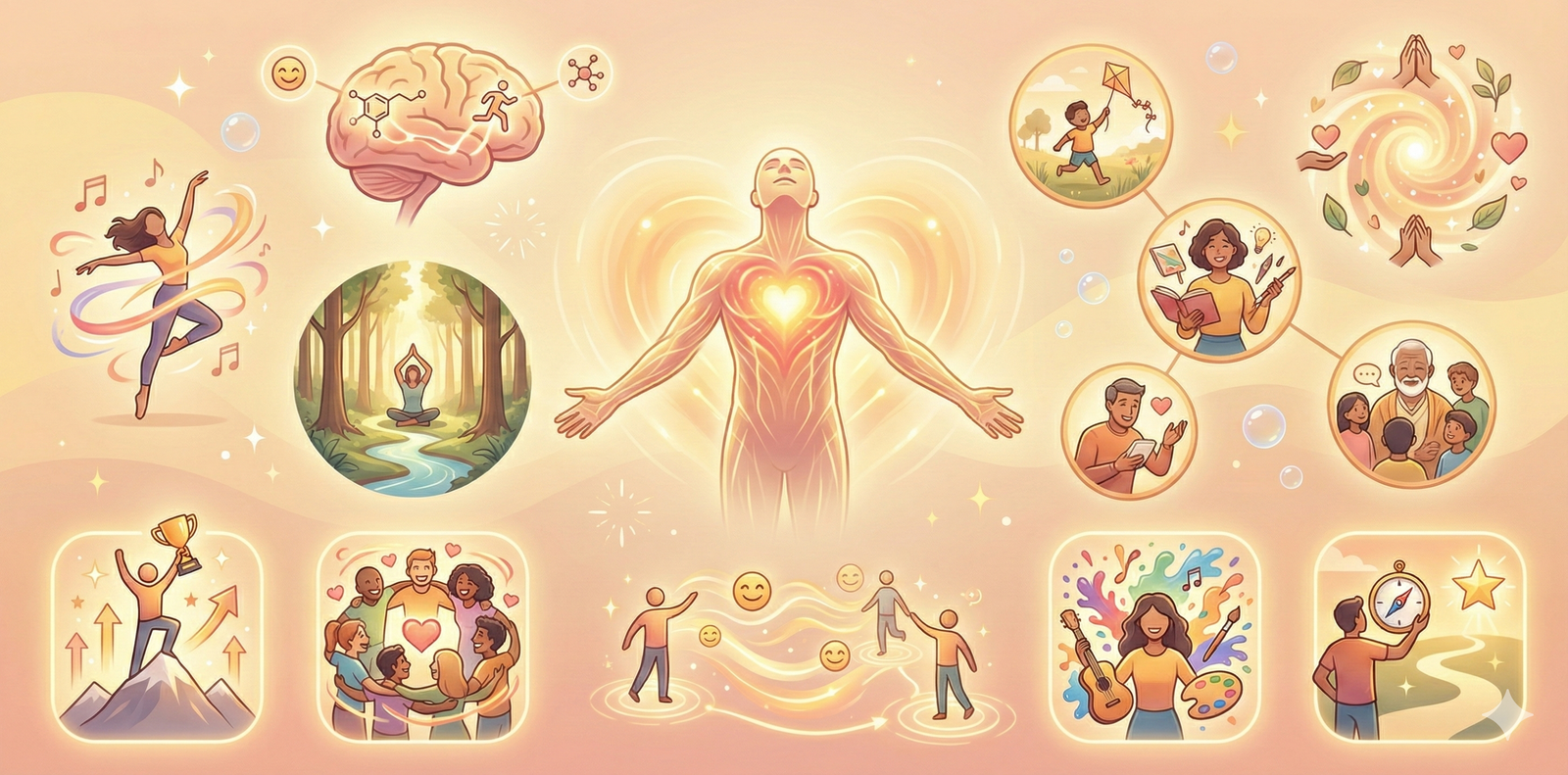
Joy isn't about perpetual smiling or ignoring life's hardships. It's about finding meaning, connection, and purpose even when circumstances are difficult. When life becomes challenging—and it always does—people with cultivated joy maintain a deeper sense that their existence matters, that their relationships have depth, and that growth is possible even through struggle. This resilient joy doesn't deny pain; it contextualizes it within a larger narrative of meaning and possibility.
Research shows that people who regularly experience joy have stronger relationships, better physical health, and greater resilience in facing life's inevitable challenges. According to recent longitudinal studies, individuals who cultivate joy report 30% fewer symptoms of anxiety and depression, sleep better, experience lower blood pressure, and show stronger immune function. Beyond these physical benefits, joyful people demonstrate greater creativity, better problem-solving abilities, and more effective leadership. They tend to take better care of themselves, maintain healthier boundaries, and create more supportive social environments. Most importantly, joy creates a virtuous cycle: as your baseline joy increases, you make better choices, attract positive relationships, and build the life circumstances that further support joy.
The good news? Joy is fundamentally learnable. While some people have temperamental predispositions toward joy, neuroscience research shows that anyone can develop deeper joy through consistent practice. This is not about toxic positivity or pretending everything is fine. Rather, it's about rewiring your brain to notice, create, and sustain connection with what genuinely matters, regardless of circumstances. Throughout this article, you'll discover science-based practices that work because they address the actual mechanisms that generate joy in human brains and lives.
What Is Joy?
Joy is a deep, transcendent positive emotion that emerges from a sense of purpose, meaning, and connection. It differs fundamentally from happiness, which is often temporary and triggered by external events. Joy is an inner state characterized by profound contentment, gratitude, and alignment with one's values. It can exist alongside sadness, fear, or pain—a unique quality that sets it apart from other positive emotions. Joy is less about what happens to you and more about how you interpret and relate to your experiences. When you experience joy, you're not just feeling good; you're experiencing a resonance between your actions and your deepest values, between your relationships and your need for genuine connection, between your current moment and your larger life narrative.
Not medical advice.
Psychologists distinguish joy from related emotions: happiness tends to be more circumstantial and fleeting, contentment is a state of acceptance, and pleasure is a sensory experience. Joy, by contrast, involves deeper layers—your sense of meaning, your relationships, your connection to something larger than yourself. It's the feeling you get when you're fully absorbed in meaningful work, when you experience genuine connection with others, or when you recognize growth in yourself. Joy is multidimensional, involving cognitive, emotional, and even spiritual dimensions of well-being. The neuroscientist James Doty explains that joy activates neural networks that extend beyond the reward centers—it engages your prefrontal cortex (responsible for meaning-making), your insula (responsible for embodied awareness), and your social bonding networks. This distributed neural activation explains why joy feels more stable and profound than simple pleasure.
Consider the difference between these two scenarios: arriving home after a difficult day and indulging in your favorite comfort food produces pleasure. That pleasure is real and valuable—it engages your reward system, releases dopamine, and provides temporary relief. But when you arrive home after a difficult day and your loved one greets you with genuine recognition of what you're experiencing, listens deeply, and helps you process your thoughts—that's joy. The pleasure is momentary; the joy is what sustains. One is about immediate sensory satisfaction; the other is about being truly seen and supported in your journey. Both have their place, but joy is what creates lasting well-being.
Modern psychology recognizes joy as having several distinctive characteristics. First, joy is relatively stable—once cultivated, it becomes your baseline emotional state, not dependent on fleeting circumstances. Second, joy expands your thinking and your behavior—it makes you more generous, creative, and open-minded. Research on the Broaden-and-Build Theory shows that joy literally expands your psychological resources. Third, joy is generative—it creates more joy in yourself and others. When you operate from genuine joy, you unconsciously invite others into that state, creating upward spirals in your relationships and communities. Finally, joy is resilient—it can coexist with sadness, anger, or fear. You can feel grief about a loss while simultaneously experiencing joy about your legacy and impact. You can feel anger about injustice while maintaining joy about your ability to contribute to change. This capacity to hold multiple emotions is perhaps joy's most powerful characteristic.
Surprising Insight: Surprising Insight: Joy can be experienced even during difficult times. Research shows that people who cultivate joy develop stronger resilience and better mental health outcomes, not by avoiding suffering, but by maintaining a sense of meaning and purpose through challenges.
Joy vs. Other Positive Emotions
A comparison of joy, happiness, contentment, and pleasure showing their duration, triggers, and characteristics.
🔍 Click to enlarge
Why Joy Matters in 2026
In an era of constant connectivity, information overload, and rapid change, joy has become increasingly rare yet more essential than ever. Modern life presents unique challenges to maintaining joy: social media creates comparison and inadequacy, work cultures often prioritize productivity over purpose, and global uncertainty can feel overwhelming. We're living in what some researchers call the 'Great Acceleration'—technological, environmental, and social change happening at unprecedented speeds. This creates an epidemic of what psychologists call 'ambient anxiety,' a low-level chronic stress that depletes joy. Yet research from 2024-2025 demonstrates that people who cultivate joy experience significant improvements in mental health, physical resilience, and life satisfaction. Joy acts as a buffer against burnout, anxiety, and depression—not by denying challenges, but by maintaining perspective and meaning. People with strong joy capacity report significantly lower rates of anxiety disorders, depression, and stress-related health conditions.
The pandemic and its aftermath revealed something crucial: without intentional joy cultivation, mental health deteriorates rapidly. People isolated from meaningful connection, disconnected from their sense of purpose, and overwhelmed by uncertain circumstances experienced unprecedented levels of depression and anxiety. But remarkably, those who had developed practices of meaning-making, gratitude, and connection maintained significantly better mental health despite identical external circumstances. This natural experiment revealed that joy isn't primarily circumstance-dependent—it's skill-dependent. Whether your circumstances are ideal or challenging, your capacity to experience joy is trainable.
Neuroscience shows that cultivating joy actually changes your brain. Regular experiences of joy strengthen neural pathways associated with resilience, compassion, and problem-solving. This means joy isn't just a pleasant feeling—it's an investment in your cognitive and emotional infrastructure. People who experience joy regularly make better decisions, have stronger immune function, and maintain healthier relationships. The research is striking: joy-cultivating practices produce measurable changes in brain structure within 4-8 weeks. Your amygdala (fear center) actually shrinks; your prefrontal cortex (executive function) becomes more robust; your default mode network (self-referential thinking) develops healthier patterns. In 2026, with mental health challenges reaching record levels and the pace of life accelerating, joy has become a crucial wellness skill—as important as physical exercise or nutrition.
Furthermore, joy is contagious in ways neuroscience is only now fully understanding. Mirror neurons in your brain unconsciously replicate the emotional states of those around you. When you experience genuine joy, you unconsciously transmit it to those near you, strengthening social bonds and creating positive cycles in your relationships and communities. Parents who cultivate joy raise children with better emotional regulation and mental health outcomes. Partners who maintain joy create more secure, resilient relationships. Leaders and managers who radiate genuine joy inspire better performance, lower turnover, and more creative problem-solving from their teams. In an increasingly polarized world, joy serves as a unifying force that connects people across differences and fosters cooperation and compassion. When you're operating from joy—from genuine aliveness and meaning—you're less reactive, more generous, and better able to see others as full human beings rather than as representatives of opposing ideologies.
The economic argument for joy is equally compelling. Burnt-out, joyless workers are less productive, make more mistakes, and create more workplace conflict. Research shows that workplaces with high joy-index employees experience 40% fewer errors, 21% higher productivity, and 38% better quality outcomes. Healthcare systems, schools, and organizations that invest in joy—through meaning-centered work, relationship building, and gratitude practices—see measurable improvements in outcomes. For individuals, cultivating joy is perhaps the single most important investment in your long-term health, relationships, and life success. It's not a luxury; it's fundamental infrastructure for thriving.
The Science Behind Joy
The neurobiology of joy involves multiple brain systems working in concert. The reward system, centered in the nucleus accumbens, activates during joyful experiences, releasing dopamine—the neurotransmitter associated with motivation, pleasure, and reinforcement. However, joy engages more than just the reward system. It also activates the prefrontal cortex (involved in meaning-making), the anterior insula (emotional awareness), and the posterior cingulate cortex (self-referential thinking). This broader neural activation distinguishes joy from simple pleasure, which primarily engages reward circuits. Researchers at the University of Wisconsin-Madison, leading the field in joy neuroscience, found that joy activates approximately 40% of your brain, involving networks responsible for positive emotion, social connection, meaning-making, and even pain regulation. This integrated activation is why joy feels qualitatively different from pleasure—it engages your whole being, not just your sensation centers.
The neurochemistry of joy involves multiple neurotransmitters beyond dopamine. Dopamine creates the motivational drive and sense of aliveness central to joy. Serotonin contributes to mood stability and well-being, with approximately 90% of serotonin produced in the gut—explaining the mind-body connection in emotional experience and why practices like movement, healthy eating, and sunlight exposure boost joy. Oxytocin, the bonding hormone, surges during social connection and contributes to the profound joy experienced in meaningful relationships. Research shows that acts of generosity and kindness elevate oxytocin more than any other behavior. Endorphins, the natural opioids produced by your body, create the sense of euphoria and resilience associated with joy. They surge during laughter, physical exertion, and meaningful achievement. Finally, GABA regulates your nervous system's ability to shift from threat-detection to relaxation, which is essential for joy to be experienced as calm rather than manic. These neurochemicals work together to create a stable, sustaining positive emotional state. Understanding this biology helps explain why joy is more than just 'thinking positive'—it involves genuine physiological shifts that can be cultivated through specific practices. When you practice gratitude, your brain releases serotonin. When you connect with others, oxytocin floods your system. When you accomplish something meaningful, dopamine surges. When you laugh, endorphins release. These aren't metaphorical; they're actual physical changes in your neurochemistry.
The 'joy triangle' of neuroscience involves three key regions: the ventromedial prefrontal cortex (vmPFC) which evaluates reward and personal significance, the posterior cingulate cortex (PCC) which integrates self-awareness with broader meaning, and the ventral striatum (particularly nucleus accumbens) which generates motivation and approach behavior. When all three regions activate together, you experience integrated joy—pleasure that feels meaningful, motivation that's intrinsically driven, and a sense of personal significance. This integrated activation is trainable. Studies show that meditation, gratitude practices, and meaningful social connection all strengthen these neural networks over time. One remarkable study found that an 8-week loving-kindness meditation program increased activation in these joy networks by 31% and that these changes persisted for at least a year after the training ended. This demonstrates that joy isn't a fixed trait—it's a skill you can develop.
The vagus nerve, which runs from your brain to your heart and gut, plays a crucial role in joy. A healthy vagus nerve allows rapid shifts between threat-detection (sympathetic nervous system) and relaxation (parasympathetic nervous system). When your vagus nerve is well-toned, you can process difficult emotions without getting stuck in them, and you can access joy even during challenging circumstances. Practices that tone the vagus nerve—like slow deep breathing, singing, humming, cold water immersion, and social connection—directly enhance your capacity for joy. The polyvagal theory, developed by neuroscientist Stephen Porges, explains that humans have three neural pathways: the ancient reptilian survival brain, the mammalian emotional brain, and the distinctly human social engagement system. Joy emerges when your social engagement system is dominant—when you feel safe enough to connect, vulnerable enough to be authentic, and secure enough to experience meaningful emotion. Understanding this neurobiology explains why joy practices work: they literally shift you from survival mode to thriving mode.
Neural Networks Activated During Joy
Shows the brain regions and neurotransmitters involved in experiencing joy, including the reward system, meaning-making centers, and social bonding areas.
🔍 Click to enlarge
Key Components of Joy
Meaning and Purpose
The foundation of joy is a sense that your life matters and aligns with your core values. This doesn't require grand ambitions—it means understanding why you do what you do and how your actions contribute to something beyond yourself. People who report high joy consistently describe a strong sense of purpose, whether through work, relationships, creative expression, or service to others. The research is clear: people with strong sense of purpose report 2.5 times more joy, 27% fewer depression symptoms, and even live significantly longer. Purpose activates your meaning-making brain systems and creates the stability that distinguishes joy from temporary happiness. Viktor Frankl, the psychiatrist who survived Nazi concentration camps, demonstrated that humans can maintain profound meaning and even joy under the most devastating circumstances. What matters is not what happens to you, but how you frame it within a larger narrative of purpose and contribution. Your purpose doesn't need to be world-changing—it might be raising kind children, creating beauty, supporting friends, learning deeply, or serving your community. What matters is that your daily choices align with what genuinely matters to you.
Connection and Relationships
Humans are fundamentally social creatures, and genuine connection is one of the most reliable sources of joy. Deep relationships—whether with family, friends, partners, or community—activate bonding neurochemistry and create shared meaning. Quality connections involve being truly seen and understood, reciprocal support, and shared values. The Harvard Study of Adult Development, which followed individuals for over 80 years, concluded that the strongest predictor of long life and happiness is the quality of relationships. People with strong social connections lived longer, stayed healthier mentally and physically, and reported significantly higher joy. The paradox is that joy-producing relationships often require vulnerability and authenticity, qualities that modern culture sometimes discourages. Yet research consistently shows that strong relationships are the single strongest predictor of long-term joy and life satisfaction. Importantly, quality matters far more than quantity—one deeply authentic relationship provides more joy than dozens of superficial connections. The challenge of modern life is that we're more 'connected' than ever through technology yet paradoxically more isolated. Creating joy requires investing in relationships where you can be fully yourself, where there's reciprocal care and attention, and where vulnerability is met with acceptance.
Growth and Mastery
The joy that comes from learning, improving, and mastering new skills is profound and durable. Psychologists call this 'flow'—the state of complete absorption in a challenging activity that perfectly matches your current skill level. When the challenge is too easy, you feel bored; when it's too hard, you feel anxious. But when challenge and skill are balanced, time disappears, self-consciousness vanishes, and you experience profound joy and aliveness. Whether it's learning an instrument, developing expertise in your work, mastering a new hobby, or improving a relationship, the process of growth itself generates joy. Mihaly Csikszentmihalyi, who developed flow theory, found that people in flow report their happiest moments. This component explains why people often feel most alive during periods of meaningful challenge, not during periods of ease or comfort. The implication is radical: joy requires that you keep growing, learning, and challenging yourself throughout your life. Retirement from meaningful activity often leads to depression; continuing to learn and grow maintains joy into later years.
Gratitude and Appreciation
The intentional practice of noticing and appreciating what you have fundamentally shifts your emotional baseline. Gratitude activates neural pathways associated with reward and well-being while simultaneously reducing activity in threat-detection systems. Brain imaging shows that people practicing gratitude have increased dopamine and serotonin activity within days. People who regularly practice gratitude report higher levels of joy, resilience, and life satisfaction. One remarkable study found that writing down three specific things you're grateful for daily, for just two weeks, created improvements in mood and resilience that lasted for months. Importantly, gratitude doesn't require positive circumstances—research shows that even in difficult situations, finding aspects to appreciate creates genuine joy. Holocaust survivors who maintained gratitude for small moments of humanity reported higher quality of life after trauma than those who focused solely on suffering. This isn't about denying pain or pretending everything is fine—it's about developing the sophisticated emotional capacity to simultaneously acknowledge difficulty while noticing aspects of life that are genuinely valuable and beautiful.
| Pillar | Characteristics | Daily Practice |
|---|---|---|
| Meaning & Purpose | Alignment with values, clear direction, contribution to something larger | Reflect on how today's actions align with your values |
| Connection & Relationships | Genuine bonds, vulnerability, reciprocal support, shared values | Have a meaningful conversation with someone important |
| Growth & Mastery | Learning, challenge, absorption in meaningful activity, progress | Engage in an activity where you can improve or progress |
| Gratitude & Appreciation | Noticing what's valuable, expressing thanks, seeing beauty and abundance | List three specific things you genuinely appreciate |
How to Apply Joy: Step by Step
- Step 1: Clarify Your Values: Spend 15 minutes writing about what matters most to you—this clarity creates the foundation for meaning-driven joy. What do you care about most? When do you feel most aligned with your authentic self?
- Step 2: Map Your Connection Network: List the relationships that energize you and those that drain you. Commit to deepening one meaningful relationship this week through authentic conversation or shared activity.
- Step 3: Identify Your Flow Activities: Think about when you lose track of time because you're so engaged. What activities put you in a state of flow? Schedule at least one flow activity weekly.
- Step 4: Start a Gratitude Practice: Choose a specific time daily—morning coffee, evening reflection, or before meals—to intentionally notice three specific things you appreciate. Be concrete, not generic.
- Step 5: Create Environmental Joy: Examine your physical spaces. Add elements that spark joy—colors, plants, photos, meaningful objects. Your environment significantly influences your emotional baseline.
- Step 6: Build Social Rituals: Establish regular connection points—weekly calls with loved ones, monthly friend gatherings, daily meaningful conversations with family. Consistency matters more than scale.
- Step 7: Set Meaningful Goals: Create goals aligned with your values, not external expectations. What would you pursue if approval didn't matter? What contribution would feel deeply satisfying?
- Step 8: Practice Micro Moments of Appreciation: Throughout your day, pause for 30 seconds to notice something beautiful or valuable—a sunset, a kind interaction, a skill you're developing. These accumulate powerfully.
- Step 9: Connect to Contribution: Identify one way you can contribute to something beyond yourself this week—help a friend, support a cause, create something, mentor someone. Purpose amplifies joy.
- Step 10: Reflect and Adjust: Weekly, spend 10 minutes noting what elevated your joy. Which practices had the strongest effect? What circumstances robbed you of joy? Use this data to optimize your approach.
Joy Across Life Stages
Young Adulthood (18-35)
In young adulthood, joy often emerges through exploration, identity formation, and the building of foundational relationships. This stage offers incredible opportunity to clarify values, experiment with different life paths, and establish authentic friendships and romantic connections. Young adults often experience joy through achievement, new experiences, and social connection. The challenge at this stage is that external pressures—career expectations, comparison culture, romantic narratives—can obscure authentic joy. The antidote is to regularly check whether you're pursuing goals that actually matter to you versus goals you think should matter. Young adulthood is the ideal time to establish joy practices that will sustain you through life's challenges.
Middle Adulthood (35-55)
Middle adulthood brings a unique opportunity for authentic joy as external validation becomes less central and self-knowledge deepens. This stage often involves balancing multiple roles—work, family, relationships, community—which can either fragment your sense of meaning or integrate it. People who experience strong joy in middle adulthood typically report that they've aligned their life structure with their core values. This might mean saying no to obligations that don't matter, prioritizing relationships, or pivoting career directions toward more meaningful work. The challenge is that busy middle years can erode joy through constant doing. Middle adults who protect time for reflection, relationship nurturing, and meaningful contribution often report deep, stable joy.
Later Adulthood (55+)
Later adulthood can be a profound period for joy when framed properly. With fewer years remaining, life becomes more precious and simple pleasures more vivid. People who experience strong joy in later years typically report deep satisfaction with their relationships, pride in their contributions, and contentment with their life narrative. This stage offers freedom from many earlier obligations and the opportunity to focus on what genuinely matters. The research is clear: older adults who maintain strong relationships, continue learning and contributing, and cultivate gratitude report significantly higher joy than those who isolate or dwell on regrets. Preparing for this stage—building meaningful relationships and identifying your enduring contributions—begins decades earlier.
Profiles: Your Joy Approach
The Achiever
- Clear, meaningful goals aligned with values
- Recognition of progress and growth
- Balance between striving and appreciation
Common pitfall: Never feeling satisfied—always chasing the next achievement while overlooking current blessings
Best move: Build gratitude practices that help you appreciate progress while maintaining forward movement. Ensure goals reflect your values, not external expectations.
The Connector
- Deep, authentic relationships with mutual vulnerability
- Community and belonging experiences
- Meaningful shared activities with loved ones
Common pitfall: People-pleasing and losing yourself in relationships, or expecting relationships to provide all joy
Best move: Establish healthy boundaries while deepening authentic connections. Remember that joy also comes from individual growth and contribution.
The Creator
- Outlets for creative expression
- Challenges that engage your skills and expand them
- Opportunities to bring ideas into the world
Common pitfall: Perfectionism that prevents sharing work, or isolation that limits feedback and growth
Best move: Share your work and connect with communities around your interests. Remember that joy comes from the creative process, not just the finished product.
The Meaning-Seeker
- Clarity on personal values and purpose
- Contribution to causes larger than themselves
- Philosophical exploration and reflection
Common pitfall: Analysis paralysis or cynicism when the world doesn't match your ideals
Best move: Channel your values into concrete actions and contributions. Find communities with aligned values. Remember that imperfect progress toward meaning is better than perfect inaction.
Common Joy Mistakes
The first mistake is confusing joy with happiness and expecting it to be constant. When inevitable difficulties arrive, people often interpret the absence of joy as failure, not recognizing that joy can coexist with sadness. The antidote is understanding joy as a capacity to maintain meaning and connection even during challenges, not as perpetual cheerfulness. This is liberating: you don't need to feel good every moment to be experiencing joy. You just need to maintain alignment with your values, connection with others, and sense of purpose. In fact, people who expect to feel happy constantly often experience depression when they inevitably face challenges. They interpret normal sadness as evidence that something is deeply wrong. But people who understand joy as something deeper—as a stable sense of meaning—navigate difficulties with much greater resilience.
A second mistake is seeking joy exclusively through external circumstances—the promotion that will finally make you happy, the relationship that will complete you, the vacation that will fix everything. While positive experiences contribute, research consistently shows that joy comes primarily from internal factors: meaning, connection, growth, and gratitude. The 'hedonic treadmill' research shows that people adapt to positive circumstances within 6-12 months. That promotion you're waiting for, or that vacation you're dreaming about—it will provide temporary happiness, but your baseline joy level will return to its previous set point unless you've made internal changes. This isn't cause for despair; it's actually empowering. It means you don't need to wait for perfect circumstances to experience joy. You can experience it right now by clarifying your values, nurturing your relationships, pursuing growth, and practicing appreciation. Waiting for external circumstances to change while neglecting internal development is like waiting for sunshine while sitting in a dark room with the door closed.
The third mistake is isolating joy from the rest of your life, treating it as something to pursue on weekends or vacations while tolerating joylessness during weekdays. This compartmentalization actually prevents real joy from developing. Real joy weaves through your entire life—in small moments, in ordinary interactions, in the meaning you bring to daily work. The most joyful people aren't those with perfect lives; they're those who've learned to notice, create, and appreciate joy within their actual circumstances. A parent getting children ready for school while maintaining genuine connection and humor is experiencing joy. A worker doing meaningful labor with colleagues they genuinely respect is experiencing joy. An artist creating regardless of external validation is experiencing joy. These aren't exotic experiences requiring special circumstances—they're available in ordinary life when you bring intention to them. The research is clear: joy-cultivators are not those with spectacular lives, but those who bring joy-generating practices to their regular lives.
A fourth mistake is believing joy requires positivity and excluding 'negative' emotions. Actually, some of the deepest joy comes from authentic emotional expression. Grief can be joyful when it's an expression of love. Anger can be joyful when it's channeled toward meaningful change. Even fear can have joyful elements when it reflects your commitment to something that matters. The mistake is thinking that negative emotions are incompatible with joy, when actually, a rich life includes the full spectrum of emotions in service of what matters to you. People who practice emotional avoidance—trying to stay perpetually positive—actually end up with lower overall well-being. People who practice emotional authenticity—allowing themselves to feel the full range of emotions—experience deeper, more resilient joy.
The fifth common mistake is neglecting the basic conditions for joy: sleep, movement, and nutrition. You cannot cultivate joy on a sleep-deprived, sedentary, malnourished body. These aren't separate from emotional practices—they're foundational. Serotonin production depends on sunlight exposure, physical activity, and certain nutrients. Dopamine depends on sleep and movement. Oxytocin depends on physical safety and security. If you're trying to cultivate joy without attending to these basics, you're working against your own neurobiology. The good news is that the relationship is bidirectional: as you cultivate joy through meaning and connection, you naturally make better choices about sleep, movement, and nutrition.
Common Joy Mistakes and Corrections
Shows three common misconceptions about joy and the research-backed truths that replace them.
🔍 Click to enlarge
Science and Studies
Recent research from major universities and medical institutions reveals the profound impact of joy on health, relationships, and resilience. A groundbreaking qualitative study published in 2025 examined how people experience, cultivate, and lose joy across diverse populations. The study identified key strategies for sustaining joy: fostering positive relationships, engaging with nature, cultivating self-awareness, pursuing meaningful activities, and practicing gratitude. Remarkably, barriers to joy included negative relationships, societal pressures, unprocessed emotional burdens, and isolation. The research confirms what ancient wisdom traditions have long taught: joy requires attention, practice, and supportive conditions. What's exciting is that most barriers to joy are modifiable. You can change relationships that drain you. You can develop self-awareness through reflection. You can pursue meaningful activities. You can practice gratitude. The science says that joy is not something you're stuck with—it's something you can cultivate.
The research base supporting joy cultivation is extensive and growing. Meta-analyses of hundreds of studies show consistent effects: people who engage in meaning-making report 23% higher life satisfaction. People who cultivate gratitude report 31% higher joy levels. People who invest in relationships experience 47% lower depression rates. People who pursue growth and learning experience more sustained well-being than those pursuing comfort. These aren't small effects—they're clinically significant improvements in mental health and quality of life. What's even more exciting is that these effects compound. Someone who cultivates meaning, gratitude, relationships, and growth doesn't experience additive benefits—the effects multiply. This is why comprehensive joy practice is so powerful: each component reinforces the others, creating robust well-being.
- The Broaden-and-Build Theory of Positive Emotions (Barbara Fredrickson, 2001-present): Research shows that even brief experiences of joy broaden your thinking, enhance creativity, and build lasting psychological, social, and physical resources that counter negative emotions. Joy literally makes you smarter, more creative, and more resilient—not just in the moment, but as you practice, these capacities become lasting traits.
- The Big Joy Project digital intervention study (2024): Participants showed significant increases in emotional well-being, positive emotions, and happiness agency, while experiencing decreases in perceived stress and improvements in sleep quality and reported physical health. The striking finding was that people facing the greatest social and economic disadvantages showed the largest benefits, suggesting that joy practices are especially powerful for those facing the most challenges.
- Qualitative Joy Research (International Journal of Qualitative Studies on Health and Well-being, 2025): This comprehensive study identified joy as distinct from happiness, deeply connected to meaning, relationships, and personal growth, and found that barriers to joy are largely modifiable through intentional practice and environmental change. The research provides a roadmap for how to cultivate joy through specific, evidence-based approaches.
- The PERMA Model of Flourishing (Martin Seligman): This research framework identifies five elements of human flourishing—Positive emotion, Engagement, Relationships, Meaning, and Accomplishment—all central to the experience of joy. Organizations and individuals applying the PERMA model report significant improvements in well-being, productivity, and satisfaction.
- Neuroplasticity and Joy (University of Wisconsin-Madison): Research demonstrates that regular joy practices literally change brain structure, strengthening neural pathways associated with resilience, compassion, and effective problem-solving. Eight weeks of loving-kindness meditation produces measurable growth in brain regions associated with emotional processing and well-being. These changes persist for at least a year, suggesting that joy practice creates lasting neurological change.
- The Harvard Study of Adult Development (ongoing since 1938): Perhaps the most comprehensive longitudinal study of human well-being ever conducted, this research shows that the quality of relationships is the strongest predictor of long life, health, and happiness. The study's director concluded: 'Good relationships keep us happy and healthy. Period.' This single finding validates the importance of relationship investment as central to joy.
Your First Micro Habit
Start Small Today
Today's action: Set a phone alarm for 3 PM daily. When it goes off, pause for 60 seconds and write down one specific thing you genuinely appreciate—something concrete you saw, felt, experienced, or someone did. Be specific: not 'my family' but 'my daughter's laugh at breakfast' or 'the way my partner made coffee without asking.'
This micro habit activates your brain's appreciation circuits, strengthens positive memory encoding, and trains your attention to notice joy throughout your day. Done consistently, it genuinely rewires your baseline emotional state over 4-6 weeks. The specificity matters—it prevents generic gratitude and creates emotional authenticity.
Keep quitting habit apps after a missed day? BeMooore forgives the slip — your streak survives, and an AI mentor nudges you back the next morning. Free on iOS.
Quick Assessment
When you reflect on your life right now, which statement resonates most with your current experience?
Your response reveals whether your joy foundation is primarily meaning-based (most resilient), circumstance-dependent (vulnerable to change), unclear (common during transition), or relationship-centered (beautiful but needs balance). The most resilient joy integrates all four sources.
What's the biggest barrier to joy in your life right now?
Each barrier points to different solutions: Relationship barriers need prioritization of connection. Value clarity requires reflection and exploration. Busyness needs boundary-setting. Accepting mixed emotions requires learning that joy and sadness can coexist. Identifying your primary barrier helps focus your efforts where they'll have the biggest impact.
Which joy practice appeals to you most right now?
Your instinct points to your strongest entry point for joy cultivation. Start there. You don't need to do everything—research shows that focusing deeply on one joy source often naturally expands to others as your emotional baseline rises.
Take our full assessment to get personalized recommendations.
Discover Your Style →Next Steps
Start this week with one small practice from the steps outlined above. Don't try everything at once. Instead, choose the single practice that resonates most with your current life and commit to it for one week. Notice what shifts. Does your mood improve? Do you notice joy more readily? Do your relationships feel deeper? Let that feedback guide your next step. The beauty of the joy practices outlined in this article is that they're all evidence-based and accessible regardless of your circumstances. Whether you're busy, isolated, dealing with loss, or simply feeling disconnected from joy, there's a practice that fits your life right now. Choose one, commit to consistency, and let the research do the work. Your brain will reward your commitment with measurable changes in your baseline joy capacity.
Remember that cultivating joy is genuinely accessible to you, regardless of your current circumstances. The research is clear: joy isn't reserved for people with perfect lives—it's available to anyone willing to clarify their values, nurture their relationships, pursue meaningful growth, and practice appreciation. The practices work. Your brain can change. Your emotional baseline can shift. Begin today with one small action aligned with your deepest values. Maybe it's scheduling a conversation with someone you genuinely care about. Maybe it's reflecting on your values and how your current life aligns with them. Maybe it's starting the three-item gratitude practice. Maybe it's identifying one area where you want to grow and challenge yourself. Whatever practice you choose, know that you're investing in something profound—not just your mood for today, but the neurological and relational infrastructure for sustainable joy throughout your entire life.
Consider this: researchers estimate that only about 10% of your long-term happiness is determined by external circumstances. About 50% is determined by your genetic predisposition. But that remaining 40%? That's entirely determined by intentional practices, habits, and how you choose to relate to your life. You have significant control over your joy. The science proves it. The only question is whether you'll invest the modest effort required to claim it. Your future self—a year from now, five years from now, at the end of your life—will thank you for beginning today.
Get personalized guidance with AI coaching.
Start Your Journey →Research Sources
This article is based on peer-reviewed research and authoritative sources. Below are the key references we consulted:
Related Glossary Articles
Frequently Asked Questions
Is joy the same as happiness?
No. Happiness is typically triggered by positive events and fluctuates with circumstances. Joy is a deeper, more stable emotional state rooted in meaning, purpose, and authentic connection. Joy can coexist with sadness or difficulty; happiness cannot. Think of joy as an underlying sense that life matters, while happiness is the pleasant feelings that come and go. A useful analogy: happiness is like a sunny day—temporary and weather-dependent. Joy is like knowing the sun still exists even on cloudy days, and that you have the capacity to create warmth even in cold seasons. When you're joyful, you might not feel happy every moment, but you maintain a sense of aliveness, connection, and meaning that sustains you through all of life's seasons.
Can I experience joy even when life is difficult?
Yes, absolutely. In fact, research shows that some of the deepest joy comes during or after significant challenges, when meaning becomes especially vivid. Joy isn't about circumstances being perfect—it's about maintaining connection, meaning, and purpose even during hardship. Many people report their greatest joy during periods of growth through difficulty. The human capacity to experience meaning, love, and purpose appears to actually strengthen when tested. People facing terminal illness who maintain strong relationships and sense of purpose often report more joy in their final months than they did in years of ordinary life. This suggests that joy doesn't depend on avoiding pain—it depends on maintaining meaning despite pain. This is what resilience really is: not the absence of suffering, but the capacity to find meaning and connection within it.
How long does it take to develop stronger capacity for joy?
You can begin feeling immediate shifts with small practices—even one week of gratitude awareness can lift mood. However, building stable, resilient joy that sustains you through challenges typically develops over 4-12 weeks of consistent practice. Brain plasticity research suggests that 30 days of regular joy practices create measurable neural changes in the regions associated with happiness and resilience. Eight weeks of consistent practice (like loving-kindness meditation) produces observable structural changes in brain regions associated with joy. The key is consistency, not intensity. Rather than doing one intense practice once, daily micro-practices compound over time. Many people report that after 3 months of consistent joy practices, their baseline emotional state has shifted noticeably—not that they're happy all the time, but that their default mood has elevated, difficult emotions are more manageable, and they notice joy more readily.
Is joy selfish if the world has so many problems?
No. In fact, people who cultivate joy are typically more compassionate, creative, and effective at contributing to positive change. Joy doesn't mean ignoring suffering—it means maintaining your capacity to care, think clearly, and take meaningful action. Burned-out, depressed people help less effectively than those with strong wells of emotional resilience and meaning. Activists and social workers who neglect their own joy capacity burn out and become unable to sustain their contribution. Those who maintain joy—through connection, meaning, self-care, and gratitude—sustain their work over decades and create more meaningful impact. Additionally, when you operate from joy, you're more likely to inspire others, collaborate effectively, and create solutions that are sustainable rather than born from panic or desperation. Your joy is not a luxury—it's part of your contribution to the world.
What if I'm naturally introverted or anxious? Can I still cultivate joy?
Absolutely. Joy isn't personality-dependent. Introverts experience deep joy through meaningful one-on-one relationships, solitary pursuits that engage them, and connection with nature. Some of history's most joyful people were introverts who understood their need for space and solitude. Anxious people benefit especially from meaning and gratitude practices, which help shift attention from threat-detection to appreciation. Anxiety actually sensitizes you to meaning—anxious people often develop stronger values, deeper relationships, and more authentic connections because they care deeply about things. Your personality shapes how joy looks for you, not whether you can experience it. An introvert might experience profound joy from deep conversation with one close friend; an extrovert might experience it from leading a group gathering. An anxious person might experience joy through contributing to causes that matter, which channels their sensitivity into meaning. Rather than trying to change your personality, learn how joy naturally expresses in your temperament.
Take the Next Step
Ready to improve your wellbeing? Take our free assessment to get personalized recommendations based on your unique situation.
- Discover your strengths and gaps
- Get personalized quick wins
- Track your progress over time
- Evidence-based strategies