Productivity
Productivity isn't about grinding harder or working longer hours. Research from Oxford University reveals that happy workers are 31% more productive than stressed or unhappy ones. When you align your work with your wellbeing, something remarkable happens: tasks feel easier, focus sharpens, and results multiply. But here's the real secret—sustainable productivity flows naturally from a mindset centered on happiness, purpose, and psychological safety. This guide reveals the science behind productivity, shows you how to enter flow states, and teaches you micro-habits that turn procrastination into momentum.
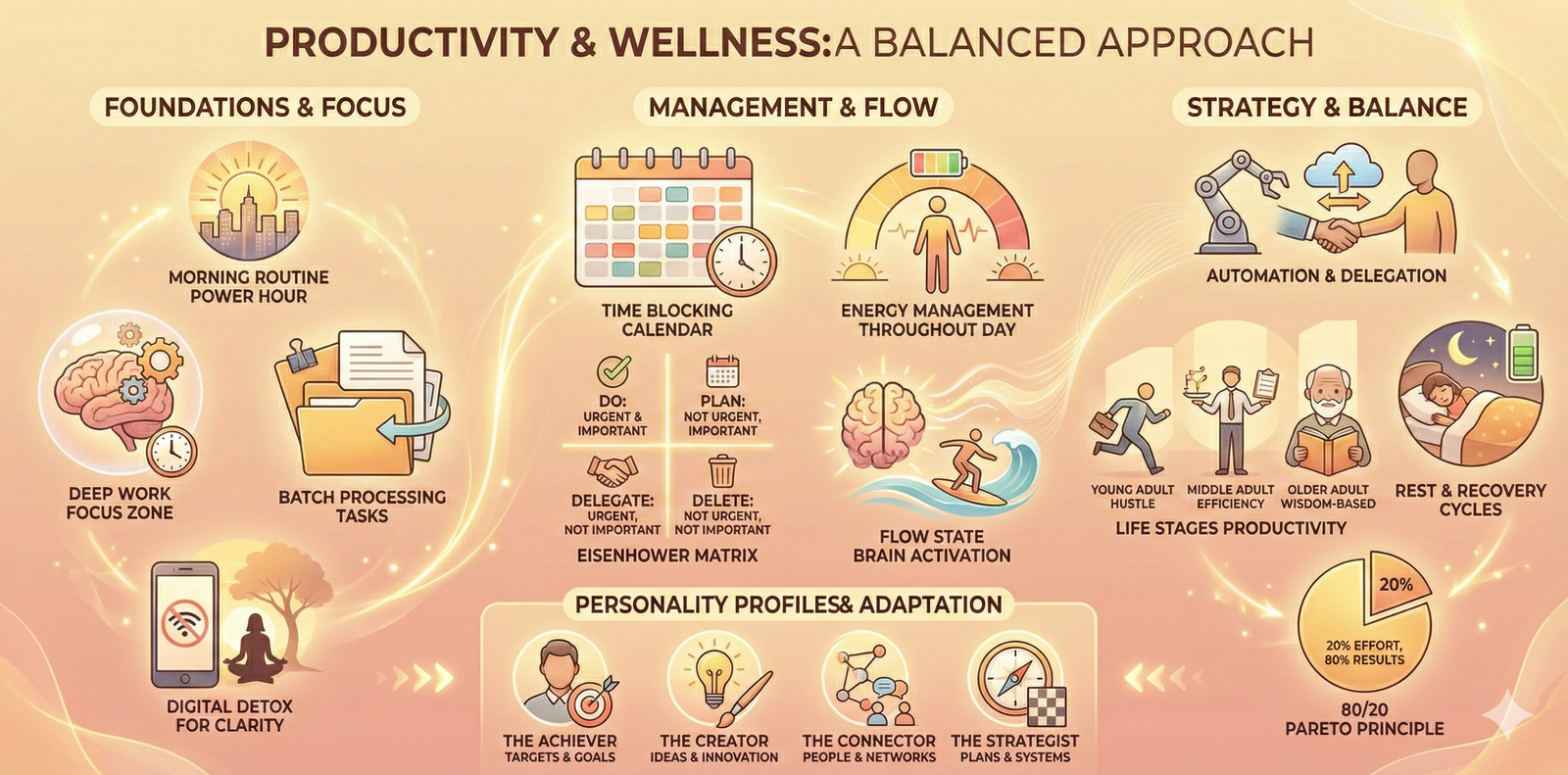
Imagine completing your hardest work by noon, feeling energized rather than exhausted. Picture yourself entering a state of complete focus where time disappears and creativity flows. That's not fantasy—that's productivity aligned with wellbeing.
Discover why happy companies outperform, how flow states unlock your best work, and the simple daily habits that compound into remarkable results.
What Is Productivity?
Productivity is the measure of how efficiently and effectively you complete meaningful work. It's not about doing more tasks—it's about doing the right tasks with full focus and good energy. True productivity combines three elements: focus (eliminating distractions), intention (working toward meaningful goals), and wellbeing (maintaining energy and motivation long-term).
Not medical advice.
Modern productivity research shows us that quality matters far more than quantity. A person working in a positive mental state produces better results in fewer hours than someone grinding through stress and fatigue. Productivity is ultimately about sustainable output paired with psychological wellbeing.
Surprising Insight: Surprising Insight: A one-point increase in happiness (on a 0-10 scale) leads to a 12% increase in productivity, with complex tasks like negotiation seeing 20% gains.
The Productivity-Wellbeing Loop
How happiness, focus, and meaningful work create a self-reinforcing cycle of sustainable productivity
🔍 Click to enlarge
Why Productivity Matters in 2026
In 2026, productivity has evolved beyond the industrial-era definition of faster, harder, longer. The world economy loses 8.9 trillion dollars annually to low employee engagement and poor wellbeing. Yet companies investing in employee wellbeing see productivity gains of 10-21%, alongside 39% lower stress and 71% lower burnout rates. Productivity that costs your health is not productivity—it's debt you'll eventually pay.
Digital overload, endless notifications, and remote work blur the boundary between working and living. Strategic productivity—paired with clear boundaries and wellbeing practices—is now a survival skill. People who master this skill report higher life satisfaction, stronger relationships, and the ability to pursue meaningful work without sacrificing their health.
The shift from hustle culture to sustainable performance is not weakness; it's strategy. Organizations and individuals who understand this gain a competitive advantage: their best people stay, their work quality improves, and their wellbeing metrics soar.
The Science Behind Productivity
Neuroscience reveals that productivity is deeply tied to emotional state. When you're happy, your brain releases dopamine, which improves focus, motivation, and working memory. Stress does the opposite—it triggers cortisol, which clouds thinking, triggers procrastination, and narrows focus. A happy worker isn't just happier; they're neurologically more capable of quality work.
Flow state, researched extensively by positive psychologist Mihály Csíkszentmihályi, represents the peak of productive performance. In flow, your brain operates optimally: task difficulty matches your skill level, distractions fade away, and work feels effortless. Athletes, artists, and knowledge workers in flow demonstrate faster reaction times, greater endurance, and superior outcomes. The challenge-to-skill ratio is the key—too easy feels boring; too hard triggers anxiety. Just right creates flow.
Flow State: The Zone of Optimal Performance
Balance between challenge and skill determines whether you experience flow, anxiety, or boredom
🔍 Click to enlarge
Key Components of Productivity
Goal Clarity
Your brain can't work toward a vague target. Productivity explodes when your daily work connects to a clear, meaningful goal. Without clarity, you're busy but not productive—checking tasks without moving the needle on what matters. When you know exactly what success looks like, your brain automatically prioritizes ruthlessly.
Deep Focus
Deep focus is the ability to concentrate on complex work for extended periods without distraction. Digital devices, emails, and notifications are productivity's greatest enemies. Research shows it takes 23 minutes to re-establish focus after an interruption. Protecting your attention is protecting your productivity. Deep focus environments—silent spaces, notification-free time blocks, single-tasking—are where real work happens.
Energy Management
You're not a machine with constant power. Your mental energy fluctuates throughout the day based on sleep, nutrition, movement, and stress. The most productive people schedule their hardest cognitive work during their peak energy hours, typically 2-4 hours after waking. They protect sleep, take breaks, and move their bodies. Energy management beats time management every single time.
Intrinsic Motivation
Work feels heavy when you're doing it only for external rewards. Productivity soars when you're driven by purpose, autonomy, and mastery—intrinsic motivators. Even in jobs with constraints, finding meaning, choosing your approach, and developing skills within your role transforms productivity from obligation to engagement.
| Metric | Stressed Worker | Happy Worker |
|---|---|---|
| Productivity Output | Baseline | +31% efficiency |
| Task Quality | Surface level | Deep, thorough |
| Focus Span | Fragmented | Sustained 90+ min |
| Creativity | Limited | Expansive |
| Error Rate | Higher | Lower |
| Burnout Risk | High | Low |
How to Apply Productivity: Step by Step
- Step 1: Define your ONE meaningful goal for the next 90 days. Everything else is secondary. Write it down where you see it daily.
- Step 2: Audit your energy: Track when you feel most alert and focused. Schedule your hardest cognitive work during those hours—protect this time fiercely.
- Step 3: Eliminate notification distractions for one week. Turn off email, Slack, and social media during work blocks. Notice how your focus deepens.
- Step 4: Identify your personal flow activity—work that makes time disappear. Ask: What tasks do I lose myself in? Schedule these regularly.
- Step 5: Practice the Pomodoro Technique: 25 minutes focused work, 5-minute break. This rhythm prevents burnout and maintains energy across the day.
- Step 6: Track three productivity wins daily. What went well? What drained your energy? Small wins compound into momentum and motivation.
- Step 7: Set a hard stop time for work. Your brain needs rest to consolidate learning and restore focus. Overwork steals tomorrow's productivity.
- Step 8: Connect daily tasks to larger purpose. Ask: How does today's work move me toward my goal? How does it serve others? Purpose fuels effort.
- Step 9: Invest in one wellbeing habit: sleep, movement, nutrition, or meditation. Wellbeing is the foundation of sustainable productivity.
- Step 10: Review weekly. What worked? What blocked you? Adjust ruthlessly. Productivity improves through iteration, not perfection.
Productivity Across Life Stages
Young Adulthood (18-35)
In your young adult years, energy is high but direction may be unclear. Your productivity challenge is developing work habits and discovering what matters to you. Build focus skills now—deep work abilities compound over decades. Experiment with different roles and industries to clarify your purpose. Establish sleep and movement routines that prevent the accumulated burnout many face in their 30s.
Middle Adulthood (35-55)
The middle years demand different productivity strategies. You likely have competing demands: career advancement, family, aging parents, health maintenance. Your superpower is experience—you know what works for you. Productivity here means strategic focus: saying no to low-impact work, delegating ruthlessly, and protecting time for deep work. Energy management becomes critical; sleep matters even more now.
Later Adulthood (55+)
Productivity later in life shifts toward legacy and impact. Energy may decrease, but clarity and wisdom increase. Your productivity advantage is knowing exactly what matters. You're less distracted by status or money, more focused on contribution. Some of the most productive people in their 60s and beyond work fewer hours but create disproportionate impact because every hour targets their genuine priorities.
Profiles: Your Productivity Approach
The Achiever
- Clear goals with measurable progress
- Competition and external validation
- Autonomy in how to reach targets
Common pitfall: Burnout from constantly pushing harder; measuring worth by output alone
Best move: Schedule mandatory rest; reconnect monthly with why the goal matters beyond metrics; celebrate milestones
The Creator
- Deep focus time without meetings
- Meaningful creative autonomy
- Feedback on quality of work
Common pitfall: Perfectionism delays completion; isolation from team input
Best move: Set clear deadlines even if unfinished; seek feedback early; remember done beats perfect; build connection time with team
The Connector
- Collaborative work environments
- Clear communication channels
- Recognition of team contributions
Common pitfall: Too many meetings reduce deep work time; difficulty saying no to social requests
Best move: Block focus time before saying yes to meetings; batch collaboration; delegate more; remember productivity needs solo work too
The Strategist
- Big-picture context and ownership
- Systems thinking and long-term planning
- Authority to implement improvements
Common pitfall: Analysis paralysis; overlooking execution details; missing joy in the work
Best move: Set decision deadlines; delegate implementation; find meaning in progress, not just optimization; celebrate small wins
Common Productivity Mistakes
Mistaking activity for productivity is the number one trap. Checking email, attending meetings, and crossing items off lists feels productive but often doesn't move your meaningful goals forward. Real productivity is ruthless prioritization—the ability to say no to almost everything so you can say a full yes to what matters.
Working through exhaustion is another critical mistake. The belief that more hours equals more output is neurologically false. Tired brains make poor decisions, introduce errors, and work slowly. A well-rested person working four focused hours produces more quality output than an exhausted person grinding eight.
Ignoring wellbeing while pursuing productivity creates a time bomb. Short-term pushes without recovery lead to burnout, health problems, and ironically, lower long-term productivity. Sustainable productivity requires sleep, movement, nutrition, and meaningful breaks.
Productivity Traps vs. Sustainable Strategies
Common productivity mistakes and their impact versus proven sustainable approaches
🔍 Click to enlarge
Science and Studies
The research on productivity and wellbeing is conclusive and compelling. Studies from Oxford University, Harvard, Stanford, and the Positive Psychology Center show that happiness directly drives productivity, that flow states optimize performance, and that wellbeing interventions increase output by 10-21%. Organizations investing in employee wellbeing see measurable returns in productivity, retention, creativity, and customer satisfaction.
- Oxford University (Oswald et al., 2015): Happy workers are 31% more productive; one-point happiness increase yields 12% productivity gain, 20% for complex tasks
- Harvard Business School (Achor, 2010): Positive employees outperform by 31% in productivity, 37% in sales, 10% in quality ratings
- Gallup: Employee engagement directly correlates with productivity; disengagement costs global economy $8.9 trillion annually
- Positive Psychology Center, UPenn: Wellbeing interventions produce 10-21% productivity improvement across multiple studies
- Stanford University: Flow state research shows optimal challenge-to-skill balance maximizes performance and satisfaction across domains
Your First Micro Habit
Start Small Today
Today's action: Tomorrow, complete your top-three priority items during your first two hours of work, with all notifications turned off. That's it. Just one morning of deep focus.
This tiny habit proves you can focus deeply, builds momentum, and often shows you can accomplish more in two focused hours than in eight distracted ones. Success compounds—one good morning leads to another, and soon productivity becomes your baseline, not the exception.
Keep quitting habit apps after a missed day? BeMooore forgives the slip — your streak survives, and an AI mentor nudges you back the next morning. Free on iOS.
Quick Assessment
How would you describe your current relationship with your daily work?
Your current experience shapes which productivity strategies will help most. Overwhelmed people need simplification; busy people need prioritization; engaged people need sustainability.
What drains your energy most during your workday?
Energy management is foundational to productivity. Once you identify your energy drains, you can design systems to protect your focus and motivation.
When do you feel most focused and capable?
Scheduling your highest-value work during your peak energy hours is one of the most powerful productivity moves. Align your best brain with your biggest challenges.
Take our full assessment to get personalized recommendations.
Discover Your Style →Next Steps
Begin with one small change this week: protect one two-hour block of uninterrupted, notification-free deep work. Notice how much you accomplish, how your focus feels, and how your energy shifts. This single experiment will teach you more than any productivity system.
From there, layer in one wellbeing habit: better sleep, a walk, or meditation. Productivity and wellbeing reinforce each other. As you invest in one, the other naturally improves. Within 30 days, you'll have clear evidence that sustainable productivity works better than grinding.
Get personalized guidance with AI coaching.
Start Your Journey →Research Sources
This article is based on peer-reviewed research and authoritative sources. Below are the key references we consulted:
Related Glossary Articles
Frequently Asked Questions
Is multitasking more productive than single-tasking?
No. Research shows multitasking reduces focus quality, increases errors, and takes 23 minutes to rebuild concentration after each switch. Single-tasking on important work produces better results in less total time.
How much sleep does productivity require?
Most research suggests 7-9 hours for optimal cognitive performance. Even one night of poor sleep reduces productivity by 30%. Sleep is not luxury; it's infrastructure for sustained performance.
Can productivity work alongside wellbeing, or is it either-or?
Not only compatible—wellbeing enables productivity. Happy workers are more productive, creative, and resilient. Organizations treating wellbeing as infrastructure see productivity gains of 10-21% alongside lower burnout.
What if my job doesn't feel meaningful?
Finding meaning sometimes requires reframing your role to connect it to larger impact. How does your work serve others? What skills are you developing? If no connection exists, it may be time to explore roles more aligned with your values.
How do I overcome procrastination?
Procrastination usually signals unclear goals, low intrinsic motivation, or anxiety about the task. Start with the smallest possible step toward the goal. Momentum creates motivation, not the reverse. Break large projects into micro-tasks and celebrate completing the first one.
Take the Next Step
Ready to improve your wellbeing? Take our free assessment to get personalized recommendations based on your unique situation.
- Discover your strengths and gaps
- Get personalized quick wins
- Track your progress over time
- Evidence-based strategies