Focus
In a world where the average person receives 31.6 interruptions per day and attention spans have shrunk to just 40 seconds, focus has become your most valuable superpower. Focus is the ability to direct your mental attention toward a single task or goal while filtering out distractions, enabling you to accomplish meaningful work and think deeply about complex problems. This cognitive skill isn't something you're born with—it's something you can deliberately develop and strengthen through practice, environmental design, and understanding how your brain actually works.
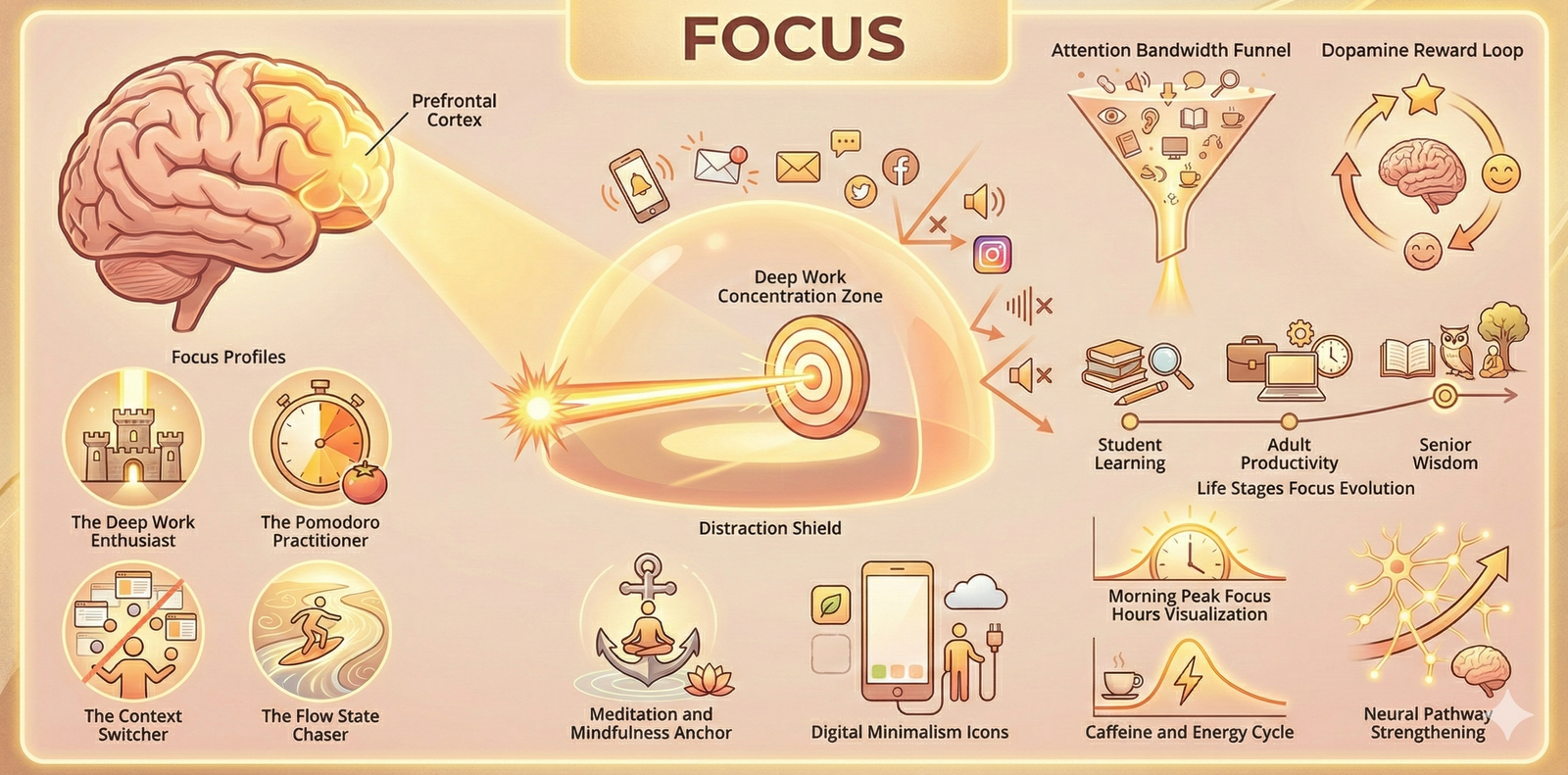
What makes focus particularly powerful is that it directly impacts your productivity, well-being, and sense of accomplishment. When you're in deep focus, you can accomplish 500% more work in less time while simultaneously reducing stress and increasing satisfaction with your output. This guide explores the neuroscience behind focus, practical techniques to build it, and how to protect it in an increasingly distraction-filled world.
By the end of this article, you'll understand exactly how your attention system works, why modern life makes focus harder than ever, and specific, evidence-based strategies you can implement today to reclaim your concentration and maximize your cognitive potential.
What Is Focus?
Focus—also called attention or concentration—is the cognitive ability to direct your mental energy toward a specific task, thought, or goal while simultaneously suppressing irrelevant information and distractions. It's a voluntary, controlled process that engages specific brain networks to prioritize what matters and filter out what doesn't. Unlike passive attention (noticing something without trying), focus is an active, intentional process that requires conscious effort and depletes mental energy.
Not medical advice.
Focus exists on a spectrum. At one end is brief, shallow attention—glancing at your phone for a notification. At the other end is deep focus or 'deep work,' where you engage in sustained, uninterrupted concentration on cognitively demanding tasks. Most people experience focus somewhere in between, with their ability fluctuating throughout the day based on energy levels, motivation, and environmental factors. The challenge is that maintaining deep focus requires energy, and modern environments are specifically designed to fracture our attention.
Surprising Insight: Surprising Insight: It takes 15-20 minutes to reach true deep work productivity, but just one distraction resets this entire clock. The average office worker is interrupted 31.6 times per day, which means most people never reach full cognitive capacity.
The Focus Spectrum
Visual representation of the different types of attention from shallow to deep focus, showing the relationship between time investment and cognitive depth.
🔍 Click to enlarge
Why Focus Matters in 2026
In 2026, focus has become a critical life skill and competitive advantage. The attention economy—an economic system built entirely on capturing and monetizing your attention—has made maintaining focus exponentially harder. Every app, notification, and digital platform uses sophisticated behavioral psychology and algorithms to pull your attention away from what matters to you. Meanwhile, the problems we need to solve—climate change, poverty, innovation—require exactly the kind of deep thinking that focus enables.
Professionally, research shows employees have 46% less focus time than they need to do their work well. Those who can maintain deep focus significantly outproduce their peers—studies show a productivity increase of up to 500% when working in a focused state. Personally, focus determines whether you can develop meaningful skills, maintain healthy relationships, and create the life you actually want. Without focus, you become a passive consumer of whatever content and experiences are algorithmically served to you.
Furthermore, the ability to focus deeply is increasingly linked to mental health and well-being. When you're constantly interrupted, your nervous system stays in a state of low-level stress, contributing to anxiety and burnout. Conversely, achieving flow states through focused work significantly improves mood, self-esteem, and sense of purpose. In an age of information overload and artificial urgency, the ability to say 'no' to distractions and 'yes' to what matters has become essential to a fulfilling life.
The Science Behind Focus
Focus operates through specific, measurable brain mechanisms that researchers have now mapped with remarkable precision. Your brain has multiple attention networks that activate and deactivate depending on what you're doing. The Fronto-Parietal Control Network (FPCN) engages when you're trying to stay on task, while the Default Mode Network (DMN) becomes active when your mind wanders or you're in internally-focused thought. When you achieve focus, the FPCN synchronizes with other networks while the DMN quiets down, creating a coordinated state optimized for sustained attention.
At the neural level, focus involves enhanced gamma synchrony (oscillations between 30-150 Hz) in your brain—a high-frequency pattern associated with attention and mental clarity. When you're distracted or unable to concentrate, your brain shows enhanced alpha synchrony (8-12 Hz), which correlates with inattention. Think of it like tuning a radio: when you're focused, your brain is tuned to a specific frequency; when distracted, it's picking up multiple conflicting signals. Additionally, neurons in your frontal lobe act as 'traffic control,' managing what information gets priority and what gets filtered out. Remarkably, research shows these beta bursts in your neurons occur roughly every 20 seconds, and predicting these patterns could eventually help identify when your attention is about to waver.
Brain Networks in Focus vs. Distraction
Illustration of how the Fronto-Parietal Control Network and Default Mode Network interact during focused states versus distracted states.
🔍 Click to enlarge
Key Components of Focus
1. Selective Attention
Selective attention is your brain's ability to pick out relevant information from a background of irrelevant information. When you're at a party and focus on one conversation despite noise everywhere, that's selective attention. This component operates at multiple levels—you consciously decide to focus on something, but your sensory system also filters information at a pre-conscious level. People with strong selective attention can work in moderately stimulating environments without being derailed by background noise or visual stimuli.
2. Sustained Attention
Sustained attention is the capacity to maintain focus on a single task over an extended period—minutes to hours. This is what allows you to work on a complex project without losing your place or having to restart. Most people can sustain attention for 60-90 minutes before needing a break, though this varies based on task difficulty, interest level, and overall energy. Sleep, nutrition, and stress all dramatically affect your capacity for sustained attention.
3. Executive Control
Executive control is your ability to manage competing demands and make decisions about what to focus on when multiple priorities exist. When faced with temptation—your phone buzzing, an interesting thought popping into your head, social media beckoning—executive control lets you override the impulse and stick with your chosen task. This component uses the most mental energy and is most vulnerable to depletion through stress, fatigue, or decision overload.
4. Alertness and Readiness
Alertness is your general state of vigilance and readiness to respond. This component is influenced by circadian rhythms, caffeine, sleep, and stress levels. You're naturally more alert at certain times of day (typically mid-morning and early evening for most people) and less alert during post-lunch dips and late night. Understanding your personal alertness rhythm and scheduling deep work during peak alert times significantly improves focus quality.
| Component | What It Does | How to Strengthen It |
|---|---|---|
| Selective Attention | Filters relevant from irrelevant information | Meditation, reducing environment stimuli |
| Sustained Attention | Maintains focus over time | Pomodoro technique, regular breaks |
| Executive Control | Resists temptation and competing demands | Time blocking, removing temptations, willpower training |
| Alertness/Readiness | Maintains general vigilance state | Sleep optimization, strategic caffeine, circadian alignment |
How to Apply Focus: Step by Step
- Step 1: Identify your peak focus times: Track when you naturally feel most alert and have the best concentration. For most people, this is within 2-3 hours of waking. Schedule your most cognitively demanding work during these windows.
- Step 2: Create a distraction-free environment: Physically remove or silence sources of distraction. Put your phone in another room, close unnecessary browser tabs, silence notifications, and use do-not-disturb mode. Even the presence of your phone (even off) reduces focus capacity.
- Step 3: Use time blocking: Allocate specific 60-90 minute blocks for focused work. Treat these blocks like unmissable appointments. During these blocks, work on one task only. Avoid context-switching, which resets your focus clock.
- Step 4: Implement a pre-focus ritual: Develop a simple routine (2-5 minutes) that signals to your brain it's time to focus. This might be brewing tea, a specific song, stretching, or a few minutes of meditation. Consistency makes this ritual progressively more effective.
- Step 5: Start with the hardest part first: During your focus window, tackle the most cognitively demanding task first, before decision fatigue sets in. Save easier tasks (email, admin) for later in the day when focus naturally wanes.
- Step 6: Take strategic breaks: After 60-90 minutes, take a 5-15 minute break doing something physical and non-digital—walk, stretch, get water. These breaks reset your attention system and prevent mental fatigue.
- Step 7: Use the 20-minute rule: If you're struggling to focus, commit to just 20 minutes. Often, starting is the hardest part, and momentum builds once you begin. Set a timer if helpful.
- Step 8: Manage your information diet: Reduce overall information consumption, especially before focus sessions. News, social media, and email spike dopamine and anxiety, fragmenting your attention even hours later.
- Step 9: Track your focus capacity: Keep a simple log of when you achieved focus and how long you sustained it. This data helps you identify patterns and gradually extend your focus duration.
- Step 10: Build in recovery: Sleep, especially 7-9 hours, is non-negotiable for focus. Without adequate sleep, your executive control collapses. Also include longer recovery periods (weekends, vacations) to prevent burnout and restore your full capacity.
Focus Across Life Stages
Young Adulthood (18-35)
Young adults typically have peak biological capacity for focus but face the greatest environmental pressures against it. This life stage includes school, career building, and often full engagement with social media and digital platforms. While neurologically your brain is fully developed and optimized for sustained attention, you're also learning professional skills and often juggling multiple competing demands. The strategic advantage in this stage is building strong focus habits now—research shows habits formed in your twenties tend to persist for decades. This is the ideal time to develop deep work practices, reduce social media dependence, and establish routines that will serve you throughout your career.
Middle Adulthood (35-55)
Middle adults often have the most competing demands on their attention: career responsibilities, family obligations, health considerations, and community involvement. However, this stage often brings benefits in experience and perspective—you know yourself better and can more effectively manage your priorities. Many high-performers in this stage report that implementing strict focus practices becomes essential rather than optional. The key challenge is protecting focus time amid competing legitimate demands. Strategic practices include delegating or eliminating low-value activities, being more selective about which opportunities to pursue, and recognizing that deep work capacity may require more intentional recovery and sleep.
Later Adulthood (55+)
Later adults can maintain sharp focus with proper support, though processing speed may gradually slow. Many people in this stage report improved ability to focus due to reduced impulsivity and stronger emotional regulation. The research on cognitive aging shows that while working memory and processing speed show modest declines, focused attention capacity is surprisingly well-preserved. Physical factors become more important—adequate sleep, exercise, cognitive engagement, and managing health conditions all directly impact focus capacity. Many highly accomplished individuals in later adulthood report that they've finally learned to say 'no' to distractions and focus purely on their most meaningful priorities.
Profiles: Your Focus Approach
The Deep Work Enthusiast
- Long, uninterrupted focus blocks (90+ minutes)
- Minimal context switching
- Clear, meaningful work
Common pitfall: Becoming rigid and overly perfectionist, burning out from too many high-intensity sessions without adequate recovery
Best move: Schedule 3-4 hours of deep work daily but ensure you're building in adequate rest, exercise, and social connection to sustain this intensity long-term
The Pomodoro Practitioner
- Structured breaks every 25-30 minutes
- Clear task lists
- External accountability
Common pitfall: Fragmenting work so much that you never achieve true deep focus, or underestimating how much time complex tasks actually require
Best move: Extend your focus blocks gradually to 45-60 minutes as your capacity grows, while keeping the structured break system that works well for you
The Context Switcher
- Visual organization systems
- Task management tools
- Explicit prioritization practices
Common pitfall: Constantly switching between tasks, never fully engaging with anything, and feeling perpetually behind despite being busy
Best move: Implement a hard rule: one main task per time block, with a prioritized list of what gets attention when. Use visual cues (different locations, specific music) for different tasks
The Flow State Chaser
- Work that matches your skill level (challenging but achievable)
- Clear goals and immediate feedback
- Intrinsically meaningful tasks
Common pitfall: Becoming frustrated with routine work that doesn't trigger flow, or only pursuing flow without developing foundational discipline
Best move: Deliberately build focus capacity through less exciting tasks first, then apply that discipline to work that energizes you. Seek roles and projects that naturally align with your interests
Common Focus Mistakes
The biggest focus mistake is treating focus as a character trait rather than a skill. Many people think 'I'm just not a focused person' and give up. In reality, focus can be developed through specific practices. The second major mistake is trying to use willpower as your primary focus strategy. Willpower is a limited resource that depletes through the day. Instead of relying on willpower to resist your phone, remove access to your phone. Instead of using willpower to avoid email, schedule specific times to check it rather than constantly monitoring it.
Another critical mistake is underestimating how long it takes to achieve deep focus. The 15-20 minute investment to reach full cognitive capacity seems long, so many people settle for shallow work thinking they don't have 'enough time.' In reality, 90 minutes of true deep work produces more value than 8 hours of shallow, distracted work. Finally, people often ignore sleep, exercise, and nutrition while trying to improve focus. These aren't nice-to-haves—they're foundational. No amount of productivity technique can compensate for inadequate sleep or chronic stress.
A subtle but important mistake is pursuing focus in isolation from meaning. You can develop excellent focus capacity but apply it to meaningless or misaligned work, which creates a hollow sense of accomplishment and leads to burnout. The most sustainable focus comes from working on things you genuinely care about or that align with your values. Finally, avoid the perfection trap of creating an 'ideal' focus environment so elaborate that you never actually sit down to work. A good-enough environment plus consistent action beats a perfect environment with no execution.
Focus Saboteurs: Common Mistakes and Antidotes
Visual representation of common focus mistakes and their practical solutions.
🔍 Click to enlarge
Science and Studies
Modern neuroscience has revealed specific, measurable mechanisms that explain how focus works and why it's becoming increasingly difficult to maintain. Research from Penn Medicine, Georgia Tech, MIT, and other leading institutions shows that focus operates through coordinated brain networks, with the Fronto-Parietal Control Network managing task-relevant attention while the Default Mode Network quiets during periods of sustained focus. Studies using EEG (electroencephalography) reveal that focused states show enhanced gamma band oscillations and coordinated neural activity, while distracted states show fragmented, uncoordinated patterns.
- Penn Medicine research identified specific neurons that drive and maintain focus, showing how attention operates at the cellular level with particular neurotransmitter systems (dopamine, norepinephrine) being crucial for sustained concentration
- Georgia Tech neuroscience studies mapped brain network patterns during deep focus, discovering that the ability to shift between networks predicts focus quality and that natural 20-second attention fluctuations occur in all brains
- Harvard Health research on mindfulness meditation shows that just 5 days of 20-minute training sessions improve executive attention measurably, with effects visible in brain imaging
- Studies on digital distraction show that the mere presence of a smartphone (even powered off) reduces cognitive capacity by approximately 10-20%, and that recovering full attention capacity after an interruption takes 15-20 minutes
- Research from Asana and Microsoft shows employees receive 46% fewer focus hours than they need, and that deep work capacity drops significantly after more than 4 hours daily, suggesting an optimal deep work window of 3-4 hours per day
Your First Micro Habit
Start Small Today
Today's action: Tomorrow, block one 25-minute focus window on your calendar, silence your phone (put it in another room), close unnecessary browser tabs, and work on one important task. That's it. Just 25 minutes of true focus.
This micro habit is small enough to be consistently doable but powerful enough to show you what real focus feels like. One successful 25-minute session often builds momentum and motivation for larger blocks. You're also training the specific behavior (removing distractions) that matters more than any particular technique.
Keep quitting habit apps after a missed day? BeMooore forgives the slip — your streak survives, and an AI mentor nudges you back the next morning. Free on iOS.
Quick Assessment
When you try to focus on important work, how long can you typically maintain concentration before your mind wanders or you get distracted?
Your baseline focus duration tells you where to start. If you're under 30 minutes, that's actually normal in the modern world—the good news is focus capacity improves quickly with practice.
What most commonly breaks your focus?
Different interruption sources require different solutions. Phone issues need environmental design; wandering thoughts need mindfulness; physical needs need better self-care prep; noise needs acoustic management.
How important is developing better focus to your current goals and well-being?
Your motivation level predicts success with focus development. If it's critical for you, you're more likely to implement the structural changes needed. If it's nice-to-have, focus on one micro-habit rather than comprehensive change.
Take our full assessment to get personalized recommendations for your focus journey.
Discover Your Style →Next Steps
Start with one simple action: Tomorrow, identify your natural peak focus time (usually within 2-3 hours of waking) and protect a single 25-60 minute focus block during that window. Remove all possible distractions—phone goes in another room, notifications off, single task only. Notice how it feels. This single experience of real focus often catalyzes a shift in how you approach your work and time.
Then, gradually build from there. If one focus block works, add a second one the next week. Extend the duration by 15 minutes every few days as your capacity grows. Pay attention to what actually works for you—your peak times, your optimal block length, what your personal focus saboteurs are. Focus isn't one-size-fits-all; it's about understanding your own attention system and designing your life accordingly.
Get personalized guidance with AI coaching on developing your focus practice.
Start Your Journey →Research Sources
This article is based on peer-reviewed research and authoritative sources. Below are the key references we consulted:
Deep Work vs. Shallow Work: Reclaim Focus
Comprehensive guide comparing deep work and shallow work, explaining why deep work has become essential in modern workplaces and providing practical strategies for protecting focus time.
Key insight: Deep work is now a competitive advantage—employees with access to deep focus time are significantly more productive and produce higher quality work.
Neuroscience Study: Brain Network Patterns and Deep Focus
Recent neuroscience research showing how different brain networks activate and deactivate during focus, revealing the neural basis of concentration and attention.
Key insight: The Fronto-Parietal Control Network (FPCN) synchronizes during focus while the Default Mode Network (DMN) quiets, creating measurable brain states associated with sustained attention.
Neuroscientists Identify Brain Mechanism that Drives Focus
Cellular-level research identifying specific neurons and neurotransmitter systems that enable and maintain focus, showing how attention operates at the synaptic level.
Key insight: Focus involves specific mechanisms at the synaptic level that amplify relevant signals while filtering noise, showing that attention is a physical, measurable process.
Dr. Cal Newport: How to Enhance Focus and Improve Productivity
Interview with deep work expert Cal Newport discussing practical, evidence-based techniques for developing sustainable focus and productive work habits in the digital age.
Key insight: Newport emphasizes structured time blocking (3-4 hours daily), elimination of digital distractions, and pre-work rituals as foundational practices for consistent deep work.
Mindfulness Meditation Improves Attention: Harvard Research
Research evidence showing that mindfulness meditation practice significantly improves various aspects of attention and focus, with measurable improvements even after short training periods.
Key insight: Just 5-30 days of guided meditation improves executive attention, with effects visible in brain imaging and behavioral performance measures.
Digital Distractions: Impact on Cognitive Performance
Meta-analysis of research on digital distractions showing the measurable impact of notifications, multitasking, and device presence on cognitive function and work performance.
Key insight: The mere presence of a smartphone (even off) reduces cognitive capacity by 10-20%, and multitasking with digital devices significantly impairs comprehension and memory.
The Science of Attention and Focus: Rice University Research
Current research examining why focus has become harder in 2026 despite—or because of—technological advances, and what neuroscience reveals about protecting attention.
Key insight: Modern attention challenges are not character flaws but the result of systems specifically designed to fragment our attention; awareness of this helps enable strategic countermeasures.
Focus and Concentration: Huberman Lab Resources
Curated resource collection on focus and concentration from neuroscience perspective, including research summaries and practical implementation strategies.
Key insight: Biological factors (sleep, exercise, dopamine) form the foundation of focus capacity, and no behavioral technique can fully compensate for poor fundamentals.
How the Brain Enables Rapid Focus and Attention
Explanation of the neural mechanisms that enable the brain to rapidly shift focus and maintain attention on selected targets while filtering distractions.
Key insight: The brain can rapidly reconfigure neural networks to shift focus, but this flexibility has limits; understanding these limits helps you work with rather than against your neurology.
Attention Spans in the Digital Age: National Geographic
Analysis of changing attention spans and the factors driving the decline (from 2.5 minutes to roughly 40 seconds), with strategies for regaining focus capacity.
Key insight: Attention span decline is real and measurable, but it's primarily environmental rather than biological—changing your environment and habits can restore capacity.
Related Glossary Articles
Frequently Asked Questions
Is it normal for my focus to decline throughout the day?
Absolutely. Your focus naturally follows your circadian rhythm and energy levels. Most people experience peak focus in the morning (within 2-3 hours of waking) and a significant dip after lunch (the post-lunch dip is neurologically real, not just from food). Scheduling your most cognitively demanding work in the morning and saving easier tasks for afternoon is a evidence-based strategy.
How long should my focus sessions be? Is Pomodoro (25 minutes) really optimal?
The Pomodoro technique's 25 minutes is a good starting point but not necessarily optimal. Research suggests 60-90 minutes is better for achieving true deep focus, as it takes 15-20 minutes just to reach full cognitive capacity. Use 25 minutes if you're building the habit, but gradually extend to 45-90 minute blocks once you've proven you can maintain focus.
Does caffeine actually help with focus?
Caffeine can help, but timing matters enormously. Caffeine takes 20-30 minutes to take effect and lasts 5-6 hours. If you drink coffee immediately upon waking, you miss your natural alertness peak. Instead, drink water first, and consume caffeine 30-60 minutes after waking for maximum effect. Also avoid caffeine after 2 PM as it interferes with sleep, and poor sleep destroys focus more than any technique can improve it.
Can meditation actually improve my focus?
Yes, meditation is one of the most evidence-supported focus interventions. Just 5-30 days of daily meditation improves measurable aspects of attention, working memory, and executive control. Even 5 minutes daily shows benefits. Focused-attention meditation (where you keep attention on your breath) is particularly effective for building focus capacity.
What if I have ADHD or diagnosed attention challenges? Are these strategies still relevant?
Many of these strategies are actually core components of ADHD management, but individual variations matter. External structure (time blocking, accountability), environmental design (removing triggers), and managing stimulation are all evidence-based for ADHD. However, ADHD sometimes requires different approaches to dopamine management and may benefit from professional guidance. The core principle—that focus improves with practice and environmental design—still applies.
Take the Next Step
Ready to improve your wellbeing? Take our free assessment to get personalized recommendations based on your unique situation.
- Discover your strengths and gaps
- Get personalized quick wins
- Track your progress over time
- Evidence-based strategies