Values
Imagine waking up each morning knowing exactly what matters to you—not what society expects, not what others want for you, but what truly resonates with your authentic self. This clarity is the power of understanding your values. Your values are the invisible compass guiding your decisions, relationships, and life direction. They shape how you spend your time, who you surround yourself with, and the legacy you create. When you live in alignment with your core values, life feels more meaningful, purposeful, and deeply satisfying. Yet many people stumble through life without ever clearly identifying what they stand for, leading to decisions that leave them feeling hollow, stressed, and disconnected from themselves. This guide reveals how to uncover your true values and harness them as your personal roadmap to happiness and fulfillment.
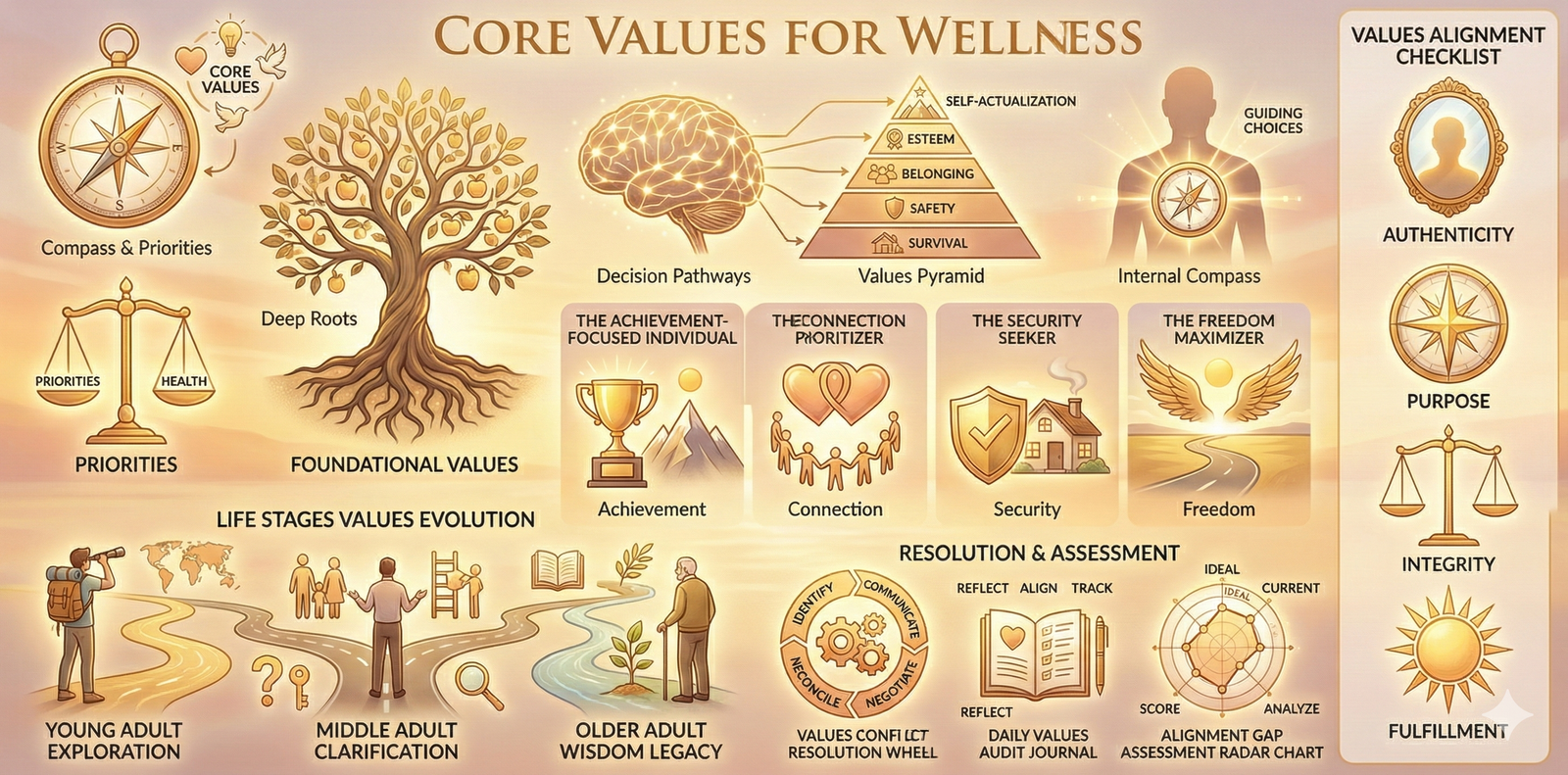
Values are like a GPS system for your life—they point you toward authentic fulfillment rather than empty achievements.
Understanding your values transforms more than just individual decisions; it revolutionizes how you experience relationships, career satisfaction, and inner peace.
What Is Values?
Values are broad, desirable goals that motivate your actions and serve as guiding principles in your life. They are the deeply held beliefs about what is fundamentally important and worthwhile—not just as ideas, but as lived principles that shape how you behave, what you prioritize, and who you become. Your values form the foundation of your identity and operate as an internal code of ethics that helps you navigate complex decisions and uncertain situations.
Not medical advice.
Values differ from goals because they are ongoing principles rather than end-points to achieve. While a goal might be to earn a certain income, a value might be financial security or family provision. While a goal is to run a marathon, a value might be health or personal discipline. Values give context and meaning to goals, explaining why those goals matter to you in the first place. Your values are learned through your family background, cultural experiences, personal interactions, and meaningful life events. Unlike temporary emotions or passing interests, values are relatively stable throughout your life, though they can evolve as you gain new experiences and wisdom.
Surprising Insight: Surprising Insight: Research shows that individuals who actively embrace and live according to their values experience higher levels of life satisfaction and psychological well-being, with more daily value-based actions correlating directly to greater daily well-being and lower psychological distress.
Values Hierarchy
Shows how values form the foundation of identity, influencing beliefs, decisions, and actions in daily life
🔍 Click to enlarge
Why Values Matter in 2026
In an era of unprecedented choice, constant digital stimulation, and competing demands on your attention, understanding your values has become more critical than ever. The modern world presents a paradox: we have more freedom to design our lives than any previous generation, yet we feel more confused and unfulfilled. This confusion often stems from making decisions based on external pressures—what looks good on social media, what your parents expect, what society deems successful—rather than what authentically matters to you.
Values provide an anchor during uncertain times. When facing a career change, relationship decision, or life crossroads, clarity about your values helps you choose paths that align with who you truly are rather than who you think you should be. People who live according to their values report greater life satisfaction, improved mental health, stronger relationships, and increased resilience when facing adversity. They experience less anxiety about decisions because they have a clear internal framework for evaluating options. In 2026, as artificial intelligence, remote work, and global connectivity reshape society, your values become your most reliable guide to maintaining authenticity and purpose.
Living by your values is also directly linked to reduced stress and improved emotional well-being. When your actions align with your beliefs, you experience coherence and consistency that helps you cope with challenges and setbacks. Even brief reflection on your values produces measurable benefits in stress reduction and resilience. This alignment creates what psychologists call 'value congruence'—the powerful state where your life circumstances match your deeply held beliefs.
The Science Behind Values
Research in positive psychology and behavioral science has thoroughly documented the relationship between values and well-being. A 2024 study examining life satisfaction found that five significant values influence overall happiness: financial satisfaction, happiness itself, freedom of choice, health, and democracy. What's particularly interesting is that different life domains carry different weights depending on individual priorities. Family and health satisfaction consistently matter most for overall life satisfaction, while other values vary significantly based on cultural background and personal experience.
The mechanism behind value-aligned living involves what researchers call 'psychological congruence'—the sense of coherence you feel when your actions align with your beliefs. This alignment activates reward centers in your brain and reduces activation in stress-response systems. Daily research specifically examining behavior found that more daily value-based actions correlate directly with greater daily psychological well-being and lower psychological distress. This isn't merely correlational; values-based actions appear to cause improvements in mental health by creating a sense of purpose and authenticity.
Values-Based Well-Being Pathway
Illustrates how living by values leads to improved mental health, relationships, and life satisfaction
🔍 Click to enlarge
Key Components of Values
Personal Values
Personal values are the individual principles that define who you are and what you believe in on a deep level. These include values like integrity, creativity, family, adventure, learning, and compassion. Personal values are intrinsic—they come from within and guide your behavior regardless of external rewards or punishments. They form your moral compass and sense of identity. Examples include valuing honesty in all interactions, prioritizing family time above career advancement, or dedicating yourself to continuous learning and growth.
Relational Values
Relational values determine how you interact with others and what you prioritize in relationships. These values include trust, loyalty, kindness, respect, and deep connection. Research shows that people who highly value family, friendship, leisure time, and prosociality (helping others) tend to be significantly more satisfied with their lives. Relational values explain why some people prioritize quality time with loved ones, why others become community volunteers, and why building meaningful connections matters more to some than accumulating wealth.
Aspirational Values
Aspirational values represent who you want to become and what you want to accomplish. These values drive personal growth and include values like excellence, mastery, leadership, innovation, and self-improvement. Unlike personal and relational values that represent who you currently are, aspirational values motivate you toward future development. They explain why some people pursue challenging careers, why others invest in education, and why certain individuals feel driven to make meaningful contributions to society.
Contextual Values
Contextual values are specific to particular life domains or situations. You might value efficiency at work, spontaneity in leisure time, and stability in finances. These values can shift based on life circumstances and contexts. Contextual values explain why someone can be competitive in professional settings while prioritizing cooperation in family dynamics. They help you navigate different roles and environments while maintaining overall integrity and authenticity. Understanding contextual values prevents internal conflict that arises from expecting yourself to apply the same values identically across all situations.
| Value Category | Core Beliefs | Influence on Life |
|---|---|---|
| Achievement & Excellence | Success, mastery, skill development | Career choices, educational pursuits, daily goal-setting |
| Relationships & Connection | Family, friendship, community, belonging | Time allocation, social engagement, major life decisions |
| Health & Well-being | Physical fitness, mental health, vitality | Daily routines, medical choices, lifestyle habits |
| Security & Stability | Financial security, safety, predictability | Career stability, housing choices, relationship commitment |
| Freedom & Autonomy | Independence, choice, flexibility | Career path, lifestyle design, boundary-setting |
| Growth & Learning | Personal development, wisdom, curiosity | Educational engagement, career transitions, hobby pursuit |
| Service & Contribution | Helping others, social impact, legacy | Career selection, volunteer work, time investment |
| Creativity & Expression | Innovation, artistry, authentic self-expression | Hobbies, career fields, personal projects |
How to Apply Values: Step by Step
- Step 1: Pause and Reflect: Set aside 30 minutes in a quiet space without distractions. Reflect on moments when you felt most proud, most like yourself, or most fulfilled. What were you doing? Who were you with? What principles were you honoring?
- Step 2: Write Down Candidate Values: Create a list of 15-20 values that resonate with you. Don't overthink—let intuition guide you. Consider values like integrity, family, adventure, security, creativity, compassion, independence, learning, health, or justice.
- Step 3: Group Related Values: Cluster similar values together. For example, family, loyalty, and community might group under connection. Achievement, mastery, and excellence might cluster under growth. This helps identify themes in what matters to you.
- Step 4: Narrow to Your Core Five: From your clusters, select five values that feel most essential to who you are. Ask yourself: 'If I could only honor five things in my life, what would they be?' This isn't easy—that's the point. The difficulty signals authenticity.
- Step 5: Create Personal Definitions: For each core value, write 2-3 sentences defining what it means to you specifically. 'Family' might mean daily connection with parents and siblings, or it might mean building a tight-knit community of chosen people. Personalize these definitions.
- Step 6: Assess Current Alignment: Honestly evaluate how well your current life aligns with each value on a scale of 1-10. Where are the gaps? Where do your actual time allocation and choices diverge from your stated values? This reveals areas for life redesign.
- Step 7: Create Action Anchors: For each core value, identify 1-3 specific, actionable ways you can honor it daily or weekly. If family is a core value, this might be weekly dinner calls, monthly visits, or daily quality time with children. Concrete anchors make values tangible.
- Step 8: Start with One Small Change: Don't try to realign your entire life overnight. Choose one value-action anchor to implement this week. Build momentum with small wins before tackling larger life changes.
- Step 9: Review and Adjust Regularly: Every 3-6 months, revisit your values and assess alignment. Life circumstances change, values evolve, and what once mattered might shift. Regular review keeps your values current and relevant.
- Step 10: Share Your Values: Tell trusted friends or family about your core values. External accountability strengthens commitment, and discussion often clarifies and refines your understanding. Others might also offer perspective on whether your actions match your words.
Values Across Life Stages
Young Adulthood (18-35)
Young adults often experience significant values clarification as they move away from family influence and discover their authentic selves. Common values in this stage include independence, adventure, personal growth, and establishing romantic relationships. This stage frequently involves experimenting with different lifestyles and identities to discover what truly matters. Young adults might prioritize freedom and exploration over stability, or conversely, seek early career establishment and financial security. The key challenge is distinguishing between inherited values from family and culturally imposed values versus genuinely held personal values.
Middle Adulthood (35-55)
Middle adulthood typically involves deeper commitment to chosen values. Career and family often become central, with values shifting toward providing, mentoring, and legacy. Many middle-aged adults find that earlier aspirational values require refinement based on real-world experience. Some discover that previously important values matter less, while overlooked values become increasingly central. This stage often involves balancing competing values—career ambition versus family time, personal growth versus financial responsibility. Strong values clarity helps navigate these tensions intentionally rather than reactively.
Later Adulthood (55+)
Later adulthood often brings profound values clarity and reordering. Research shows that older adults frequently shift from external values (achievement, status) toward internal values (meaning, relationships, personal growth). Concerns about legacy become central—what will remain, what impact will endure. Many older adults experience greater peace and satisfaction as they stop chasing values that never truly belonged to them and fully commit to what genuinely matters. This stage offers wisdom from decades of experience about which values actually contribute to happiness and which were hollow pursuits.
Profiles: Your Values Approach
The Achievement-Focused Individual
- Clear metrics for success and progress
- Recognition and acknowledgment of accomplishments
- Opportunities for growth and skill mastery
Common pitfall: Achieving goals while sacrificing relationships and health; constant striving without enjoying accomplishments; defining self-worth by external achievements
Best move: Intentionally schedule time for relationships and wellness; celebrate milestones meaningfully; occasionally reflect on whether achievements align with deeper values beyond success
The Connection Prioritizer
- Quality time with loved ones
- Deep conversations and emotional intimacy
- Community and belonging
Common pitfall: Over-accommodating others' needs; losing sense of individual identity in relationships; avoiding necessary conversations about boundaries
Best move: Practice healthy boundary-setting; maintain individual interests and friendships; communicate values directly with loved ones about expectations
The Security Seeker
- Financial stability and predictability
- Safe environments and reliable systems
- Contingency planning and risk mitigation
Common pitfall: Playing it too safe and missing meaningful opportunities; difficulty taking calculated risks; analysis paralysis when facing uncertainty
Best move: Gradually expose yourself to manageable risks; recognize that some goals require accepting uncertainty; balance security with growth opportunities
The Freedom Maximizer
- Autonomy and flexibility in choices
- Minimal external constraints and obligations
- Ability to design their own path
Common pitfall: Difficulty maintaining commitments; reluctance to establish roots; avoiding responsibilities necessary for long-term goals
Best move: Find ways to exercise autonomy within committed relationships; recognize that some structure enables rather than limits freedom; choose consciously chosen commitments over imposed ones
Common Values Mistakes
The most common values mistake is living by inherited values without examining whether they truly reflect your authentic self. Many people spend decades honoring their parents' values about career, relationships, or success only to realize at midlife that these values never resonated with them. The solution is honest self-reflection: Do these values feel genuinely important to me, or am I defending them out of loyalty or habit? Which moments in my life felt most authentic and fulfilling?
Another frequent mistake is claiming values you don't actually embody through your actions. Someone might value health but spend no time on fitness. Another might claim family is central while working 70-hour weeks with minimal family interaction. This misalignment creates internal conflict, shame, and inauthenticity. Honesty about your actual values—even if you wish they were different—is essential. You can always work to develop values over time, but self-deception prevents growth.
A third critical mistake is failing to communicate your values to the important people in your life. Partners might not understand why you prioritize certain decisions. Children might wonder why you enforce certain boundaries. Colleagues might misinterpret your choices. Clear communication about your core values reduces conflict, creates understanding, and helps others respect your decisions even if they'd choose differently.
Values Alignment Assessment
Framework for identifying gaps between stated values and actual behavior
🔍 Click to enlarge
Science and Studies
Extensive research demonstrates that values alignment significantly impacts psychological well-being, life satisfaction, and mental health outcomes. Below are key research findings that support the importance of identifying and living by your core values:
- Values Congruence Research (Psychology Today, 2023): Studies show that living in alignment with personal values is associated with greater life satisfaction, self-esteem, and positive affect. When individuals' actions match their beliefs, they experience improved emotional regulation, resilience, and better mental health outcomes.
- Well-Being and Daily Actions (ScienceDirect, 2024): Research examining daily behavior patterns found that more daily value-based actions directly correlate with greater daily psychological well-being and significantly lower daily psychological distress. This suggests values aren't abstract—they produce tangible daily improvements in mental health.
- Global Life Satisfaction Analysis (World Values Survey, 2024): A comprehensive 2024 study identified that family, health, freedom of choice, financial satisfaction, and social connection are the most significant values influencing overall life satisfaction, with cultural variations in how different populations weight these values.
- Value Orientation and Meaning Research (PMC, 2023): Research on value orientation found that individuals with clear, aligned values report higher levels of meaning in life and greater resilience when facing adversity. The sense of coherence provided by aligned values appears protective against depression and anxiety.
- Stress Reduction Through Value Reflection (Brain Insights, 2024): Studies show that even brief periods of reflection on core values produce measurable benefits including reduced stress, improved resilience, and enhanced coping ability when facing challenges. This suggests values work as a protective factor against stress and adversity.
Your First Micro Habit
Start Small Today
Today's action: Spend 5 minutes writing down 3 moments this past month when you felt most authentic, proud, or fulfilled. For each moment, identify one principle or value you were honoring. Notice the pattern—your values are already within you.
This micro-habit bypasses overthinking and connects you directly with lived values. Rather than philosophizing about what you should value, you're identifying patterns from actual experiences when you felt best. This creates confidence and clarity about authentic values.
Keep quitting habit apps after a missed day? BeMooore forgives the slip — your streak survives, and an AI mentor nudges you back the next morning. Free on iOS.
Quick Assessment
When thinking about your current life, how much do your daily choices and time allocation reflect your deepest values?
Your answer reveals your values alignment baseline. Those who feel well-aligned report significantly higher life satisfaction, while those experiencing misalignment often experience stress and inauthenticity that can be addressed through intentional values clarification.
Which aspect of identifying your values feels most challenging to you right now?
This assessment helps you identify your next step. Value clarification requires reflection, alignment requires behavior change, and communication requires vulnerability. Starting with your biggest challenge creates momentum.
If you could redesign one area of your life to better reflect your values, which would have the most positive impact on your overall well-being?
Your answer points toward your highest-leverage change. Research shows that when you realign a major life area with your core values, you experience cascading improvements in overall life satisfaction and mental health.
Take our full assessment to get personalized recommendations.
Discover Your Style →Next Steps
Now that you understand what values are and why they matter, your next step is moving from awareness to action. The five core values you identify will serve as your personal constitution—the framework for major life decisions and daily choices. This isn't a one-time exercise but an ongoing practice that deepens as you reflect and learn.
Start with the micro-habit today: identify three recent moments of authenticity and the values they reflect. This connects you with values you already embody rather than imposing values you think you should have. From there, gradually complete the step-by-step process, narrowing from candidate values to your true five. As you clarify values, notice where your current life aligns and where gaps exist. These gaps aren't failures—they're opportunities for intentional redesign.
Get personalized guidance with AI coaching.
Start Your Journey →Research Sources
This article is based on peer-reviewed research and authoritative sources. Below are the key references we consulted:
Related Glossary Articles
Frequently Asked Questions
How do I know if I'm confusing my values with my goals?
Values are ongoing principles that guide behavior, while goals are specific outcomes to achieve. If you can complete it or finish it, it's likely a goal. If it describes how you want to live or who you want to be continuously, it's a value. Example: 'Get fit' is a goal; 'health' is a value. 'Earn $1 million' is a goal; 'financial security' is a value. Values provide context for why goals matter to you.
Can my values change, or should I expect them to stay the same forever?
Your core values tend to remain relatively stable, but they absolutely can evolve. Life experiences, new relationships, significant challenges, and personal growth often shift what you prioritize. Rather than viewing this as inconsistency, recognize it as wisdom. Regular values review every 3-6 months helps you stay current with where you actually are rather than where you used to be.
What do I do when my values conflict with each other?
Conflicting values are common and normal. Someone might value both adventure and family security. Another might value career achievement and also deep relationships. Rather than choosing one, look for integration. Adventure might become family adventures. Career success might be pursued in roles that allow flexibility for relationships. Accept that life involves navigating value tensions rather than perfectly optimizing all values simultaneously.
How can I help my children identify their own values instead of inheriting mine?
Expose them to diverse experiences and ask curious questions about what they enjoy, what makes them feel proud, and what they worry about. Encourage them to notice moments when they feel most like themselves. Share your own values openly, but make space for them to discover theirs. Model that people can hold different values and still love each other deeply. Resist the urge to judge values that differ from your own.
Is it selfish to prioritize my values if they don't align with what others want from me?
Living authentically isn't selfish—it's essential for your well-being and for healthy relationships. Ironically, when you honor your own values, you become more capable of genuine connection because you're being authentic rather than performing. That said, values alignment requires communication. Explain your values to others, listen to theirs, and find ways to respect differences. Healthy relationships accommodate different values, not eliminate them.
Take the Next Step
Ready to improve your wellbeing? Take our free assessment to get personalized recommendations based on your unique situation.
- Discover your strengths and gaps
- Get personalized quick wins
- Track your progress over time
- Evidence-based strategies