Fitness
Fitness is more than just looking good in the mirror. It's about building a body that can do what your mind wants, whether that's climbing stairs without huffing, playing with kids, or setting a new personal record. The truth about fitness is that it transforms you from the inside out—your heart gets stronger, your brain gets sharper, and your mood lifts with every workout.
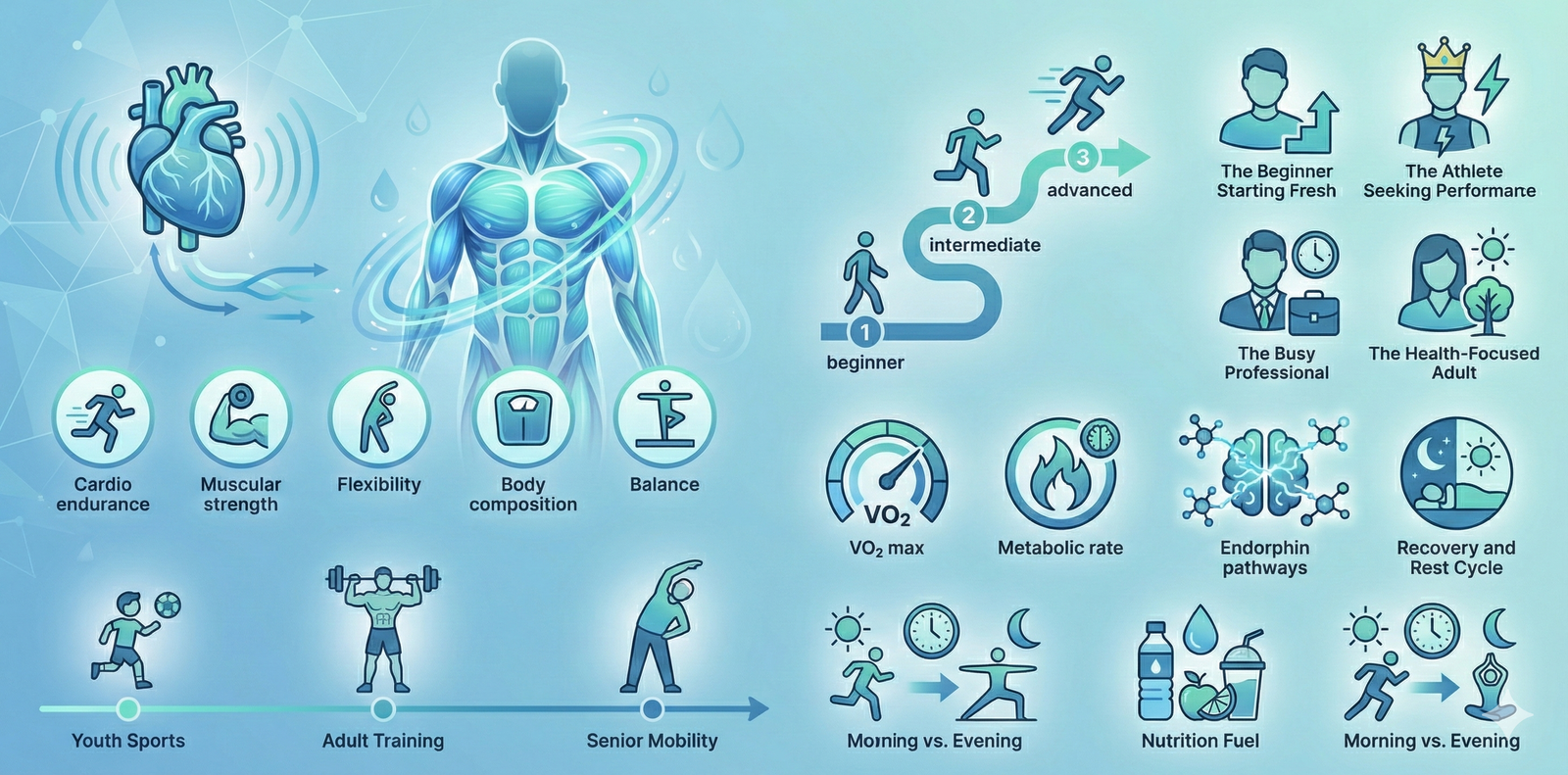
What most people don't realize is that you don't need hours at the gym or extreme diets to become fit. Small, consistent actions create enormous results over time.
This guide shows you exactly what fitness is, why it matters, and how to build a sustainable practice that fits your life.
What Is Fitness?
Fitness is the set of physical attributes that allows your body to perform daily activities with ease and energy. It's not about being perfect—it's about being capable. Fitness includes cardiorespiratory endurance (how long your heart and lungs can keep working), muscular strength (how much force your muscles can produce), muscular endurance (how long muscles can sustain effort), flexibility (your range of motion), and body composition (the ratio of muscle to fat).
Not medical advice.
Fitness differs from general physical activity. Physical activity is any movement your body makes—walking to the store, gardening, playing with pets. Exercise is planned, structured movement aimed at improving fitness. Fitness is the actual result of consistent training—it's a measurable change in what your body can do.
Surprising Insight: Surprising Insight: Your body doesn't start getting stronger in the gym. It gets stronger during recovery. Muscles repair themselves and rebuild bigger and stronger when you rest, sleep, and eat well.
The Fitness Cycle: Work, Recover, Improve
Shows the continuous cycle of exercise stimulus, recovery adaptation, and performance improvement that builds fitness over time
🔍 Click to enlarge
Why Fitness Matters in 2026
In 2026, fitness is more critical than ever because lifestyle diseases are accelerating. Cardiovascular disease, type 2 diabetes, obesity, and cognitive decline are linked directly to inactivity. Research shows that consistent exercise reduces all-cause mortality by 30-40%, meaning it's one of the most powerful health interventions available.
Mental health is another reason fitness has risen to top priority. Exercise is now ranked #6 in fitness trends (up from #8), reflecting scientific evidence that movement is as effective as therapy for depression and anxiety. Your brain craves the neurochemical changes that come from physical activity.
Aging is also central to why fitness matters now. Studies show that muscle mass, bone density, and cognitive function decline rapidly if untrained—but they respond dramatically to consistent training at any age. Fitness gives you independence, reduces fall risk, and keeps your mind sharp.
The Science Behind Fitness
When you exercise, your muscles produce tiny tears and metabolic stress. Your body responds by triggering adaptation: it repairs the damage and builds stronger, more resilient muscle fibers. This is called the overload principle. Your cardiovascular system similarly adapts—your resting heart rate drops, your heart pumps more efficiently, and oxygen delivery to tissues improves.
At the cellular level, exercise reshapes how your tissues handle stress, inflammation, immunity, and metabolism. Physical activity increases mitochondrial density (the powerhouses in your cells), improves insulin sensitivity, reduces systemic inflammation, and boosts BDNF (brain-derived neurotrophic factor), a molecule that builds new brain cells and protects against cognitive decline.
How Exercise Changes Your Body at the Cellular Level
Illustrates the cellular adaptations including mitochondrial growth, inflammation reduction, and improved oxygen utilization
🔍 Click to enlarge
Key Components of Fitness
Cardiovascular Endurance
Cardiovascular (or aerobic) endurance is your heart and lungs' ability to deliver oxygen to working muscles over extended periods. This is built through activities that elevate your heart rate: running, cycling, swimming, dancing, or brisk walking. The CDC recommends 150 minutes of moderate-intensity aerobic activity per week for adults. Strong cardiovascular fitness reduces heart disease risk, lowers blood pressure, improves blood sugar control, and boosts mental clarity.
Muscular Strength
Muscular strength is the maximum force a muscle can produce in a single contraction. It's built through resistance training: weight lifting, bodyweight exercises, bands, or machines. Strength training should target all major muscle groups (legs, hips, back, abdomen, chest, shoulders, and arms) at least 2 days per week. Strong muscles support joints, maintain bone density, improve metabolism, and enable independence in daily activities like lifting, climbing, and carrying.
Muscular Endurance
Muscular endurance is how long a muscle group can sustain repeated contractions against resistance. Unlike strength, which emphasizes one powerful contraction, endurance is about duration. High repetitions with moderate weight, circuit training, and activities like rowing build muscular endurance. This capacity lets you hike for hours, carry groceries without fatigue, or play sports without early exhaustion.
Flexibility and Mobility
Flexibility is your joints' range of motion, measured by how far you can stretch. Mobility is the ability to move a joint through its full range under control. Both are critical—they prevent injury, reduce pain, improve posture, and maintain functional movement as you age. Stretching, yoga, foam rolling, and dynamic mobility work build this component. Most people overlook flexibility until they lose it and struggle with simple movements.
| Component | Definition | Key Benefit |
|---|---|---|
| Cardiovascular Endurance | Heart and lung capacity to deliver oxygen | Reduced disease risk, better mood, improved stamina |
| Muscular Strength | Maximum force muscles can produce | Functional independence, bone density, metabolism |
| Muscular Endurance | Sustained muscle contraction over time | Fatigue resistance, daily task capability, performance |
| Flexibility | Range of motion in joints | Injury prevention, pain reduction, movement quality |
| Body Composition | Ratio of muscle to fat tissue | Metabolic health, disease prevention, physical confidence |
How to Apply Fitness: Step by Step
- Step 1: Assess your current fitness level with a simple baseline test: Can you do 10 pushups? Walk a mile? Sit and reach your toes? Know where you start so you can measure progress.
- Step 2: Choose activities you genuinely enjoy—this is non-negotiable. Hate running? Don't run. Love swimming? Make that your cardio. Sustainability beats perfection.
- Step 3: Start with 3 days per week of any movement. This could be 30 minutes of walking, 20 minutes of bodyweight exercises, or one yoga class. Consistency matters more than intensity.
- Step 4: Add resistance training on 2 of those days. This could be dumbbells, bodyweight (pushups, squats), resistance bands, or gym machines. Work all major muscle groups.
- Step 5: Incorporate flexibility work daily—even 5-10 minutes of stretching or mobility counts. Many people do this while watching TV or before bed.
- Step 6: Track something measurable: reps completed, distance covered, weight lifted, or minutes exercised. Tracking creates awareness and motivation.
- Step 7: Schedule recovery as seriously as you schedule workouts. Recovery is when adaptation happens. Sleep 7-9 hours, eat adequate protein, and take at least one full rest day weekly.
- Step 8: Adjust intensity gradually using the progressive overload principle: add more weight, more reps, more distance, or more intensity week by week.
- Step 9: Reassess every 4 weeks. Take progress photos, retest strength, check how you feel. Visible progress is the best motivator.
- Step 10: Build community around fitness. Share goals with friends, find a workout buddy, or join a class. Social accountability increases adherence dramatically.
Fitness Across Life Stages
Young Adulthood (18-35)
This is your prime fitness building window. Your recovery is fast, your bones are still densifying, and building muscle and cardiovascular capacity now creates a foundation for life. Young adults often focus on building strength and exploring different training styles. The risk here is overtraining or comparing yourself to social media fitness influencers. The goal is sustainable habits, not perfection. High-intensity interval training (HIIT) is effective during this stage because recovery is quick.
Middle Adulthood (35-55)
Metabolism naturally slows, muscle loss accelerates, and priorities shift. Middle adults benefit most from consistent, varied training that maintains muscle, preserves bone density, and manages weight. Strength training becomes essential rather than optional. Flexibility work becomes more important as joints stiffen. Many people rediscover fitness during this stage after years of inactivity and experience rapid improvements in health markers, energy, and appearance.
Later Adulthood (55+)
Fitness in later adulthood is about preserving independence, maintaining balance to prevent falls, and supporting cognitive health. Strength training prevents age-related muscle loss (sarcopenia), flexibility work maintains mobility, and balance exercises reduce fall risk. Walking remains excellent, but it must be combined with resistance and balance work. The good news: even people in their 80s and 90s can build muscle and improve fitness with consistent training.
Profiles: Your Fitness Approach
The Beginner Starting Fresh
- Sustainable habit over intensity
- Simple, enjoyable activities to build consistency
- Realistic expectations (fitness takes weeks to notice, months to show, years to master)
Common pitfall: Starting too hard, too fast and burning out within 2 weeks
Best move: Begin with 3 days of 20-30 minutes of any activity you enjoy, add consistency for 4 weeks before increasing intensity
The Athlete Seeking Performance
- Progressive overload within their sport
- Sport-specific training programming
- Balance between intensity and recovery
Common pitfall: Only training hard and neglecting recovery, flexibility, and injury prevention
Best move: Structure training with periodization: build phases, peak phases, and recovery phases to optimize performance
The Busy Professional
- Time-efficient training that delivers results
- Flexibility in scheduling workouts
- Mental health benefits from movement
Common pitfall: All-or-nothing thinking (if you can't do 60 minutes, skip it entirely)
Best move: Embrace 20-30 minute sessions, HIIT training, and home workouts that fit your schedule
The Health-Focused Adult
- Balanced fitness for longevity and disease prevention
- Consistency over intensity
- Understanding fitness as medicine
Common pitfall: Neglecting strength training, focusing only on cardio
Best move: Combine 150 minutes aerobic activity with 2 days strength training weekly—this is the evidence-based prescription for health
Common Fitness Mistakes
The biggest mistake people make is starting too hard. You see a fitness transformation video and decide you'll do 90-minute workouts every day. Three days later, you're sore, exhausted, and quit. Fitness is built through consistency, not intensity. Starting small (20-30 minutes, 3 days per week) and building gradually is far more effective.
Another critical mistake is neglecting recovery. Your muscles don't grow in the gym—they grow during sleep and recovery. If you train hard every day without adequate rest, you get worn down, injured, or sick. Recovery includes sleep (7-9 hours), nutrition (especially protein), and active recovery (light movement on rest days).
Many people also skip strength training or do it inconsistently. Cardio alone doesn't maintain muscle, bone density, or metabolic health. Strength training 2 days per week is non-negotiable for sustainable fitness, especially as you age. It's also not true that lifting weights makes women bulky—that requires specific programming and genetics.
The Fitness Mistake Cycle and How to Escape It
Shows the common pattern of unsustainable intensity leading to burnout and how consistency breaks the cycle
🔍 Click to enlarge
Science and Studies
Recent research from 2024-2025 reveals that fitness is one of the most powerful health interventions. Studies show that consistently active people have a 30-40% lower risk of dying from any cause compared to sedentary people. Remarkably, people who fit most of their exercise into one or two days per week (weekend warriors) had the same reduced mortality risk as people who spread activity throughout the week. Physical activity reshapes tissues at the cellular level, improving stress handling, inflammation control, immunity, and fat metabolism. Research also debunks a persistent myth: fitter people use fewer total heartbeats each day thanks to lower resting heart rates, even accounting for their workouts. This proves that fitness truly adds to daily health rather than triggering energy conservation elsewhere.
- Ciolac, E.G., & Guimarães, G.V. (2013). 'Exercise training as a nonpharmacological tool for prevention and treatment of systemic arterial hypertension and vascular dysfunction.' Brazilian Journal of Physical Therapy demonstrates exercise's role in cardiovascular disease prevention.
- National Institute on Aging (2024). 'Three Types of Exercise Can Improve Your Health and Physical Ability' confirms that aerobic, strength, and balance training are essential components.
- WHO (2024). 'Physical Activity Guidelines' state that adults need 150 minutes moderate-intensity aerobic activity plus 2 days muscle-strengthening weekly.
- NIH Research Matters (2024). 'Different exercise patterns bring health benefits' shows that flexibility in exercise timing doesn't reduce health outcomes.
- American College of Sports Medicine (2025). 'Top Fitness Trends for 2025' rank 'Exercise for Mental Health' as #6 trend, up from #8, reflecting growing recognition of fitness's mental health impact.
Your First Micro Habit
Start Small Today
Today's action: Do 10 minutes of movement you enjoy today—a walk, dancing to music, bodyweight exercises, or stretching. No timer, no intensity target. Just move and notice how you feel.
Micro-movements don't feel like a chore, so you're likely to repeat them. Starting tiny removes the activation energy barrier that stops most people. After 3 days of 10 minutes, you'll naturally extend it to 12-15 minutes, then 20 minutes, without willpower. Small actions compound into major transformations.
Track your daily movement micro-habits and get personalized coaching on progression with our Bemooore app. Your AI mentor helps you build fitness consistency without motivation crashes.
Quick Assessment
What best describes your current relationship with physical exercise?
Your experience level helps determine which fitness approach works best for you. Beginners benefit from habit-building, while experienced exercisers may need progression strategies.
What's most important to you in fitness right now?
Your primary goal shapes your training focus. Strength athletes need resistance training, cardio seekers need aerobic work, weight management requires both plus nutrition, while energy improvement comes from any consistent movement.
What type of exercise sounds most appealing to you?
Choosing activities you genuinely enjoy dramatically increases consistency. Social exercisers thrive in classes; solo exercisers prefer independence. Variety prevents boredom and works different fitness components.
Take our full assessment to get personalized fitness recommendations.
Discover Your Style →Next Steps
Fitness is not a destination—it's a sustainable practice built on small, consistent actions. Start where you are with what you have. If you've never exercised, commit to 20 minutes three times this week. If you exercise inconsistently, add one more session weekly. If you already have a routine, add one new component (flexibility, strength, balance) to round out your fitness.
Remember: progress comes from consistency, not perfection. Your fitness journey is personal—compare yourself only to your past self. The best fitness program is the one you'll actually do. Choose activities you enjoy, schedule them, show up, and trust the process. Your future self will thank you for the investment you're making today.
Get personalized guidance with AI coaching.
Start Your Journey →Research Sources
This article is based on peer-reviewed research and authoritative sources. Below are the key references we consulted:
Related Glossary Articles
Frequently Asked Questions
How long until I see fitness results?
You'll feel different within 1-2 weeks (more energy, better sleep, improved mood). Visible strength changes appear in 4-6 weeks. Significant body composition changes take 8-12 weeks. The key is patience and consistency—results compound over time, but the internal benefits come first.
Do I need a gym membership to get fit?
Absolutely not. You can build excellent fitness using bodyweight exercises (pushups, squats, planks), running, cycling, walking, swimming, dancing, or home equipment like dumbbells or resistance bands. Gym access accelerates certain goals but is never required.
Is it too late to start fitness at my age?
Never. Muscle responds to training and bone responds to loading at any age. People in their 60s, 70s, and 80s have built significant fitness from zero. The timeline is longer than for younger people, but the results are real and dramatic for health and independence.
How often should I do cardio versus strength training?
The evidence-based prescription is 150 minutes moderate-intensity aerobic activity weekly plus 2 days of strength training weekly. This doesn't mean 7 days of training—many people do a 30-minute combined workout (cardio + strength) 3 times per week.
Why am I not losing weight despite exercising regularly?
Exercise builds fitness but weight loss requires caloric deficit. You can't out-exercise a bad diet. Weight loss is approximately 80% nutrition, 20% exercise. Focus on whole foods, adequate protein, and reasonable portions. Many people also gain muscle (heavier) while losing fat (smaller), so the scale doesn't reflect real progress.
Take the Next Step
Ready to improve your wellbeing? Take our free assessment to get personalized recommendations based on your unique situation.
- Discover your strengths and gaps
- Get personalized quick wins
- Track your progress over time
- Evidence-based strategies