Health
You exercise regularly but feel mentally exhausted. You eat clean but struggle with chronic stress. You have excellent medical checkups but feel disconnected from others. Treating health as merely physical misses most of what determines whether you thrive or merely survive. This fundamental misunderstanding explains why many health efforts fail despite genuine commitment.
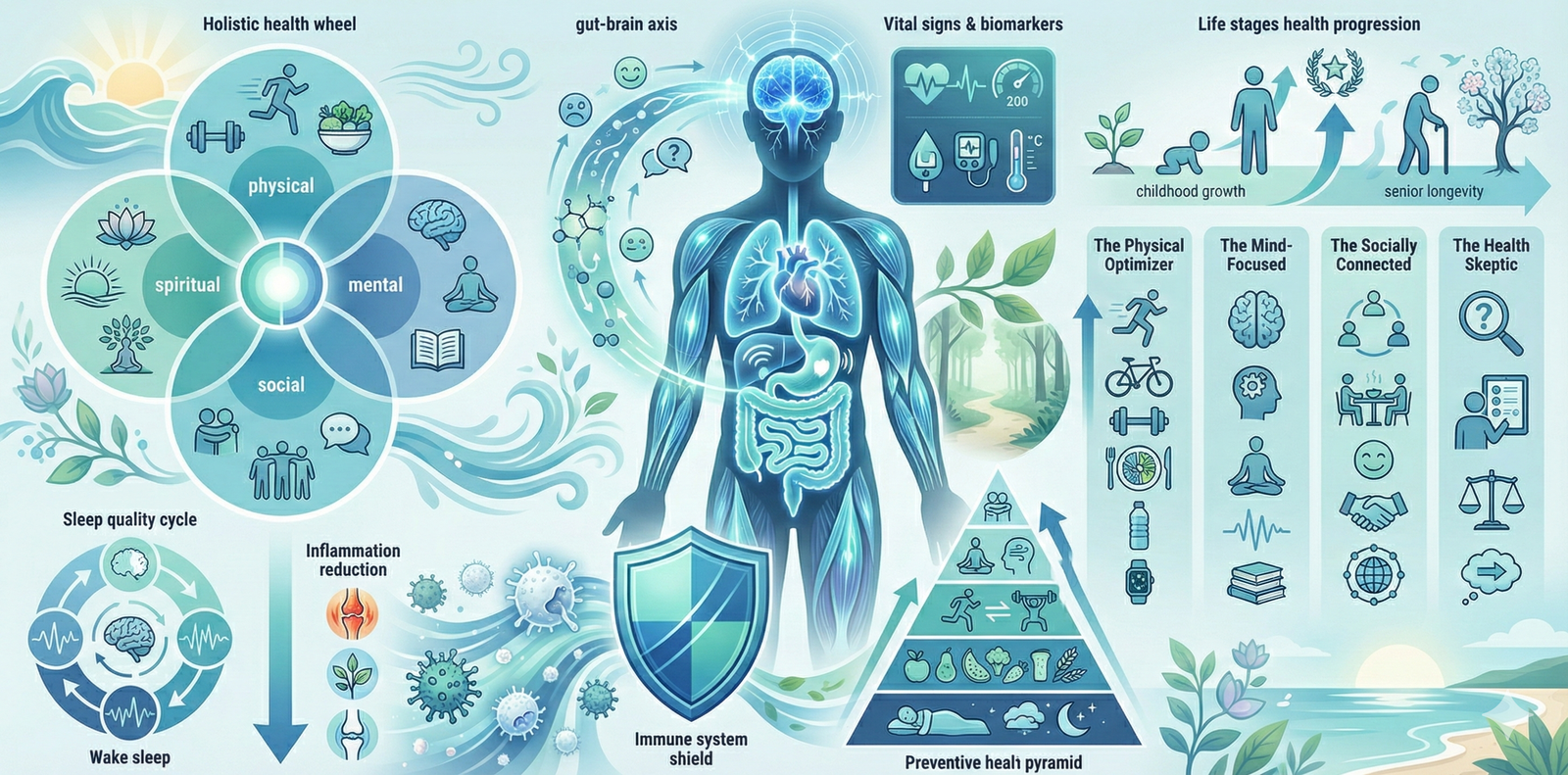
Health is far more than the absence of disease. The World Health Organization defined it in 1948 as a state of complete physical, mental, and social wellbeing. This revolutionary definition recognized that true health encompasses how you feel, think, relate, and find meaning. Your body cannot be separated from your mind, emotions, and connections to others.
The Harvard Study of Adult Development, tracking participants for over 75 years, discovered something remarkable. The quality of your relationships at age 50 predicts your health at age 80 better than your cholesterol levels. Social connection is not soft psychology but hard biology affecting health outcomes decades later. Later sections explore how optimizing all health dimensions creates results impossible through physical approaches alone.
Surprising Insight: Surprising Insight: Social determinants account for 80-90 percent of health outcomes, while healthcare contributes only 10-20 percent. The conditions where you live, work, and relate to others shape your health more profoundly than any medical intervention. Understanding this transforms how you approach wellbeing.
What Is Health?
Health represents the optimal functioning of your entire being across multiple interconnected dimensions. The WHO constitution states health is a state of complete physical, mental and social wellbeing and not merely the absence of disease or infirmity. This definition, revolutionary in 1948, remains the foundation for understanding health today.
The meaning of health has evolved significantly over time. Early definitions focused narrowly on the body's ability to function, viewing health as normal function occasionally disrupted by disease. Modern understanding recognizes health as dynamic, multidimensional, and deeply connected to how you live, work, and relate to others.
Not medical advice.
Health exists on a spectrum rather than as a binary state. Some people have comparatively poor health status while others enjoy excellent health. Everyone is positioned somewhere along this continuum, and your position can change based on choices, circumstances, and interventions across all health dimensions.
In 1984, WHO revised its definition to describe health as the extent to which an individual or group is able to realize aspirations and satisfy needs and to change or cope with the environment. This reframing positioned health as a resource for everyday life rather than the objective of living, emphasizing both personal and social resources alongside physical capacities.
The Three Dimensions of Health
WHO framework showing interconnected physical mental and social aspects
🔍 Click to enlarge
Physical Health: The Foundation
Physical health encompasses the optimal functioning of your body's systems, structures, and processes. It includes cardiovascular fitness, muscular strength, flexibility, immune function, and the absence of disease or injury. Physical health provides the foundation upon which mental and social health depend.
The four pillars of lifestyle medicine form the core of physical health. Sleep, nutrition, physical activity, and stress management work together to maintain body function. Research consistently shows that these factors predict health outcomes more strongly than genetics or medical care.
Sleep deprivation creates cascading health problems. Studies of over 240,000 individuals published in JAMA Network Open showed that sleeping under five hours daily increased type 2 diabetes risk significantly. An umbrella review found short sleep duration increased age-adjusted mortality by substantial percentages.
Physical activity contributes to prevention and management of noncommunicable diseases such as cardiovascular disease, cancer, and diabetes. It reduces symptoms of depression and anxiety, enhances brain health, and improves overall wellbeing. The WHO estimates physical inactivity costs approximately 27 billion dollars annually in healthcare costs globally.
Nutrition profoundly affects disease risk. Research published in BMJ showed a direct association between greater ultraprocessed food consumption and higher cardiovascular disease-related mortality. The relationship between what you eat and how your body functions extends far beyond weight management.
Mental Health: More Than the Absence of Disorders
Mental health is more than the absence of mental disorders. WHO states there is no health without mental health. Mental health is an integral part of health that determines how you think, feel, regulate emotions, and make decisions affecting every aspect of life.
Mental health is a state of wellbeing in which you realize your own abilities, cope with normal stresses of life, work productively, and contribute to your community. This positive definition moves beyond merely avoiding mental illness toward cultivating psychological flourishing.
Mental wellness involves both cognitive function and emotional regulation. A sharp mind that processes anxiety poorly is not mentally healthy. Similarly, emotional stability without cognitive engagement produces its own problems. Balance across mental dimensions creates true mental health.
Research from psychology and psychiatry demonstrates that lifestyle behaviors promote mental health and can treat mental health conditions including anxiety, depression, bipolar spectrum disorders, PTSD, and psychotic disorders. Exercise has consistently been shown to effectively reduce symptoms of depression both as primary treatment and alongside medication.
Mental health requires both stimulation and rest. Continuous cognitive demand without recovery degrades function over time. Learning new skills builds cognitive reserve while managing stress prevents mental resource depletion. The rhythm between challenge and recovery sustains mental health long-term.
Social Health: The Hidden Determinant
Social health involves the quality of your relationships, sense of belonging, and meaningful connection to others. The Harvard Study of Adult Development, one of the longest studies of adult life ever conducted, found that relationships are the strongest predictor of health and happiness across the lifespan.
Loneliness kills. Social isolation damages health as significantly as smoking, obesity, or physical inactivity. The mechanisms are biological: loneliness triggers chronic inflammation, impairs immune function, and accelerates cellular aging. Human beings evolved as social creatures, and isolation creates physiological stress responses.
Quality matters more than quantity in social health. A few deep connections provide more health benefits than many superficial ones. Vulnerability and authenticity in relationships create the protective effects that casual contact cannot replicate. The depth of your connections determines their health impact.
Social determinants of health are the nonmedical factors that influence health outcomes. They include the conditions in which you are born, grow, work, live, and age. The CDC notes these factors contribute 80-90 percent to health outcomes, while healthcare accounts for only 10-20 percent.
Key social determinants include economic stability, education access, healthcare access, neighborhood environment, and social community context. At all levels of income, health follows a social gradient: the lower the socioeconomic position, the worse the health outcomes. Social factors shape health more than individual choices.
| Dimension | Core Focus | Key Practices | Warning Signs of Imbalance |
|---|---|---|---|
| Physical | Body function and vitality | Sleep, nutrition, movement, preventive care | Fatigue, illness, chronic pain, low energy |
| Mental | Cognitive and emotional health | Stress management, learning, rest, therapy | Anxiety, brain fog, mood swings, burnout |
| Social | Connection and belonging | Relationships, community, vulnerability | Isolation, loneliness, conflict, disconnection |
The Social Determinants Framework
The Healthy People 2030 framework identifies five key domains of social determinants. Economic stability explores the link between financial resources and health. Education examines the relationship between learning opportunities and wellbeing. Social and community context focuses on how relationship environments affect health.
Healthcare access and quality looks at how availability of services impacts health outcomes. Neighborhood and built environment explores how physical surroundings affect wellbeing. These five domains interact to create the conditions that shape health more powerfully than any individual behavior.
People with limited access to quality housing, education, social protection, and job opportunities face higher risk of illness and death. These structural factors create health inequities that individual effort alone cannot overcome. Understanding social determinants explains why health outcomes vary so dramatically across populations.
Social Determinants of Health
Five domains that shape health outcomes beyond individual behavior
🔍 Click to enlarge
The Interconnection of Health Dimensions
Physical, mental, and social health cannot be separated in reality. Your body affects your mind. Your mind influences your body. Your relationships impact both. Treating these dimensions separately misses how deeply interconnected they are at biological, psychological, and social levels.
The gut-brain connection demonstrates how digestive health affects mental state. Your microbiome influences mood, anxiety, and cognitive function through direct neural pathways and chemical signaling. Diet affects mental health through mechanisms beyond nutrition alone.
Psychoneuroimmunology reveals how thoughts and emotions affect immune function. Chronic stress suppresses immunity while positive emotions enhance it. Your psychological state creates biological changes affecting disease resistance. Mind and body communicate constantly through multiple channels.
Social connection creates physiological changes. Positive relationships reduce cortisol, lower blood pressure, and decrease inflammation. Loneliness triggers the opposite responses. Your relationships literally change your biology in measurable ways that predict health outcomes years later.
This interconnection means improvements in one dimension cascade to others. Better sleep improves emotional regulation. Better emotional regulation reduces stress. Lower stress improves physical health. Improved physical health enhances cognitive function. Each improvement amplifies others in virtuous cycles.
Evidence-Based Health Practices
The shift toward evidence-based wellness reflects growing demand for approaches that actually work. Consumers increasingly prioritize clinically proven interventions over marketing claims. This represents a maturation in how people approach health decisions.
Physical activity remains one of the most evidence-supported health practices. A systematic review examining cardiorespiratory fitness confirmed that regular exercise reduces both cardiovascular mortality and all-cause mortality significantly. The protective effects apply across age groups and health conditions.
Sleep hygiene practices have strong research support. Consistent sleep schedules, dark cool sleeping environments, and limiting screen exposure before bed improve both sleep quality and health outcomes. Sleep is not optional for health but fundamental to physical and mental function.
Nutritional approaches emphasizing whole foods over processed alternatives show consistent benefits. Mediterranean dietary patterns, plant-forward eating, and reducing ultraprocessed food consumption all demonstrate health improvements in rigorous studies. What you eat shapes disease risk profoundly.
Mind-body practices including mindfulness meditation, yoga, and breathing exercises reduce stress biomarkers and improve mental health outcomes. These practices address the mental dimension while creating physical benefits through stress reduction pathways.
Building Your Health Practice
Creating optimal health requires attention to all three dimensions without overwhelming yourself. The approach involves gradual integration rather than simultaneous transformation. Sustainable change builds incrementally on existing habits.
- Step 1: Assess your current state across physical, mental, and social dimensions
- Step 2: Identify which dimension most affects others negatively for you
- Step 3: Begin with foundational practices in your weakest dimension
- Step 4: Notice how improvements cascade to other areas over time
- Step 5: Add practices addressing your secondary dimension
- Step 6: Build daily routines that touch multiple dimensions simultaneously
- Step 7: Create weekly practices for dimensions needing more time investment
- Step 8: Develop monthly review habits to track progress across all areas
- Step 9: Adjust practices based on life season and changing needs
- Step 10: Maintain balance by monitoring all three dimensions regularly
Health Across the Lifespan
Young Adulthood (18-35)
Foundation building years shape health trajectories for decades. Physical resilience allows neglecting health without immediate consequences, creating dangerous habits that compound over time. Mental health challenges often emerge during this period, requiring attention and support.
Social dimension is often strong but may lack depth as young adults navigate identity formation and relationship development. Establishing healthy patterns during this period prevents chronic disease development and creates habits that persist into later life.
Middle Adulthood (35-55)
Peak responsibility years strain multiple health dimensions simultaneously. Career demands affect physical health through sedentary work and chronic stress. Family obligations test emotional resources and sleep quality. Social connections often narrow to work and family contexts.
Chronic disease risk increases significantly during middle adulthood. Approximately 8 in 10 midlife adults report one or more chronic conditions. Prevention efforts during this period yield substantial returns. Balance across health dimensions becomes essential rather than optional for sustained function.
Later Adulthood (55+)
Physical dimension requires more attention as body changes with age. Maintaining mobility, strength, and cognitive function becomes priority. Mental wellness involves continued cognitive engagement and managing health-related challenges that may emerge.
Social dimension faces potential losses requiring intentional rebuilding. Retirement can disrupt social networks built around work. Approximately 9 in 10 older adults report chronic conditions, making health management increasingly important. Quality relationships during this period buffer against physical decline and support mental health.
Profiles: Your Health Approach
The Physical Optimizer
- Mental health attention and stress management
- Deeper social connections beyond fitness communities
- Rest and recovery as essential rather than optional
Common pitfall: Excellent physical fitness masking mental strain and social isolation
Best move: Use physical activity as gateway to mental practices and social connection. Exercise with others, practice mindful movement, address emotional health with same discipline as physical training.
The Mind-Focused
- Physical activity integration into daily routine
- Moving from self-help to genuine social connection
- Balance between learning about health and living healthily
Common pitfall: Strong knowledge of health principles without consistent physical practice
Best move: Embody knowledge through regular physical activity. Join communities where connection and learning combine. Transform intellectual understanding into lived experience.
The Socially Connected
- Personal health habits independent of others
- Mental health practices for individual resilience
- Physical self-care that does not require social motivation
Common pitfall: Health dependent on others, neglecting personal responsibility
Best move: Build individual health practices while maintaining social strength. Develop self-care routines that work even when alone. Create resilience that enhances rather than depends on relationships.
The Health Skeptic
- Evidence-based entry points that match skeptical nature
- Personal experimentation with measurable outcomes
- Gradual opening to dimensions beyond physical
Common pitfall: Dismissing mental and social dimensions as unscientific
Best move: Start with well-researched physical interventions. Track results personally. Let evidence from your own experience expand openness to other dimensions.
Common Health Mistakes
Dimension neglect is the most common health mistake. Focusing exclusively on physical fitness while ignoring mental health. Building social networks while neglecting body care. Developing mental resilience in isolation from relationships. Health requires attention to all three dimensions, not just preferred ones.
Treating symptoms without addressing root causes produces temporary relief at best. You treat insomnia with medication without addressing the anxiety causing it. You address anxiety with therapy without considering nutritional deficiencies affecting brain chemistry. Connected factors require integrated approaches.
Expecting dramatic change from dramatic effort leads to unsustainable patterns. Research shows that sustainable results come from consistent moderate practices rather than intense short-term interventions. Health is built daily through small actions, not transformed through heroic efforts.
Ignoring social determinants while focusing on individual behavior creates frustration. If your environment limits healthy choices, individual willpower alone cannot overcome structural barriers. Understanding the broader context of health helps direct effort effectively.
Your First Micro Habit
The Three-Dimension Daily Check
Today's action: Each evening, take two minutes to rate each health dimension 1-10: Physical (how does your body feel?), Mental (how is your mind?), Social (how connected do you feel?). Notice patterns over a week. Which dimension consistently scores lowest? That is where to focus your health development first.
Awareness precedes change. Most people have blind spots about neglected health dimensions. Brief daily tracking reveals patterns invisible in busy daily life. The check-in takes seconds but provides crucial information about where your health truly needs attention. Research shows that monitoring behavior consistently precedes behavior change.
Track all three health dimensions and get personalized recommendations for balanced development with AI coaching.
Quick Assessment
Which health dimension do you naturally prioritize most?
Your natural priority reveals your health strengths. The dimension you prioritize least often holds the key to unlocking improvements across all areas.
How do you typically respond when one health area declines?
Your response pattern reveals whether you approach health holistically or in isolation. Connected thinking produces better outcomes than isolated interventions.
What most influences your daily health choices?
Your motivation source affects sustainability. Internal motivation and habit-based approaches tend to produce more consistent health behaviors than external pressure or momentary feelings.
Take our comprehensive assessment to understand your health across all three dimensions and get personalized recommendations for balanced development.
Discover Your Health Profile →Chronic Disease Prevention
Chronic diseases are the leading cause of illness, disability, and death globally. Most chronic conditions have common modifiable lifestyle factors: physical inactivity, poor nutrition, tobacco use, and excessive alcohol consumption. Evidence-based interventions exist for all these factors.
In 2023, approximately 194 million American adults reported one or more chronic conditions. Prevalence increased significantly among young adults over the past decade, indicating growing health challenges. Prevention during young adulthood pays dividends throughout life.
Research examining lifestyle factors found that adopting multiple healthy behaviors significantly reduces risk of noncommunicable diseases and mortality. The population attributable risks associated with healthy lifestyle factors were substantial for both major diseases and all-cause mortality.
The Framingham Heart Study revealed that achieving high physical activity levels, maintaining normal weight, and never smoking associated with lower cardiovascular disease risk and more years lived free of cardiovascular disease. Lifestyle interventions in diabetes prevention trials significantly improved cardiovascular risk profiles.
Several lines of evidence indicate that realistic modifications of diet and lifestyle can prevent most coronary artery disease, stroke, diabetes, colon cancer, and smoking-related cancers. Prevention is more effective and less costly than treatment for these conditions.
The Future of Health
Personalized approaches to health represent a major trend. Advances in genetic testing and AI enable tailored health plans based on individual biology, microbiome composition, and specific health needs. One-size-fits-all approaches give way to individualized interventions.
Integration of mental health into mainstream healthcare continues expanding. Practices like mindfulness and meditation have become mainstream. Mental health apps and teletherapy services make support more accessible than ever before.
Holistic fitness routines integrating physical, mental, and spiritual elements grow more common. The artificial separation between body and mind in healthcare gives way to integrated approaches recognizing their fundamental connection.
Technology enables better health tracking and intervention. Wearable devices monitor physical metrics while apps track mental and social wellbeing. Data-driven insights help individuals understand their health patterns and make informed decisions.
Health Improvement Cycle
How improvements in one dimension cascade to others
🔍 Click to enlarge
Next Steps
Health is not about doing more but integrating what you do across physical, mental, and social dimensions. The three-dimension daily check micro habit creates awareness that guides action. Start there to identify your priority area.
Explore the dimension you most neglect first. Small improvements in your weakest area often create the largest overall gains. Balance improves faster by addressing weakness than by further strengthening strengths.
Related topics including wellness practices, mental wellness, emotional wellbeing, and holistic wellness provide depth in specific areas while maintaining integrated perspective on health.
Get personalized guidance for developing all three health dimensions with AI coaching that tracks your progress holistically.
Optimize Your Health →Research Sources
This article is based on peer-reviewed research and authoritative sources. Below are the key references we consulted:
Related Glossary Articles
Frequently Asked Questions
What is the WHO definition of health?
WHO defines health as a state of complete physical, mental and social wellbeing, not merely the absence of disease or infirmity. This definition from 1948 recognizes health as multidimensional, encompassing how you feel physically, mentally, and socially.
Why do social factors matter so much for health?
Social determinants contribute 80-90 percent to health outcomes while healthcare contributes only 10-20 percent. The conditions where you live, work, learn, and relate to others shape disease risk, access to resources, and health behaviors more than individual choices alone.
Can you be healthy with a chronic condition?
Yes. Health exists on a spectrum rather than as binary. Someone managing diabetes or heart disease can achieve optimal health within their circumstances by addressing all three dimensions: managing their physical condition, maintaining mental wellness, and cultivating social connection.
How much exercise do I need for good health?
WHO recommends adults get at least 150 minutes of moderate-intensity or 75 minutes of vigorous-intensity physical activity weekly. However, any movement provides benefit. The relationship between activity and health is dose-dependent, with more activity providing more protection.
Does mental health affect physical health?
Absolutely. Psychoneuroimmunology demonstrates that thoughts and emotions affect immune function. Chronic stress suppresses immunity, increases inflammation, and raises disease risk. Mental health conditions increase risk of physical diseases and vice versa.
How do relationships affect health?
The Harvard Study of Adult Development found that relationship quality at age 50 predicts health at age 80 better than cholesterol levels. Loneliness triggers chronic inflammation and impairs immune function. Positive relationships reduce cortisol and decrease disease risk.
What should I prioritize first for health improvement?
Assess all three dimensions and identify which one most negatively affects the others for you. That is your leverage point. Often addressing your weakest dimension produces the largest overall health gains because improvements cascade to other areas.
Is it possible to be too focused on health?
Yes. Orthorexia and health anxiety represent unhealthy preoccupations with health. Balance includes accepting imperfection, enjoying life beyond health optimization, and maintaining perspective. Mental wellbeing includes not obsessing about physical health.
Take the Next Step
Ready to improve your wellbeing? Take our free assessment to get personalized recommendations based on your unique situation.
- Discover your strengths and gaps
- Get personalized quick wins
- Track your progress over time
- Evidence-based strategies