Social Wellbeing
In our increasingly digital world, something fundamental is happening to our health: loneliness has become an epidemic. Yet the solution is as old as humanity itself—connection. Social wellbeing is the foundation of a thriving life. When you cultivate meaningful relationships, participate in community, and feel genuinely connected to others, your brain releases hormones that reduce stress, boost immunity, and protect against depression. Research from major health organizations shows that strong social bonds are as protective of health as quitting smoking—and often more powerful than exercise or diet alone. Your connections aren't a luxury; they're medicine.
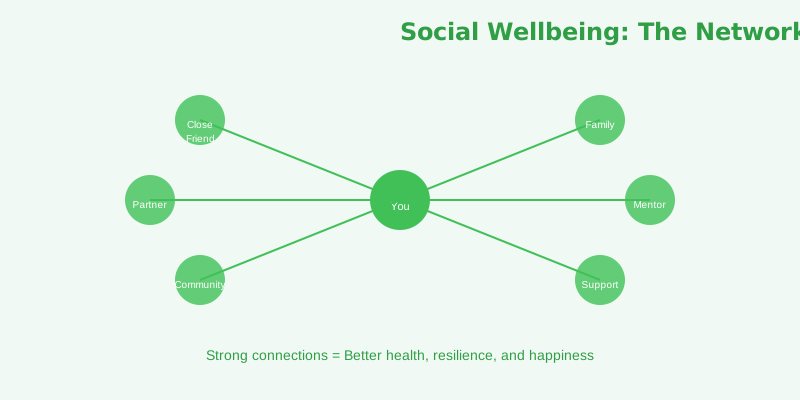
This guide reveals how social wellbeing works, why it matters more than ever, and exactly how to build the connections that sustain your happiness.
Discover that social wellbeing isn't about having hundreds of friends—it's about having relationships where you feel seen, supported, and genuinely valued.
What Is Social Wellbeing?
Social wellbeing is the dimension of your health and happiness that depends on meaningful connections with others. It encompasses having supportive relationships, feeling part of a community, experiencing belonging, and maintaining the bonds that make life worth living. Unlike loneliness (which is emotional) or social isolation (which is physical), social wellbeing is about the quality and depth of your connections—not the quantity. It's the feeling that people know you, care about you, and that you matter to them. Social wellbeing includes both the relationships you nurture and the broader sense of community involvement that makes you feel like you belong somewhere meaningful.
Not medical advice.
Social wellbeing sits at the intersection of mental health, community engagement, and emotional fulfillment. The World Health Organization recognizes it as a pillar of overall health. In 2025, the World Health Assembly adopted the first-ever resolution on social connection, urging countries to develop evidence-based policies that promote positive social connection for both mental and physical health. This shift reflects a growing global understanding: social connection is not optional. It's fundamental to thriving.
Surprising Insight: Surprising Insight: People with strong social connections have a 50% increased likelihood of survival compared to those with fewer social bonds—a protective effect equal to or greater than quitting smoking.
The Social Wellbeing Spectrum
Visual showing the relationship between isolation, belonging, and community integration
🔍 Click to enlarge
Why Social Wellbeing Matters in 2026
We are living through an unprecedented loneliness crisis. Despite being more connected digitally than ever, rates of loneliness, social anxiety, and disconnection have soared. Social media connects us to many but often leaves us feeling understood by few. This gap between connection and belonging creates a health crisis that affects every age group—from isolated teens to lonely seniors. Research shows that chronic loneliness increases the risk of heart disease by 29%, stroke by 32%, and dementia by approximately 50% in older adults. The health impacts are comparable to smoking, obesity, and physical inactivity. In 2026, prioritizing social wellbeing isn't just about feeling better—it's about living longer.
The mental health benefits are equally profound. When you have secure social connections, your brain is literally protected against depression, anxiety, and cognitive decline. Social support acts as a buffer against stress—it lowers cortisol, regulates your nervous system, and creates resilience. People with strong social bonds handle adversity better, recover faster from illness, and experience greater life satisfaction. In an age of rapid change and uncertainty, your relationships are your anchor. They remind you who you are and why you matter.
Workplace and organizational awareness of social wellbeing is finally shifting. Forward-thinking companies recognize that employee wellbeing is not separate from social connection—it depends on it. Remote work, burnout, and rapid team changes have made many people realize they're working alongside colleagues they barely know. In 2026, organizations are investing in social wellbeing policies, mentorship programs, and community-building initiatives because they understand: connected teams are healthier, more innovative, and more resilient.
The Science Behind Social Wellbeing
The neuroscience of connection reveals something remarkable: your brain is wired for relationship. When you interact with someone you trust, your brain releases oxytocin (the bonding hormone), reduces cortisol (the stress hormone), and activates your parasympathetic nervous system (the relaxation response). Mirror neurons fire in synchrony with others, creating neurological resonance—literally, you sync with people you're connected to. This isn't metaphorical; it's biological. Active listening and empathetic connection physically change brain structure, strengthening regions responsible for emotional regulation and social cognition. Loneliness, by contrast, activates threat-detection systems in your brain, keeping you in a state of vigilance and stress.
Longitudinal research from institutions like Harvard's Study of Adult Development (tracking adults over 80+ years) shows consistently that the quality of relationships is the strongest predictor of longevity and happiness. Perceived support—feeling that help is available if you need it—often matters more than actually receiving support. This means that secure, stable relationships provide psychological protection even when you're not actively getting help. The research is unambiguous: social connection protects physical health (through immune function, cardiovascular health, and reduced inflammation), mental health (through buffering against depression and anxiety), and cognitive health (through protection against decline and dementia).
How Social Connection Protects Your Health
The biological pathways through which social wellbeing improves physical and mental health outcomes
🔍 Click to enlarge
Key Components of Social Wellbeing
Close Relationships & Emotional Support
These are the core of social wellbeing—the people who know you deeply, accept you as you are, and provide emotional support when life gets hard. Close relationships include family, intimate friends, partners, and mentors. What matters is not the number of these relationships but their quality: Do you feel safe being vulnerable? Can you be authentic? Do they celebrate your wins and support you through difficulties? These relationships are where you're truly seen. They're also where attachment develops—the secure base from which you can explore the world and take risks. Without at least a few close relationships, other social connections feel hollow.
Community & Belonging
Beyond intimate relationships, humans need to belong to groups larger than themselves—communities, teams, faith groups, hobby clubs, neighborhoods. Community provides purpose, shared values, and a sense of mattering. When you're part of a community, you're not just an individual; you're a member of something meaningful. You contribute, you receive, you're woven into a social fabric. Community reduces loneliness, provides practical support, creates accountability, and gives life direction. Even introverts who prefer smaller groups benefit tremendously from community involvement when it aligns with their interests and values.
Reciprocity & Mutuality
Healthy social wellbeing requires balance—you give and you receive. When relationships are one-directional (you're always helping or always being helped), they become unstable. Reciprocity creates equality and respect. It means asking for help when you need it, not just offering it. It means your friends can depend on you, and you can depend on them. Reciprocal relationships feel safe because both people matter equally. This is why family members providing care for elderly parents need to also receive help—they need to know their effort is acknowledged and that others share the load. Reciprocity prevents caregiver burnout and keeps relationships thriving.
Social Skills & Communication
Social wellbeing requires skills: the ability to listen deeply, express yourself authentically, navigate conflict, read social cues, and repair ruptures in relationships. These aren't innate talents; they're learnable skills. Active listening—focusing fully on what someone says without planning your response—is perhaps the most foundational. Expressing yourself with clarity and vulnerability (sharing your real thoughts and feelings, not just surface pleasantries) deepens connection. Being able to have honest conversations about disagreements, to apologize genuinely, and to forgive strengthens bonds. People with strong social skills build and maintain relationships more easily; they also feel more confident in social situations.
| Component | What It Includes | Key Health Benefit |
|---|---|---|
| Close Relationships | Family, intimate friends, partners, mentors | Emotional safety, belonging, secure attachment |
| Community | Groups, teams, clubs, neighborhoods, faith communities | Purpose, shared values, mattering, social identity |
| Reciprocity | Mutual support, balanced giving and receiving | Equality, stability, sustainable relationships |
| Social Skills | Listening, authenticity, conflict resolution, empathy | Connection quality, relationship satisfaction, confidence |
How to Apply Social Wellbeing: Step by Step
- Step 1: Assess your current social connections: Map out your relationships. Who are your close confidants? Which communities do you belong to? Where do you feel most like yourself? Be honest about gaps.
- Step 2: Schedule regular one-on-one time with people you care about: Pick specific people and specific dates. Don't wait for occasions—create them. Even 30 minutes of genuine conversation weekly strengthens bonds dramatically.
- Step 3: Join one community based on your values or interests: This could be a gym class, volunteer group, book club, faith community, or sports league. Start with just one. Consistency matters more than perfection.
- Step 4: Practice active listening in your next three conversations: Focus completely on what the other person says. Ask clarifying questions. Resist the urge to jump in with your own story. Notice how the conversation deepens.
- Step 5: Have one honest conversation about how you're really doing: Pick someone you trust and share something true beyond surface level. Notice how vulnerability invites deeper connection.
- Step 6: Set a boundary that protects your social wellbeing: If certain relationships drain you, limit them. If social media makes you feel worse, reduce it. Protecting your energy is an act of respect for your wellbeing.
- Step 7: Reach out to someone you've lost touch with: Send a message to an old friend. Reconnection often requires just one brave first step. Many people feel relieved to hear from you.
- Step 8: Offer help to someone in your circle without being asked: Notice who's struggling. Bring a meal, listen without trying to fix things, or just show up. Giving strengthens your sense of belonging.
- Step 9: Host something small: Invite people over for coffee, a walk, a meal, or online hangout. You don't need a special occasion. Creating gathering spaces strengthens community.
- Step 10: Reflect on one relationship you want to deepen: Identify one connection worth investing in. What would it look like to move closer? Take one step toward that.
Social Wellbeing Across Life Stages
Young Adulthood (18-35)
In young adulthood, social wellbeing is about building your foundational relationships and finding communities aligned with your emerging identity. Friendships formed during this period often become lifelong. The challenge: rapid life changes (moves, job changes, relationship transitions) can fragment your social world. Strategy: Prioritize consistency over breadth. Invest in 2-3 deep friendships rather than maintaining a large loose network. Join communities (classes, teams, volunteer groups) where you see the same people repeatedly. These repeated interactions build trust and belonging. Use technology to maintain connections across distance, but don't let digital substitution replace in-person time.
Middle Adulthood (35-55)
Middle adulthood brings competing demands: career, family responsibilities, aging parents, children's needs. Social wellbeing often gets squeezed, yet research shows it's precisely when you most need it. People in this stage often experience hidden loneliness—they're surrounded by responsibilities but feel misunderstood. Strategy: Protect time for your relationships fiercely. Schedule friend time like you schedule work meetings. Integrate your loved ones into your life rather than compartmentalizing (invite friends to family events, bring kids to community activities). Be intentional about which relationships matter most and prioritize those. Recognize that your social needs evolve—what worked in your 20s may not work now.
Later Adulthood (55+)
In later adulthood, social wellbeing becomes increasingly predictive of both mental and physical health. Retirement, loss of loved ones, health changes, and reduced mobility can increase isolation risk. Yet this is also when people report greatest satisfaction with their relationships—they've learned what matters. Strategy: Proactively maintain your social circles as circumstances change. If mobility is limited, use technology and invite people to you. Volunteer or join groups—older adults who contribute feel more valued and connected. Intergenerational connection (mentoring younger people) provides purpose. Invest in friendships and family actively; relationships aren't automatic in later life. Studies show that older adults with strong social bonds recover faster from illness, maintain better cognitive function, and live longer.
Profiles: Your Social Wellbeing Approach
The Socially Anxious Introvert
- Small group connections rather than large social events
- Time to recharge after social interaction
- Deep friendships over broad networks
Common pitfall: Isolating completely because social anxiety feels too big, mistaking introversion for loneliness
Best move: Start with one person you feel safe with. Invest in that relationship. Gradually expand to small groups around shared interests where conversation flows naturally.
The Busy Professional
- Structured time for relationships (scheduled, not spontaneous)
- Relationships that integrate with your lifestyle
- Permission to say no to some obligations
Common pitfall: Assuming relationships will maintain themselves; drifting from friends because life is busy
Best move: Block time for relationships weekly—even 30 minutes. Choose communities that overlap with other commitments (lunch with a friend on work break, joining a professional association).
The Remote or Isolated Worker
- Intentional community building (social isolation risk is high)
- Regular in-person human interaction
- Diverse social contexts outside work
Common pitfall: Building relationships only through screens; experiencing loneliness despite being constantly connected online
Best move: Join a consistent in-person community (gym, class, volunteer group) where you see the same people regularly. Schedule video calls with intention; they shouldn't replace face-to-face connection.
The Social Butterfly
- Depth in at least a few relationships, not just breadth
- Time for reflection and vulnerability
- Community commitment, not just surface socializing
Common pitfall: Having many acquaintances but few true confidants; exhaustion from constant socializing; feeling misunderstood
Best move: Intentionally deepen 2-3 relationships. Create space for genuine conversation, not just activities. Get involved in something where you show up consistently and contribute meaningfully.
Common Social Wellbeing Mistakes
Mistake 1: Confusing surface connection with real belonging. You can have 500 social media friends and still feel completely alone. Real social wellbeing comes from relationships where you're known, not just followed. If you're investing primarily in digital interaction or maintaining relationships that don't feel reciprocal or authentic, you're not building real wellbeing. Quality matters infinitely more than quantity. Even one person who truly knows and accepts you provides more wellbeing benefit than hundreds of shallow connections.
Mistake 2: Isolating when you most need connection. When you're struggling—depressed, anxious, grieving, or ashamed—the instinct is often to withdraw. But this is precisely when you need connection most. Your brain is designed to heal in relationship. Reaching out feels impossible, but it's the antidote. Isolation intensifies suffering; connection metabolizes it. If you notice yourself withdrawing, that's a sign to do the opposite: reach out to someone, even if it feels awkward or scary.
Mistake 3: Waiting for the perfect community or friend instead of investing in the real people in your life. Perfectionism kills belonging. You don't need friends who check all boxes; you need friends who care. You don't need a community that's perfectly aligned; you need people showing up together. Real relationships have friction, misunderstandings, and different values on some topics. Accept good-enough connection and invest in it. The best friendships are built through showing up consistently, not through finding your perfect match.
Barriers to Social Wellbeing & How to Overcome Them
Common obstacles to connection and practical solutions for each
🔍 Click to enlarge
Science and Studies
Research from top institutions consistently demonstrates the health impact of social connection. Large longitudinal studies and meta-analyses show that social wellbeing is one of the strongest predictors of health outcomes across the lifespan. Here are key findings:
- Harvard Study of Adult Development: 85+ years of research shows that close relationships are the single strongest predictor of a long, happy life—more influential than wealth, fame, or career success.
- WHO 2025 Resolution: The World Health Assembly adopted the first-ever resolution on social connection, recognizing loneliness as a major public health risk affecting all age groups.
- Cardiovascular Health: Poor social relationships increase risk of heart disease by 29% and stroke by 32%, with effects comparable to smoking and obesity.
- Cognitive Health: Chronic loneliness increases dementia risk by 50% in older adults and is associated with cognitive decline across age groups.
- Mental Health: Social isolation is strongly associated with depression, anxiety, and suicidal ideation; social connection buffers against these conditions.
Your First Micro Habit
Start Small Today
Today's action: Text one person today just to check in—not with a request or problem, just saying 'I was thinking of you' or 'Hope your week is good.' That's it.
This tiny action signals to your brain that connection matters. It's small enough to do immediately, yet it activates the same neural pathways as deep conversation. One text often leads to a conversation, which leads to connection. More importantly, you're practicing being vulnerable enough to reach out. This habit rewires your default response from isolation to connection.
Keep quitting habit apps after a missed day? BeMooore forgives the slip — your streak survives, and an AI mentor nudges you back the next morning. Free on iOS.
Quick Assessment
How would you describe your current social connections?
Your answer reveals your current social wellbeing baseline. Those who feel genuinely connected tend to have better mental health, stress resilience, and life satisfaction. If you're craving deeper connection or feeling isolated, that's valuable awareness. It means social wellbeing is an area worth investing in.
What would improving your social wellbeing look like?
Different people need different things. Some need deeper intimacy, others need community, others need to practice vulnerability. Your answer helps clarify where to focus your energy. All of these elements together create genuine social wellbeing.
Which barrier most affects your social wellbeing?
Understanding your specific barrier helps you address it directly. Fear requires courage and safe practice. Practical constraints need creative solutions. Anxiety responds to gradual exposure and skill-building. Grief needs time and supportive community. None of these barriers are permanent.
Take our full assessment to get personalized recommendations.
Discover Your Style →Next Steps
Social wellbeing isn't a destination; it's an ongoing practice. You won't perfect your relationships or community involvement—you'll continually tend to them, navigate challenges, and deepen them over time. Start where you are. If you're isolated, start by reaching out to one person. If you feel lonely despite having relationships, invest in deeper authenticity. If you're in a community that doesn't feel right, try a different one. The goal isn't perfection; it's genuine connection.
Remember: your connections are not a distraction from your real work or goals. Your connections ARE the real work. They're also the source of your resilience, joy, and meaning. In investing in social wellbeing, you're not being selfish or indulgent; you're building the foundation for a thriving life. You're also contributing to others' wellbeing—connection is mutual. Every time you show up authentically, listen deeply, or offer genuine support, you're creating the kind of world you want to live in.
Get personalized guidance with AI coaching.
Start Your Journey →Research Sources
This article is based on peer-reviewed research and authoritative sources. Below are the key references we consulted:
Related Glossary Articles
Frequently Asked Questions
Is social wellbeing the same as having lots of friends?
No. Social wellbeing is about the quality and depth of your connections, not the quantity. You can have one deeply authentic relationship and strong social wellbeing, or have 100 friends and feel profoundly alone. What matters is feeling genuinely known, accepted, and valued by at least some people.
Can introverts have good social wellbeing?
Absolutely. Introverts often have the deepest, most meaningful relationships. Social wellbeing isn't about how much time you spend socializing; it's about the quality of your connections. Introverts may prefer smaller groups and need recovery time, but they thrive with close, authentic relationships and communities aligned with their interests.
How much social connection do I actually need?
Research suggests most people need at least 2-3 close relationships where they feel truly understood, plus involvement in at least one community. That said, needs vary. What matters is that your level of connection feels sufficient for you and that you don't experience chronic loneliness. Quality matters far more than specific numbers.
Can social media replace in-person connection?
Not for genuine social wellbeing. While technology can maintain connections across distance, it cannot replace in-person interaction. Neuroscience shows that face-to-face connection activates different neural pathways than digital communication. In-person presence allows for vulnerability, mirror neurons, and the full spectrum of communication (touch, presence, full attention). Use technology to supplement, not replace.
What if I've been hurt in relationships? Can I still build social wellbeing?
Yes, with support. Relational trauma makes connection feel risky. Healing often requires therapy, patience, and eventually, practicing vulnerability in safer relationships. You might start with one safe person or a support group for people with similar experiences. Healing happens in relationship, not isolation.
Take the Next Step
Ready to improve your wellbeing? Take our free assessment to get personalized recommendations based on your unique situation.
- Discover your strengths and gaps
- Get personalized quick wins
- Track your progress over time
- Evidence-based strategies