Belonging
There's a deep human hunger that no amount of success can satisfy—the longing to be truly seen, accepted, and valued. This is belonging. It's the quiet feeling that you matter to others, that there's a place where you fit without pretense. Yet in our hyperconnected world, many feel more isolated than ever. Belonging isn't just about being around people; it's about finding your tribe, those connections where mutual respect and authentic presence transform how we experience life. When you belong, everything shifts—your resilience strengthens, your health improves, and your capacity for joy expands. This guide explores the science of belonging and shows you how to cultivate genuine connection in every part of your life.
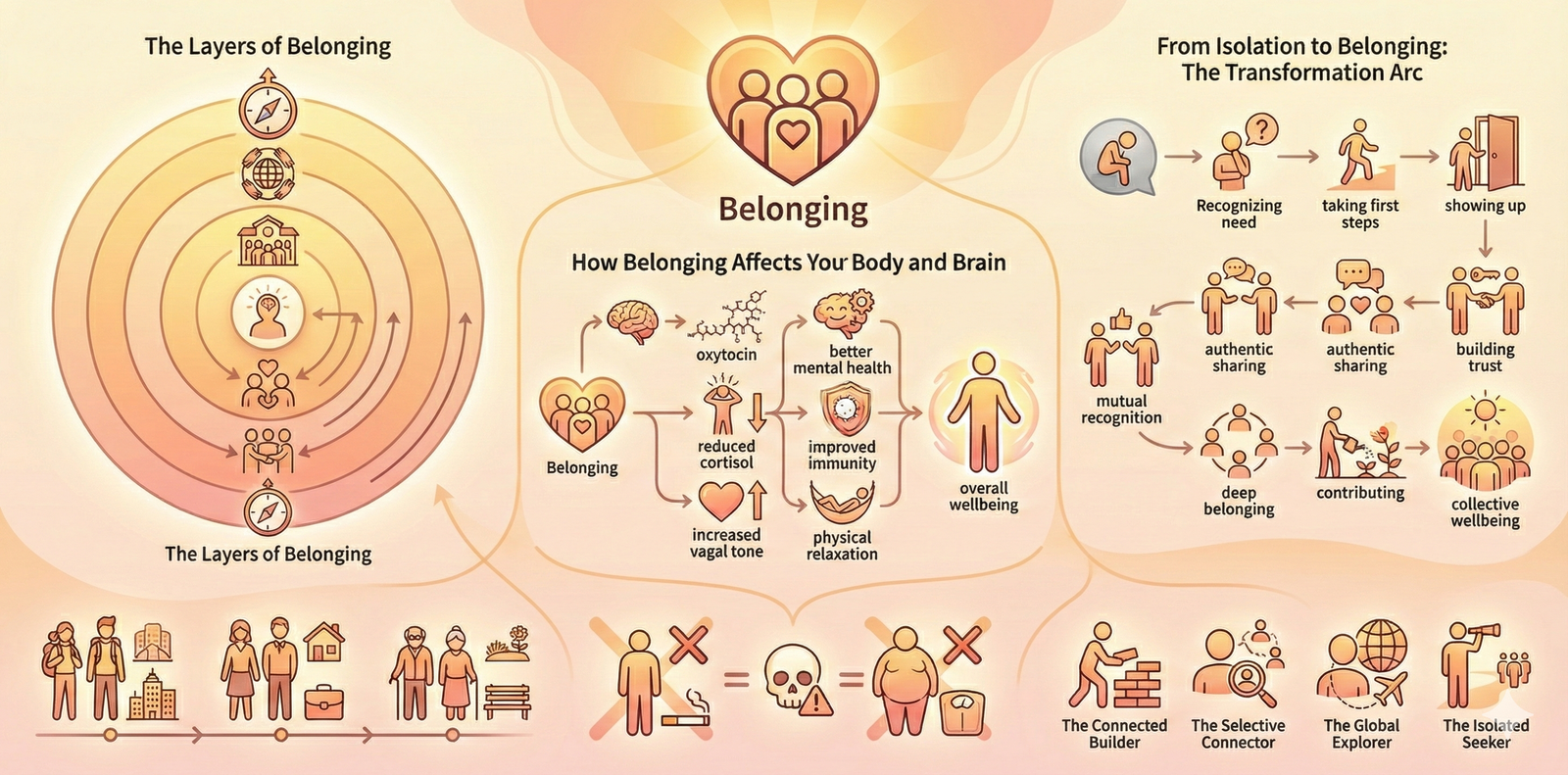
Belonging shapes your mental health in ways you might not realize. People with strong community connections experience lower anxiety, reduced depression symptoms, and greater overall life satisfaction.
Your nervous system responds differently when you feel you belong. Safety, trust, and mutual support activate your parasympathetic nervous system, helping your body relax and recover.
What Is Belonging?
Belonging is the subjective feeling of deep connection with social groups, physical places, and shared experiences. It goes beyond mere association or presence in a group. True belonging means feeling understood, accepted, and valued for who you are—not for what you achieve or produce. It's about perceiving stable and emotionally significant interpersonal connections that endure over time. Belonging is fundamentally about being part of something larger than yourself while maintaining your authentic identity.
Not medical advice.
Belonging operates on the principle that humans are inherently social creatures with a fundamental need for connection. The quality of your relationships matters far more than the quantity. One deeply meaningful friendship provides more benefit than dozens of superficial acquaintances. Belonging creates a sense of psychological safety—the confidence that you can be yourself without fear of rejection or judgment. This safety becomes the foundation for all personal growth and resilience.
Surprising Insight: Surprising Insight: A meta-analysis of 70 studies found that the health impact of social isolation is equivalent to smoking 15 cigarettes daily and twice as harmful as obesity. Yet belonging, not size of social network, is what truly protects health.
The Layers of Belonging
Understanding how belonging builds from individual identity through intimate relationships to community and contribution
🔍 Click to enlarge
Why Belonging Matters in 2026
Loneliness has reached epidemic proportions in developed countries. The pandemic accelerated social fragmentation, leaving millions feeling disconnected despite digital connectivity. Yet neurobiological research shows that virtual connection, while valuable, cannot fully replace in-person belonging. Your brain craves face-to-face interaction for optimal wellbeing.
In 2026, workplace belonging directly impacts retention, productivity, and innovation. Companies with high belonging metrics see 50% lower turnover and 56% higher performance. Educational institutions recognize belonging as foundational to student success, with belonging interventions reducing academic anxiety and improving achievement.
Marginalized communities face particular belonging challenges. LGBTQ+ individuals, racial minorities, migrants, and people with disabilities experience higher rates of isolation and discrimination. Creating inclusive spaces where diverse individuals can belong becomes not just beneficial but essential for collective wellbeing and social justice.
The Science Behind Belonging
Neuroscientific research reveals that belonging activates the same reward centers in your brain that respond to food and shelter. When you experience accepted connection, your brain releases oxytocin, dopamine, and serotonin—the neurochemicals of wellbeing. These aren't abstract benefits; they're measurable physiological responses that literally change how your body functions.
The vagus nerve, your body's longest cranial nerve, communicates directly with your heart, lungs, and digestive system. When you feel safe within your community, vagal tone improves, reducing inflammation and supporting parasympathetic activation. This explains why people with strong social connections have lower cortisol levels, better heart health, and stronger immune function. Belonging isn't psychological luxury; it's biological necessity.
How Belonging Affects Your Body and Brain
The physiological cascade from social connection to improved health outcomes
🔍 Click to enlarge
Key Components of Belonging
Authentic Self-Expression
True belonging requires the freedom to be yourself without masks or performance. In groups where you must hide aspects of your identity—your beliefs, your struggles, your passions—belonging remains elusive. Authentic self-expression means bringing your whole self to your relationships: your humor, your doubts, your dreams, and your vulnerabilities. This vulnerability paradoxically creates stronger bonds because others can genuinely know and accept the real you.
Mutual Recognition and Respect
Belonging isn't one-directional. It requires both being seen by others and seeing them with genuine appreciation. Mutual recognition means acknowledging each person's unique strengths, struggles, and contributions. When community members feel recognized and respected, they reciprocate, creating cycles of positive interaction. This mutual respect transcends hierarchy; it means honoring differences without judgment.
Shared Values and Purpose
The strongest belonging emerges from shared values and collective purpose. Whether through religious communities, volunteer organizations, professional teams, or affinity groups, people bond most deeply around what matters most. Shared purpose creates meaning that extends beyond individual benefit. You belong not just to people but to something larger—a cause, a vision, a way of life that aligns with your deepest values.
Consistent Presence and Reliability
Belonging requires consistency over time. Sporadic connection doesn't build the emotional security that true belonging provides. Reliable presence—showing up reliably, remembering what matters to people, maintaining consistent engagement—creates the stable foundation belonging requires. This consistency communicates that you value the relationship enough to prioritize it, and others feel this as genuine care.
| Dimension | Strong Belonging | Isolation/Loneliness |
|---|---|---|
| Emotional Safety | Feel safe being authentic | Fear judgment or rejection |
| Communication | Can express needs and concerns | Hide true thoughts and feelings |
| Recognition | Feel seen and valued by others | Feel invisible and insignificant |
| Health Outcomes | Lower stress, better immunity | Chronic stress, health decline |
| Life Satisfaction | High engagement and meaning | Emptiness despite connections |
| Physical Health | Stronger immune function | Increased inflammation |
How to Apply Belonging: Step by Step
- Step 1: Identify Your Values: Write down what matters most to you—connection, growth, service, creativity, spirituality, or justice. These values become your compass for finding your people.
- Step 2: Assess Your Current Connections: Evaluate your existing relationships. Which ones feel authentic and reciprocal? Which feel obligatory or draining? Belonging requires quality over quantity.
- Step 3: Seek Communities Aligned with Values: Find groups, organizations, or communities where your values align—volunteer groups, hobby clubs, religious communities, professional associations, or online forums focused on shared interests.
- Step 4: Show Up Consistently: Commit to regular presence. Belonging deepens through consistent interaction over time. Whether weekly meetings, daily check-ins, or monthly gatherings, consistency builds trust.
- Step 5: Practice Authentic Self-Expression: Share genuinely in your communities. Speak your truth, ask for help when needed, celebrate others' successes, and acknowledge challenges. Authenticity invites authenticity.
- Step 6: Invest in Listening: Practice active listening without judgment. Understand others' perspectives before responding. When people feel truly heard, belonging deepens exponentially.
- Step 7: Offer Genuine Contribution: Look for ways to add value to your communities. This might be organizing an event, supporting a struggling member, sharing expertise, or simply showing appreciation and encouragement.
- Step 8: Set Boundaries with Compassion: Healthy belonging includes setting boundaries. Say no to relationships or groups that diminish you, and do this with respect for all involved. Real belonging respects individual wellbeing.
- Step 9: Create Rituals Together: Regular rituals—weekly dinners, monthly hikes, daily messages—create shared identity and deepen belonging. Rituals anchor community through predictable moments of connection.
- Step 10: Extend Belonging to Others: The final step is helping others feel they belong. Welcome newcomers, include quiet members, celebrate diversity, and actively work against exclusion in your spaces.
Belonging Across Life Stages
Young Adulthood (18-35)
Early adulthood is when many people first establish independent social identities separate from family. This stage involves exploring different communities, finding peers who share interests and values, and developing intimate friendships. The risk is fragmentation—jumping between groups without deep roots. Young adults benefit from intentionally choosing communities that align with emerging values, whether through education, work, shared interests, or activism. Building friendship skills now creates foundations for lifelong belonging.
Middle Adulthood (35-55)
Middle adulthood brings career demands, family responsibilities, and shifting friend groups. Many middle-aged adults report decreased social engagement despite increased responsibilities. This stage requires intentional protection of community time. Deepening belonging in existing relationships becomes more valuable than acquiring new connections. Professional communities, parent networks, and long-established friendships provide anchoring. The challenge is preventing isolation amid competing demands.
Later Adulthood (55+)
Later life brings both opportunity and challenge for belonging. Retirement provides time for community engagement, yet loss—of spouse, peers, work identity, mobility—can threaten belonging. Later-life belonging benefits from intergenerational connection, continued purpose through mentoring or volunteering, and active engagement with peers. Technology enables connection across distances. Many discover profound belonging in their 60s, 70s, and beyond through new communities and deepened existing relationships.
Profiles: Your Belonging Approach
The Connected Builder
- Intentional community involvement
- Leadership opportunities to strengthen group bonds
- Regular structured gatherings that deepen connection
Common pitfall: Taking on too many commitments and becoming burned out, losing the joy of belonging
Best move: Choose 2-3 communities for deep involvement rather than many superficial ones. Quality over quantity preserves energy and deepens roots.
The Selective Connector
- Small, intimate groups of close friends
- One-on-one connection time rather than large gatherings
- Depth and authenticity in relationships
Common pitfall: Limiting social circle too narrowly, missing growth opportunities and diverse perspectives
Best move: Gradually expand your circle through your existing connections. Host small gatherings that allow for meaningful conversation.
The Global Explorer
- Diverse communities and international connections
- Exposure to different cultures and perspectives
- Freedom to move between groups
Common pitfall: Building many surface connections without deep roots or stable community base
Best move: Establish one or two anchor communities while enjoying broader exploration. Depth in some relationships provides stability.
The Isolated Seeker
- Gentle entry into community without pressure
- Safe, accepting spaces to practice connection
- Patient support from understanding people
Common pitfall: Waiting for belonging to find them instead of taking active steps toward connection
Best move: Start small—one volunteer opportunity, one class, one regular hangout spot. Build confidence through repeated positive interactions.
Common Belonging Mistakes
The first mistake is confusing quantity with quality. Having hundreds of social media connections provides no belonging if those interactions are superficial. Belonging requires intimate knowledge and mutual investment, something that develops only through consistent, genuine engagement. Stop measuring your social life by follower counts and start measuring it by how seen and valued you feel.
Another common error is seeking belonging through people-pleasing or losing your identity. When you hide your authentic self to fit in, you create pseudo-belonging—acceptance of a false version of you. This never satisfies because the real you remains unseen. True belonging requires the risk of authentic self-expression and the courage to find people who accept your whole self.
A third mistake is passive waiting. Belonging doesn't just happen to you; it requires active participation. Waiting for invitations, assuming others aren't interested, staying isolated until you feel more confident—these patterns perpetuate loneliness. Belonging requires showing up, taking initiative, and extending genuine interest even when uncertain of reception.
From Isolation to Belonging: The Transformation Arc
How consistent small actions transform loneliness into deep connection and community
🔍 Click to enlarge
Science and Studies
Decades of research across psychology, neurobiology, medicine, and sociology confirm that belonging is foundational to human wellbeing. Recent studies show the measurable impact of community connection on both mental and physical health outcomes. The research consistently demonstrates that investing in belonging isn't luxury—it's preventive health care.
- Johns Hopkins University research (2025) documents that strong sense of belonging significantly predicts mental health, quality of life, and physical wellbeing
- NIH meta-analysis of 70 studies found social isolation health effects equivalent to smoking 15 cigarettes daily, twice as harmful as obesity
- Frontiers in Psychology study (2025) on Chinese international students found belonging essential for psychological wellbeing and reducing loneliness across cultures
- Canadian health research shows community belonging associated with better self-rated health across all life stages, with very weak belonging linked to 3.21 times higher odds of poor health
- PMC studies document that strong social connections reduce mortality risk equivalent to quitting smoking and exercise benefits combined
Your First Micro Habit
Start Small Today
Today's action: Send one genuine message today to someone you appreciate in your community. Not a like or emoji—a real message expressing specific appreciation for who they are or how they've impacted your life.
This single action accomplishes multiple belonging goals: it reminds someone they matter, it strengthens your relationship, and it creates positive reciprocity. Consistency with this micro habit—daily or several times weekly—gradually rewires how you relate to others. You shift from passive consumption to active contribution.
Track your connection moments with our AI mentor app. Bemooore helps you build belonging habits systematically, reminding you of relationships to nurture and celebrating your progress in deepening community.
Quick Assessment
Which best describes your current sense of belonging in your communities?
Your current belonging level helps determine which strategies will create the fastest, deepest shifts in your experience of connection.
What matters most when thinking about belonging for you?
Understanding your primary belonging focus helps you direct energy toward strategies that match your unique needs and strengths.
What's your biggest barrier to experiencing more belonging?
Identifying your specific barrier helps you address the root cause rather than just treating symptoms of disconnection.
Take our full assessment to get personalized recommendations.
Discover Your Style →Next Steps
Your journey toward deeper belonging begins with recognizing that this human need matters—it's not selfish, frivolous, or optional. It's foundational to your health, resilience, and capacity for joy. Start this week by identifying one community that aligns with your values and one action you'll take to show up more authentically within it.
Remember that belonging is built through consistent small actions, not grand gestures. Each genuine connection, each moment of authentic self-expression, each time you extend appreciation—these accumulate into the experience of true belonging. You deserve to feel deeply seen, valued, and connected. Take action today.
Get personalized guidance with AI coaching.
Start Your Journey →Research Sources
This article is based on peer-reviewed research and authoritative sources. Below are the key references we consulted:
Related Glossary Articles
Frequently Asked Questions
Can introverts experience deep belonging?
Absolutely. Belonging isn't determined by extroversion level. Introverts often build fewer but deeper relationships and find belonging in intimate settings and small groups. The key is authentic connection, not social volume.
Is online community a valid form of belonging?
Online communities provide real connection and belonging for many people, especially those with geographical limitations, mobility challenges, or shared interests difficult to find locally. However, most people benefit from balancing online connection with some in-person belonging.
What if I've been hurt by past communities or betrayed by friends?
Past wounds make belonging harder but not impossible. Healing often requires processing the hurt with support, then gradually rebuilding trust in smaller, lower-stakes relationships. Professional support can help transform patterns that kept you in harmful communities.
How do I find belonging if I don't share obvious interests or identities with others?
Look for value alignment rather than interest alignment. Volunteer with organizations addressing issues you care about. Attend workshops or classes in areas you want to learn. Sometimes belonging emerges around purpose more than hobbies.
Is family belonging different from chosen community?
Both matter, but they're different. Family belonging can't always be chosen, while community belonging usually can. Sometimes family relationships are sources of support; sometimes chosen community becomes your primary family. Many people experience rich belonging through both.
Take the Next Step
Ready to improve your wellbeing? Take our free assessment to get personalized recommendations based on your unique situation.
- Discover your strengths and gaps
- Get personalized quick wins
- Track your progress over time
- Evidence-based strategies