Purpose
Have you ever felt that something was missing despite achieving your goals? That hollow feeling despite external success often points to one thing: lack of purpose. Purpose is the compass that guides your entire life, transforming ordinary days into meaningful moments. It's not about grand achievements or changing the world, though it might include those. Purpose is the answer to three powerful questions: Who are you? What do you love? Who do you serve? When you understand these answers, life shifts from merely existing to truly living. Research shows that people with strong purpose live longer, healthier, and significantly happier lives. Your purpose becomes the lens through which you make decisions, build relationships, and create a legacy. The remarkable truth is that purpose doesn't find you—you discover it through intentional reflection and action.
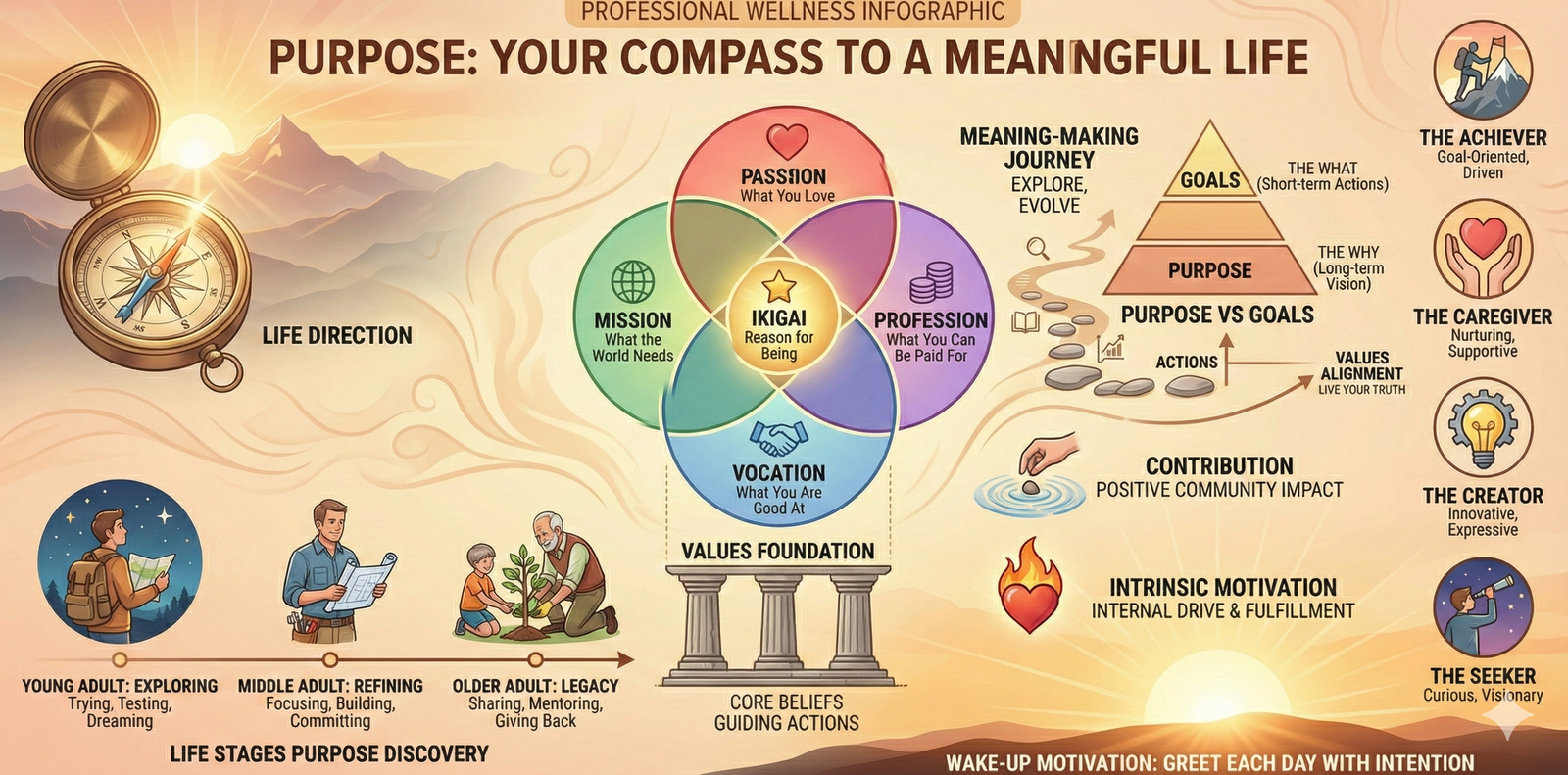
Most people search for purpose in the wrong places: in job titles, salary brackets, or social status. They wait for inspiration to strike or expect others to reveal their meaning. Meanwhile, purpose quietly exists within your values, relationships, and the unique gifts you bring to the world.
The science is clear: purpose is not a luxury but a biological necessity for human thriving. Your brain, body, and mental health all depend on it.
What Is Purpose?
Purpose is a stable and generalized intention to accomplish something personally meaningful. It's the sense that your life has direction, meaning, and value beyond yourself. Purpose goes deeper than happiness or pleasure—it's about engaging in activities that feel significant and aligned with your core beliefs. Viktor Frankl, a Holocaust survivor and psychiatrist, discovered that even in the darkest circumstances, humans can find purpose and meaning. He called this the "will to meaning," arguing that the search for meaning is the most fundamental human motivation. Purpose manifests as a feeling that your life matters, that you contribute to something larger than yourself, and that your existence makes a difference.
Not medical advice.
Purpose differs from happiness in a crucial way. Happiness is often fleeting and depends on pleasant experiences, while purpose is enduring and rooted in deep meaning. You might feel happy watching a sunset, but purpose feels different—it's the satisfaction of living according to your values. Purpose can involve challenge, sacrifice, and difficulty. A parent caring for a sick child experiences purpose despite stress and exhaustion. A person pursuing a meaningful career may earn less but feel more fulfilled. Purpose transcends momentary emotions and connects you to something greater.
Surprising Insight: Surprising Insight: A six-year Cornell study found that giving people $400 with instructions to contribute to others created sustained happiness for up to two months—simply because the contribution activated their sense of purpose.
The Purpose Pyramid
A visual model showing how purpose builds from self-understanding through values and contribution to create life meaning and sustained wellbeing.
🔍 Click to enlarge
Why Purpose Matters in 2026
In 2026, we face unprecedented challenges: economic uncertainty, rapid technological change, social fragmentation, and mental health crises. Anxiety and depression have reached epidemic levels, particularly among young adults and middle-aged individuals facing life transitions. The 2024 mental health statistics show alarming trends across all demographics. Young adults report lower life satisfaction than any previous generation at the same age. Middle-aged adults describe unprecedented stress managing aging parents, adult children, and career pressures simultaneously. Older adults often face isolation and loss of identity after retirement. In this landscape, purpose has become more critical than ever. Research published in 2024-2025 shows that people with strong purpose experience 57% lower mortality risk over five years, significantly fewer chronic diseases, and better resistance to depression and anxiety. Purpose acts as a buffer against life's inevitable difficulties, offering psychological resilience that no amount of external achievement alone can provide.
The modern world often disconnects us from meaning in ways previous generations never experienced. We work jobs chosen for income rather than impact, spending eight hours daily in misalignment with our values. Social media shows us curated lives that feel hollow, simultaneously connecting and isolating us. Technology connects us globally but isolates us locally—we communicate online while loneliness reaches crisis levels. We achieve external metrics of success—degrees, job titles, promotions, possessions—only to feel unfulfilled and questioning whether any of it matters. Purpose is the antidote to this existential void that haunts even the successful. It's what gives your achievements meaning. It's what makes your relationships authentic. It's what transforms your daily routines from obligatory tasks into a life well-lived. Without purpose, success becomes a treadmill with no destination. With purpose, ordinary days become significant.
Additionally, purpose is proven to enhance cognitive function and slow age-related decline through measurable neurobiological mechanisms. People with high purpose show better white matter integrity in the brain, more efficient neural connections, and dramatically lower dementia risk—studies suggest 40-50% lower cognitive decline over 5-10 years. Your hippocampus, critical for memory, actually has better structural integrity when you have purpose. Your prefrontal cortex, responsible for executive function and decision-making, works more efficiently. Your brain literally works better when you have clear purpose because purposeful living engages multiple cognitive systems simultaneously. In 2026, as we grapple with extending both lifespan and healthspan, purpose isn't optional—it's essential health maintenance equivalent to exercise and sleep.
The Science Behind Purpose
Neuroscience reveals that purpose activates specific brain regions involved in emotional processing, self-reflection, and reward generation. The default mode network—areas that activate when you're thinking about yourself and your future—shows dramatically greater efficiency in people with strong purpose. This neural network, which includes the medial prefrontal cortex, posterior cingulate, and angular gyrus, activates when we think about personal meaning and future possibilities. In people with purpose, these regions show stronger and more organized connections. This means purposeful people can access their emotions and reflect on their experiences more effectively. They also show better connectivity between regions responsible for decision-making (dorsolateral prefrontal cortex) and emotional regulation (amygdala and ventromedial prefrontal cortex). Functionally, this enhanced neural organization translates to better judgment, less impulsive behavior, greater emotional regulation, and enhanced resilience in stressful situations. Brain imaging studies show these differences remain stable over time, suggesting that purpose creates lasting structural changes in how the brain organizes itself.
At the physiological level, purpose lowers cortisol (the primary stress hormone) and increases DHEA (dehydroepiandrosterone, a hormone associated with health, vitality, and longevity). This represents a fundamental shift in the body's stress response system—the hypothalamic-pituitary-adrenal (HPA) axis that controls stress hormones literally calms down in response to purposeful living. People with purpose show lower inflammation markers throughout their body, better immune function (stronger antibody responses to vaccines, faster healing), and significantly reduced cardiovascular disease risk. They also show better metabolic function, including improved glucose regulation and more favorable cholesterol profiles. Purpose appears to work through multiple interconnected biological pathways: improving stress management through reduced reactivity, enhancing health behaviors through motivation aligned with values, strengthening social connections which trigger biochemical bonding cascades, and providing psychological resilience through meaning-making in adversity. A 2024 meta-analysis in the Journal of Positive Psychology examining 142 studies found that purpose predicts better outcomes across every major health measure examined—from cardiovascular health to immune function to physical fitness to mental health to life satisfaction. The effect sizes were remarkably consistent: people with high purpose showed 20-40% better outcomes across most measures.
Purpose's Path to Better Health
A flowchart showing how purpose impacts the brain, stress hormones, health behaviors, relationships, and ultimately physical and mental wellbeing.
🔍 Click to enlarge
Key Components of Purpose
Self-Understanding
Purpose begins with knowing yourself deeply—not the self you present to the world, but your authentic inner self. This includes understanding your temperament (are you introverted or extroverted, analytical or intuitive?), your natural strengths and talents, your values and what matters most, and what activities make you lose track of time because you're so engaged. Self-understanding means brutally honest reflection about what genuinely matters to you, not what you think should matter based on family expectations, cultural norms, or social pressure. Many people pursue purposes inherited from family without ever checking if these align with their authentic selves. A parent's dream becomes your obligation. A cultural expectation becomes your identity. Years later, you succeed at someone else's purpose and feel hollow. Take time to identify patterns in your life through reflection: When do you feel most alive and authentic? When has time disappeared because you were so engaged? What problems do you naturally want to solve, even when not asked? What would you do if money and status didn't matter, if no one would judge, if success was guaranteed? What specific activities or roles have made you feel most like yourself? These questions, answered with brutal honesty, point toward genuine purpose rooted in who you actually are.
Values Alignment
Purpose emerges from core values—the fundamental principles that guide your decisions and define your character. Values are different from goals; they're deeper and more stable. While goals can be achieved and completed, values are lived continuously. Common values include family, creativity, justice, learning, health, compassion, excellence, adventure, security, or spirituality. Your authentic purpose should reflect your highest values, not conflict with them. Someone whose core value is family but whose "purpose" involves constant travel away from loved ones will feel perpetually conflicted. Their daily choices contradict their deepest beliefs, creating cognitive dissonance and psychological strain. Genuine purpose creates fundamental alignment between what you do daily and what you believe deeply about what matters. This alignment generates the psychological harmony that sustains motivation through challenges. When you face difficulty pursuing your purpose, if it's truly aligned with your values, you find motivation from within. If your purpose conflicts with your values, the difficulty feels exhausting and meaningless.
Contribution and Impact
Purpose typically extends beyond yourself to something larger. The research on purpose consistently shows that the most sustaining purposes involve meaningful contribution—how you help others, improve your community, advance causes you believe in, or create something of value. This doesn't require grand gestures or saving the world. A teacher finding purpose in developing young minds and helping them discover their potential. A nurse finding purpose in patient care and comfort during vulnerable moments. A parent finding purpose in raising children and shaping the next generation. A craftsperson finding purpose in creating quality work that lasts and brings beauty or function. A friend finding purpose in being present during another's crisis. A gardener finding purpose in creating beauty and growth. All these involve genuine contribution. The Harvard Study of Adult Development, following participants for over 80 years, found that those with the strongest sense of purpose were those who felt their lives mattered to others, whose choices positively affected people they cared about. This relational dimension of purpose proves more sustaining than achievement-only purposes. When your purpose includes serving something beyond yourself, motivation becomes intrinsic and resilient.
Meaning in Struggle
One of Viktor Frankl's most profound insights is that purpose doesn't require comfortable circumstances—it often emerges precisely through challenge and adversity. This reframed how we understand meaning-making in suffering. Parents find purpose in caring for seriously ill children despite sleepless nights and emotional exhaustion. Activists find purpose in fighting injustice despite opposition and personal risk. Artists find purpose in creating despite scarcity and rejection. Frankl identified three primary paths to meaning: creating work or accomplishing tasks that matter, loving and being loved in deep relationships, and finding dignity and meaning in how we face suffering when external circumstances are beyond our control. The third path is revolutionary: even when circumstances are brutal, even when we cannot change what happens to us, we retain the power to choose how we respond and what meaning we extract. This is profoundly different from toxic positivity or pretending suffering doesn't matter. It's acknowledging that our choice of meaning in the face of hardship is a genuine expression of purpose and freedom. This is why purpose is ultimately about more than happiness—it's about significance, dignity, and the meaning we create even in darkness.
| Source | Characteristics | Examples |
|---|---|---|
| Work & Contribution | Using skills to make a difference, solving problems | Teaching, healthcare, building, advocating, creating |
| Relationships | Loving and being loved, caring for others | Parenting, partnerships, mentoring, community care |
| Personal Growth | Developing mastery, learning, becoming your best | Skill development, education, self-improvement, artistry |
| Meaning in Hardship | Finding dignity in adversity, choosing response | Overcoming challenges, resilience, turning pain into wisdom |
How to Apply Purpose: Step by Step
- Step 1: Reflect deeply on who you are beneath the roles you play. Take 15-20 minutes with a journal or blank screen and write freely about your temperament and personality (Are you introverted or extroverted? Analytical or intuitive? Risk-taking or cautious?). Write about your natural strengths—what comes easily that other people seem to struggle with. Don't filter for practicality or how others might judge you. Capture the real you that exists beneath professional titles, family roles, and social expectations.
- Step 2: Identify what you genuinely love by looking at patterns of engagement and time. Create a list of activities where you lose track of time because you're so engaged you forget to check the clock. Include things you'd do without external reward—no payment, no recognition, no obligation. Include what genuinely excites and energizes you, not what you think should excite you. Then look across this list for patterns. Do you love creating? Understanding? Helping? Building? Teaching? Analyzing? Organizing? These patterns point toward your authentic interests.
- Step 3: Clarify your core values through honest reflection. What principles guide your life, even when it's costly? What do you refuse to compromise on? What injustices anger you? What achievements feel hollow without meaning? Which values, when honored in daily life, make you feel most authentically yourself? Write down your top 5-7 values. These become the compass for your purpose.
- Step 4: Identify who you serve and what impact matters to you. Purpose typically extends beyond yourself. Who matters most to you? Who do you naturally want to help? What populations, communities, or causes call to you? What difference do you want to exist in the world? This might be parenting, teaching, creating, healing, building, changing systems, or creating beauty. Get clear on who your contribution serves.
- Step 5: Define your contribution by connecting your gifts to others' needs. This is where purpose becomes specific. How do your gifts and passions meet the genuine needs of those you serve? What unique value do only you bring? What difference are you uniquely positioned to make? This isn't about being irreplaceable; it's about recognizing how your specific constellation of gifts, experience, and passion intersects with real needs.
- Step 6: Write your purpose statement as a simple, grounded declaration. Combine these elements into 1-3 sentences that feel both true and inspiring. Make it grounded in reality, not abstract or grandiose. Example: 'I help parents find peace in chaos by teaching evidence-based stress management, so they can be present with their families.' Notice this includes: your role, your method, your beneficiaries, and the impact. Your statement should make you feel both calm certainty and genuine excitement.
- Step 7: Test your purpose statement against your current life. Look at your current work, relationships, daily choices, and time allocation. Does your daily life align with your stated purpose? Where are the biggest gaps? What would need to change for alignment? This isn't about judgment—it's about clarity. The gaps show you where intentional change might matter most.
- Step 8: Share your purpose with trusted people and notice your own clarity. Telling others creates accountability and generates helpful feedback. When you explain your purpose to someone you trust, does it feel true and authentic, or do you feel you're performing or justifying? This internal sense reveals whether your purpose is genuinely yours or borrowed from others' expectations.
- Step 9: Take one small action aligned with your emerging purpose within one week. You don't need to transform your entire life immediately. One decision aligned with purpose. One conversation about your emerging direction. One small project that reflects your values. This action breaks the contemplation-only cycle and begins actualizing your purpose. Small actions generate momentum and clarity.
- Step 10: Revisit your purpose quarterly through reflection. Purpose evolves as you grow, learn, and circumstances change. Set a reminder to spend 30 minutes every three months reflecting: Does my purpose still feel true? Has my understanding deepened? What has shifted? This regular practice keeps you aligned as your life develops.
Purpose Across Life Stages
Young Adulthood (18-35)
Young adults often face intense conflicting pressures from multiple directions: parental expectations ("You should become a doctor or lawyer"), peer influences ("Everyone's working for the same tech companies"), educational system pressures ("Your degree determines your career"), economic pressures ("You need to make money fast"), and the existential search for identity and meaning. This stage is crucial and often underestimated because young adults are simultaneously discovering who they are and expected to commit to life direction. The psychological challenge is discerning between genuine passion and authentic purpose versus cultural conditioning, parental dreams, or media-shaped aspirations. Many young adults benefit tremendously from exploration—trying different roles, environments, values, and careers to see what resonates with their authentic self. Purpose at this stage often focuses on discovering who you really are beneath the roles others assigned you, and what kind of work or contribution feels genuinely meaningful to you. The neurological good news: young adult brains have remarkable plasticity and flexibility, making this an ideal time for exploration and trying different directions. The psychological challenge: not knowing your purpose yet, while peers may appear settled and confident in their direction, can feel destabilizing and create pressure to commit before you're ready. The key insight: purpose often clarifies through action and experience, not through contemplation alone. Try things, learn about yourself, adjust, and trust the process.
Middle Adulthood (35-55)
Middle adulthood is paradoxically both the most crisis-prone and potentially most powerful time for purpose. By mid-life, many people have invested decades in a particular path—a career, a relationship structure, a lifestyle—and suddenly find themselves questioning whether it's actually meaningful. This is often when the profound realization hits: "I've succeeded at achieving what I was supposed to do, but I don't feel fulfilled. I have financial security and status, but I feel empty." This is not weakness or ingratitude; it's the soul's cry for alignment. Simultaneously, middle adulthood offers remarkable advantages: you have real experience and self-knowledge from years of living, genuine clarity about what you actually value (as opposed to what you thought you should value), and critically, enough time remaining to make meaningful changes. Purpose deepens dramatically during this stage, shifting from the young adult question "What do I want to do?" to the more profound "What impact do I want to make? How do I want to be remembered? What truly matters?" Many people pursue greater purpose alignment by courageously changing careers (often with financial stability to cushion the transition), deepening relationships that matter, or stepping into community leadership and mentoring roles. The midlife reassessment, while uncomfortable and sometimes disorienting, frequently leads to greater authenticity, fulfillment, and a life that actually reflects your values. Additionally, children often become independent during this stage, which paradoxically frees significant emotional and practical capacity for renewed purpose beyond parenting. This can be a gateway to previously delayed dreams and contributions.
Later Adulthood (55+)
Research consistently surprises people with its findings: older adults often report the strongest and most integrated sense of purpose of any life stage. This makes intuitive sense once we consider it: with fewer decades remaining, life priorities naturally clarify. What truly matters becomes obvious when time is limited and precious. Grandparenting, mentoring, legacy building, service to community, and creative expression become natural and powerful expressions of purpose. The transition of retirement, which can feel terrifying ("Who am I if not my job?"), can either be a purposeless drift into television and slow decline, or a gateway to previously delayed purposes. Some volunteer extensively. Some pursue creative expression they deferred. Some focus their energy entirely on relationships and family. Some mentor young people in their field. Some pursue deferred dreams—travel, education, projects. The research is clear: maintaining strong purpose predicts not only wellbeing but also healthy aging, cognitive preservation, reduced dementia risk, and longevity. Rather than declining into irrelevance as cultural narratives suggest, purpose often reaches its deepest and most integrated form in later adulthood. The challenge is that contemporary culture doesn't always support elder purpose and contribution—we culturally devalue older adults despite their wisdom and experience. Meeting this challenge requires actively claiming your purpose rather than accepting cultural invisibility. Older adults who do claim and pursue meaningful purpose report the highest life satisfaction of any age group.
Profiles: Your Purpose Approach
The Achiever
- Clear goals and measurable progress
- Recognition of impact and accomplishments
- Challenge and growth opportunities
Common pitfall: Defining purpose purely through achievement and external validation. Burnout when goals are met but emptiness remains.
Best move: Shift from achievement-only to impact-focused purpose. Ask 'Who benefits from my success?' and 'What am I building toward that's greater than myself?'
The Caregiver
- Deep relationships and connection
- Meaningful contribution to others' wellbeing
- Permission to prioritize relationships without guilt
Common pitfall: Self-neglect in service to others. Resentment if caregiving feels obligatory rather than purposeful. Loss of identity in service roles.
Best move: Recognize that your relational gifts are your purpose. Maintain your own wellbeing so you can sustain caregiving. Expand purpose beyond obligatory care to chosen contribution.
The Creator
- Outlet for creative expression and innovation
- Freedom from rigid structures and rules
- Audience or impact for creative work
Common pitfall: Feeling that 'real work' is only practical work, relegating creativity to hobby status. Pursuing creative purpose without honoring financial needs, creating unsustainable stress.
Best move: Legitimate creativity as valid purpose. Find ways to integrate creative gifts into sustainable work. Even if your job isn't creative, develop creative outlets that feel purposeful.
The Seeker
- Exploration and permission to change direction
- Deeper understanding of self and values
- Flexibility and openness to evolution
Common pitfall: Endless searching without committing to direction. Analysis paralysis that prevents action. Feeling guilty about changing course when new understanding emerges.
Best move: Recognize that exploration is purposeful in itself. Take action in promising directions even without complete clarity. Purpose clarifies through doing, not only thinking.
Common Purpose Mistakes
One major mistake is confusing purpose with passion. Passion and purpose are related but distinct. Passion is what excites you, what energizes you emotionally, what you find thrilling and stimulating. Purpose is what sustains you through difficulty, what you're willing to struggle for, what you choose to continue even when it's hard. You might be passionate about painting—love the materials, the colors, the creative flow—but find your purpose in teaching art to underserved communities. Through that teaching purpose, you might express your painting passion, but the purpose is the teaching and the impact, not the painting itself. Passion can be changeable and fickle; purpose tends to be more stable and grounded. A critical mistake is waiting for passion to find you before acting. Instead, start with clarity about your values and who you want to serve, take action, and passion often follows from engagement and meaning.
Another deeply limiting error is believing purpose must be extraordinary or world-changing. People think they need to start a movement, change policy, become famous, save the world, or achieve something remarkable and visible. This perfectionist thinking about purpose actually prevents authentic purpose discovery. If your purpose isn't grandiose enough in your own mind, you discount it. The research consistently shows that ordinary purposes—being a great parent who raises healthy humans, creating quality in your work regardless of field, strengthening your immediate community through friendship and service—provide equal life satisfaction, health benefits, and deep meaning as extraordinary purposes. A nurse finding purpose in patient care, a teacher finding purpose in student development, a parent finding purpose in raising children, a craftsperson finding purpose in quality work, a friend finding purpose in loyalty and presence—these ordinary purposes are deeply meaningful. Your purpose doesn't need to be unique or revolutionary; it needs to be authentic and grounded in your actual values.
A third costly mistake is pursuing inherited purpose without questioning authentic fit. Many people unconsciously adopt their parents' values and dreams, their culture's definition of success, or their peers' life trajectories without genuine reflection about whether these fit them. A parent's dream of law school becomes your obligation. A cultural expectation of entrepreneurship becomes your assumed path. A peer group's focus on status and income becomes your direction. Years later, you've achieved impressive goals—you became the lawyer or entrepreneur or executive you were supposed to become—and you feel empty. "But I succeeded," you think confusedly. "Why do I feel like I've failed?" You succeeded at someone else's purpose. This creates the painful experience of achieving your goals only to feel hollow. The discomfort of questioning inherited purposes is often the gateway to authentic purpose discovery. Some inherited purposes will remain true for you because they genuinely reflect your values (this is beautiful alignment). Others won't. Only you can determine the difference through honest reflection. This requires courage to potentially disappoint people who invested in your inherited purpose, but the alternative is a lifetime of misalignment.
From Confusion to Clarity: The Purpose Journey
A timeline showing the transition from purpose confusion and searching through self-discovery, testing and refinement, to integrated purpose and meaningful living.
🔍 Click to enlarge
Science and Studies
The research on purpose has grown exponentially since 2010, with hundreds of peer-reviewed studies published in psychology, neuroscience, and medicine journals. The evidence is remarkably consistent across studies, populations, and methodologies: purpose predicts better outcomes across every major life dimension. This isn't merely correlation (X and Y happen together) but increasingly shows causal relationships (increasing purpose causes health improvements). Longitudinal studies following people over 5-10+ years show that when people increase their sense of purpose, health outcomes improve, suggesting direction of causation. Intervention studies where people complete purpose-focused exercises show measurable improvements in wellbeing and health markers within weeks to months. The research comes from diverse sources: major universities, national health institutes, international research teams, and both laboratory and real-world studies. Some examine thousands of participants; others examine small populations intensively. The consistency of findings across all these different approaches strengthens the evidence that purpose has genuine biological, psychological, and social impact.
- William Damon (2025): 'The Psychology of Purpose' in Sage Journals—comprehensive meta-analysis of how purpose develops across the entire human lifespan and robustly predicts wellbeing at every life stage.
- Cornell University (2024): Purpose-driven contribution study showing that giving $400 with instructions to contribute to others generates two months of sustained happiness through the specific mechanism of purpose activation, compared to other uses of $400.
- Journal of Positive Psychology (2025): Large meta-analysis of 142 studies confirming across cultures that purpose predicts happiness, life satisfaction, reduced depression, and lower stress with consistent effect sizes of 20-40% improvement.
- Frontiers in Psychiatry (2024): Brain imaging studies from the Midlife in the U.S. study showing that purpose associates with better white matter integrity, specifically in the right hippocampus critical for memory, predicting dementia prevention and cognitive preservation.
- National Institutes of Health (2024): Longitudinal studies of 1000+ participants showing purpose linked to 57% lower mortality risk over five years, significant cardiovascular disease reduction, lower cancer incidence, and better metabolic health outcomes.
Your First Micro Habit
Start Small Today
Today's action: Spend 10 minutes this week answering Adam Leipzig's five questions: Who are you? What do you love? Who do you do it for? What do they want or need? How do they change as a result? Write freely without filtering. This isn't a final answer—it's exploration.
Purpose discovery requires reflection, but reflection without action stays abstract. These five questions activate all the purpose components simultaneously: self-understanding, values, contribution, and impact. Writing creates clarity that thinking alone doesn't. This small action shifts your brain from passive wondering to active discovery.
Keep quitting habit apps after a missed day? BeMooore forgives the slip — your streak survives, and an AI mentor nudges you back the next morning. Free on iOS.
Quick Assessment
When you imagine your life five years from now, how do you feel?
Your answer reflects your current purpose clarity. Uncertainty indicates it's time for reflection. Hope suggests you're awakening to purpose. Energy and fulfillment indicate strong purpose alignment. Notice where you are without judgment—wherever you start is the right starting point.
What would change if you spent one hour weekly on something deeply meaningful (regardless of income or recognition)?
This reveals your hidden purpose—what you would choose if external constraints disappeared. Your answer points toward authentic purpose. The gap between your answer and your current life shows where alignment work is needed.
How much of your current work and daily activities reflect your core values?
This measures values-life alignment, which predicts authenticity and wellbeing. Low alignment suggests rethinking current commitments. Moderate alignment indicates you're on a positive trajectory. High alignment indicates you've built a purposeful life or are very close.
Take our full assessment to get personalized recommendations.
Discover Your Style →Next Steps
You now understand what purpose is—not a luxury but a biological necessity for health and longevity. You understand why it matters for your health and happiness, predicting everything from mortality risk to cognitive function. You've learned the components that create authentic purpose: self-understanding, values alignment, contribution, and meaning in struggle. You've seen the neuroscience showing how purpose literally changes your brain structure and chemistry. You've read about how purpose evolves across life stages. You've heard about others' journeys. The time for abstract understanding has passed. The next step is personal action, and it's simpler than you might think. This week, spend 30 minutes with the five questions from Adam Leipzig's framework that you encountered in the video: Who are you? What do you love? Who do you do it for? What do those people want or need? How do they change as a result? Write freely without filtering. Don't judge your answers as right or wrong—just explore honestly. This single act begins the shift from abstract understanding to embodied discovery. Your purpose won't descend from the heavens or arrive in a flash of inspiration; it emerges through honest reflection and meaningful action.
As you complete that reflection, notice where your current life aligns with your emerging purpose and where gaps exist. These gaps are information, not failure. If your work doesn't reflect your purpose, that's information. If your relationships do, that's information. If your daily time allocation contradicts your stated values, that's information. You don't need to fix everything immediately or completely transform your life. That all-or-nothing thinking prevents action. Instead, commit to one decision aligned with your purpose. One conversation with someone about your emerging direction. One small change toward your authentic purpose. Research shows that people who increase their sense of purpose experience measurable improvements in health, happiness, and resilience within weeks, not years. Your brain, body, and spirit are literally ready for this alignment. The neurobiological systems are there, waiting for you to activate them through intentional purpose. The only remaining question is: are you ready to discover what your life is truly meant to be?
Get personalized guidance with AI coaching.
Start Your Journey →Research Sources
This article is based on peer-reviewed research and authoritative sources. Below are the key references we consulted:
Related Glossary Articles
Frequently Asked Questions
How do I know if I've found my true purpose?
True purpose feels grounded and real, not grandiose or forced. It aligns consistently with your core values, involves contribution and impact beyond yourself, and sustains motivation through difficulty and challenge. You feel it in your entire being—a sense of rightness and alignment that goes deeper than excitement. Unlike passion (which is exciting and sometimes fleeting), purpose can feel calm and certain, like coming home to yourself. If you're consistently moving toward this purpose despite real obstacles, if setbacks motivate you to try again rather than giving up, and if the work energizes you despite genuine effort and difficulty, that's authentic purpose. Ask yourself: Does this reflect who I really am? Does it matter beyond my own comfort? Would I pursue this even without external rewards? If yes to all three, you've found something real.
Can my purpose change?
Absolutely, and this is healthy evolution, not failure. Purpose evolves as you grow, gain experience, learn about yourself, and circumstances change. A young adult's purpose discovering themselves differs from a parent's purpose raising children, which differs from a midlife adult's purpose contributing to their field, which differs from an older adult's purpose building legacy and mentoring. A parent's purpose during active parenting may fundamentally shift when children become independent—suddenly there's capacity for different expressions. Someone who found purpose in corporate achievement and advancement may later recognize that legacy building, mentoring, or community contribution feel more meaningful. This isn't failure or instability—it's deepening wisdom and maturation. Regular reflection helps you notice when evolution is needed and when you're ignoring signs of misalignment. The core values underlying purpose tend to remain stable across your life (you remain compassionate, creative, or justice-oriented), but their expression shifts. This flexibility is actually a sign of psychological health.
What if I can't change my job to match my purpose?
Purpose is far larger than your job—it encompasses your entire integrated life. You can honor your purpose in multiple ways: through how you show up in your current work (bringing integrity and your values even in misaligned work), through service and contribution outside your job (volunteer work that's meaningful, community involvement), and through relationships (how you show up for family and friends). A person whose purpose is serving vulnerable people can do this through work as a counselor, or through volunteer work at nights and weekends, or through being present for struggling friends. A creative person blocked from creative work can create art outside their office job, find creative solutions in their current work, or develop creative hobbies that feel purposeful. Purpose is about integrated living—weaving meaning across work, relationships, contribution, and personal pursuits. That said, significant persistent misalignment between your job and your purpose does take a psychological and physical toll. It's worth exploring what's truly possible: Could your job be done with more alignment? Is remote work possible? Could you transition within your field? Could you develop a side project or parallel path? Sometimes small shifts create massive improvement.
Is purpose the same as happiness?
No—they're related but fundamentally different. Happiness is the pleasant feeling of contentment and positive emotion. Purpose is the sense that your life is meaningful and directed toward something significant. You can be happy without purpose (comfortable but drifting, no sense of direction or meaning). You can live purposefully through genuine difficulty, grief, and challenge (a parent with a seriously ill child, an activist facing opposition, an artist persisting despite rejection). Purpose creates more robust wellbeing precisely because it survives ups and downs. A parent in the exhausting early years with infants might not feel happy on a daily basis—they're sleep-deprived, touched out, isolated—but they feel profound purpose in developing young humans. That purpose sustains them when happiness would abandon them. Purpose provides meaning even in suffering. The research shows that purposeful people ultimately report greater life satisfaction and psychological wellbeing than people pursuing pleasure alone, because purpose creates meaning that transcends momentary emotions.
How do I overcome the fear of committing to a purpose?
Fear is completely normal and understandable. Committing to a purpose means consciously saying no to other paths, taking responsibility for direction, and risking that you might choose wrongly. This takes genuine courage. Here's the key reframe: You don't need to commit to perfection. Start small with micro-commitments. You don't need to overhaul your entire life immediately. Take one action aligned with emerging purpose. Talk to one person about it. Explore one direction. Most people find that once they start moving toward purpose, the fear diminishes because you're no longer in paralysis—you're gathering information through action. You can always adjust your direction. The research on regret consistently shows that inaction based on fear of wrong choice creates more regret than committed action with adjustments along the way. Fear of "choosing wrong" often keeps people stuck in genuine wrong-ness, while courage to choose imperfectly allows discovery. Purpose clarifies through doing, not through contemplation alone. Start somewhere real but small.
Take the Next Step
Ready to improve your wellbeing? Take our free assessment to get personalized recommendations based on your unique situation.
- Discover your strengths and gaps
- Get personalized quick wins
- Track your progress over time
- Evidence-based strategies