Self Understanding
Self understanding is your ability to see yourself clearly—to recognize your strengths, limitations, values, and patterns. It's the foundation that determines whether you'll make decisions aligned with who you truly are or drift through life based on external expectations. When you understand yourself, you gain the power to shape your future intentionally. Research shows that people with genuine self-awareness make better life choices, build stronger relationships, and experience significantly higher levels of happiness and satisfaction. Unlike self-awareness, which is often flawed by blind spots and biases, self understanding goes deeper—it's about truly knowing who you are beneath the social masks.
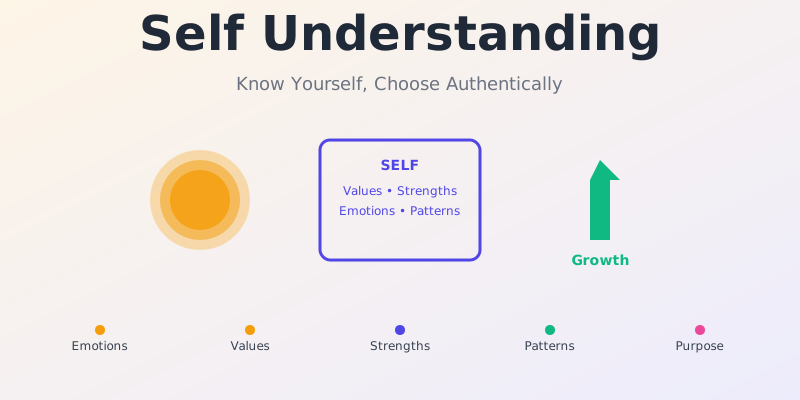
Many people believe they're self-aware, but research reveals a sobering truth: 95 percent of people think they're self-aware, yet only 10-15 percent actually are. This gap matters because decisions made without genuine self understanding—about careers, relationships, or finances—often lead to regret and misalignment with our authentic values.
The good news? Self understanding is a skill you can develop. Unlike fixed personality traits, your ability to know yourself can improve through specific practices, feedback, and reflection. This article explores what self understanding truly is, why it's crucial for your wellbeing, and exactly how to develop it starting today.
What Is Self Understanding?
Self understanding is the comprehensive awareness of who you are across multiple dimensions: your personality traits, emotional patterns, core values, strengths, weaknesses, beliefs, and how others perceive you. It encompasses both internal awareness (knowing your emotions, motivations, and thoughts) and external awareness (understanding your impact on others and how you're perceived).
Not medical advice.
Self understanding differs from self-esteem or confidence. You can feel confident while being completely out of touch with your actual abilities or values. True self understanding requires honest self-observation without judgment—seeing yourself as you actually are, not as you wish to be or fear to be. It's the accurate, grounded sense of your identity that serves as the compass for all major life decisions.
Surprising Insight: Surprising Insight: Only 10-15% of people are truly self-aware, despite 95% believing they are. This self-awareness gap explains why so many talented people make career decisions that misalign with their values or stay in relationships that don't serve them.
Dimensions of Self Understanding
Visual map showing the key areas of self understanding including emotional awareness, behavioral patterns, values and beliefs, strengths and limitations, and interpersonal impact.
🔍 Click to enlarge
Why Self Understanding Matters in 2026
In today's world of infinite choices and competing demands, self understanding has become essential for maintaining mental health and living authentically. Without it, you're vulnerable to making major life decisions based on trends, peer pressure, or the achievements of others rather than your own values.
Self understanding directly impacts your happiness levels. Research in positive psychology demonstrates that individuals who accurately know their strengths, values, and limitations make choices that better reflect who they are. These aligned choices lead to what psychologists call 'life satisfaction'—the deep sense that your life is meaningful and on purpose. When your external life matches your internal values, stress decreases, relationships improve, and overall wellbeing increases significantly.
Additionally, self understanding is foundational for genuine personal growth. You cannot improve what you don't accurately see. Without understanding your emotional patterns, for example, you'll keep repeating the same relationship cycles or career mistakes. With self understanding, you can target interventions that actually work because they address your unique patterns and needs rather than generic advice.
The Science Behind Self Understanding
Decades of psychological research confirm that accurate self-knowledge correlates with improved mental health, better decision-making, and higher life satisfaction. Neuroscientist studies show that self-reflection activates the default mode network in your brain—the same network involved in memory, social processing, and understanding others. This explains why self understanding naturally improves your empathy and relationship quality.
Recent research from organizational psychology (conducted by Tasha Eurich and colleagues) reveals that asking 'what' questions rather than 'why' questions dramatically improves self-awareness. When you ask 'Why did I react that way?' your brain tends to invent plausible but inaccurate stories. But when you ask 'What could I do differently?' you stay objective and forward-focused. This simple shift in questioning makes self-reflection significantly more productive and less likely to spiral into rumination or self-criticism.
Self Understanding Brain Networks
Shows how self-understanding engages the default mode network, anterior cingulate cortex, and prefrontal regions involved in decision-making, memory, and social awareness.
🔍 Click to enlarge
Key Components of Self Understanding
1. Emotional Awareness
Emotional awareness—knowing what you feel and why—is foundational. Many people operate on autopilot, reacting to emotions without understanding them. True emotional awareness means you can name your feelings accurately, recognize what triggered them, and understand what your emotions are signaling. For example, recognizing that your anger often masks fear, or that your anxiety appears when you feel loss of control. This awareness gives you the ability to respond rather than simply react.
2. Values and Priorities
Self understanding includes knowing what truly matters to you versus what you think should matter. Many people discover in midlife that they've been pursuing goals that align with their parents' values or society's expectations rather than their own. Understanding your core values—whether that's family, creativity, security, adventure, or contribution—provides the filter for all major decisions. When you make choices aligned with your values, you experience less internal conflict and greater satisfaction.
3. Strengths and Growth Areas
Genuine self understanding includes honest assessment of your natural abilities and genuine limitations. This isn't about false humility or arrogance—it's about accuracy. Knowing that you're naturally analytical but struggle with spontaneity allows you to leverage your strengths and either develop your weaker areas or work with people who compensate. Research shows that playing to your strengths is far more effective for growth than obsessing over weaknesses.
4. Behavioral Patterns and Triggers
Self understanding includes recognizing your default responses and what activates them. Do you withdraw when criticized or push back? Do you seek approval or maintain independence? Do you procrastinate under pressure or accelerate? These patterns aren't random—they developed for reasons, often related to your early experiences. Understanding them gives you the opportunity to respond differently when it matters.
| Stage | Characteristics | Impact |
|---|---|---|
| Unaware | Limited insight into motivations, blind to impact on others, reactive responses | Repeated mistakes, relationship conflicts, poor decision alignment |
| Awakening | Beginning to notice patterns, open to feedback, some emotional awareness | More thoughtful choices, improved relationships, increased self-compassion |
| Developed | Clear understanding of strengths, values, triggers; proactive responses | Authentic living, better decisions, meaningful relationships, higher wellbeing |
How to Apply Self Understanding: Step by Step
- Step 1: Start a 'reflection journal' where you write for 10 minutes daily about one recent decision, emotion, or interaction. Don't over-analyze—describe what happened, how you felt, and what you notice about your response pattern.
- Step 2: Ask yourself 'what' questions instead of 'why.' Instead of 'Why did I overreact?', ask 'What was I afraid of?' or 'What would have helped me respond better?' This keeps you objective and solution-focused.
- Step 3: Identify one core value that matters most to you right now—family, growth, security, authenticity, or contribution. For one week, notice how often your daily choices align with this value.
- Step 4: Request honest feedback from someone who knows you well. Ask specifically: 'What do you notice about how I respond under stress?' or 'Where do you see me limiting myself?' Listen without defending.
- Step 5: Create a personal strengths inventory. List 5-7 things you're genuinely good at based on feedback and your own experience, not aspirations. Use this when facing decisions.
- Step 6: Identify your top three emotional triggers—situations that consistently upset or overwhelm you. For each, explore the pattern: What belief underlies this trigger? When did you first feel this way?
- Step 7: Conduct a 'values audit' of your last month. How much time did you spend on things aligned with your top values versus obligations? Notice any misalignment without judgment.
- Step 8: Practice mindful self-observation in the moment. When you notice strong emotion, pause and name it: 'I'm feeling anxious right now' rather than acting on it immediately. This creates space for conscious choice.
- Step 9: Interview yourself monthly with this question: 'What have I learned about myself this month?' Write the answer and track patterns over time. You'll be amazed what emerges.
- Step 10: Share your growing self-understanding with someone you trust. Vulnerability deepens self-awareness and often reveals blind spots as others reflect back what they notice.
Self Understanding Across Life Stages
Young Adulthood (18-35)
Young adults are typically forming their identity, often separating from family values and discovering their own. Self understanding during this stage involves exploring different roles, values, and paths to see what actually fits rather than following inherited expectations. The challenge is balancing exploration with building some stability. Young adults benefit from journaling, diverse experiences, and honest conversations about what they genuinely want versus what they feel obligated to want.
Middle Adulthood (35-55)
Middle adulthood often brings a deeper self understanding as life choices create natural feedback. You see the results of earlier decisions, which clarifies what works and what doesn't. Many middle adults experience what feels like a 'crisis' but is actually a call toward greater authenticity. This is an excellent time to reassess: Are you still pursuing goals because they matter to you or because of momentum? Do your relationships serve you? Does your work engage your strengths? Self understanding here can lead to powerful mid-course corrections.
Later Adulthood (55+)
Older adults often have the deepest self understanding, having lived through enough to see long-term patterns clearly. The benefit comes from reduced concern with others' judgment and increased focus on authenticity. Later adulthood often involves passing on self knowledge—sharing what you've learned with younger generations. Self understanding becomes about legacy: What do you want to be remembered for? How has your understanding of yourself evolved? What wisdom can you share?
Profiles: Your Self Understanding Approach
The Introspective Analyzer
- Permission to think deeply without needing to act immediately
- Structured reflection frameworks (not just free-form wondering)
- Feedback from others to balance internal focus with external perspective
Common pitfall: Over-thinking without action—endless analysis that becomes procrastination or rumination without progress
Best move: Combine reflection with small experiments: Reflect on a pattern, form a hypothesis about what might work better, try it, then reflect on results
The Feedback-Driven Learner
- Regular, direct feedback from trusted sources
- Safe environments where honesty is possible
- Reflection time to integrate feedback before the next round
Common pitfall: Becoming overly dependent on others' opinions and losing connection to your own inner compass
Best move: Use feedback as data about your impact, but develop your own internal metric for decisions based on your values
The Skeptical Pragmatist
- Evidence-based approaches to self understanding
- Practical tools and assessments (personality tests, strength inventories)
- Clear connection between self understanding and real-world results
Common pitfall: Avoiding deeper emotional self-awareness in favor of surface-level assessments; treating self understanding like a project to complete rather than an ongoing practice
Best move: Start with tangible tools like a strengths assessment or personality framework, then gradually deepen to emotional and values exploration
The Experiential Learner
- New experiences to learn about themselves through action
- Permission to make mistakes and learn from them
- Reflection prompts to extract meaning from experiences
Common pitfall: Staying so busy with new experiences that you never pause to integrate what you're learning; constant motion without depth
Best move: Build in regular pause points: After each significant experience, spend time reflecting on what you learned about yourself
Common Self Understanding Mistakes
The first major mistake is confusing self-judgment with self-understanding. Being highly critical of yourself is not the same as understanding yourself. In fact, harsh self-judgment often prevents self understanding because you're focused on what's wrong rather than honestly observing what is. Genuine self understanding requires curiosity and compassion—approaching yourself like an anthropologist studying an interesting culture rather than a prosecutor building a case against you.
The second mistake is relying entirely on your own perspective without outside feedback. Your internal view is inherently limited—you can't see your blind spots by definition. Someone who is kind to everyone might genuinely believe they're assertive, not realizing they avoid conflict. Genuine self understanding requires the courage to ask how others experience you, then to believe them even if it's uncomfortable.
The third mistake is treating self understanding as a destination rather than an ongoing practice. Many people complete a personality assessment or have a therapeutic breakthrough and believe they've 'figured themselves out.' But humans are dynamic—you change with experience, age, and circumstances. Self understanding is a regular practice, not a one-time achievement. Your values evolve, your triggers shift, and your strengths find new expressions.
From Self-Judgment to Self-Understanding
Shows the progression from harsh self-criticism through neutral observation to compassionate self-understanding.
🔍 Click to enlarge
Science and Studies
Research consistently demonstrates that self-knowledge and self-awareness are foundational for wellbeing, decision-making, and interpersonal effectiveness. Multiple studies show that people with accurate self-awareness have stronger relationships, make better career choices, and report higher life satisfaction.
- Eurich, T. (2017). Insight: Why We're Not as Self-Aware as We Think, and How Seeing Ourselves Clearly Helps Us Succeed. Published in Harvard Business Review, demonstrating that only 10-15% of people have genuine self-awareness despite 95% believing they do.
- Berkeley Well-Being Institute research shows that people with developed self-knowledge make decisions more aligned with their values, resulting in improved wellbeing and life satisfaction.
- Oxford Research Encyclopedia on Self-Knowledge documents how self-awareness improves decision-making quality, relationship effectiveness, and personal growth outcomes.
- Psychology Today studies confirm that accurate self-perception correlates with emotional stability, better stress management, and improved mental health.
- PubMed research indicates that self-understanding developed through structured reflection and feedback leads to sustained behavioral change and improved coping mechanisms.
Your First Micro Habit
Start Small Today
Today's action: Tonight or tomorrow morning, spend 5 minutes writing about one small decision you made today: What was it? How did you feel? What does that tell you about yourself? That's it—not analyzing, just observing.
This micro habit builds the foundational skill of self-observation without the overwhelm of trying to understand your entire personality at once. Tiny, consistent reflection accumulates into genuine self understanding over weeks and months.
Keep quitting habit apps after a missed day? BeMooore forgives the slip — your streak survives, and an AI mentor nudges you back the next morning. Free on iOS.
Quick Assessment
How clearly would you say you understand your own emotional triggers and patterns?
Your answer indicates how much self-understanding you've already developed. If you chose 'not very', you're a great candidate for beginning the practices in this article. If you chose 'very clearly', you might focus on deeper values alignment or getting feedback on blind spots.
When making major decisions, how often do you check whether they align with your core values?
This shows your level of values-based self understanding. If you rarely check alignment, exploring your core values through the reflection practices in this article could be transformative. If you always align with values, you might deepen by noticing where your stated values and actual choices diverge.
How comfortable are you receiving honest feedback about your weaknesses or blind spots from others?
Your comfort with feedback correlates strongly with how deep your self understanding can become. The most self-aware people actively seek external perspectives. If you're uncomfortable, this might be the area for growth that will most improve your self understanding.
Take our full assessment to get personalized recommendations.
Discover Your Style →Next Steps
Self understanding is a skill that develops through consistent, honest practice. Start with the micro habit and the reflection journaling—these are the foundations. Within a few weeks, you'll notice increased clarity about your patterns, triggers, and values. This clarity is the soil from which meaningful change grows.
The most important thing is to approach yourself with curiosity rather than judgment. You're not trying to be perfect or to fix yourself—you're trying to know yourself. That difference in mindset transforms self-reflection from a painful audit into a fascinating exploration. Give yourself permission to be human, flawed, and constantly learning.
Get personalized guidance with AI coaching.
Start Your Journey →Research Sources
This article is based on peer-reviewed research and authoritative sources. Below are the key references we consulted:
Related Glossary Articles
Frequently Asked Questions
Can I become too self-aware? Isn't there such a thing as overthinking?
Yes, there's a difference between healthy self-reflection and rumination. Healthy self understanding leads to insight and action. Rumination is thinking circles that don't lead anywhere. The key difference: Good self-reflection asks 'what' and 'how' questions and moves toward solutions. Rumination asks 'why' repeatedly without reaching conclusions. If your reflection leads to clarity and better decisions, it's helping. If it leads to anxiety and paralysis, you might need to shift your approach or balance thinking with action.
What if self understanding reveals things I don't like about myself?
This is actually when self understanding becomes most valuable. Seeing what you don't like is the prerequisite for change. Many people don't change patterns because they haven't honestly acknowledged them. Once you see 'I tend to withdraw when conflict arises' or 'I often prioritize others' needs over my own', you can actually work with that pattern. The discomfort of seeing yourself clearly is temporary; the freedom from changing those patterns is lasting.
How long does it take to really understand yourself?
Self understanding isn't a final destination you reach—it's an ongoing practice. You can start noticing significant patterns within weeks of consistent reflection. Within months, you'll have genuine clarity about your core values and typical responses. But deeper self understanding continues to develop throughout your life as you have new experiences and gain perspective. That's actually what makes life interesting—you're never completely done learning about yourself.
Is self understanding the same as having high self-esteem?
Not at all. You can have high self-esteem (positive self-evaluation) while having low self understanding (inaccurate self-knowledge). In fact, false confidence often prevents genuine self understanding because you don't see the need to look deeper. True self understanding can actually lower your self-esteem initially if you discover you're not as capable or mature as you believed—but this honest assessment is the foundation for authentic growth.
What's the most common barrier to self understanding?
Fear. Understanding yourself means seeing things that might be uncomfortable—ways you hurt others, ways you limit yourself, ways your life doesn't match your values. It's easier to stay in the comfortable fog of not knowing. But every person who develops genuine self understanding discovers that the temporary discomfort of seeing yourself clearly is worth the freedom it brings. You get to make conscious choices instead of being controlled by unconscious patterns.
Take the Next Step
Ready to improve your wellbeing? Take our free assessment to get personalized recommendations based on your unique situation.
- Discover your strengths and gaps
- Get personalized quick wins
- Track your progress over time
- Evidence-based strategies