Mindset
Your mindset is the lens through which you interpret challenges, failures, and opportunities. It shapes whether you see obstacles as roadblocks or stepping stones, whether you believe you can grow or whether you're stuck with fixed abilities. A powerful mindset can transform your entire life—your career success, relationships, health, and happiness. Yet most people never examine theirs. The remarkable discovery from decades of psychological research is simple but profound: your beliefs about your abilities are not fixed facts—they're patterns you can reshape. This article explores what mindset truly is, why it matters more than you think, and most importantly, how to develop the mindset that leads to the life you want.
Did you know that students who simply learned about how the brain grows—through effort and practice—showed significant improvements in math grades over time, while students who didn't receive this information showed no improvement?
Your mindset is not something you're born with. It's learned, and because it's learned, it can be changed.
What Is Mindset?
Your mindset is your deeply held set of beliefs about your abilities, intelligence, and capacity to learn and grow. Psychologist Carol Dweck defines it as the framework through which you interpret events in your life and determine your likelihood of success. It's not about positive thinking or self-esteem—it's about how you fundamentally view the nature of human abilities. Do you believe abilities are fixed traits you're born with, or do you believe they can be developed through effort and practice? Your answer to this question shapes every decision you make and every challenge you face.
Not medical advice.
Mindset operates in the background of your consciousness, influencing your behavior and choices before you're even aware of it. Someone with a growth mindset might interpret failure as feedback and motivation to improve. Someone with a fixed mindset might interpret the same failure as proof that they lack natural talent. Neither is seeing the situation objectively—they're both filtered through their mindset lens. Understanding your mindset is the first step to consciously choosing beliefs that serve you better.
Surprising Insight: Surprising Insight: Brain imaging studies show that people with a growth mindset activate different brain regions when receiving feedback about errors. Specifically, they show more neural activity in the areas responsible for learning and error correction (anterior cingulate cortex and dorsolateral prefrontal cortex), while people with fixed mindsets show virtually no brain response to the same feedback.
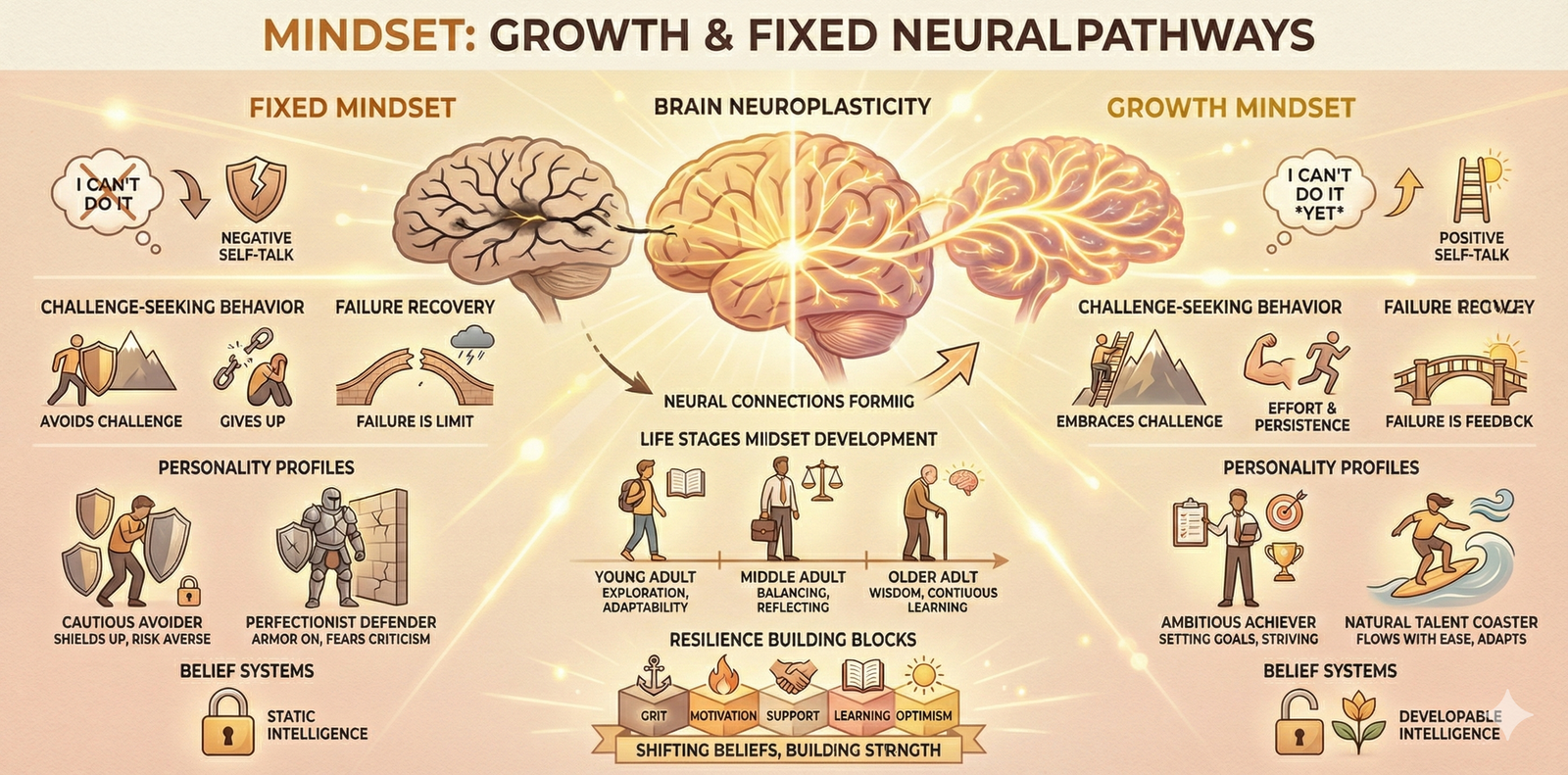
Fixed vs Growth Mindset Framework
Visual comparison showing how fixed mindset and growth mindset interpret the same events differently, leading to different outcomes.
🔍 Click to enlarge
Why Mindset Matters in 2026
In 2026, the pace of change is accelerating. The skills you learned five years ago might be obsolete. Industries are transforming. New technologies emerge monthly. Career paths are no longer linear. In this environment, the ability to learn, adapt, and grow is your most valuable asset. A growth mindset isn't optional anymore—it's essential. People with fixed mindsets become increasingly frustrated as they encounter situations where their existing abilities don't suffice. People with growth mindsets thrive because they see rapid change as an opportunity to develop new capabilities.
Your mindset directly affects your mental health and well-being. Research shows that growth mindset is associated with lower anxiety, better stress management, and improved resilience when facing setbacks. Fixed mindset thinking contributes to learned helplessness and depression. In a world with constant pressure and uncertainty, your mindset determines whether challenges energize you or overwhelm you. It determines whether you pursue your goals or abandon them after the first difficulty.
Your mindset also affects your relationships and social connections. People with growth mindsets tend to be better at communication because they view conflicts as problems to solve together rather than evidence that the relationship is fundamentally flawed. They're more likely to invest in deepening relationships because they believe people can change and improve. They inspire others through their example of resilience and learning.
The Science Behind Mindset
Carol Dweck's research at Stanford University, spanning over three decades, provides the foundational science of mindset. Her seminal studies showed that when junior high school students were taught that intelligence could be developed like a muscle, their grades in math and science improved significantly compared to control groups. Her brain imaging research revealed that growth mindset individuals activated neural regions associated with error correction and learning when they made mistakes, while fixed mindset individuals showed no such neural activity. This explains why growth mindset people actually learn from their mistakes—their brains are literally processing them as learning opportunities.
The mechanism behind mindset's power involves neuroplasticity—the brain's ability to reorganize itself by forming new neural connections throughout life. When you adopt a growth mindset, you're more likely to engage in behaviors that stimulate neuroplasticity: seeking challenges, practicing deliberately, learning from feedback, and persisting through difficulty. These behaviors physically reshape your brain, creating new neural pathways and strengthening existing ones. Over time, skills improve, capabilities expand, and confidence grows. This creates a virtuous cycle: growth mindset leads to growth behaviors, which lead to actual growth, which reinforces your growth mindset.
Mindset Neuroplasticity Cycle
Illustration of how mindset beliefs trigger behaviors that activate neuroplasticity, leading to actual growth and reinforcing the original mindset.
🔍 Click to enlarge
Key Components of Mindset
Your Beliefs About Intelligence and Ability
The core of mindset is your belief about whether intelligence and ability are fixed traits or developed capacities. Fixed mindset people believe 'I'm either good at math or I'm not.' Growth mindset people believe 'I might not be good at math yet, but I can develop this skill.' This single belief shapes whether you approach learning opportunities or avoid them. It determines whether you take a challenging course in school or avoid it because you fear failure. It determines whether you pursue that career shift or convince yourself you're not the type of person who can do that work. This fundamental belief acts as a gatekeeper to all your other possibilities.
Your Interpretation of Failure and Mistakes
Everyone experiences failure and makes mistakes. But what they mean depends entirely on your mindset. To a fixed mindset person, a failure is evidence of deficiency—'I'm not smart enough,' 'I don't have talent,' 'This confirms I can't do this.' To a growth mindset person, a failure is information—'What can I learn from this?', 'What strategy should I try next?', 'How is my brain developing through this challenge?' The same event produces completely different emotional and behavioral responses. Growth mindset people actually feel energized by failure because it tells them where they need to focus their effort. Fixed mindset people feel demoralized because they interpret it as confirmation of their limitations.
Your Response to Effort and Challenge
Effort is the bridge between your current abilities and your potential abilities. But how you view effort depends on your mindset. Fixed mindset thinking says 'If I have to work hard, it means I'm not naturally talented. Real talent should come easily.' Growth mindset thinking says 'Effort is what activates my ability. The harder I work, the more I develop my potential.' This belief shapes everything. It determines whether you're willing to practice deliberately, invest time in developing new skills, or pursue difficult projects. Research shows that children praised for their effort and strategy—the growth mindset message—pursue harder problems and show more perseverance than children praised for their intelligence—the fixed mindset message.
Your Relationship With Feedback and Criticism
Feedback is fuel for growth, but only if you can receive it as such. Fixed mindset people tend to view criticism as a personal attack—'They're judging me, criticizing my worth.' They become defensive and resistant. Growth mindset people view the same criticism as valuable information—'They're showing me where I can improve.' They listen carefully, ask follow-up questions, and integrate the feedback. This difference is crucial in relationships, work, and personal development. People with growth mindsets actually attract more mentorship and coaching because others want to help someone who's genuinely trying to improve. People with fixed mindsets often repel this support because their defensiveness makes it difficult for others to help them.
| Situation | Fixed Mindset Response | Growth Mindset Response |
|---|---|---|
| You make a mistake | "I'm not good at this. I should give up." | "I made an error. What can I learn from this?" |
| Someone challenges you | "They're threatening me. I need to defend myself." | "This is an opportunity to grow stronger together." |
| You face a difficult task | "I'll probably fail. Why bother trying?" | "This will take effort. I'm ready for the challenge." |
| You get constructive criticism | "They don't believe in me. This is unfair." | "This feedback helps me improve. I'm grateful." |
| Someone else succeeds | "They have more talent. I can never reach that." | "Their success proves it's possible. I can develop too." |
How to Apply Mindset: Step by Step
- Step 1: Identify your current mindset patterns. Notice when you're thinking 'I can't do this' versus 'I can't do this yet.' Notice when you avoid challenges or when you embrace them. Spend one week just observing without judgment where your fixed mindset appears most.
- Step 2: Catch your fixed mindset thoughts. When you encounter a challenge or setback, pause and notice your self-talk. Are you thinking 'This proves I'm not good enough?' or 'This shows me where to focus my effort?'
- Step 3: Reframe using 'yet'. Whenever you catch yourself thinking 'I can't do this,' add one word: 'yet.' 'I can't code yet. I can't run a 10K yet. I can't understand calculus yet.' This simple word reminds your brain that ability is a process, not a final verdict.
- Step 4: Seek challenges deliberately. Growth mindset develops through challenge. Start small. Take a course in something unfamiliar. Try a sport you're bad at. Volunteer for a project that stretches you. Each challenge is an investment in your brain's development.
- Step 5: Embrace mistakes as data. When you make a mistake, pause and get curious. What specifically went wrong? What would you do differently? Write it down. Treat every mistake as a learning moment your brain is recording.
- Step 6: Practice deliberate effort. Effort without strategy is just hard work. Identify what specific skill you want to develop. Design practice that targets that skill. Get feedback. Adjust. Repeat. This is how elite performers in every field develop their abilities.
- Step 7: Consume growth mindset content regularly. Read stories of people who developed abilities late in life. Watch documentaries about practice and skill development. Follow people with visible growth mindsets. Your environment shapes your mindset.
- Step 8: Celebrate effort and strategy, not just outcomes. When you or others do well, ask 'What effort did that take? What strategy worked? What did you learn?' This reinforces the growth mindset message that good outcomes come from good processes.
- Step 9: Find a growth mindset community. Surround yourself with people who embrace challenges, see mistakes as learning, and invest in their development. Mindset is contagious. Their growth mindset will reinforce yours.
- Step 10: Practice self-compassion when you fail. The biggest obstacle to developing a growth mindset isn't believing growth is possible—it's the shame and self-criticism that comes when you fail. When you struggle, talk to yourself like you'd talk to a good friend: with kindness and encouragement to keep trying.
Mindset Across Life Stages
Young Adulthood (18-35)
Your twenties and thirties are prime time for developing a growth mindset because you're making major decisions about education, careers, and relationships. If you adopt a growth mindset now, you'll make career choices based on 'What do I want to learn?' rather than 'What do I think I'm good at?' You'll change careers if needed without the identity crisis that fixed mindset thinking creates. You'll build relationships based on shared growth rather than checking boxes. You'll take on bigger challenges because you believe in your capacity to develop. The investment in mindset now pays dividends for decades.
Middle Adulthood (35-55)
By middle age, many people feel trapped by their fixed identity: 'I'm not the creative type. I'm not good with technology. I'm not a people person.' A growth mindset becomes your liberation. Research shows that people who adopt a growth mindset in their 40s and 50s show improved job satisfaction, lower burnout, and better life satisfaction than their fixed mindset peers. This is the stage where you can mentor younger people, modeling what a growth mindset looks like in real life. You can pivot careers, learn new skills, and reimagine your life because you no longer believe you're finished developing. This can be the most fulfilling period of life if your mindset allows it.
Later Adulthood (55+)
Later adulthood brings changes that challenge fixed mindset people deeply: retirement transitions, changing social roles, physical changes. But a growth mindset thrives in this stage because it embraces change as opportunity for learning. People with growth mindsets approach later adulthood as a new chapter of development. They learn new hobbies, deepen relationships, volunteer in meaningful ways, mentor others, and continue growing mentally and emotionally. Research shows that older adults with growth mindsets report higher life satisfaction, better cognitive health, and more resilience in facing the challenges that come with aging. Your mindset becomes increasingly important as the years add up.
Profiles: Your Mindset Approach
The Ambitious Achiever
- Learning that effort and strategy matter more than innate talent
- Permission to fail in the pursuit of excellence
- Reframing setbacks as course corrections, not failures
Common pitfall: Burning out because you equate your worth with your achievements and fear any indication that you might have limits.
Best move: Develop a growth mindset about resilience itself. See rest, reflection, and recovery as part of the growth process, not signs of weakness.
The Cautious Avoider
- Safe opportunities to practice challenges and build evidence that you can learn
- Celebrating small efforts, not just successes
- Models of ordinary people who developed extraordinary abilities through practice
Common pitfall: Playing it safe and watching opportunities pass because you don't believe you have the natural ability to take them on.
Best move: Start tiny. Choose one small challenge below your comfort zone. Document what you learn. Use this as evidence that your brain develops through effort.
The Perfectionist Defender
- Understanding that imperfection is the price of learning and growth
- Feedback reframed as coaching, not criticism of your worth
- Examples of perfectionists who became more effective by embracing iteration
Common pitfall: Avoiding feedback, delaying sharing work, or abandoning pursuits when results aren't immediately excellent because you interpret any imperfection as evidence of inadequacy.
Best move: Practice showing imperfect work early and often. Each iteration gets better. Make 'version 1.0' your new standard for starting things.
The Natural Talent Coaster
- Experiencing challenges that your natural talent alone can't overcome
- Understanding that without continued growth, your advantages diminish over time
- Community that values effort and progress, not just innate ability
Common pitfall: Coasting on early talent, avoiding challenges where you're not naturally gifted, becoming increasingly frustrated as competition catches up to your innate ability.
Best move: Choose a domain where you start from behind. Develop it through consistent effort. Discover that developed ability beats coasted talent.
Common Mindset Mistakes
The biggest mindset mistake is confusing false growth mindset with true growth mindset. False growth mindset says 'I praise effort even when the effort is misguided or ineffective. I avoid all negative feedback. I believe everyone should get a participation trophy.' True growth mindset says 'Effort matters, but I need feedback about whether my effort is productive. I want honest feedback that tells me where to focus. I celebrate learning, not just participation.' The difference is crucial. False growth mindset creates entitlement and fragility. True growth mindset creates resilience and genuine improvement.
Another common mistake is thinking mindset alone creates change. Understanding that your brain is plastic and that abilities develop through effort is important. But mindset without behavior is just wishful thinking. You need the behaviors: deliberate practice, seeking challenge, learning from feedback, persisting through difficulty. Mindset creates the motivation and framework for these behaviors, but the behaviors do the actual work of development. Don't fool yourself that having the right mindset belief is enough. You have to act on it.
A third mistake is having a fixed mindset about the mindset itself. Some people learn about growth mindset and then judge themselves for not having it perfectly. 'I'm still afraid of failure. I still sometimes avoid challenges. This means I don't really have a growth mindset.' This is your fixed mindset about your mindset! Developing a growth mindset is itself a growth process. You'll slip back into fixed mindset thinking regularly, especially under stress. That's not failure. That's the normal learning process. You're developing your ability to catch fixed mindset thoughts and choose growth mindset responses.
The Mindset Development Journey
Shows that developing a growth mindset is not linear—you progress, regress, and progress again as you build the skill of growth-oriented thinking.
🔍 Click to enlarge
Science and Studies
Decades of peer-reviewed research confirm that mindset profoundly influences achievement, well-being, and resilience across all ages and domains. The research is not without nuance—recent meta-analyses show that growth mindset interventions are most effective when combined with supportive environments and that the size of effects varies by context. However, the fundamental principle stands: what you believe about your capacity to grow shapes whether you invest in growing, and whether you invest in growing determines what you actually become capable of.
- Dweck, C.S., et al. (2007). Implicit theories of intelligence predict achievement across an adolescent transition. Child Development, 78(1), 246-263. Shows that students who believe intelligence is learnable show improved math grades during transition periods.
- Blackwell, L.S., Trzesniewski, K.H., & Dweck, C.S. (2007). Implicit theories of intelligence and grade motivation across the transition to junior high school. Developmental Psychology, 43(4), 934-946. Demonstrates improvement in academic performance when students receive growth mindset intervention.
- Schroder, H.S., Yalçin, Ö., Donnellan, M.B., & Murayama, K. (2018). Mindset heterogeneity in the development of self-regulated learning. Scientific Reports, 8, 16117. Recent research showing individual differences in how mindset develops and its effects on learning.
- Romero, C., Master, A., Paunesku, D., Dweck, C.S., & Gross, J.J. (2019). Mindset intervention influences stress appraisals in adolescents. The Journal of Experimental Social Psychology, 82, 221-229. Shows that growth mindset reframes how people appraise stressful situations, leading to better coping.
- Crum, A.J., Salovey, P., & Achor, S. (2013). Rethinking stress: The role of mindsets in determining the stress response. Journal of Personality and Social Psychology, 104(4), 716-733. Demonstrates that stress mindset (viewing stress as enhancing versus debilitating) directly affects health and performance outcomes.
Your First Micro Habit
Start Small Today
Today's action: When you catch yourself thinking 'I can't do this,' pause for three seconds and add the word 'yet' at the end. Say it out loud or write it down. Do this once today.
This tiny habit reprograms your neural response to limitation. The word 'yet' shifts your brain from fixed ('I'm unable') to growth ('I'm developing'). One instance rewires nothing, but repeated small instances compound into a genuine mindset shift. You're literally training your brain to see challenges as current state, not permanent identity.
Keep quitting habit apps after a missed day? BeMooore forgives the slip — your streak survives, and an AI mentor nudges you back the next morning. Free on iOS.
Quick Assessment
When you face something difficult, what's your first thought?
Your answers reveal how fixed or growth-oriented your thinking tends to be. There's no 'right' answer here—just honest information about your current mindset patterns.
When someone gives you critical feedback, how do you typically feel?
Your reaction to feedback is a key indicator of your growth mindset. People with true growth mindsets don't just accept feedback—they genuinely appreciate it because they see it as fuel for development.
What's your biggest obstacle to developing a growth mindset?
Understanding your specific obstacle helps you address it directly. Each obstacle has a specific antidote in the strategies above.
Take our full assessment to get personalized recommendations.
Discover Your Style →Next Steps
Your mindset isn't something you develop once and then have forever—it's something you practice developing repeatedly. Every time you face a challenge, you have a choice: respond with fixed mindset thinking ('I can't do this') or growth mindset thinking ('I can't do this yet'). Every time you receive feedback, you choose: defend yourself or learn. Every time you fail, you choose: see it as a verdict or as information. Each choice reinforces one mindset or the other. The good news is that you're making these choices constantly, which means you have constant opportunities to practice and strengthen your growth mindset.
Start with the micro habit above—add 'yet' to your self-limiting thoughts. Then pick one area of your life where you want to develop a growth mindset: a skill you want to learn, a challenge you want to face, or a relationship you want to improve. Commit to deliberately practicing that skill using the step-by-step guide above. Give it thirty days. Notice how your thinking changes, how your approach changes, and what becomes possible when you stop believing your abilities are fixed.
Get personalized guidance with AI coaching.
Start Your Journey →Research Sources
This article is based on peer-reviewed research and authoritative sources. Below are the key references we consulted:
Related Glossary Articles
Frequently Asked Questions
Is growth mindset just positive thinking?
No. Positive thinking is 'I can do anything!' Growth mindset is 'I can't do this yet, and here's my plan to develop the skill.' Growth mindset is realistic and action-oriented. It's not about believing everything will work out—it's about believing your effort and strategy matter and committing to them even when success isn't guaranteed.
Can you develop a growth mindset if you're older?
Absolutely. Neuroplasticity—your brain's ability to form new connections—continues throughout your entire life. Research shows that people develop growth mindsets at every age, from teenagers to people in their 70s and 80s. Your brain's capacity to learn and grow doesn't end. Your mindset determines whether you use that capacity.
What if I naturally have a fixed mindset? Can I change it?
Yes. Remember, mindset itself is something you can develop. If you grew up in an environment that emphasized fixed traits ('You're smart' rather than 'You worked hard'), you absorbed fixed mindset thinking. But that's learned, not innate. You can unlearn it and develop growth mindset thinking through the strategies in this article.
Does growth mindset mean I should never feel discouraged?
No. Growth mindset doesn't eliminate discouragement—it changes what you do with it. You'll still feel frustrated when something is hard or when you fail. The difference is that with a growth mindset, you don't stay in that discouragement. You see it as a signal to adjust your strategy and keep going, rather than proof that you can't do it.
Can mindset be too powerful? Could it be harmful?
The research shows that growth mindset is universally beneficial when practiced authentically. The potential harm comes from false growth mindset—pretending that effort alone guarantees success regardless of strategy, or using mindset language to shame yourself ('I should be able to do this with effort'). True growth mindset is compassionate: effort matters, strategy matters, and sometimes you need to rest, seek help, or adjust your goals.
Take the Next Step
Ready to improve your wellbeing? Take our free assessment to get personalized recommendations based on your unique situation.
- Discover your strengths and gaps
- Get personalized quick wins
- Track your progress over time
- Evidence-based strategies