Achievement
Achievement is the feeling of accomplishment that comes when you reach a meaningful goal. It goes far beyond earning a trophy or receiving recognition. When you complete something important to you, your brain releases powerful chemicals that create deep satisfaction and lasting wellbeing. This fundamental human need drives us forward, shapes our identity, and connects directly to happiness and life satisfaction.
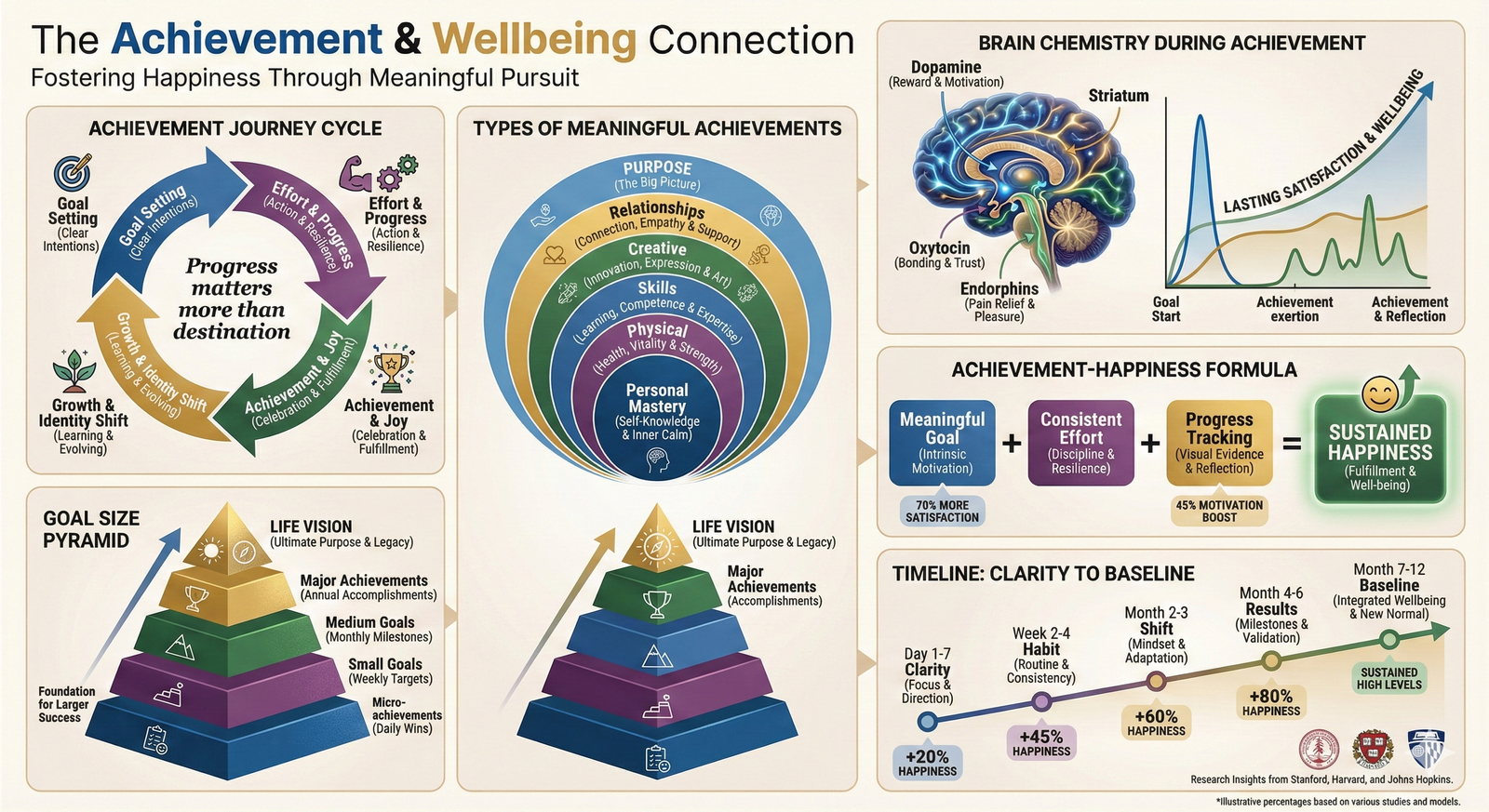
Have you ever noticed the joy that lingers after completing a project you cared about? That's achievement working its magic on your mental and emotional health.
Recent research shows that progress toward meaningful goals creates more sustained happiness than reaching the destination itself. The journey matters as much as the arrival.
What Is Achievement?
Achievement is a multifaceted experience combining competence, progress, and personal growth. In positive psychology, achievement goes beyond external markers of success. It centers on recognizing your own progress in mastering a skill, learning a subject, or accomplishing something aligned with your values.
Not medical advice.
Achievement fulfills one of humanity's core psychological needs: the drive for competence and superior performance. When you experience achievement, you're satisfying a deep evolutionary need that connects to survival, belonging, and meaning. This need appears across all cultures and life stages, from young children learning to read to older adults mastering new hobbies.
Surprising Insight: Surprising Insight: Achieving something personally meaningful creates greater wellbeing than accomplishing tasks with no personal value. The meaning you attach to your goal matters more than the goal's external status.
The Achievement Happiness Connection
Shows how achievement drives wellbeing through multiple pathways
🔍 Click to enlarge
Why Achievement Matters in 2026
In our fast-paced digital world, achievement takes on new significance. We face unprecedented choice, constant comparison through social media, and pressure to prove our worth online. Understanding authentic achievement helps you navigate these pressures with clarity and purpose.
Achievement provides psychological grounding in an uncertain world. When you accomplish something real, you build resilience, clarify your capabilities, and develop a stable sense of self beyond external validation. This internal strength becomes your foundation for navigating change.
Research demonstrates that people who pursue meaningful achievements experience better mental health, reduced anxiety and depression, and greater overall life satisfaction. Achievement also strengthens your relationships because sharing accomplishments deepens connections and provides mutual inspiration and support.
The Science Behind Achievement
Neuroscience reveals that achievement activates multiple brain systems. When you complete a meaningful goal, your brain releases dopamine, reinforcing the behavior and creating the drive for future achievements. This isn't just pleasure—it's your brain recognizing that you've grown and succeeded.
Psychologists have identified that achievement goals are cognitively represented guides for behavior, directing your actions toward competence-related future states. This means your brain literally organizes itself around achieving what matters to you. When achievement goals align with your deeper values—what researchers call self-concordant goals—the wellbeing benefits multiply significantly.
Brain Systems Activated by Achievement
Neural pathways and neurotransmitters involved in achievement experience
🔍 Click to enlarge
Key Components of Achievement
Goal Clarity and Meaning
The first component of achievement is knowing what you're pursuing and why it matters. Vague wishes don't create achievement. Clear, specific goals aligned with your values activate your brain's motivational systems and direct your energy efficiently. When your goal connects to something larger than yourself, the motivation strengthens dramatically.
Sustained Progress and Effort
Achievement requires consistent forward movement. Progress doesn't always feel dramatic—small daily actions compound into significant accomplishment. The satisfaction you feel watching your efforts accumulate is itself a form of achievement. Effort applied with intention creates both the destination and the meaningful journey.
Competence and Mastery
Genuine achievement includes developing real capability in your chosen domain. This might be professional expertise, creative skill, physical ability, or emotional depth. As you build competence, your confidence grows, and your sense of identity strengthens. Competence is internally motivating—humans naturally want to become skilled at things they value.
Recognition and Reflection
Achievement completes when you acknowledge what you've accomplished. This recognition doesn't require external applause. The most powerful achievement includes a moment of reflection where you consciously recognize your progress. This might be personal celebration, sharing with someone you trust, or simply noting how far you've come.
| Domain | Example Achievement | Wellbeing Impact |
|---|---|---|
| Professional | Completing a major project or promotion | Increased confidence and career satisfaction |
| Personal Growth | Learning a new skill or hobby | Expanded sense of capability and identity |
| Health | Reaching fitness goal or improving sleep | Enhanced energy and body confidence |
| Relationships | Deepening connection or improving communication | Greater intimacy and social belonging |
| Creative | Completing artwork, writing, or music | Expression fulfillment and identity integration |
How to Apply Achievement: Step by Step
- Step 1: Define what success looks like for you personally, not what others expect. What achievement would feel genuinely meaningful?
- Step 2: Set a specific, measurable goal with a realistic timeline. Vague intentions don't create achievement—clear targets activate your brain.
- Step 3: Break your goal into smaller milestones. Achievement isn't always one big moment; it's a series of meaningful accomplishments.
- Step 4: Create a system to track progress. Seeing your advancement reinforces motivation and builds momentum.
- Step 5: Identify daily actions that move you toward your goal. Small, consistent effort compounds into achievement.
- Step 6: Develop a practice routine. Whether daily or weekly, regular engagement builds competence faster than sporadic effort.
- Step 7: Find accountability partners who support your goal. Sharing your journey strengthens commitment and provides encouragement.
- Step 8: Celebrate intermediate wins. Don't wait for the final destination to acknowledge your accomplishment.
- Step 9: Reflect on what you're learning throughout the process. Achievement includes growth, not just completion.
- Step 10: Plan your next achievement before finishing the current one. Momentum builds when you maintain forward focus.
Achievement Across Life Stages
Young Adulthood (18-35)
In young adulthood, achievement often focuses on establishing capability and independence. You're building foundational skills, proving competence in your chosen field, and establishing identity beyond family influence. Achievement experiences during this stage create the confidence and capability narratives that shape your entire adult life. Success builds on success, so early achievement investments pay compound returns.
Middle Adulthood (35-55)
Middle adulthood brings achievement shifts toward depth, integration, and legacy. Rather than starting new pursuits, you often deepen existing competencies, mentor others, and seek achievement that connects to larger purposes. Many people experience their most powerful achievements during this phase because they combine experience, capability, and clarity about what truly matters.
Later Adulthood (55+)
Later adulthood unlocks achievement opportunities focused on integration, wisdom-sharing, and generativity. Retirement can activate new pursuits you couldn't explore earlier. Achievement in this stage often emphasizes personal mastery, creative expression, and contributing to your community. Many people report greater life satisfaction through achievement that prioritizes meaning over competition.
Profiles: Your Achievement Approach
The Steady Climber
- Clear milestones and progress tracking
- Regular recognition of small wins
- Support systems to maintain motivation
Common pitfall: Getting discouraged if progress feels slow compared to others
Best move: Focus on your own timeline. Consistency beats speed. Track your incremental progress visibly.
The Big Picture Visionary
- Inspiring, meaningful goals connected to larger purpose
- Creative freedom to pursue ambitious visions
- Flexibility to adapt approaches
Common pitfall: Losing interest or overwhelm when facing implementation details
Best move: Break vision into quarterly milestones. Delegate details to support your strategic focus.
The Balanced Integrator
- Goals across multiple life domains
- Systems to manage diverse achievements
- Connections between achievements
Common pitfall: Spreading too thin and achieving nothing deeply
Best move: Prioritize ruthlessly. Choose 2-3 primary achievements per year. Master integration, not everything.
The Mastery Specialist
- Deep technical challenges
- Opportunity to develop expertise
- Recognition of nuanced progress
Common pitfall: Perfectionism preventing completion or sustainable effort
Best move: Define 'good enough' standards. Completion matters more than perfection. Celebrate expertise development.
Common Achievement Mistakes
The biggest achievement mistake is pursuing goals that don't align with your values. External achievement—doing what's expected or impressive to others—creates hollow victory. Accomplishment of misaligned goals can leave you feeling emptier than before. Invest your effort in achievements that actually matter to your life.
Another common error is treating achievement as a single destination rather than a continuous practice. You finish one goal and feel lost without a new direction. Instead, view achievement as an ongoing relationship with growth. Always have a forward focus, but celebrate arrivals before launching new journeys.
Many people sabotage achievement through all-or-nothing thinking. They set ambitious goals, face temporary setbacks, and abandon the entire pursuit. Achievement requires resilience and the ability to persist through difficulty. Small course corrections matter more than perfect execution. Your only real failure is stopping completely.
Achievement Barriers and Breakthroughs
Common obstacles and how to overcome them
🔍 Click to enlarge
Science and Studies
Recent research in positive psychology demonstrates that achievement goals are positively correlated with life satisfaction when they involve the perception of successful agency—the sense that you're in control and competent. Studies also show that approach-oriented goals (what you want to achieve) create more happiness than avoidance-oriented goals (what you want to avoid). Achievement is most powerful when it aligns with your authentic values, what researchers call self-concordant goals.
- Emmons, R. A. (2003). Personal goals, life meaning, and virtue: Wellsprings of a positive life. Journal of Positive Psychology, examining how achievement goals drive life meaning and virtue development.
- Seligman, M. E. P. (2011). PERMA model research demonstrating that accomplishment is one of five pillars of human flourishing and wellbeing.
- Goal progress and happiness research from Psychology Today showing that incremental progress toward goals creates more sustained happiness than goal completion.
- Evaluation studies on happiness through goal-setting training programs showing measurable increases in life satisfaction and wellbeing.
- Achievement goals and life satisfaction studies (PMC) confirming the mediating role of successful agency between goal achievement and life satisfaction.
Your First Micro Habit
Start Small Today
Today's action: Choose one small achievable goal you can complete this week. Make it specific and measurable—read two chapters, complete one workout, finish one creative project, or learn one new skill. Track completion daily.
Immediate achievement builds momentum and confidence. Small wins activate your reward circuits and establish the neural pathways for larger achievements. You prove to yourself that you can set a goal and accomplish it. This becomes your foundation for bigger pursuits.
Track your micro achievements and get personalized AI coaching with our app. Log daily progress, celebrate wins, and build sustainable achievement habits without needing discipline.
Quick Assessment
How would you describe your current relationship with achievement?
Your current achievement level helps determine which strategies will work best for you. All approaches can move forward from where you are now.
What type of achievement would feel most meaningful to you right now?
Understanding your achievement priority helps you focus energy where it creates the greatest life satisfaction for your current situation.
What typically blocks you from pursuing your goals?
Knowing your specific barrier helps you develop targeted strategies to overcome it and build sustainable achievement practice.
Take our full assessment to get personalized recommendations.
Discover Your Style →Next Steps
Start by identifying one achievement that would genuinely improve your wellbeing if you accomplished it in the next three months. Not what you think you should achieve—what would actually matter to you. Write it down with specific details about what success looks like.
Then break that achievement into three weekly milestones. You don't need a perfect plan. You need clarity about direction and commitment to small, consistent progress. Track your forward movement daily. Notice how achievement practice transforms your confidence and life satisfaction.
Get personalized guidance with AI coaching.
Start Your Journey →A goal you see every morning gets acted on more often than one that lives in a note app. Build a vision board free in your browser, no account, and export a phone wallpaper you can set tonight.
Build a free vision board →Research Sources
This article is based on peer-reviewed research and authoritative sources. Below are the key references we consulted:
Related Glossary Articles
Frequently Asked Questions
Is achievement necessary for happiness?
Achievement contributes significantly to wellbeing, but it's not the only factor. Connection, meaning, health, and contentment matter equally. However, pursuing meaningful achievements does boost overall life satisfaction and resilience. The key is authentic achievement aligned with your values, not external pressure.
What's the difference between achievement and ambition?
Achievement is accomplishing something meaningful to you. Ambition is the drive to accomplish. You can be highly ambitious in pursuits that don't actually matter to you, or mildly ambitious in pursuits that bring deep satisfaction. True achievement combines meaningful goals with consistent effort.
Can I have too much achievement focus?
Yes. All-achievement cultures can create burnout, damage relationships, and reduce wellbeing despite external success. Balance achievement with rest, connection, and contentment. The healthiest approach celebrates what you accomplish while savoring what you already have.
How do I know if my goal is authentic?
Authentic goals align with your values and create internal motivation. Ask yourself: Would I pursue this even if no one noticed? Does it reflect what I genuinely care about? Does working toward it feel energizing rather than obligatory? If yes, it's likely authentic.
What if I fail to achieve my goal?
Failure is part of every achievement journey. The most successful people encounter more failures than average because they attempt more. Reframe failure as data—what did you learn? How can you adjust? What micro-achievements did you accomplish along the way? Then set your next goal.
Take the Next Step
Ready to improve your wellbeing? Take our free assessment to get personalized recommendations based on your unique situation.
- Discover your strengths and gaps
- Get personalized quick wins
- Track your progress over time
- Evidence-based strategies