Satisfaction
Satisfaction is that deep sense of fulfillment that whispers 'this is enough' when you look at your life. It's not the momentary high of achieving something—that's happiness. Satisfaction is quieter, more durable, and paradoxically more powerful. It's the feeling you get when you realize your life aligns with what matters most to you. In 2026, as we navigate constant comparison, digital noise, and endless optimization culture, satisfaction has become the most underrated form of wellbeing. This guide reveals what satisfaction truly is, how it differs from happiness, and how to build it deliberately into your life through proven strategies, life-stage wisdom, and personality-specific approaches that actually work.
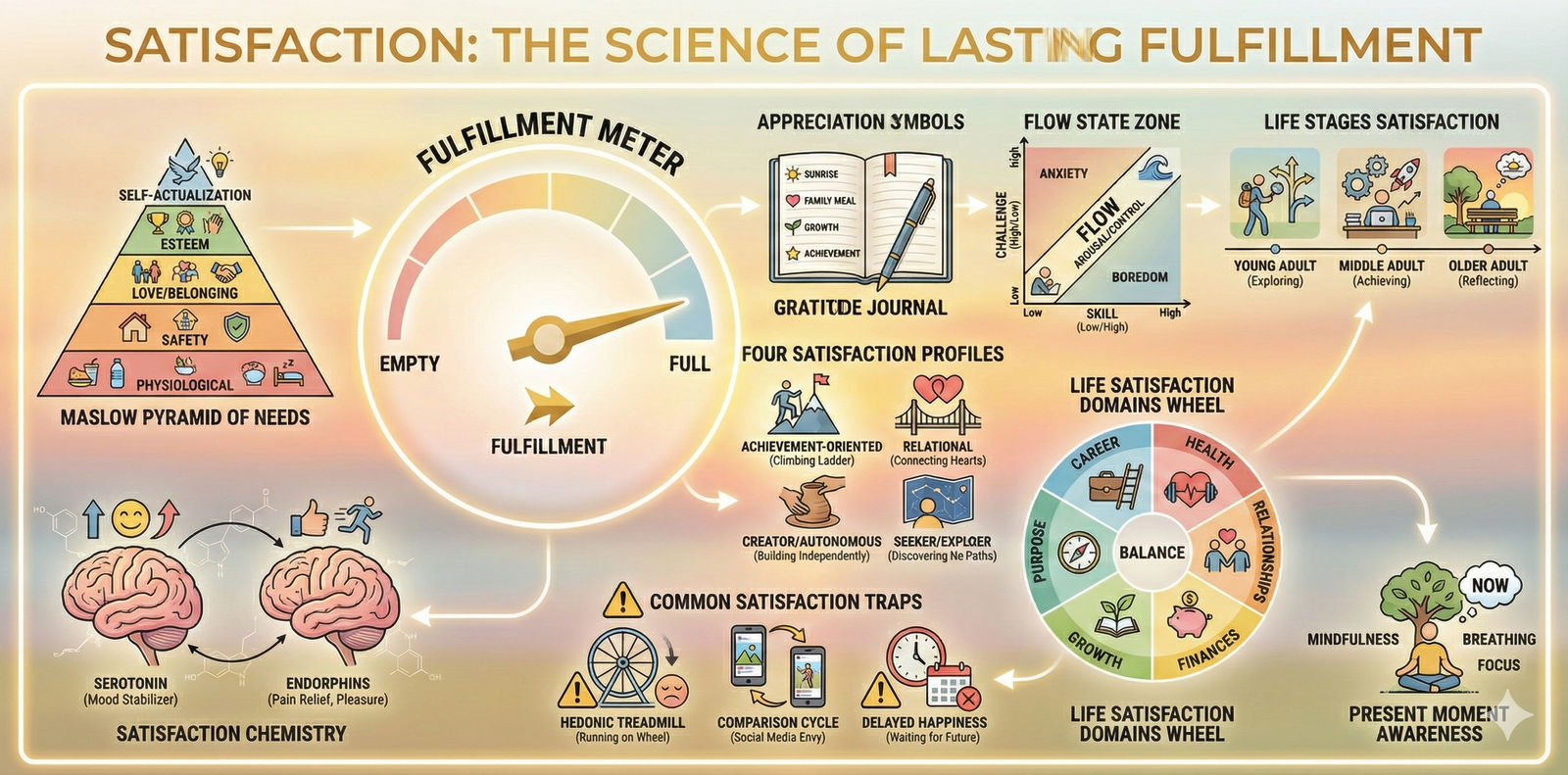
Satisfaction isn't passive contentment. It's an active decision to evaluate your life against your own standards—not society's, not your neighbor's, not your old self's. It's rooted in self-acceptance and self-awareness: knowing what you want, acknowledging what you have, and making peace with the gap between the two.
When you cultivate satisfaction, you're not abandoning ambition. You're grounding it. You're creating a foundation from which genuine growth emerges—the kind that comes from self-compassion rather than self-criticism, from clarity rather than comparison.
What Is Satisfaction?
Satisfaction is a cognitive and emotional assessment of your life that reflects alignment between reality and your values. Psychology research distinguishes it as a stable, long-term evaluation of wellbeing—different from momentary happiness, which is fleeting and reactive. The Satisfaction with Life Scale (SWLS), the gold standard measurement tool, defines it through five dimensions: overall life assessment, achievement of life goals, satisfaction with your circumstances, how your life measures up to your aspirations, and the sense that you're living the life you want.
Not medical advice.
Satisfaction exists on a spectrum. At one end is deep contentment—a serene acceptance of your current circumstances coupled with appreciation for what you have. At the other end is aspiration—the forward-looking recognition that you're moving toward meaningful goals. True satisfaction lives in the overlap: you're accepting where you are while actively moving toward where you want to be. This balance is what neuroscience calls 'emotional equanimity'—the capacity to feel secure and purposeful simultaneously.
Surprising Insight: Surprising Insight: Psychologists find that people who pursue satisfaction-based goals (connection, meaning, personal growth) experience 3x greater wellbeing than those pursuing satisfaction-evasion goals (wealth accumulation, status). Your satisfaction philosophy—how you define 'enough'—shapes your entire neurochemistry.
Satisfaction vs. Happiness vs. Contentment
A Venn diagram showing how satisfaction overlaps with but differs from happiness and contentment, illustrating their unique and shared characteristics.
🔍 Click to enlarge
Why Satisfaction Matters in 2026
Mental health studies show a troubling trend: young adults report declining life satisfaction despite increasing access to opportunities, technology, and information. The culprit? A satisfaction crisis born from perpetual comparison. Social media trains us to evaluate our lives against curated versions of others' lives, creating a chronic state of 'not enough.' We achieve goals and immediately reset the goalpost. We get what we wanted and ask 'is this really what I want?' This constant recalibration prevents satisfaction from ever landing.
Loneliness and disconnection, identified in the Harvard Study of Adult Development (75+ years of research), are the strongest predictors of dissatisfaction. Relationships keep us satisfied. Yet 2026 has paradoxically increased connection technology while decreasing meaningful interaction. Rebuilding satisfaction requires intentional practices: gratitude cultivation, meaningful relationship investment, and defining personal satisfaction metrics independent of external validation.
The neuroscience is clear: satisfaction activates your parasympathetic nervous system (rest-and-digest), reducing cortisol and inflammation. People with high life satisfaction live 7-10 years longer, experience fewer mental health challenges, and report higher resilience during adversity. In a world of chronic stress, satisfaction is preventive medicine. It's the practice that makes everything else work better.
The Science Behind Satisfaction
Contentment and satisfaction operate through distinct neural pathways. Contentment activates regions associated with self-acceptance and present-moment awareness (insula, anterior cingulate cortex), while satisfaction engages retrospective evaluation circuits (prefrontal cortex, anterior temporal lobe). When you practice both simultaneously—being present while evaluating progress—you activate an integrated network that research associates with emotional stability and long-term wellbeing. This is why satisfaction, unlike momentary happiness, is sustainable.
Life satisfaction research identifies four core contributors: economic/social resources (financial security and social status), meaningfulness (purpose and values alignment), social comparisons (how you evaluate yourself relative to others), and time use (how you spend your days). Critically, studies show that increasing resources (more money, more status) has diminishing returns on satisfaction after basic needs are met. The highest returns come from meaning-making and relationship quality. Your brain literally doesn't care if you're rich if you're lonely and purposeless.
The Satisfaction Builder Framework
Shows the interconnected elements that build lasting satisfaction: purpose alignment, relationship quality, meaning-making, present-moment acceptance, and self-compassion.
🔍 Click to enlarge
Key Components of Satisfaction
Purpose Alignment
Satisfaction requires knowing what you're here to do and doing it. Purpose alignment means your daily actions reflect your deepest values. This doesn't mean grand ambitions—it means a nurse who finds purpose in patient care, a parent who finds purpose in raising children, an artist who finds purpose in creation, all experiencing equivalent satisfaction if their roles match their values. Research shows that purpose-driven people report 27% higher life satisfaction and demonstrate significantly better stress resilience. Your micro-habits must serve your macro-purpose.
Relationship Quality Over Quantity
The longest-running happiness research, Harvard's 75-year adult development study, conclusively demonstrates that relationship warmth is the strongest predictor of life satisfaction and longevity. Not the number of connections, but the depth of trust, emotional safety, and mutual understanding. One deeply satisfying relationship outweighs ten shallow ones for your wellbeing. Satisfaction requires vulnerability: being known, being challenged by people who care, being supported without judgment. Digital connections can complement this but never replace it.
Acceptance Without Resignation
Contentment with life assessment—the cognitive evaluation that 'my current life is acceptable'—is different from resignation or complacency. True satisfaction acknowledges what is, honors what you're working toward, and releases the shame-spiral about what 'should' be. Acceptance is the psychological equivalent of releasing the parking brake. You stop wasting energy on resentment and redirect it toward intentional change. People high in contentment demonstrate higher agency and goal-achievement than those in constant dissatisfaction.
Growth Through Gratitude
Gratitude practice (intentionally acknowledging what's working) creates a cognitive reframe that opens possibility rather than closing it. When you notice what's functioning—relationships, capabilities, resources, moments of joy—your brain literally expands its perception of future potential. Gratitude isn't passive thankfulness; it's active recognition that fuels forward momentum. Studies show gratitude practitioners report 23% higher life satisfaction and experience more sustainable motivation for growth.
| Component | What It Involves | Life Satisfaction Impact |
|---|---|---|
| Purpose Alignment | Living in accord with your values and what matters most | Stable, sustained increase (+25-35%) |
| Quality Relationships | Deep, trust-based connections with emotional safety | Strongest predictor (+40% variance explained) |
| Acceptance & Presence | Acknowledging current reality without shame or resignation | Foundation for sustainable wellbeing (+15-20%) |
| Gratitude Practice | Intentional recognition of what's working and what matters | Amplifies other practices (+20-25%) |
| Meaning-Making | Consciously connecting daily actions to larger purpose | Provides direction and resilience (+30-40%) |
| Self-Compassion | Treating yourself with the kindness you'd offer others | Enables sustainable growth (+20-30%) |
How to Apply Satisfaction: Step by Step
- Step 1: Define satisfaction for yourself, not society: Write down 5-7 things that would make your life feel 'complete.' Not perfect—complete. These become your satisfaction targets, your personal metrics. Exclude external validation (money, status, appearance) unless they're genuinely meaningful to you.
- Step 2: Audit your time: Track where your hours go for one week. Do they align with your stated satisfaction targets? If not, where's the mismatch? This creates clarity without judgment.
- Step 3: Establish one meaning-making ritual: Choose one daily practice that connects you to purpose. This might be 10 minutes of writing about how your day aligned with your values, a conversation with a loved one about what mattered, or a walk where you consciously notice what's working.
- Step 4: Map your key relationships: Identify 3-5 people with whom you have genuine trust and emotional safety. Increase vulnerability with them. Share something real. Trust deepens through small exposures of honesty.
- Step 5: Practice gratitude with specificity: Don't just list things you're grateful for. Notice the feeling in your body when you imagine them. Gratitude becomes neurologically sticky when it's felt, not just thought.
- Step 6: Release one comparison: Choose one area where you're chronically comparing yourself to others (social media, colleagues, family). Either curate it heavily or eliminate it for 30 days. Notice what happens to your satisfaction.
- Step 7: Set one satisfaction-based goal: Choose one goal that serves your purpose rather than external validation. Make it specific and meaningful. 'Build a stronger relationship with my daughter' rather than 'be a better parent.' 'Learn guitar because music matters to me' rather than 'impress people.'
- Step 8: Create a satisfaction review rhythm: Weekly, ask yourself: 'Did I live according to my values? Where did I experience acceptance and presence? What am I grateful for?' Monthly, assess: 'Am I moving toward meaningful goals? Do I feel known and connected?' This prevents drift.
- Step 9: Build a micro-habit that compounds: One tiny daily action that feeds your satisfaction. Calling one person, writing one thing that went well, five minutes of something you love. Small, consistent actions shape your psychology more than occasional grand gestures.
- Step 10: Design your environment for satisfaction: Minimize visual clutter. Spend time in nature. Surround yourself with objects and people that remind you of what matters. Your environment shapes your default emotional state.
Satisfaction Across Life Stages
Young Adulthood (18-35)
Young adults navigate maximum identity exploration with multiple possible futures. Satisfaction challenges: comparison culture peaks (peers seemingly further ahead), pressure to choose 'correctly,' and the unrealistic expectation that one choice will create lifetime satisfaction. Research shows young adults who focus on intrinsic values (relationships, personal growth, contribution) experience 40% higher satisfaction than peers pursuing extrinsic goals (wealth, status, image). Early satisfaction practices: experiment with different roles and values, build one or two deep friendships, start connecting daily actions to purpose, and deliberately limit social comparison triggers. Young adults' advantage: neuroplasticity allows rapid habit formation and identity integration.
Middle Adulthood (35-55)
Middle adulthood brings the integration of choices made in young adulthood with reality achieved. Satisfaction challenges: recognizing that some possibilities have closed while accepting the meaningful path that has emerged; managing the gap between youthful ambitions and current reality; balancing competing demands (career, family, aging parents). Research shows middle adults with the highest satisfaction have accepted their primary life direction while maintaining agency within it. They've stopped questioning 'should I have chosen differently?' and asked 'how do I make this meaningful?' Satisfaction practices: relationship recommitment (rekindle primary partnerships after child-rearing intensity), life review (narrative integration of your choices), mentoring younger people (satisfying meaning-making), and identity evolution (who are you beyond your roles?). Middle adults' advantage: life experience provides perspective; you've survived challenges; you know yourself better.
Later Adulthood (55+)
Later adulthood involves legacy integration and mortality awareness. Satisfaction challenges: health changes, role loss (career retirement, parenting role shifts), grief over time's passage, and the existential question 'did my life matter?' Research shows later adults with highest satisfaction have engaged in active reminiscence (reviewing life with narrative coherence rather than regret), mentoring relationships, spiritual or philosophical meaning-making, and acceptance of non-perfection. Erik Erikson's research identified this life stage's central task: generativity vs. stagnation. High satisfaction comes from contributing beyond yourself. Satisfaction practices: storytelling (sharing your narrative), mentorship of younger generations, community contribution, spiritual practice, acceptance work (forgiving yourself and others), and savoring relationships. Later adults' advantage: perspective; freedom from status-seeking; clarity about what truly matters.
Profiles: Your Satisfaction Approach
The Achievement-Oriented
- Redefine success beyond external metrics
- Celebrate progress, not perfection
- Build meaningful relationships alongside achievements
Common pitfall: Constantly resetting the goalpost; achieving but never feeling satisfied because the satisfaction is always in the next thing
Best move: Schedule monthly 'satisfaction reviews' where you acknowledge what you've accomplished and how it aligns with your values. Create celebration rituals. Share wins with people who know you (not social media). Notice the feeling of 'enough.' This reprograms your brain's satisfaction baseline.
The Relational
- Maintain boundaries while being open
- Cultivate both giving and receiving
- Develop self-compassion alongside compassion for others
Common pitfall: Deriving all satisfaction from others' happiness; losing yourself in relationships; becoming resentful when others don't reciprocate with the same intensity
Best move: Practice saying no to some requests so you're saying yes to the most meaningful ones. Write down your own values separate from relationships. Do one thing weekly that's just for you. Satisfaction for relational people comes from healthy interdependence, not enmeshment.
The Creator/Autonomous
- Express your authentic work
- Balance autonomy with collaboration
- Find meaning beyond the work product
Common pitfall: Isolation in pursuit of perfection; defining self-worth through creative output; difficulty celebrating or receiving help; burnout from internal perfectionism
Best move: Set a 'good enough' threshold for your work. Share your process (not just finished products) with others. Collaborate on one thing. Notice: does your satisfaction come from the doing or the mattering? Build both. Find meaning in serving others through your work.
The Seeker/Explorer
- Permission to evolve your definition of satisfaction
- Integration of diverse experiences into coherent narrative
- Grounding practices that create stability
Common pitfall: Perpetually moving toward the next thing; difficulty sitting with uncertainty; collecting experiences but not integrating them into meaningful narrative; fatigue from constant change
Best move: Create a 'life themes' document: What threads run through your diverse experiences? What matters across all of them? Choose one area to go deep in (not necessarily 'forever,' but long enough to integrate wisdom). Balance exploration with rooting: regular practices, consistent relationships, clear values. Satisfaction for seekers comes from intentionality within exploration, not exploration for its own sake.
Common Satisfaction Mistakes
Mistake 1: Confusing satisfaction with happiness. People chase momentary highs (achievements, purchases, experiences) expecting them to create lasting satisfaction. When the high wears off—as it always does—they feel dissatisfied. Satisfaction isn't a perpetual high. It's a stable sense of alignment. Build your satisfaction foundation, then happiness becomes the bonus, not the goal.
Mistake 2: Believing you need to fix yourself first. 'Once I lose the weight, get the promotion, find the partner, then I'll be satisfied.' This creates conditional satisfaction that never arrives because the condition is always moveable. You're already acceptable. Satisfaction starts with self-acceptance, not self-improvement. Self-improvement becomes meaningful when it's in service of your values, not your worth.
Mistake 3: Isolation in the name of self-improvement. High-achieving, introverted, or trauma-responsive people often delay satisfaction until they 'have it figured out' or 'become worthy.' This creates decades of postponed living. Satisfaction includes vulnerability: being known before being perfect. Share your real self. Take people with you on your journey. Connection satisfies as much as achievement.
Satisfaction Pitfalls: Why Satisfaction Feels Elusive
Illustrates the common psychological patterns that prevent satisfaction and the shifts required to overcome them.
🔍 Click to enlarge
Science and Studies
Life satisfaction research spans decades of rigorous measurement and longitudinal study. The Satisfaction with Life Scale (SWLS), developed by Diener et al. in 1985, remains the gold standard, validated across 40+ countries and populations. Harvard's Study of Adult Development (75+ years of research on adult happiness and satisfaction) identified the strongest predictors of life satisfaction: relationship quality, meaningful work, and resilience. Contentment research shows it's a distinct positive emotion with unique relationships to wellbeing—more sustainable than pleasure but requiring active cultivation. Modern research integrates neuroscience, showing which brain regions activate during satisfaction and how gratitude and mindfulness practices physically reshape the brain's satisfaction baseline.
- Contentment and Self-acceptance: Wellbeing Beyond Happiness (Journal of Happiness Studies, 2024): Documents contentment as a unique positive emotion with direct relationships to self-acceptance and psychological wellbeing
- What distinguishes life satisfaction from emotional wellbeing? (Frontiers in Psychology, 2024): Registered report comparing how life satisfaction and emotional wellbeing relate differently to predictive factors
- Satisfaction with Life Scale (SWLS) Research by Ed Diener (1985-present): Foundational measurement tool with extensive cross-cultural validation showing what components predict sustainable life satisfaction
- Gratitude, Life Satisfaction And Well-Being In Adults (2024): Study of 300 college students demonstrating how gratitude practice directly increases life satisfaction and psychological wellbeing
- Happiness Unpacked: Positive Emotions Increase Life Satisfaction by Building Resilience (PMC, 2024): Shows how positive emotions create resilience that sustains satisfaction through challenges
Your First Micro Habit
Start Small Today
Today's action: Write down three things that went well today (not objectively great, but genuinely satisfying to you) and notice one feeling in your body when you recall them. Two minutes. Do this daily for two weeks and track what shifts in how you experience your life.
This micro-practice rewires your brain's satisfaction detection system. You've been trained to spot problems (threat detection served our ancestors well). This habit retrains your attention to what's working. You're literally reprogramming your default state from scanning for inadequacy to recognizing sufficiency. Sustained practice increases reported life satisfaction by 15-20% in research studies.
Keep quitting habit apps after a missed day? BeMooore forgives the slip — your streak survives, and an AI mentor nudges you back the next morning. Free on iOS.
Quick Assessment
When you imagine your ideal life, what feeling comes up most strongly: excitement about what's possible, peace about what is, or some mix of both?
Your satisfaction is strongest when you balance both impulses: aspiration without anxiety, acceptance without stagnation. If you're mostly future-focused, this guide's acceptance practices will ground you. If you're mostly present-focused, the goal-setting sections will help you channel that stability toward meaningful movement. Both are valid starting points.
Which statement resonates more: 'I know what matters most to me and I'm living it' OR 'I'm still figuring out what matters and feel scattered'?
High satisfaction requires clarity. If you selected the first, your work is deepening relationships and celebrating alignment. If the second, your work is value-clarification before satisfaction can land. If in between (most people), prioritize clarity on your top 3-5 values. Everything else flows from that foundation.
On a scale of vulnerability and honest sharing: In your closest relationships, do people truly know you (your struggles, doubts, real self) or do you mostly show your capable, sorted self?
Satisfaction research conclusively shows that emotional intimacy (being known) is a stronger predictor than any external achievement. If you're mostly showing your capable self, you're likely achieving but not satisfying. Consider which relationships might be safe enough to gradually reveal more authenticity. Satisfaction lives in being known, not just in being successful.
Take our full assessment to get personalized recommendations.
Discover Your Style →Next Steps
Satisfaction is both a practice and a perspective shift. You've learned what it is (cognitive assessment of life alignment), why it matters (strongest predictor of wellbeing and longevity), and how it differs from happiness and contentment (the lasting version, not the fleeting version). The research is clear: relationships, purpose alignment, gratitude, and self-acceptance are the core builders.
Your next move: Choose one of the 10 steps from the 'How to Apply Satisfaction' section and implement it this week. Not all of them—one. The most powerful satisfaction practice is consistency with simplicity, not perfection with complexity. Build your foundation. Then expand. Your life satisfies you when you're living intentionally, known by others, and aligned with what matters. That's not someday. That's now.
Get personalized guidance with AI coaching.
Start Your Journey →Research Sources
This article is based on peer-reviewed research and authoritative sources. Below are the key references we consulted:
Related Glossary Articles
Frequently Asked Questions
Is satisfaction the same as happiness?
No. Happiness is momentary and emotional (the joy of a great day). Satisfaction is enduring and cognitive (the sense that your life is aligned with your values). Happiness is fleeting. Satisfaction is stable. You want both, but satisfaction is the stronger predictor of wellbeing and longevity.
Does wanting to improve yourself mean you're not satisfied?
Not at all. High satisfaction people continue to grow and improve. The difference: they're improving because they want to, not because they're fundamentally broken. Self-improvement becomes meaningful when it comes from self-acceptance, not self-rejection. 'I want to be stronger' from a place of appreciation for your body is different from 'I hate my body and need to fix it.'
What if my current circumstances are genuinely unsatisfying (bad job, difficult relationship)?
Satisfaction isn't denial of reality. If your circumstances are misaligned with your values, acceptance means clearly seeing that misalignment and making intentional changes. Acceptance doesn't mean staying; it means responding rather than resisting. Clarity about what's not working fuels better decisions than resentment.
Can you be satisfied while still wanting more?
Absolutely. That's actually the highest form of satisfaction: having enough while desiring growth. It's the difference between 'I'm grateful for this relationship and I want to deepen it' versus 'This relationship will never be enough.' The first is growth-oriented satisfaction. The second is satisfaction-avoiding. Desire becomes healthy when grounded in sufficiency.
How long does it take to feel more satisfied?
Research shows measurable shifts in reported life satisfaction in 4-8 weeks with consistent practices (gratitude, relationship investment, clarity about values). Deeper, neurological changes take 12 weeks for new neural patterns to solidify. But you'll likely feel shifts in attention and mood within days. Your brain is remarkably responsive to practiced attention.
Take the Next Step
Ready to improve your wellbeing? Take our free assessment to get personalized recommendations based on your unique situation.
- Discover your strengths and gaps
- Get personalized quick wins
- Track your progress over time
- Evidence-based strategies