Acceptance
In a world that constantly pushes us to achieve, fix, and improve, acceptance might seem like giving up. Yet psychological research shows that acceptance is one of the most powerful paths to genuine happiness and emotional freedom. When you stop fighting reality and start working with it, something shifts inside you. Your stress decreases, your relationships improve, and paradoxically, your life often changes for the better. Acceptance isn't passive resignation—it's an active, courageous choice to engage fully with life as it is, while still pursuing meaningful change where it's possible.
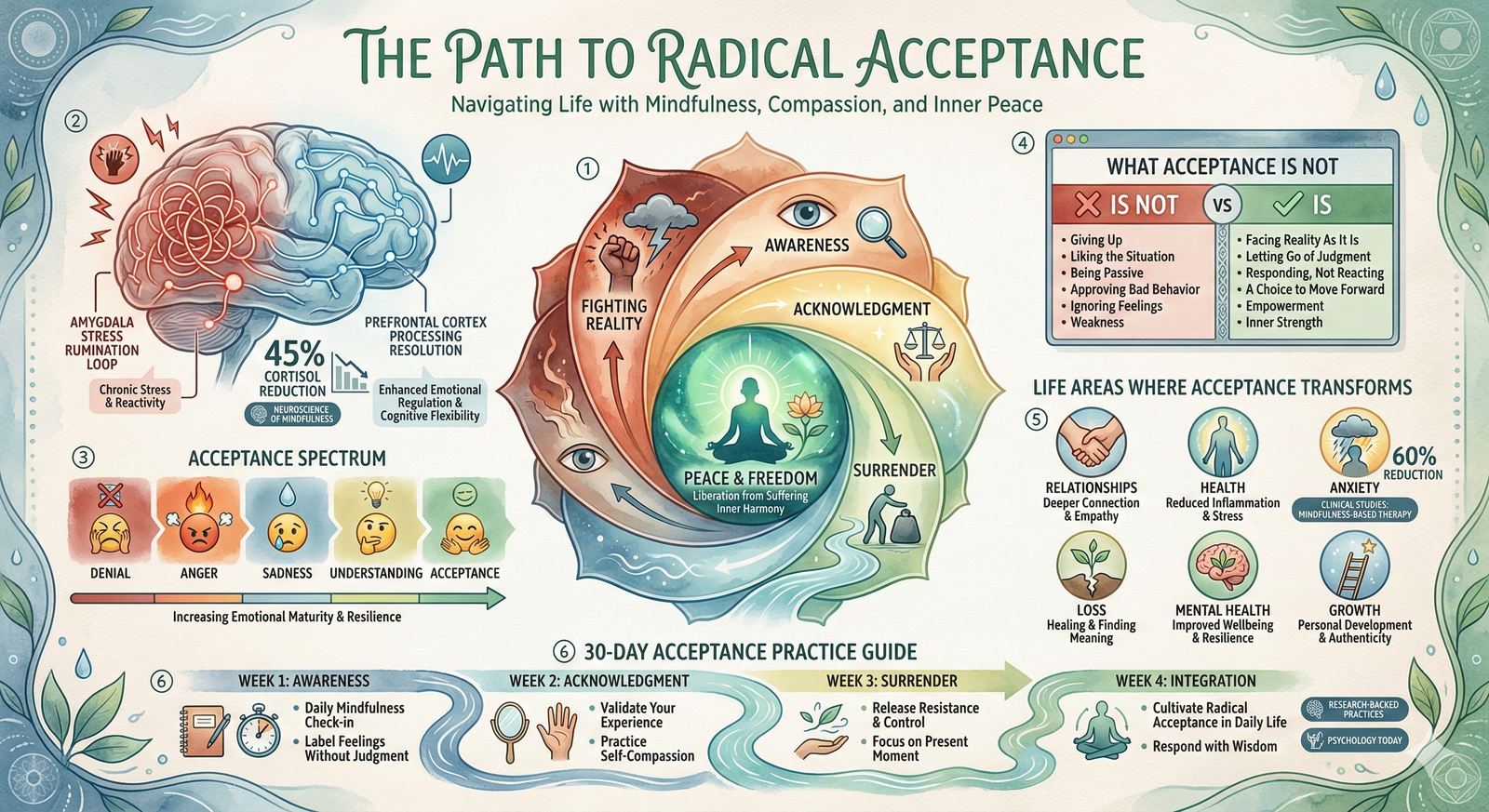
This article explores what acceptance really means in psychology and spirituality, why it matters more than ever in 2026, and practical techniques you can start using today to experience greater peace and resilience.
Whether you're struggling with anxiety, chronic pain, difficult relationships, or simply the daily frustrations of modern life, acceptance offers a proven path forward that doesn't require you to pretend everything is fine—just to stop exhausting yourself by refusing to acknowledge what is.
What Is Acceptance?
Acceptance in psychology refers to the deliberate, mindful acknowledgment of your internal experiences—thoughts, feelings, bodily sensations, and life circumstances—without trying to change, escape, or judge them. Unlike resignation or defeat, acceptance is an active stance of openness toward reality as it is right now. It's rooted in the understanding that suffering often comes not from the difficult situations themselves, but from our resistance to them.
Not medical advice.
The formal definition used in Acceptance and Commitment Therapy (ACT) is psychological flexibility: the ability to contact the present moment more fully with acceptance and mindfulness, while being guided by your personal values. This means you can feel anxious while still giving a presentation, experience grief while still taking care of yourself, or acknowledge pain while still pursuing a meaningful life. You're not trying to eliminate the difficult experience—you're learning to live well alongside it.
Surprising Insight: Surprising Insight: Studies from Harvard and NIH show that self-help interventions combining mindfulness and acceptance reduce anxiety and depression symptoms with small to medium effect sizes, and these effects persist when people practice them consistently over time.
The Acceptance Mindset Shift
Visual showing the contrast between resistance and acceptance, illustrating how avoidance creates additional suffering while acceptance reduces emotional burden.
🔍 Click to enlarge
Why Acceptance Matters in 2026
In 2026, we face unprecedented sources of stress: information overload, social media comparison, economic uncertainty, climate anxiety, and rapid technological change. Many of these stressors are partly outside our direct control. Our natural response is to fight, control, and fix everything. But this approach creates what psychologists call experiential avoidance—the attempt to escape or suppress unwanted thoughts and feelings—which actually amplifies psychological distress. Acceptance offers a radically different strategy that aligns with how our minds actually work.
Research from over 1,300 randomized controlled trials of Acceptance and Commitment Therapy shows that acceptance-based approaches work for anxiety, depression, chronic pain, addiction, trauma, and general life satisfaction. These aren't quick fixes or temporary band-aids—they're sustainable changes that people maintain years later. In a world of constant disruption, acceptance teaches you resilience that transcends any specific circumstance.
Additionally, acceptance is increasingly recognized by neuroscientists and mental health professionals as a core component of psychological health. Unlike strategies that focus on eliminating negative thoughts (which often backfires), acceptance approaches teach you to change your relationship with difficult experiences. This fundamental shift produces longer-lasting benefits and builds what researchers call psychological resilience—your capacity to handle life's inevitable challenges.
The Science Behind Acceptance
Acceptance has deep scientific foundations spanning psychology, neuroscience, and behavioral science. The theoretical framework most commonly used is Relational Frame Theory (RFT), which explains how our ability to think symbolically creates both great achievements and unique psychological suffering. We're the only species that can suffer about suffering, worry about worry, or feel anxious about feeling anxious. This capacity for self-reflection, while necessary for human achievement, can trap us in cycles of avoidance.
Brain imaging studies show that when people try to suppress or avoid unwanted thoughts, they actually activate the areas of the brain associated with the very experience they're trying to avoid. Conversely, when people practice acceptance—simply observing thoughts without judgment—these brain regions show reduced activation over time. This is why acceptance-based therapies consistently outperform thought-suppression strategies in research. Studies show that mindfulness and acceptance-based self-help interventions produce significant improvements in anxiety, depression, stress reduction, and overall quality of life.
The Acceptance and Commitment Therapy Model
The six core elements of ACT: acceptance, mindfulness, cognitive defusion, values clarification, self-as-context, and committed action working together for psychological flexibility.
🔍 Click to enlarge
Key Components of Acceptance
Mindfulness: Observing Without Judgment
Mindfulness is the foundation of acceptance. It's the practice of paying attention to the present moment with a stance of openness and curiosity rather than judgment. In practical terms, this means noticing when you're having a anxious thought without immediately believing it's true or acting on it. You might observe: I'm having the thought that I'll fail, rather than I will fail. This small shift—from identification with the thought to observation of the thought—is the beginning of psychological freedom. Research shows that even brief mindfulness practices increase positive affect and happiness, with effects strongest at the end of the day when people have had time to integrate the experience.
Cognitive Defusion: Separating Thought from Reality
Cognitive defusion is the process of stepping back from the literal meaning of your thoughts and seeing them as mental events rather than facts or commands. Your mind produces thoughts constantly—many of them unhelpful, contradictory, or simply untrue. Defusion techniques help you recognize that having a thought doesn't mean you need to believe it or act on it. For example, if you have the thought I'm not good enough, defusion might involve saying to yourself, I'm having the thought that I'm not good enough, which is quite different from I am not good enough. One creates distance and perspective; the other creates suffering. Practicing this distinction trains your mind to be more flexible and less dominated by habitual negative thinking patterns.
Values Clarification: Knowing What Matters
Acceptance isn't about passively accepting a meaningless life. It's about accepting reality while actively pursuing what matters most to you. Values clarification involves identifying your core values—the directions you want your life to move in. These might include family, creativity, learning, contribution, health, adventure, or integrity. When you're clear about your values, acceptance becomes a powerful tool: you can accept your anxiety while still pursuing your values by, for instance, speaking up in meetings despite fear, or maintaining close relationships despite past hurt. Your values give purpose to your acceptance, transforming it from mere resignation into meaningful living.
Self-Compassion: Kindness in the Face of Difficulty
Self-compassion is a crucial component of acceptance. It means treating yourself with the same kindness and understanding you'd offer a good friend facing similar struggles. When you practice acceptance, you're often facing painful or uncomfortable experiences. Self-compassion ensures that you don't compound this discomfort with harsh self-judgment (I shouldn't feel this way, I'm weak, I'm a failure). Instead, self-compassion recognizes: This is difficult. I'm human. Others struggle too. This doesn't mean you accept harm or abuse—it means you acknowledge suffering with care rather than criticism. Research shows that combining acceptance with self-compassion produces the most robust improvements in emotional wellbeing and reduces anxiety more effectively than acceptance alone.
| Strategy | How It Works | Long-term Effectiveness |
|---|---|---|
| Avoidance/Suppression | Try to avoid or suppress unwanted thoughts/feelings | Low - often backfires and increases suffering |
| Distraction | Redirect attention away from the problem | Moderate - temporary relief, doesn't address root |
| Acceptance | Acknowledge experience without judgment while pursuing values | High - sustainable, builds resilience |
| Cognitive Reframing | Try to change how you think about something | Moderate - helpful but can feel forced |
| Acceptance + Values | Accept experience AND commit to meaningful action | Very High - most durable improvements |
How to Apply Acceptance: Step by Step
- Step 1: Notice what you're experiencing without immediately trying to change it. Pause and name it: I'm feeling anxious right now. I'm having worried thoughts. This is grief. Simply noticing is the first step of acceptance.
- Step 2: Observe the physical sensations associated with your experience. Where do you feel it in your body? Is it tight, heavy, warm, or cold? Getting curious about the physical dimension takes you out of your thinking mind and into direct experience.
- Step 3: Practice non-judgment. Notice the urge to label your experience as bad, wrong, or something you shouldn't have. Instead, try simply observing: This is what's happening right now. This is a human experience. Other people feel this too.
- Step 4: Create space around your thoughts. Imagine you're watching clouds pass across the sky. Your thoughts are like clouds—they appear, they drift, they disappear. You don't have to grab them or push them away. You can simply watch them move through your mental sky.
- Step 5: Connect with your breath as an anchor. When you notice yourself getting caught in resistance or struggle, return attention to your natural breathing. Feel the breath moving in and out. This simple anchor helps regulate your nervous system and reminds you of the present moment.
- Step 6: Identify what matters to you in this situation. Even while accepting difficult circumstances, ask: What does my value ask of me right now? If you value family, how can you show up for loved ones despite your struggle? This prevents acceptance from becoming passivity.
- Step 7: Take one small action aligned with your values. Acceptance isn't about doing nothing. It's about doing what matters even when it's uncomfortable. Call a friend despite anxiety. Work on your project despite self-doubt. Learn something new despite fear of failure.
- Step 8: Practice self-compassion when resistance arises. Notice moments when you slip back into fighting reality or harsh self-judgment. Meet these moments with kindness rather than another layer of criticism: This is hard. It's okay to struggle. I'm learning.
- Step 9: Repeat the cycle. Acceptance isn't a destination you reach once. It's a skill you develop through regular practice. The more you practice acceptance in small moments, the more available it becomes when facing larger challenges.
- Step 10: Track your experience over time. Notice which situations become easier as you practice. Do you worry less? Sleep better? Enjoy relationships more? These subtle improvements accumulate into significant life changes.
Acceptance Across Life Stages
Young Adulthood (18-35)
Young adulthood is a time of major life transitions, identity formation, and often perfectionism. You're establishing careers, relationships, and who you want to be. Acceptance in this phase helps you navigate the gap between idealized visions and reality. You might need to accept that your first job isn't your dream role, that finding the right partner takes time, or that you're not as naturally talented at something as you hoped. Practicing acceptance early helps you pivot toward meaningful directions rather than spinning wheels in impossible situations. Young adults who develop acceptance skills report higher life satisfaction, more resilience in facing setbacks, and better ability to build authentic relationships rather than performing a false self.
Middle Adulthood (35-55)
Middle adulthood often brings the realization that time is finite and that certain dreams may not materialize exactly as imagined. You might grieve unlived possibilities while still having decades of meaningful life ahead. Acceptance here means acknowledging these losses without getting stuck in regret, while simultaneously committing to new directions. This is also often when health challenges emerge, when aging parents need care, and when career trajectories become clearer. Acceptance helps you respond to these realities wisely rather than wastefully fighting or denying them. Research shows that acceptance is particularly protective against depression and anxiety in midlife, and supports the transition from achievement-focused living to meaning-focused living that characterizes the most satisfied people in this stage.
Later Adulthood (55+)
Later adulthood brings inevitable physical changes, loss, and confrontation with mortality. Acceptance becomes not just useful but essential for wellbeing. This doesn't mean fatalism—older adults who practice acceptance actually engage in more health-promoting behaviors, pursue meaningful activities, and maintain stronger social connections than those who resist aging. Acceptance in this stage means acknowledging real limitations while focusing on what remains available: wisdom, relationships, contribution, creativity, and presence. Elders who have developed strong acceptance skills report greater life satisfaction, less depression, and stronger sense of purpose than those dominated by regret or denial. Interestingly, those who practice acceptance often become resources for younger people, modeling how to age gracefully and find meaning across the lifespan.
Profiles: Your Acceptance Approach
The Striver
- Permission to rest and be enough as you are
- Recognition that some things cannot be optimized
- Acceptance that effort has limits
Common pitfall: Believing you must earn your worth through achievement; exhausting yourself trying to control everything
Best move: Practice accepting one small thing weekly that you cannot change or improve, noticing how freedom emerges
The Avoider
- Safe ways to face difficult emotions
- Support in staying present when tempted to escape
- Gradual exposure rather than forced intensity
Common pitfall: Using distraction, substances, or activity to escape discomfort; missing important signals about what needs attention
Best move: Start with very small acceptances: feel your foot on the ground, notice one uncomfortable sensation, breathe through a brief moment of anxiety
The Perfectionist
- Acceptance that mistakes are information not failure
- Recognition that good-enough is actually excellent
- Values clarification beyond perfection
Common pitfall: Getting stuck revising, never shipping, missing life while perfecting details; harsh self-judgment when imperfect
Best move: Identify one area where you can consciously accept your current level, release the drive for perfection, and notice what happens
The Ruminator
- Tools to observe thoughts without believing them
- Values-based action to interrupt the thinking loop
- Self-compassion when caught in rumination
Common pitfall: Endlessly analyzing and re-analyzing, believing that thinking harder will solve emotional problems; getting lost in what-ifs
Best move: When you catch yourself ruminating, label it: I'm in rumination mode, then redirect to one concrete action aligned with your values
Common Acceptance Mistakes
One of the most common mistakes is confusing acceptance with passivity or resignation. Some people interpret acceptance as giving up on their goals or tolerating harmful situations. True acceptance involves simultaneously acknowledging reality and committing to meaningful change. You can accept that your relationship isn't meeting your needs while still working toward improvement or making the difficult decision to leave. You can accept your body as it is right now while also exercising because you value health. The key is that acceptance informs wise action rather than preventing all action.
Another mistake is forcing acceptance too quickly or aggressively. Acceptance is a skill that develops gradually. If someone has experienced trauma or significant loss, they need to move at their own pace. Telling someone to just accept their grief or just accept their anxiety is like telling someone to just run a marathon—the timeline matters. Effective acceptance is gentle, patient, and self-compassionate, meeting you where you are rather than demanding you be further along.
A third mistake is using acceptance to bypass necessary professional help. If you're experiencing severe depression, trauma, active addiction, or suicidal thoughts, acceptance is a valuable tool but not a substitute for professional treatment. Acceptance works best as part of a comprehensive approach that might include therapy, medication, medical care, or other interventions. Smart acceptance means accepting what you need and seeking it.
The Acceptance Mistake Cycle
Common errors people make when practicing acceptance, and how to recognize when you've slipped into counterproductive patterns.
🔍 Click to enlarge
Science and Studies
Acceptance and Commitment Therapy (ACT) is one of the most rigorously researched psychological interventions ever developed. As of January 2025, there were over 1,300 randomized controlled trials of ACT, over 550 meta-analyses and systematic reviews, and 88 mediational studies examining how and why ACT works. This extensive research base demonstrates consistent effectiveness across diverse populations and conditions. Self-help interventions incorporating mindfulness and acceptance components show significant improvements in mindfulness and acceptance skills, with significant reductions in anxiety and depression symptoms compared to control groups. Research from Harvard Health shows that greater self-acceptance improves emotional wellbeing and is associated with higher quality of life, positive affect, and self-esteem while being inversely associated with depression and anxiety.
- Can Mindfulness and Acceptance Be Learnt by Self-Help: A systematic review and meta-analysis showing that self-help interventions with mindfulness/acceptance components produced significant benefits on measures of mindfulness, anxiety, and depression (PubMed, 2014)
- Acceptance and Commitment Therapy: A Transdiagnostic Behavioral Intervention for Mental Health and Medical Conditions: Large-scale study demonstrating ACT effectiveness across anxiety, depression, chronic pain, and other conditions (PMC, 2017)
- Greater Self-Acceptance Improves Emotional Well-Being: Harvard Health research showing the strong connection between self-acceptance and emotional wellbeing outcomes (Harvard Health, 2016)
- Mindfulness, Acceptance, and Emotion Regulation: Research examining the mechanisms by which mindfulness and acceptance improve emotional health through the Monitor and Acceptance Theory framework (PMC, 2019)
- How Mindfulness Training Promotes Positive Emotions: Two randomized controlled trials showing that acceptance skills training specifically increases positive emotions and happiness over time (PMC, 2019)
Your First Micro Habit
Start Small Today
Today's action: The 5-4-3-2-1 Grounding Practice: When you notice yourself anxious or resistant to what's happening, pause and name five things you can see, four things you can physically feel, three things you can hear, two things you can smell, and one thing you can taste. Takes 2-3 minutes.
This practice immediately anchors you in present-moment reality through your senses, interrupting the worry-resistance loop and activating your parasympathetic nervous system. The sensory focus bypasses analytical thinking and helps you practice acceptance through direct experience.
Keep quitting habit apps after a missed day? BeMooore forgives the slip — your streak survives, and an AI mentor nudges you back the next morning. Free on iOS.
Quick Assessment
When you experience difficult emotions or situations, what's your typical first response?
Your response shows your current relationship with difficult experiences. Option 4 indicates you already have some acceptance skills. Options 1-3 are where most people start, and all can be improved with practice.
What matters most to you in life right now?
Acceptance is most powerful when guided by your values. If you chose option 4, clarifying your values is your first step. The others show different value orientations that can guide which acceptance practices work best for you.
How often do you practice self-compassion when you struggle?
Self-compassion is crucial for genuine acceptance. If you're in the first two categories, adding self-compassion to your practice will dramatically increase your results.
Take our full assessment to get personalized recommendations.
Discover Your Style →Next Steps
Start with one area of life where you've been fighting reality. This might be something minor—an inconvenience, a small physical sensation, a recurring worry. Practice accepting it exactly as it is, without trying to change it. Notice what happens. Often, when you stop fighting something, your relationship with it transforms. The energy you were using to resist becomes available for actually dealing with the situation wisely or letting it go entirely.
Next, clarify one value that matters to you. This might be family, creativity, health, integrity, adventure, or learning. Once you're clear about your value, notice moments where you can act in alignment with it even when it's uncomfortable. This integration of acceptance (acknowledging difficulty) with committed action (pursuing what matters) is where acceptance becomes truly transformative. You're not accepting hardship and then passively accepting it—you're accepting reality while moving toward a life worth living.
Get personalized guidance with AI coaching.
Start Your Journey →Research Sources
This article is based on peer-reviewed research and authoritative sources. Below are the key references we consulted:
Can Mindfulness and Acceptance Be Learnt by Self-Help: A Systematic Review and Meta-Analysis
Comprehensive meta-analysis examining effectiveness of self-help mindfulness and acceptance interventions
Key insight: Self-help interventions with mindfulness or acceptance components significantly improved mindfulness/acceptance skills and reduced anxiety and depression symptoms with small to medium effect sizes
Acceptance and Commitment Therapy: A Transdiagnostic Behavioral Intervention for Mental Health and Medical Conditions
Large-scale research review of ACT effectiveness across diverse psychological and medical conditions
Key insight: ACT is empirically-based and uses acceptance, mindfulness, and behavior-change strategies to increase psychological flexibility with demonstrated efficacy in anxiety, depression, chronic pain, and other conditions
Acceptance and Commitment Therapy and Psychological Well-Being: A Narrative Review
Recent narrative review of ACT and psychological wellbeing demonstrating core principles of acceptance
Key insight: Psychological flexibility—the ability to recognize emotions and stay true to values—is the main benefit of acceptance-based therapy and is associated with greater wellbeing
Greater Self-Acceptance Improves Emotional Well-Being
Harvard Health article on connection between self-acceptance and emotional wellbeing
Key insight: Research shows strong positive correlations between self-acceptance and quality of life, positive affect, and self-esteem, with inverse associations with depression and anxiety
Mindfulness, Acceptance, and Emotion Regulation: Perspectives from Monitor and Acceptance Theory
Research examining the theoretical mechanisms by which mindfulness and acceptance improve emotion regulation
Key insight: Acceptance helps regulate emotions by reducing experiential avoidance and teaching open monitoring rather than fighting unwanted experiences
How Mindfulness Training Promotes Positive Emotions: Dismantling Acceptance Skills Training
Two randomized controlled trials isolating the specific benefits of acceptance skills for promoting positive emotions
Key insight: Acceptance skills training directly increases positive emotions and happiness over time, with benefits most robust for end-of-day well-being reports
Radical Acceptance and Your Emotional Health
Practical guide to radical acceptance as a DBT skill for emotional health
Key insight: Radical acceptance means conscious acknowledgment of difficult situations and emotions in a nonjudgmental way, reducing the additional stress from fighting reality
Association for Contextual Behavioral Science (ACBS): Acceptance and Commitment Therapy
Official professional organization resource on ACT research and evidence base
Key insight: As of January 2025, there were over 1,300 randomized controlled trials of ACT, over 550 meta-analyses/systematic reviews, and 88 mediational studies demonstrating robust effectiveness
What Is Zen Acceptance and Non-Attachment: Buddhist Perspectives
Exploration of acceptance and non-attachment in Zen Buddhism and how they relate to suffering and spiritual growth
Key insight: In Buddhist philosophy, acceptance doesn't mean inaction or not caring; it means stopping resistance to what is while still taking wise action to address suffering
Self-Acceptance in Buddhist Practice
Buddhist teachings on self-acceptance as a path to spiritual growth and freedom from suffering
Key insight: Buddhist practice emphasizes acceptance of all aspects of oneself—including the difficult and painful—as essential to enlightenment and liberation from suffering
Related Glossary Articles
Frequently Asked Questions
Isn't acceptance just giving up on change?
No. Acceptance and change work together. You accept your current reality (including your thoughts, feelings, and circumstances) while simultaneously committing to meaningful action aligned with your values. For instance, you can accept that you feel nervous while still pursuing the career change you value. Acceptance often leads to more effective change because you're working with reality rather than fighting it.
How long does it take to develop acceptance skills?
Acceptance is a skill that develops progressively. Some people notice benefits within days of starting to practice—reduced anxiety in specific situations, better sleep, less rumination. More significant changes usually emerge over weeks and months of consistent practice. The good news is that unlike some skills, acceptance shows benefits at every stage. You don't have to wait until you're perfect to experience the advantages.
Can I accept something and still want to change it?
Absolutely—and this is actually where acceptance works best. Paradoxically, when you stop fighting reality and genuinely accept your situation, you often become more capable of changing it. A key insight from ACT is that psychological flexibility means you can accept internal experiences (thoughts, feelings) while taking committed action toward external change (behavior, circumstances). They're not mutually exclusive.
Is acceptance the same as mindfulness?
They're related but distinct. Mindfulness is the skill of paying attention to present moment experience without judgment. Acceptance is using that mindful awareness to open to experience rather than fight it. You could be mindfully aware of your anxiety while still fighting it (unhelpful), or you could be mindfully aware of your anxiety and accept it (helpful). Acceptance is mindfulness with the added element of intentionally opening to experience rather than trying to change it.
What if acceptance feels impossible when I'm in severe pain or crisis?
True acceptance isn't about forcing yourself to be okay with severe pain or trauma. In acute distress, your priority is safety and stabilization, not acceptance. However, even in difficult circumstances, acceptance can help by reducing the secondary suffering (anxiety about the pain, resistance to the situation) while you access needed support. If you're in crisis, please reach out to a mental health professional or crisis line. Acceptance is a tool that becomes more helpful as your acute distress stabilizes.
Take the Next Step
Ready to improve your wellbeing? Take our free assessment to get personalized recommendations based on your unique situation.
- Discover your strengths and gaps
- Get personalized quick wins
- Track your progress over time
- Evidence-based strategies