Commitment
Commitment is the glue that holds relationships together. It's the conscious choice you make every day to show up for your partner, to work through challenges, and to build a future together. Many people confuse commitment with obligation or duty, but true commitment is rooted in love, intention, and mutual respect. It's what transforms attraction into lasting partnership and creates the foundation for deep emotional connection.
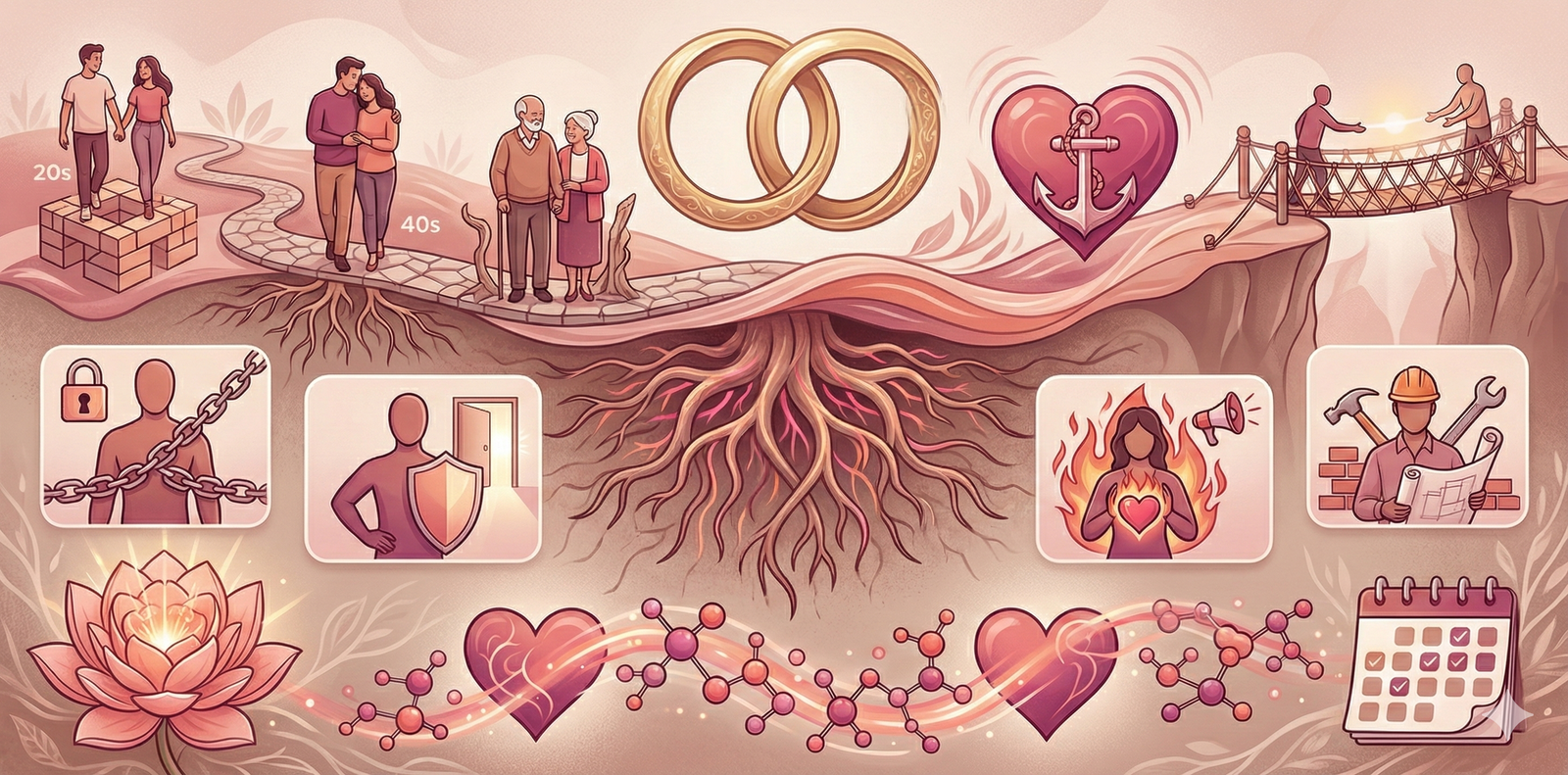
Without commitment, relationships drift. With it, they flourish. The difference lies not in grand gestures, but in the small, everyday actions—the messages you send, the time you invest, the conversations you have, and the choices you make when things get difficult.
In 2026, many people struggle with commitment because they fear losing freedom or worry about choosing wrong. But research shows that committed partners report higher life satisfaction, better mental health, and deeper happiness than those who avoid commitment.
What Is Commitment?
Commitment in relationships refers to the psychological state in which you are dedicated to maintaining and improving your relationship with your partner over time. It combines intention, behavior, and emotional investment into a coherent whole.
Not medical advice.
Relationship researchers identify three dimensions of commitment. Personal commitment reflects your own desire to maintain the relationship because you love your partner and enjoy being together. Moral commitment comes from your values, beliefs about monogamy, or spiritual convictions. Structural commitment involves the practical investments you've made—shared finances, housing, children, or mutual friends—that make leaving more complicated.
Surprising Insight: Surprising Insight: Couples who experience the highest relationship satisfaction aren't those who never face conflict—they're the ones who commit to resolving conflict respectfully and consistently.
The Three Dimensions of Commitment
Personal, moral, and structural commitments form the complete picture of relationship stability. All three work together to create sustainable partnerships.
🔍 Click to enlarge
Why Commitment Matters in 2026
In our rapidly changing world, commitment has become more valuable, not less. Technology connects us to thousands of potential partners, creating paradox of choice. Dating apps make new relationships just a swipe away. Yet research shows that committed individuals report 40% higher life satisfaction than those constantly seeking alternatives.
Commitment provides psychological safety. When you know your partner is committed to you, your nervous system relaxes. You can be vulnerable, authentic, and fully yourself. This safety enables genuine intimacy—the kind that shallow connections can never provide.
For younger generations, commitment offers stability amid uncertainty. Economic pressures, climate anxiety, and social fragmentation create stress. A committed partnership becomes a refuge—a place where you're truly known and supported. Recent studies on Generation Z show that those in committed relationships report 35% lower anxiety and depression rates than their single peers.
The Science Behind Commitment
Dr. John Gottman, who has studied relationships for over 40 years, discovered that successful relationships follow predictable patterns. His research with thousands of couples led to the development of the LOVE EQUATIONS—mathematical models that explain how commitment, trust, and calm interact to create lasting partnerships. Gottman can predict with 90% accuracy whether a couple will stay together based on how they handle conflict and commitment.
Neuroscience shows that committed partners experience synchronization in their brain patterns. Partners who feel secure in their commitment show aligned stress responses, suggesting that the safety provided by commitment literally changes how our brains function. This neurological bonding creates resilience during challenges.
The Love Equations: Gottman's Formula for Lasting Relationships
Research demonstrates that calm, trust, and commitment create a predictable framework for relationship success. These three elements work synergistically.
🔍 Click to enlarge
Key Components of Commitment
Intention & Choice
Commitment begins with a conscious choice. You wake up and decide to invest in this relationship, to prioritize your partner's wellbeing, and to work toward shared goals. This isn't something that happens to you—it's something you do. Psychologists call this deliberate commitment, and it's stronger than the feelings-based commitment that naturally ebbs and flows.
Consistent Action
Actions matter more than words. Commitment manifests in daily behaviors: listening without interrupting, keeping small promises, showing up on time, remembering details your partner mentioned, and choosing kindness when you're frustrated. These micro-commitments accumulate to create the emotional bedrock of the relationship.
Trust & Vulnerability
A committed relationship requires vulnerability—the willingness to be seen and known. This only feels safe when you trust your partner to handle your fragile heart with care. Trust is built through thousands of micro-moments where your partner proves reliable, honest, and protective of your wellbeing.
Future Orientation
Committed partners think about their future together. They make plans, set goals, and invest in creating something larger than themselves. This might mean financial planning, discussing children, choosing to live together, or building shared rituals. Future orientation gives the relationship direction and meaning.
| Aspect | Attraction | Commitment |
|---|---|---|
| Duration | Peaks in months 6-18 | Grows over years |
| Basis | Physical & initial chemistry | Shared values & daily investment |
| Effort Required | Happens naturally | Requires conscious choice |
| Resilience | Fragile during conflict | Strengthened by challenges |
| Growth | Often plateaus | Deepens continuously |
How to Apply Commitment: Step by Step
- Step 1: Name your commitment explicitly. Have a conversation where you both state what you're committing to—whether it's exclusivity, partnership, marriage, or specific shared values. Clarity prevents misunderstandings.
- Step 2: Make micro-commitments daily. Send a text asking about their day. Remember something they mentioned and follow up. Show up on time. These small acts prove you're reliable.
- Step 3: Establish communication rituals. Schedule weekly check-ins where you discuss the relationship itself, not just logistics. Use frameworks like the Daily Temperature Reading from couples therapy.
- Step 4: Resolve conflict with calm. When disagreements arise, pause if you're escalating. Gottman's research shows that how you fight matters more than what you fight about.
- Step 5: Invest time together intentionally. Quality time strengthens commitment. Put phones away, have meaningful conversations, and create shared experiences that belong only to you two.
- Step 6: Support each other's growth. Encourage your partner's goals, celebrate their wins, and help them become the best version of themselves. Commitment includes wanting the best for them.
- Step 7: Practice forgiveness actively. When mistakes happen—and they will—address them directly. Sincere apology and genuine forgiveness strengthen commitment more than perfect behavior ever could.
- Step 8: Build shared rituals. Develop routines that bond you: morning coffee together, weekly date nights, annual traditions. Rituals create continuity and deepened connection.
- Step 9: Discuss your future regularly. Align on big questions: Do you want children? Where will you live? What's your financial vision? Shared future planning deepens commitment.
- Step 10: Choose commitment during difficulty. When attraction fades or challenges arise, recommit consciously. This is where true commitment—beyond feelings—becomes visible.
Commitment Across Life Stages
Young Adulthood (18-35)
In young adulthood, commitment often feels scary because you're still discovering yourself. Many fear that committing means losing freedom. However, research on college students and young professionals shows that those in committed relationships actually have better academic and career outcomes than their single peers. Why? Because committed partners provide accountability, support, and motivation. The key is finding a partner whose growth goals align with yours.
Middle Adulthood (35-55)
By middle age, commitment takes on deeper dimensions. If you've weathered challenges together—health scares, career transitions, raising children—your commitment has been tested. The beauty of this stage is that you've proven to each other that you're reliably there. Many couples report that their most satisfying years come in this phase because the commitment is no longer questioned; it's bedrock.
Later Adulthood (55+)
In later adulthood, commitment becomes a source of great joy. Couples who have remained committed report extraordinary companionship and life satisfaction. The shared history, inside jokes, and deep knowing of each other create incomparable intimacy. Health challenges are faced together, and the commitment deepens further.
Profiles: Your Commitment Approach
The Steadfast Partner
- Clear communication about relationship status
- Reassurance during insecurity
- Regular appreciation for consistency
Common pitfall: May become complacent or take the relationship for granted over time
Best move: Refresh your commitment periodically by rediscovering why you chose this partner
The Cautious Explorer
- Time to build trust before deepening commitment
- Freedom to maintain individual identity
- Gradual steps rather than quick escalation
Common pitfall: Fear of commitment can undermine relationship growth and cause partner resentment
Best move: Recognize that commitment doesn't eliminate freedom—it actually enables it through security
The Passionate Advocate
- Emotional intensity and regular affirmation
- Transparency about feelings and commitment level
- Active engagement and shared experiences
Common pitfall: May expect partner to match intensity constantly, leading to burnout
Best move: Balance emotional expression with practical consistency—feelings fluctuate, but actions endure
The Practical Builder
- Clear commitment frameworks and plans
- Shared goals and concrete progress markers
- Logical discussions about relationship direction
Common pitfall: May neglect emotional intimacy in favor of logistics
Best move: Remember that emotions are data—they provide crucial information about relationship health
Common Commitment Mistakes
The first major mistake is confusing commitment with loss of identity. Many people avoid commitment because they fear they'll disappear into a relationship. But research shows the opposite: secure, committed relationships actually support stronger individual identity. You can be fully yourself and fully committed simultaneously.
The second mistake is letting commitment become complacency. Many couples, after years together, stop investing in the relationship. They assume commitment means the relationship will survive neglect. It won't. Commitment requires active renewal. The passion may evolve into deeper companionship, but the effort must continue.
The third mistake is committing to the wrong person without self-awareness. Taking time to understand your own values, boundaries, and growth needs before committing prevents years of struggle. Rushing into commitment before truly knowing yourself often leads to regret.
The Commitment Lifecycle: How Relationships Deepen Over Time
Healthy relationships move through predictable stages. Understanding where you are helps you navigate it better.
🔍 Click to enlarge
Science and Studies
Recent research reveals powerful evidence about commitment's impact on wellbeing and relationship success. Studies from 2024-2025 show that commitment is not merely romantic—it's essential for health and happiness.
- Gottman & Murray (2005): Mathematical models created the LOVE EQUATIONS, enabling prediction of relationship success with 90% accuracy based on commitment patterns
- Journal of Social and Personality Psychology (2024): Couples who regularly express commitment assurances report 45% higher relationship satisfaction and stronger future planning
- Frontiers in Psychology (2025): Commitment and digital intimacy together shape relationship satisfaction in Generation Z, with committed partners showing 35% lower anxiety
- The Journal of Social Psychology (2025): Perception of partner commitment predicts daily relationship satisfaction, suggesting that believing your partner is committed matters as much as their actual commitment
- Utah State University Extension (2024): Five key practices for strong commitment in marriage include regular communication, maintaining individual identities, shared vision, forgiveness, and consistent effort
Your First Micro Habit
Start Small Today
Today's action: Set a daily 5-minute commitment conversation with your partner. Every evening, share one thing you appreciated about them today and ask one question about their day. Just five minutes.
This micro-habit creates consistency, deepens knowing, and proves reliability through daily repetition. Small acts accumulate to transform relationships. You're not trying to fix anything—just connect.
Track your commitment conversations and relationship milestones with the Bemooore app. Our AI mentor provides personalized guidance to deepen your partnership and overcome relationship challenges without reading countless relationship books.
Quick Assessment
How would you describe your current commitment level in your primary relationship?
Your current position helps determine which strategies will help you most. Early-stage commitment needs clarity; established commitment needs renewal.
When your relationship faces challenges, what's your instinct?
How you handle difficulty reveals your commitment foundation. Those who engage directly build stronger relationships.
What feels most challenging about commitment for you personally?
Identifying your specific commitment challenge helps you address it directly rather than letting it undermine your relationship.
Take our full assessment to get personalized recommendations.
Discover Your Style →Next Steps
Start with self-awareness. Before committing to anyone, understand your own values, patterns, and what you need in a partnership. This prevents choosing from loneliness or fear rather than from clarity.
If you're already committed, refresh your approach. Have the hard conversations. Recommit consciously. Invest in building the partnership you truly want rather than simply maintaining the one that exists. Your relationship will improve more in one month of conscious effort than years of autopilot.
Get personalized guidance with AI coaching.
Start Your Journey →Research Sources
This article is based on peer-reviewed research and authoritative sources. Below are the key references we consulted:
Related Glossary Articles
Frequently Asked Questions
Does commitment mean you can never leave a relationship?
No. Commitment is a choice you renew daily. If a relationship becomes abusive or fundamentally misaligned with your values, leaving can be the most committed choice you make—committed to your own health and wellbeing. Healthy commitment has boundaries.
Can you be committed without being in love?
Yes, temporarily. But sustainable commitment requires love to evolve into deeper partnership. Commitment without any love becomes obligation and usually fails. The goal is for commitment to deepen your love over time.
How long does it take to truly commit?
This varies greatly. Some people commit within months; others need years. Research suggests that couples who wait 12-24 months before major commitments (marriage, cohabitation) have higher success rates because they've weathered different seasons together.
What if my partner isn't as committed as I am?
This mismatch is concerning and worth addressing directly. Have honest conversations about expectations. If the gap is fundamental and can't be bridged, you may need to reconsider whether this is the right partnership. Unequal commitment creates resentment.
How do I rebuild commitment after betrayal?
Rebuilding requires genuine apology, accountability, and time. The betrayed partner must see consistent behavioral change, not just promises. Many couples work with therapists to rebuild trust and recommit after infidelity or other breaches. It's possible but demands both partners' active participation.
Take the Next Step
Ready to improve your wellbeing? Take our free assessment to get personalized recommendations based on your unique situation.
- Discover your strengths and gaps
- Get personalized quick wins
- Track your progress over time
- Evidence-based strategies