Vision
A vision is your personal North Star—a clear, compelling picture of what you want your life to become. It's not just a distant dream floating in your mind; it's a tangible roadmap that guides your decisions, shapes your priorities, and connects every action you take to something meaningful. When you have a true vision, you're no longer wandering through life hoping good things happen. Instead, you're intentionally moving toward a future that aligns with your deepest values and desires. This is the essence of purposeful living.
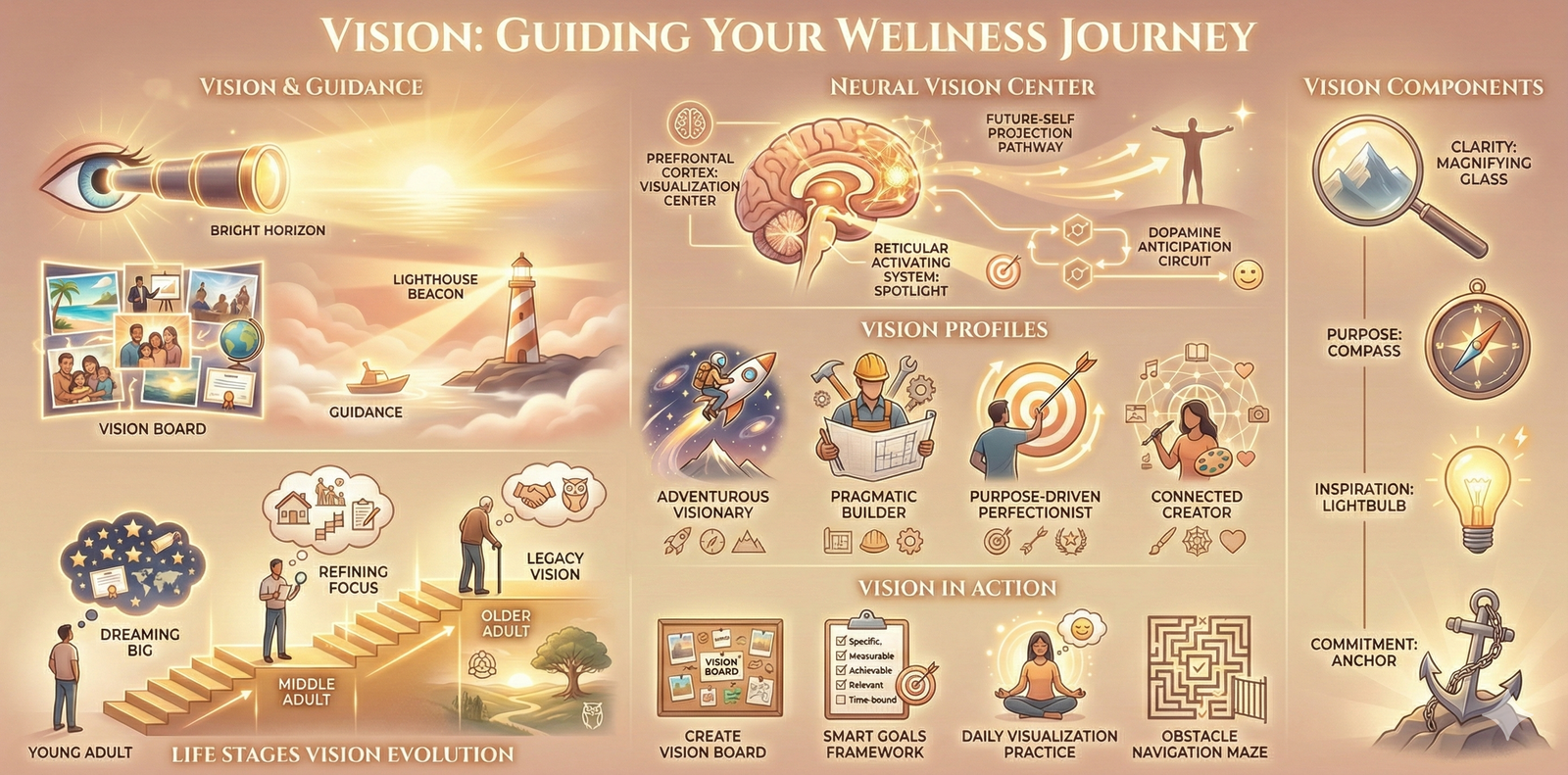
Your vision is the bridge between who you are today and who you want to become. It answers the question that matters most: why am I doing this? When you know your why, motivation comes naturally, obstacles become opportunities to learn, and setbacks transform into stepping stones rather than barriers.
In 2025, having a personal vision isn't just nice-to-have—it's a cornerstone of mental wellness, career satisfaction, and lasting happiness. People with a clear vision sleep better, feel more focused, and report higher life satisfaction than those drifting without direction.
What Is Vision?
Vision is a vivid, emotionally resonant image of your desired future—a personal statement that crystallizes your values, goals, and the legacy you want to create. It's different from a goal: a goal is specific and measurable (like 'exercise three times a week'), while a vision is the bigger picture (like 'I want to be a healthy, energetic person who inspires others to live fully'). Your vision encompasses all areas of life: health, relationships, career, spirituality, and personal growth.
Not medical advice.
A true vision serves as an internal compass that helps you navigate life's complexities with clarity and purpose. It acts as a filter for decisions, allowing you to say 'yes' to opportunities that align with your vision and 'no' to distractions that don't. This isn't about being rigid—your vision can evolve as you grow—but having it creates a coherent narrative for your life story.
Surprising Insight: Surprising Insight: People with vivid mental imagery of their vision are more motivated to pursue their goals because the vision evokes positive emotions, and these emotions spill over to make their goals feel more compelling and achievable.
From Vision to Achievement: The Motivation Pathway
This diagram shows how a clear vision creates positive emotions, which fuel goal commitment and consistent action toward meaningful outcomes.
🔍 Click to enlarge
Why Vision Matters in 2026
In an increasingly fast-paced, distraction-filled world, having a personal vision is more important than ever. The constant noise of social media, competing priorities, and endless options can leave you feeling scattered and unfulfilled. Research from over 40,000 participants across multiple countries shows that people who set clear goals (which flow from a vision) experience higher achievement rates and greater life satisfaction.
A personal vision directly impacts your mental health and emotional wellbeing. When you know what matters most to you and can see progress toward it, anxiety decreases, depression lifts, and a sense of purpose fills the void that aimlessness creates. Your vision becomes your anchor during difficult times, reminding you of what you're working toward and why perseverance matters.
Professionally, people with a clear vision advance faster in their careers, negotiate better salaries, and report higher job satisfaction. They're not just showing up to work; they're building something meaningful. This sense of purpose radiates outward, making them more attractive leaders, more engaged colleagues, and more effective in their roles.
The Science Behind Vision
Neuroscience reveals that when you visualize your vision vividly, you activate the same neural pathways as if you were actually experiencing it. This mental rehearsal strengthens your brain's readiness to recognize opportunities and take action when they appear. Studies show that visualization—the mental imagery component of vision—can enhance performance nearly as much as physical practice.
Goal-setting pioneer Edwin Locke and Gary Latham's decades of research show that specific, challenging goals increase performance. When those goals are connected to a meaningful vision, the effect multiplies. The vision provides the emotional fuel while the goals provide the specific direction. Together, they create a powerful motivational force. When your goals feel disconnected from something larger—a personal vision—your motivation wanes, but when they're tightly linked, commitment soars.
Vision vs. Goals: The Complete Framework
Vision is the 'why' and the big picture, while goals are the specific, measurable steps to get there. Both are essential.
🔍 Click to enlarge
Key Components of Vision
Values Alignment
Your vision must reflect your core values—the principles that define who you are at your deepest level. These might include family, creativity, integrity, adventure, or service. When your vision aligns with your true values, it feels authentic and sustainable. You're not chasing someone else's dream; you're living your own.
Mental Imagery & Emotional Resonance
The most powerful visions engage your senses and emotions. Rather than 'I want a successful career,' a stronger vision might be 'I want to wake up excited about my work, knowing I'm solving problems that matter, surrounded by people I respect and enjoy.' This vivid mental image—feeling the excitement, seeing the environment, sensing the satisfaction—creates the emotional energy that drives you forward.
Specificity Within Flexibility
Your vision should be clear enough to guide your decisions but flexible enough to evolve. Life changes. You change. A vision might evolve from 'I want to be financially independent by age 50' to 'I want to create multiple income streams that give me time freedom and impact.' The core—freedom and impact—remains, but the implementation adapts.
Integration Across Life Areas
A complete vision doesn't focus on just career or health or relationships in isolation. It weaves together how you want to show up in all areas: health, relationships, career, spirituality, learning, contribution, and leisure. This integration creates a life that feels balanced and harmonious rather than fragmented.
| Component | Characteristics | Impact |
|---|---|---|
| Values Alignment | Reflects your core principles; feels authentic and intrinsically motivated | Sustainable motivation and fulfillment |
| Mental Imagery | Vivid, sensory, emotionally engaging; you can visualize it clearly | Enhanced motivation and neural pathway activation |
| Specificity | Clear enough to guide decisions; not so rigid it can't evolve | Focused action without limiting growth |
| Life Integration | Includes health, relationships, career, learning, contribution | Balanced, harmonious life feeling |
| Meaningful Purpose | Connected to something larger than yourself | Resilience during challenges |
How to Apply Vision: Step by Step
- Step 1: Reflect on your past: Recall moments when you felt most alive, engaged, and fulfilled. What were you doing? Who were you with? What values were being honored? These moments contain clues about your vision.
- Step 2: Identify your core values: From your reflection, extract 5-7 values that appear repeatedly. Are they freedom, connection, growth, creativity, security, service? Write them down clearly.
- Step 3: Imagine your ideal future: Set a time horizon—maybe 5-10 years—and vividly imagine what a life aligned with your values looks like. Where do you live? How do you spend your days? Who are you becoming? Write this in present tense as if it's already true.
- Step 4: Create your vision statement: Distill your ideal future into a 2-3 paragraph vision statement that's specific, emotionally resonant, and written in the present tense. Example: 'I am a healthy, present parent who brings my whole self to my work, creating solutions that help others thrive. My life balances productivity with presence, allowing me to feel energized rather than depleted.'
- Step 5: Break vision into life areas: Divide your vision across major life domains: health, relationships, career, learning, spirituality, finances, and contribution. How does your overall vision express itself in each area?
- Step 6: Translate to 1-year goals: For each life area, create 1-3 specific goals for the next year that move you toward your vision. Keep them challenging but achievable. Write them in outcome form, not task form: 'Feel strong and energized' rather than 'Go to gym 4x/week.'
- Step 7: Create quarterly milestones: Break your annual goals into quarterly milestones. This makes progress visible and keeps momentum. You're not waiting a year to check progress; you're checking every 13 weeks.
- Step 8: Design weekly actions: Each week, identify 3-5 actions that connect to your quarterly milestones. These actions should feel connected to something larger—your vision—not just random tasks.
- Step 9: Build micro-habits for momentum: Identify one tiny habit per life area that reinforces your vision. A 2-minute morning reflection, a 10-minute movement practice, one meaningful conversation per week. Small, consistent actions compound.
- Step 10: Review monthly and adjust: Every month, reflect on progress toward your vision and goals. Are you moving in the right direction? What obstacles appeared? What did you learn? Adjust your actions accordingly, but keep your vision steady unless life fundamentally changes.
Vision Across Life Stages
Young Adulthood (18-35)
Your vision during young adulthood often involves exploration, identity formation, and establishing foundational direction. You're figuring out what matters to you, testing different paths, and beginning to make choices that compound over time. A vision in this stage might emphasize learning, skill-building, and relationship-forming. The key is to start clarifying your values now—the direction you set influences opportunities available later.
Middle Adulthood (35-55)
During middle adulthood, your vision often becomes more refined and integrated. You've experienced enough to know what genuinely matters and what was someone else's expectation. Visions in this stage often balance ambition with presence, achievement with connection. Many people in this phase intentionally shift their vision toward legacy and contribution—not just for themselves but for their families and communities.
Later Adulthood (55+)
Later adulthood is a powerful time for vision because you have perspective and freedom. Freed from some earlier constraints, many people's visions shift toward meaning, legacy, and shared wisdom. Visions often emphasize health to maintain independence, relationships to deepen connections, and contribution to create lasting impact. The clarity that often comes with age makes vision-setting particularly potent.
Profiles: Your Vision Approach
The Adventurous Visionary
- Freedom to explore and adapt
- Big-picture thinking over rigid detail
- Meaningful work over financial security alone
Common pitfall: Gets inspired by visions but struggles with execution because enthusiasm wanes without clear milestones
Best move: Create vision first, then work with someone detail-oriented to break it into specific milestones that maintain your sense of adventure
The Pragmatic Builder
- Clear, measurable goals tied to vision
- Step-by-step processes to follow
- Evidence that the vision is achievable
Common pitfall: Focuses so much on the steps that the larger vision becomes forgotten; work feels like grinding through tasks
Best move: Regularly reconnect to your vision's emotional core; revisit why these specific goals matter beyond the metrics
The Purpose-Driven Perfectionist
- A vision that aligns with higher purpose
- Permission to be imperfect in execution
- Integration across all life areas
Common pitfall: Sets an idealistic vision but abandons it when reality doesn't match perfectly; struggles with self-compassion
Best move: Build flexibility into your vision; progress over perfection; celebrate small wins that move toward your vision even if they're messy
The Connected Creator
- A vision that includes relationships and impact
- Community support and accountability
- Opportunities to express creativity
Common pitfall: Creates beautiful visions but doesn't take individual action, waiting for others or perfect conditions
Best move: Start your vision journey solo, even as you involve others; take one small action this week independent of anyone else's readiness
Common Vision Mistakes
One of the most common mistakes is creating someone else's vision instead of your own. You adopt a vision because it's impressive, because a parent or partner had it, or because it looks good on social media. The problem: lack of intrinsic motivation. When a vision isn't truly yours, willpower fails. The first action is to pause and ask: 'Whose dream is this really? Do I genuinely want this, or do I think I should want it?' Honesty here saves years of effort toward a goal that won't fulfill you.
Another mistake is confusing vision with fantasy—imagining an outcome without connecting it to reality and effort. Vision is not visualization without action. The most motivating visions are those that feel both compelling and achievable. Too granular ('I'll save $10 million'), and you feel hopeless. Too vague ('I'll be happy'), and you have no direction. The sweet spot is specific enough to guide action but bold enough to excite you.
A third mistake is staying attached to a vision long past its usefulness. Life changes. You change. A vision that made sense at 25 might not at 40. Many people cling to old visions out of ego ('I've invested so much already') or guilt ('I promised myself this'). Permission granted: evolve your vision when it no longer fits. The power is in having clarity now, not being loyal to an old story.
Vision Mistakes & Redirections: From Stuckness to Momentum
Common pitfalls in vision-setting and the reframes that help you get back on track
🔍 Click to enlarge
Science and Studies
Decades of goal-setting research from Locke and Latham, first conducted in the 1960s and continuing today, shows that specific, challenging goals increase performance across 88+ different tasks involving over 40,000 participants from Asia, Australia, Europe, and North America. When those goals are connected to a personal vision—your 'why'—the motivational effect amplifies. Recent neuroscience research shows that vivid mental imagery (a core component of vision) activates the same neural pathways as physical experience, preparing your brain to recognize and seize relevant opportunities.
- Locke & Latham (1960s-2006): Foundational research showing specific goals outperform vague goals in performance across 88+ different tasks
- Oettingen et al. (2001): Research on mental contrast with implementation intentions showing how to connect visions to action plans effectively
- Positive Psychology Center (2020-2024): Studies showing that people with clear personal visions report higher life satisfaction and lower anxiety
- Fishbach & Finkelstein (2012): Research on how goals derived from emotional visions are pursued with greater commitment and success
- University of Chicago neuroscience research (2023): Brain imaging studies showing visualization activates the same neural regions as actual experience
Your First Micro Habit
Start Small Today
Today's action: Spend 5 minutes tonight writing down: 'When I'm living my best life, I am...' and complete the sentence 5 times. Don't overthink it—just write what comes. This plants a seed for your vision.
Starting your vision journey with one tiny reflection removes the pressure of creating something perfect. Five minutes is manageable, and writing activates a different part of your brain than thinking. You're beginning to externalize and clarify what's been vague. This micro habit disrupts drift and points your consciousness toward possibility.
Track your vision reflections and micro-habits with personalized AI coaching. Our app helps you build momentum by celebrating small wins and connecting daily actions to your bigger vision.
Quick Assessment
How clear is your current personal vision?
Your awareness of where you stand helps determine the first steps. If you're early in the process, starting with values clarification is powerful. If you already have vision in some areas, the work is connecting and integrating them.
When you think about your vision, what's your biggest concern?
Different concerns point to different next actions. Unrealistic worries often need perspective from others who've achieved similar visions. Uncertainty about wants calls for values clarification and reflection. Execution challenges benefit from breaking vision into milestones.
How connected do your daily actions feel to something larger?
The more connected your daily actions feel to a larger vision, the more sustainable your motivation and the greater your happiness. If the connection feels weak, revisiting or clarifying your vision can dramatically shift how fulfilled you feel.
Take our full assessment to get personalized recommendations for your wellbeing journey.
Discover Your Style →Next Steps
Your vision is waiting to be clarified and claimed. It's not locked away in some special people's brain; it lives in your experiences, your values, and your deepest sense of what matters. The work of vision creation is the work of honest self-reflection and brave self-expression. Start this week: spend 5-10 minutes journaling about what a day in your ideal life looks like. Don't edit yourself. Let possibilities emerge. This is how vision begins—with imagination and permission.
Once you've clarified your vision, the next step is connecting it to action. Visions without momentum stay as fantasies. Your job is to translate vision into quarterly milestones, then monthly actions, then daily habits. Make it real. Share your vision with someone you trust. Write it down. Revisit it monthly. Let it guide your biggest decisions. This is how the future you want becomes the life you're actually living.
Get personalized guidance with AI coaching to clarify and achieve your vision.
Start Your Journey →A goal you see every morning gets acted on more often than one that lives in a note app. Build a vision board free in your browser, no account, and export a phone wallpaper you can set tonight.
Build a free vision board →Research Sources
This article is based on peer-reviewed research and authoritative sources. Below are the key references we consulted:
Related Glossary Articles
Frequently Asked Questions
How is vision different from goals?
Vision is the bigger picture—the 'why' and the overall direction. Goals are specific, measurable milestones that help you move toward your vision. You might have one vision but many goals supporting it. Vision is about who you want to become; goals are about specific achievements along the way.
Can my vision change?
Absolutely. Your vision should evolve as you grow, learn, and as circumstances change. The key is to evolve intentionally—not out of distraction, but because you've genuinely clarified that your priorities have shifted. Many people find their vision evolves every 5-10 years, and that's healthy.
What if I have no idea what my vision should be?
Start with values clarification and reflection on moments when you felt most alive. Look at your natural strengths and what you lose track of time doing. Your vision often emerges from the intersection of what you value, what you're good at, and what the world needs. It doesn't have to come all at once—it can crystallize over weeks or months of reflection.
How do I know if my vision is realistic?
A realistic vision is one that challenges you but doesn't paralyze you. It should feel exciting and possible, not fantasy. Ask: 'Can I find examples of people who've achieved something similar?' If yes, it's likely realistic. 'Do I have or can I develop the capabilities needed?' If yes, move forward. 'Is this timeline reasonable?' Adjust if needed. Realistic doesn't mean small—it means grounded.
What if my vision conflicts with my partner's or family's expectations?
This is real and important. Sometimes your vision and others' expectations collide. The path forward involves honest conversation about what matters to each person and where compromise is possible. Often, you'll find more alignment than you expected. Sometimes, you'll need to choose your wellbeing. Either way, clarity about your vision helps you navigate these conversations with integrity.
Take the Next Step
Ready to improve your wellbeing? Take our free assessment to get personalized recommendations based on your unique situation.
- Discover your strengths and gaps
- Get personalized quick wins
- Track your progress over time
- Evidence-based strategies