Sleep
Sleep is your body's reset button. Every night, your brain and body undergo a profound transformation that scientists are only beginning to fully understand. While you rest, your brain clears toxins, consolidates memories, and repairs itself. Yet millions of people shortchange this essential process. Missing even one night of quality sleep impairs your thinking, mood, and health. Chronic sleep deprivation shaves years off your life—more than smoking, more than loneliness, more than almost any other factor except disease. The good news? Understanding sleep science gives you the power to reclaim your nights.
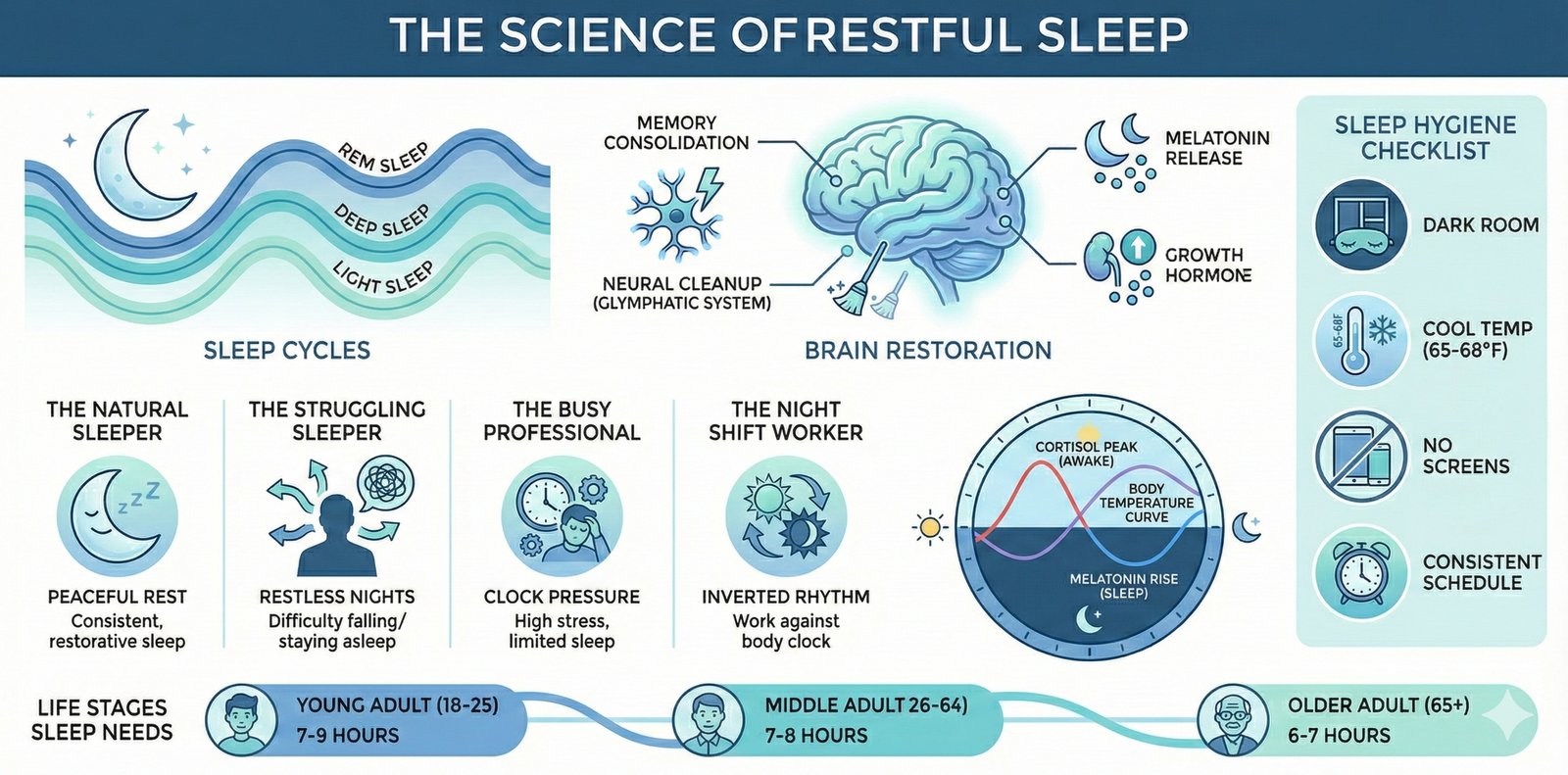
Did you know that humans spend about a third of their lives asleep? That's roughly 26 years of an 78-year lifespan dedicated to rest.
Sleep isn't a luxury—it's a biological necessity that determines your energy, immunity, and mental clarity.
What Is Sleep?
Sleep is a natural recurring state of rest and reduced consciousness. During sleep, your brain shifts into different modes of activity, cycling through several distinct stages over 90-minute intervals. Your eyes close, muscles relax, and your body temperature drops. But your brain doesn't shut down—it becomes remarkably active in specific ways. Sleep affects every system in your body: nervous, immune, endocrine, digestive, and cardiovascular. It's not a passive state of dormancy but an active process orchestrated by complex neural pathways and chemical signals throughout your brain and body.
Not medical advice.
Sleep involves two main types of activity: NREM sleep, which makes up 75-80% of your night, and REM sleep, which accounts for 20-25%. A complete sleep cycle lasts 90-110 minutes. Most people experience 4-5 cycles per night, with each cycle serving distinct biological purposes. Stage 1 NREM is the transition to sleep, lasting just a few minutes as your brain waves slow and your body begins to relax. Stage 2 NREM is when your brain begins organizing information and consolidating memories from the day, lasting 20-45 minutes. Stage 3 NREM, called slow-wave or deep sleep, is the most restorative phase when physical restoration happens—your body repairs muscles, strengthens immunity, and consolidates procedural memories. REM sleep, which occurs more in later cycles and can last up to 45 minutes, is when vivid dreams occur and emotional memories are processed.
Surprising Insight: Surprising Insight: Getting fewer than 7 hours of sleep is linked to a shorter lifespan. Recent research from 2025 shows that sleep duration impacts life expectancy more than diet, exercise, or loneliness—with only smoking being a stronger behavioral factor affecting how long you live.
Sleep Cycle Architecture
The 90-minute sleep cycle progresses through four distinct stages, repeating 4-5 times per night, with REM sleep becoming longer and more intense in later cycles.
🔍 Click to enlarge
Why Sleep Matters in 2026
In our hyperconnected, always-on culture, sleep is under siege. Phones glow in bedrooms. Work emails ping at night. Social media feeds run endless loops. News cycles never stop. Sleep deprivation has become normalized as a badge of productivity—'I'll sleep when I'm dead' has become a cultural mantra. But the science is clear: this is a crisis. Insufficient sleep is now recognized as a major public health challenge affecting millions worldwide. The CDC reports that 60% of American adults aren't getting enough sleep, a stunning statistic that reveals a population running on fumes.
Sleep impacts every dimension of your life and health. When you sleep well, your immune system strengthens, your heart stays healthy, your weight stabilizes, your mood lifts, and your brain performs at peak capacity. You think more clearly, solve problems more creatively, make better decisions, and handle emotions more skillfully. When you don't sleep enough, all of these systems suffer profoundly. One sleepless night impairs your attention, memory, and decision-making ability as much as being legally drunk. Chronic insufficient sleep contributes to obesity, diabetes, heart disease, depression, anxiety, and cognitive decline. Your risk of accidents skyrockets. Your ability to exercise discipline and resist temptation crumbles. Sleep deprivation doesn't just make you tired—it dismantles your mental and physical performance.
The CDC reports that 60% of American adults aren't getting enough sleep, making this one of the most pressing health issues of our time. This isn't just about feeling tired after a late night—it's about survival and longevity. Sleep scientists have found that sleep deserves the same priority in public health conversations as diet and exercise. Recent research from 2025-2026 shows that insufficient sleep is associated with decreased life expectancy, ranking behind only smoking as a behavioral driver of lifespan variation. That means your sleep habits may be more important than your exercise habits or diet choices for determining how long you live.
The Science Behind Sleep
Your circadian rhythm is your body's master clock. It's set primarily by light exposure and regulates your sleep-wake cycle over a 24-hour period. When light, especially blue light from the sun, hits your eyes in the morning, your brain suppresses melatonin production and you feel alert and energized. Your cortisol rises naturally to support wakefulness and activity. This triggers a cascade of hormonal and neurological changes that prepare your body and mind for action throughout the day. As darkness falls, melatonin rises and you become drowsy. Your body temperature naturally drops, and your nervous system begins shifting from activation to relaxation. This ancient rhythm has been hardwired into human biology for millions of years, and it remains powerful even in our modern world despite artificial lights and digital screens.
During sleep, your brain undergoes dramatic changes that are essential for health and function. In NREM sleep, your prefrontal cortex—responsible for logical thinking, decision-making, and impulse control—quiets down. Meanwhile, cerebrospinal fluid flow increases dramatically, creating a dynamic process called the glymphatic system. This system washes away metabolic waste products accumulated during wakefulness, including proteins like beta-amyloid that accumulate in neurodegenerative diseases like Alzheimer's. Your brain consolidates memories from short-term storage into long-term storage during NREM sleep, particularly during Stage 2 when sleep spindles burst occur. In REM sleep, your brain reactivates to process emotions, consolidate emotional memories, and support creative thinking. Different brain regions activate and deactivate in precise sequences. Your entire brain chemistry shifts—neurotransmitter levels change, new neural connections form, and old ones are pruned away.
Energy use changes dramatically during sleep stages. Your metabolic rate decreases as sleep deepens, conserving energy while your body performs essential maintenance functions. Blood flow patterns shift, with increased flow to areas supporting memory consolidation. Your body temperature drops by one to two degrees Fahrenheit, a critical signal that facilitates the transition to sleep and the progression through sleep stages. Heart rate slows. Blood pressure decreases. Muscle tension reduces except during REM sleep, when muscle atonia occurs—your voluntary muscles become paralyzed while your mind dreams, preventing you from acting out your dreams and injuring yourself.
Brain Changes During Sleep Stages
Different brain regions activate and deactivate during each sleep stage, with distinct patterns of metabolic activity and cerebrospinal fluid dynamics.
🔍 Click to enlarge
Key Components of Sleep
Sleep Duration
The CDC and American Academy of Sleep Medicine recommend at least 7 hours of sleep per night for adults aged 18-65. The Sleep Research Society concurs with this recommendation. Some people are genetically programmed to need 8-9 hours, and these natural long sleepers shouldn't fight their biology by forcing themselves into seven-hour sleep schedules. Sleep need is partly genetic, partly influenced by age, physical activity level, stress, and health status. If you consistently sleep less than 7 hours, your cognitive function, mood, and metabolism suffer. Studies show that people sleeping 5-6 hours nightly have increased risk of cardiovascular disease, obesity, and shorter lifespan compared to those sleeping 7-8 hours. Children need more sleep than adults—school-age children need 9-12 hours, and teenagers need 8-10 hours. Older adults still need 7-8 hours, though the composition of their sleep changes, with less deep sleep and more light sleep.
Sleep Quality
Duration alone isn't enough—the quality of your sleep matters deeply. Quality sleep means spending adequate time in deep sleep and REM sleep, not just light sleep. It means experiencing minimal arousals or awakenings during the night. It means waking feeling refreshed, restored, and ready to face the day. It means sleeping continuously rather than in fragmented pieces. Poor sleep quality occurs when you're interrupted frequently by noise, pets, partner movements, or nighttime bathroom trips. It occurs when you don't progress through all sleep stages fully, spending the entire night in light sleep without adequate deep sleep or REM sleep. Poor sleep quality is what many people experience even when they spend enough hours in bed. You might sleep 8 hours but feel exhausted if those hours lack depth and continuity because you're missing the restorative phases.
Sleep Consistency
Your body thrives on routine. Sleeping and waking at the same time every day—even weekends—trains your circadian rhythm and makes falling asleep easier. Your brain learns to expect sleep at a certain hour and gradually initiates the biochemical cascade that leads to sleepiness. This consistency is more important than adding an extra hour on weekends or sleeping in to catch up on sleep debt. Irregular sleep patterns confuse your circadian rhythm, making it harder to fall asleep and reducing sleep quality dramatically. This is why shift work disrupts health so profoundly—your body never adapts to irregular sleep schedules. Instead, consistency allows your circadian rhythm to synchronize with your chosen sleep schedule, making sleep automatic and natural rather than something you have to force.
Sleep Environment
Your bedroom powerfully influences sleep quality and the ability to fall asleep. Cool temperature, ideally between 60-67°F (16-19°C), promotes sleep because your body naturally drops temperature when preparing for rest. This temperature drop is one of the most powerful signals for sleep onset. A bedroom that's too warm prevents this natural cooling and makes deep sleep harder to achieve. Complete darkness—or as dark as possible—supports melatonin production because any light signals your brain that it's daytime and suppresses the sleep hormone. Even small amounts of light from digital clocks, phone lights, or street lights filtering through windows can disrupt sleep quality. Quiet environments allow your brain to relax without disturbance. White noise machines can help mask disruptive sounds. Comfortable bedding matters—your mattress should be supportive and your pillow should properly support your head and neck alignment. A bedroom reserved primarily for sleep, not for work or screens, trains your brain to associate it with rest.
| Stage | Duration per Cycle | Key Features | Primary Function |
|---|---|---|---|
| Stage 1 NREM | 5-10 min | Light sleep, easy to awaken, transition between wake and sleep | Transition to sleep |
| Stage 2 NREM | 45-55 min | Brain waves slow, body temperature drops, memory consolidation bursts | Memory organization and consolidation |
| Stage 3 NREM | 20-40 min | Slowest brain waves, hardest to awaken, deep restorative sleep | Physical restoration, immune strengthening |
| REM Sleep | 10-30 min | Rapid eye movements, vivid dreams, increased brain activity, emotional processing | Emotional memory processing, creativity, problem-solving |
How to Apply Sleep: Step by Step
- Step 1: Set a consistent sleep schedule: Choose a bedtime and wake time that aligns with your lifestyle and commit to it seven days a week, even weekends. Your brain needs consistency to regulate your circadian rhythm effectively.
- Step 2: Dim lights two hours before bed: Start reducing blue light exposure in the evening by using warm-light bulbs, wearing blue-light glasses, or enabling night mode on devices. This allows melatonin to rise naturally without interference from artificial light.
- Step 3: Create a cool, dark bedroom: Aim for 60-67°F (16-19°C), blackout curtains or an eye mask, and earplugs or white noise if needed. A dark, cool room signals your body it's time to sleep and facilitates the natural temperature drop necessary for sleep onset.
- Step 4: Avoid caffeine after 2 PM: Caffeine has a half-life of 5-6 hours, meaning half the caffeine remains in your system six hours after consumption. Even afternoon coffee can interfere with nighttime sleep, keeping your nervous system activated when it should be relaxing.
- Step 5: Stop eating heavy meals 3 hours before bed: Digestion requires energy and can interfere with sleep quality. However, a light snack with complex carbs and protein—like whole-grain toast with almond butter or yogurt with berries—can prevent hunger from waking you.
- Step 6: Exercise regularly, but not near bedtime: Physical activity improves sleep quality and duration by reducing stress and promoting deeper sleep, but intense exercise within 3 hours of bedtime can delay sleep onset by raising your heart rate and body temperature.
- Step 7: Develop a relaxing pre-sleep routine: Spend 20-30 minutes doing calming activities like reading, gentle stretching, meditation, journaling, or taking a warm bath. This signals your brain that sleep is approaching and helps you transition from the stimulation of the day.
- Step 8: Keep your bedroom for sleep and intimacy only: Avoid working, watching intense movies, or scrolling social media in bed. Your brain should associate your bedroom exclusively with rest and sleep, strengthening the connection between bed and sleep onset.
- Step 9: Manage stress during the day: Unresolved stress activates your nervous system and makes falling asleep harder. Use daytime strategies like exercise, journaling, social connection, and breathing exercises to reduce evening stress and racing thoughts.
- Step 10: Limit alcohol and avoid it near bedtime: While alcohol makes you drowsy, it fragments sleep and prevents deep sleep. If you drink, stop at least 3-4 hours before bed to allow your body to metabolize it before sleep.
Sleep Across Life Stages
Young Adulthood (18-35)
Young adults often feel invincible and minimize sleep's importance, viewing sleep as time lost to productivity. College all-nighters, startup culture, and early career demands create chronic sleep deprivation as a default. But your brain and body still need 7-9 hours every night to function optimally. Sleep deprivation during young adulthood impairs academic performance, increases accident risk, and sets the stage for long-term health problems that emerge later in life. Young adults also experience natural circadian rhythm shifts—an internal timing that makes falling asleep later feel more natural than in earlier years. This is called delayed sleep phase and is partly biological. Instead of fighting this biological tendency, optimize sleep quality by setting a consistent schedule that honors your natural rhythm and improving your sleep environment. The habits you build now determine your health trajectories for decades.
Middle Adulthood (35-55)
Middle-aged adults often juggle careers, children, aging parents, and financial pressures. Sleep gets squeezed as responsibilities expand. Hormonal changes, especially in women approaching menopause, can disrupt sleep with hot flashes and mood changes. Sleep disorders become increasingly common and often go undiagnosed. Yet this is the critical decade to protect sleep because the cumulative effects of poor sleep create health problems in older age—cardiovascular disease, cognitive decline, weight gain. Middle adults often benefit from being stricter about sleep schedules and addressing emerging sleep disorders early rather than letting them progress. Protecting sleep becomes an act of long-term health preservation.
Later Adulthood (55+)
Older adults sleep differently than younger adults. Sleep becomes lighter and more fragmented due to changes in circadian rhythm function and increased nighttime arousals. You spend more time in light sleep and less in restorative deep sleep. Nighttime bathroom trips increase due to changes in bladder function and fluid regulation. Sleep disorders like sleep apnea become more prevalent and often go untreated. However, you still need 7-8 hours of sleep for optimal health. The quality of sleep becomes even more critical because you're spending less time in restorative deep sleep, so the sleep you do get must be high-quality. Addressing sleep disorders, maintaining consistent schedules, and optimizing your sleep environment becomes critical for maintaining cognitive health, independence, and quality of life.
Profiles: Your Sleep Approach
The Natural Sleeper
- Consistent schedule to maintain natural rhythm
- Basic sleep environment optimization
- Stress management to prevent disruption
Common pitfall: Takes sleep for granted and doesn't protect it during busy periods, then sleep suffers dramatically
Best move: Maintain your sleep routine as non-negotiable, like a business meeting you don't cancel. Protect it fiercely.
The Struggling Sleeper
- Professional assessment for sleep disorders
- Environmental control like temperature, darkness, quiet
- Behavioral changes like consistent scheduling and wind-down routines
Common pitfall: Tries medication before addressing lifestyle factors, or gives up after one approach doesn't work immediately
Best move: Work with a sleep specialist to identify root causes, then systematically address them with professional guidance.
The Busy Professional
- Non-negotiable boundaries around sleep time
- Stress reduction and evening wind-down routine
- Strategic napping on travel days
Common pitfall: Sacrifices sleep to gain productivity, not realizing poor sleep destroys productivity and increases mistakes
Best move: Treat sleep as productivity investment—7 hours focused sleep beats 5 hours plus caffeine crashes and poor decisions.
The Night Shift Worker
- Blackout curtains for daytime sleep
- Strategic light exposure to reset circadian rhythm
- Consistency in shift schedule if possible
Common pitfall: Inconsistent sleep schedules that never allow circadian adaptation
Best move: Commit to the same sleep hours even on days off to give your body consistency to adapt to.
Common Sleep Mistakes
One of the biggest sleep mistakes is believing you can catch up by sleeping longer on weekends. While one extra hour might help slightly, sleeping until noon Saturday after staying up until 3 AM Friday doesn't restore you. Your circadian rhythm gets confused. You shift your sleep schedule backward, then try to snap back forward Monday morning, creating internal jet lag that makes the whole week harder. Your body can partially recover from one or two nights of poor sleep, but you can't fully make up for chronic sleep deprivation by oversleeping occasionally. Consistency matters more than total hours.
Another common mistake is using alcohol as a sleep aid. Alcohol does make you drowsy initially, but it destroys sleep quality. It prevents REM sleep and deep sleep, causing you to spend most of the night in light, fragmented sleep. You might sleep more hours but wake exhausted because you never entered restorative sleep stages. Over time, this pattern creates alcohol dependency and actually worsens insomnia. The initial sedative effect diminishes while the sleep-disrupting effects persist. There's no biological benefit to drinking before bed—only costs.
A third critical mistake is using your phone or laptop right before bed. Blue light suppresses melatonin, making your brain think it's daytime. The content itself—emails, news, social media—activates your nervous system and increases cortisol. You might eventually fall asleep, but your sleep will be lighter and more fragmented. You might experience racing thoughts even after you close the device. The stimulation you receive from screens lingers in your nervous system. Put devices away at least one hour before bed.
Sleep Mistakes and Solutions
Common sleep sabotage patterns paired with evidence-based alternatives that improve sleep quality.
🔍 Click to enlarge
Science and Studies
Sleep research has exploded in the past decade, with groundbreaking discoveries about how sleep affects every biological system. Here are key findings from recent research that demonstrate sleep's critical importance for health, longevity, and overall wellbeing. These studies represent consensus findings from major institutions, showing that sleep isn't optional—it's fundamental.
- OHSU (2025): A major study found that insufficient sleep is associated with decreased life expectancy, with sleep duration impacting lifespan more than diet, exercise, or loneliness—ranking only behind smoking as a behavioral factor affecting longevity.
- NIH/NHLBI Sleep Health Research: Sleep influences cardiometabolic health, immune function, brain health, and mental wellbeing. Sleep deprivation increases risk of cardiovascular disease, metabolic disorders, and cognitive decline across the lifespan.
- CDC Sleep Epidemiology: 60% of American adults don't get enough sleep. The CDC defines sufficient sleep as at least 7 hours nightly for adults, with 8-10 hours needed for teenagers and children.
- Harvard Medical School: Sleep deprivation impairs cognitive performance including attention, working memory, decision-making, and executive function. Even one night of poor sleep impacts brain function the next day.
- Nature Translational Psychiatry (2024): REM sleep loss has significant negative impacts on human brain connectivity and emotional regulation. REM sleep is crucial for processing emotions, maintaining mood stability, and creative thinking.
- Frontiers in Neuroscience (2025): Research shows how brain activity, energy use, and blood flow patterns change during sleep, with distinct patterns for each sleep stage supporting different biological functions.
- The Lancet Public Health: Sleep health deserves prioritization in global public health agendas alongside nutrition and physical activity due to its impact on chronic disease risk and mortality.
Your First Micro Habit
Start Small Today
Today's action: Tonight, set your bedroom temperature to 65°F (18°C) and commit to the same bedtime for three consecutive nights. This single change—cool temperature plus consistency—is one of the most powerful sleep improvements you can make immediately.
Temperature drop is your body's natural sleep signal. Consistency trains your circadian rhythm so your brain anticipates sleep at the same hour every night. These two changes together remove friction from sleep and create momentum. You'll likely notice deeper, longer sleep within days. The simplicity makes it sustainable.
Track your sleep timing and bedroom temperature in our app to build the consistency habit. Your AI mentor will remind you and help you overcome obstacles like late work meetings or social plans that threaten your schedule.
Quick Assessment
How would you describe your current sleep situation?
Your sleep baseline helps identify which changes will have the biggest impact. Struggling sleepers often benefit from professional assessment first. Occasional poor sleepers usually need lifestyle optimization. Already-good sleepers might explore advanced techniques for peak performance.
What's your biggest sleep challenge right now?
Different sleep problems have different solutions. Racing mind benefits from wind-down routines and stress management. Fragmented sleep often indicates sleep apnea or environmental factors. Early waking might signal mood or hormonal issues. Inconsistent schedule needs strict routine enforcement.
Which aspect of better sleep matters most to you right now?
Your primary motivation determines which sleep improvements you'll prioritize. Energy-focused people respond well to sleep tracking. Productivity-focused people benefit from sleep's cognitive advantages. Mood-focused people see rapid emotional benefits from better sleep. Health-focused people are motivated by longevity research.
Take our full assessment to get personalized recommendations for your unique sleep challenges.
Discover Your Style →Next Steps
Sleep isn't something to improve 'someday.' It's foundational. Everything else—your productivity, your mood, your health, your relationships, your longevity—depends on sleep. The changes that improve sleep are simple and free: consistent schedule, cool dark room, no screens before bed, stress management. Start with one change this week. Don't try everything at once. Build momentum by succeeding with one change, then add another. Small consistent changes compound into transformed sleep.
If you've tried these changes and still struggle, talk to a doctor. Sleep disorders like insomnia, sleep apnea, and restless leg syndrome are treatable. Don't accept chronic poor sleep as normal. Your health depends on addressing it. Sleep medicine specialists exist to help. Your sleep is too important to leave to chance.
Get personalized guidance with AI coaching to build better sleep habits.
Start Your Journey →Research Sources
This article is based on peer-reviewed research and authoritative sources. Below are the key references we consulted:
Related Glossary Articles
Frequently Asked Questions
How much sleep do I actually need?
Most adults need 7-9 hours per night, with 7 hours being the minimum recommended by health authorities like the CDC and American Academy of Sleep Medicine. Some people are genetically wired to need 8-9 hours. The best way to know your true need is to sleep without an alarm for a week on vacation—that natural sleep duration is likely your true need. Children need more (8-10 hours) and teenagers need 8-10 hours. Needs vary by genetics, age, physical activity level, and lifestyle demands.
Is it true that you can adapt to less sleep?
No, this is a persistent myth with dangerous health consequences. Your brain and body cannot adapt to chronic sleep deprivation. You might stop feeling as acutely sleepy after weeks of short sleep, but this is your brain adapting to sleep loss, not becoming less dependent on sleep. Your cognitive function, mood, immunity, and metabolism continue to suffer silently. Sleep deprivation impairs judgment so much that sleep-deprived people often can't accurately assess their own impairment.
What's the best sleeping position?
Sleeping on your back or side is generally better than sleeping on your stomach, which twists your spine and neck. Back sleeping is ideal for spine alignment but can worsen snoring or sleep apnea. Side sleeping is excellent for most people and reduces snoring. Choose whichever position feels comfortable—you'll naturally rotate positions during the night anyway. The most important factor is a supportive mattress and pillow that maintains proper spinal alignment.
Can I make up for lost sleep?
Partial recovery is possible if you've lost just one or two nights of sleep. Sleeping an extra hour or two in following nights helps restore some cognitive function. However, you can't fully make up for chronic sleep deprivation by oversleeping on weekends. This creates a pattern that actually worsens your sleep schedule and circadian rhythm. Consistency beats catch-up sleep every time.
What should I do if I can't fall asleep after 20 minutes?
Don't lie in bed fighting sleep—this trains your brain to associate bed with wakefulness and anxiety. After 20 minutes, get up and do something quiet and calming in dim light like reading, gentle stretching, or journaling until you feel sleepy. Then return to bed. This prevents 'performance anxiety' about sleep and strengthens the brain's association between bed and sleep onset. The goal is to make sleep automatic rather than something you struggle for.
Take the Next Step
Ready to improve your wellbeing? Take our free assessment to get personalized recommendations based on your unique situation.
- Discover your strengths and gaps
- Get personalized quick wins
- Track your progress over time
- Evidence-based strategies