Mind-Body Connection
You feel anxious and start pacing. You exercise and your mood lifts. A stressful thought makes your heart race. These experiences hint at something science has now confirmed: your mind and body are not separate systems but deeply interconnected through your brain's architecture.
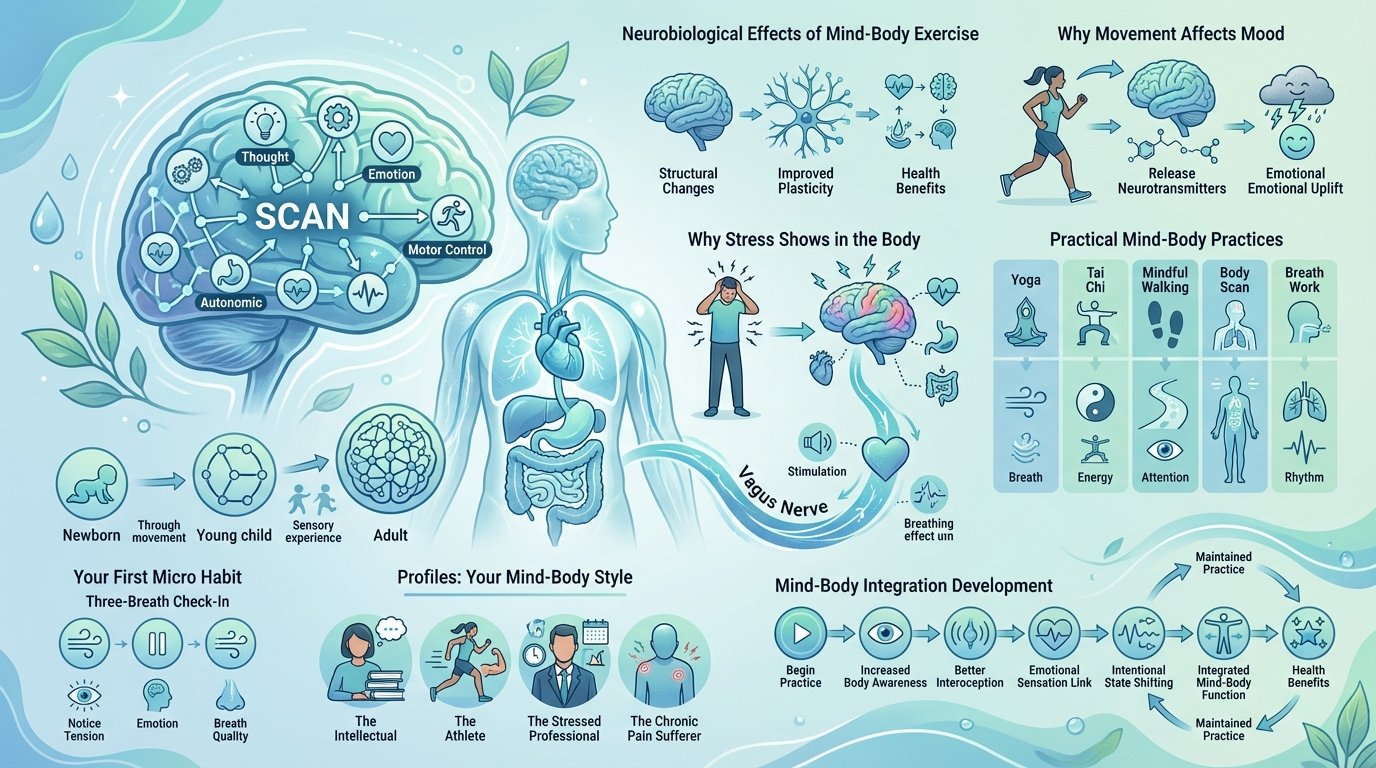
A groundbreaking study from Washington University School of Medicine discovered that the connection between body and mind is literally built into brain structure. Parts of the brain controlling movement are plugged into networks for thinking, planning, and even involuntary functions like blood pressure. This is not metaphor. It is anatomy.
What if understanding this connection could change how you approach health? Later sections reveal the newly discovered brain network that explains why movement affects mood and why mental states show up in physical symptoms. The implications transform how we think about exercise, stress, and healing.
Surprising Insight: Surprising Insight: Researchers named their discovery the Somato-Cognitive Action Network, or SCAN. This network was not detectable in newborns but clearly evident in one-year-olds and nearly adult-like in nine-year-olds. The mind-body connection literally develops through early life experience and movement.
The Science: How Mind-Body Connection Works
For decades, scientists assumed the brain's motor areas simply controlled movement. The new research published in Nature reveals something far more complex. Movement control areas connect directly to networks handling cognition, emotion, and autonomic functions.
The SCAN network explains phenomena that previously puzzled researchers. Why does anxiety make people pace? Because the thinking network and movement network are wired together. Why does exercise improve mood? Because activating movement areas also activates emotional regulation circuits.
Not medical advice.
The researchers scanned brains across development stages and even compared human brains to monkey brains. The SCAN network appears unique to humans or at least far more developed in our species. This may explain our unique capacity for intentional, goal-directed physical activity.
The SCAN Network: Mind-Body Brain Architecture
How brain areas connect body and mind
🔍 Click to enlarge
Mind-Body Connection Throughout Life
The SCAN network develops through early childhood. Newborns do not yet show this integration. By age one, the network is clearly visible. By age nine, it resembles adult patterns. This development happens through movement and sensory experience.
This finding has profound implications. Early movement experiences literally shape how mind and body connect. Children who move more may develop stronger mind-body integration. The playground is not just recreation but neurological development.
The connection can strengthen throughout life. Mind-body practices like yoga, tai chi, and mindful movement continue building these neural pathways. The brain remains plastic, meaning the mind-body connection can improve at any age with practice.
Neurobiological Effects of Mind-Body Exercise
A systematic review and meta-analysis investigated how mind-body exercise affects the brain. The results showed structural changes including increased gray matter volume in multiple brain regions. Movement literally builds brain tissue.
MRI studies show mind-body exercises affect brain plasticity and neural transmission. These changes correlate with health benefits including improved emotional regulation, reduced anxiety, and better cognitive function.
The 2024 Frontiers in Human Neuroscience research emphasized how integrative approaches from Eastern traditions are now validated by Western neuroscience. What yoga practitioners knew experientially, brain imaging confirms scientifically.
Practical Mind-Body Practices
Understanding the science points to practical applications. Any practice that combines movement with mental attention strengthens the mind-body connection. Some practices are particularly effective.
Yoga
Yoga integrates movement, breath, and attention in ways that directly engage the SCAN network. The focus required to hold poses while breathing consciously bridges body sensation and mental awareness. Regular practice increases interoception, your ability to sense internal body states.
Tai Chi
Tai chi involves slow, deliberate movement with mental focus on body position and energy flow. Research shows tai chi improves balance, reduces falls, and enhances cognitive function. The slow pace allows detailed attention to body sensation.
Mindful Walking
Simple walking becomes mind-body practice when done with attention. Notice the sensation of feet touching ground. Feel the shift of weight. Observe the rhythm of breath during movement. This transforms routine activity into neural training.
Body Scan Meditation
Body scan involves moving attention systematically through the body, noticing sensation without trying to change it. This builds interoceptive awareness, the foundation of mind-body connection. Regular practice increases sensitivity to subtle body signals.
Breath Work
Breath is unique because it operates both automatically and voluntarily. Conscious breathing practice bridges unconscious body functions and conscious mind. Different breathing patterns produce different mental and physical states.
| Practice | Primary Focus | Key Benefits | Time Investment | Difficulty |
|---|---|---|---|---|
| Yoga | Movement + breath | Flexibility, stress reduction, interoception | 30-60 min | Varies by style |
| Tai Chi | Slow movement | Balance, cognition, calm | 20-40 min | Beginner-friendly |
| Mindful Walking | Attention in motion | Accessible, mood boost | 10-30 min | Easy |
| Body Scan | Internal sensation | Body awareness, relaxation | 10-20 min | Easy |
| Breath Work | Conscious breathing | Immediate state change | 5-15 min | Easy |
Why Movement Affects Mood
The SCAN network discovery explains the well-established finding that exercise improves mental health. When you move, you activate brain areas that connect to emotional processing. Physical activation produces emotional effects through direct neural pathways.
This also explains why exercise works for depression and anxiety. You are not just distracting yourself from problems. You are literally changing brain state through body movement. The effect is neurological, not just psychological.
Exercise increases BDNF, brain-derived neurotrophic factor, which supports neuron growth and connection. Movement also stimulates neurotransmitter release including serotonin and dopamine. The brain chemistry changes through body chemistry.
How Movement Changes Brain State
Pathways from physical activity to mental effects
🔍 Click to enlarge
Why Stress Shows in the Body
The same neural architecture explains psychosomatic symptoms. Mental stress activates the SCAN network, which connects to autonomic functions. Your racing thoughts literally affect your heart rate, digestion, and muscle tension.
This is not imagining symptoms. The connection is physical and measurable. Chronic stress produces chronic physical effects because the mental and physical systems cannot be separated. Treating only the mind or only the body misses the integrated reality.
Understanding this integration changes treatment approaches. Physical interventions like massage, movement, or breathing can affect mental states. Mental interventions like therapy or meditation can affect physical symptoms. Both work through the same network.
Vagus Nerve: The Mind-Body Highway
The vagus nerve is a major pathway connecting brain and body. It influences heart rate, digestion, immune response, and mood. Vagal tone, the activity level of this nerve, correlates with emotional regulation capacity.
The SCAN discovery helps explain why stimulating the vagus nerve alleviates depression. You are activating a physical pathway that connects to emotional circuits. The treatment is physical but the effect is psychological.
Practices that stimulate the vagus nerve include cold exposure, singing, humming, and slow exhale breathing. These simple activities activate the parasympathetic nervous system and shift mental state through physical pathways.
- Step 1: Start with body scan meditation to build interoceptive awareness
- Step 2: Add five minutes of conscious breathing daily
- Step 3: Include some form of mindful movement three times weekly
- Step 4: Notice how physical sensations accompany emotional states
- Step 5: Use breath to shift state when stressed
- Step 6: Experiment with different practices to find what resonates
- Step 7: Practice slow exhale breathing to activate vagus nerve
- Step 8: Pay attention to posture and its effect on mood
- Step 9: Use movement deliberately to change mental state
- Step 10: Build daily practices that maintain mind-body connection
Mind-Body Connection and Pain
Pain illustrates mind-body integration vividly. Physical pain has psychological components. Psychological distress manifests as physical pain. The SCAN network helps explain why these are not separate phenomena.
Research on mindfulness-based interventions for pain shows that mental practices affect physical sensation. While placebo effects play a role, the changes are also neurological. Attention and interpretation shape pain experience.
Chronic pain often involves both physical and psychological factors interacting through shared neural circuits. Effective treatment frequently requires addressing both dimensions rather than treating them separately.
Creative Arts and Mind-Body Connection
Research concludes that creative arts function as complementary therapeutic strategy by engaging shared neural mechanisms with emotional regulation. Making art, music, or movement engages the mind-body connection in healing ways.
Dance combines movement, music, and expression in ways that deeply engage the SCAN network. Playing music involves precise motor control with emotional expression. Visual art creation involves body position and attention with creative cognition.
These activities are not just pleasant diversions. They actively strengthen mind-body integration while providing therapeutic benefits. Art therapy works through the same neural architecture that connects movement and emotion.
Profiles: Your Mind-Body Style
The Intellectual
- Practices that get out of the head
- Understanding the science to buy in
- Gentle entry points that don't feel foreign
Common pitfall: Treating mind-body practice as another intellectual exercise
Best move: Start with breath work where counting provides cognitive anchor while accessing body.
The Athlete
- Internal focus during familiar movement
- Slowing down to notice sensation
- Practices that complement rather than replace activity
Common pitfall: Pushing through rather than tuning in
Best move: Add mindful attention to existing exercise. Notice body sensation during workout.
The Stressed Professional
- Quick practices for busy schedule
- Techniques usable anywhere
- Stress relief as immediate benefit
Common pitfall: Treating mind-body practice as another task to accomplish
Best move: Use breath work during transitions between activities. One minute is enough.
The Chronic Pain Sufferer
- Gentle approaches that respect limitations
- Understanding pain is real, not imagined
- Hope without dismissing experience
Common pitfall: Pushing into pain or avoiding all sensation
Best move: Body scan starting with comfortable areas. Build tolerance for attention to sensation.
Measuring Mind-Body Connection
A new questionnaire called the Body-Mind Connection Questionnaire (BMCQ) provides the first validated self-report measure of mind-body integration. It assesses interoceptive attentional control, ability to link sensations and emotions, and broader mind-body values.
Research tools now allow objective measurement of what was previously subjective. Brain imaging shows structural and functional changes from mind-body practice. Self-report measures track experiential changes over time.
This measurement capacity advances the field from intuition to evidence. Practices can be compared. Outcomes can be tracked. What works and for whom can be determined scientifically.
Mind-Body Integration Development
How practice builds stronger connection
🔍 Click to enlarge
Your First Micro Habit
The Three-Breath Check-In
Today's action: Three times daily, pause and take three slow breaths while noticing: Where do I feel tension in my body? What emotion am I experiencing? What is the quality of my breathing? This takes about thirty seconds and builds interoceptive awareness.
Brief check-ins throughout the day build the mind-body connection more effectively than occasional long practices. You are training attention to notice the link between physical sensation and mental state. Frequency matters more than duration for building awareness.
Track your mind-body check-ins and notice patterns in how physical and emotional states connect with personalized AI guidance.
Quick Assessment
How aware are you of physical sensations in your body throughout the day?
Your interoceptive awareness level indicates how developed your mind-body connection currently is and where to focus practice.
When you feel a strong emotion, do you notice where it shows up in your body?
The ability to link emotions and physical sensations is central to mind-body integration and can be developed through practice.
Which approach to mind-body practice appeals to you most?
Your preferred entry point helps determine which practices to try first for sustainable mind-body development.
Take our full assessment to understand your current mind-body integration and get personalized practice recommendations.
Discover Your Mind-Body Type →Next Steps
The mind-body connection is not mystical but neurological. Understanding the science empowers practical application. Your brain already has the architecture connecting thought, emotion, and body. Practice strengthens these connections.
Start with the three-breath check-in micro habit. This simple practice builds awareness of how physical and mental states connect in your own experience. Thirty seconds three times daily creates more change than occasional longer sessions.
Explore related topics including meditation practices, breathing techniques, mental wellness, and stress reduction to find practices that fit your preferences and lifestyle.
Get personalized mind-body practices with AI coaching that tracks your progress and adapts recommendations.
Strengthen Your Mind-Body Link →Research Sources
This article is based on peer-reviewed research and authoritative sources. Below are the key references we consulted:
Related Glossary Articles
Frequently Asked Questions
Is mind-body connection real or just belief?
Brain imaging research confirms the connection is structural and neurological. The SCAN network discovery published in Nature shows mind and body share neural circuits. The connection is anatomical, not just psychological.
Can mind-body practices treat physical illness?
Mind-body practices complement medical treatment but do not replace it. Research supports benefits for stress-related conditions, chronic pain, and mental health. Always work with healthcare providers for medical conditions.
How long until I notice benefits from mind-body practice?
Many people notice immediate effects like reduced tension or improved mood. Structural brain changes appear after weeks to months of regular practice. Building strong interoceptive awareness typically takes months of consistent practice.
Do I need to do yoga to build mind-body connection?
No. Any practice combining movement or body awareness with mental attention builds the connection. Walking mindfully, breath work, body scan, tai chi, and many other practices work. Choose what appeals to you.
Why do I feel emotions in my body?
The SCAN network connects emotional processing areas with body control areas. Emotions produce physical changes through direct neural pathways. Feeling emotions physically is normal neurology, not imagination.
Can mind-body practices help anxiety?
Research supports mind-body practices for anxiety management. The mechanisms include vagus nerve activation, stress hormone reduction, and direct effects on emotional circuits through movement. They work best alongside other appropriate treatments.
Is the mind-body connection the same across cultures?
Eastern traditions have recognized and developed mind-body integration for millennia. Western science now confirms and explains what these traditions practiced. The underlying neurology is universal; the practices vary culturally.
Can children develop mind-body connection?
The SCAN network develops throughout childhood. Movement experiences build these neural pathways. Physical play, yoga for kids, and mindful movement all support mind-body development. Early experiences matter.
Take the Next Step
Ready to improve your wellbeing? Take our free assessment to get personalized recommendations based on your unique situation.
- Discover your strengths and gaps
- Get personalized quick wins
- Track your progress over time
- Evidence-based strategies