Holistic Wellness
You eat well but feel emotionally drained. You exercise regularly but lack purpose. You have career success but your relationships suffer. Addressing health in isolation misses how deeply all dimensions connect. This is why conventional approaches often fail despite effort.
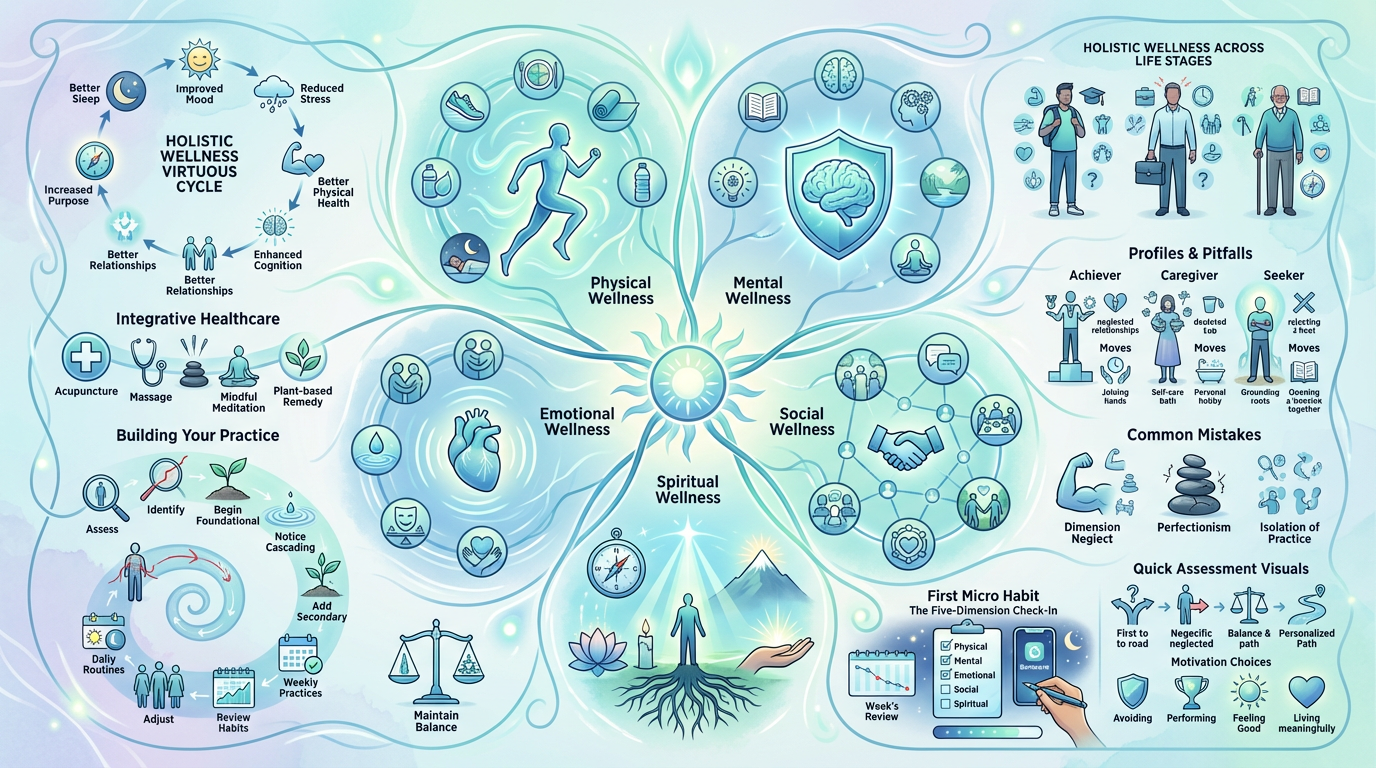
Holistic wellness treats you as a complete person, not a collection of separate systems. Physical health affects mental state. Emotional wellbeing influences physical symptoms. Social connection impacts longevity. Spiritual meaning shapes everything. These dimensions cannot be separated in reality, so why separate them in treatment?
The Harvard Study of Adult Development, running for over 75 years, reveals what actually creates good lives. The clearest message is this: good relationships keep us happier and healthier. Later sections explore how integrating all wellness dimensions creates outcomes impossible through isolated approaches.
Surprising Insight: Surprising Insight: The longest running study on human happiness found that the quality of your relationships at age 50 predicts your health at age 80 better than your cholesterol levels. Social connection is not soft psychology but hard biology affecting health outcomes decades later.
What Is Holistic Wellness?
Holistic wellness is an approach to health that considers the whole person in their environment. It integrates physical, mental, emotional, social, and spiritual dimensions rather than treating each separately. The word holistic comes from the Greek holos meaning whole.
This approach recognizes that problems in one dimension affect others. Chronic stress (mental) causes physical symptoms. Physical illness affects emotional state. Social isolation damages physical health. Treating symptoms without addressing root causes in connected dimensions provides temporary relief at best.
Not medical advice.
Holistic wellness does not reject conventional medicine but integrates it with complementary approaches. Hospitals increasingly offer acupuncture, massage therapy, and mind-body practices alongside conventional treatments. This represents mainstream recognition of holistic principles.
Dimensions of Holistic Wellness
Interconnected aspects of whole-person health
🔍 Click to enlarge
The Five Dimensions of Holistic Wellness
Physical Wellness
Physical wellness involves caring for your body through nutrition, movement, sleep, and preventive care. It forms the foundation supporting other dimensions. Without adequate sleep, emotional regulation suffers. Without proper nutrition, cognitive function declines.
Physical wellness is not about perfect fitness but sustainable practices that maintain body function. Regular movement matters more than intense exercise. Adequate sleep matters more than optimized supplements. Consistency trumps intensity.
Mental Wellness
Mental wellness encompasses cognitive function, focus, learning, and management of mental health challenges. It involves both developing capabilities and addressing difficulties. A sharp mind that processes anxiety poorly is not mentally well.
Mental wellness requires both stimulation and rest. Continuous cognitive demand without recovery degrades function. Learning new skills builds cognitive reserve. Managing stress prevents mental resource depletion.
Emotional Wellness
Emotional wellness means the ability to understand, express, and regulate emotions. It includes experiencing positive emotions and navigating negative ones without being overwhelmed. Emotional wellness is not constant happiness but emotional literacy and resilience.
Self-compassion is central to emotional wellness. Treating yourself with the kindness you would offer a friend creates emotional stability. Harsh self-criticism damages emotional wellness regardless of external success.
Social Wellness
Social wellness involves healthy relationships, sense of belonging, and meaningful connection. The Harvard study found relationships are the strongest predictor of health and happiness. Loneliness is as damaging to health as smoking.
Quality matters more than quantity. A few deep connections provide more benefit than many superficial ones. Vulnerability and authenticity in relationships create the protective effects that casual contact cannot.
Spiritual Wellness
Spiritual wellness involves sense of purpose, meaning, and connection to something larger than yourself. This does not require religious belief. Purpose can come from family, work, creativity, or contribution. What matters is feeling that life has meaning.
Spiritual wellness anchors other dimensions. Purpose provides motivation during physical difficulty. Meaning sustains during emotional pain. Values guide decisions when circumstances are unclear.
| Dimension | Core Focus | Key Practices | Warning Signs of Imbalance |
|---|---|---|---|
| Physical | Body function and vitality | Sleep, nutrition, movement | Fatigue, illness, low energy |
| Mental | Cognitive health and focus | Learning, stress management, rest | Brain fog, anxiety, burnout |
| Emotional | Emotional regulation | Self-compassion, expression, processing | Mood swings, numbness, overwhelm |
| Social | Connection and belonging | Relationships, community, vulnerability | Isolation, conflict, loneliness |
| Spiritual | Purpose and meaning | Values, contribution, reflection | Emptiness, lack of direction, nihilism |
Why Holistic Approach Works Better
Conventional approaches often address symptoms without root causes. You treat insomnia with sleep medication without addressing the anxiety causing it. You address anxiety with therapy without considering the nutritional deficiencies affecting brain chemistry. Problems persist because connected factors are ignored.
Holistic approaches create virtuous cycles. Better sleep improves emotional regulation. Better emotional regulation reduces stress. Lower stress improves physical health. Improved physical health enhances cognitive function. Each improvement amplifies others.
Research increasingly validates holistic approaches. The gut-brain connection shows digestive health affects mental state. Psychoneuroimmunology demonstrates how thoughts affect immune function. The mind-body connection is built into brain architecture. Science confirms what holistic practitioners intuited.
Holistic Wellness Virtuous Cycle
How improvements in one dimension cascade to others
🔍 Click to enlarge
Integrative Healthcare: Holistic Goes Mainstream
Integration of holistic wellness into mainstream healthcare represents significant shift toward patient-centered care. Hospitals offer complementary therapies including acupuncture, massage therapy, and mind-body practices alongside conventional treatments.
Holistic approaches integrate social determinants of health, trauma-informed care, behavioral health, spiritual care, and coaching models into health systems. This is evidence-based, accountable, and outcome-oriented work, not alternative medicine separate from mainstream practice.
Corporate wellness programs evolved to address holistic employee needs. Mental health support, fitness programs, and flexible work arrangements promote work-life balance. Comprehensive initiatives recognize that worker health cannot be separated into physical-only programs.
Building Your Holistic Wellness Practice
Creating holistic wellness requires attention to all dimensions without overwhelming yourself. The approach is gradual integration, not simultaneous transformation.
- Step 1: Assess current state across all five dimensions
- Step 2: Identify the dimension most affecting others negatively
- Step 3: Begin with foundational practices in that dimension
- Step 4: Notice how improvements cascade to other areas
- Step 5: Add practices addressing secondary dimension
- Step 6: Build daily routines that touch multiple dimensions
- Step 7: Create weekly practices for dimensions needing more time
- Step 8: Develop monthly and quarterly review habits
- Step 9: Adjust practices based on life season and needs
- Step 10: Maintain balance by monitoring all dimensions regularly
Holistic Wellness Across Life Stages
Young Adulthood (18-35)
Foundation building years. Physical resilience allows neglect without immediate consequences, creating dangerous habits. Social dimension is often strong but may lack depth. Purpose and meaning questions emerge. Establish sustainable practices before consequences teach harder lessons.
Middle Adulthood (35-55)
Peak responsibility years strain multiple dimensions simultaneously. Career demands affect physical health. Family obligations test emotional resources. Social connections often narrow to work and family. Spiritual questions intensify. Balance becomes essential rather than optional.
Later Adulthood (55+)
Physical dimension requires more attention as body changes. Mental wellness involves cognitive maintenance. Social dimension faces losses requiring intentional rebuilding. Spiritual dimension often strengthens as mortality awareness grows. Integration and acceptance characterize mature holistic wellness.
Profiles: Your Holistic Wellness Pattern
The Achiever
- Permission for rest and play
- Spiritual dimension development
- Relationship prioritization
Common pitfall: Neglecting social and spiritual for physical and mental achievement
Best move: Schedule relationship time like important meetings. Success without connection is hollow.
The Caregiver
- Self-care without guilt
- Physical wellness attention
- Personal purpose beyond serving others
Common pitfall: Depleting all dimensions while giving to others
Best move: Recognize that self-care enables better care of others. You cannot pour from empty cup.
The Seeker
- Grounding in physical dimension
- Social connection practice
- Integration of insights into action
Common pitfall: Strong spiritual focus without physical and social foundation
Best move: Embody spiritual insights through physical practice and relationship engagement.
The Skeptic
- Evidence-based entry points
- Personal experimentation
- Gradual expansion beyond physical
Common pitfall: Dismissing dimensions that cannot be measured easily
Best move: Start with physical wellness, add mental practices, let experience open to other dimensions.
Common Holistic Wellness Mistakes
Dimension neglect is the most common mistake. Focusing intensely on physical fitness while ignoring emotional health. Developing spiritually while relationships deteriorate. Holistic means all dimensions, not just favorite ones.
Perfectionism in each dimension creates unsustainable demands. Holistic wellness is not maximizing every dimension but maintaining adequate function across all. Good enough in each dimension beats excellent in some and failing in others.
Isolation of practice separates what should be integrated. Exercise can be social. Cooking can be mindful. Work can be meaningful. The most sustainable practices address multiple dimensions simultaneously.
Your First Micro Habit
The Five-Dimension Check-In
Today's action: Each evening, take two minutes to rate each wellness dimension 1-10: Physical, Mental, Emotional, Social, Spiritual. Notice patterns over a week. Which dimension consistently scores lowest? That is where to focus first.
Awareness precedes change. Most people have blind spots about neglected dimensions. Brief daily tracking reveals patterns invisible in busy daily life. The check-in takes seconds but provides crucial information for holistic wellness development.
Track all five wellness dimensions and get personalized recommendations for balanced development with AI coaching.
Quick Assessment
Which wellness dimension do you tend to neglect most?
Your neglected dimension is often the key to unlocking improvements across all areas. Addressing it creates cascading benefits.
How do you typically approach health and wellness?
Your current approach reveals whether you need to expand focus, become proactive, improve balance, or deepen existing practice.
What most motivates your wellness efforts?
Your motivation source suggests which dimension anchors your wellness and which might need more attention for balance.
Take our full assessment to understand your holistic wellness profile and get personalized recommendations for all dimensions.
Discover Your Wellness Balance →Next Steps
Holistic wellness is not about doing more but integrating what you do. The five-dimension check-in micro habit creates awareness that guides action. Start there to identify your priority area.
Explore the dimension you most neglect first. Small improvements in your weakest area often create the largest overall gains. Balance improves faster by addressing weakness than by further strengthening strengths.
Related topics including wellness practices, mind-body connection, mental wellness, and emotional wellbeing provide depth in specific dimensions while maintaining holistic perspective.
Get personalized guidance for developing all five wellness dimensions with AI coaching that tracks your progress holistically.
Balance Your Wellness →Research Sources
This article is based on peer-reviewed research and authoritative sources. Below are the key references we consulted:
Related Glossary Articles
Frequently Asked Questions
Is holistic wellness the same as alternative medicine?
No. Holistic wellness integrates conventional and complementary approaches. It does not reject mainstream medicine but expands focus to include all health dimensions. Many hospitals now incorporate holistic approaches into standard care.
Do I need to address all dimensions equally?
No. Dimensions require different attention at different times. The goal is adequate function across all, not equal investment. Your weakest dimension often needs most attention. Balance means no dimension is severely neglected.
Can I practice holistic wellness without spirituality?
Yes. Spiritual dimension involves purpose and meaning, not necessarily religious belief. Meaning can come from family, work, creativity, or contribution. What matters is feeling life has significance, however you define that.
How is holistic wellness different from self-care?
Self-care is component of holistic wellness, usually focused on physical and emotional dimensions. Holistic wellness is broader, including mental, social, and spiritual dimensions plus their interconnections. Self-care without holistic awareness may miss important areas.
Does holistic wellness require lots of time?
Not necessarily. Many practices address multiple dimensions simultaneously. A walk with a friend covers physical and social. Meaningful work addresses mental and spiritual. Integration makes holistic wellness time-efficient.
What if my environment does not support holistic wellness?
Environment shapes but does not determine wellness. Some dimensions are harder to develop in unsupportive contexts. Focus on what you can control while working to improve or change limiting circumstances. Small practices accumulate despite obstacles.
How do I know if holistic approach is working?
Track all dimensions over time. Notice if improvements in one area affect others. Holistic wellness shows cascading benefits. If practicing in one dimension does not affect others, integration may be missing.
Can holistic wellness help with serious health conditions?
Holistic approaches complement but do not replace medical treatment for serious conditions. They can improve quality of life, support recovery, and address dimensions medicine does not target. Always work with healthcare providers for medical conditions.
Take the Next Step
Ready to improve your wellbeing? Take our free assessment to get personalized recommendations based on your unique situation.
- Discover your strengths and gaps
- Get personalized quick wins
- Track your progress over time
- Evidence-based strategies