Supplements
Are you spending money on supplements that might not actually help you? The supplement industry is worth over $177 billion globally, yet most of that investment comes from people taking vitamins they don't need. The truth is nuanced: while certain supplements can be genuinely life-changing for specific people with documented deficiencies, most multivitamins taken by healthy people have zero measurable impact on longevity, disease prevention, or overall wellness. Understanding the science behind supplements means learning which ones have solid evidence, who really needs them, and how to get your nutrients primarily through food. This guide cuts through marketing claims to show you the real evidence.
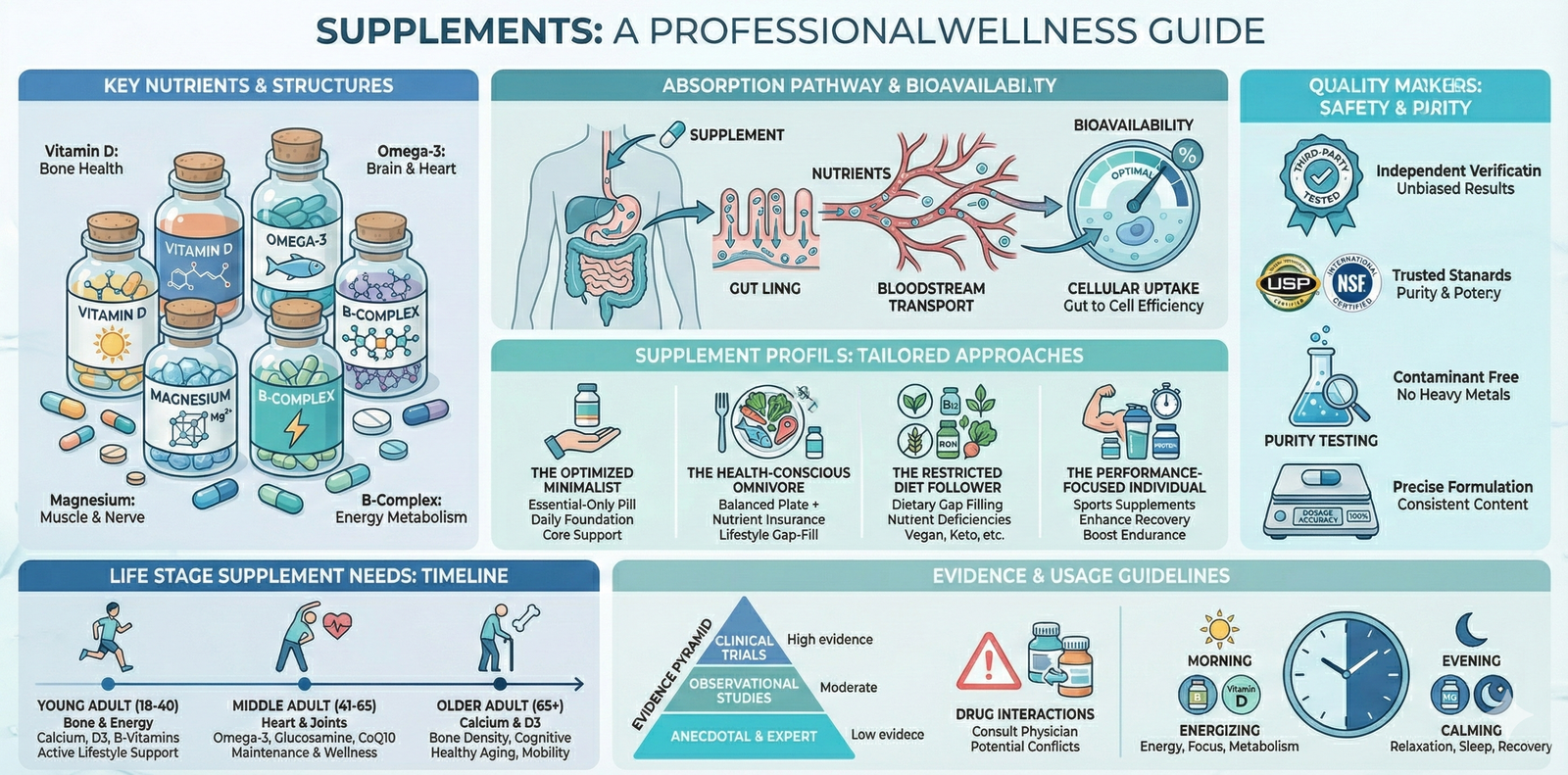
Between 58-75% of American adults take at least one supplement daily, making it one of the most common health behaviors. Yet the NIH Office of Dietary Supplements has found that most people taking supplements don't actually have the nutritional deficiencies those supplements address. The key to smarter supplementation isn't taking more pills—it's understanding your actual needs and choosing strategically.
The evidence shows that your food choices matter far more than your supplement cabinet. A person eating whole foods, fruits, vegetables, and adequate protein will nearly always have better health outcomes than someone eating poorly while loading up on expensive supplements. But there are specific exceptions where supplementation genuinely moves the needle on health.
What Is Supplements?
Supplements are products containing vitamins, minerals, amino acids, herbs, or other dietary substances intended to supplement the diet. They come in many forms: tablets, capsules, powders, liquids, and even gummies. Technically, the FDA regulates supplements as food, not as drugs, which means they don't go through the same rigorous testing and approval process that medications do. This regulatory difference is crucial—manufacturers don't have to prove that a supplement is effective before selling it, and they don't have to verify the contents match what's on the label. A 2025 study found that about 21% of supplement products tested contained ingredients not listed on the label.
Not medical advice.
The global supplement market has expanded 8-10% annually over the past decade, driven largely by wellness marketing rather than new scientific breakthroughs. Supplements fill a psychological need: they make people feel proactive about their health. They're also convenient—taking a pill feels easier than overhauling your diet. But convenience doesn't equal effectiveness. The scientific evidence suggests that for most healthy people, supplements are a solution looking for a problem.
Surprising Insight: Surprising Insight: After a 12-year study of over 14,000 doctors taking multivitamins, researchers found zero difference in heart attacks, strokes, cancer, or mortality compared to those taking placebos. The same findings held in multiple large studies—multivitamins simply don't prevent disease in people who aren't deficient.
When Supplements Actually Help vs. Marketing Hype
Visual showing the evidence pyramid for different supplement categories from high-evidence (specific deficiency correction) to low-evidence (general wellness claims)
🔍 Click to enlarge
Why Supplements Matter in 2026
Supplement literacy has become a critical health skill in 2026. Unlike previous decades when supplements were niche products, they're now mainstream, often recommended by influencers, wellness coaches, and even some doctors without proper evidence. The average American is exposed to supplement marketing dozens of times daily through social media, podcasts, and health content. Learning to separate evidence from hype directly impacts your health outcomes and your wallet. Many people spend $500-$2000 yearly on supplements with minimal or zero benefit.
The regulatory landscape has also become more complex. While the FDA has increased enforcement against false claims, the supplement industry's scale makes monitoring difficult. 2025 studies showed that a significant percentage of supplement products either didn't contain the ingredients they claimed or contained dangerous contaminants. For consumers, this means understanding which supplements are worth the risk and which are definitively a waste of money.
From a longevity perspective, your supplement strategy should match your life stage. Young adults with adequate food intake need almost no supplements. Middle-aged adults benefit from targeted supplementation for specific conditions. Older adults have genuine nutritional needs that supplements can address. The scientific evidence shows clear differences in who benefits and who doesn't. Making these distinctions saves money and prevents unnecessary supplement-related health risks.
The Science Behind Supplements
The scientific research on supplements reveals a striking pattern: the more carefully a study is conducted, the fewer benefits supplements show. Large randomized controlled trials consistently find minimal benefits from popular supplements like multivitamins, vitamin E, and beta-carotene. The U.S. Preventive Services Task Force, after reviewing thousands of studies, concluded that there's insufficient evidence to recommend multivitamins for disease prevention in healthy adults. Even more striking: some supplements like beta-carotene and vitamin E showed potential harm in high doses. Meanwhile, the few supplements with solid evidence—like vitamin D for people in dark climates, or magnesium for migraine sufferers—address specific biological needs rather than general wellness.
Bioavailability has emerged as a crucial factor in supplement effectiveness. A 2025 analysis found that modern supplement formulations using permeation enhancers, lipid-based delivery, and encapsulation technologies can actually exceed the bioavailability of naturally-occurring nutrients in food. This is counterintuitive but important: a well-formulated supplement might deliver nutrients better than a poorly-cooked vegetable. However, whole foods still win overall because they contain thousands of compounds that supplements don't—phytochemicals, fiber, and compounds we haven't even identified yet. The research suggests supplementing should be targeted and specific, not general and broad.
Nutrient Absorption: Food vs. Supplements
Comparison showing bioavailability percentages for key nutrients from whole foods versus supplement forms, including modern enhanced formulations
🔍 Click to enlarge
Key Components of Supplements
Vitamins: Organic Micronutrients
Vitamins are organic compounds that your body cannot produce in sufficient quantities, requiring dietary intake. They function as coenzymes, helping enzymes carry out metabolic reactions. There are 13 essential vitamins (A, C, D, E, K, and the B-complex family), each with distinct roles. Fat-soluble vitamins (A, D, E, K) can accumulate in body fat and reach toxic levels if over-supplemented, while water-soluble vitamins (C and B-complex) are excreted in urine, making overdose less likely but also meaning storage is impossible. The evidence strongly supports getting vitamins primarily from food because food provides vitamins in the complex, balanced ratios your body evolved to process.
Minerals: Inorganic Micronutrients
Minerals like calcium, magnesium, zinc, and iron are inorganic substances that your body requires for hundreds of physiological processes. They're structural components of bones, teeth, and proteins, and they're essential for nerve transmission, muscle contraction, and immune function. Unlike vitamins, minerals maintain their chemical structure and cannot be damaged by heat or processing. Interestingly, the form of mineral in a supplement matters significantly—organic forms (like calcium citrate) are often absorbed better than inorganic forms (like calcium carbonate). A 2025 meta-analysis found that magnesium supplementation specifically can reduce migraine frequency by an average of 2.5 attacks per month and reduce severity—one of the few minerals with robust clinical evidence.
Amino Acids and Protein Derivatives
Amino acids are the building blocks of protein, and some supplement manufacturers sell them separately. For healthy people eating adequate protein, amino acid supplements are unnecessary—your digestive system breaks down protein into amino acids perfectly well. However, branched-chain amino acids (BCAAs) and creatine have some evidence, particularly for athletic performance. Creatine supplementation has shown consistent benefits for strength, muscle mass, and even cognitive function in well-designed studies. A 2024 meta-analysis found that creatine improved working memory and processing speed in healthy young adults. This is a rare example of a supplement with solid performance evidence for non-deficient populations.
Herbal Compounds and Phytonutrients
Herbal supplements and plant-based compounds like curcumin, resveratrol, and various botanicals are heavily marketed with wellness claims. The evidence for most is weak or mixed. Some herbs have active compounds with genuine biological effects—turmeric contains curcumin which shows anti-inflammatory properties in laboratory settings. However, most herbal supplements suffer from poor bioavailability and inconsistent potency. The FDA doesn't require supplements to prove efficacy, so manufacturers can make vague claims like 'supports wellness' without actual evidence. Your best approach is high skepticism toward herbal supplements unless a specific compound has robust clinical trial evidence, which few do.
| Supplement | Strength of Evidence | Best For | Potential Risks |
|---|---|---|---|
| Vitamin D | Strong | People with limited sun exposure, bone health | Rare toxicity at very high doses |
| Vitamin B12 | Strong | Vegans, older adults, pernicious anemia | Virtually none; water-soluble |
| Folic Acid | Strong | Women planning pregnancy, preventing neural tube defects | Can mask B12 deficiency if high dose |
| Magnesium | Moderate | Migraine prevention, muscle function | Digestive upset at high doses |
| Creatine | Moderate | Muscle strength and cognitive function | Dehydration risk; requires adequate water |
| Omega-3 (Fish Oil) | Moderate | High triglycerides, not general health | Blood thinning at high doses; GI upset |
| Calcium | Mixed | Bone health if dietary intake low | May interfere with iron absorption |
| Iron | Strong (if deficient) | Diagnosed anemia only | GI upset, constipation; dangerous if not deficient |
| Multivitamins | Weak | Very narrow diet, documented deficiency | General ineffectiveness; wasted money |
| Most Herbal Supplements | Very Weak | Minimal evidence for any condition | Quality control issues; contamination risk |
How to Apply Supplements: Step by Step
- Step 1: Assess Your Current Diet: Spend one week tracking what you eat using an app like Cronometer. This shows your actual micronutrient intake and reveals real deficiencies rather than assumed ones. Most people discover they get far more nutrients than they thought and have zero deficiencies.
- Step 2: Get Blood Work Done: Ask your doctor to test key nutrients: vitamin D, B12, iron (ferritin), and magnesium. Supplementing without knowing your actual status is shooting in the dark. This is especially important if you have digestive issues, follow restrictive diets, or are over 50.
- Step 3: Prioritize Food First: Before buying any supplement, optimize your diet. Increasing vegetable intake, adding fatty fish twice weekly, eating nuts and seeds, and ensuring adequate protein addresses 95% of micronutrient needs for most people. Food provides vitamins in combination with fiber, antioxidants, and other beneficial compounds supplements can't replicate.
- Step 4: Choose Only Evidence-Based Supplements: Based on your blood work and diet analysis, select supplements with documented effectiveness for your situation. If you're not deficient in something, supplementing it won't help you. This typically means no more than 1-3 supplements maximum.
- Step 5: Start with Dosing Guidelines: Follow the recommended dietary allowance (RDA) from the NIH, not the 'maximum daily value' you see on labels. Higher doses don't help and can cause harm. For most nutrients, more isn't better.
- Step 6: Time Supplementation Strategically: Fat-soluble vitamins (A, D, E, K) absorb better with food containing fat. Take them with your largest meal. Water-soluble vitamins (C and B-complex) are less timing-dependent but take in the morning with food to reduce stomach upset.
- Step 7: Choose Quality Brands: Verify that supplements are third-party tested by organizations like ConsumerLabs or USP. These tests confirm that the bottle actually contains what the label claims. Quality matters because contamination is a real issue in the supplement industry.
- Step 8: Monitor and Reassess: Supplement for 2-3 months, then reassess. Are you feeling better? Has your energy improved? If not, discontinue. Many supplements take time to show effects, but if you don't notice improvements after 12 weeks, it's probably not working for you personally.
- Step 9: Track Supplementation: Keep a simple log of what you're taking, doses, and any changes you notice. This prevents accidentally double-dosing and helps you identify which supplements actually make a difference in how you feel.
- Step 10: Consult About Drug Interactions: Some supplements interfere with medications. Ask your pharmacist or doctor about interactions, especially if you're on blood thinners, diabetes medications, or other prescriptions. This is a critical safety step.
Supplements Across Life Stages
Young Adulthood (18-35)
If you're eating a reasonably balanced diet, you likely need zero supplements at this life stage. Your body is at peak nutrient absorption, your metabolic needs are straightforward, and you have decades of time to build good habits. The only potential exceptions: if you're vegan (vitamin B12), training intensively (creatine has solid evidence for muscle gain), or living somewhere with minimal sun exposure (vitamin D). Most young adults taking multivitamins are wasting money. The better investment is spending that supplement money on better food quality—organic produce, wild-caught fish, pasture-raised eggs. At this stage, your job is to build food-based nutrition habits that serve you for life. Supplements can't make up for poor food choices, so focus on the fundamentals first.
Middle Adulthood (35-55)
By your late 30s, some targeted supplementation may become relevant, depending on health conditions and dietary gaps. If you have high triglycerides, omega-3 supplementation has documented benefits. If you get migraines, magnesium may help—the research is solid on this one. If you follow a vegetarian diet, B12 becomes important. If you had digestive issues (Crohn's, IBS) or certain medications affecting absorption, supplementation becomes more justified. At this life stage, get blood work done to check vitamin D, B12, and iron status. Many women become iron-deficient during their 40s and 50s due to heavy menstrual bleeding, and iron deficiency significantly impacts energy and cognitive function. Men should focus on vitamin D and B12 if eating few animal products. This is the life stage where individualized supplementation, based on your actual needs, makes sense.
Later Adulthood (55+)
After 55, nutritional support becomes more medically justified. Absorption of certain nutrients decreases with age—vitamin B12 absorption drops significantly because stomach acid production declines. Vitamin D becomes more critical because skin synthesis becomes less efficient and sun exposure often decreases. Calcium and magnesium needs don't increase, but the risk of deficiency does if dietary intake is inadequate. Recent research found that multivitamin-mineral supplements containing vitamins C, D, E, B-complex, zinc, copper, magnesium, and selenium significantly improved cognition and memory in older adults over two years. At this life stage, a carefully chosen supplement regimen based on blood work is reasonable. However, even here, the evidence is strongest for addressing documented deficiencies rather than general wellness. Work with your doctor to identify actual needs rather than taking a broad-spectrum multivitamin.
Profiles: Your Supplement Approach
The Optimized Minimalist
- One comprehensive blood test showing actual deficiencies
- Simple targeted supplementation (maximum 2-3 supplements)
- Focus on food quality over supplementation
Common pitfall: Completely dismissing supplements even when genuinely deficient, missing opportunities for targeted help
Best move: Get blood work done annually, supplement only documented deficiencies, invest supplement money into better food instead
The Health-Conscious Omnivore
- Vitamin D if living in low-sunlight area
- Potential omega-3 if not eating fatty fish regularly
- Magnesium if prone to migraines or muscle tension
Common pitfall: Taking expensive multivitamins despite excellent diet, following wellness trends without evidence
Best move: Skip the multivitamin, take 1-2 targeted supplements based on personal risk factors, focus on nutrient-dense foods
The Restricted Diet Follower
- Vitamin B12 if vegan (critical)
- Iron if female and menstruating on plant-based diet
- Calcium if avoiding dairy, vitamin D year-round
Common pitfall: Believing your restrictive diet is automatically complete, ignoring nutrients only found in eliminated food groups
Best move: Be strategic with specific supplements your diet cannot provide, get annual blood work, consider nutrient-density in food choices
The Performance-Focused Individual
- Creatine monohydrate (strong evidence for strength)
- Adequate protein from food (not amino acid supplements)
- Magnesium for muscle recovery and sleep
Common pitfall: Buying expensive proprietary supplement blends with minimal evidence, confusing activity with results
Best move: Focus on creatine (cheap, proven), protein timing, and recovery. Skip trendy supplements. Get strength training right first
Common Supplements Mistakes
The biggest mistake is taking supplements to compensate for a poor diet. A multivitamin cannot make up for eating processed foods high in sugar and low in vegetables. The research is clear: all the supplements in the world won't give you the health benefits of eating whole foods. Another common error is high-dose supplementation of fat-soluble vitamins. Vitamin D toxicity is rare but possible; excessive vitamin A (in retinoid form) can damage the liver; vitamin E and beta-carotene at high doses may increase mortality risk. Many people also make the mistake of taking supplements long-term without reassessing. After 12 weeks, if a supplement hasn't improved your symptoms or blood markers, discontinue it. Supplements should solve a problem or address a documented deficiency—not be a permanent ritual.
A third mistake is trusting supplement labels without verification. The supplement industry has significant quality control issues. Third-party testing organizations like ConsumerLabs have found products containing undeclared ingredients, missing active ingredients, or dangerous contaminants. Don't just buy based on brand reputation—verify third-party testing. Another error is combining multiple supplements without considering interactions. Vitamin K interferes with blood thinners; high calcium interferes with iron absorption; certain herbs interact with prescription medications. Supplements are drugs—they have mechanisms of action and potential side effects. Treat them with appropriate caution.
Finally, many people make the mistake of treating supplements as insurance against unhealthy living. Taking a multivitamin while eating poorly, sleeping badly, and avoiding exercise doesn't improve health outcomes. The evidence shows that lifestyle fundamentals—food quality, sleep, movement, stress management—matter exponentially more than supplementation. Your supplement strategy should enhance an already-solid foundation, not replace it. Start with excellent nutrition habits first.
Decision Tree: Do You Actually Need This Supplement?
Flowchart to help determine if a specific supplement is worth taking based on evidence and personal circumstances
🔍 Click to enlarge
Science and Studies
The strongest body of evidence on supplements comes from large randomized controlled trials, meta-analyses of multiple studies, and systematic reviews from institutions like the NIH and Harvard Medical School. Research from Johns Hopkins Medicine, Stanford University, the American Medical Association, and the U.S. Preventive Services Task Force consistently reaches similar conclusions: broad-spectrum supplementation for healthy people without documented deficiencies produces minimal benefits. However, targeted supplementation for specific deficiencies or health conditions with proven supplements has documented value. The research landscape has shifted significantly over the past 5 years, with more rigorous studies revealing that many previously-popular supplements don't deliver benefits that justify their cost.
- NIH Office of Dietary Supplements (2024-2025): Comprehensive fact sheets on individual nutrients, showing evidence levels for different health conditions and populations
- Dietary Supplement Investigation (PMC, 2021): Meta-analysis showing multivitamin supplements have no effect on cardiovascular disease, cancer, or mortality in healthy people; U.S. Preventive Services Task Force does not recommend them for disease prevention
- Magnesium and Migraine Study (2024): Meta-analysis demonstrating magnesium supplementation reduces migraine frequency by ~2.5 attacks per month and reduces severity, with moderate-quality evidence
- Creatine and Cognition Meta-Analysis (2024): Review showing creatine improves working memory and processing speed in healthy young adults; one of the few supplements with evidence beyond muscle building
- Micronutrient Supplementation Review (Frontiers in Nutrition, 2025): Analysis showing that while bioavailability of modern supplement formulations can exceed whole food sources, routine indiscriminate supplementation for disease prevention lacks scientific support
Your First Micro Habit
Start Small Today
Today's action: This week, track your current diet using the free Cronometer app (or simple food log) for just 3 days. See your actual micronutrient intake compared to recommended amounts. This single action reveals whether you actually have nutrient gaps or if you're just buying supplements unnecessarily.
You can't fix a problem you haven't measured. Most people discover they get adequate vitamins and minerals from food alone. This data-driven approach prevents wasting money on supplements you don't need while identifying real gaps worth addressing. It's the opposite of supplements-first thinking—it's evidence-first thinking.
Keep quitting habit apps after a missed day? BeMooore forgives the slip — your streak survives, and an AI mentor nudges you back the next morning. Free on iOS.
Quick Assessment
How do you currently approach supplementation in your life?
Your answer reveals your supplement philosophy. Those taking broad supplements without testing are likely wasting money. Those with targeted approaches based on evidence are making smarter decisions. The most effective approach combines blood work (knowing your actual status) with strategic supplementation (only taking what you genuinely need).
What's your biggest concern about your current nutritional status?
Your concern shapes your supplement strategy. If you have dietary restrictions or absorption issues, strategic supplementation is justified. If you feel fine, formal blood work should be your first step—don't supplement based on worry alone. If you're optimizing an already-healthy status, focus on the highest-ROI supplements with solid evidence.
How much do you typically spend on supplements annually?
Higher spending doesn't equal better health. Research shows that people spending $300+ yearly often see zero additional health benefits compared to those spending $100 or less, IF the higher-spending group takes supplements they don't need. Your spending should match your documented needs from blood work, not marketing messaging. Consider reallocating that money to premium whole foods instead.
Take our full assessment to get personalized recommendations for your specific situation.
Discover Your Style →Next Steps
Your next step is concrete: Schedule a blood test with your doctor checking vitamin D, B12, iron (ferritin), and magnesium levels. Don't supplement blindly—measure first. This $200-400 investment in information will likely save you thousands in unnecessary supplements. You'll know exactly what you need and what you don't. Based on those results, you'll know whether you're the person who needs supplements or the person saving money by skipping them.
In the meantime, use the Cronometer app (free) to track three days of eating and see your micronutrient intake. This gives you concrete data on whether your diet is actually creating deficiencies. Most people discover their diet is better than they thought. Combine blood work + diet tracking, and you'll have the information you need to make evidence-based supplement decisions instead of marketing-driven ones. This is the mindset shift that matters: measure before you buy, skip supplements that address non-existent problems, and invest that money in food quality instead.
Get personalized guidance with AI coaching on nutrition and supplement strategy.
Start Your Journey →Research Sources
This article is based on peer-reviewed research and authoritative sources. Below are the key references we consulted:
Related Glossary Articles
Frequently Asked Questions
Should I take a multivitamin if I eat a balanced diet?
Research shows that multivitamins provide no health benefit for people eating a balanced diet. A 12-year study of 14,000 physicians found zero difference in heart disease, cancer, or mortality between those taking multivitamins and those taking placebos. Save your money and invest in food quality instead.
How do I know if I actually have a nutrient deficiency?
Get blood work done. Ask your doctor to test vitamin D, B12, iron (ferritin), and magnesium levels. Don't guess or rely on symptoms—nutrient deficiencies show up in blood tests. Cronometer (free app) can also estimate your daily intake from food. Most people discover they get enough nutrients without supplements.
Which supplements actually have scientific evidence?
Supplements with strong evidence include: Vitamin D (low sunlight areas), Vitamin B12 (vegans/older adults), Folic acid (pregnancy), Iron (diagnosed anemia), Magnesium (migraines), and Creatine (strength/cognition). Most other popular supplements lack robust evidence. If a supplement isn't on this short list, ask yourself why you're taking it.
Can supplements interact with medications?
Yes, definitely. Vitamin K interferes with blood thinners. High-dose calcium interferes with some antibiotics. Certain herbs interact with prescription medications. Always ask your pharmacist about supplement-drug interactions, especially if you're on medications. Don't assume supplements are automatically safe just because they're natural.
What's the difference between food-based and synthetic supplements?
For most nutrients, there's no meaningful difference in effectiveness between natural and synthetic forms. What matters far more is bioavailability (how well you absorb it) and potency (whether the label claims match actual content). Third-party testing matters more than the 'natural' label. Some people report different tolerability between forms, but this is individual.
Take the Next Step
Ready to improve your wellbeing? Take our free assessment to get personalized recommendations based on your unique situation.
- Discover your strengths and gaps
- Get personalized quick wins
- Track your progress over time
- Evidence-based strategies