Learning
Learning is the transformative process of acquiring new knowledge, skills, and understanding through experience and practice. It's not passive—your brain actively rewires itself every time you absorb something new. This isn't just about school or credentials. Learning fuels happiness, builds confidence, keeps your mind young, and opens doors to opportunities you can't yet see. In 2026, when everything changes rapidly, learning is your superpower. The ability to adapt, grow, and discover is what separates thriving from merely surviving.
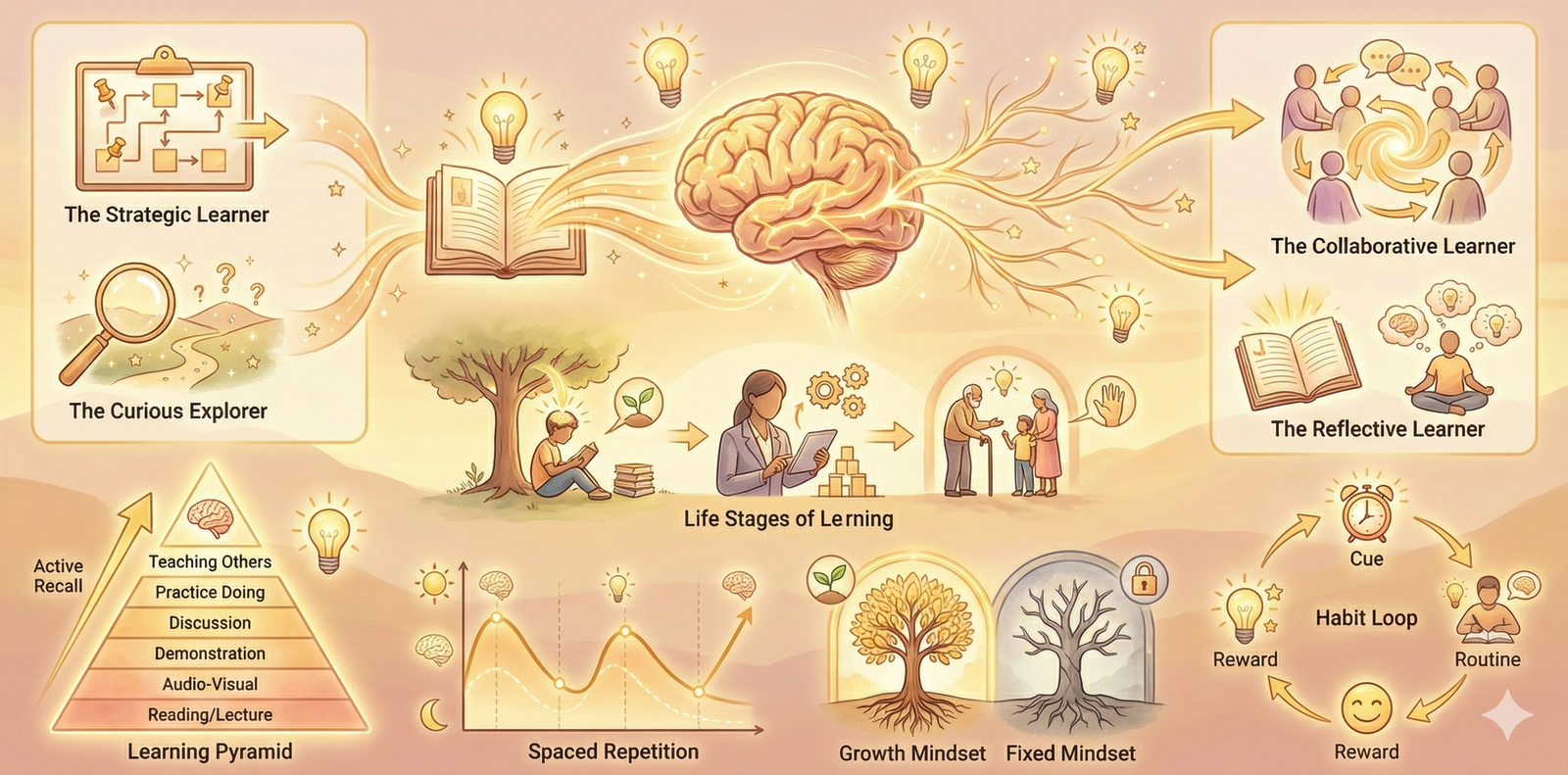
What if everything you learned about studying was wrong? Cramming, rereading, and passive review waste hours. Research shows strategic learning techniques can double retention.
Your brain isn't fixed. It rewires itself throughout your entire life. This neuroplasticity means learning doesn't slow down with age—it evolves.
What Is Learning?
Learning is the cognitive process of acquiring new knowledge, skills, attitudes, and behaviors through study, experience, observation, and instruction. It involves transforming information into meaningful understanding that you can apply and recall. Learning happens when your brain forms new neural connections and strengthens existing ones through repeated practice and reinforcement. It's both a biological process (neuroplasticity) and a behavioral outcome (changed capability).
Not medical advice.
Learning occurs across the lifespan in formal settings (classrooms, courses), informal contexts (reading, hobbies, conversations), and through direct experience (trial and error, mentorship). Modern science reveals that effective learning combines multiple strategies: spacing out study sessions, actively retrieving information from memory, metacognitive awareness (thinking about thinking), and connecting new information to existing knowledge. Learning is the foundation of personal growth, career success, relationship quality, and lifelong wellbeing.
Surprising Insight: Surprising Insight: Students who practiced retrieval by self-testing retained 80% of material after one week, compared to only 34% retention for those using passive review—making study method more important than study time.
The Learning Cycle: From Exposure to Mastery
A cyclical diagram showing how learning progresses through exposure, engagement, retrieval practice, consolidation, and application, with feedback loops for continued improvement
🔍 Click to enlarge
Why Learning Matters in 2026
The world changes faster than ever. In 2026, skills that seemed permanent become outdated. Jobs evolve. Technologies emerge. The competitive edge belongs to lifelong learners who adapt quickly. Learning isn't just career insurance—it's joy. Discovering new ideas activates the brain's reward systems, releasing dopamine. Learning builds self-efficacy, that quiet confidence that you can handle challenges. When you learn, you're literally rewiring your brain for resilience.
Learning protects mental health. Cognitive engagement reduces anxiety, depression, and cognitive decline with age. Older adults who engage in learning show better memory, faster processing speed, and higher life satisfaction. Learning combats stagnation. When we stop learning, boredom and disconnection creep in. Happiness research shows that people who grow—who challenge themselves—report higher fulfillment than those in static comfort.
Learning strengthens relationships. When you understand others' perspectives through learning about psychology, culture, communication, you connect deeper. It opens economic opportunity. Higher education correlates with better earnings, but so does continuous skill development. Learning is social currency in a knowledge economy. Most importantly, learning is what makes us human—the ability to imagine futures we haven't lived, to understand worlds we haven't explored, to become versions of ourselves we haven't yet met.
The Science Behind Learning
Learning is a biological process rooted in neuroplasticity—the brain's ability to reorganize neural connections in response to experience. When you learn something new, your brain doesn't just store information like a computer. Instead, neurons form new connections, existing pathways strengthen, and neurotransmitters reset. Long-term potentiation (LTP) is the mechanism: repeated neural firing strengthens synaptic connections, making information transfer easier. This is why practice matters. Each repetition reinforces the pathway.
The brain also exhibits neurogenesis—the creation of entirely new neurons—especially in the hippocampus (memory center) and prefrontal cortex (executive function). Physical exercise, cognitive challenge, sleep, and novel experience all trigger neurogenesis. This means your brain's learning capacity isn't fixed. It grows throughout life. Even at seventy, your brain can form new connections, learn new languages, master new skills. The research is clear: neuroplasticity doesn't decline with age—it adapts. Younger brains change faster through novelty; older brains excel at deep learning through experience and pattern recognition.
How the Brain Learns: From Neurons to Memory
Detailed diagram showing synaptic connections, neurotransmitter release, receptor activation, and how repeated stimulation strengthens connections through long-term potentiation
🔍 Click to enlarge
Key Components of Learning
Spaced Repetition
Spaced repetition is the strategy of reviewing information at increasing intervals: after one day, three days, one week, two weeks, one month. Each time you review, you reset the forgetting curve and deepen the memory trace. Research shows spaced repetition more than doubles retention compared to cramming. The spacing effect works because each retrieval attempt strengthens the memory and extends the time before you forget. Spaced repetition is the backbone of effective learning. It's why flashcard apps like Anki work—they optimize spacing automatically.
Active Recall
Active recall is retrieving information from memory without looking at notes. Instead of rereading, you close the book and answer questions from memory. This is the testing effect: the act of retrieving information strengthens memory more than exposure. Active recall activates the brain's retrieval pathways, making future recall easier. It reveals gaps in knowledge immediately. Flashcards, practice quizzes, teaching others, and summarizing from memory all use active recall. Research from Roediger and Karpicke found that students using retrieval practice retained 80% of material after one week versus 34% for passive review—a 235% improvement.
Metacognition
Metacognition is thinking about your own thinking—awareness of what you know, what you don't know, and how to learn effectively. It includes self-monitoring (assessing your understanding), self-regulation (adjusting your strategy), and reflection (analyzing what worked). People with strong metacognitive skills notice when they're confused, seek clarification, switch strategies when stuck, and review what they learned. Metacognition is learnable. Asking yourself questions like 'Do I understand this concept?' 'Can I explain this to someone else?' and 'What's my next learning step?' builds metacognitive awareness. Studies show children with stronger metacognitive strategies have better learning outcomes across ages 3 to 19.
Elaboration & Connection
Elaboration is connecting new information to existing knowledge. When you learn a concept, you strengthen understanding by asking: Why does this matter? How does this relate to what I already know? What's an example? Elaboration creates multiple retrieval cues—different pathways to access the memory. The more connections you make, the more ways you can retrieve the information. Connection is why storytelling aids learning: stories provide context and emotional resonance that isolated facts lack. Elaborative interrogation (asking and answering 'why' and 'how' questions) is a powerful learning strategy supported by research.
| Strategy | Effectiveness | Best Use |
|---|---|---|
| Active Recall/Testing | High | Assess understanding, create memory strength |
| Spaced Repetition | High | Long-term retention, skill mastery |
| Elaboration | High | Understanding connections, transfer to new domains |
| Metacognition | Moderate-High | Optimizing personal study approach |
| Interleaving | Moderate-High | Discrimination between concepts, problem-solving |
| Distributed Practice | High | All learning outcomes |
| Massed Practice/Cramming | Low | Short-term recall only, poor long-term retention |
| Rereading | Low | Inefficient for long-term memory |
| Passive Highlighting | Low | False sense of fluency, minimal retention |
How to Apply Learning: Step by Step
- Step 1: Clarify Your Goal: Define specifically what you want to learn. Not 'learn Spanish' but 'understand conversational Spanish at A2 level' or 'read academic papers in my field.' Specific goals guide strategy choice.
- Step 2: Survey the Material: Before diving deep, get the big picture. Read summaries, watch overview videos, scan chapter headings, look at diagrams. This creates mental scaffolding for detailed learning.
- Step 3: Engage Actively: Don't passively consume. Take notes in your own words (not verbatim transcription). Ask questions. Predict answers before reading them. Create examples. Your brain learns through effort.
- Step 4: Use Retrieval Practice: Test yourself regularly without looking at notes. Use flashcards, practice problems, quizzes, or teach someone else. The struggle of retrieval strengthens memory.
- Step 5: Space Your Learning: Don't cram. Study for 30-50 minutes, then space your next session by at least one day. Optimal spacing increases with material complexity and your desired retention duration.
- Step 6: Elaborate Connections: Connect new knowledge to what you know. Ask: Why does this work? How does this relate to concepts I've learned? What are real-world applications? Elaboration deepens understanding.
- Step 7: Interleave Problems: Don't practice one type of problem repeatedly. Mix problem types. Switch topics. Interleaving feels harder but builds flexible, transferable learning.
- Step 8: Review and Reflect: Periodically review what you learned. Reflect on what worked, what confused you, what you need to deepen. Reflection drives metacognitive growth and reveals gaps.
- Step 9: Apply Knowledge: Use what you've learned in real contexts: teach others, solve new problems, create projects. Application reveals shallow versus deep learning and builds long-term retention.
- Step 10: Build Learning Habits: Make learning a consistent practice, not a one-time event. Micro-learning (15 minutes daily) beats occasional cram sessions. Habits compound learning over years and decades.
Learning Across Life Stages
Young Adulthood (18-35)
Your brain has peak neuroplasticity in young adulthood—changes happen faster, memory is quick, learning feels easy. This is a critical window for foundational skills and identity formation. Your challenge isn't capability; it's direction. You have infinite potential but limited time. Use this stage to learn deeply (not just widely). Build strong fundamentals in your field. Develop meta-learning skills—learn how you learn best. Seek diverse experiences: different cultures, professions, perspectives. Your brain is optimized for novelty; use it.
Middle Adulthood (35-55)
Your learning style shifts. You learn best when information connects to experience and purpose. You're less interested in abstract theory; you want practical application. Your memory for facts may slow slightly, but your pattern recognition excels. Use this advantage. Learn from your accumulated experience. Your strength is making connections others miss. You might pursue career pivots, leadership development, or deeper mastery in your domain. Middle adulthood is when you transition from accumulating knowledge to synthesizing wisdom. Teach others—it deepens your own learning.
Later Adulthood (55+)
Neuroplasticity persists throughout life. Older adults show slower learning speed but often superior depth of understanding. Your advantage is pattern recognition and wisdom. Learning in later adulthood combats cognitive decline, maintains neural health, and boosts wellbeing. Choose learning with intrinsic meaning—not to impress anyone, but because it fascinates you. Legacy learning is powerful: learning to pass knowledge to younger generations. You have accumulated decades of tacit knowledge. Share it. Keep your brain active: language learning, new skills, intellectual hobbies. The research is clear: cognitive engagement predicts better aging.
Profiles: Your Learning Approach
The Strategic Learner
- Clear goals and measurable milestones
- Structured learning paths and timelines
- Feedback on progress
Common pitfall: Becomes so focused on efficiency that learning feels mechanical; misses joy and serendipitous discovery
Best move: Build in time for exploration. Efficiency matters, but so does curiosity. Balance structure with flexibility.
The Curious Explorer
- Freedom to follow interests and make unexpected connections
- Diverse resources and exposure to multiple domains
- Permission to meander without judgment
Common pitfall: Breadth without depth; never completes anything or develops mastery in any area
Best move: Channel curiosity into focused projects. Set one deep-learning goal per year, then explore around it.
The Collaborative Learner
- Learning communities and group discussions
- Opportunities to teach and explain to others
- Social accountability and shared goals
Common pitfall: Dependent on external validation; struggles with independent learning and self-direction
Best move: Build peer learning groups, but also practice solo learning. Develop internal motivation alongside community support.
The Reflective Learner
- Time to process and integrate new information
- Opportunities for self-assessment and metacognitive reflection
- Low-pressure environments for experimentation
Common pitfall: Over-analyzes and second-guesses; slow to act on knowledge; gets stuck in planning without execution
Best move: Balance reflection with action. Set regular review intervals, then commit to applying what you learn.
Common Learning Mistakes
Mistake 1: Passive Review Without Testing. Rereading notes, highlighting textbooks, and watching videos without self-testing creates fluency illusion—you feel like you know it, but you don't. Your brain confuses familiarity with learning. Instead, close the book and retrieve. Test yourself. Research shows this is the single highest-impact change most learners can make.
Mistake 2: Cramming Instead of Spacing. Last-minute marathon study sessions transfer information to short-term memory, not long-term. You'll forget within days. Spacing out study is harder (it requires planning and consistency), but retention is 2-3x better. Space matters more than time spent.
Mistake 3: Learning in Isolation Without Elaboration. You memorize facts but don't understand why they matter or how they connect. Elaboration—asking why, making examples, connecting to prior knowledge—is what creates deep learning. Without elaboration, knowledge is shallow and doesn't transfer to new problems.
The Forgetting Curve vs. Spaced Review Strategy
Comparison showing how retention drops dramatically without review (classic forgetting curve) versus how spaced repetition resets the curve, resulting in exponentially better long-term retention
🔍 Click to enlarge
Science and Studies
Learning science is one of the most researched areas in psychology and education. Decades of cognitive science research have identified evidence-based strategies that work across ages, domains, and learner types. Below are the most important findings and sources:
- Roediger & Karpicke (2006): The testing effect showed students using retrieval practice retained 80% after one week versus 34% for passive study—demonstrating that testing is more powerful than rereading.
- Dunlosky et al. (2013): A comprehensive meta-analysis identified spaced repetition and distributed practice as high-utility learning strategies effective across ages 8 to older adults.
- Ebbinghaus (1885): Foundational research on the forgetting curve showed that spacing review intervals dramatically improves retention, a principle still foundational to learning science today.
- Zimmerman (2002) & Schunk: Research on self-regulated learning showed metacognitive monitoring and strategy adjustment predict learning outcomes more than ability alone.
- Bjork & Bjork (1992): Desirable difficulties theory showed that learning feels easier with rereading but spacing, testing, and interleaving create stronger long-term learning despite feeling harder during learning.
- National Institutes of Health & Cognitive Science Research (2024-2025): Recent research confirms neuroplasticity persists across the lifespan and that learning-induced neurogenesis maintains cognitive function in aging.
- Knowles & Adult Learning Theory (2025): Andragogy research shows adults learn best when information connects to experience, when they're self-directed, and when learning has immediate application.
Your First Micro Habit
Start Small Today
Today's action: Choose one thing you want to learn this week. Commit to 15 minutes daily of active practice (retrieval, not passive review). Write one quiz question and answer it without looking. That's it. One micro-habit: daily active learning.
Micro-learning builds the learning habit without overwhelming. Fifteen minutes daily outperforms two-hour cram sessions. Active retrieval (answering your own question) activates learning more than passive review. Consistency matters more than duration. Starting tiny builds momentum and sustainable learning identity.
Track your learning sessions and get personalized suggestions with the Bemooore app. Build the learning habit with AI coaching that adapts to your pace and learning style.
Quick Assessment
What's your current relationship with learning?
Your learning identity shapes your growth. If you see yourself as a learner, you're more likely to persist through difficulty and view challenges as opportunities.
Which learning strategy have you tried before?
The most effective learners use multiple strategies. The jump from passive review to active retrieval multiplies learning outcomes. Consider experimenting with testing and spacing.
What motivates your learning most?
All motivations work, but intrinsic motivation (learning because you're curious) predicts persistence and joy. If you're extrinsically motivated, consider connecting learning to deeper interests.
Take our full assessment to get personalized learning recommendations.
Discover Your Style →Next Steps
Learning is the foundation of everything—career success, relationship quality, personal growth, aging well, and lasting happiness. You've now learned the science. The next step is application. Pick one learning goal. One thing you want to understand, master, or become skilled at in the next three months.
Apply what you learned: use spacing (review after 1 day, 3 days, 1 week), active retrieval (test yourself), elaboration (connect to prior knowledge), and metacognition (reflect on what's working). Start with your 15-minute micro-habit. Build the learning identity. Watch how it compounds. Every day you learn, your brain strengthens. Every skill you master opens new possibilities. Learning isn't a destination—it's the journey itself.
Get personalized learning guidance and build sustainable growth habits with AI coaching.
Start Your Journey →Research Sources
This article is based on peer-reviewed research and authoritative sources. Below are the key references we consulted:
Related Glossary Articles
Frequently Asked Questions
How long does it take to learn something well?
The 10,000-hour rule is partly myth. Deliberate practice—focused, challenging, with feedback—matters more than hours. Complex skills (languages, music, expertise) take years. Simple skills take weeks. Quality of practice matters far more than quantity. Spacing and active retrieval compress the timeline significantly compared to passive review.
Can adults learn as well as young people?
Yes, but differently. Young brains change faster through novelty. Older adults learn more slowly but often achieve deeper understanding. Older learners excel at pattern recognition and integrating new information with experience. Research shows neuroplasticity and neurogenesis continue throughout life. The key advantage of youth is speed; the advantage of age is wisdom.
Does learning style (visual, auditory, kinesthetic) matter?
Learning style theory is popular but not well-supported by research. Most people benefit from multiple modalities. What matters is engaging with material actively and meaningfully. A visual learner still learns better through retrieval practice than passive image review. Don't let learning style become an excuse—engage with the material in ways that work for you, but prioritize effective learning principles over learning style matching.
How do I stay motivated to keep learning when it's hard?
Connect learning to meaning. Why do you want to learn this? How does it serve your values or goals? Break learning into micro-goals. Celebrate small wins. Learn with others for accountability. Embrace 'desirable difficulties'—the struggle is where learning happens. If you're always comfortable, you're not learning. Discomfort signals growth.
Is it ever too late to learn something new?
Neuroplasticity continues throughout life. The oldest humans can learn new languages, skills, sports, and subjects. Speed may slow slightly with age, but capacity doesn't. In fact, later-life learning may offer cognitive protection against decline. The barrier is rarely capability—it's belief. If you believe it's possible, you can learn at any age.
Take the Next Step
Ready to improve your wellbeing? Take our free assessment to get personalized recommendations based on your unique situation.
- Discover your strengths and gaps
- Get personalized quick wins
- Track your progress over time
- Evidence-based strategies