Leadership Development
Leadership development is the intentional process of improving your ability to guide, inspire, and influence others toward shared goals. It transforms how you make decisions, communicate with teams, and navigate complex challenges. Whether you're emerging into a leadership role or refining decades of experience, developing your leadership capabilities directly impacts your career trajectory, organizational success, and team engagement. The world's top performers understand that leadership isn't a fixed trait—it's a skill you actively cultivate and strengthen over time.
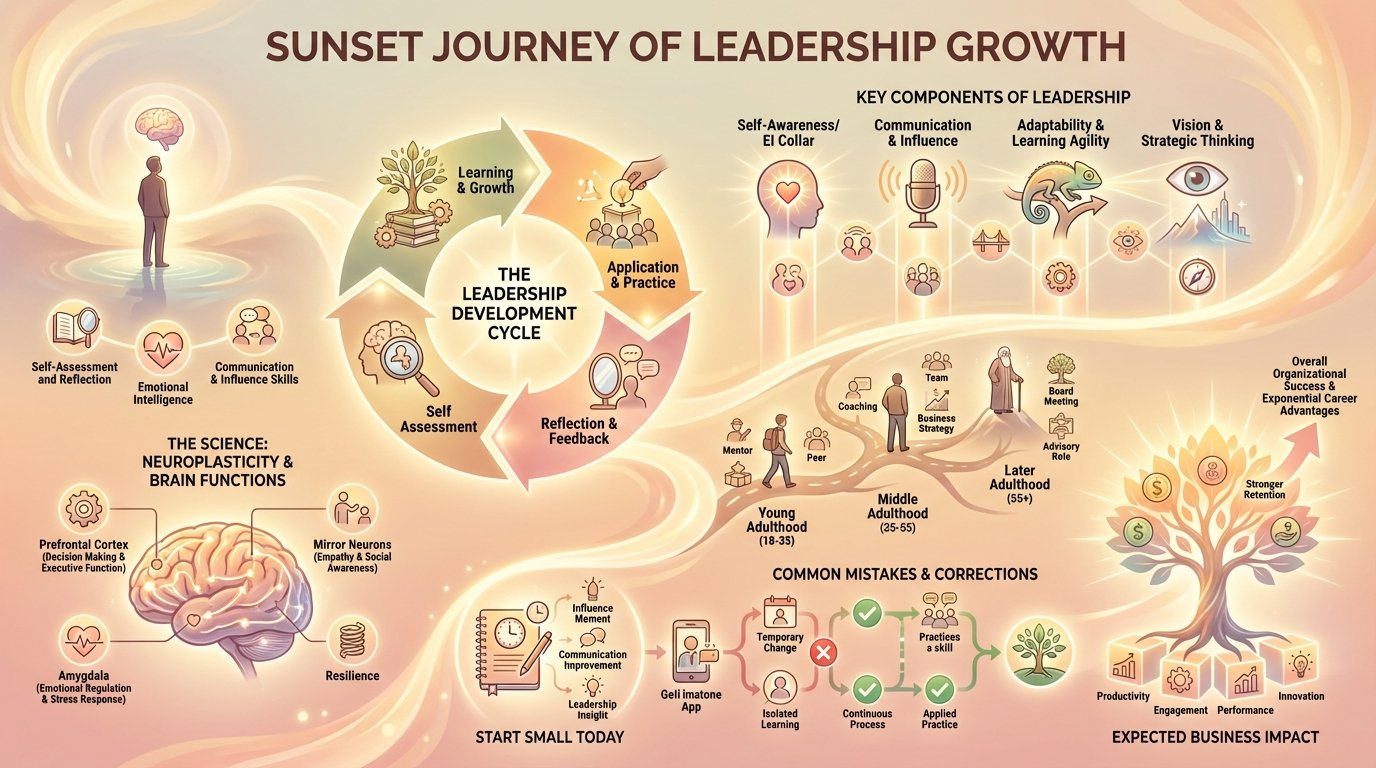
Every leader started somewhere. The difference between good leaders and exceptional ones isn't talent alone—it's their commitment to continuous growth and self-awareness. Studies show that organizations investing in leadership development see 56% increases in productivity and engagement.
Leadership development combines psychological principles, practical skills, and neuroscience-informed strategies to help you lead with confidence, clarity, and compassion in an increasingly complex world.
What Is Leadership Development?
Leadership development is a structured and intentional process of acquiring, enhancing, and refining the skills, knowledge, and mindset required to lead others effectively. It goes beyond simply holding a leadership title—it's about developing the capacity to influence, make sound decisions under pressure, inspire commitment, and guide teams through change. Leadership development encompasses both formal training programs and informal learning experiences that build your self-awareness, emotional intelligence, communication skills, and strategic thinking ability.
Not medical advice.
Leadership development recognizes that leaders are made, not born. It focuses on three core dimensions: internal development (self-awareness and personal growth), interpersonal development (communication and relationship building), and organizational development (strategic thinking and systems understanding). The goal is to create leaders who not only achieve business results but also develop other leaders, creating a multiplier effect throughout organizations.
Surprising Insight: Surprising Insight: Research shows 95% of people believe they're self-aware, but only 10-15% actually are. This gap explains why many leaders struggle despite good intentions—they lack awareness of their blind spots.
The Leadership Development Cycle
A continuous cycle showing how leaders progress through assessment, learning, application, and reflection.
🔍 Click to enlarge
Why Leadership Development Matters in 2026
In 2026, leadership development has become a strategic business imperative, not a luxury. The global leadership development market is valued at $366 billion, with organizations spending over $60 billion annually on formal programs alone. This investment reflects a fundamental truth: poor leadership is among the top reasons employees leave their jobs, and effective leadership directly drives organizational performance. The World Economic Forum identifies emotional intelligence as one of the top skills required in the business world, making it essential to successful workplace dynamics and team performance.
Delaying leadership development has measurable costs—organizations can lose up to 7% of profits when leadership gaps go unaddressed. Gen Z and Millennial employees are particularly sensitive to leadership quality, with 75-77% willing to leave organizations with ineffective managers. The modern business landscape requires leaders who can navigate rapid technological change, manage hybrid teams, adapt to uncertainty, and lead with purpose.
Leadership development is also increasingly data-driven and neuroscience-informed. Organizations now understand that effective leadership development engages the prefrontal cortex, builds neuroplasticity, and leverages surprise-based learning to help leaders unstick from negative behavioral patterns. The leaders who invest in continuous development compound their effectiveness over years, creating exponential career advantages.
The Science Behind Leadership Development
Modern neuroscience reveals that leadership development works by physically rewiring the brain through neuroplasticity. When you practice new leadership behaviors—like active listening, empathetic decision-making, or strategic thinking—you strengthen specific neural pathways in your prefrontal cortex responsible for executive function, emotional regulation, and perspective-taking. Neuroscience-informed leadership development recognizes that change in behavioral patterns typically occurs in weeks, not years, when programs are designed to engage the brain's learning mechanisms effectively.
Research shows that integrating neuroscience strategies into leadership development significantly increases program effectiveness by tailoring training to how the brain actually processes information and learns. Pre-cognitive processes—automatic functions like heart rate variability, gut-brain signaling, and hormonal regulation—play a significant role in leadership effectiveness. Leaders who understand and manage their nervous system responses can make better decisions during high-pressure situations and model emotional regulation for their teams.
Brain Regions and Leadership Functions
Shows which brain regions are engaged during different leadership activities and skills.
🔍 Click to enlarge
Key Components of Leadership Development
Self-Awareness and Emotional Intelligence
Self-awareness is the foundation of all leadership development. It's your ability to understand your strengths, weaknesses, values, triggers, and how your emotions influence your decision-making and team interactions. Leaders with high self-awareness recognize their blind spots and actively seek feedback through 360-degree assessments, journaling, and mentorship. Emotional intelligence—the ability to recognize, understand, and manage your emotions and those of others—consistently correlates with better leadership outcomes, higher employee engagement, and stronger team performance. Research shows that leaders who master empathy perform more than 40% higher in coaching, engaging others, and decision-making.
Communication and Influence Skills
Exceptional leaders communicate with clarity, authenticity, and adaptability. Communication skills in leadership development include active listening (putting away distractions and genuinely hearing others), clear articulation of vision and strategy, conflict resolution, and the ability to influence without authority. Leaders who develop strong communication skills can interpret non-verbal cues, create psychological safety, foster collaboration, and align diverse teams around shared objectives. These skills are particularly critical in hybrid and remote work environments where intentional communication becomes more important than ever.
Adaptability and Learning Agility
In 2026, adaptability is among the most important leadership skills. Learning agility—the ability to extract lessons from experiences and apply them to new situations quickly—enables leaders to navigate rapid technological change, market disruption, and organizational transformation. Leaders with high learning agility remain calm during uncertainty, ask powerful questions, challenge assumptions, and adapt their strategies based on emerging information. This component of leadership development focuses on building a growth mindset, resilience, and the cognitive flexibility to see problems from multiple perspectives.
Vision and Strategic Thinking
Strategic leadership development includes the ability to see the big picture, connect dots across complex systems, anticipate future trends, and articulate a compelling vision that inspires commitment. Strategic leaders move beyond tactical execution to understand how their decisions impact the organization's long-term success, stakeholder value, and competitive positioning. This component combines data analysis, systems thinking, and the imagination to envision possibilities others haven't yet recognized.
| Leadership Competency | Definition | Business Impact |
|---|---|---|
| Self-Awareness | Understanding your strengths, weaknesses, and impact on others | 56% increase in team engagement and productivity |
| Emotional Intelligence | Recognizing and managing emotions in yourself and others | 40% higher performance in coaching and decision-making |
| Communication | Clear articulation and active listening | Stronger alignment and reduced conflict |
How to Apply Leadership Development: Step by Step
- Step 1: Conduct a comprehensive self-assessment using tools like 360-degree feedback, personality assessments (Myers-Briggs, DiSC), and reflective journaling to identify your current leadership strengths and development areas.
- Step 2: Seek feedback actively from your manager, peers, and team members about how they experience your leadership. Ask specific questions about your impact and blind spots.
- Step 3: Identify one to three high-impact development priorities based on your assessment results and feedback. Focus on areas that matter most to your role and career aspirations.
- Step 4: Find a mentor or executive coach who has expertise in the areas you want to develop. Their external perspective and guidance accelerate your growth significantly.
- Step 5: Enroll in formal leadership development programs aligned with your priorities—whether through your organization, universities, or specialized coaching firms. Look for programs combining instruction, practice, and reflection.
- Step 6: Practice new leadership behaviors consistently in low-stakes situations before applying them in high-pressure environments. Neuroplasticity requires repetition and reinforcement.
- Step 7: Create an application plan that translates learning into specific workplace behaviors. Plan how you'll communicate differently, make decisions, or handle challenging situations.
- Step 8: Establish regular reflection practices through journaling or structured conversations with your mentor. Reflection consolidates learning and prevents reverting to old patterns.
- Step 9: Measure your progress through behavioral changes, team feedback, and business outcomes. Track metrics like employee engagement, retention, team performance, and project success.
- Step 10: Commit to continuous development by rotating focus areas, seeking new challenges, and staying current with leadership research and emerging practices in your field.
Leadership Development Across Life Stages
Young Adulthood (18-35)
Early-career professionals benefit from foundational leadership development that builds self-awareness, communication skills, and the ability to influence without formal authority. This stage focuses on developing technical competence, building professional networks, seeking mentorship from experienced leaders, and taking on visible project leadership roles. Young leaders should prioritize learning how their personality, strengths, and values shape their leadership style. This age group benefits tremendously from structured mentorship, peer learning groups, and early coaching experiences that establish good leadership habits.
Middle Adulthood (35-55)
Middle-career leaders typically hold formal management positions and benefit from development that deepens emotional intelligence, strategic thinking, and organizational systems understanding. This stage emphasizes building and developing other leaders, managing complex stakeholder relationships, and developing the business acumen required for senior roles. Middle-career leaders often benefit from peer learning with other leaders facing similar challenges, executive coaching focused on specific leadership transitions, and formal leadership programs that combine business strategy with leadership capability building.
Later Adulthood (55+)
Senior leaders focus development on legacy building, succession planning, and adapting to new technologies and cultural shifts. This stage emphasizes wisdom development—integrating decades of experience into lessons that guide organizational strategy and developing the next generation of leaders. Later-career leaders benefit from board service, advisory roles, executive councils focused on emerging trends, and reflection work that crystallizes their leadership philosophy. Staying current with neuroscience, generational dynamics, and digital transformation helps senior leaders maintain relevance and credibility with younger team members.
Profiles: Your Leadership Development Approach
The Emerging Leader
- Foundational leadership skills and confidence in their emerging role
- Clear mentorship and role models to learn from
- Early feedback and safe spaces to practice leadership
Common pitfall: Trying to lead like someone else rather than developing an authentic leadership style
Best move: Find a mentor who matches your values, focus on understanding your strengths, and practice leadership in progressively larger circles
The Busy Manager
- Practical, time-efficient development that fits busy schedules
- Coaching that addresses real workplace challenges immediately
- Peer learning and shared problem-solving
Common pitfall: Putting leadership development aside during high-pressure periods, missing the value of continuous small improvements
Best move: Commit to micro-learning (15 minutes weekly), apply one new practice immediately, and leverage peer coaching conversations
The Strategic Leader
- Advanced development in organizational systems and strategic foresight
- Exposure to emerging trends and future-focused thinking
- Board and advisor roles that broaden perspective
Common pitfall: Losing touch with tactical execution and team dynamics while focused on strategy
Best move: Balance strategic development with staying close to your team, seek international or cross-industry perspectives, and invest in developing successor leaders
The Technical Expert Moving into Leadership
- Bridge from technical expertise to people leadership skills
- Help translating technical vision into organizational strategy
- Coaching on emotional intelligence and relationship building
Common pitfall: Leading primarily through technical knowledge rather than building team capability and engagement
Best move: Invest in coaching focused on emotional intelligence, establish peer relationships with non-technical leaders, and learn to delegate effectively
Common Leadership Development Mistakes
One of the biggest mistakes leaders make is treating leadership development as a one-time event rather than a continuous process. Attending a single conference or completing a program won't create sustainable change—it's the daily practices, consistent feedback, and ongoing reflection that rewire your leadership patterns. Many organizations and individuals expect transformation in years when neuroscience shows behavioral change typically takes weeks with the right approach.
Another critical mistake is developing leadership skills in isolation from application. Research shows that when organizations don't embed application and practice into development programs, transfer is limited and participants revert to previous behaviors. Effective leadership development includes designed opportunities to apply new skills to real work challenges, with reflection and feedback built into the process.
Leaders also commonly neglect self-awareness work, assuming they understand how others experience their leadership. The gap between self-perception and others' perception is significant—95% of people believe they're self-aware while only 10-15% actually are. Without addressing this blind spot, other development efforts have limited impact. Seeking feedback, working with a coach, and regularly reflecting on your impact creates the self-awareness foundation everything else builds upon.
Development Mistakes and Corrections
Common leadership development pitfalls and how to correct them for better results.
🔍 Click to enlarge
Science and Studies
Leadership development is backed by decades of rigorous research from institutions like Harvard Business School, the Center for Creative Leadership, and neuroscience research labs. Multiple longitudinal studies demonstrate that formal leadership development programs consistently improve individual competencies and organizational outcomes. Research shows 98% of organizations with ongoing leadership training report experiencing better results, with a $7 return on every dollar invested in leadership development.
- The World Economic Forum's Future of Jobs Survey 2025 identifies emotional intelligence as one of the top skills required in the business world, essential to successful workplace dynamics.
- Harvard Business School research demonstrates that versatile leadership can drive up to 56% increases in productivity and employee engagement.
- Center for Creative Leadership studies show that effective leadership development works by embedding application to real work challenges, with reflection and feedback built into the program design.
- Neuroscience research from leading universities reveals that neuroplasticity enables behavioral change in weeks (not years) when programs engage the prefrontal cortex and build new neural pathways through repetition.
- Global market research from Research.com shows the leadership development market is valued at $366 billion globally, with organizations spending over $60 billion annually on formal programs, reflecting confidence in the ROI of these investments.
Your First Micro Habit
Start Small Today
Today's action: Conduct a 5-minute reflection daily: Write down one moment where you influenced someone, one moment where you could have communicated better, and one insight about your leadership.
This daily micro-habit builds self-awareness (the foundation of all leadership development), identifies patterns in your leadership impact, and creates the reflection practice that consolidates learning. Over time, this simple practice significantly improves your ability to understand how others experience your leadership.
Keep quitting habit apps after a missed day? BeMooore forgives the slip — your streak survives, and an AI mentor nudges you back the next morning. Free on iOS.
Quick Assessment
How would you describe your current approach to leadership development?
Your answer reveals your readiness for leadership development and the type of support that would help most.
Which aspect of leadership do you most want to develop?
Your priority area suggests which development path and resources would create the most meaningful impact.
What's your preferred way to learn new leadership skills?
Understanding your learning preference helps you choose development approaches that stick and create sustained change.
Take our full assessment to get personalized recommendations.
Discover Your Style →Next Steps
Your leadership development journey begins with a single decision: committing to growth. Start by scheduling a 360-degree assessment or asking trusted mentors and colleagues for honest feedback about your leadership impact. This creates the self-awareness foundation that makes all other development efforts more effective. Identify one to three specific areas where you want to develop, then design a practical development plan that includes formal learning, mentorship, peer support, and daily reflection.
Remember that leadership development is not a destination but a continuous journey. The most effective leaders are those who remain curious, stay open to feedback, practice intentionally, and regularly reflect on their impact. Start today with your first micro habit of daily reflection about your leadership moments. Use our app to track your progress, get personalized guidance, and connect with other leaders on similar development journeys.
Get personalized guidance with AI coaching.
Start Your Journey →Research Sources
This article is based on peer-reviewed research and authoritative sources. Below are the key references we consulted:
Related Glossary Articles
Frequently Asked Questions
How long does leadership development typically take?
The timeline varies based on your starting point and development goals. Research shows meaningful behavioral change can occur in weeks to months when programs embed application and reflection. Developing into a highly effective strategic leader typically requires 2-5 years of consistent development. The key is consistent practice, feedback, and reflection rather than the duration of formal programs.
Can anyone become an effective leader through development, or is leadership natural?
Leadership is a set of learnable skills, not an innate talent. While people may have different natural predispositions (introversion, analytical thinking, empathy), research clearly shows that deliberate practice and focused development create effective leaders. The success stories of leaders who developed from quiet, technical backgrounds prove that leadership is made through commitment to growth, not born from natural talent alone.
What should I do if my organization doesn't offer leadership development programs?
Take ownership of your development. Seek mentorship from experienced leaders inside or outside your organization, invest in executive coaching focused on your development goals, enroll in university-based leadership programs, read leadership literature and neuroscience research, join peer learning groups with other leaders, and practice self-reflection consistently. Many top leaders developed outside of formal programs through relationships, self-directed learning, and committed practice.
How does emotional intelligence relate to leadership development?
Emotional intelligence is foundational to all effective leadership. The four components—self-awareness, self-management, social awareness, and relationship management—underpin your ability to make good decisions, communicate clearly, build trust, and inspire commitment. Leaders with high emotional intelligence significantly outperform in coaching, engagement, and decision-making. Developing emotional intelligence should be a core focus of any leadership development effort.
What's the ROI of investing in leadership development?
Research consistently shows $7 return for every $1 invested in leadership development. Organizations with ongoing leadership training report better organizational outcomes, stronger employee retention, higher engagement, improved decision-making, and accelerated innovation. Individual leaders who invest in development experience faster career advancement, higher compensation, broader opportunities, and greater impact. The data overwhelmingly supports leadership development as one of the highest-ROI investments organizations and individuals can make.
Take the Next Step
Ready to improve your wellbeing? Take our free assessment to get personalized recommendations based on your unique situation.
- Discover your strengths and gaps
- Get personalized quick wins
- Track your progress over time
- Evidence-based strategies