Influence
Have you ever wondered why some people effortlessly convince others to see their perspective? Why certain voices seem to carry more weight in a room? Influence is the invisible force that shapes how we persuade, connect, and impact others. It's not about manipulation or coercion—it's about understanding the psychology of how ideas spread, how people make decisions, and how you can authentically inspire action. In 2026, influence skills are more critical than ever. Whether you're building relationships, advancing your career, or simply wanting to be heard, mastering influence is the gateway to meaningful impact and lasting happiness.
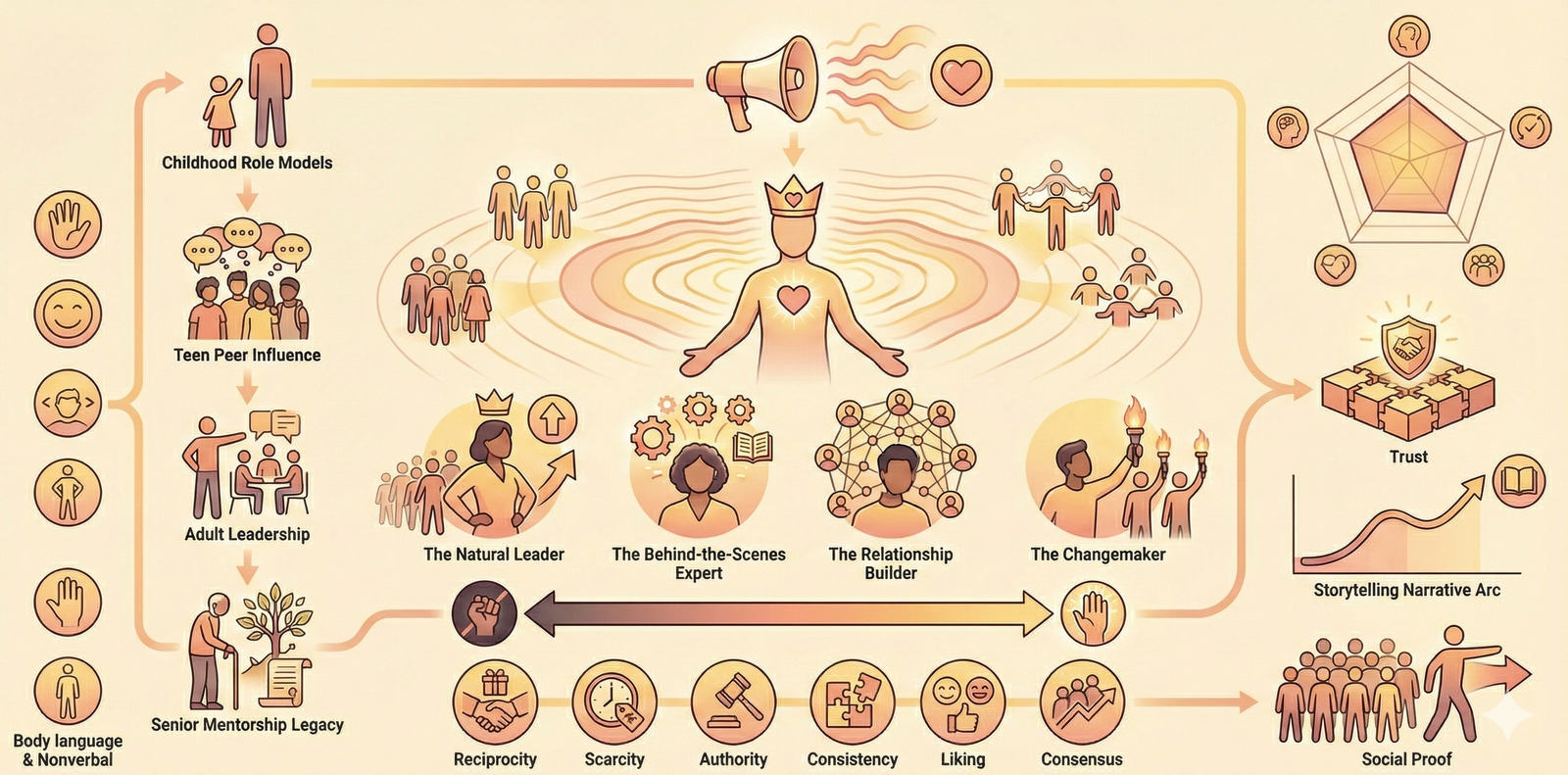
Influence operates through trust, credibility, and connection—not tricks or pressure tactics.
When you understand how influence works, you unlock the ability to create positive change in your life and the lives of others.
What Is Influence?
Influence is the capacity to shape opinions, behaviors, and decisions in others through communication, presence, expertise, or relationships. It's a fundamental human skill that exists on a spectrum—from subtle, everyday persuasion (convincing a friend to try a new restaurant) to major life decisions (inspiring someone to pursue their dreams). Unlike power, which is often hierarchical, influence is about connection. It's rooted in psychology, neuroscience, and human behavior. Research shows that people with high influence combine credibility (expertise), trustworthiness (character), and warmth (relatability). These three elements form the foundation of persuasion. Influence isn't something you're born with—it's a skill you can develop through understanding human psychology and practicing authentic communication.
Not medical advice.
The study of influence became mainstream through Robert Cialdini's groundbreaking research on the psychology of persuasion. His work identifies six universal principles that guide human behavior: reciprocity (we feel obligated to return favors), commitment and consistency (we prefer to be consistent with our values), social proof (we follow the actions of others), authority (we trust experts), liking (we're more influenced by people we like), and scarcity (we value rare things). These principles explain why certain messages resonate while others fall flat. Understanding influence means recognizing these deep psychological triggers and using them ethically. When you master influence, you're essentially learning to communicate in ways that align with how human brains naturally process information and make decisions.
Surprising Insight: Surprising Insight: People with high influence aren't necessarily louder or more dominant—they're better listeners who understand what others care about and communicate with authenticity.
The Three Pillars of Influence
Shows how credibility, trustworthiness, and warmth combine to create lasting influence
🔍 Click to enlarge
Why Influence Matters in 2026
In 2026, we live in an age of information overload where countless voices compete for attention. Influence has become more valuable than ever because it cuts through the noise. People trust recommendations from those they believe have genuine knowledge and character. In professional settings, influence determines who gets heard in meetings, whose ideas get funded, and who advances in their career. In personal relationships, influence strengthens bonds—it's how parents guide children, how friends support each other through challenges, and how partners build lasting partnerships. Beyond individual relationships, influence drives social change. History shows that transformative movements succeeded not because one person had power, but because they influenced millions to believe in a cause.
The digital age has amplified influence's reach. Social media has democratized influence—anyone can build an audience. Yet this also means that authentic influence (built on trust and real value) has become rarer and more valuable. People increasingly gravitate toward genuine voices over polished marketing. Understanding influence in this context means knowing how to communicate authentically across platforms, build real credibility, and create trust in a skeptical world.
Research from 2024-2025 shows that people matching persuasion strategies to individual personality traits are significantly more effective than those using one-size-fits-all approaches. This means modern influence requires empathy and personalization—understanding what motivates specific people, not just applying generic tactics. When you develop this capability, you become someone whose voice matters.
The Science Behind Influence
Neuroscience reveals that influence works through multiple brain systems. When you communicate persuasively, you're activating emotional centers (the limbic system), rational analysis (the prefrontal cortex), and mirroring networks (mirror neurons that create empathy). The most effective influence engages all three. For example, a powerful story activates emotional engagement while data provides rational justification. Neuroscientific studies using hyperscanning EEG show that when persuasion is successful, the speaker's and listener's brainwaves actually synchronize—they enter a state of neural alignment. This explains why some conversations feel easy and mutually understood while others create friction.
The elaboration likelihood model explains that people process persuasive messages through two routes: the central route (deep, analytical processing) and the peripheral route (quick, emotional responses). Effective influence uses both. High-involvement decisions (buying a house, choosing a career) require central-route persuasion (detailed facts and logical arguments). Low-involvement decisions (choosing a snack) respond to peripheral-route persuasion (attractive packaging, endorsements). Understanding which route applies to your audience dramatically increases your effectiveness. Research also shows that the affective-cognitive matching effect—where emotional tone matches the audience's natural processing style—significantly enhances persuasion. People high in agreeableness respond well to warm, relationship-focused appeals, while those high in analytical thinking respond to data-driven arguments.
How Persuasion Works: The Brain's Response
Demonstrates the neural pathways activated during effective influence
🔍 Click to enlarge
Key Components of Influence
Credibility and Expertise
Credibility is earned through demonstrated knowledge and consistent results. People follow those they perceive as experts in their field. This doesn't mean you need to be perfect—it means knowing your domain deeply, admitting what you don't know, and standing behind your ideas. Credibility is built slowly through competence and maintained through integrity. When you say something, people assess: 'Does this person actually know what they're talking about? Have they proven it?' Your credibility determines whether your influence is welcomed or resisted. In professional contexts, credibility comes from certifications, experience, results, and reputation. In personal relationships, it comes from following through on commitments and giving advice that actually helps.
Trustworthiness and Character
Trust is fragile and takes time to build but moments to destroy. Trustworthiness is demonstrated through consistency between words and actions, honesty (especially when it's hard), and genuine concern for others' wellbeing. People follow those they believe have their interests in mind, not just self-serving motives. The research is clear: if people suspect you're trying to manipulate them for personal gain, your influence collapses. Authentic influence requires alignment between your stated values and actual behavior. This means sometimes saying no to opportunities that violate your principles, admitting mistakes transparently, and prioritizing relationships over short-term gains. Character is influence's bedrock.
Warmth and Relatability
You can be highly credible and trustworthy but still fail to influence if people feel disconnected from you. Warmth—the perception that you genuinely care about others—activates approachability and receptiveness. Warmth includes being a good listener, asking genuine questions, showing empathy for others' challenges, and communicating in accessible language. When people feel seen and understood, they're far more likely to accept your perspective. Relatability doesn't mean being fake—it means finding genuine common ground, sharing appropriate vulnerability, and remembering that everyone struggles. Warmth makes credibility likeable. Without it, expertise feels cold and distant.
Communication Clarity
Even brilliant ideas fail if communicated poorly. Clarity means expressing complex ideas simply, removing jargon, and tailoring your message to your audience. It means knowing when to use data, stories, or emotional appeals. Research on persuasive language shows that the most effective communicators use more concrete, specific language and fewer abstract terms. They tell stories that make ideas memorable. They ask questions that help others discover insights rather than lecturing. Clarity also requires active listening—understanding your audience's concerns, values, and objections before crafting your message. The influence-building communication cycle is: listen, understand, speak, listen again.
| Influence Style | Strengths | Potential Pitfall |
|---|---|---|
| Analytical Influencer | Data-driven, logical arguments, detailed planning | Can seem cold; may overwhelm with information |
| Relational Influencer | Builds strong connections, creates buy-in, empathetic | May avoid necessary difficult conversations |
| Visionary Influencer | Inspires with big ideas, motivates action, charismatic | May lack follow-through on details |
| Collaborative Influencer | Brings people together, builds consensus, inclusive | May struggle making decisive moves quickly |
How to Apply Influence: Step by Step
- Step 1: Identify your authentic influence foundation: Assess what you genuinely know well and care about. Authentic influence starts with identifying your actual expertise and values, not pretending to know things you don't.
- Step 2: Build credibility strategically: Share your knowledge freely through articles, presentations, or conversations. Demonstrate results. Let your track record speak. Invest time in mastering your domain deeply.
- Step 3: Develop genuine relationships: Spend time understanding people's motivations, challenges, and values. Ask questions more than you make statements. Show interest in their success, not just your own.
- Step 4: Listen actively: Influence begins with listening. Understand concerns and objections before responding. This shows respect and provides information to tailor your message effectively.
- Step 5: Match your communication style to your audience: Some people respond to data and logic. Others need emotional resonance and relatability. Observe and adapt rather than using a one-size-fits-all approach.
- Step 6: Tell compelling stories: Stories are 22 times more memorable than facts alone. Use examples from your experience or others' experiences that illustrate your point and create emotional connection.
- Step 7: Be transparent about intent: People are more influenced when they understand your purpose. 'I want you to consider this because...' builds more influence than hidden agendas. Transparency builds trust.
- Step 8: Create psychological reciprocity: When you help others first without expecting immediate return, they naturally want to reciprocate. Genuine helpfulness creates goodwill and influence.
- Step 9: Use social proof strategically: Mention when others similar to your audience have benefited from your perspective. 'People in your situation often find...' leverages social proof authentically.
- Step 10: Follow through consistently: Your influence is only as strong as your reliability. Every kept promise strengthens influence. Every broken commitment weakens it dramatically.
Influence Across Life Stages
Young Adulthood (18-35)
In young adulthood, influence-building focuses on establishing credibility and finding your authentic voice. This stage is ideal for developing expertise through education, entry-level roles, and learning from mentors. Young adults are discovering what they genuinely care about—this authenticity is your foundation for future influence. Building influence in this stage means being willing to learn publicly, asking questions, and gradually taking on leadership in small contexts. Your peers during this time often become lifelong networks, so investing in genuine relationships creates long-term influence foundations. Developing communication skills now—learning to speak up in meetings, write clearly, present effectively—pays dividends throughout your career.
Middle Adulthood (35-55)
Middle adulthood is when influence often peaks. You have substantial expertise, established credibility, and proven track records. This stage is critical for leveraging your influence for meaningful impact. You're likely in positions where your decisions affect others—how you use that influence defines your legacy. Middle adults often become mentors, leaders, and decision-makers. Influence-building in this stage involves being intentional about what you teach others, setting good examples, and sometimes making difficult decisions that prioritize long-term integrity over short-term gains. This is also when many people discover their greatest influence comes not from formal power but from relationships, reputation, and being the person others trust with important matters.
Later Adulthood (55+)
In later adulthood, influence often shifts from day-to-day professional impact to legacy-building and wisdom-sharing. Your longest perspective and accumulated experience become increasingly valuable. Many of the most influential voices in society are those with decades of credible experience. In this stage, influence is often expressed through mentoring, advising, writing, or speaking. The influence you've built throughout your life becomes increasingly powerful because people recognize the depth of your understanding. Paradoxically, later adults who maintain curiosity, remain open to learning, and adapt their perspectives often maintain the most vital influence. Those who become rigid or refuse to update their views lose influence to younger minds.
Profiles: Your Influence Approach
The Natural Leader
- Learning to listen as much as you speak
- Understanding that not everyone processes information the way you do
- Developing patience with slower decision-makers
Common pitfall: Assuming people want to be told what to do rather than helped to discover
Best move: Use your natural confidence to help others find their own voice, not just follow yours
The Behind-the-Scenes Expert
- Practicing public visibility and sharing your expertise
- Building comfort with self-promotion without arrogance
- Connecting with people beyond your immediate circle
Common pitfall: Assuming your good work speaks for itself when it actually needs amplification
Best move: Share your knowledge generously; let others see your expertise in action
The Relationship Builder
- Grounding relationships in real expertise and values
- Being willing to have difficult conversations when needed
- Building influence beyond your immediate circle
Common pitfall: Prioritizing being liked over being respected, avoiding necessary conflicts
Best move: Use your relationship skills as foundation, but add credibility and clarity
The Changemaker
- Understanding that lasting change requires bringing people along
- Balancing urgency with patience for hearts to change
- Building coalitions rather than going it alone
Common pitfall: Pushing too hard too fast and creating resistance rather than momentum
Best move: Harness your passion while respecting others' pace of accepting change
Common Influence Mistakes
The first common mistake is confusing influence with manipulation. Manipulation means hiding your true intent and using psychological tricks for personal gain. Influence is transparent persuasion. When people discover they've been manipulated, all influence evaporates and trust is destroyed. Authentic influence is fundamentally different—it's honest, considers the other person's wellbeing, and doesn't require secrecy to work.
The second mistake is trying to influence before building credibility. People resist being influenced by those they don't respect. If you immediately try to persuade before establishing that you know what you're talking about, you'll face resistance. Credibility comes first. Then influence becomes possible. Rushing this sequence wastes your effort.
The third mistake is using the same influence approach with everyone. Different personalities, backgrounds, and communication styles require different persuasion strategies. Someone analytical needs data and logic. Someone emotionally-driven needs stories and connection. Using only one approach leaves most people uninfluenced. Effective influencers are flexible—they adapt their communication to their audience.
The Influence Mistakes Cycle: How to Avoid It
Shows how common mistakes can undermine your influence and how to break the pattern
🔍 Click to enlarge
Science and Studies
Research from 2024-2025 reveals fascinating insights into how influence actually works. A comprehensive analysis from Frontiers in Neuroscience examined the neural mechanisms of persuasion and negotiation, using advanced EEG measurements to understand how persuasion affects brain activity. Studies show that matching persuasion strategies to individual personality traits—particularly agreeableness and neuroticism—significantly increases effectiveness. Research published in peer-reviewed journals demonstrates that those high in agreeableness respond best to warm, relationship-focused persuasion, while analytical thinkers respond to data-driven arguments. This personalization principle explains why generic persuasion often fails. Multiple 2025 studies analyzed how AI and digital platforms are changing persuasion mechanisms, revealing that authenticity and transparency have become even more critical in an age when fake or manipulative content is easily detectable.
- Frontiers in Neuroscience (2025): Neural synchronization during persuasion shows that successful influence creates measurable brain-wave alignment between speaker and listener
- Communication & Sport (2025): Taxonomy of 42 social influence techniques across different contexts shows which strategies build lasting influence vs. temporary compliance
- Personality and Individual Differences (2025): Systematic review of 80 studies confirms that personalizing persuasion to personality traits increases effectiveness 40-60% compared to generic approaches
- Frontiers in Psychology (2025): Analysis of how AI-generated content affects human persuasion mechanisms, showing that transparency about AI is increasingly important
- Harvard Business Review: Research on influence in professional settings shows that credibility and warmth are more predictive of promotion and success than raw intelligence or effort
Your First Micro Habit
Start Small Today
Today's action: Today: Spend one conversation genuinely listening without planning your response. Ask one follow-up question that shows you understood what mattered to them. Notice how this small act of attention builds connection.
Listening is the foundation of all influence. When you genuinely listen first, people feel respected and heard. This single habit—practiced daily—gradually transforms how people perceive you. Trust and influence grow from being truly heard.
Keep quitting habit apps after a missed day? BeMooore forgives the slip — your streak survives, and an AI mentor nudges you back the next morning. Free on iOS.
Quick Assessment
When you want someone to accept your perspective, what's your natural tendency?
Your natural approach reveals your influence style. Analytics lead with expertise, relators with connection, visionaries with inspiration, collaborators with questions. None is wrong—understanding your style helps you recognize your strengths and blind spots.
How do people typically respond to you?
This reveals how your current influence operates. Building awareness of your impact is the first step to expanding it. The best influencers learn to combine all four responses in balanced ways.
What concerns you most about trying to influence others?
Your concern points to where you need development. Those worried about credibility need expertise-building. Those worried about relationships need to distinguish healthy persuasion from people-pleasing. Those worried about compromise need to stay grounded in values. Those worried about missing perspectives are already thinking like great influencers.
Take our full assessment to get personalized recommendations.
Discover Your Style →Next Steps
Start by identifying one person in your life whose influence you respect. What specifically do they do that makes people listen to them? Study their approaches. Which of their habits could you practice? Real influence-building starts with observation and small habit shifts, not overnight personality changes.
Then focus on one area of development: If credibility is your gap, commit to deepening expertise in one domain. If warmth is your gap, practice listening before speaking. If clarity is your gap, work on communicating complex ideas simply. One area of focus creates momentum that spills into other areas. You don't need to fix everything at once.
Get personalized guidance with AI coaching.
Start Your Journey →Research Sources
This article is based on peer-reviewed research and authoritative sources. Below are the key references we consulted:
Related Glossary Articles
Frequently Asked Questions
Is influence the same as manipulation?
No. Influence is transparent persuasion that respects the other person's autonomy and wellbeing. Manipulation hides intent and uses deception for personal gain. Influence builds trust; manipulation destroys it once discovered.
Can introverts be influential?
Absolutely. Introversion and influence are independent. Many of the most influential people are introverts who lead through expertise, deep listening, and one-on-one relationships rather than large group charisma. Susan Cain's research shows introverts often have advantages in influence—they listen more, they think before speaking, and their words carry weight because they speak less.
How long does it take to build real influence?
Building genuine influence takes time—typically years, not weeks. Credibility is built through consistent demonstration of expertise and reliability. However, you can begin building influence immediately by starting with authentic listening, being transparent, and gradually earning trust. Small influence grows into larger influence with consistency.
Can you influence someone who disagrees with you?
Yes, but rarely by arguing or pressuring. The most effective approach is understanding their perspective first, finding genuine common ground, and presenting your viewpoint in a way that acknowledges their concerns. People are more open to influence when they feel understood, not judged.
Is it ethical to use influence principles?
Using influence principles is ethical if your intent is honest and you respect the other person's autonomy. The same principles used authentically (honest persuasion) are fundamentally different from manipulation (deceptive persuasion). Ethical influence means being transparent about intent and genuinely considering what's best for both parties.
Take the Next Step
Ready to improve your wellbeing? Take our free assessment to get personalized recommendations based on your unique situation.
- Discover your strengths and gaps
- Get personalized quick wins
- Track your progress over time
- Evidence-based strategies