Growth
Growth is the journey of becoming more than you are today—developing new skills, expanding your mindset, building resilience, and evolving through challenges. Whether you're starting a new career, recovering from setbacks, deepening relationships, learning new capabilities, or simply seeking greater fulfillment, growth is the invisible thread connecting all meaningful change in your life. Yet most people mistake growth for achievement alone, missing the transformative power of the process itself. They fixate on destinations—the promotion, the diploma, the project completion—while overlooking the person they're becoming through the journey. In this guide, you'll discover why personal growth matters profoundly for happiness and fulfillment, how to cultivate a growth mindset that welcomes challenges, and practical strategies to turn challenges into stepping stones toward your best self.
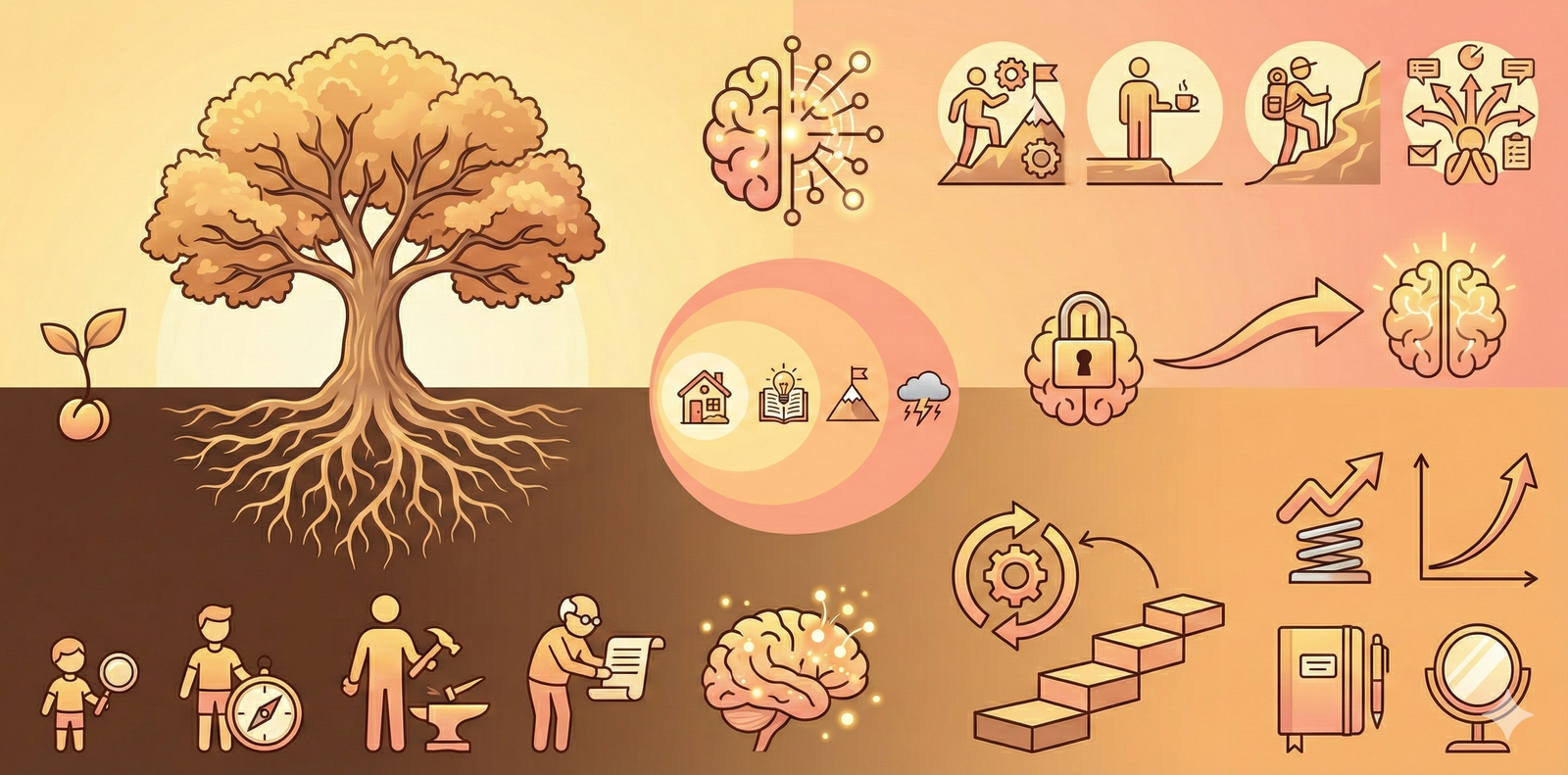
Did you know that your brain physically changes when you learn something new? This isn't metaphorical—your brain's structure literally rewires itself through neuroplasticity. When you deliberately practice something new, you're not just acquiring information; you're reshaping neural architecture. Neuroplasticity means growth isn't a fixed trait determined by genetics or past performance—it's a skill you can develop at any stage of life, regardless of past failures or current circumstances. This understanding changes everything. If growth is possible for you, the question isn't 'Can I grow?' but rather 'What do I want to grow into, and how will I pursue it?'
This comprehensive article reveals the science-backed strategies that separate people who grow from those who stagnate, including micro-habits that rewire your thinking toward growth, life-stage specific approaches that honor different seasons of life, and the exact steps to turn insights into lasting behavioral and capability transformation. You'll discover why growth matters profoundly for happiness, the four essential components of sustainable growth, common mistakes to avoid, and how to design a personalized growth approach that fits your actual life while honoring your individual pace and values. Whether you're beginning your growth journey for the first time or reigniting it after a pause, whether you're a student, professional, parent, or in later life, this guide provides a comprehensive roadmap for intentional development.
What Is Growth?
Growth is the intentional, ongoing process of developing yourself across multiple dimensions—mentally, emotionally, physically, and spiritually. It encompasses expanding your capabilities and skills, deepening your self-awareness and self-understanding, building resilience and ability to handle challenges, and evolving your mindset to handle increasingly complex situations. Growth isn't about perfection, reaching some final destination where you're 'done,' or matching anyone else's timeline or path. It's fundamentally about continuous progress—becoming incrementally better than you were yesterday, recognizing small wins, and maintaining forward momentum even when progress feels imperceptible.
Not medical advice.
Growth manifests in multiple interconnected dimensions. Intellectual growth happens through learning—acquiring knowledge, developing skills, understanding new domains. Emotional growth happens through managing your feelings more effectively, understanding emotional patterns, building emotional resilience, and developing emotional intelligence. Physical growth happens through better health habits—exercise, nutrition, sleep, recovery. Relational growth happens through deeper connections with others, more authentic communication, improved conflict resolution, and greater intimacy. Spiritual growth happens through finding meaning, connecting with values, experiencing purpose, and integrating your experiences into a coherent worldview.
Most importantly, growth involves embracing challenges rather than avoiding them—understanding challenge as opportunity for development. It means viewing failures as feedback and information rather than finality and catastrophe. It means understanding that effort and struggle are signs of development and learning, not proof of inadequacy. When you encounter difficulty, people with fixed mindsets think 'This means I'm not capable.' People with growth mindsets think 'This means I'm approaching my edge, which is exactly where growth happens.' Same experience, completely different interpretations, leading to entirely different outcomes and trajectories.
Surprising Insight: Surprising Insight: Your brain remains plastic—capable of forming new neural connections—throughout your entire lifetime. This neuroplasticity means that growth potential doesn't decline with age; rather, the strategies for cultivating growth may need to evolve.
The Growth Cycle: From Challenge to Transformation
Visual representation showing how challenges lead to effort, which builds new neural pathways, resulting in capability expansion and eventual resilience through repeated cycles.
🔍 Click to enlarge
Why Growth Matters in 2026
In 2026, personal growth has become essential rather than optional for meaningful life success. Technological disruption moves faster than ever—the skills you learned five years ago may already be obsolete; the jobs you learned to do well are being reimagined. Economic uncertainty is structural, not temporary; career security comes not from stable roles but from adaptability and continuous development. Rapidly changing social dynamics require constantly updated relationship skills, communication approaches, and emotional sophistication. Meanwhile, research consistently shows that people who prioritize intentional growth report significantly higher levels of happiness, greater life satisfaction, improved mental health, stronger and more resilient relationships, and more fulfilling and meaningful careers than those who don't invest in growth.
Growth directly impacts happiness because it provides what researchers call the three pillars of psychological well-being: purpose (clarity on what matters and why), autonomy (agency in shaping your direction), and mastery (developing genuine capability). When you're actively developing capabilities that genuinely matter to you—abilities aligned with your values rather than imposed externally—you experience flow states (that absorbed, timeless engagement), enhanced self-efficacy (belief in your ability to handle challenges), and a sense of meaningful progress toward something that matters. Growth also builds resilience in concrete ways: people with growth mindsets recover faster from setbacks because they see setbacks as information rather than verdict, adapt more effectively to changing circumstances because they see change as possibility rather than threat, and maintain optimism during difficulties because they understand struggle as part of development rather than evidence of failure.
Research tracking actual wellbeing outcomes shows people actively engaged in growth report higher life satisfaction, greater emotional stability, stronger sense of meaning, better stress management, and more resilience than those who stagnate. The happiness benefits aren't subtle—they're measurable and significant. People pursuing growth tend to be more engaged with life, more hopeful about the future, more satisfied in relationships, and more confident in facing challenges. These aren't personality traits you're born with; they're capabilities developed through growth practices.
Beyond personal benefits, growth has societal implications. Organizations filled with growth-oriented people innovate faster because they welcome new ideas and aren't locked into 'how we've always done it.' They solve complex problems more creatively because they approach problems from multiple angles. They demonstrate higher employee engagement and retention because people find meaning in development. Communities with continuous learners adapt to challenges more effectively and build stronger social bonds through mutual support and learning. Families with growth mindsets navigate conflicts more constructively, model resilience for children, and create environments where all members feel safe experimenting and learning from mistakes. Your commitment to growth creates a ripple effect—when people see you courageously pursuing development despite difficulty, it gives them permission and inspiration to do the same.
Growth in 2026 specifically addresses the defining challenges of contemporary life. Rapid technological change demands skill agility—not learning one technology but developing capability to learn whatever emerges. Economic uncertainty requires adaptability and multiple capability streams. Increasing complexity in relationships and work requires emotional sophistication and adaptability. People with growth orientations don't panic during disruption—they see it as opportunity. They view technology shifts not as threats but as fields for new learning and new value creation. They approach relationship challenges as chances to deepen understanding rather than failures of connection. They see career transitions as chapters of development rather than career derailment. This single mindset shift from fixed to growth is perhaps the most valuable adaptation you can make to thrive in contemporary life and create resilience for whatever future brings.
The Science Behind Growth
Carol Dweck's groundbreaking research on growth mindset reveals that people operate from one of two fundamental belief systems. Those with fixed mindsets believe abilities are unchangeable—you're either smart or you're not, creative or you're not, good at relationships or you're not. Those with growth mindsets understand that abilities develop through dedication and effort. This single belief difference dramatically influences how people respond to challenges, persist through difficulty, and ultimately what they achieve.
Neuroscience corroborates this framework profoundly. When you engage in new learning, your brain produces new neural connections through a process called neuroplasticity. Myelin, a fatty substance that coats neural pathways, becomes thicker and more insulating with repeated practice, allowing signals to travel faster and more efficiently. This isn't metaphorical—growth literally restructures your brain physically. Brain imaging studies show that people learning new languages develop enlarged language processing regions. Musicians show structural changes in motor and auditory cortex areas. People learning complex mathematical concepts show increased white matter connectivity supporting abstract thinking. These aren't subtle changes; they're significant neurological transformations visible in brain scans.
The timing of your growth mindset matters too. When you believe abilities are fixed and face difficulty, you experience what researchers call 'challenge-threat response'—your amygdala activates, stress hormones increase, and your working memory capacity decreases, making problems feel harder. When you believe abilities are malleable and face the same challenge, your brain activates different neural networks supporting learning, problem-solving, and persistence. Over time, repeated growth mindset responses literally reshape your brain's default reactions to difficulty. Your neural pathways become wired to engage with challenges rather than avoid them. This neurological shift makes growth-oriented people genuinely better learners—not because they have smarter brains initially, but because their beliefs have trained their brains to respond to difficulty in learning-supporting ways.
Fixed vs. Growth Mindset: How Beliefs Shape Outcomes
Comparison chart showing how fixed mindset people avoid challenges and quit easily, while growth mindset people embrace challenges and persist through difficulty, leading to fundamentally different life trajectories.
🔍 Click to enlarge
Key Components of Growth
All sustainable growth rests on four interconnected foundations. Without these elements, growth efforts often feel effortful, unsustainable, or unfulfilling. With them, growth becomes natural, enjoyable, and self-reinforcing. Understanding these components helps you diagnose where growth might be stalling and where to focus your efforts.
Self-Awareness and Reflection
Growth begins with understanding yourself—your current capabilities, limiting beliefs, emotional patterns, and potential blind spots. Self-awareness involves honest assessment without judgment, recognizing where you are authentically today rather than where you think you should be. Regular reflection through journaling, meditation, or discussion with trusted people helps clarify your values, identify growth gaps, and notice patterns in your thinking and behavior. This foundation is crucial because you can't deliberately grow in areas you don't acknowledge. Self-aware people notice when they automatically respond with fixed thinking—'I'm not a math person,' 'I can't speak publicly,' 'I'm not creative'—and can deliberately shift perspective. They track their emotional reactions during challenges, noticing whether they feel threat or curiosity. They assess strengths without arrogance and limitations without shame. This balanced self-knowledge becomes the base camp from which all growth expeditions depart.
Intentional Challenge-Seeking
Growth requires stepping beyond your comfort zone into the stretch zone—where tasks are challenging but still within reach with effort. This isn't about reckless risk-taking; it's about deliberately choosing difficulties that develop specific capabilities you value. Whether learning a language, building public speaking skills, or deepening emotional intimacy, growth happens in the friction zone where capability meets challenge. People who grow actively seek these challenges rather than avoiding them. They notice what activities trigger discomfort but feel aligned with their values and deliberately practice those. If public speaking matters but terrifies you, growth-oriented people volunteer for speaking opportunities. If vulnerability matters but feels risky, they practice sharing authentically in progressively more significant relationships. If mastery matters but requires persistence through failure, they choose pursuits where mistakes are inevitable and information-rich. This challenge-seeking is trained behavior, not innate personality—even naturally cautious people develop comfort with challenge when they understand its role in growth.
Resilience and Perspective Shifts
Growth requires reframing setbacks as information rather than identity. When you make mistakes, face rejection, or experience failure, growth mindset interprets these as feedback—data about what didn't work, not evidence of your fundamental inadequacy. This perspective shift allows you to maintain effort and optimism even when growth feels slow or setbacks feel significant. Research shows that resilient people don't experience fewer setbacks; they simply interpret them differently. They ask 'What can I learn?' rather than 'What does this prove about me?' They notice the impulse to blame themselves or give up entirely, then consciously choose a different interpretation. After a presentation that didn't land well, a fixed mindset person thinks 'I'm not good at presenting and never will be,' while a growth mindset person thinks 'That approach didn't work; I need to try different pacing, better visuals, or more practice.' Same experience, fundamentally different interpretation, leading to completely different next actions. One leads to avoidance and stagnation; the other leads to adjusted strategy and eventual capability. This reframing becomes nearly automatic with practice, allowing resilient people to bounce back quickly from setbacks and maintain forward momentum toward their growth goals.
Continuous Learning and Adaptation
Growth is inherently about learning, but not just academic learning through classes and books, though those help. It includes learning from experience through deliberate reflection on what worked and what didn't. It includes learning from others through observation, mentorship, and conversation. It includes learning from failure through dissection of what went wrong and why. And it includes learning from success through understanding what conditions made success possible so you can recreate them. It means staying curious even about uncomfortable truths, updating your knowledge as new evidence emerges, developing new skills that matter to you, and adapting your approach as circumstances change. Continuous learners read widely across domains—not just their specialty—because insights from unexpected places spark connections and creativity. They seek mentorship from people further along their growth paths, hungry to learn from others' experience. They experiment with new methods rather than rigidly maintaining approaches that worked in the past. They remain genuinely humble about what they don't know, recognizing that expertise in one area doesn't grant automatic competence in another. This learning orientation keeps growth momentum even as external circumstances shift, making continuous learners the most adaptable people during disruption and change.
These four interconnected components create a system where each supports and amplifies the others. Self-awareness reveals where to focus challenge-seeking. Challenge-seeking creates situations requiring resilience reframing. Resilience reframing enables persistence in continuous learning. Continuous learning deepens self-awareness. Together, they create a virtuous cycle of sustainable growth.
| Accelerator | What It Means | How to Apply It |
|---|---|---|
| Self-Awareness | Honest understanding of current state and potential | Journal weekly about progress, limiting beliefs, emotional patterns; seek feedback from trusted people; assess capabilities without judgment |
| Challenge-Seeking | Deliberately choosing appropriate stretch activities | Set goals in growth areas; volunteer for projects that scare you; take on progressively harder challenges; seek novelty in routines |
| Resilience Framing | Reinterpreting setbacks as learning opportunities | When you fail, ask 'What can I learn?'; celebrate effort not just outcomes; normalize mistakes as part of development |
| Continuous Learning | Maintaining curiosity and knowledge expansion | Read daily; take courses; attend workshops; find mentors; experiment with new approaches; stay updated in your field |
How to Apply Growth: Step by Step
Understanding growth intellectually and actually implementing growth are different skills. Many people understand growth completely—they can articulate the theory, quote research, explain neuroplasticity—yet still don't grow because understanding doesn't automatically translate to action. This step-by-step process transforms growth from an abstract ideal into concrete daily practice. These steps work best when followed sequentially rather than jumped around, though you'll iterate through them repeatedly as you deepen your growth and new layers of development emerge.
The key is starting immediately rather than planning the perfect approach. Growth begins with small action taken today—not tomorrow, not after you've read more, not when circumstances are perfect. Today. A small commitment creates momentum, builds confidence, and establishes the habit of acting despite uncertainty. Perfect planning often becomes procrastination in disguise. So begin with Step 1 today, even in small form.
- Step 1: Assess your current mindset by noticing your self-talk when facing challenges. Do you think 'I can't do this yet' (growth) or 'I can't do this' (fixed)? Write down specific situations where you defaulted to fixed thinking—'I'm not creative,' 'I'm bad with technology,' 'I'm not a confident person.' Notice the patterns. These automatic thoughts reveal your current mindset and show where deliberate reframing will unlock growth.
- Step 2: Identify one specific growth area that matters to you—something you genuinely want to develop because it aligns with your values, not because you think you should. This might be professional skills like data analysis or leadership, relationship capabilities like vulnerable communication or conflict resolution, health habits like consistent exercise or emotional eating awareness, or creative expression like writing or painting. The key is intrinsic motivation—you want this for yourself, not to prove something to others.
- Step 3: Set a specific, challenging but achievable goal in this growth area. Instead of vague 'get better at public speaking,' aim for concrete 'deliver a 5-minute presentation to my team by March 15 without extensive notes.' Specificity creates accountability. Make it challenging enough to require growth but achievable with focused effort. A goal requiring 10 times current capability is demoralizing; a goal requiring 20-30% more capability creates growth zone engagement.
- Step 4: Create a learning plan with multiple information sources and formats: find a mentor or coach who can guide specifically, read books to understand frameworks, watch tutorials for technique visualization, take courses for structured progression, or join communities for peer learning and accountability. Diverse learning formats strengthen understanding more than single sources and address different learning styles.
- Step 5: Establish a realistic practice schedule that fits your life. Growth requires consistent effort, so 15 minutes daily beats sporadic marathon sessions. Schedule practice like any important appointment.
- Step 6: Implement reflection rituals—weekly journaling where you write about learning moments, monthly progress reviews where you assess capability changes, or quarterly assessments where you evaluate overall trajectory. Ask yourself: What's working? What needs adjustment? What patterns am I noticing? What breakthroughs happened? What plateaus am I navigating? This deliberate reflection turns raw experience into extractable wisdom rather than just activity.
- Step 7: Develop specific reframes for setbacks before you face them. Write down how you'll interpret failures: 'If I stumble, it means I'm approaching my edge, the perfect place for growth,' or 'If this approach didn't work, the next approach will teach me something,' or 'This difficulty means I'm learning, not that I'm incapable.' Pre-commitment to these reframes prevents negative spiraling when you're emotionally activated by setback.
- Step 8: Find an accountability partner or community. Others pursuing growth provide encouragement, share lessons, help you persist when motivation wavers, celebrate your progress, and normalize the struggle. Growth needn't be solitary—in fact, community amplifies both motivation and learning. Online communities, local meet-ups, or one-on-one partnerships all work; choose the format that sustains your engagement.
- Step 9: Track visible progress with metrics relevant to your goal. Not just performance metrics like 'passed the exam' or 'finished the project'—also effort metrics like 'days I practiced,' 'people from whom I sought feedback,' 'mistakes I analyzed for learning,' 'new approaches I tried.' This rebalances your focus from outcomes you don't fully control to effort you do control, which sustains motivation through inevitable plateaus.
- Step 10: Celebrate effort and learning, not just outcomes. Notice how you're developing courage to try harder things, resilience to bounce back from difficulty, self-discipline to maintain practice, or any growth-related quality emerging. Acknowledging internal development and skill-building—the actual growth—maintains momentum for the long journey. Dopamine releases from effort and learning, not just from success, so deliberately savoring the learning process keeps you motivated through the months it takes to develop real capability.
These ten steps form a complete growth cycle. After completing one round toward a goal, you assess what you learned, celebrate progress, and either deepen in the same area or choose new growth focus. Growth becomes a way of life, a continuous cycle of challenge-effort-learning-consolidation-new challenge rather than a project with an endpoint.
Growth Across Life Stages
Young Adulthood (18-35)
This stage offers perhaps the greatest growth potential because exploration is both expected and easier. Identity formation happens through trying different roles, relationships, careers, and beliefs. A young adult might work in three different industries, live in two different countries, major in one field then pursue another, and discover capabilities they never suspected. Young adults benefit from deliberately broadening experiences—living in different places, trying diverse careers, studying varied subjects, and meeting people from different backgrounds. This breadth-seeking in young adulthood creates foundation for deeper expertise later. The key task is developing a growth foundation: establishing self-awareness about values and capabilities, learning how you learn best through experimentation, building study and practice habits, and creating resilience through manageable challenges. Young adulthood is when growth habits become established, influencing trajectories for decades. A young adult who develops meditation practice, reading habits, deliberate practice in valued skills, and growth mindset establishes patterns that compound dramatically. Investing time now in developing confidence through small wins, learning skills that expand capability, and cultivating growth mindset creates a trajectory of increasing capability and fulfillment throughout subsequent decades.
Middle Adulthood (35-55)
With career, family, and financial responsibilities often peak, middle adults may feel growth has slowed. Actually, this stage demands sophisticated growth in different dimensions: deepening expertise toward mastery level, developing leadership capabilities to influence others, mentoring younger people to accelerate their growth, navigating major role transitions as children become independent or careers shift, and managing increased psychological complexity as you integrate contradictions and nuance. Growth in middle adulthood often involves depth rather than breadth—becoming a true expert in your chosen field, developing wisdom through accumulated experience, and finding greater meaning as you see longer-term consequences of your choices. This is also when reinvention becomes both possible and valuable: career changes become investments in the next 20-30 years of work; relationship transformations deepen intimacy; health overhauls prevent decades of disease; and spiritual deepening creates meaning framework for final decades. Middle adults who intentionally grow report higher life satisfaction because they're progressing in ways that matter to their specific life circumstances—becoming the parent they want to be, the professional they respect, the partner they're proud to be—rather than pursuing generic ideals that don't fit their values.
Later Adulthood (55+)
Growth continues with different emphases that often feel more meaningful than earlier life: legacy creation—understanding what you want to be remembered for and how you'll contribute your accumulated wisdom; deepening relationships as superficiality falls away and only authentic connections remain; continued learning driven by genuine curiosity rather than career advancement; and finding meaning in life's narrative arc—how all your experiences weave into a coherent story. Research on successful aging shows that older adults who remain engaged in growth—learning new skills, developing new interests, mentoring younger people, pursuing creative expression—maintain cognitive health better than those who stagnate, experience depression less frequently, and report higher life satisfaction. Growth in later adulthood often shifts toward wisdom—integrating life experience into deeper understanding of human nature, values, and meaning—and toward contribution—sharing accumulated knowledge and helping others avoid costly mistakes. The freedom from some earlier responsibilities can actually increase growth capacity. Many people find their most fulfilling growth happens after traditional career peaks, freed from advancement pressures to pursue learning for its own sake. An older adult might finally learn the language they always wanted to speak, pursue art they'd shelved for decades, deepen spiritual practice, or volunteer in ways that align with accumulated wisdom. This growth often radiates outward as mentorship, grandparenting, community contribution, and modeling lifelong development for younger generations.
Profiles: Your Growth Approach
Everyone brings different challenges and strengths to growth. Here are four common profiles and their specific growth strategies. You may recognize yourself in one or recognize patterns from different profiles at different times in your growth journey.
The Ambitious Achiever
- Breaking unhealthy perfectionism that blocks learning and experimentation
- Learning to value effort and process improvement, not just outcomes and wins
- Building resilience after setbacks and competitive defeats without spiraling
Common pitfall: Pursuing growth as another achievement metric to conquer, measuring self-worth by how quickly progress happens, quitting when not excelling immediately because setbacks feel intolerable. Often takes on too many growth goals simultaneously, competing with themselves and others.
Best move: Reframe growth as personal mastery and capability development rather than competitive performance. Practice celebrating small improvements and effort—the actual mechanics of growth—not just wins. Deliberately fail at something low-stakes to normalize mistakes as learning. Find communities focused on growth for learning rather than competition for status.
The Comfortable Maintainer
- Rekindling curiosity after years of relative stability and routine
- Finding growth goals that feel intrinsically motivating, aligned with values, not obligatory should-dos
- Overcoming fear of starting and feeling incompetent when skills have atrophied from disuse
Common pitfall: Assuming growth requires dramatic life changes or leaving everything familiar, feeling too old or set in ways to change at midlife or beyond, dismissing growth as irrelevant to current contentment. May equate stability with success and interpret growth-seeking as restlessness.
Best move: Start with micro-challenges in areas of genuine interest—something you've always wondered about. Join communities of learners where you can observe others re-engaging. Notice how growth creates new vitality, meaning, and engagement. Understand that comfort without growth can gradually become stagnation and boredom disguised as peace.
The Struggling Learner
- Building confidence through early wins and visible improvement in learning
- Finding learning methods and environments that match how their brain actually works
- Developing persistence and hope when standard approaches haven't worked in the past
Common pitfall: Believing 'I'm just not good at learning' based on school experiences, avoiding challenges that might prove inadequacy, attributing struggles to fixed ability rather than strategy mismatch or teaching approach mismatch. May feel shame about learning difficulty and hide rather than seek help.
Best move: Experiment deliberately with different learning styles—visual, auditory, kinesthetic, experiential—to find what works for your brain. Find a teacher, tutor, or mentor who can personalize approach and explain things your way. Start with very achievable targets where early success is nearly guaranteed. Celebrate effort regardless of immediate results. Understand your learning journey differs from others' not because you lack ability but because you learn differently.
The Overwhelmed Overcommitter
- Learning to ruthlessly prioritize one or two meaningful growth areas
- Building sustainable habits that fit actual life reality, not idealized life
- Understanding that slow, consistent growth compounds far better than sporadic intense effort
Common pitfall: Taking on too many growth projects simultaneously to avoid choosing, expecting unrealistic progress speed, burning out spectacularly and abandoning growth altogether. Confuses busyness with growth and activity with progress.
Best move: Choose one growth focus per quarter maximum. Set a realistic practice schedule—15 minutes daily is better than unrealistic hour-long commitments you won't sustain long-term. Track actual effort and consistency, not just results. Build adequate rest into your growth plan. Notice what one thing, if you let go of, would create space for real growth.
Common Growth Mistakes
One pervasive mistake is confusing growth with busyness—with productive activity. You can be extremely, genuinely active without growing. Someone might consume growth content obsessively—reading articles, watching videos, listening to podcasts—while never practicing what they learn or changing actual behavior. Another person might complete five online courses yearly without mastering any single skill, collecting certifications instead of developing genuine capability. Another might change growth goals monthly, constantly pursuing new targets without giving any goal sufficient time to develop. This performative growth creates an illusion of development while actual capability remains static. Colleagues might think you're growing because they see you busy with improvement, but you know you're not actually changing. Real growth requires sustained focus on fewer, more meaningful development areas, deliberate practice where you're actually doing the skill under challenge, and genuine capability development you can demonstrate and use in real situations.
Another mistake is expecting linear progress. Growth is inherently non-linear, with predictable phases that people misunderstand. There are initial enthusiasm phases where progress is fast and visible. Then comes learning and skill-building phases where steady progress continues. Then come plateaus—frustrating phases where you practice consistently but progress feels invisible. Nothing seems to be changing even though you're putting in consistent effort. People who misunderstand this often quit during plateaus, never reaching the breakthrough that follows the consolidation phase. They interpret the plateau—the natural consolidation phase where neural pathways are integrating learning—as evidence that the goal is impossible or that they lack ability. Yet the plateau is exactly where growth becomes secure and integrated into your being rather than remaining fragile new skill. Without the plateau, breakthroughs don't stick.
A third mistake is comparing your beginning to someone else's middle or end. When you start public speaking, you're not comparing yourself against your own past nervous self—you're mentally competing with seasoned speakers who've given hundreds of presentations. When building fitness, you're comparing yourself to people years into their training journey with training plans optimized by experience. When starting a business, you're measuring against established companies with teams, resources, and decades of learning. This distorted comparison kills motivation before you've given yourself a fair chance to develop actual capability. Healthy growth measures progress against your previous self: Am I more capable than six months ago? Am I more resilient? Do I persist longer when challenged? Can I handle situations that would have overwhelmed past me? These self-comparisons maintain motivation and reveal genuine progress that external comparisons obscure. A fourth mistake involves neglecting the emotional dimension of growth. Many people focus entirely on skill-building while ignoring the identity shifts, self-doubt, and anxiety that inevitably accompany real development. Learning new skills threatens old identity: 'I've always been bad at math' must die to become 'I'm developing math capability.' Discovering capability you didn't know you had requires revising how you understand yourself. Taking risks creates vulnerability and fear of judgment. Acknowledging the emotional work—the discomfort of identity transition, the fear of failure, the grief of letting go of old limitations that paradoxically felt safe—and seeking support makes growth more sustainable and humane.
The Growth Journey: Realistic Progress Patterns
Chart showing the actual non-linear nature of growth with initial enthusiasm, learning plateaus, breakthrough moments, and consolidation phases—not the straight linear progress people expect.
🔍 Click to enlarge
Science and Studies
Decades of psychological research confirm that growth mindset and intentional development create measurable improvements in learning, resilience, career success, relationship quality, and overall wellbeing across diverse populations. The research spans neuroscience showing neuroplasticity and brain change, psychology demonstrating how mindset shapes response to difficulty, education revealing learning optimization strategies, and organizational studies proving that growth-oriented cultures outperform fixed cultures. When you understand that growth is both possible and achievable through your own effort—that your abilities aren't locked in but can develop—you engage with challenges differently. You see failures as information rather than verdicts. You persist longer through difficulty because you understand struggle as growth process rather than evidence of inadequacy. You ultimately achieve more while reporting greater satisfaction because growth provides intrinsic motivation and meaning beyond external rewards.
- Dweck, C. S. (2006). Mindset: The new psychology of success. Random House. — Foundational research distinguishing fixed mindsets—belief abilities are unchangeable—from growth mindsets—belief abilities develop through effort. Shows how this single belief difference predicts achievement, resilience, relationship quality, and life satisfaction across age groups and domains.
- Snyder, C. R., et al. (2002). Hope Theory: Updating the definition of hope. Psychological Inquiry, 13(4), 293-296. — Demonstrates that hope consists of two elements: having meaningful goals and seeing pathways to achieve them. Shows hope is a trainable skill that directly supports growth and wellbeing and can be taught to improve achievement and reduce depression.
- Blackwell, L. S., Trzesniewski, K. H., & Dweck, C. S. (2007). Implicit theories of intelligence predict achievement across an adolescent transition. Child Development, 78(1), 246-263. — Shows that students with growth mindsets improve grades significantly more than fixed mindset peers during challenging transitions like entry to middle school, when previously successful approaches suddenly don't work and adaptation becomes necessary.
- Frankl, V. E. (1946). Man's Search for Meaning. — Demonstrates how finding meaning through challenges and growth creates resilience and psychological wellbeing even under extreme hardship. Shows that meaning-seeking and continued growth become life-saving when external circumstances cannot be changed.
- Baumeister, R. F., & Vohs, K. D. (2001). Self-regulation and self-control: Selected works. Psychology Press. — Research on willpower and self-discipline showing these aren't fixed traits but trainable skills that improve through practice. Demonstrates that attempting self-control exercises makes you better at self-regulation, supporting sustained effort required for growth.
Your First Micro Habit
Growth transformation begins not with dramatic life changes but with micro-habits—tiny, repeated actions that gradually rewire your automatic thinking and strengthen neural pathways supporting growth. A single three-minute practice repeated consistently creates measurable change in your mindset, reaction patterns, and capability development. Start here.
Start Small Today
Today's action: For the next 3 days, when you face a challenge, mistake, or setback, pause and complete this sentence: 'This is an opportunity to learn about....' before responding. Finish the sentence with what you can learn from the situation. This simple practice rewires your automatic interpretation from threat to opportunity.
Your brain's default mode is threat-detection for survival, so growth thinking requires deliberate practice to become automatic. Micro-habits create neural pathways through repetition. Forcing yourself to complete a sentence makes your brain generate learning framings, which you then internalize. Three days establishes initial patterning; if it feels helpful, continue indefinitely.
Keep quitting habit apps after a missed day? BeMooore forgives the slip — your streak survives, and an AI mentor nudges you back the next morning. Free on iOS.
After three days of this micro-habit, notice: Did setbacks feel less threatening? Did you naturally think more about learning and less about failure? Did you persist longer on challenging tasks? Did your emotional response to difficulty shift even slightly? Small changes compound exponentially. This single practice, if maintained consistently for weeks and months, gradually shifts your identity from 'someone who avoids challenges' to 'someone who learns from challenges.' That identity shift from fixed to growth is where real transformation begins.
Your brain has tremendous plasticity remaining. It wants to grow and develop. You're not broken, too old, or incapable of growth. The only question is whether you'll commit to the small, repeated actions that unlock it. That commitment, sustained over time, changes everything in your life.
Quick Assessment
These three assessment questions provide a snapshot of your current growth mindset and reveal where your specific growth work might be most valuable. There are no 'right' answers—only information about where you stand and where growth is waiting.
How do you typically interpret failure or significant mistakes?
Your answer reveals your current implicit theory about failure and learning. Growth happens most readily for those seeing failure as information (option 2) rather than verdict. If you selected other options, you've identified your priority growth work—reframing failure is the single most powerful growth mindset shift you can make. This one shift, practiced over months, can transform every domain of your life.
What prevents you from pursuing growth in areas important to you?
Each barrier responds to different solutions and strategies. Fear needs graduated exposure to manageable challenges where success builds confidence. Unclear paths need mentorship, coaching, and structured planning. Busyness needs ruthless prioritization and renegotiation of boundaries. Limiting beliefs need contradictory evidence that you're capable. Identify your primary barrier—the one that most frequently stops you—and target your growth strategy specifically at that barrier.
How often do you deliberately practice skills or knowledge outside your comfort zone?
Growth research shows consistent practice matters far more than intensity or duration. If you selected options 3 or 4, you've identified your priority work: building regular practice into your routine and reframing practice as enjoyable learning rather than obligation. Even 15 minutes of deliberate practice daily compounds to mastery far faster than sporadic marathon sessions that feel like punishment.
Take our full assessment to get personalized recommendations.
Discover Your Style →These common questions reflect the uncertainties people face when considering growth. Understanding typical obstacles and misconceptions helps clarify what growth actually is and how to pursue it sustainably.
Next Steps
Your growth journey begins with a single decision: accepting that you are capable of development, that effort changes ability, and that challenges are invitations to expand. This isn't about striving for perfection or competing with anyone else. It's about becoming more capable, resilient, and authentic than you are today. It's about future-proofing yourself for a world of constant change. It's about modeling possibility for others, especially young people who need to see that growth continues throughout life. Start by choosing one area you genuinely want to develop—not because you think you should, not because someone else achieved something impressive, but because it aligns with your values and vision for your life. What capability would make you feel more capable and confident? What skill or quality would enable you to live more fully according to your values?
Then take concrete action: find a mentor or teacher who can guide you, set a specific goal with clear completion date, create a sustainable practice schedule that fits your life, establish weekly reflection rituals to extract learning from experience, and find community of others pursuing growth. Growth is simultaneously individual and relational—your development inspires and enables others' development. When your friend sees you courageously pursuing growth, it gives them permission to do the same. When you model resilience after setback, you teach your children that failure isn't final. When you mentor someone beginning their growth journey, you compress their learning curve and gift them years of accelerated development.
As you cultivate growth mindset, you create a ripple effect of possibility that extends far beyond yourself. Your commitment to growth today plants seeds for a more fulfilling, resilient, and meaningful life tomorrow. The person you will become by deliberately developing yourself will look back at this moment and feel grateful that you said yes to growth. That future, more capable version of you is already waiting in the choices you make today.
Get personalized guidance with AI coaching.
Start Your Journey →Research Sources
This article is based on peer-reviewed research and authoritative sources. Below are the key references we consulted:
Related Glossary Articles
Frequently Asked Questions
I'm already 50+ and feel like my growth years are behind me. Is it too late to develop new capabilities?
No—this belief is actually a growth mindset misconception that can limit you unnecessarily. Research on neuroplasticity definitively shows your brain remains capable of forming new connections, learning new skills, and developing new capabilities throughout your entire life. Many people find their most fulfilling growth happens in later adulthood because they pursue development for intrinsic reasons—pure interest and genuine curiosity—rather than external pressure, comparison, or career advancement. The skills may take slightly longer to develop than in youth, but you often learn more efficiently because you understand yourself better, know your learning style, can focus on what matters, and have accumulated wisdom that helps integrate new learning. Start with areas genuinely interesting to you, not what you think you 'should' learn or what impressed someone else.
What's the difference between growth and just being busy trying to improve myself constantly?
This distinction matters tremendously. Growth is intentional, focused on meaningful development areas, and sustainable. Constant busyness trying to improve everything is often driven by perfectionism, comparison with others, or external pressure. Real growth involves choosing one or two development areas that genuinely matter to you, investing consistent effort, reflecting on actual progress, and maintaining patience with non-linear advancement. If you're changing goals monthly, doing random online courses without applying them, or feeling perpetually inadequate no matter how hard you try, that's not growth—that's hustle culture. Quality growth feels purposeful and aligned with your values, allows adequate recovery, celebrates small wins, and creates space for life beyond development.
I tried personal growth before and failed. Doesn't that mean growth just isn't for me?
Your previous attempt provides valuable information about what didn't work—not whether growth is possible for you. Before interpreting it as failure to grow, investigate: Did you choose a goal that truly mattered to you intrinsically, or was it someone else's priority that you intellectually agreed with? Did you have support, accountability, and community, or did you try to do it entirely alone? Did you have realistic timelines and patience with non-linear progress, or did you expect quick results? Did you practice consistently, or did effort come in sporadic bursts? One unsuccessful approach means you need to adjust your strategy—not that growth is impossible for you. Many successful people tried multiple approaches and failed multiple times before finding what worked. Your 'failure' is actually rich data for your next growth attempt. Use it wisely.
How long does it actually take to develop a new skill or capability?
Timeline varies dramatically by skill complexity and starting point. Simple habits or skills might establish visible changes in 2-3 weeks of practice. Moderate skills—like becoming functionally competent at public speaking, a new language, or a technical skill—often require 100-200 hours of deliberate practice spread over 3-6 months. Complex capabilities like expert-level leadership, mastery in a field, or deep emotional health work require years of sustained practice. However, meaningful progress—noticing real improvement, gaining genuine confidence, developing momentum—can happen in 4-8 weeks even for longer development arcs. Most people quit before seeing results because they expected faster progress or didn't celebrate incremental development. The key is celebrating incremental capability gains while maintaining patience with the overall timeline. Track not just results but effort, learning, and resilience.
What if my growth goal conflicts with obligations to family, work, or others?
This is genuinely real and requires honest prioritization. Growth doesn't mean abandoning responsibilities to others; it means integrating development into your actual life realistically. Can your growth goal connect to your work and professional development? Can family time include growth activities where you learn together? Sometimes growth requires renegotiating boundaries—being less available for less important tasks to make room for development that genuinely matters. The question isn't 'growth or obligations' but rather 'how do I honor both?' This often requires creativity and honest communication with people who care about you. Many find their most meaningful growth happens through integrating it with existing responsibilities, not separate from them.
Should I pursue multiple growth goals simultaneously or focus on one at a time?
Unless you have exceptional discipline and capacity, one growth focus per quarter produces better results than spreading attention across multiple goals. Multiple simultaneous growth efforts dilute your attention, reduce deliberate practice in each area, and increase overwhelm and burnout risk. However, this doesn't mean only one goal ever—it means focusing your intensive effort and deliberate practice on one primary area while maintaining existing habits in other areas. You might deepen your meditation practice while maintaining fitness habits, but you wouldn't simultaneously try to learn an instrument, master a new language, and develop leadership skills. Sequential focus—mastering one skill, then moving to next—often produces superior results to scattered parallel effort.
Take the Next Step
Ready to improve your wellbeing? Take our free assessment to get personalized recommendations based on your unique situation.
- Discover your strengths and gaps
- Get personalized quick wins
- Track your progress over time
- Evidence-based strategies