Optimism
Imagine waking up knowing that today will be better than yesterday, that challenges are opportunities, and that your future is bright. This is the power of optimism—the profound belief that good things are possible, even when facing setbacks. Optimism isn't about ignoring reality or wearing rose-tinted glasses. It's a scientific approach to life that rewires your brain, strengthens your immune system, and dramatically extends your lifespan. Research shows optimistic people live longer, experience less depression, and recover faster from illness. The remarkable truth: optimism is not a fixed trait. It's a skill you can learn and develop starting today.
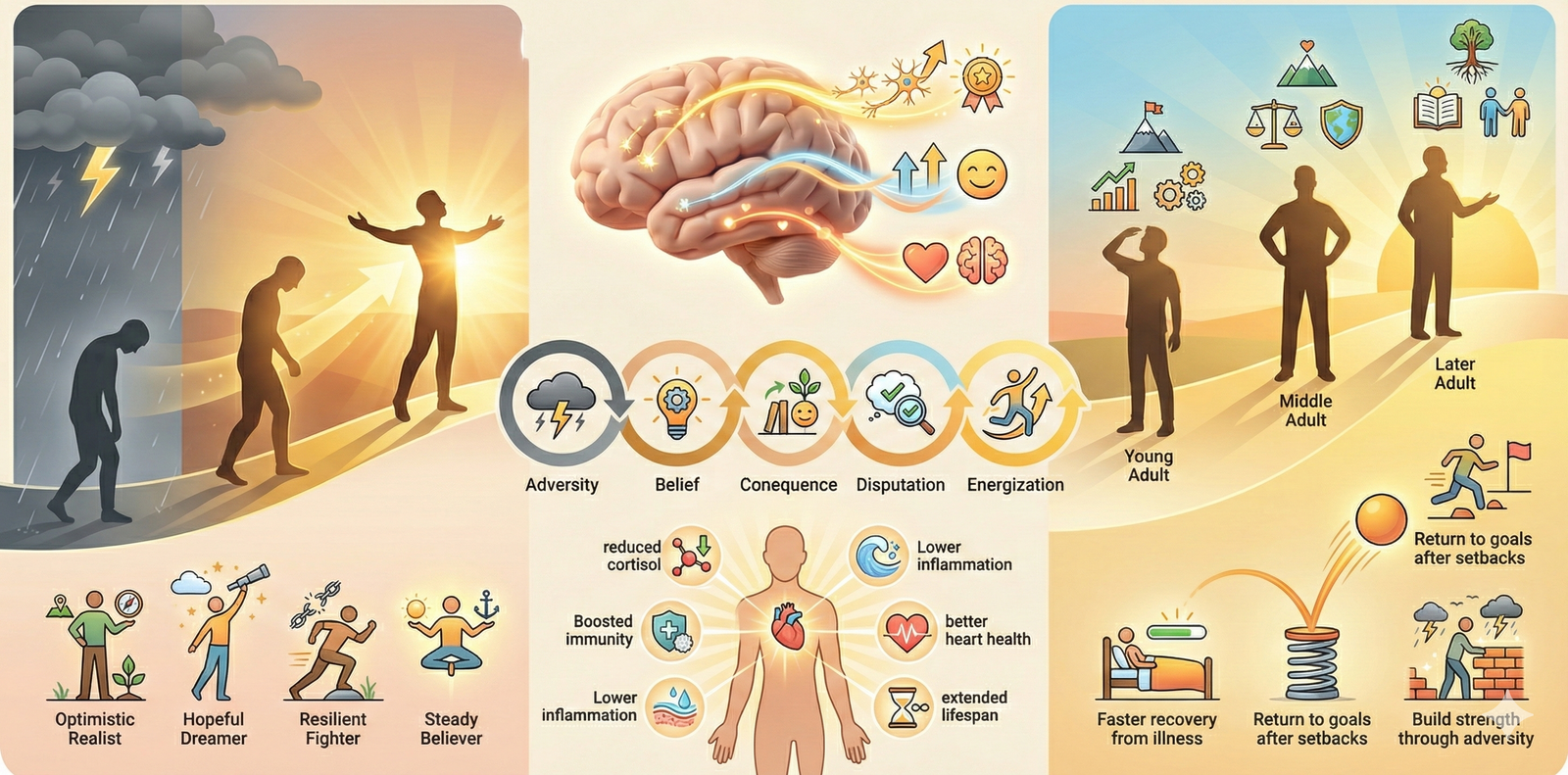
Optimism directly shapes your actions. Optimistic individuals exercise more, follow medical advice, maintain healthier relationships, and pursue their goals with greater persistence. They don't give up when obstacles appear.
Beyond behavior, optimism triggers biological changes. It reduces stress hormone cortisol, improves immune function, and even slows cellular aging. This is why optimists consistently report greater life satisfaction and better health outcomes.
What Is Optimism?
Optimism is the psychological tendency to expect positive outcomes in the future, combined with the belief that you can influence events through your actions. It's rooted in how you explain life events—particularly adversity. When faced with setback, an optimist thinks: 'This is temporary, it's about this situation, and I can do something about it.' A pessimist thinks: 'This is permanent, it defines who I am, and nothing will change it.' The key difference lies in explanatory style—your habitual way of interpreting why things happen.
Not medical advice.
Optimism operates at multiple levels. At the cognitive level, it involves rational assessment mixed with hopeful thinking. At the emotional level, it creates feelings of buoyancy and energy. At the behavioral level, it drives action even when outcomes seem uncertain. The integration of these three elements creates a powerful psychological force that influences every aspect of your life.
Surprising Insight: Surprising Insight: A 2019 study found that optimistic men and women who scored in the top 25% had an 85% higher likelihood of exceptional longevity, living to age 85 or older. Lifestyle factors explained only 25% of this effect, meaning optimism's biological mechanisms are even more powerful than behavioral changes.
Optimism vs Pessimism: How Explanatory Style Works
Shows the three dimensions of explanatory style: permanence, pervasiveness, and personalization. Optimists see setbacks as temporary, situation-specific, and external. Pessimists see them as permanent, pervasive, and personal.
🔍 Click to enlarge
Why Optimism Matters in 2026
In an era of information overload, constant connectivity, and rapid change, optimism has become crucial for mental health. News cycles bombard us with crises, social media highlights others' successes, and uncertainty about the future can feel paralyzing. Optimism isn't an escape from these realities—it's the antidote. It provides psychological protection against burnout, depression, and anxiety. People with strong optimism recover faster from setbacks and maintain greater resilience during prolonged stress.
The mental health crisis facing modern society is partly rooted in depleted optimism. Social media algorithms feed us negativity bias—our brains naturally focus on threats and bad news. When this combines with economic uncertainty, climate concerns, and rapid technological change, many people fall into learned helplessness. They stop believing their actions matter. Optimism interrupts this pattern by restoring agency—the sense that your choices influence your outcomes.
Optimism directly impacts career success and relationships. Optimistic employees show higher engagement, better problem-solving, and greater creativity. Studies show that optimistic salespeople outsell pessimistic ones by 37%, and optimistic leaders inspire teams to higher performance. In relationships, optimistic partners express more appreciation, handle conflicts more constructively, and maintain satisfaction even through challenging periods. They model positivity for children, partners, and communities, creating ripple effects of wellbeing.
Career advancement increasingly requires optimism because it drives persistence. In competitive fields, the difference between success and failure often comes down to who keeps trying after initial setbacks. Optimists maintain motivation longer, invest in skill development during slow periods, and view rejections as information rather than verdicts. This persistence compounds over years, creating substantially better career outcomes.
The 2025 research shows that optimism acts as a protective factor against digital burnout, social comparison anxiety, and future uncertainty. Optimistic people maintain perspective when comparing themselves to others' curated social media lives. They don't catastrophize about uncertain futures. As economic and social pressures increase, the ability to maintain realistic optimism becomes not just beneficial—it becomes essential for thriving.
The Science Behind Optimism
Neuroscience reveals that optimism literally changes brain structure. The prefrontal cortex—responsible for planning and decision-making—shows increased activation in optimistic individuals. The amygdala, which processes fear and threat, shows less reactivity. This neural pattern means optimists perceive threats as manageable challenges rather than overwhelming dangers. Over time, this rewires emotional processing pathways, making optimism self-reinforcing.
Brain imaging studies using fMRI show that optimists have stronger connections between the prefrontal cortex and amygdala, essentially creating better emotional regulation circuits. Their default mode network—active during rest and self-reflection—shows patterns consistent with positive self-reference. Pessimists show opposite patterns: weaker prefrontal control and stronger amygdala reactivity. The remarkable finding: these differences aren't immutable. They can be reshaped through practice.
At the hormonal level, optimism reduces cortisol (stress hormone), increases serotonin (mood regulator), and enhances immune function through increased natural killer cells. A 2008 Harvard study of 2,873 healthy adults found that positive outlook correlated with lower cortisol levels, explaining part of the longevity effect. These aren't small changes—they're the difference between a body primed for fight-or-flight versus one optimized for growth and healing.
The immune system response to optimism is measurable and significant. Optimists show higher counts of CD4+ T cells (infection-fighting cells) and stronger antibody response to vaccines. This explains why optimistic people recover faster from surgery, fight off colds more effectively, and show better health outcomes across virtually every measured disease category. The mechanism works through reduced inflammation: chronic stress (from pessimism) triggers inflammatory cascades, while optimism suppresses them.
Cellular aging also responds to optimism. Telomeres—the protective caps on chromosomes that shorten with stress—show less degradation in optimistic people. A study of women managing chronic stress found that those with high optimism had telomere lengths equivalent to people 9-17 years younger. This suggests that optimism may literally slow aging at the cellular level.
Biological Cascade: How Optimism Improves Health
Shows the chain reaction from optimistic thinking through neurological, hormonal, and immune changes to health outcomes.
🔍 Click to enlarge
Key Components of Optimism
Explanatory Style
Your explanatory style—how you interpret why events happen—is the foundation of optimism. When positive events occur, optimists attribute them to internal, stable, global causes: 'I did well because I'm capable, and this ability extends to many areas of my life.' When negative events occur, optimists attribute them to external, temporary, specific causes: 'I failed at this task because of external circumstances, it won't affect other domains.' This mental habit can be trained and modified through deliberate practice.
Realistic Assessment
True optimism isn't naive positivity. It includes realistic assessment of challenges while maintaining belief in solutions. Optimists acknowledge problems directly—they just don't catastrophize them. They ask: 'What can I do about this?' rather than 'Why does this always happen to me?' This balance between realism and hope creates what psychologists call 'realistic optimism,' which predicts better outcomes than either optimism or pessimism alone.
Hope and Agency
Hope, in psychological terms, combines two elements: the belief that positive outcomes are possible (pathways) and the confidence that you can work toward them (agency). Without pathways, you have wishful thinking. Without agency, you have helplessness. Optimism requires both. You must believe good futures exist AND believe you can take meaningful action toward them. This drives the behavioral persistence that makes optimists successful.
Growth Mindset
Optimists view challenges as opportunities to develop capabilities rather than threats to fixed identity. They embrace the learning that comes from setbacks. Research on growth mindset shows that this perspective increases motivation, improves performance, and builds resilience. When you believe abilities can develop, failure becomes information rather than judgment.
Sense of Agency and Control
Agency—the belief that your actions matter—is central to optimism. Learned helplessness (believing nothing you do makes a difference) is its opposite. Optimists believe their efforts influence outcomes. This isn't delusional. They accurately recognize that some things are outside their control while focusing on what they can influence. Psychologists call this 'locus of control.' Optimists have internal locus of control: they attribute outcomes to their effort and choices. This drives action. When facing unemployment, an optimist asks 'What job search strategies can I improve?' A pessimist thinks 'The economy is bad and nothing I do matters.'
Positive Expectancy
Simply expecting good things to happen creates better outcomes—not through magic, but through behavior. People who expect to succeed prepare more thoroughly, maintain effort longer when things get difficult, and notice opportunities that pessimists miss. This creates what researchers call 'self-fulfilling prophecy.' Your expectations influence your actions, which influence outcomes. Optimists literally create better futures through the behavioral consequences of their expectations.
| Life Domain | Optimistic Approach | Expected Outcomes |
|---|---|---|
| Career | View challenges as development opportunities, persist through setbacks, seek feedback | Higher achievement, better performance, greater advancement |
| Health | Maintain positive lifestyle habits, follow medical advice, believe in recovery | Better health metrics, faster recovery, lower disease risk |
| Relationships | Assume good intentions, work through conflicts constructively, invest in connections | Greater satisfaction, stronger bonds, better communication |
| Learning | Embrace mistakes as feedback, persist with difficult subjects, believe in growth | Higher achievement, better retention, greater engagement |
| Finances | Believe in ability to improve situation, take calculated risks, build wealth gradually | Better financial outcomes, less financial anxiety, greater prosperity |
How to Apply Optimism: Step by Step
- Step 1: Identify your explanatory style by noticing how you explain bad events—look for patterns of blame, permanence, and pervasiveness over the next week
- Step 2: Challenge pessimistic thoughts using the ABCDE model: Acknowledge the event, identify your belief, examine consequences, dispute the belief, and establish an energizing alternative
- Step 3: Reframe setbacks explicitly: When something fails, write down one external factor, one temporary aspect, and one domain where this doesn't apply
- Step 4: Collect evidence of past resilience by listing three challenges you've overcome, what you did to overcome them, and what that reveals about your capabilities
- Step 5: Practice gratitude daily by identifying three specific things that went well today and why they happened, focusing on your role
- Step 6: Visualize positive outcomes before important events: spend two minutes clearly imagining a successful scenario with specific sensory details
- Step 7: Take action on one small goal that requires persistence, noticing how small progress builds confidence and optimism
- Step 8: Surround yourself with optimistic models: spend more time with people who handle challenges constructively and less time with chronic complainers
- Step 9: Practice self-compassion when things don't go as planned: treat yourself with the same understanding you'd offer a good friend
- Step 10: Build a success journal documenting daily accomplishments, no matter how small, to reinforce your sense of capability
The ABCDE Model of Learned Optimism
The ABCDE model, developed by Martin Seligman, is the most evidence-based tool for training optimism. It works by interrupting automatic pessimistic thought patterns and replacing them with realistic optimism. Here's how it works in practice.
A stands for Adversity—the triggering event. Something goes wrong. You make a mistake at work. You get rejected by someone. You fail a test. B stands for Belief—your automatic thought about why it happened. This is where pessimism typically kicks in: 'I'm bad at my job' or 'I'm unlovable' or 'I'm stupid.' C stands for Consequence—how this belief makes you feel and behave. Pessimistic beliefs trigger depression, anxiety, and withdrawal. You avoid situations, don't try again, and reinforce the negative belief.
D stands for Disputation—actively challenging the pessimistic belief with evidence. Ask yourself: 'Is this belief actually true? What evidence contradicts it? Have I succeeded in this before? Is it possible other factors contributed?' This step requires honest assessment, not cheerleading. You're looking for realistic alternatives to automatic pessimism.
E stands for Energization—the emotional and behavioral shift that comes from updating your belief. When you successfully dispute pessimism and adopt a more realistic view, your mood improves, motivation returns, and you're more likely to take productive action. Research shows that practicing ABCDE significantly reduces depression and increases optimism within weeks.
The power of this model is that it's completely learnable. You don't need natural optimism. You need awareness of your automatic thoughts and willingness to question them. Even five minutes of daily ABCDE practice for four weeks creates measurable improvements in mood and resilience.
Optimism Across Life Stages
Young Adulthood (18-35)
Young adults benefit tremendously from developing optimism during a period when they're establishing patterns around achievement, relationships, and identity. Optimism during this stage predicts better educational outcomes, more stable relationships, and lower rates of early mental health challenges. The key is reframing failures in education or early career moves as information rather than indicators of future inability. Young adults high in optimism are more likely to pursue challenging goals, invest in relationships, and maintain wellbeing through typical young adult stressors.
Middle Adulthood (35-55)
During middle adulthood, optimism becomes critical for navigating complex responsibilities: career advancement, family obligations, health changes, and sometimes caregiving demands. Optimistic middle-aged adults experience less burnout, maintain better health despite increased stress, and model resilience for younger and older family members. This stage offers opportunity to examine whether pessimistic patterns established earlier still serve you, and to deliberately shift toward more optimistic interpretations. Longitudinal research shows that increasing optimism in middle adulthood can still significantly improve health trajectories through retirement years.
Later Adulthood (55+)
Optimism becomes increasingly protective in later adulthood, predicting not just longevity but quality of life in those added years. Optimistic older adults maintain greater engagement, report higher life satisfaction, and experience less depression related to aging. They adjust better to inevitable losses and maintain stronger social networks. Research on centenarians shows that optimism is one of the consistent psychological traits shared by those who live longest. It's never too late to develop more optimistic thinking patterns.
Optimism in Real-Life Situations
Understanding optimism theoretically is one thing. Applying it when things go wrong is another. Let's look at how realistic optimism works in common situations. Imagine you're applying for jobs and get rejected for your third position. A pessimist thinks: 'I'll never get hired. I'm not qualified. There's no point in applying anymore.' An optimist thinks: 'I didn't match this particular role, but I can improve my interview skills. Let me get feedback and apply to companies that better fit my background.' Both face the same rejection. The difference is the meaning they assign to it. The pessimist might stop applying altogether, virtually guaranteeing they don't get hired. The optimist keeps trying, gets better at interviews through practice, and eventually succeeds.
In relationships, consider a conflict with a partner. A pessimist immediately jumps to 'They don't respect me, this relationship is doomed, and I always pick the wrong people.' An optimist thinks 'We had a disagreement about this specific issue. We can talk it through and understand each other better.' Same conflict, different interpretation. The optimist's interpretation leads to conversation and resolution. The pessimist's leads to withdrawal and self-fulfilling prophecy. Over time, the pessimist's expectation of doom actually contributes to it through their withdrawn, defensive behavior.
In health, consider getting a diabetes diagnosis. A pessimist thinks 'My life is over, I'll be sick forever, nothing will help.' An optimist thinks 'This is manageable through diet, exercise, and medical care. Many people live well with this condition. I can take control of this.' Both face the same diagnosis. The optimist's belief leads to better diet adherence, more exercise, and ultimately better health outcomes. Optimism becomes self-fulfilling. Research shows optimistic patients have better glucose control and fewer complications precisely because their optimism drives better behaviors.
In financial challenges, a pessimist experiencing job loss thinks 'I'll never find another job, we'll lose everything, my career is over.' An optimist thinks 'This job loss is temporary. I can update my resume, network, and find something new. This might even be an opportunity to move into a better role.' The optimist starts job searching immediately, leverages their network, and often lands something better. The pessimist might delay applying or apply with defeatist energy, extending their unemployment and creating the financial crisis they feared.
These aren't examples of denying reality. Optimists acknowledge the problem directly. The difference is they maintain belief in solutions and their capacity to implement them. This combination of realistic problem recognition plus confidence in solutions is what drives better outcomes across health, career, relationships, and finances. Optimism isn't magical thinking—it's strategic thinking that acknowledges problems while maintaining agency.
Profiles: Your Optimism Approach
The Cautious Optimist
- Evidence that optimism works in their specific situation
- Acknowledgment that realistic thinking matters
- Small wins that build confidence gradually
Common pitfall: Waiting for certainty before feeling hopeful, missing opportunities while gathering evidence
Best move: Balance your need for realism with action: gather some evidence, then commit to optimistic action anyway. Small experiments prove optimism to yourself more than endless analysis.
The Energetic Optimist
- Grounding in reality to avoid blind spots
- Systems to maintain consistency when initial energy fades
- Others to help reality-check their plans
Common pitfall: Over-committing, burning out when obstacles appear because energy isn't backed by realistic planning
Best move: Channel your natural optimism into sustained effort: create structures, accountability, and checkpoints that help your energy translate into actual results.
The Recovering Pessimist
- Compassion for how deeply pessimism ran
- Permission to build optimism gradually without perfectionism
- Recognition of why pessimism made sense at some point
Common pitfall: Trying to flip immediately to pure optimism, then losing faith when old patterns resurface
Best move: Practice realistic optimism: acknowledge genuine challenges while building belief that you can handle them. This integration works better than forced positivity.
The Situational Optimist
- Awareness that optimism in one area can transfer to others
- Deliberate practice extending optimism beyond comfort zones
- Understanding that consistency matters more than perfection
Common pitfall: Being optimistic about career but pessimistic about relationships, creating inconsistent outcomes
Best move: Identify one domain where you're already optimistic, analyze what makes that possible, and deliberately apply those same thinking patterns elsewhere.
Common Optimism Mistakes
The first major mistake is confusing optimism with denial. Real optimism involves acknowledging problems while maintaining confidence in solutions. Many people mistake pessimism for realism, thinking that preparing for worst-case scenarios will prevent disappointment. Instead, chronic worry creates anxiety without preventing problems. It simply makes you feel bad while preparing for events that often never occur. True optimism says: 'I see the problem. Here's my plan to address it. I'm confident I can handle this.'
The second mistake is expecting optimism to eliminate challenge. Optimism doesn't remove obstacles—it changes how you respond to them. Optimists still experience failure, loss, and pain. The difference is they don't spiral into hopelessness. They get up, adjust their approach, and try again. Many people give up on optimism because they expect it to guarantee positive outcomes rather than improve their resilience when outcomes disappoint. Set realistic expectations: optimism improves your response to adversity, not the frequency of adversity.
The third mistake is attempting forced positivity without addressing underlying beliefs. Simply telling yourself 'stay positive' while believing you're incapable doesn't work. You must address the explanatory style—the deep beliefs about causation that drive pessimism. Without this cognitive work, surface-level positive thinking feels fake and doesn't stick. This is why the ABCDE model works better than affirmations: it rewires the automatic thoughts that underlie behavior.
The fourth mistake is comparing your pessimism to others' optimism and feeling broken. Many people feel that optimism comes naturally to some people but not to them. Actually, even naturally optimistic people must maintain their optimism through conscious practice. Conversely, naturally pessimistic people can absolutely develop optimism through deliberate work. The difference between optimists and pessimists often isn't innate personality—it's practice and habit.
The fifth mistake is over-optimizing too quickly and then losing momentum. Starting with grand goals and positive affirmations often backfires when you encounter inevitable setbacks. Better to start small. One tiny habit of realistic reframing, practiced consistently, creates bigger change than dramatic optimism attempts that fade. Sustainability beats intensity.
Common Optimism Mistakes and Solutions
Three common errors in applying optimism with explanations of how to correct them.
🔍 Click to enlarge
Science and Studies
Extensive research over the past three decades demonstrates optimism's profound effects on health, happiness, and longevity. Meta-analyses combining multiple studies consistently show that optimists experience better mental health, physical health, and life outcomes. The research comes from respected institutions including Harvard Medical School, the National Institute on Aging, the University of Pennsylvania, and numerous international psychology journals.
- Harvard Health study showing optimists have 35% lower cardiovascular disease risk and longer overall lifespan
- National Institute on Aging research finding optimistic women in diverse racial/ethnic groups had 85% higher likelihood of exceptional longevity
- PNAS study of 2,873 adults showing positive outlook linked to lower stress hormone cortisol levels
- University of Pennsylvania research on learned optimism training reducing depression and improving resilience in college students
- Journal of Positive Psychology 2025 study showing optimism predicted career success and relationship satisfaction independent of other personality factors
Your First Micro Habit
Start Small Today
Today's action: When something disappointing happens today, pause and write down three things: one external factor that contributed, one way this situation is temporary or limited, and one area of your life where this doesn't apply. Do this for just one setback.
This tiny practice directly trains the explanatory style that underlies optimism. Instead of letting pessimistic interpretations take root automatically, you interrupt them with realistic optimism. One practice seems small, but repeated daily, this rewires your automatic thinking patterns in weeks, not years.
Keep quitting habit apps after a missed day? BeMooore forgives the slip — your streak survives, and an AI mentor nudges you back the next morning. Free on iOS.
Quick Assessment
When something doesn't go as planned, what's your typical response?
Your response pattern reveals your current explanatory style. Notice whether you tend toward permanence (pessimism) or see setbacks as temporary and improvable (optimism).
What best describes your view of the future?
This reveals your agency—whether you feel capable of influencing your future. High agency combined with positive expectation creates true optimism.
When facing a new challenge, what feeling comes first?
Your initial emotional response shows whether you see challenges as threats or opportunities. Optimists experience challenges as invitations to growth rather than dangers to avoid.
Take our full assessment to get personalized recommendations.
Discover Your Style →Building Optimism: From Theory to Practice
Building optimism isn't about pretending negative things don't happen. It's about developing the habit of balanced thinking. When faced with adversity, you learn to ask: 'Is this temporary or permanent? Is this about me or about the situation? Does this affect everything in my life or just this domain?' These questions train your brain to see challenges in realistic, manageable ways rather than catastrophic ones.
One powerful practice is keeping a challenge journal. When something disappointing happens, write it down along with your automatic pessimistic thought. Then deliberately generate three alternative explanations. Example: You give a presentation and it goes poorly. Automatic thought: 'I'm bad at public speaking and always will be.' Alternative 1: 'The room was too warm and people were distracted by external noise.' Alternative 2: 'I was nervous because it was important to me. Nervousness is normal and decreases with practice.' Alternative 3: 'This particular presentation didn't land, but I've given successful presentations before.' By generating alternatives, you weaken pessimism's grip.
Another practice is gratitude specifically paired with agency. Don't just list things you're grateful for. For each item, identify your role in it or your capacity to maintain it. Example: 'I'm grateful for my health, and I actively maintain it through exercise and nutrition choices.' This pairs gratitude with agency—the belief that your actions matter—creating sustainable optimism rather than passive luck-dependent thinking.
Setting small, achievable goals and completing them is perhaps the most powerful way to build optimism. Each success, no matter how small, provides evidence that you can accomplish things through effort. This evidence directly counteracts pessimistic beliefs about your incapability. A person who doubts their ability to change often needs evidence before they believe. Small wins provide that evidence.
Next Steps
Your next step is to notice your explanatory style without judgment. For the next three days, simply observe how you explain events. When something goes wrong, what's your automatic thought? When something goes right, how do you interpret it? This awareness is the foundation for change. You can't modify patterns you don't notice. Write down three examples of events you experienced today and how you interpreted them. Look for patterns: Do you tend to blame yourself or situations? Do you see problems as temporary or permanent? Do you see them as situation-specific or affecting everything?
After building awareness, pick one domain of life where you'll deliberately practice optimistic thinking. Maybe it's work, relationships, or health. Start small. When adversity hits in that domain, use the ABCDE model to dispute pessimistic thoughts. Document what happens. Many people find that just a few weeks of deliberate practice creates noticeable shifts in motivation and outcomes. The key is consistency, not intensity. Five minutes daily beats an hour once a week.
Consider finding an optimism partner—someone working on their own optimism who can support your journey. Discussing your reframes with another person increases accountability and helps you refine your thinking. You'll benefit from their perspectives on situations where you're stuck in pessimism, and they'll benefit from yours. This creates mutual growth.
Finally, use our app to track this journey with AI coaching supporting your progress. The app helps you log your thought patterns, get feedback on your reframes, and celebrate small wins that build your optimism momentum. Over weeks, you'll develop new automatic thinking patterns that serve you better than the old pessimistic defaults. This is how genuine optimism develops—not through motivation, but through repeated practice until the new patterns become automatic.
Get personalized guidance with AI coaching.
Start Your Journey →Research Sources
This article is based on peer-reviewed research and authoritative sources. Below are the key references we consulted:
Related Glossary Articles
Frequently Asked Questions
Is optimism just wishful thinking or denial?
No. Research distinguishes between naive optimism (denying reality) and realistic optimism (acknowledging challenges while maintaining belief in positive possibilities and your ability to address them). True optimism is realistic. It says 'I see the problem AND I believe I can handle it.' Studies show that realistic optimists, not naive optimists, have the best outcomes. They acknowledge genuine threats while maintaining confidence in their capacity to respond effectively.
Can you really learn optimism if you're naturally pessimistic?
Absolutely. Learned optimism, pioneered by Martin Seligman, shows that explanatory style can be changed through deliberate practice. People who've been pessimistic for decades have successfully shifted toward optimism through training their explanatory style. It takes consistent practice, but it's definitely possible. The key is understanding that pessimism is a habit of interpretation, not a fixed fact about the world or about you.
Will optimism prevent bad things from happening?
No. Optimism doesn't prevent challenges—it changes how you respond to them. You'll still experience failure, loss, and disappointment. The difference is that optimists recover faster, learn more from setbacks, and maintain wellbeing despite adversity rather than spiraling into helplessness. In fact, research shows optimists often achieve more because they persist through challenges that pessimists give up on.
How long does it take to develop genuine optimism?
Research suggests meaningful changes in explanatory style occur within 4-8 weeks of consistent practice. However, deeply ingrained pessimism may require several months. The key is consistency—small daily practices (like the ABCDE model) prove more effective than occasional intensive work. You'll notice emotional shifts before deep belief changes, and belief changes typically solidify around 8-12 weeks of consistent practice.
If I'm going through genuine hardship, is optimism appropriate?
Yes. Optimism during hardship doesn't mean pretending things are fine. It means believing you can endure this, that it's temporary even if it lasts years, and that meaning or growth might emerge. This is actually when optimism becomes most protective. The research on resilience shows optimists recover better from trauma and major life challenges. Optimism provides the psychological strength needed for long-term hardship while pessimism depletes resources and makes suffering worse.
Doesn't optimism require ignoring real problems?
No. Optimism requires acknowledging real problems while maintaining belief in your capacity to address them. An optimist with cancer doesn't deny having cancer. They follow medical treatment, research their options, and maintain the belief that they can handle whatever comes. The difference between optimism and denial is that optimists act on their acknowledgment of problems. Denial involves avoiding acknowledgment entirely.
Can optimism be situational—optimistic in some areas but not others?
Yes, and this is very common. Many people are optimistic about career but pessimistic about relationships, or vice versa. Your explanatory style can vary across domains. The good news is that building optimism in one domain can transfer to others. As you develop confidence through success in one area, you can intentionally apply that same thinking to other areas where you tend toward pessimism.
Take the Next Step
Ready to improve your wellbeing? Take our free assessment to get personalized recommendations based on your unique situation.
- Discover your strengths and gaps
- Get personalized quick wins
- Track your progress over time
- Evidence-based strategies