Gratitude Practice Guide
In a world that constantly demands more, gratitude offers a quiet rebellion. It's the practice of noticing and appreciating what you already have—the small kindnesses, unexpected joys, and even the lessons hidden in challenges. Gratitude isn't about ignoring life's difficulties or pretending everything is fine. Instead, it's about consciously acknowledging goodness, both inside and around you. When you practice gratitude regularly, something shifts. Your brain rewires itself to notice opportunities instead of threats. Your relationships deepen. Your resilience strengthens. And most importantly, your happiness increases—not because your circumstances change, but because your perspective transforms. This isn't wishful thinking; it's backed by decades of neuroscience research showing that gratitude literally alters your brain chemistry.
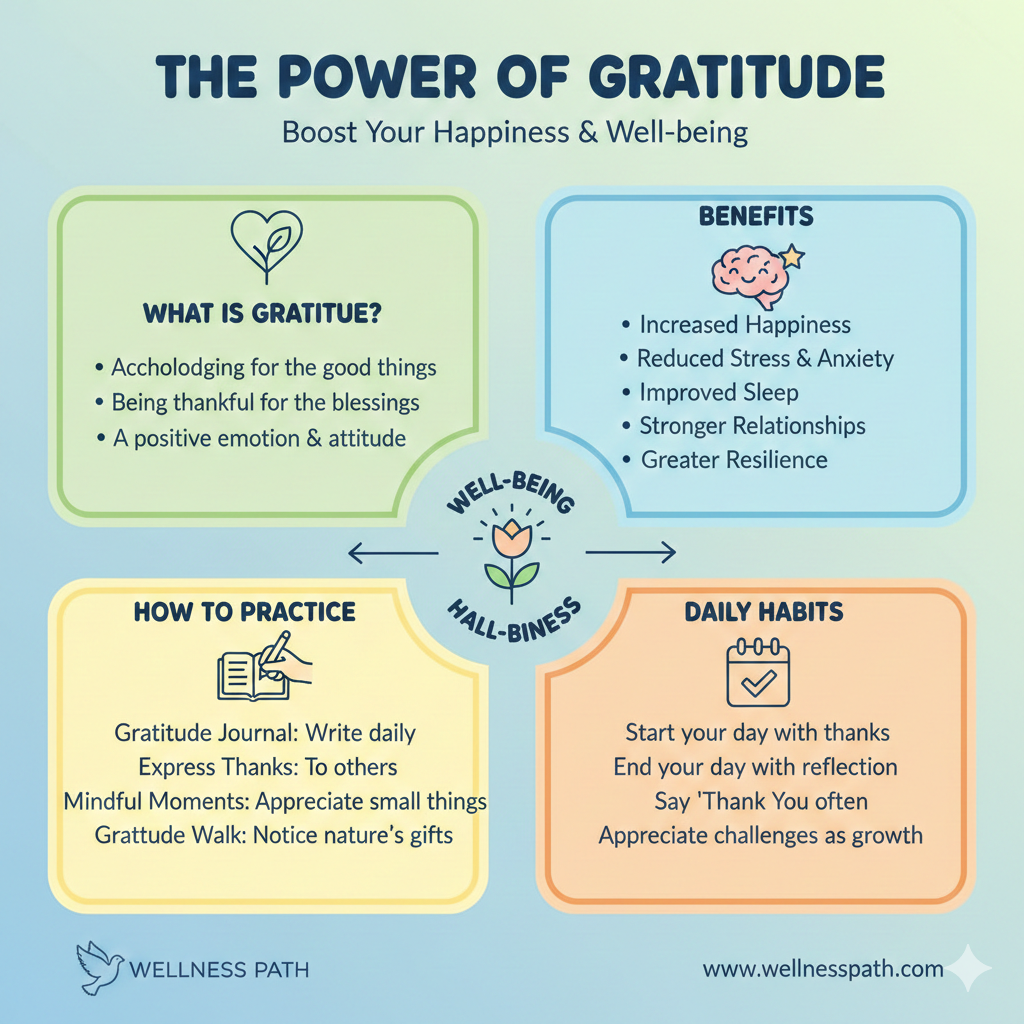
You might be wondering: Can gratitude really change my life? Or is it just another wellness buzzword? The evidence says it's the real deal. Studies show gratitude reduces anxiety, decreases depression, improves sleep quality, and even boosts your immune system.
Whether you're facing a major life transition, dealing with stress, or simply want to feel more satisfied with your life, gratitude offers a practical, scientifically-proven pathway to deeper fulfillment.
This comprehensive guide will walk you through everything you need to know about gratitude—what it is, why it works, and how to make it a sustainable part of your life. You'll learn the neuroscience behind why gratitude literally changes your brain, discover different ways to practice based on your personality and preferences, understand how to apply gratitude across different life stages, and find practical steps to start today. Most importantly, you'll learn how to move beyond gratitude as a practice you do to gratitude as a way of being—where appreciation becomes your natural response to life itself.
What Is Gratitude?
Gratitude is the conscious recognition and appreciation of the goodness in your life. It's not just saying thank you or feeling momentarily pleased. True gratitude is a practice—a deliberate choice to notice and acknowledge gifts, both material and immaterial. These gifts might be relationships, health, opportunities, nature, lessons learned, or even the capacity to laugh. Gratitude exists on a spectrum. You might feel fleeting gratitude when someone holds the door for you, or deep, transformative gratitude when someone shows up for you during a crisis. The practice of gratitude involves training your mind to actively seek positive elements in your day, your relationships, and your life as a whole.
At its core, gratitude is a recognition of interdependence. When you practice gratitude, you acknowledge that you don't exist or succeed in isolation. Your life is built on countless gifts—some earned through effort, but many unearned. Your parents' love, your education, your natural abilities, unexpected kindness from strangers, fortunate timing, and even the natural resources that sustain you are all gifts. Recognizing this creates a sense of humble appreciation and often inspires generosity toward others. You begin to understand that just as you've received gifts, you have the capacity to be a gift to others.
Not medical advice.
Gratitude creates a positive feedback loop in your nervous system. When you practice appreciating what you have, your brain releases dopamine and serotonin—the neurotransmitters responsible for happiness and contentment. Over time, this rewires your neural pathways, making appreciation your default mode rather than criticism or complaint. Gratitude also shifts you from a scarcity mindset (there's never enough) to an abundance mindset (I have more than I realized). This shift is powerful because it directly affects your decision-making, relationships, and resilience.
The beauty of gratitude is that it doesn't require your circumstances to change. You don't have to win the lottery or achieve your dreams to experience the benefits of gratitude. In fact, gratitude is most transformative for people facing real challenges. Someone with a chronic illness can be grateful for days with less pain. Someone in financial difficulty can be grateful for a meal with loved ones. Someone grieving can be grateful for the love they shared with someone they lost. This doesn't minimize the difficulty; it simply acknowledges that even in hard situations, elements of goodness persist. Gratitude helps you hold both realities simultaneously—that life is hard AND that goodness exists.
Surprising Insight: Surprising Insight: Studies show that gratitude is one of the strongest predictors of happiness—even more powerful than optimism, hope, or compassion. In fact, expressing gratitude activates the same reward centers in your brain as winning money.
How Gratitude Transforms Your Brain
The neurological pathway showing how practicing gratitude affects your brain chemistry and emotions
🔍 Click to enlarge
Why Gratitude Matters in 2026
In 2026, we're living in an age of comparison. Social media feeds filled with highlight reels, news cycles that amplify negativity, and a culture obsessed with the next achievement create chronic dissatisfaction. Even when we achieve our goals, we're quickly onto the next one, never pausing to appreciate what we've accomplished. This mindset fuels anxiety, depression, and a deep sense that we're never enough. Gratitude is the antidote to this exhausting treadmill. It teaches us to pause and recognize what's working.
The comparison trap is particularly insidious because it's invisible. You don't consciously decide to feel inadequate; it happens automatically as you scroll through carefully curated content showing others' best moments. Your brain evolved to pay attention to threats and what's missing, not to celebrate abundance. Without conscious gratitude practice, you naturally drift toward comparing your behind-the-scenes reality with everyone else's highlight reel. This gap creates the illusion that you're failing while everyone else thrives. Gratitude disrupts this pattern by training your brain to notice what's actually working in your life, not just what's missing.
Additionally, the workplace and personal relationships in 2026 benefit enormously from gratitude. Employees who feel appreciated are more engaged and productive. Studies show that employees who receive recognition from their managers have better attendance, lower turnover, and higher performance. Relationships where partners express gratitude are stronger and more resilient. Couples who thank each other regularly report higher satisfaction and better conflict resolution. Communities built on appreciation are more cohesive. In a world of digital connection and physical isolation, gratitude reconnects us to what truly matters—the actual humans in our lives, not their Instagram profiles.
Beyond the psychological benefits, gratitude addresses the growing mental health crisis. Anxiety and depression rates have risen steadily, especially post-pandemic. Gratitude practices offer a low-cost, accessible tool that anyone can use—whether they have access to therapy or not. It's both preventative and therapeutic, making it one of the most valuable skills you can develop in 2026. A person who practices gratitude is more resilient to future stress because they've trained their brain to notice resources and support, not just threats. They're also more likely to reach out for help when they need it because gratitude reminds them of the goodwill and support available in their lives.
The Science Behind Gratitude
The neuroscience of gratitude is compelling. When you practice gratitude, several important changes occur in your brain. The prefrontal cortex—responsible for planning, decision-making, and complex thought—becomes more active. Simultaneously, the amygdala, your brain's threat-detection center, quiets down. This means you literally perceive fewer threats and approach life from a place of safety and openness rather than fear and defensiveness. This neurological shift has cascading effects on your entire physiology. Your nervous system moves from a stressed, reactive state (sympathetic) to a calm, responsive state (parasympathetic). In this state, your body can rest, digest, heal, and recover.
Researchers have documented these changes using functional MRI scans, showing that the brains of people practicing gratitude look measurably different from those not practicing it. The increased activity in gratitude involves several neurotransmitters: dopamine (the motivation and reward neurotransmitter), serotonin (the mood neurotransmitter), and oxytocin (the bonding neurotransmitter). When you practice gratitude regularly, your brain becomes more skilled at producing these chemicals naturally, which means you're literally changing your brain's baseline chemistry. This isn't just a temporary emotional boost; it's a structural change that persists even when you're not actively practicing gratitude.
Research from institutions like UC Berkeley's Greater Good Science Center has shown that gratitude interventions—even simple ones like writing three things you're grateful for daily—produce measurable improvements in happiness, life satisfaction, and mental health within just a few weeks. A systematic review and meta-analysis of 25 randomized controlled trials involving 6,745 participants found that gratitude interventions had significant positive effects on psychological wellbeing compared to control groups. These benefits include reduced anxiety, decreased depression, improved relationships, better sleep, and even improvements in physical health markers like lower blood glucose levels.
Gratitude Practice Benefits: The Complete Picture
A comprehensive view of how gratitude affects mental, emotional, physical, and relational health
🔍 Click to enlarge
Key Components of Gratitude
Awareness
The first component of gratitude is awareness—the ability to notice what's good. Most people move through life on autopilot, their attention drawn to problems, threats, and what's missing. This isn't laziness or negativity; it's evolutionary psychology. Your ancestors survived by being hypervigilant to threats. The cost of missing a danger was death; the cost of missing an opportunity was often just a missed meal. Your brain still operates with this threat-bias, which served survival but undermines happiness in the modern world. Developing awareness means deliberately shifting your attention toward positive elements. This might be a warm cup of coffee, a friend's text message, or your own health. Awareness isn't about pretending bad things don't exist; it's about developing the capacity to see the full spectrum of your experience, including the good parts you often overlook. With practice, you can train your brain's attention like you'd train a muscle, directing focus where you consciously choose rather than where your evolutionary wiring automatically takes it.
Practical awareness begins with mindfulness—the practice of noticing what's present right now without judgment. When you drink your morning coffee, instead of thinking about your to-do list, you might notice the warmth of the cup in your hands, the aroma, the taste. When someone texts you, instead of quickly moving on, you might pause to notice that someone cares enough to reach out. When you're walking outside, instead of being lost in thought, you might notice the light, the movement of leaves, the presence of other living things. These moments of awareness are the seeds of gratitude. They create an opening where appreciation can take root.
Appreciation
Once you notice something good, appreciation is the feeling and acknowledgment of its value. Appreciation goes deeper than mere awareness. It involves understanding why something matters—how it contributes to your life, what it means to you, and how much you'd miss it if it were gone. When you truly appreciate something, you feel a sense of richness and abundance. You recognize that many of your blessings were unearned gifts rather than achievements you had to fight for. This recognition is humbling and deeply gratifying. The difference between awareness and appreciation is the difference between noticing the sun and feeling the warmth of its rays. True appreciation engages your emotions and creates a felt sense of abundance, not just an intellectual acknowledgment.
Expression
Gratitude becomes most powerful when expressed. This might mean saying thank you to someone, writing a gratitude letter, or simply speaking your appreciation aloud. Expression moves gratitude from an internal feeling to an action that strengthens relationships and reinforces neural pathways. When you express gratitude to others, you deepen your connection with them and often inspire them to feel more grateful as well. Expression also makes gratitude feel real and tangible rather than abstract. When you vocalize what you're grateful for, it becomes more concrete in your mind. Research shows that the person receiving expressed gratitude often experiences a significant boost to their wellbeing and sense of being valued. In expressing gratitude, you're not just strengthening your own neural pathways; you're actively contributing to someone else's sense of worth and belonging.
Integration
Finally, integration means making gratitude a way of being rather than an occasional practice. Integration happens when gratitude shifts from something you do to something you are. You develop a grateful disposition—a natural tendency to notice and appreciate goodness. At this stage, gratitude becomes less effortful because your brain has rewired itself to seek positive elements automatically. You find yourself spontaneously noticing beauty, recognizing kindness, and appreciating ordinary moments. This integrated gratitude is sustainable and transformative. A person with integrated gratitude doesn't need to remind themselves to feel thankful; it's simply how they perceive the world. This level of practice usually takes months or even years of consistent effort, but the investment pays dividends in baseline happiness and resilience.
| Stage | Description | Practice Focus |
|---|---|---|
| Awareness | Notice what's good in your life | Observation and attention |
| Appreciation | Understand the value and significance | Reflection and feeling |
| Expression | Communicate thanks and recognition | Writing, speaking, sharing |
| Integration | Gratitude becomes your natural disposition | Living as a grateful person |
How to Apply Gratitude: Step by Step
Gratitude practice is simple but not always easy. The steps below are designed to start small and build gradually. You don't need to do all of them at once. Choose one step that resonates with you, practice it for a week, then add another layer. The goal is to develop a sustainable practice that becomes woven into the fabric of your daily life.
- Step 1: Start small with one thing: Choose one moment today where you notice something you appreciate. It could be the taste of food, a kind word, or a comfortable bed. Don't force it; just notice. This trains your brain's attention and begins the rewiring process.
- Step 2: Name it specifically: Instead of 'I'm grateful for my family,' try 'I'm grateful for the way my partner laughed this morning' or 'I'm grateful for my mother's strength.' Specificity makes gratitude feel real and engages your emotional center more fully.
- Step 3: Feel the feeling: Take a moment to actually feel the emotion of gratitude in your body. Where do you feel it? Does it feel warm, light, or expansive? Allow yourself to sit with the emotion. This bridges the gap between intellectual acknowledgment and actual felt appreciation.
- Step 4: Write it down: Grab a journal and write three to five things you're grateful for, along with why each matters to you. Research shows writing amplifies the benefits of gratitude practice by creating a record you can review and by engaging multiple sensory pathways.
- Step 5: Share your gratitude: Tell someone what you appreciate about them. Send a message, make a phone call, or express it face to face. Expression strengthens both your own gratitude and your relationships. The person you thank will likely feel valued and more inclined to reciprocate.
- Step 6: Notice patterns: Over several days of practice, you'll start noticing patterns in what you're grateful for. Do you appreciate experiences more than things? People more than circumstances? This awareness deepens your practice and reveals what truly matters to you.
- Step 7: Make it a ritual: Anchor your gratitude practice to an existing daily habit—maybe morning coffee, lunch, or bedtime. Consistency is key to rewiring your brain. Habits stick when attached to existing routines, so leverage the neural pathways already formed.
- Step 8: Expand beyond the obvious: As your practice deepens, challenge yourself to find gratitude in difficult situations. What can you learn? How has this situation made you stronger? This is advanced gratitude that doesn't deny the difficulty but finds value in it.
- Step 9: Practice gratitude for people: Write a gratitude letter to someone important in your life. Include specific reasons you appreciate them. You can send it or keep it for yourself; both create powerful shifts. Research shows that people who receive gratitude letters experience lasting improvements in wellbeing.
- Step 10: Live gratefully: Eventually, let gratitude infuse your daily decisions. Choose actions that honor what you appreciate. Spend time with people you're grateful for. Engage in activities that fill you with appreciation. Make gratitude your baseline. At this stage, grateful living becomes automatic rather than effortful.
Gratitude Across Life Stages
Young Adulthood (18-35)
Young adults often struggle with gratitude because they're focused on building their futures. There's pressure to accomplish, achieve, and prove yourself. The narrative you internalize is that success comes from striving, and that satisfaction comes after you reach the next milestone. In this stage, gratitude practice helps you recognize that you're already worthy and that many of your opportunities are gifts rather than things you had to earn. Someone gave you life. Someone raised you. Someone taught you. Someone believed in you. These are not things you earned; they are gifts. Gratitude in young adulthood often focuses on relationships—appreciating mentors, friends, and family members who support your growth. It also helps combat the comparison trap that social media creates. A young adult who practices gratitude is more likely to feel satisfied with their progress, less anxious about their future, and more connected to their community. For young adults, gratitude can be practiced through gratitude with friends (making it social), appreciation for growth and learning, and recognition of supportive relationships. This stage sets the foundation for a lifetime of grateful living.
Middle Adulthood (35-55)
Middle adults often carry the weight of multiple responsibilities—careers, families, aging parents, financial obligations. Life becomes simultaneously fuller and more stretched. Gratitude becomes essential because it shifts attention from everything that's not done to what is working. In this stage, gratitude practice often involves appreciating your own resilience and the strength you've developed. You've made it through mistakes, failures, challenges, and losses. You're still standing. That's worth appreciating. Middle adults benefit from gratitude for health, stable relationships, and the wisdom that comes with experience. Many middle adults report that gratitude helps them feel less resentful and more satisfied, even when their lives are busy and demanding. The practice helps prevent the subtle burnout that can occur when you constantly focus on obligations. Gratitude practice for middle adults often involves appreciation for simple pleasures, recognition of accomplishments, and gratitude for the people who make life possible. This stage also offers the opportunity to express gratitude in meaningful ways—mentoring younger colleagues, showing appreciation to partners, and modeling grateful living for children. Middle adults who practice gratitude often report feeling more peaceful despite their busy lives.
Later Adulthood (55+)
Older adults who practice gratitude report higher life satisfaction, better physical health, and deeper contentment. In this stage, gratitude often focuses on legacy—appreciation for what you've accomplished, the people you've influenced, and the wisdom you've gained. Many older adults find meaning in expressing gratitude through storytelling, sharing lessons with younger generations, and deepening spiritual or philosophical connections. Gratitude helps older adults navigate loss and change by emphasizing what remains rather than what's been lost. This is crucial because aging involves experiencing loss—loss of physical abilities, loss of friends and loved ones, loss of role and identity if retirement happens suddenly. A grateful older adult is more likely to maintain active relationships, stay mentally and physically engaged, and find purpose and meaning in their remaining years. Rather than focusing on what's diminished, they appreciate what persists—their capacity to love, to learn, to connect, to contribute. For older adults, gratitude practice often includes life review (appreciating your journey), recognition of enduring relationships, and appreciation for moments of peace and presence. Many older adults report that gratitude helps them find unexpected joy in simple things—a bird song, a grandchild's laughter, a meal shared with friends.
Profiles: Your Gratitude Approach
One-size-fits-all gratitude practices don't work. What resonates deeply with one person might feel forced for another. The following profiles describe different approaches to gratitude. You might see yourself in one profile, or you might recognize elements of several. The goal isn't to fit perfectly into a category but to understand what approach will feel most authentic and sustainable for you. When your gratitude practice aligns with your natural tendencies, you're far more likely to stick with it and experience its benefits.
The Achiever
- Permission to appreciate progress without comparing to others
- Recognition that gratitude and ambition can coexist
- Specific, measurable gratitude practices (like tracking wins)
Common pitfall: Believing that gratitude means accepting mediocrity or stopping trying to improve
Best move: Practice gratitude for effort and progress, not just outcomes. This motivates continued growth while reducing anxiety and resentment.
The Caregiver
- Appreciation for their own generosity and sacrifice
- Gratitude practices that include self-appreciation
- Recognition of the love beneath their service
Common pitfall: Giving so much to others that they never feel personally grateful or appreciated
Best move: Practice gratitude for your own capacity to care, and specifically ask for appreciation from those you help. Let others serve you sometimes.
The Skeptic
- Scientific evidence (which you'll find here)
- Practical application focused on measurable outcomes
- Permission to start small without toxic positivity
Common pitfall: Dismissing gratitude as shallow positivity or denying its effectiveness because it seems too simple
Best move: Start with one week of gratitude journaling and notice your sleep quality, mood, or stress levels. Let results convince you.
The Overwhelmed
- Simple, micro gratitude practices (one thing a day)
- Permission to feel both grateful and overwhelmed
- Connection between gratitude and stress relief
Common pitfall: Feeling guilty for not feeling grateful when struggling, or believing gratitude will fix everything
Best move: Practice gratitude for small things during difficult times. Gratitude won't make problems disappear, but it will help you feel supported and less alone.
Common Gratitude Mistakes
The biggest gratitude mistake is toxic positivity—forcing gratitude or using it to bypass real problems. You don't have to be grateful for terrible things. You can be grateful that you're surviving them and learning from them, but you don't have to thank the universe for pain. Authentic gratitude acknowledges both the good and the hard. It's possible to feel grief and gratitude simultaneously. When you force gratitude, you suppress legitimate emotions and create internal conflict. Instead, practice honest gratitude that includes acknowledgment of challenges. A parent grieving the loss of a child can be grateful for the years they had together while also being devastated by the loss. A person with a chronic illness can appreciate the care they receive while also being angry about their condition. Authentic gratitude creates space for the full range of human emotion.
Another common mistake is practicing gratitude only when life is good. This is backwards. Gratitude practice is most valuable during difficult times because it reminds you of what still works, what you still have, and what you're still capable of. During stress, grief, or illness, gratitude becomes a lifeline. When everything feels dark, finding even small things to appreciate—a friend's text, a moment of relief, your own resilience—can be anchoring. Many people also make the mistake of practicing gratitude mechanically—listing three things daily without actually feeling the emotion. Gratitude is meant to be felt, not just thought. Slow down. Feel the appreciation in your body. Let it matter. The difference between mechanical gratitude and authentic gratitude is like the difference between reading a love letter and hearing it spoken with genuine emotion.
Some people believe that gratitude should be constant and effortless. In reality, gratitude is a practice that requires intention and repetition, especially when you're starting. You might not feel grateful all the time, and that's normal. The practice of noticing and naming gratitude gradually shifts your baseline, but it's not about feeling grateful 24/7. It's about developing the skill of noticing goodness and choosing appreciation more often than not. Think of it like physical fitness—starting an exercise routine requires effort, but over time your fitness baseline improves and movement becomes easier. Similarly, practicing gratitude rewires your brain's baseline, but the initial practice requires intentional effort.
A final mistake is comparing your gratitude practice to others' or expecting immediate transformation. Gratitude is powerful, but it's not magic. Some people experience rapid shifts in mood and perspective; others notice slower, subtler changes. Both are valid. Your gratitude practice is personal. What matters is consistency, not intensity. Five minutes of genuine, felt gratitude daily will create more transformation than an hour of forced, mechanical gratitude once a week.
Gratitude Myths vs. Reality
Clearing up common misunderstandings about gratitude practice
🔍 Click to enlarge
Science and Studies
The scientific evidence for gratitude is robust and growing. Decades of research from psychology, neuroscience, and health sciences demonstrate consistent benefits across diverse populations and cultures. Studies have shown that gratitude interventions produce measurable improvements in mental health, physical health, relationships, and life satisfaction. The effects are real, replicable, and often surprisingly rapid—many studies show significant improvements within two to four weeks of consistent practice.
One landmark study from the University of California found that people who kept a gratitude journal focusing on how events contributed to their lives experienced more optimism, better sleep quality, and fewer physical complaints compared to control groups. The mechanism appears to involve both neurological and behavioral changes. Neurologically, gratitude shifts activity from the amygdala (fear center) to the prefrontal cortex (reasoning and reward center). Behaviorally, practicing gratitude often leads to more prosocial behavior—people who feel grateful are more likely to help others, which in turn creates positive social connections that further improve wellbeing.
Post-pandemic research shows that gratitude practices have been particularly effective for people dealing with trauma, loss, and ongoing uncertainty. Studies of healthcare workers using gratitude interventions showed decreased burnout, improved mental health, and better job satisfaction. These results suggest that gratitude isn't just for people with few problems; it's especially valuable during difficult times. The consistency of benefits across different populations—young and old, rich and poor, different cultures and backgrounds—suggests that the human capacity for gratitude and its benefits are universal.
Beyond the brain, gratitude also affects your physical health. People who practice gratitude have been shown to have lower blood pressure, reduced inflammation markers, better sleep quality, and stronger immune function. These physical benefits likely result from the shift from sympathetic (stressed) to parasympathetic (calm) nervous system activation. When your body is chronically stressed, it allocates resources to immediate survival rather than healing and maintenance. When gratitude shifts you into a calm state, your body can allocate resources to digestion, repair, immunity, and recovery. This explains why gratitude practitioners often report feeling better physically, sleeping more deeply, and getting sick less frequently. The benefits of gratitude aren't just in your mind; they're embodied throughout your entire system.
- UC Berkeley Greater Good Science Center: Multiple peer-reviewed studies showing gratitude reduces anxiety, decreases depression, improves sleep quality, and increases life satisfaction.
- NIH/PubMed Meta-Analysis: A systematic review and meta-analysis of 25 randomized controlled trials involving 6,745 participants found gratitude interventions had significant positive effects on psychological wellbeing.
- Stanford Medicine: Research demonstrating that gratitude practices lower blood pressure, reduce inflammation, and strengthen immune function, particularly important for healthcare workers.
- Springer Nature Research: Post-COVID studies showing gratitude practice decreases psychological disturbance and facilitates post-traumatic growth in adults.
- Journal of Medical Internet Research: A prospective cohort study of web-based gratitude interventions for healthcare workers showed improved wellbeing and reduced burnout symptoms.
Your First Micro Habit
Start Small Today
Today's action: Name three specific things you appreciate about today (not generic things—be concrete). Examples: 'the warmth of my coffee cup,' 'my friend's text message,' 'the sound of birds.' Spend 30 seconds feeling the appreciation in your body.
Your brain needs specific, concrete details to create emotional activation. Vague gratitude ('I'm grateful for my family') doesn't engage your reward centers. But specific gratitude ('I'm grateful for the way my partner made me laugh this morning') activates dopamine and creates a real feeling of appreciation.
Keep quitting habit apps after a missed day? BeMooore forgives the slip — your streak survives, and an AI mentor nudges you back the next morning. Free on iOS.
Quick Assessment
How often do you currently notice things you appreciate in a typical day?
Your answer reveals your current gratitude baseline. If you rarely notice appreciation, gratitude practice will have the biggest impact. If you already notice regularly, deepening your practice through expression or integration will create new benefits.
What tends to block your ability to feel grateful?
Understanding your barrier helps you design a gratitude practice that works for you. If stress blocks you, gratitude becomes a stress-relief tool. If comparison blocks you, gratitude helps you see your own good life. If perfectionism blocks you, gratitude teaches self-acceptance.
What form of gratitude expression appeals to you most?
Your preferred expression style matters because gratitude sticks when you practice in a way that feels authentic. Forcing yourself to journal when you prefer speaking means lower consistency. Choose your expression style based on your natural inclinations.
Take our full assessment to get personalized recommendations.
Discover Your Style →As you begin your gratitude practice, questions naturally arise. How long does it take to work? Is it real if I don't feel it? Can it really help with clinical anxiety or depression? Can I practice it even if I'm grieving? The answers to these questions can deepen your understanding and help you build a practice that fits your situation. Below are the most common questions we receive about gratitude, along with thoughtful, research-based answers.
Next Steps
You now understand what gratitude is, why it matters, and how to practice it. The only step left is to actually begin. Start today with just one thing. Notice something you appreciate, name it specifically, and feel the gratitude in your body for 20 seconds. That's enough to begin rewiring your brain and shifting your baseline. You don't need to overhaul your entire life or commit to an hour of gratitude meditation. Small, consistent practice creates remarkable results. Research shows that even five minutes daily produces measurable improvements in mood, stress, and life satisfaction within two weeks.
Over the coming weeks, experiment with different gratitude practices. Try journaling one day, gratitude conversations the next. Notice what feels natural and sustainable. Build your practice around your life rather than trying to fit your life around a rigid practice. Remember that gratitude isn't about forcing positivity or bypassing real problems. It's about developing the skill of noticing goodness and choosing appreciation more often. This skill transforms your relationship with life itself.
As you deepen your practice, you may notice shifts that extend beyond your individual wellbeing. You might find yourself more generous, more patient, more connected to others. You might naturally spend less time scrolling social media and more time with real people. You might make different choices about how you spend your time and energy. These shifts happen because gratitude realigns your values. When you practice appreciation, you naturally gravitate toward people, activities, and experiences that deserve appreciation. This creates a positive cycle where your improved wellbeing leads to better relationships, which lead to more to be grateful for, which deepens your wellbeing further.
The practice of gratitude is both simple and profound. It costs nothing, requires no special equipment or expertise, and can begin anywhere, anytime. Yet it has the power to transform your brain chemistry, strengthen your relationships, improve your health, and fundamentally shift how you experience being alive. Whether you're starting this practice for mental health, relationship improvement, spiritual growth, or simple happiness, you're engaging with one of the most evidence-supported wellbeing practices available. Welcome to grateful living.
Get personalized guidance with AI coaching.
Start Your Journey →Research Sources
This article is based on peer-reviewed research and authoritative sources. Below are the key references we consulted:
Related Glossary Articles
Frequently Asked Questions
Can gratitude help with depression or anxiety?
Yes, research shows gratitude is one of the most effective tools for managing anxiety and depression. It works by shifting your brain from threat-detection (amygdala activation) to positive attention (prefrontal cortex activation). Gratitude isn't a replacement for therapy or medication, but it's a powerful complement. Studies show that combining gratitude practice with professional treatment produces better outcomes than either alone.
How long until I notice benefits from gratitude practice?
Some people notice improvements in mood and sleep quality within 3-7 days of consistent practice. Most experience measurable changes in anxiety, stress, and life satisfaction within 2-4 weeks. However, the deepest transformations—shifts in how you perceive yourself and your life—often take 8-12 weeks. Consistency matters more than intensity. Daily practice for two weeks beats sporadic practice for months.
Does gratitude work across different cultures and backgrounds?
Yes. While specific expressions of gratitude vary by culture, the neurological and psychological benefits are universal. Research on gratitude includes diverse populations across North America, Europe, Asia, Africa, and Latin America, showing consistent benefits. The underlying human capacity to appreciate and feel grateful appears to be universal.
What if I'm grieving or going through something hard—is gratitude insensitive?
Authentic gratitude never requires you to feel grateful for pain or loss. During difficult times, gratitude focuses on what remains, what still works, and what you're still capable of. Many people find that even during grief, gratitude for small moments—a friend's presence, a moment of peace, your own resilience—provides comfort without denying their pain.
Is journaling the only way to practice gratitude?
No. While gratitude journaling is popular and effective, other practices work equally well: gratitude conversations with a partner, meditation on appreciation, writing gratitude letters, expressing thanks to people, or simply pausing throughout the day to notice and feel appreciation. The key is consistency and genuine feeling, not the specific method. Choose a practice that feels sustainable and authentic for you.
Take the Next Step
Ready to improve your wellbeing? Take our free assessment to get personalized recommendations based on your unique situation.
- Discover your strengths and gaps
- Get personalized quick wins
- Track your progress over time
- Evidence-based strategies