Love
Love is one of the most powerful forces shaping human experience, yet for centuries it remained largely mysterious. Today, neuroscience has revealed that love is far more than a feeling—it's a complex biological process involving multiple brain systems, hormones, and neurotransmitters working in concert. When you fall in love, your brain experiences measurable changes in activity, chemistry, and even structure. These changes influence everything from your decision-making and stress levels to your immune function and longevity. Whether you're in the early euphoria of new romance, the deeper commitment of long-term partnership, or the unconditional love of family, understanding the science behind these experiences can help you cultivate more authentic, meaningful connections.
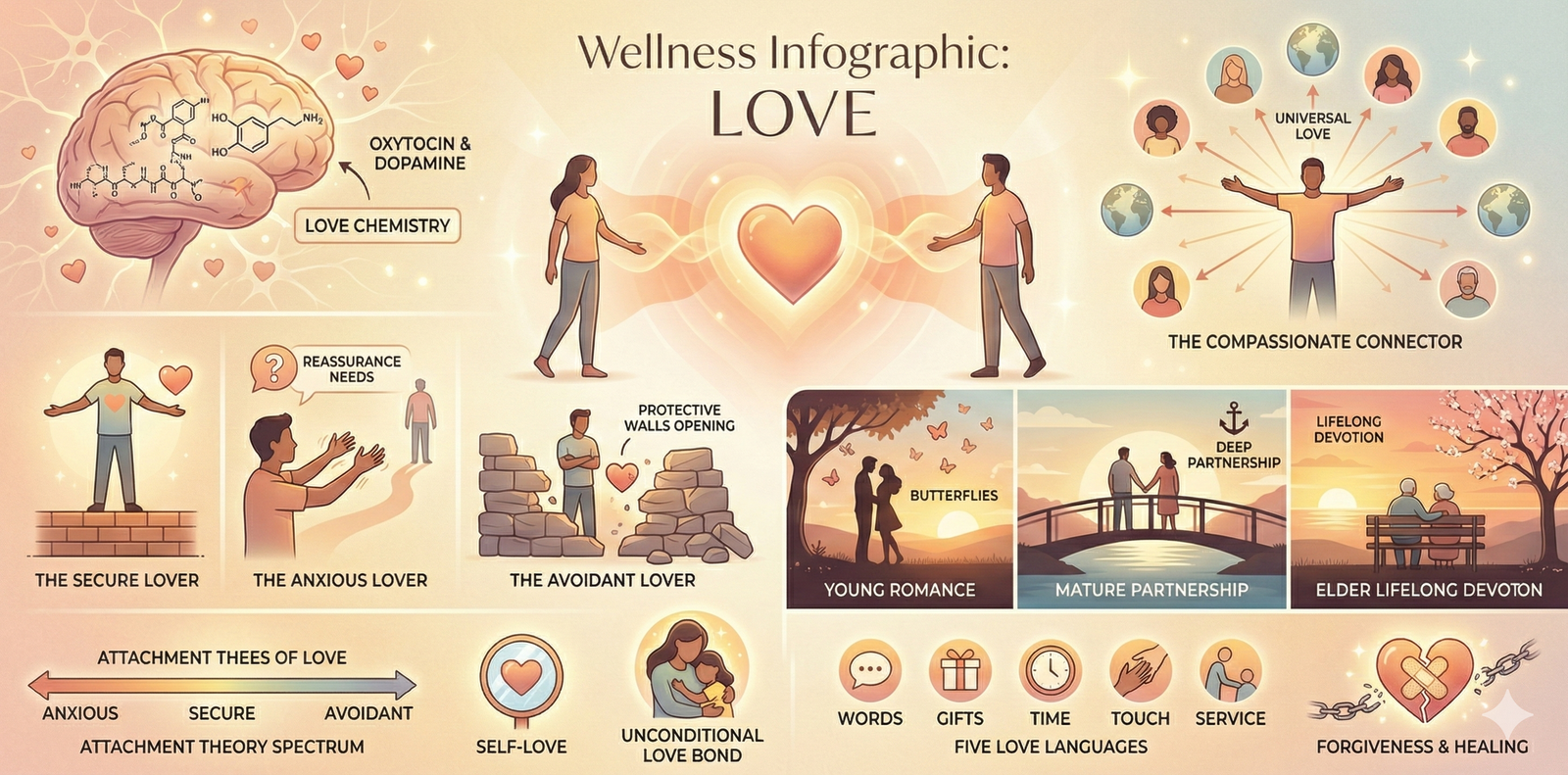
What makes love so transformative is that it engages multiple dimensions of our humanity simultaneously—emotional, physical, psychological, and spiritual. Love isn't just about attraction or passion; it encompasses intimacy, commitment, vulnerability, and the courage to be truly known by another person.
This guide explores the neuroscience, psychology, and practical application of love across different life stages and relationship types, giving you a comprehensive understanding of this fundamental human experience.
What Is Love?
Love is a multifaceted emotional and physiological state characterized by deep affection, desire for connection, and commitment to another person's wellbeing. At its core, love involves the activation of specific neural circuits that produce powerful neurochemicals like oxytocin, dopamine, and serotonin. These chemicals create feelings of pleasure, bonding, trust, and reward when we interact with someone we love.
Not medical advice.
While romantic love is the most commonly discussed form, love encompasses many expressions: parental love, sibling love, friendship love, and universal compassion. Each form activates similar brain regions but with varying intensities. Research shows that love for your children generates the most intense brain activation, followed closely by romantic love. The neurobiological pathways of love are so fundamental to human survival and flourishing that they've been conserved across evolution, making love a truly universal human experience.
Surprising Insight: Surprising Insight: When people view images of individuals they love, brain scans show activation in the caudate nucleus (linked to reward and motivation) and decreased activity in areas associated with judgment and fear—essentially, love makes us trust and reward those we care about at a neural level.
The Brain Chemistry of Love
This diagram illustrates the key neurotransmitters and hormones involved in love, from the initial rush of dopamine in new romance to the sustained bonding of oxytocin in long-term relationships.
🔍 Click to enlarge
Why Love Matters in 2026
In an increasingly disconnected digital world, the capacity for genuine love and connection has become more valuable—and more challenged—than ever. Social isolation has risen to epidemic levels, with loneliness linked to serious health consequences comparable to smoking or obesity. Yet love, in all its forms, serves as a protective factor against these modern challenges.
Love directly impacts your physical health: people in loving relationships have lower blood pressure, reduced inflammation, stronger immune systems, and even longer lifespans. Beyond health, love provides psychological resilience, helping us navigate stress, uncertainty, and change with greater emotional stability. In the workplace, love-based values like compassion and authentic connection are increasingly recognized as drivers of innovation, collaboration, and sustained success.
Perhaps most importantly, love is the antidote to the anxiety and meaninglessness that characterize much of modern life. When you feel genuinely loved and connected, existential questions become less urgent. You develop a sense of purpose rooted in relationships rather than external achievement. In 2026, learning to love—yourself, others, and the world—is not just a personal growth goal; it's a form of resistance against the forces fragmenting human connection.
The Science Behind Love
Neuroscientists have identified the specific brain regions and chemical systems that create love. The process begins in the limbic system, particularly the ventral tegmental area (VTA), which floods the brain with dopamine when you encounter someone attractive or when you think about them. This dopamine surge activates the caudate nucleus, creating a sense of reward and motivation. Simultaneously, serotonin levels drop, which researchers believe explains why people in love become somewhat obsessive, unable to stop thinking about their partner.
As love deepens beyond the initial infatuation stage, oxytocin becomes the dominant neurochemical. Often called the 'bonding hormone' or 'love hormone,' oxytocin is released during physical touch, intimate conversation, and sexual activity. It creates feelings of trust, safety, and attachment, fundamentally shifting how you perceive and relate to your partner. Oxytocin also activates the prefrontal cortex, enhancing empathy and reducing fear responses. In long-term relationships, oxytocin levels remain elevated, sustaining the emotional intimacy and sense of safety that characterizes mature love.
How Brain Regions Activate During Love
Brain imaging studies show distinct activation patterns depending on the stage of love: new romance activates reward centers, while long-term love shows more distributed activation across regions associated with attachment, meaning, and deep commitment.
🔍 Click to enlarge
Key Components of Love
Emotional Intimacy
Emotional intimacy is the foundation of love. It involves being fully known and accepted by another person—sharing your authentic thoughts, feelings, fears, and dreams without judgment. Emotional intimacy develops through vulnerability, active listening, and consistent responsiveness to your partner's emotional needs. Research shows that couples who regularly engage in deep emotional sharing experience greater relationship satisfaction, lower stress levels, and improved mental health. Creating space for emotional intimacy requires setting aside distractions, asking meaningful questions, and responding with genuine empathy rather than trying to fix or minimize your partner's experience.
Physical Affection and Touch
Physical touch is not merely pleasant—it's neurologically essential for love to flourish. Skin-to-skin contact triggers the release of oxytocin, lowers cortisol (the stress hormone), and activates the parasympathetic nervous system, creating a state of calm and safety. Handholding, hugging, massage, and sexual intimacy all serve as powerful bonding mechanisms. Importantly, physical affection doesn't require sexual expression; a simple touch on the arm or hand can convey love and deepen connection. Couples who maintain consistent physical affection report higher satisfaction and better conflict resolution, as the oxytocin released helps regulate emotions and enhance empathy.
Commitment and Consistency
Love without commitment is merely infatuation. Commitment—the conscious choice to prioritize someone's wellbeing and the relationship's growth—transforms fleeting attraction into enduring partnership. Commitment shows up in consistency: following through on promises, showing up during difficulties, and continuing to choose your partner even when the initial euphoria fades. This sustained commitment activates different neural pathways than new love does, creating what researchers call 'compassionate love'—a deeper, more stable emotional connection based on values and deliberate choice rather than pure neurochemistry.
Vulnerability and Authenticity
True love requires the courage to be seen, flaws and all. Vulnerability—sharing your insecurities, failures, and deepest fears—paradoxically creates stronger connection than presenting a perfect facade. When your partner responds to your vulnerability with acceptance and support, your brain registers this as safety, deepening attachment. Research on attachment styles shows that securely attached individuals, who learned to be vulnerable and trust others early in life, tend to develop healthier, more satisfying relationships. Authenticity means showing your real self rather than performing a version you think your partner wants, which ultimately creates space for genuine reciprocal love.
| Stage | Duration | Primary Neurochemicals | Brain Focus |
|---|---|---|---|
| Infatuation | 6 months - 3 years | Dopamine, Norepinephrine, Low Serotonin | Caudate nucleus, VTA, Prefrontal cortex |
| Early Love | 3-5 years | Dopamine declining, Oxytocin rising | Anterior cingulate, Insula |
| Mature/Companionate Love | 5+ years | Oxytocin, Endorphins, Sustained Dopamine | Distributed neural networks, Prefrontal cortex |
How to Apply Love: Step by Step
- Step 1: Assess your current relationship with love: Notice patterns from your past relationships and family. Do you tend toward emotional distance, anxious attachment, or secure connection? Understanding your baseline helps you work intentionally on growth.
- Step 2: Create safe space for emotional expression: Set aside dedicated time with your partner (or friend, family member) to share thoughts and feelings without rushing or distractions. Put phones away, make eye contact, and listen without planning your response.
- Step 3: Practice active listening: When someone shares with you, resist the urge to problem-solve or minimize. Instead, reflect back what you hear: 'It sounds like you felt betrayed when...' This builds emotional intimacy and activates oxytocin.
- Step 4: Increase physical affection intentionally: If you're in a romantic relationship, increase non-sexual touch—holding hands, hugging longer, back rubs. For other relationships, appropriate physical warmth (hugs, arm touches) conveys genuine care and triggers bonding neurochemistry.
- Step 5: Communicate vulnerably: Share something real about your struggles, fears, or insecurities with someone you trust. Start small if you're not practiced at vulnerability. This invites reciprocal openness and deepens connection.
- Step 6: Make conscious commitments: Express your commitment clearly and follow through consistently. Say 'I choose to invest in this relationship' and demonstrate it through reliable presence and effort, especially during difficult times.
- Step 7: Practice empathy exercises: Before responding to conflict, genuinely try to understand your partner's perspective. Ask 'What's important to you about this?' or 'Help me understand why you felt hurt.' Empathy shifts you from opposing positions to collaborative problem-solving.
- Step 8: Manage conflict constructively: Instead of attacking character ('You're selfish'), address specific behaviors ('When you don't text back for hours, I feel disconnected'). Use 'I' statements and focus on solutions rather than blame.
- Step 9: Maintain novelty and play: Regular new experiences activate dopamine and keep long-term relationships feeling alive. This might mean trying new activities together, traveling, learning something new as a couple, or simply being playful and humorous together.
- Step 10: Invest in your own wellbeing: People who practice self-love, maintain interests outside their relationships, exercise, sleep well, and manage stress are better partners. Your capacity to love others is directly connected to how well you care for yourself.
Love Across Life Stages
Young Adulthood (18-35)
In young adulthood, love is often characterized by intense passion, exploration of identity, and formation of first committed relationships. This stage typically involves navigating the transition from infatuation-based love to deeper commitment. Young adults are developing their attachment style and learning patterns they often repeat throughout life. The brain is still maturing, particularly the prefrontal cortex (responsible for impulse control and long-term thinking), which explains why young love can be impulsive and intense. This is the ideal time to develop healthy relationship skills: learning to communicate authentically, manage conflict constructively, and understand what you truly need from partnership rather than simply what feels exciting. Many young adults benefit from understanding their attachment style (secure, anxious, avoidant, or disorganized) as this self-knowledge dramatically improves relationship outcomes.
Middle Adulthood (35-55)
Middle adulthood is often the deepest phase of long-term love if a relationship has survived this far. Infatuation has fully faded, and what remains is compassionate love—a more stable, deeper commitment based on years of shared experience. Many couples report increased satisfaction in this stage as they've developed strong conflict resolution skills and profound understanding of their partner. However, middle adulthood also brings challenges: career pressures, raising children, aging parents, and the reality that your partner cannot meet all your needs. Successful long-term relationships in this stage are characterized by maintaining emotional connection despite life's distractions, continuing to invest in physical affection and novelty, and developing individual identity alongside partnership identity. This is also when many people rediscover or deepen love through acts of service, shared values, and the pride of having built something lasting together.
Later Adulthood (55+)
In later adulthood, love often becomes more generous and less possessive. Long-term couples often report greater relationship satisfaction and lower conflict in this stage. The brain's emotional regulation systems are more mature, making it easier to forgive and maintain perspective. Couples who have remained together for 30+ years often describe their relationship as more like a deep friendship than passionate romance—and they typically find this deeply satisfying. However, later adulthood also brings grief: loss of peers, health challenges, and awareness of mortality. Couples who navigate these challenges together often experience profound intimacy born from having truly suffered and endured together. For those single in later adulthood, love can take many forms: deepened friendships, connection with grandchildren, community involvement, and self-love practices. Research shows that regardless of relationship status, people who cultivate meaningful connections in later life experience better health outcomes and greater life satisfaction.
Profiles: Your Love Approach
The Secure Lover
- Consistent emotional and physical connection
- Clear communication about needs and boundaries
- Balance between togetherness and individual identity
Common pitfall: May take their secure attachment for granted and stop investing effort in the relationship
Best move: Maintain the practices that created security (regular date nights, vulnerable conversations, appreciation) and recognize that secure love requires ongoing commitment, not just initial luck
The Anxious Lover
- Frequent reassurance and responsiveness from partner
- Clear communication from partner about their feelings and commitment
- Therapy or self-development work to build internal security
Common pitfall: Can become clingy or demanding, pushing partner away through over-pursuit and constant reassurance-seeking
Best move: Build self-esteem independent of your partner's validation; practice grounding techniques when anxiety arises; communicate needs clearly rather than hinting; gradually extend your sense of safety to be less dependent on constant external reassurance
The Avoidant Lover
- Ample personal space and independence
- Partners who respect their need for autonomy
- Gradual, low-pressure building of emotional intimacy
Common pitfall: May withdraw from relationships at signs of conflict or deepening intimacy, creating distance that partners perceive as rejection
Best move: Recognize that your need for independence and your capacity for love are not mutually exclusive; practice staying present during emotional conversations even when uncomfortable; communicate your needs directly rather than withdrawing; work on trusting that closeness doesn't mean loss of self
The Compassionate Connector
- Reciprocal effort from partners to sustain the relationship
- Boundaries to protect against caretaker burnout
- Validation that their emotional labor is noticed and valued
Common pitfall: Often puts others' needs before their own, leading to resentment and exhaustion when their care isn't reciprocated
Best move: Practice asking for what you need rather than always giving; recognize that healthy love includes receiving, not just providing; set boundaries around emotional labor; choose partners capable of mutual care rather than those who primarily need saving
Common Love Mistakes
Mistaking infatuation for true love is one of the most common errors, leading people to commit to relationships based on neurochemical euphoria rather than genuine compatibility. The dopamine-fueled obsession of new love typically lasts 18 months to 3 years before reality sets in. By understanding that infatuation is a stage, not the totality of love, you can make commitment decisions more wisely, recognizing that real intimacy develops after the neurochemical high fades.
Another critical mistake is neglecting the relationship once commitment is established. Many people assume that once you've committed to someone, love will maintain itself without ongoing investment. In reality, all relationships require consistent effort: regular vulnerable conversations, physical affection, novelty and fun, and acts of service and appreciation. Relationships that start with intense connection but fade to roommate status often result from this neglect, not from incompatibility.
A third mistake is expecting one person to meet all your needs—romantic, social, intellectual, spiritual, and practical. This impossible expectation creates pressure that no relationship can sustain. Healthy people maintain a network of relationships: romantic partners, close friends, family connections, mentors, and community. Each relationship serves different functions, and none should bear the full weight of your wellbeing.
The Relationship Lifecycle and Common Failure Points
This diagram shows where relationships typically encounter challenges and where intentional effort matters most. Understanding these critical junctures helps you recognize warning signs and invest proactively.
🔍 Click to enlarge
Science and Studies
The modern science of love has been revolutionized by neuroscientific research, particularly the work of Helen Fisher and neuroscientists who use brain imaging to observe what happens in the brain during love. Studies consistently show that love involves measurable neurochemical and neuroanatomical changes, making it as 'real' as any physical process. Recent research from 2024-2025 has expanded our understanding of love's health benefits, attachment mechanisms, and the role of communication in sustaining long-term relationships.
- Helen Fisher's research (TED) demonstrates that romantic love activates the ventral tegmental area and caudate nucleus, the same regions associated with reward and addiction. This explains why new love feels so compelling and why we become somewhat obsessed with thinking about our partners.
- Neuroscience research shows that oxytocin, the bonding hormone, is released during physical touch and intimate conversation, creating trust and attachment. Long-term partners who maintain consistent physical affection have sustained oxytocin levels, correlating with relationship satisfaction.
- A 2024 study in Frontiers in Psychology introduced the Love and Rejection Messages Theory (LRMT), a new framework for understanding how couples can rekindle romantic love in long-term relationships through specific communication patterns and reconnection practices.
- Research from Northwestern Medicine and University of Utah Health documents that people in loving relationships experience measurable health benefits: lower blood pressure, reduced stress hormones, improved immune function, and even increased longevity—demonstrating that love is not just emotionally important but physically protective.
- A meta-analysis examining how expressions of love correlate with feeling loved shows that the more openly and consistently we express love to our partners, the more loved we feel in return, suggesting that love is partly a skill that can be developed through practice and intention.
Your First Micro Habit
Start Small Today
Today's action: Tonight or tomorrow, ask your partner, close friend, or family member one genuine question about something that matters to them—not small talk, but something real: 'What's been weighing on you lately?' or 'What are you proud of about yourself?' Then listen without planning your response.
This single practice creates emotional intimacy, activates oxytocin, and signals to the other person that they matter. Over time, asking genuine questions builds trust and deepens connection. If you practice this consistently, you'll notice the other person becomes more open, the conversation becomes more meaningful, and your relationship strengthens.
Keep quitting habit apps after a missed day? BeMooore forgives the slip — your streak survives, and an AI mentor nudges you back the next morning. Free on iOS.
Quick Assessment
How do you typically respond when someone you care about shares something vulnerable or difficult?
Your response reveals your attachment style and empathic capacity. Those who naturally move into understanding and validation tend to have secure attachment and stronger relationships. If you default to problem-solving, you're likely trying to help but might miss the emotional need to simply be heard. If you feel uncomfortable, you may have avoidant tendencies worth exploring. The good news: all these patterns can be developed and improved with intentional practice.
When conflict arises in a close relationship, what's your typical first instinct?
This question reveals your conflict resolution style. Direct, calm addressing correlates with secure attachment and better long-term relationship outcomes. Withdrawal might indicate avoidant attachment. Defensiveness can signal insecurity or anxiety. Anxious peacemaking often stems from a fear of abandonment. Understanding your pattern helps you work intentionally toward the most effective style for healthy relationships.
In your most important relationships, what do you believe is most essential?
While all four elements matter in healthy relationships, your primary answer reveals what you naturally prioritize. Those focused on emotional intimacy tend to value vulnerability and depth. Those emphasizing activities might express love through doing rather than talking. Those seeking security may have experienced instability and need reassurance. Those prioritizing respect may have been undervalued in past relationships. Recognizing your priority helps you communicate your needs clearly and choose compatible partners.
Take our full assessment to get personalized recommendations.
Discover Your Style →Next Steps
Understanding love intellectually is just the beginning. Real transformation comes from applying these insights to your relationships and yourself. Start by identifying which insights resonate most with you: Are you learning about your attachment style for the first time? Do you need to address communication patterns in a current relationship? Are you grieving a lost relationship and need to rebuild trust in love? Your starting point shapes your next steps.
Consider taking our full Wellbeing Assessment to explore your unique relationship patterns, attachment style, and what you most need to cultivate deeper love in your life. Many people find that understanding themselves—their fears, their values, their patterns—is the foundation for building better relationships with others. Then, commit to one small practice: ask one genuine question daily, initiate physical affection, or have one vulnerable conversation this week. Love builds through consistent small actions repeated over time.
Get personalized guidance with AI coaching.
Start Your Journey →Research Sources
This article is based on peer-reviewed research and authoritative sources. Below are the key references we consulted:
Related Glossary Articles
Frequently Asked Questions
Is love a choice or a feeling?
Love is both. The initial attraction and feelings of infatuation are neurochemical reactions you don't fully control. However, mature love—the decision to prioritize someone's wellbeing, to work through conflict, to show up consistently—absolutely is a choice. The most satisfying long-term relationships are characterized by this combination: you feel affection (the emotional component) and you actively choose commitment (the behavioral component). As the saying goes, 'Love is a verb.'
How do you know if you're in love vs. infatuation?
Infatuation is characterized by obsessive thinking about the other person, idealization (seeing only their good qualities), focus on their appearance and sexuality, and a sense that this person is the key to your happiness. It typically lasts 18 months to 3 years before reality sets in. True love develops after infatuation fades and includes genuine knowledge of the other person (seeing and accepting their flaws), commitment that doesn't depend on constant euphoria, and the ability to maintain your own identity and other relationships. True love grows over time; infatuation fades. If your relationship survives the fading of infatuation and deepens into genuine commitment and intimate knowledge of each other, you've likely moved into real love.
Can a relationship survive without physical affection?
Physical affection is neurologically important for bonding, stress reduction, and maintaining oxytocin levels. Long-term relationships that lose physical affection often experience declining satisfaction and increased distance. That said, 'physical affection' doesn't mean only sexual touch—it includes holding hands, hugging, massage, and non-sexual closeness. Some people have lower touch needs due to their neurology or past trauma, but even these individuals benefit from some level of appropriate physical connection. If physical affection has declined in your relationship, addressing it—whether by exploring what's caused the distance or adapting to what feels comfortable for both partners—is important for maintaining intimacy.
What should I do if I'm not sure I love my partner anymore?
This is a complex question that deserves honest reflection. First, distinguish between a temporary decline in feelings (which happens in long-term relationships during stressful periods) and a fundamental shift in compatibility or attraction. Consider: Do you still respect and care about their wellbeing? Can you address the specific distance or disappointment rather than assuming love is gone? Sometimes what feels like 'falling out of love' is actually the normal transition from infatuation to companionate love, and it's improved by consciously investing in the relationship. If you've tried honest communication, couples counseling, and intentional reconnection and you still feel fundamentally disconnected, it may be worth exploring whether this relationship serves both of you. Therapy can help you determine what's true.
Is it possible to love someone you're no longer in a relationship with?
Yes, absolutely. Love and romantic partnership are not the same thing. You can love someone—genuinely care about their wellbeing and carry affection for them—without being in a healthy romantic relationship with them. Many people experience this with exes, family members they've had to distance from for their own health, or friends they once dated. The key is ensuring that love doesn't prevent you from making choices that serve your own wellbeing. You can love someone and recognize that being together isn't what's best for either of you. Over time, romantic love often transforms into a different kind of care and appreciation, especially when physical and emotional distance is maintained to support healing.
Take the Next Step
Ready to improve your wellbeing? Take our free assessment to get personalized recommendations based on your unique situation.
- Discover your strengths and gaps
- Get personalized quick wins
- Track your progress over time
- Evidence-based strategies