Compassion
Have you ever felt your heart ache when someone you love struggles? That visceral pull toward wanting to ease their suffering—that's compassion awakening. Compassion is the bridge between empathy and action, the moment when understanding someone's pain transforms into the desire to help. It's not just about feeling sorry for others; it's about recognizing our shared humanity and choosing kindness even when it's hard. In a world of disconnection and hurt, compassion may be the most powerful healing force we possess.
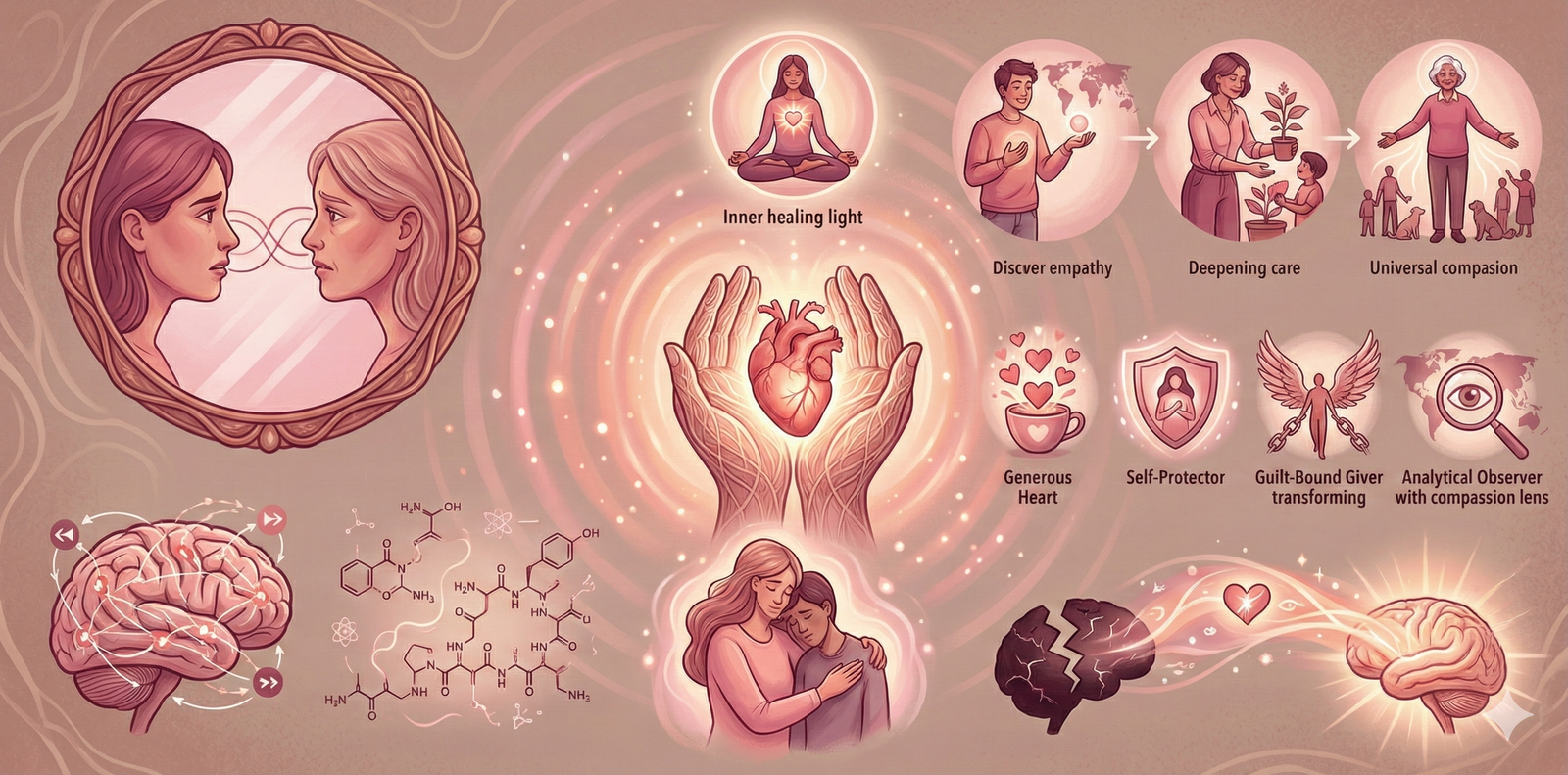
Compassion rewires your brain, strengthening neural pathways of love and connection while reducing stress hormones that fuel anxiety and isolation.
The practice of compassion is learnable, measurable, and transformative—beginning with how you treat yourself and radiating outward to transform every relationship you touch.
What Is Compassion?
Compassion is the combination of awareness of another person's suffering paired with a genuine desire to help alleviate that suffering. It goes beyond empathy—empathy is understanding and sharing what someone feels, while compassion is taking that understanding and moving toward action, connection, and care. Compassion is where the heart opens and you recognize the sacred humanity in another person's struggle, including your own.
Not medical advice.
Compassion has three essential layers. First, it requires mindful awareness—you notice when someone (including yourself) is struggling. This means developing the sensitivity to catch the subtle signs: the slight tension in someone's voice, the heaviness in their eyes, the way they've withdrawn from conversation. It requires slowing down enough to really see people. Second, compassion involves emotional resonance—you allow yourself to feel the weight of that struggle without becoming overwhelmed. This is the tender heart part, where you let the reality of someone's pain touch you. Third, it manifests as motivation to respond—you want to help, comfort, and ease the pain. This desire moves from feeling into action, from understanding into doing.
This three-part process distinguishes compassion from related but different states. Pity feels from a distance, as if the suffering person is somehow separate from you—less fortunate, more broken, fundamentally different. Compassion recognizes shared humanity. Burnout occurs when empathy overshadows self-care—when you feel so much of others' pain that you lose yourself. True compassion includes boundaries and self-kindness. Indifference is the absence of all these elements—a turning away, a hardening, a pretense that the suffering doesn't matter. Compassion is the opposite: it's a turning toward, a softening, an acknowledgment that everything matters because everyone matters.
Surprising Insight: Surprising Insight: Compassion doesn't fatigue us. Research shows that feelings of compassion activate brain regions linked to reward processing, flooding the brain with oxytocin and vasopressin—the bonding hormones. Unlike the pain networks exhausted by raw empathy, compassion actually energizes us.
The Compassion Cycle: From Awareness to Action
How awareness of suffering leads to emotional response, which motivates compassionate action that creates connection and healing
🔍 Click to enlarge
Why Compassion Matters in 2026
We live in an era of isolation despite hyper-connectivity. Social media shows curated versions of others' lives, technology buffers face-to-face interaction, and polarization creates an us-versus-them mentality. People are more lonely than ever, despite—or because of—being constantly connected to screens. Anxiety and depression are epidemic, particularly among young adults who've grown up comparing their inside experience to everyone else's outside presentation. Compassion is the antidote to all of this. It cuts through judgment, bridges divides, and reminds us that beneath all differences, we all want to love and be loved. It reduces loneliness, strengthens communities, and heals the wounds created by disconnection. When you extend compassion, you acknowledge the full humanity of another person—their fears, their failures, their longing to matter. This simple acknowledgment is revolutionary in a world of surface-level interaction.
Compassion also protects your mental health with measurable effects. Studies show that people who practice self-compassion experience lower rates of anxiety, depression, and loneliness compared to those who tend toward self-criticism. They're more resilient under stress because they respond to their own struggles with kindness rather than harsh self-judgment. When you fail, self-compassion says: 'Of course I'm struggling—this is hard.' Self-criticism says: 'I'm broken and weak.' The difference in these two responses is the difference between resilience and despair. When life falls apart, compassion becomes the ground beneath your feet—a place of acceptance rather than judgment. This is not resignation or complacency. It's the recognition that suffering is part of being alive, and that kindness in the face of suffering is the only sane response.
In your relationships, compassion is the glue that holds people together through difficulty. Partners who practice compassion toward themselves and each other report higher satisfaction, better communication, and greater ability to navigate conflict without defensiveness. Instead of attacking when hurt, they pause and ask: 'What is my partner really struggling with right now?' This shift from blame to curiosity changes everything. Parents who approach parenting with compassion raise children who feel secure, worthy of love, and able to trust their own emotions. Children who grow up receiving compassion learn to extend it—to themselves and others. Friends who practice compassion create the kind of bonds that last decades because they show up fully in each other's pain and joy. Compassion isn't soft or weak—it's the strongest force in human connection. It's what makes people stay, what makes relationships deepen, what makes life meaningful.
The Science Behind Compassion
Neuroscience reveals that compassion is hardwired into your brain, shaped by evolution to help us survive and thrive in groups. Brain regions including the anterior insula and anterior cingulate cortex (ACC) activate both when you experience pain and when you witness someone else's suffering. This neural mirroring creates the foundation of empathy—your brain literally resonates with another's experience. When someone you love feels pain, the same neural regions that would activate if you felt that pain yourself light up. Your brain doesn't distinguish between my pain and their pain; it treats all suffering as significant. This is why you feel the weight of others' struggles in your own body.
What makes compassion unique and distinct from raw empathy is that it engages additional brain regions, particularly the ventral striatum and parts of the insula that connect empathy to caring motivation. These regions transform the passive mirroring of pain into active motivation to help. They're the difference between feeling someone's suffering and wanting to ease it. When you feel genuine compassion, your brain releases oxytocin and vasopressin—neurochemicals associated with bonding, trust, attachment, and prosocial behavior. These are the same hormones released between mothers and newborns, between long-term partners, between friends who deeply trust each other. Oxytocin literally makes you more trusting, more generous, more willing to take risks for others' wellbeing. Simultaneously, compassionate states activate the brain's reward centers—releasing dopamine and serotonin that make you feel good—while suppressing activity in brain regions associated with pain, threat detection, and distress. This is why compassion feels good even when you're sitting with someone in difficult circumstances. Your brain is receiving a reward for connecting, helping, and caring. Evolution built compassion to feel better than indifference.
How Compassion Transforms Your Brain
Neural pathways activated during compassion practice, showing connection between awareness, emotion regulation, and prosocial motivation
🔍 Click to enlarge
Key Components of Compassion
Mindful Awareness
The foundation of compassion is noticing. Without awareness, you can't respond with compassion. This means slowing down enough to really see people—the exhaustion in your partner's eyes that says they're running on fumes, the loneliness in a friend's words even when they're talking about something mundane, the struggle in your own heart when you notice the voice of self-criticism. Mindful awareness isn't judgment or analysis; it's gentle, open noticing without trying to fix or change what you see. It's the pause before reaction, the space where you can choose a compassionate response instead of an automatic one. In our fast-paced world, most of us move through days on autopilot, responding to texts while thinking about deadlines. Mindful awareness requires you to slow down, to look up from your phone, to ask: 'What is really happening here? What is this person trying to tell me? What does my own heart need right now?' This simple act of pausing is revolutionary.
Emotional Resonance
Emotional resonance means allowing yourself to feel what another person feels, without being overwhelmed by it. It's the difference between drowning in someone's grief (which is empathic overwhelm) and standing with them in it (which is compassion). If your friend is crying about a breakup, emotional resonance means you feel the sadness with them, you don't stay detached. But you also don't fall apart alongside them. You're present to their pain while staying grounded in your own experience. Emotional resonance requires regulation—the ability to hold space for pain while also staying grounded in your own nervous system. This is why self-compassion is essential; it teaches your nervous system how to be present with difficulty without becoming destabilized. Without this regulation skill, caregivers burn out. Without this skill, parents become reactive instead of responsive. Without this skill, you unconsciously communicate to others that their pain is too much for you.
Motivation to Help
True compassion includes the impulse to ease suffering. This impulse can express itself in countless ways—listening deeply while someone processes their fear, offering practical help like bringing a meal when someone is overwhelmed, sitting quietly with someone in their pain without trying to fix it, or simply believing in their ability to heal even when they've lost faith in themselves. Sometimes the most compassionate thing is a text that says: 'I'm thinking of you' or 'I don't have answers, but I'm here.' The motivation to help distinguishes compassion from detachment (where you understand someone's struggle intellectually but feel no pull to respond) and from pity (where you feel sorry for someone but from a place of distance). Authentic compassion creates the urge to respond, to show up, to use your unique gifts and abilities to ease someone's burden.
Sustainable Self-Care
Compassion for others isn't sustainable without compassion for yourself. This is one of the most important understandings in the field of helping professions. Therapists, doctors, nurses, parents, teachers—all of them face burnout if they don't practice self-compassion. Self-compassion means treating yourself with the same kindness, understanding, and respect you'd offer a good friend who is struggling. It means not berating yourself when you make mistakes. It means acknowledging that you're doing your best with the resources you have. It means taking breaks without guilt. When you practice self-compassion, you refill your own cup so you can give generously to others without burning out or becoming resentful. You develop the capacity to say no without guilt. You recognize that taking care of your own mental health, your own needs, your own restoration is not selfish—it's the prerequisite for genuine generosity.
| State | Feeling | Action Tendency | Long-Term Impact |
|---|---|---|---|
| Compassion | Warm, tender, motivated | Help and support | Increased connection, reduced stress |
| Empathy Alone | Overwhelmed, drained | May withdraw or avoid | Burnout and compassion fatigue |
| Pity | Superior, distant | May judge or patronize | Weakened relationships, shame |
| Indifference | Numb, disconnected | Ignore or minimize | Isolation and loneliness |
| Self-Compassion | Accepting, gentle, courageous | Self-care and growth | Resilience and well-being |
Building a Personal Compassion Practice
Compassion is not something you achieve once and then own forever. It's a practice you return to, deepening each time. Think of it like learning to play an instrument or learning a language. You start with basics, stumble through early attempts, gradually develop fluency, and eventually reach a place where it feels natural. But even skilled musicians practice, even multilingual people continue learning. The practice is never finished; it deepens. This is actually liberating because it means you don't need to be perfect. You just need to show up.
The first layer of building a compassion practice is awareness. Most of us move through life on autopilot, reacting without pausing. We speak harshly to ourselves out of habit—'I'm so stupid,' 'I always mess up,' 'I don't deserve rest.' We defend against others' pain because we never learned to be present with difficult emotions; it feels too risky. We judge quickly because judgment creates a sense of safety and distance; if we can categorize someone as broken, we don't have to feel their struggle. Building compassion practice means interrupting these autopilots. It means noticing when you're being unkind to yourself and pausing. It means noticing when you're defending against someone and asking what you're afraid of. It means noticing judgment and getting curious instead. This noticing itself is the practice. You're not trying to be different; you're becoming aware of how you are. That awareness is the first step.
The second layer is permission. Many people unconsciously believe compassion is weak, naive, or a sign of poor boundaries. If you grew up in an environment where emotions weren't safe, where people used vulnerability against you, where kindness was framed as pathetic or soft, you have deep programming against compassion. If you were raised to be independent at all costs, to never ask for help, to view needing others as failure, you have programming against both receiving and extending compassion. Before you can practice compassion, you often need to give yourself permission first. Permission to soften. Permission to care about people. Permission to be moved by others' struggles. Permission to take care of yourself without guilt. Permission to prioritize your own well-being. This permission is often the hardest part because it's not logical; it's emotional and neurobiological. It requires acknowledging what was true in your past while recognizing that it's not the whole truth now. It requires grieving what you didn't get while celebrating what you can give yourself now.
The third layer is small, consistent action. You don't jump from zero to practicing an hour of meditation daily. You start with two minutes of sitting quietly with yourself. You start with one compassionate phrase a day: 'May I be kind to myself.' You start with one moment of really listening to someone without planning your response, without offering advice, just being present. You start small precisely because starting small is sustainable. Small is more powerful than ambitious. A person who practices five minutes daily for a year changes their nervous system far more than a person who practices an hour twice and then stops. Your nervous system needs time to recognize that opening to compassion is safe. It doesn't flip a switch instantly; it gradually learns. Your amygdala (alarm system) gradually recognizes that softness doesn't mean danger. Your prefrontal cortex gradually strengthens its capacity to regulate emotion. Your heart gradually learns to open.
The fourth layer is integration. As you practice over months and years, compassion stops being something you consciously do and starts being how you are naturally. You find yourself responding to setbacks with kindness instead of the old self-criticism. You find yourself listening with genuine curiosity instead of defensiveness. You find yourself naturally extending understanding to people who are struggling because you recognize their humanity, their fear, their effort. This isn't sudden enlightenment or personality change; it's gradual rewiring. Neural pathways strengthen through repetition. The brain actually changes shape—cortical thickening in areas associated with empathy and social connection. What required conscious effort and willpower becomes natural. This is when the real transformation happens—not when you become a 'compassionate person' with a title or identity, but when compassion becomes your default response to difficulty. It becomes as natural as breathing.
One final important element: self-compassion in your practice. Many people bring harsh judgment to their compassion practice itself. 'I meditated but didn't feel anything—I'm doing it wrong.' 'I lost patience with my kid and yelled—I'm a failure at compassion.' 'I've been practicing for weeks and I still feel anxious—nothing's working.' This is the voice of the inner critic trying to control compassion itself. The antidote is to extend compassion to yourself about your practice. Some days you'll feel the tenderness; some days you'll go through the motions. Both count. Some days you'll be reactive and harsh; then you'll notice and come back to gentleness. That returning is the practice. The path of compassion isn't linear. It spirals. You circle back to the same lessons from a deeper place. You stumble and rise again. And each cycle of stumbling and rising is sacred.
How to Apply Compassion: Step by Step
- Step 1: Pause and notice what's happening. When you encounter suffering—your own or someone else's—take a moment to really see it. Don't rush to fix, minimize, judge, or move on. Simply pause and notice: 'Something painful is happening right now.' This pause is the foundation. In our rushed lives, we typically move through suffering without truly witnessing it. That pause interrupts the automatic pattern.
- Step 2: Acknowledge the universal nature of struggle. Remind yourself: suffering is part of being human. Loneliness, pain, fear, confusion, failure, disappointment—these are not signs that something is wrong with you or them; they're signs of being alive. Everyone struggles. This universal recognition is what separates compassion from pity.
- Step 3: Name the emotion with kindness. Instead of 'I'm broken' or 'They're so pathetic,' try internal phrases like 'This is really hard. Of course I'm struggling' or 'This person is suffering, just like I have suffered, just like everyone does sometimes.' Naming with kindness means choosing words that acknowledge pain without shame.
- Step 4: Feel what's true in your heart. Don't force emotion, but allow your natural caring to surface. What would genuine kindness look like here? What would you offer a beloved friend who was struggling this way? Sometimes compassion begins with imagination—imagining how you'd respond to someone you love deeply, then offering yourself that same response.
- Step 5: Begin with yourself. Self-compassion is often harder than compassion for others because self-criticism has deep roots. Practice phrases like 'May I be kind to myself in this moment' or 'May I accept this part of myself' or even 'May I forgive myself for trying so hard and still falling short.' This seeds your capacity to give from fullness rather than emptiness.
- Step 6: Extend to someone you love easily. Once you've connected with self-compassion, extend those same wishes to someone whose suffering moves you. This might be a child, a best friend, a partner, a parent. Say silently: 'May you find peace. May your pain ease. May you know you're not alone. May you be well.'
- Step 7: Gradually expand your circle. Extend compassion to people who are neutral in your life—the cashier at the grocery store, your coworker, the person who cut you off in traffic. Imagine their whole life: their fears, their struggles, their hopes. Notice how compassion becomes more natural when you're not trying to achieve anything, just recognizing shared humanity.
- Step 8: Include difficult people and yourself. This is the edge of compassion practice. Compassion for those who've hurt you or disappointed you doesn't mean accepting their behavior, minimizing harm, or staying in relationship with them. It means acknowledging their struggle while maintaining firm boundaries. You can recognize that their behavior came from fear or wounding while also protecting yourself.
- Step 9: Practice loving-kindness meditation regularly. Even 10 minutes daily rewires your brain toward compassion. Consistency matters more than duration or perfection; the brain changes through repeated practice, the same way muscles develop through repeated exercise. A short daily practice is more powerful than an occasional long session.
- Step 10: Notice the effects over time. Over weeks and months of consistent practice, you'll likely find yourself responding with less defensiveness, feeling more connected to others, sleeping better, experiencing less anxiety and rumination. Compassion creates a cascade of healing that ripples through your nervous system, your relationships, and your sense of meaning.
Compassion Across Life Stages
Young Adulthood (18-35)
Young adults often struggle with self-compassion, especially in competitive or achievement-focused environments where your worth feels tied to your productivity, your appearance, your career trajectory. The voice of self-criticism runs loud during this stage: 'You should have figured this out by now. You should be further along. You're falling behind.' The invitation is to practice self-kindness as you navigate identity formation (Who am I really, underneath the expectations?), relationship experiments (What kind of partner do I want to be?), and career uncertainty (What kind of work matters to me?). Compassion toward peers builds the foundation for lasting friendships and intimate relationships that can weather difficulty. This stage is ideal for establishing a meditation or mindfulness practice before adult responsibilities intensify. The habits you build now—the ability to pause, to breathe, to respond rather than react—become your anchor through busier seasons.
Middle Adulthood (35-55)
Middle adulthood often brings the pressure of balancing career advancement, parenting (often during the most demanding years), aging parents who need increasing support, and personal dreams that feel increasingly urgent as time passes. Many people in this stage experience the squeeze of competing demands and limited energy. Compassion becomes a lifeline here—compassion for yourself as you navigate impossible complexity (you can't be fully present everywhere, and that's not failure), for your children as they develop and struggle with their own challenges, for your parents as they age and lose independence, and for your partner as you both evolve separately and together. This stage benefits from deepening self-compassion to prevent burnout—acknowledging that asking for help isn't weakness, that saying no isn't selfish, that rest is essential. It also benefits from compassion for extended family to maintain connection across generations, recognizing that imperfect presence is better than absence driven by guilt.
Later Adulthood (55+)
Later adulthood brings the gift of perspective and often deeper spiritual capacity. You've lived through enough disappointment to know that most of what seemed urgent wasn't, and enough joy to recognize what actually matters. Compassion often expands toward legacy—how you've affected others and what you want your influence to be moving forward. Health challenges, loss of friends and loved ones, and mortality become more present and undeniable, creating natural openings for self-compassion and wisdom about suffering. Instead of fighting against these realities, many people in this stage find that embracing them—with gentleness toward themselves and others—transforms the experience. Compassion becomes the healing force that makes aging meaningful. You have time to deepen relationships, to forgive more fully (others and yourself), to appreciate the ordinary moments that younger people rush through.
Profiles: Your Compassion Approach
People approach compassion from different starting points. Understanding your natural style—what comes easily and what requires more conscious effort—helps you build a sustainable practice. Read through these profiles and notice which resonates most. You might see yourself in multiple profiles depending on context.
The Generous Heart
- Boundaries to prevent over-giving and the burnout that follows
- Permission to receive compassion and help from others
- Recognition that helping others requires maintaining your own well-being
- Understanding that saying no is an act of self-respect, not rejection
Common pitfall: Giving so much to others that you neglect your own needs, leading to resentment, exhaustion, and burnout. You become depleted and then your compassion feels forced or angry.
Best move: Practice saying no without guilt and invest equal energy in self-compassion practices. Remind yourself daily: 'My well-being is not selfish; it's essential. I can't pour from an empty cup.' When you feel resentment, it's a signal that your boundaries need strengthening, not that you're bad at compassion.
The Self-Protector
- Safety to soften, which requires small, manageable vulnerability—not throwing open all your walls at once
- Understanding that emotional hardness is protective but limiting, a survival strategy that protected you once
- Gradual practice extending compassion as an experiment and exploration, not a permanent commitment you're locked into
Common pitfall: Using emotional distance and protective walls as a shield, which isolates you and makes it hard to feel genuinely close to others or even to yourself. You appear okay but feel lonely.
Best move: Start with one person you partially trust and practice listening without defending. Practice responding instead of protecting. Notice how small moments of openness feel in your body. Compassion grows from tiny experiments in softness—a text that says 'I was hurt,' a moment where you let someone see you struggle. These small acts rewire your nervous system gradually.
The Guilt-Bound Giver
- Understanding that guilt and compassion are fundamentally different emotions driving different behaviors
- Permission to extend compassion from genuine love and care, not from obligation or fear
- Clarity about healthy responsibility versus unhealthy responsibility for others' feelings and choices
Common pitfall: Offering compassion driven by guilt rather than love, which creates resentment because you're doing something you don't genuinely want to do. This undermines genuine connection because people sense the obligation beneath the kindness.
Best move: Notice when guilt is driving your behavior. Pause and ask: 'Am I doing this because I love this person, or because I feel I should? Am I trying to prove something or fix something?' Genuine compassion feels different—lighter, more energizing, more aligned with your values. If it feels heavy and obligatory, that's guilt wearing compassion's mask.
The Analytical Observer
- Permission to feel your emotions before understanding them intellectually
- Recognition that compassion is felt in the body and heart, not just thought in the mind
- Trust in your intuition and heart wisdom alongside intellectual analysis
- Acceptance that some things matter more than they can be logically explained
Common pitfall: Understanding others intellectually while remaining emotionally distant, which leaves everyone feeling unseen. You can articulate someone's struggle beautifully while they still feel alone with you.
Best move: Practice pausing your analysis and simply feeling. When someone shares something difficult, notice what emotion arises in you before your mind explains it. Ask your heart: 'What does this person need?' before your head steps in. Compassion begins with feeling, not thinking. You might notice your chest tighten, a wave of tenderness, a recognition that this matters. That's your body's wisdom speaking. Trust it.
As you develop your compassion practice, you'll likely find that your natural style strengthens in its gifts while you expand in your growing edges. The Generous Heart learns boundaries without losing generosity. The Self-Protector learns to soften without losing safety. The Guilt-Bound Giver learns to choose yes from love. The Analytical Observer learns to feel alongside thinking. Integration is the goal—bringing your whole self to compassion.
Common Compassion Mistakes
One of the most common mistakes is confusing compassion with enabling. Compassion for someone who's struggling doesn't mean accepting harmful behavior, funding their addictions, absorbing their abuse, or preventing them from experiencing natural consequences that might motivate change. You can be deeply compassionate about someone's pain—understanding why they're acting this way, recognizing their suffering—while still maintaining firm boundaries. You can love someone and not accept their behavior. You can wish them well while also creating distance. These aren't contradictory; they're complementary. Healthy compassion includes wisdom about what helps and what hurts. Sometimes the most compassionate thing is to let someone experience the consequences of their choices. Sometimes compassion means saying 'I love you, but I can't be in this relationship.' Compassion without wisdom becomes complicity.
Another common mistake is practicing compassion as a performance for others—appearing caring while staying defended inside. Many people were taught that showing vulnerability is weak, that emotions are dangerous, that it's safer to perform kindness than to actually feel it. True compassion is felt first; it emerges from genuine connection with your own heart. If you're performing compassion to be seen as good, to avoid judgment, to live up to an ideal of yourself, or to earn love, you're still defended. You might appear kind on the surface while your nervous system stays in protection mode. Real compassion is simple and private—it's the kindness in how you listen (actually hearing, not planning your response), the tenderness in how you hold space (not trying to fix or minimize), the consistency in how you show up (even when it's inconvenient). People feel the difference between performed compassion and genuine compassion. They know when you're really there and when you're just going through the motions.
A third common mistake is assuming that compassion comes naturally or that if you struggle to feel compassionate, you're somehow broken or insufficient. This belief often keeps people from practicing. Compassion is a learnable skill, like meditation or cooking or public speaking. It's not something you either have or don't have; it's something you develop through practice. You'll get better with repetition. Early in practice, you might feel clumsy or even fake—this is completely normal. Your nervous system has been wired by years of self-protection, achievement-focus, and busyness. It doesn't switch instantly to compassion just because you decide to practice. The brain requires hundreds of repetitions to rewire toward compassion, so start small and be patient with yourself. Those first awkward, clumsy attempts at compassion are actually the most valuable because you're consciously choosing kindness even when it doesn't feel automatic. That's how transformation begins.
From Guilt-Based Caring to Genuine Compassion
The journey from obligation and burnout to sustainable, heart-centered compassion
🔍 Click to enlarge
Science and Studies
The neuroscience of compassion reveals just how powerful this practice is. Longitudinal studies show that people who practice compassion meditation develop measurably thicker cortical tissue in brain regions associated with learning, memory, perspective-taking, emotional awareness, and social connection. This thickening happens because neurons that fire together wire together. When you repeatedly activate compassion circuits, those neural pathways become more robust and easily accessible. Regular compassion practice also increases gray matter density in areas linked to emotional regulation and social bonding. The prefrontal cortex (your rational brain) strengthens while the amygdala (your fear and threat response system) shrinks. Most remarkably, these changes can be detected within weeks of consistent practice. Unlike some benefits that take months to appear, compassion rewires the brain relatively quickly—another reason why daily practice matters.
- A 2025 meta-analysis published in Scientific Reports analyzed hundreds of studies and found that both compassion for others and self-compassion significantly predict improved mental health, better physical health outcomes, reduced disease markers, and greater overall well-being across diverse populations, ages, and cultures. The effect sizes were substantial, not just statistically significant.
- Research at UC Berkeley's Greater Good Science Center showed that just 30 minutes of compassion meditation training increases altruistic behavior in measurable ways—people gave more help, more time, more money to others in need. Brain imaging revealed activation in regions associated with reward, positive emotion, and social motivation. Importantly, the brain changes predicted behavioral changes.
- A longitudinal study spanning five years followed 1,090 community-dwelling adults and found that increased self-compassion and compassion toward others predicted sustained improvements in mental health, significantly reduced loneliness (one of the most harmful chronic conditions), and greater life satisfaction. The benefits weren't temporary—they were sustained over years.
- A 2024 study published in PMC examined compassion across 21 countries during the COVID-19 pandemic and found that compassion protected mental health and increased social safety regardless of cultural context. This suggests compassion isn't a luxury for certain cultures or personality types—it's a universal healing mechanism wired into all humans.
- Research on meditation practices from multiple universities and research centers shows that loving-kindness meditation (a compassion practice) reduces anxiety and depression while increasing self-compassion, with effect sizes comparable to some therapeutic interventions and sometimes superior to standard medications for mild to moderate anxiety and depression.
Your First Micro Habit
Start Small Today
Today's action: For the next three days, spend two minutes in the morning saying silently to yourself: 'May I be kind to myself today. May I accept myself as I am. May I forgive myself for being imperfect.' Notice how you feel before and after.
Self-compassion is the gateway to compassion for others. These simple phrases rewire your brain away from self-criticism and toward self-acceptance. Practicing daily—even two minutes—creates neural changes that compound over time. Within weeks, you'll notice you're less harsh with yourself and more available for genuine connection with others. This tiny shift is the beginning of transformation.
Track your compassion practice with our AI mentor app. Use the habit tracker to build consistency, get reminders on difficult days, and see your progress over time. Our app helps you overcome the resistance that stops practice and builds the momentum that creates lasting change.
Quick Assessment
How do you typically respond when you make a mistake or fall short of your expectations?
Your relationship with yourself sets the tone for all your relationships. If you tend toward self-criticism, practicing self-compassion will unlock your capacity for deeper compassion with others. If you already treat yourself kindly, you likely find compassion for others flowing naturally.
When someone you care about is struggling, what feels most natural to you?
Your natural compassion style reveals where your strengths are. If empathy overwhelms you, you're learning to regulate emotion. If you tend toward analysis, you're learning to trust feeling. If you naturally feel connected, you're learning to sustain that without burnout. All styles can develop fuller compassion.
What feels most true about practicing compassion for yourself?
Self-compassion practice builds gradually. There's no wrong starting point—every stage of this journey is valuable. Even becoming aware that self-compassion is possible is the first step. Consistency matters more than perfection; small daily practices compound into transformation.
Take our full assessment to get personalized recommendations.
Discover Your Style →Next Steps
Begin where you are, exactly as you are right now. If you've never practiced compassion meditation, start with the guided video in this article. You don't need any special setup—no perfect quiet space, no special cushion, no particular clothing. Commit to just five minutes daily for one week. Notice how your body feels before, during, and after. What emotions arise? Do you notice resistance? Resistance is normal and doesn't mean you're doing it wrong. Does your relationship with yourself shift even slightly? This isn't about getting it 'right' or achieving some perfect state of compassion. It's about beginning to rewire your brain and nervous system toward openness, softness, and care. Five minutes of genuine practice is more valuable than an hour of going through the motions.
As you practice over weeks and months, you'll likely notice that compassion for yourself and others isn't something you achieve once and then own permanently—it's a practice you return to again and again, deepening each time. Life will test your compassion. You'll face betrayal, disappointment, unforgiveness, and suffering that tempts you back toward defensiveness. You'll feel your walls coming up. When that happens, that's not failure—that's information. That's your nervous system protecting you because it doesn't yet fully trust that opening is safe. With patience, the practice continues to soften those walls. Each time you choose compassion anyway—even when it feels clumsy or incomplete—you strengthen those neural pathways. You become more consistently kind without needing to be nice. Your relationships deepen because people feel truly seen and cared for. You experience less suffering because you're no longer fighting what's true about the human condition: that we all struggle, we all fail, we all long to love and be loved. You become the person you needed when you were suffering—to yourself and to others. And that person, quietly, changes the world.
Get personalized guidance with AI coaching.
Start Your Journey →Research Sources
This article is based on peer-reviewed research and authoritative sources. Below are the key references we consulted:
Related Glossary Articles
Frequently Asked Questions
Isn't compassion just letting people walk all over you?
No. This is one of the most important misconceptions to clear up. Compassion doesn't require accepting harmful behavior, absorbing abuse, funding someone's self-destruction, or ignoring your own needs. You can have compassion for someone's struggle while maintaining firm boundaries. You can love someone deeply and still say no. In fact, boundaries are an act of self-compassion—you're honoring your own needs, your own nervous system, and modeling what healthy respect looks like. A person with strong boundaries who acts from compassion is far more powerful than someone who rescues out of guilt. Compassion is not about being nice; it's about being real.
If I practice self-compassion, won't I become lazy or unmotivated?
Actually, the opposite is true. Research consistently shows that self-compassion increases motivation and resilience. Here's why: when you treat yourself kindly after a failure, you recover faster. You're more likely to try again because you're not paralyzed by shame and self-blame. You set goals from self-respect rather than self-rejection. Goals fueled by 'I'm worthless so I have to prove myself' feel desperate and exhausting. Goals fueled by 'I respect myself and want to grow' feel sustainable and energizing. Self-compassion also reduces perfectionism, which is often the enemy of progress. You're willing to be a beginner because you're not expecting perfection. Self-compassion is the ground from which healthy motivation grows.
I've tried meditation before and it didn't work for me. How do I know compassion practice will be different?
Every person's nervous system is unique, shaped by their history, genetics, and current circumstances. If one approach didn't land, try a different one. Some people respond beautifully to loving-kindness meditation, silently repeating phrases. Others need movement—yoga, walking meditation, dance. Others connect through acts of compassion, volunteering, creating something. Others through rational understanding first. The goal isn't perfection or a particular experience; it's finding the practice that feels true for you, that lands in your body, that your nervous system recognizes as safe. Experiment without pressure and notice what shifts your nervous system, what makes you feel a little more open, a little less defended.
How can I practice compassion for someone who deeply hurt me?
This is the edge of compassion practice, and it's important to approach it carefully and thoughtfully. Compassion for someone who hurt you doesn't mean forgetting what happened, minimizing the harm, saying it was okay, or staying in relationship with them. It means recognizing their suffering and the wounds that created their wounding behavior without letting their pain excuse what they did. A useful starting point is the recognition that hurt people hurt people. Someone who betrayed you was probably betrayed themselves. Someone who was cruel was probably shown cruelty. This awareness doesn't make their behavior acceptable, but it can soften your heart without compromising your boundaries or self-protection. You can hold both truths: they hurt me, and they were probably hurting. That both/and understanding is mature compassion.
What if I practice compassion but people take advantage of it?
Compassion paired with clear boundaries is powerful and rare. You can be deeply compassionate while also being completely clear about what you will and won't accept, what behavior you'll tolerate, what you're willing to do. Some people will test your boundaries—that's human nature, not a sign that your compassion is wrong. That's information. It tells you something about that person and what they need from you. Real compassion includes the wisdom to know when to give, when to hold firm, and when to walk away from relationships that harm you. The wisest people are often deeply compassionate and also have the strongest boundaries.
Can compassion really change my brain?
Yes, absolutely. Neuroimaging shows that compassion meditation practice literally changes brain structure over weeks and months. Areas associated with emotional regulation, empathy, social connection, and reward processing develop thicker cortical tissue through a process called cortical thickening. Your amygdala (the brain's alarm system) actually shrinks through regular compassion practice because your nervous system needs less activation to threat-detect. Your default mode network (the brain's self-referential chatter) quiets down. Your nervous system becomes more naturally inclined toward compassion because the neural pathways have been repeatedly activated. These changes are measurable through brain imaging and sustained with consistent practice.
How long until I notice changes from practicing compassion?
Many people notice subtle shifts within days—sleeping a little better, feeling a little less anxious, relating to others with a little more ease. Deeper changes typically show up within weeks of consistent practice, particularly in how you talk to yourself. Brain imaging shows measurable changes within eight weeks of daily practice. But the real transformation—when compassion becomes your default way of responding to yourself and others without needing to think about it—that's a longer journey that deepens over months and years. This is why consistency matters more than duration. Five minutes of daily practice changes your brain faster than sporadic longer sessions.
What's the difference between compassion and love?
Compassion is how love expresses itself in action. Love is the underlying connective force that says 'you matter to me.' Compassion is that love meeting suffering with the desire to help. You can love someone and not always feel compassionate (if you're hurt or defended). You can feel compassion for a stranger whose story you read. But when compassion flows from love—when you're caring for someone you're bonded to—it's the most powerful force on earth. They work together, creating relationships of depth, resilience, and meaning that sustain us through all of life's difficulties.
Take the Next Step
Ready to improve your wellbeing? Take our free assessment to get personalized recommendations based on your unique situation.
- Discover your strengths and gaps
- Get personalized quick wins
- Track your progress over time
- Evidence-based strategies