Self-Love
You probably speak to yourself more harshly than you would ever speak to a friend. When you make a mistake, an inner voice may attack with criticism that you would never direct at someone you care about. This painful pattern affects most people, yet few recognize how deeply it undermines wellbeing and success.
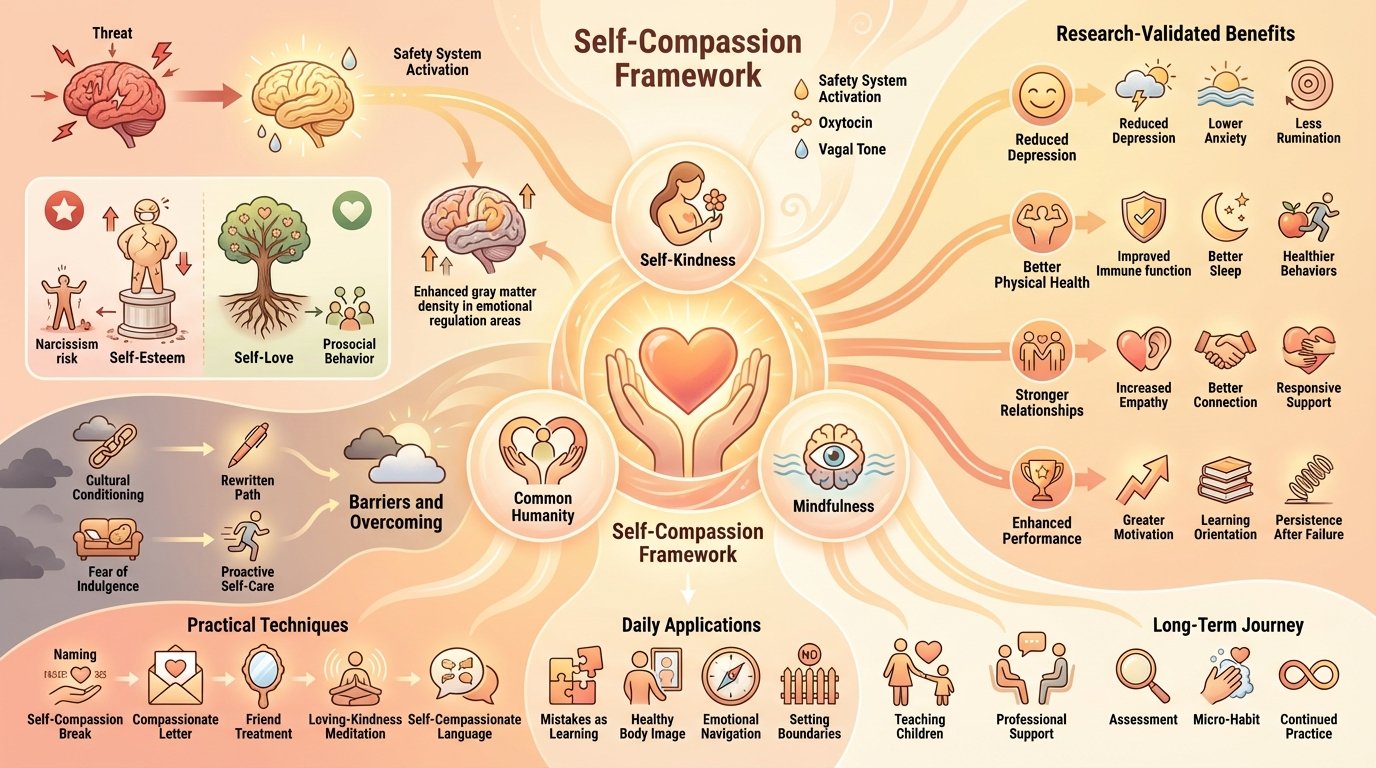
Research by Dr. Kristin Neff shows over 4,000 published studies now confirm that self-compassion significantly enhances mental health, reduces anxiety and depression, and improves resilience. Self-love is not selfish indulgence but a scientifically validated path to emotional strength and authentic confidence.
This guide reveals the surprising difference between self-love and narcissism, explores brain science showing how self-compassion rewires neural pathways, and provides practical techniques you can start using today. Later you will discover why self-love actually strengthens your relationships rather than making you self-absorbed.
What Is Self-Love? Understanding True Self-Compassion
Self-love means treating yourself with the same kindness, care, and understanding you naturally extend to people you care about. It involves accepting yourself as you are while still working toward growth, recognizing your shared humanity, and responding to your own suffering with warmth rather than harsh judgment.
Surprising Insight: Surprising Insight: Self-love is the opposite of narcissism, not a pathway to it. Research from the University of Wollongong shows that genuine self-compassion promotes concern for others and reduces self-centeredness. People high in self-compassion show greater empathy and prosocial behavior than those focused on protecting fragile self-esteem.
Dr. Kristin Neff's research identifies three essential elements of self-compassion. Self-kindness means being warm and understanding toward yourself when suffering, failing, or feeling inadequate, rather than ignoring pain or attacking yourself with self-criticism. Common humanity involves recognizing that suffering and personal inadequacy are part of the shared human experience, not something that happens only to you. Mindfulness means holding painful thoughts and feelings in balanced awareness rather than over-identifying with them or suppressing them.
Self-love differs fundamentally from self-esteem. Self-esteem involves evaluating yourself positively and often requires feeling special or above average. Self-love requires no such comparisons. You can love yourself even during failures or when performing poorly because self-compassion does not depend on achievement or external validation.
The American Psychological Association defines self-worth as an evaluation of yourself as a capable human being deserving consideration and respect. This stable internal value differs from fluctuating self-esteem based on external factors like performance, appearance, or social approval.
The Science Behind Self-Love and Brain Health
Neuroscience reveals that self-love creates measurable changes in brain structure and function. Understanding these mechanisms explains why self-compassion practices produce such profound effects on mental health and emotional wellbeing.
The Three Pillars of Self-Compassion
🔍 Click to enlarge
Self-compassion activates the mammalian caregiving system in the brain, releasing oxytocin and endorphins that promote feelings of safety, connection, and wellbeing. Research using functional MRI scans shows that self-compassionate responses activate brain regions associated with emotional regulation and deactivate threat-detection areas like the amygdala.
Studies from the University of Exeter found that self-compassion practices reduce activity in the sympathetic nervous system responsible for fight-or-flight responses while increasing vagal tone, which reflects parasympathetic nervous system activity associated with rest, digestion, and recovery. This shift from threat mode to safety mode allows your brain and body to heal and restore themselves.
Dr. Paul Gilbert's research on compassion-focused therapy demonstrates that self-criticism activates the same brain regions as physical threats. When you attack yourself mentally, your brain responds as if you face external danger, triggering cortisol release and inflammatory responses that damage health over time.
Neuroplasticity research shows that regular self-compassion practices strengthen neural pathways associated with emotional regulation, perspective-taking, and resilience. A study published in Brain and Behavior found that eight weeks of self-compassion training increased gray matter density in brain regions involved in emotional regulation and self-referential processing.
Self-Love vs. Self-Esteem: Critical Differences
Many people confuse self-love with self-esteem, yet these concepts operate fundamentally differently and produce distinct psychological outcomes. Understanding this distinction helps you cultivate genuine wellbeing rather than fragile ego protection.
| Aspect | Self-Love (Self-Compassion) | Self-Esteem |
|---|---|---|
| Foundation | Unconditional self-acceptance | Performance and social comparison |
| Stability | Remains stable through failures | Fluctuates with success and failure |
| Response to Failure | Kind self-talk, learning focus | Self-criticism, defensiveness |
| Relationship with Others | Increases empathy and connection | Can trigger competitive comparison |
| Motivation | Growth-oriented, intrinsic | Proving self-worth, external validation |
| When Struggling | Self-kindness, seek support | Hide weakness, maintain image |
| Narcissism Risk | Reduces self-centeredness | Can promote self-absorption |
| Long-term Wellbeing | Strongly predicts mental health | Weak or negative predictor |
| Cultural Universality | Benefits consistent across cultures | Varies significantly by culture |
Self-esteem requires you to feel good about yourself, which often means feeling better than others or achieving socially valued outcomes. This creates a fragile foundation because failures inevitably occur and comparisons always reveal someone performing better than you.
Research from the University of Texas shows that people high in self-esteem but low in self-compassion become defensive when criticized, blame others for failures, and struggle to acknowledge mistakes. Those high in self-compassion can admit shortcomings without feeling their core worth threatened.
The pursuit of high self-esteem sometimes leads to narcissistic tendencies, as people protect their positive self-image by dismissing criticism, exaggerating achievements, or putting others down. Self-compassion eliminates this dynamic by removing the need to feel superior or special.
The Research Evidence for Self-Love Benefits
Thousands of scientific studies now document the powerful effects of self-compassion on psychological wellbeing, physical health, relationships, and life outcomes. This evidence base spans diverse populations and rigorous research methodologies.
Research-Validated Benefits of Self-Compassion
🔍 Click to enlarge
Meta-analyses examining hundreds of studies confirm that self-compassion strongly predicts psychological wellbeing. People higher in self-compassion report significantly less depression, anxiety, and stress while experiencing greater life satisfaction, happiness, and optimism.
Research published in Clinical Psychology Review analyzed data from over 14,000 participants across multiple countries. The findings showed that self-compassion protected against psychopathology more effectively than self-esteem and remained beneficial across different ages, genders, and cultural backgrounds.
Self-compassion predicts healthier behaviors and better physical health outcomes. Studies show that people with higher self-compassion exercise more consistently, eat more nutritiously, visit doctors for preventive care, and adhere better to medical treatments. They view health behaviors as self-care rather than punishment or obligation.
Contrary to fears that self-compassion leads to complacency, research consistently shows it enhances motivation and performance. A study from UC Berkeley found that self-compassionate students showed greater academic motivation, spent more time studying after failures, and performed better on subsequent tests compared to self-critical students.
Self-compassion helps people maintain motivation when pursuing difficult goals. Research shows that self-compassionate individuals set equally ambitious goals as self-critical people but persist longer when facing obstacles. They view setbacks as learning opportunities rather than evidence of personal inadequacy.
Why Self-Love Feels Difficult: Common Barriers
Despite clear benefits, many people struggle to develop self-compassion. Understanding common obstacles helps you recognize and work through resistance that may arise during practice.
Common Barriers to Self-Compassion
🔍 Click to enlarge
Cultural conditioning often teaches that self-criticism drives success while self-compassion leads to laziness. Many people grew up believing they needed harsh inner discipline to achieve goals. Research contradicts this assumption, but the conditioning runs deep.
Fear of self-indulgence stops people from practicing self-compassion. They worry that being kind to themselves means making excuses, avoiding responsibility, or becoming self-centered. Studies show the opposite occurs. Self-compassionate people take more personal responsibility because they can acknowledge mistakes without feeling their entire worth threatened.
Some people believe they do not deserve compassion due to past actions or perceived flaws. This belief often stems from trauma, abuse, or attachment difficulties in childhood. Recognizing that all humans deserve basic kindness, including you, challenges this deeply held belief.
Emotional avoidance makes self-compassion uncomfortable. Being kind to yourself when suffering requires acknowledging that suffering exists. People accustomed to pushing through pain or numbing emotions may find this direct acknowledgment threatening at first.
Researcher Paul Gilbert identifies three types of fears about compassion. Fear of compassion from others reflects worry about appearing weak or vulnerable. Fear of compassion for others involves concerns about being exploited or hurt. Fear of self-compassion includes beliefs that you do not deserve kindness or that it will make you weak.
Practical Self-Love Techniques: Evidence-Based Methods
Research has identified specific practices that effectively cultivate self-compassion. These techniques provide concrete ways to develop self-love through regular practice rather than waiting for a sudden shift in perspective. Each method addresses different aspects of self-compassion, so experimenting with multiple approaches helps you discover what resonates most deeply with your personality and circumstances. The practices range from simple five-minute exercises to more involved ongoing commitments, making self-compassion accessible regardless of your schedule or experience level.
The Self-Compassion Break
Dr. Kristin Neff developed this three-step practice for moments of difficulty. First, acknowledge the struggle by saying to yourself something like 'this is a moment of suffering' or 'this hurts' or 'this is stress'. This mindfulness step validates your experience without exaggeration or minimization. Recognizing suffering as it occurs prevents you from either suppressing the pain or becoming overwhelmed by it. The simple act of naming difficulty creates psychological distance that allows you to respond more wisely.
Second, remind yourself that suffering is part of being human. Say 'suffering is part of life' or 'I am not alone in this' or 'everyone struggles sometimes'. This common humanity step counters the isolating feeling that you alone face such difficulties. Struggle does not mean something is wrong with you specifically. It means you are human. This perspective shift reduces shame and opens the door to self-kindness.
Third, place your hands over your heart or offer yourself a gentle touch while saying something kind like 'may I be kind to myself' or 'may I give myself what I need'. This self-kindness step activates your caregiving system and provides comfort in difficult moments. The physical gesture of touch releases oxytocin and signals safety to your nervous system. Combined with compassionate words, this practice creates a complete self-soothing response.
You can complete this entire practice in under two minutes, making it accessible during brief moments throughout your day. Use it when you notice stress rising, after making a mistake, when feeling inadequate, or during any difficult emotion. The more you practice during smaller challenges, the more naturally it flows during bigger crises.
Writing a Compassionate Letter to Yourself
Think of a situation where you feel inadequate, flawed, or disappointed in yourself. Write a letter to yourself from the perspective of an unconditionally loving friend who sees your struggles with kindness and understanding. Include acknowledgment of your pain, recognition that everyone struggles with similar issues, and supportive words about your inherent worth regardless of this particular situation.
Research shows this exercise significantly reduces self-criticism and increases self-compassion. The act of taking an outside perspective and expressing kindness in words helps shift habitual self-critical patterns.
How Would You Treat a Friend?
When you notice self-critical thoughts, ask yourself how you would respond to a close friend facing the same situation. What would you say to them? What tone of voice would you use? How would you show support? Then turn that same response toward yourself.
Most people immediately recognize the stark difference between their compassionate responses to others and their harsh self-talk. This awareness exercise reveals the double standard you apply and invites you to extend your natural compassion inward.
Loving-Kindness Meditation
This traditional practice cultivates feelings of goodwill and care. Begin by bringing to mind someone who loves you unconditionally. Feel their caring presence. Then direct phrases of well-wishing toward yourself, such as 'may I be safe, may I be peaceful, may I be kind to myself, may I accept myself as I am'.
Research from Stanford University shows that even brief loving-kindness meditation increases positive emotions, decreases self-criticism, and enhances feelings of social connection. Regular practice creates lasting changes in how you relate to yourself and others.
Self-Compassionate Language Patterns
Notice your self-talk and actively reframe harsh judgments into compassionate statements. Instead of 'I am so stupid for making that mistake', try 'I made a mistake, like everyone does sometimes. What can I learn from this?'. Replace 'I should be better at this by now' with 'I am doing my best. Learning takes time and everyone progresses at different rates'.
This linguistic shift may feel awkward initially, but research on cognitive behavioral therapy shows that changing thought patterns through deliberate practice creates genuine emotional shifts over time. The way you speak to yourself shapes how you feel about yourself.
Self-Love in Daily Life: Practical Applications
Self-compassion transforms everyday challenges when integrated into regular life rather than reserved for special practices. Understanding how to apply self-love in common situations makes it accessible and actionable.
Responding to Mistakes and Failures
When you make a mistake, pause before launching into self-criticism. Take a few deep breaths and place a hand on your heart. Acknowledge that making mistakes is an inherent part of being human and trying new things. Ask yourself what you can learn from this experience and how you can support yourself moving forward.
Research shows that self-compassionate responses to failure predict greater persistence and better performance over time. Athletes who practice self-compassion after poor performances train harder and perform better in subsequent competitions compared to those who engage in self-criticism.
Managing Physical Health and Body Image
Self-compassion supports healthier relationships with your body and more sustainable health behaviors. Instead of punishing your body for not meeting idealized standards, approach health from a place of care for your wellbeing. This shift from criticism to care transforms how you eat, move, and rest. When health behaviors stem from self-love rather than self-loathing, they become sustainable and enjoyable instead of restrictive and punishing.
Studies show that self-compassion predicts more intuitive eating, less disordered eating, and greater body appreciation. People who practice self-compassion exercise for enjoyment and wellbeing rather than punishment or compensation. They make food choices based on nourishment and pleasure rather than rigid rules driven by self-judgment. This balanced approach leads to better long-term health outcomes than harsh discipline or perfectionism.
When you slip from health goals, self-compassion helps you return to healthy behaviors faster than self-criticism does. Research shows that self-compassionate people who overeat or skip exercise respond by gently recommitting to their values rather than spiraling into shame-driven binges or giving up entirely. They recognize that everyone struggles with consistency and that one off-track moment does not define their entire health journey.
Body image improves dramatically through self-compassion practice. Instead of constantly evaluating your appearance against impossible standards, you appreciate your body for what it does rather than how it looks. This functional appreciation creates genuine respect for your body as the vehicle that carries you through life, regardless of its shape or size.
Navigating Difficult Emotions
Self-compassion provides a middle path between suppressing emotions and being overwhelmed by them. When painful emotions arise, mindfulness allows you to acknowledge them without pushing them away or becoming consumed. Self-kindness offers comfort as you experience the emotion. Common humanity reminds you that everyone experiences these feelings.
Research from mindfulness-based stress reduction programs shows that this balanced approach to emotions reduces anxiety, depression, and emotional reactivity while increasing emotional intelligence and psychological flexibility.
Setting Boundaries and Saying No
Self-love includes protecting your energy and wellbeing through healthy boundaries. Recognize that saying no to others sometimes means saying yes to yourself. You cannot pour from an empty cup, and depleting yourself serves no one in the long run.
People high in self-compassion set clearer personal boundaries and communicate their needs more directly. They recognize that self-care is not selfish but necessary for sustainable engagement with others.
Self-Love and Relationships: Strengthening Connection
Contrary to fears that self-love creates self-absorption, research consistently shows that self-compassionate people form stronger, healthier relationships. Understanding this connection dispels misconceptions about self-focus. Self-love paradoxically increases your capacity to love others more fully because you no longer desperately seek validation or defensively protect a fragile self-image. You can show up as your authentic self and allow others to do the same.
Self-compassion provides emotional stability that allows you to be more present and responsive in relationships. When you do not depend on others for your sense of worth, you can engage more authentically without desperate neediness or defensive self-protection. This emotional independence actually creates deeper intimacy because you connect from wholeness rather than from deficiency. You choose relationships based on genuine connection rather than trying to fill internal voids through others.
The ability to acknowledge your own imperfections without harsh self-judgment translates directly into accepting others' flaws and mistakes. Self-compassionate people extend the same understanding to loved ones that they practice toward themselves. This creates relationships characterized by mutual acceptance rather than constant criticism or impossible expectations.
Studies show that people higher in self-compassion display more empathy toward others, offer more emotional support to loved ones, and respond more constructively during conflicts. They can acknowledge their role in problems without defensive reactions because their self-worth does not depend on being perfect.
Research on romantic relationships finds that self-compassionate individuals experience more relationship satisfaction, greater relationship stability, and more secure attachment patterns. They communicate more openly, compromise more effectively, and maintain their own identity within relationships.
Self-compassion helps you maintain compassion for others even when stressed or depleted. Caregivers who practice self-compassion experience less burnout and continue providing quality care over longer periods compared to those who neglect their own needs.
When both partners practice self-compassion, relationships benefit multiplicatively. Self-compassionate partners take responsibility for their emotions, communicate needs clearly, forgive more readily, and support each other's growth without trying to fix or control each other.
Teaching Self-Love to Children and Adolescents
Early development of self-compassion provides lifelong benefits for mental health and resilience. Parents, educators, and mentors can cultivate self-love in young people through modeling and explicit teaching.
Children naturally extend compassion to others but often develop harsh self-criticism as they internalize cultural messages about achievement, appearance, and performance. Intervening early prevents these patterns from becoming deeply ingrained.
Research shows that teaching self-compassion to adolescents reduces depression, anxiety, and stress while increasing life satisfaction and emotional resilience. Programs like Making Friends with Yourself have demonstrated effectiveness in school settings across diverse student populations.
Model self-compassionate responses to your own mistakes and struggles. When children see adults treating themselves kindly after failures, they learn that self-criticism is not the only option. Narrate your self-compassionate thinking aloud so children understand the internal process.
Validate children's emotions without rushing to fix or minimize their experiences. Saying 'I see this is really hard for you right now' teaches mindful awareness of suffering. Adding 'everyone struggles with this sometimes' normalizes their experience and prevents isolation.
Encourage self-kindness by asking questions like 'what do you need right now to feel better?' or 'how can you take care of yourself when feeling this way?'. These questions guide children toward self-compassionate responses rather than imposing adult solutions.
Overcoming Self-Compassion Roadblocks
Even when intellectually convinced of self-compassion's benefits, many people encounter internal resistance during practice. Recognizing common roadblocks and having strategies to work through them supports continued progress.
If self-compassion feels too uncomfortable initially, start by cultivating compassion for others or imagining how you would comfort a child facing your situation. These indirect approaches activate your compassionate mind without triggering blocks specific to self-compassion.
When self-compassionate phrases feel false or mechanical, focus on physical gestures of kindness like placing a hand on your heart or giving yourself a gentle hug. Somatic approaches can bypass cognitive resistance and activate your caregiving system directly.
If you fear that self-compassion will make you complacent, remind yourself that research consistently shows the opposite effect. Self-compassion increases motivation and persistence. Set an experiment for yourself to practice self-compassion for a month while tracking your actual behavior and productivity.
Strong emotions may surface when you first practice self-compassion, especially if you carry significant pain from the past. This emotional release is normal and often therapeutic. Allow feelings to arise without judgment. Seek professional support if emotions feel overwhelming or unmanageable.
Progress is not linear. Some days self-compassion flows easily while other days you slide back into habitual self-criticism. This fluctuation is normal. Practice self-compassion about your struggles with self-compassion rather than criticizing yourself for not being self-compassionate enough.
The Role of Professional Support in Developing Self-Love
While self-compassion practices can be learned independently, professional guidance sometimes accelerates progress and addresses deeper psychological barriers. Understanding when to seek support helps you access appropriate resources.
Therapists trained in compassion-focused therapy, mindful self-compassion, or related approaches provide structured programs for developing self-love. These evidence-based interventions combine education, guided practice, and exploration of personal obstacles to self-compassion.
Professional support becomes particularly valuable when childhood trauma, attachment difficulties, or mental health conditions interfere with self-compassion development. Therapists can help you work through these deeper issues in a safe, supportive environment.
Group programs like Mindful Self-Compassion provide community support and normalize struggles with self-criticism. Participants benefit from seeing others work through similar challenges and often develop compassion for themselves through extending compassion to fellow group members.
Online courses, apps, and guided meditations offer accessible starting points for self-compassion practice. While not replacements for therapy when clinical support is needed, these resources provide valuable tools for ongoing practice and learning.
Measuring Your Self-Compassion Levels
Understanding your current self-compassion levels provides a baseline for tracking growth over time. Researchers have developed validated assessment tools that measure different aspects of self-compassion.
The Self-Compassion Scale developed by Dr. Kristin Neff measures six components including self-kindness versus self-judgment, common humanity versus isolation, and mindfulness versus over-identification. This research-validated tool helps you identify specific areas for development.
Notice patterns in your self-talk throughout the day. Do you speak to yourself with warmth or harshness? When facing difficulties, do you remind yourself of shared humanity or feel isolated in your struggles? Do you acknowledge emotions without suppressing or exaggerating them?
Track your responses to setbacks and disappointments. Self-compassionate responses involve acknowledgment of pain, self-kindness, recognition of common humanity, and constructive action. Self-critical responses involve harsh judgment, isolation, rumination, and either giving up or pushing harder with increased self-punishment.
Regular self-assessment helps you celebrate progress and identify situations where self-compassion still feels challenging. Use this information to target your practice rather than judging yourself for not being perfectly self-compassionate in all situations.
Advanced Self-Love Practices for Deeper Transformation
After establishing basic self-compassion skills, advanced practices deepen your capacity for self-love and extend compassion to increasingly difficult aspects of experience.
Compassion for the inner critic involves recognizing that even your self-critical voice developed trying to protect you, perhaps by motivating you to avoid rejection or failure. Thank your inner critic for trying to keep you safe, then gently let it know you have healthier ways to motivate yourself now.
Working with shame requires particular gentleness. Shame convinces you that something is fundamentally wrong with you as a person. Self-compassion transforms shame by recognizing that everyone has aspects they feel ashamed about and that your worth is not contingent on being perfect or meeting arbitrary standards.
Backdraft refers to the painful emotions that sometimes arise when you practice self-compassion. As you open to yourself with kindness, old wounds or unprocessed grief may surface. This emotional release, while temporarily uncomfortable, represents healing. Approach these feelings with the same compassion you are cultivating for yourself.
Compassion for all parts of yourself includes the aspects you judge most harshly. Whatever qualities you reject in yourself, whether weakness, anger, neediness, or something else, see if you can acknowledge these parts with curiosity and care rather than condemnation. All parts of you developed for reasons and deserve compassion.
Cultural and Spiritual Dimensions of Self-Love
While self-compassion research emerged from Western psychology, related concepts appear across spiritual and philosophical traditions worldwide. Understanding these broader contexts enriches self-love practice.
Buddhist traditions emphasize metta or loving-kindness toward all beings, explicitly including oneself. The Buddha taught that you can search throughout the entire universe for someone more deserving of love and compassion than yourself and not find that person anywhere. You, yourself, deserve your love and affection as much as anybody in the entire universe.
Christian traditions speak of loving your neighbor as yourself, implying that self-love provides the foundation for love of others. Many mystics and contemplatives emphasized that recognizing divine love for yourself allows you to extend that love outward.
Indigenous wisdom traditions often emphasize connection to community and nature while also honoring the unique gifts and worth of each individual. This balance of belonging and individual value supports both common humanity and self-kindness.
Humanistic psychology, particularly the work of Carl Rogers, highlighted unconditional positive regard as essential for psychological health. This acceptance of yourself and others without conditions mirrors the non-judgmental quality of self-compassion.
Watch This: Dr. Kristin Neff on Self-Compassion
Dr. Kristin Neff, the pioneering researcher who brought self-compassion into mainstream psychology, explains the core concepts and shares research findings in this comprehensive presentation.
Dr. Neff's research has transformed how psychologists understand self-relationship. Her work demonstrates that self-compassion provides more stable wellbeing than self-esteem while avoiding narcissistic pitfalls. The practices she developed have helped millions of people worldwide develop healthier relationships with themselves.
Self-Love Action Plan: Step-by-Step Implementation
Developing genuine self-compassion requires consistent practice over time. This structured approach guides you from initial exploration through sustainable integration into daily life.
- Step 1: Assess your current self-compassion levels using informal self-observation or the Self-Compassion Scale. Notice patterns in your self-talk and responses to difficulty without judgment.
- Step 2: Choose one basic practice to try daily for two weeks. The self-compassion break works well as a starting practice because it takes only a few minutes and applies to any difficult moment.
- Step 3: Journal about your experiences with self-compassion practice. What feels natural? What feels uncomfortable? What changes do you notice in your emotional state or behavior?
- Step 4: Identify your personal barriers to self-compassion. Do you fear it will make you lazy? Do you feel undeserving? Do emotions feel overwhelming? Understanding your specific obstacles helps you address them directly.
- Step 5: Experiment with different practices to find what resonates for you. Some people connect more with physical gestures, others with words, still others with meditation or writing.
- Step 6: Notice situations where self-criticism habitually arises. These moments offer the richest opportunities for practicing self-compassion instead.
- Step 7: Extend your practice gradually to more challenging situations. Start with minor frustrations before tackling deep shame or significant failures.
- Step 8: Connect with others learning self-compassion if possible. Support groups, classes, or online communities provide encouragement and normalize struggles.
- Step 9: Celebrate small shifts in your self-relationship. Notice when you speak to yourself slightly more kindly or catch yourself in self-criticism sooner. These small changes accumulate over time.
- Step 10: Maintain regular practice even after initial progress. Self-compassion is a skill that deepens with continued practice rather than a permanent state achieved once and forgotten.
Your First Micro Habit
Begin Your Self-Love Journey
Today's action: Each time you wash your hands today, place one hand on your heart while the water runs and say silently 'I am doing my best, and that is enough'. Feel the warmth of your hand on your chest for three breaths before drying your hands.
This micro habit links self-compassion practice to an existing routine you perform multiple times daily. The physical gesture of a hand on your heart activates your caregiving system and provides soothing through self-touch. The affirmation counters perfectionistic self-criticism. Multiple daily repetitions strengthen new neural pathways for self-kindness.
Track your self-compassion practice and receive personalized guidance for developing self-love with our AI wellness coach.
Quick Assessment
Discover your self-compassion style with these self-reflection questions. Your answers reveal which aspects of self-love may need attention and which practices will resonate most with your personality.
When you make a mistake or fail at something important, what is your typical first response?
Your default response to failure reveals your current level of self-compassion versus self-criticism. Self-compassionate responses acknowledge mistakes while maintaining self-worth and focusing on growth.
How do you typically talk to yourself when facing a difficult challenge or painful emotion?
Your internal dialogue style indicates whether you extend compassion inward or maintain a harsh, critical relationship with yourself. Noticing this pattern is the first step toward change.
When you notice others experiencing similar struggles or failures as you, what do you typically think?
Your sense of common humanity versus isolation reveals whether you recognize suffering as a shared human experience or see your struggles as evidence of personal inadequacy.
Take our complete assessment to understand your unique patterns and receive personalized recommendations for developing self-compassion.
Discover Your Wellbeing Style →Next Steps on Your Self-Love Journey
You now understand what self-love truly means, how it differs from narcissism and self-esteem, and why thousands of studies confirm its benefits for mental health, physical wellbeing, and relationships. This knowledge provides a foundation for developing genuine self-compassion.
Start with the hand-on-heart micro habit this week. This simple yet powerful practice introduces self-kindness into your daily routine multiple times per day. Notice how even brief moments of self-compassion shift your emotional state and self-relationship.
Explore related topics like self-compassion for deeper understanding of research and techniques, self-acceptance to work with difficult aspects of yourself, and self-worth to understand your inherent value. The topics of emotional wellbeing and mental wellness provide broader context for self-love within overall psychological health.
Consider related practices including mindfulness for the awareness component of self-compassion, meditation practices for formal training, and self-care practices for translating self-love into concrete actions. Understanding emotional intelligence and mental resilience shows how self-compassion strengthens these crucial capacities.
Remember that developing self-compassion is a practice, not a destination. You will have moments of clear self-kindness and moments when you slip back into criticism. This is completely normal and expected. Extend compassion to yourself about your struggles with self-compassion. Each time you notice self-judgment and respond with kindness instead, you strengthen new neural pathways that make self-love increasingly natural and automatic over time.
Author Bio
Research Sources
This article is based on peer-reviewed research and authoritative sources. Below are the key references we consulted:
Related Glossary Articles
Frequently Asked Questions
Is self-love the same as being selfish or narcissistic?
No. Research shows self-compassion is the opposite of narcissism. Self-love involves accepting yourself as imperfect while caring for your wellbeing. Narcissism requires feeling superior to others and maintaining an inflated self-image. Self-compassionate people show more empathy, stronger relationships, and greater concern for others compared to those focused on protecting self-esteem.
Will self-compassion make me lazy or unmotivated?
No. Studies consistently show that self-compassion increases motivation and persistence. Self-compassionate people set equally ambitious goals as self-critical people but maintain motivation longer when facing obstacles. They view failures as learning opportunities rather than evidence of inadequacy, which supports continued effort rather than giving up.
How long does it take to develop self-compassion?
Most people notice shifts in self-talk and emotional responses within two to four weeks of regular practice. Deeper transformation typically requires several months of consistent practice. Research shows that eight-week structured programs produce measurable improvements in self-compassion, mental health, and wellbeing. The practice continues deepening over years as it becomes more automatic.
What if I start crying or feeling overwhelmed when practicing self-compassion?
Strong emotions sometimes surface when you first extend kindness toward yourself, especially if you carry unprocessed pain. This emotional release is normal and often therapeutic. Allow feelings to arise without judgment. If emotions feel unmanageable, work with a therapist trained in compassion-focused approaches. Start with indirect practices like imagining comforting a child or friend if direct self-compassion triggers too much distress initially.
Can I practice self-compassion if I have done truly harmful things in the past?
Yes. Self-compassion does not mean excusing harmful behavior or avoiding responsibility. It means recognizing your humanity even when you have made serious mistakes. Research shows that self-compassion actually increases accountability because you can acknowledge wrongdoing without your entire worth collapsing. This allows genuine remorse, sincere apologies, and committed behavior change rather than defensive denial.
How is self-compassion different from positive affirmations?
Self-compassion acknowledges difficulty and pain while offering kindness, whereas positive affirmations try to replace negative thoughts with positive ones. Research shows affirmations can backfire when they conflict too strongly with how you genuinely feel. Self-compassion meets you where you are, validating struggle while providing support. It does not require believing you are perfect or exceptional, just recognizing your shared humanity and inherent worth.
Take the Next Step
Ready to improve your wellbeing? Take our free assessment to get personalized recommendations based on your unique situation.
- Discover your strengths and gaps
- Get personalized quick wins
- Track your progress over time
- Evidence-based strategies