Longevity
What if the secrets to living to 100 weren't locked in expensive supplements or cutting-edge technology, but hidden in the everyday habits of people who've already done it? Across pockets of the world called Blue Zones—from the mountains of Sardinia to the islands of Okinawa—people routinely live past 100 with vitality, health, and joy. The science is clear: longevity isn't random luck or good genes alone. It's a combination of lifestyle choices, social connections, purposeful activity, and cellular health that anyone can cultivate starting today. Whether you're 25 or 65, your choices over the next decade will shape whether you spend your final decades struggling or thriving.
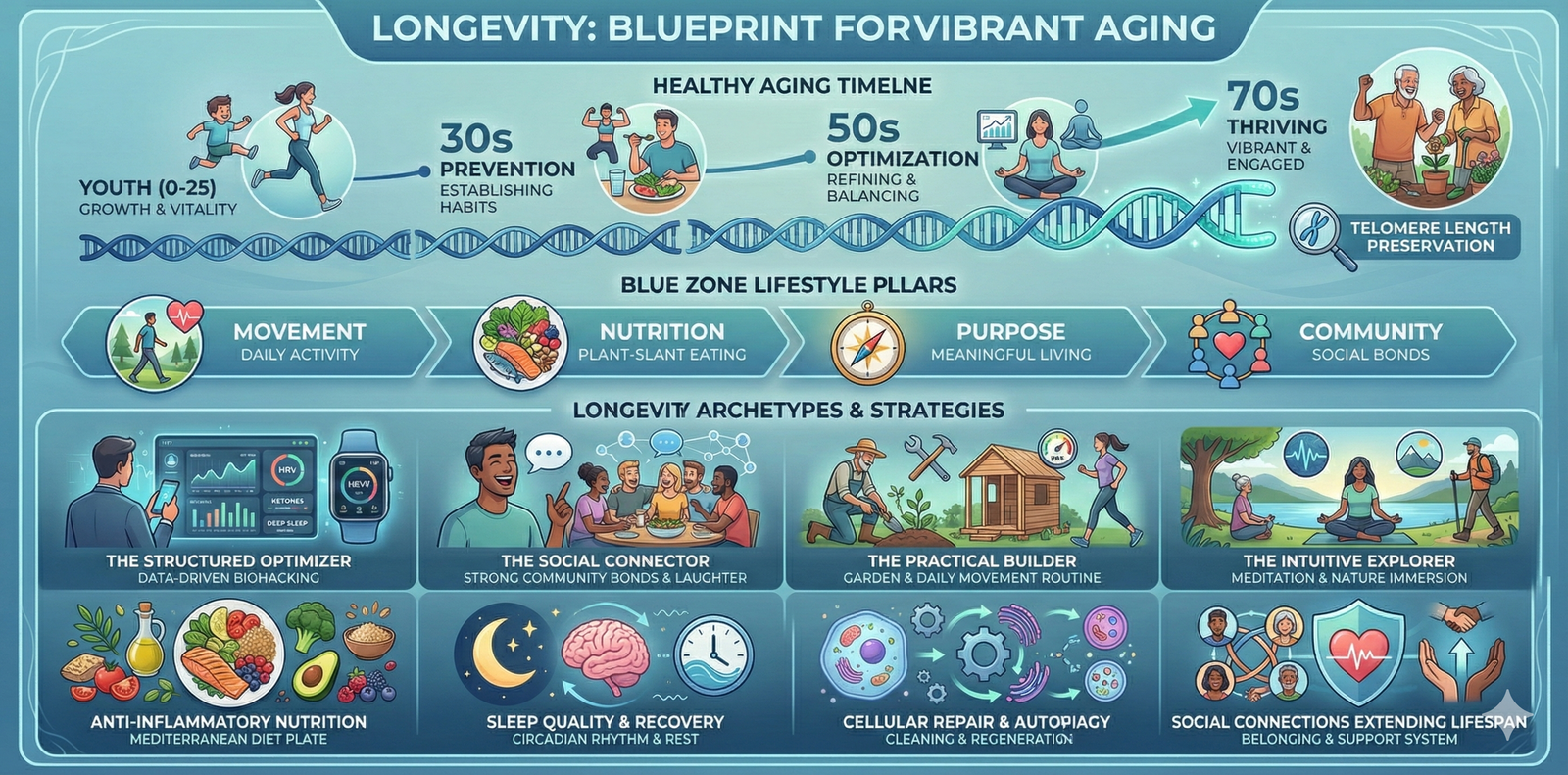
Longevity has shifted from a pursuit of mere lifespan to optimizing healthspan—the years you live with energy, independence, and purpose.
This guide explores how aging actually works at the cellular level, reveals what makes some people live past 100, and gives you concrete steps to extend your vibrant years right now.
What Is Longevity?
Longevity is the state of living a long life—but modern longevity science focuses not just on how long you live, but how well you live those years. This is called healthspan: the number of years you spend in good health without chronic disease, cognitive decline, or loss of independence. A 90-year-old who runs marathons has better healthspan than an 80-year-old with multiple chronic conditions. Longevity encompasses the biological, behavioral, and environmental factors that allow your body and mind to thrive across decades, not just survive them.
Not medical advice.
Modern longevity research integrates gerontology (the study of aging), genetics, nutrition, exercise science, psychology, and community health. Researchers like Peter Attia and Dan Buettner have spent decades identifying patterns in how the longest-living populations structure their lives. The evidence shows that 75-80% of longevity outcomes come from lifestyle choices, not inherited genetics. This is powerful: you have more control over your aging than you might think.
Surprising Insight: Surprising Insight: People in Blue Zones don't exercise for fitness—they move naturally throughout the day through gardening, walking, and daily tasks. Yet they maintain superior strength and cardiovascular fitness compared to people who hit the gym regularly.
The Longevity Spectrum: From Lifespan to Healthspan
Visualization showing the difference between living longer but sick (poor healthspan) versus living long AND vibrant (optimal longevity). Shows three scenarios: short lifespan/poor health, long lifespan/poor health, long lifespan/great health.
🔍 Click to enlarge
Why Longevity Matters in 2026
The average human lifespan has increased by 30 years over the past century—a stunning achievement. Yet this gain comes with a shadow: most of those extra years are spent battling chronic disease. Heart disease, diabetes, cancer, and cognitive decline now stretch across decades rather than taking people quickly. For the first time in history, living longer without living better has become a major life challenge. Understanding longevity science gives you a roadmap to be part of the minority who ages well.
In 2026, longevity has become mainstream. The global longevity market reached $42 billion in 2024 and continues growing as research reveals new mechanisms of aging. Senotherapy—drugs that clear damaged cells—show promise. Blood tests can now estimate the biological age of your organs. Wearables track sleep, heart rate variability, and recovery. Yet amid this technology boom, the most powerful longevity tools remain unchanged: sleep, community, movement, purpose, and plant-based nutrition. Modern science confirms what Blue Zones knew all along.
Your decision to engage with longevity science today shapes your independence at 80. Will you be climbing stairs, traveling, and playing with grandchildren? Or will you be managing multiple medications and losing autonomy? The good news: the interventions that add decades to your life also add quality to those decades. Exercise that extends longevity also improves mood today. Foods that slow aging taste delicious. This isn't a sacrifice—it's an upgrade.
The Science Behind Longevity
Aging happens through multiple interconnected biological processes. Your cells divide thousands of times throughout your life—each time the protective tips of your chromosomes called telomeres shorten slightly. After 50-70 divisions, telomeres become critically short and cells can no longer divide, entering a state called senescence. Meanwhile, your body's production of NAD+ (a critical molecule in cellular energy production) declines by 50% between age 20 and age 50. This NAD+ decline impairs sirtuins—proteins that regulate lifespan and stress resistance. At the same time, mitochondria (your cellular powerhouses) become less efficient, producing more inflammation and oxidative damage. DNA damage accumulates. Stem cell function declines. It's not one thing breaking—it's a cascade of interconnected failures. Yet this cascade can be slowed dramatically through lifestyle interventions.
Modern longevity science focuses on the hallmarks of aging. Research published by the National Institute on Aging identifies nine core aging mechanisms: genomic instability, telomere attrition, epigenetic alterations, loss of proteostasis, mitochondrial dysfunction, cellular senescence, stem cell exhaustion, altered intercellular communication, and disabled macroautophagy. Each of these can be influenced by lifestyle. Exercise repairs DNA damage. Sleep allows your brain to clear damaged proteins. Caloric restriction activates autophagy—your cells' cleaning system. Social connection reduces inflammation. Movement preserves stem cell function. This isn't philosophy; it's biology you can control.
The Cascade of Aging: How Lifestyle Blocks Decline
Shows the pathway from young cells to senescent cells, highlighting intervention points where lifestyle factors (exercise, sleep, nutrition, stress management) can interrupt the aging cascade.
🔍 Click to enlarge
Key Components of Longevity
Cellular Health and NAD+ Optimization
NAD+ is the currency of cellular energy. It's required for sirtuins to function—the proteins that repair DNA and regulate longevity pathways. As you age, NAD+ drops by roughly 50% from age 20 to 50. Research shows that restoring NAD+ in aging mice improves mitochondrial function, extends lifespan, and reverses some aging markers. In humans, interventions that boost NAD+ (like fasting, intense exercise, and certain precursors like NMN and NR) show promise for improving cellular health. Even modest NAD+ restoration appears to enhance muscle function, cognitive health, and cardiovascular fitness in aging humans. This happens not through supplements alone, but through consistent behavioral choices that trigger the body's natural NAD+ pathways.
Movement and Physical Resilience
The longest-living populations move naturally every day—not through formal exercise, but through gardening, walking to errands, carrying loads, and daily activity. Yet modern longevity science shows that structured exercise—particularly resistance training and high-intensity intervals—is essential to preserve muscle mass, bone density, and cardiovascular capacity. In Blue Zones, the average person walks 5-10 miles daily as a side effect of living, not as a gym routine. You don't need to run marathons for longevity; you need consistent, varied movement that includes both aerobic work and strength. Studies show that maintaining muscle mass and VO2 max (aerobic capacity) in your 60s and 70s is one of the strongest predictors of independence and survival past 80.
Nutrition and Plant-Forward Eating
The Blue Zones eat almost exclusively plant-based diets—not because they're vegan, but because that's what's available and affordable. Their diets center on beans (excellent sources of fiber and plant protein), seasonal vegetables, whole grains, nuts, and olive oil. Meat appears occasionally, usually in celebrations. Fish and seafood are included in some zones. Yet the pattern is clear: the longest-living people eat far more plants than Westerners. Studies show that diets high in plants and legumes predict longevity, while processed foods, refined sugars, and excessive red meat accelerate aging. The protective compounds in plants—polyphenols, carotenoids, and thousands of other phytonutrients—reduce inflammation, protect DNA, and boost cellular antioxidant systems. You don't need to be vegetarian for longevity; you need plants to dominate your plate.
Social Connection and Purpose
Loneliness is as deadly as smoking 15 cigarettes daily. Conversely, strong social bonds predict longevity more reliably than exercise or diet. In Blue Zones, people have deep family ties, active social circles, and strong community bonds. They also have a sense of purpose (called ikigai in Japan)—a reason to get up in the morning that extends beyond personal pleasure. People with clear purpose show lower inflammation, better cardiovascular health, and longer lifespans. This isn't sentimental; it's measurable. Loneliness triggers chronic inflammation, impairs immune function, and accelerates aging. Community, family, and purpose are as essential to longevity as vegetables and exercise.
| Power 9 Factor | What It Is | Longevity Benefit |
|---|---|---|
| Natural Movement | Daily walking, gardening, housework—not gym routines | Preserves muscle, bone density, cardiovascular fitness without injury risk |
| Purpose | Clear reason to wake up; ikigai or vocation | Adds 7+ years to lifespan; reduces inflammation and disease risk |
| Downshift Routine | Daily stress relief: meditation, naps, prayer, nature | Lowers cortisol and inflammation; protects brain health |
| Plant Slant | 80%+ of calories from plants; legumes as staple | Reduces disease risk; provides longevity phytonutrients |
| Wine in Moderation | Moderate red wine with food (optional) | Resveratrol and social benefits; not essential for longevity |
| Family First | Prioritize family; multi-generational living | Strong predictor of longevity; reduces stress and isolation |
| Right Tribe | Close friendships; active social engagement | As protective as quitting smoking; essential for healthspan |
| Centenarian Outlook | Positive mindset; low expectations for wealth | Stress reduction; better health outcomes and reported life satisfaction |
| Adequate Sleep | 7-9 hours nightly; daytime rest when possible | Repairs DNA; consolidates memory; reduces disease risk |
How to Apply Longevity: Step by Step
- Step 1: Map your current movement: Wear a step counter for three days and track daily movement. Blue Zones residents average 7,000-10,000 steps naturally through living. If you're below 6,000, add 30-minute walks three times weekly.
- Step 2: Identify your purpose: Write three things that give your life meaning—family, creative work, helping others, spiritual growth, learning. People with clear purpose live 7+ years longer on average.
- Step 3: Audit your food: Track one typical week of eating. If plants account for less than 50% of your calories, gradually shift plates toward legumes, vegetables, whole grains, nuts, and seeds.
- Step 4: Establish a downshift routine: Choose one daily stress-relief practice—10 minutes of meditation, a walk in nature, prayer, or deep breathing. Chronic stress shortens telomeres; daily calm preserves them.
- Step 5: Strengthen family connections: Schedule one weekly family meal or regular time with immediate family. Multi-generational closeness predicts longevity more than most medical interventions.
- Step 6: Build or deepen friendships: Identify 3-5 people you can see regularly or speak with weekly. Loneliness accelerates aging; friendship slows it. Make this non-negotiable.
- Step 7: Add resistance training: Perform strength work 2-3 times weekly—bodyweight exercises, weights, or resistance bands. Muscle preservation is crucial after 40 for maintaining independence.
- Step 8: Optimize sleep: Aim for 7-9 hours nightly with consistent bedtime. Sleep allows DNA repair and clears damaged brain proteins. This may be the single most powerful aging intervention.
- Step 9: Include high-intensity movement: Add 1-2 sessions weekly of hard exercise (running, cycling, swimming, HIIT) to maintain VO2 max and cardiovascular capacity across decades.
- Step 10: Get baseline testing: Consider blood work to assess biological age, cardiovascular risk, metabolic health, and organ-specific aging. Track trends over years to guide interventions.
Longevity Across Life Stages
Young Adulthood (18-35)
Your 20s and 30s are when foundational habits form. Your body is building peak bone density, neurological connections, and metabolic efficiency. This is the ideal time to establish regular exercise (mix of strength and aerobic), adopt plant-forward nutrition, and build deep friendships. The habits you form now compound across decades. Someone who establishes consistent sleep, daily movement, and strong social bonds in their 20s will have dramatically better aging outcomes at 70. This isn't just about health—it's about preventing the slow decline that most people accept as inevitable. At this stage, longevity feels abstract, but the choices you make are the most powerful you'll ever make for your future self.
Middle Adulthood (35-55)
Middle age is when the compounding effects of lifestyle choices become visible. People who prioritized exercise, sleep, and social connection often feel more energetic at 45 than at 25. Those who neglected these show accelerating decline. This is also when preventive screening becomes valuable—blood work, cardiovascular assessment, cognitive baseline. Muscle loss accelerates after 40 if not actively resisted; this is the critical decade to establish or intensify strength training. Career demands peak; this is when stress management and sleep protection become essential. The good news: middle-aged people who adopt longevity practices often see rapid improvement in energy, mood, and health markers within weeks.
Later Adulthood (55+)
At 55+, you're living in the future you prepared for. People with decades of healthy habits often thrive—maintaining independence, cognitive sharpness, and joy. Those without face accelerating decline. This is when preventive medicine intensifies—managing blood pressure, glucose control, and early disease detection matter greatly. Physical training shifts toward preservation rather than building: maintaining muscle through resistance work, protecting balance and flexibility, preserving cardiovascular capacity. Social connection becomes even more protective as work identity fades and mortality becomes concrete. Purpose shifts, often toward mentoring, volunteering, or creative expression. The trajectory from 55 onward was largely set by choices made decades earlier—but positive change is always possible. Studies show that people who adopt healthy practices even at 60 show measurable improvements in strength, cognition, and lifespan.
Profiles: Your Longevity Approach
The Structured Optimizer
- Detailed tracking and protocols
- Clear metrics and milestones
- Scientific evidence for every choice
Common pitfall: Becomes paralyzed by perfect information; never starts due to waiting for ideal conditions or final data
Best move: Choose one longevity practice (strength training, sleep hygiene, or plant-based meals) and commit for 30 days with daily tracking, then expand methodically
The Social Connector
- Group activities and community
- Accountability partners
- Shared purpose and celebration
Common pitfall: Neglects individual health practices; relies only on group motivation which wanes without structure
Best move: Join a group (walking club, strength class, volunteer organization) that combines social connection with longevity practices; make it recurring
The Practical Builder
- Simple, integrated habits
- Minimal time requirements
- Clear cause-and-effect results
Common pitfall: Oversimplifies complex aging science; misses nuance and individual optimization opportunities
Best move: Master the fundamentals—consistent sleep, daily movement, plant-heavy diet, strong relationships—before optimizing details
The Intuitive Explorer
- Flexible experimentation
- Permission to customize
- Deep self-awareness about what works for them
Common pitfall: Hops between practices without consistency; never sustains long enough to see benefits
Best move: Pick three longevity practices aligned with your personality, commit for 90 days of consistent application, then assess results before changing
Common Longevity Mistakes
The biggest mistake in longevity is viewing it as binary—healthy or unhealthy, fit or unfit, young or old. Aging is a gradient; nearly every intervention moves you in the direction of younger biology. Another common mistake is thinking longevity requires extreme sacrifice—raw food diets, obsessive exercise, or expensive supplements. The longest-living people on Earth eat normal food, move naturally, and enjoy community. Complexity is the enemy. Simple habits sustained for decades beat perfect protocols attempted for weeks.
Many people focus on single interventions while neglecting the foundation. They'll take expensive NAD+ precursors while sleeping six hours and having no close friends. Or they'll obsess over dietary supplements while sedentary. The science is clear: sleep, movement, nutrition, and social connection matter far more than any supplement. Get the fundamentals right first. Only then optimize details.
Perhaps the most costly mistake is waiting for perfect information or perfect conditions before starting. You don't need to understand all the mechanisms of aging to benefit from longevity practices. Walking doesn't require VO2 max testing. Eating more legumes doesn't require genetic testing. Connecting with friends doesn't require biomarkers. Start where you are with what you know. The data shows that the person who exercises imperfectly but consistently outlives the person waiting for the optimal program.
The Longevity Decision Tree: Mistakes vs. Mastery
Shows common decision paths in longevity: the trap of overthinking/optimizing, the trap of single-factor focus, the trap of waiting, versus the successful path of simple consistent action on fundamentals.
🔍 Click to enlarge
Science and Studies
Longevity research comes from multiple scientific domains. The Blue Zones research, led by Dan Buettner and validated by gerontologists, identifies five regions where people routinely live past 100 in good health: Okinawa Japan, Sardinia Italy, Nicoya Costa Rica, Ikaria Greece, and Loma Linda California. The National Institute on Aging funds extensive research on aging mechanisms and interventions. Peter Attia's work synthesizes exercise science, nutrition, cardiovascular medicine, and cognitive neuroscience into actionable longevity protocols. Cellular aging research reveals how telomere length, NAD+ levels, senescent cells, and mitochondrial function predict biological age independently of chronological age.
- National Institute on Aging (NIH, 2025): Hallmarks of Aging research showing nine interconnected aging mechanisms all modifiable through lifestyle interventions
- Dan Buettner & National Geographic: Blue Zones research identifying five longevity hotspots and the Power 9 common lifestyle factors predicting 100+ lifespan
- Peter Attia MD: Outlive framework emphasizing early detection of four killers (cardiovascular disease, cancer, neurodegenerative disease, metabolic dysfunction) and personalized longevity protocols
- Cell Biology Research (Nature, 2024): Telomeres, NAD+ metabolism, and senescence pathways showing lifestyle's influence on cellular aging rate
- WHO Decade of Healthy Aging (2021-2030): Global initiative showing that 75-80% of aging outcomes derive from modifiable lifestyle factors, not genetics
Your First Micro Habit
Start Small Today
Today's action: Tonight, set a consistent sleep bedtime 30 minutes earlier than usual and stick to it for one week. Sleep is the foundation—it repairs DNA, clears damaged proteins, and preserves cellular health. Everything else builds on this.
Sleep is non-negotiable for longevity. The oldest humans report prioritizing sleep above almost everything. One extra hour nightly compounds across years into decades of added healthspan. This tiny shift has outsized impact because sleep affects every aging mechanism.
Track your sleep consistency and receive personalized sleep optimization tips with our app. Set reminders for your bedtime and log your sleep quality each morning.
Quick Assessment
How would you describe your current relationship with daily movement?
Your movement baseline reveals which longevity pillar to prioritize first. Most aging-related decline comes from sedentary lifestyle, so increasing natural movement compounds across years.
What's your primary motivation for extending longevity?
Your motivation shapes which longevity practices stick. Those driven by family connection thrive in group-based practices. Those seeking independence benefit from strength training. Align practices to your 'why.'
Which longevity factor feels most challenging for you currently?
Your biggest challenge is your greatest opportunity. One practice with highest friction often yields highest returns when addressed first. Master one pillar and others follow.
Take our full assessment to get personalized recommendations.
Discover Your Style →Next Steps
Longevity isn't a destination—it's a direction. You don't need to be perfect. You need to be consistent. Choose one practice from the Blue Zones Power 9 that aligns with your life and personality. Commit to it for 30 days. Notice how you feel. Then add another practice. Compound tiny improvements across years and watch your aging trajectory shift. The person you'll be at 75 is being shaped by the choices you make this week and next month and next year.
Start with the micro habit: secure your sleep tonight. Then pick one other practice—perhaps adding a 20-minute daily walk or replacing one meat meal with legumes. The goal isn't perfection; it's momentum. Every longevity practice you adopt now is an investment in years of better health, independence, and joy later.
Get personalized guidance with AI coaching.
Start Your Journey →Research Sources
This article is based on peer-reviewed research and authoritative sources. Below are the key references we consulted:
Related Glossary Articles
Frequently Asked Questions
Is longevity mainly genetic, or can I actually control my aging?
Genetics account for roughly 20-25% of longevity outcomes. The remaining 75-80% comes from lifestyle factors: sleep, movement, nutrition, stress management, and social connection. This means you have enormous control. People with family histories of early death who adopt longevity practices often outlive those with family histories of longevity who neglect lifestyle.
Do I need to take expensive NAD+ supplements or senolytic drugs for longevity?
Not necessarily. While these interventions show promise in research, the most powerful longevity tools remain free or cheap: sleep, exercise, plant-based nutrition, stress relief, and community. These naturally boost NAD+, clear senescent cells, and activate longevity pathways. Master the fundamentals first; supplements are optional optimization.
How much exercise do I need for longevity benefits?
Blue Zones residents achieve longevity through natural daily movement (gardening, walking, housework) rather than formal exercise. Yet modern research shows that adding structured training—both aerobic and resistance—extends both lifespan and healthspan. Aim for 150 minutes weekly of moderate aerobic activity plus 2-3 sessions of strength training. More matters, but consistency matters more than volume.
Can I eat meat and still achieve longevity?
Yes. Blue Zones residents eat meat occasionally (usually on celebrations), fish regularly, and plants predominantly. The pattern is: plants form the base (80%+ of calories), with small amounts of fish, poultry, and rarely red meat. Complete vegetarianism isn't required, but plant dominance is. Even modest shifts toward plants—one meat-free day weekly, legumes at most meals—show health benefits.
What's the single most important longevity factor I should focus on first?
Sleep. Everything in your body—cellular repair, hormone regulation, immune function, cognitive processing, emotional regulation—depends on adequate sleep. Before optimizing diet or exercise, stabilize your sleep. Seven to nine hours nightly, consistent schedule, dark cool room. Sleep is the foundation all other longevity factors build upon.
Take the Next Step
Ready to improve your wellbeing? Take our free assessment to get personalized recommendations based on your unique situation.
- Discover your strengths and gaps
- Get personalized quick wins
- Track your progress over time
- Evidence-based strategies