Efficiency
You feel the weight of endless tasks. Your to-do list grows faster than you can check items off. Yet somewhere inside, you sense that working harder isn't the answer—working smarter is. Efficiency is the bridge between chaos and calm, between overwhelm and accomplishment. It's not about doing more. It's about doing what matters most with crystal clarity and focused energy. When you master efficiency, you reclaim your time, reduce stress, and discover the surprising truth: working less strategically can yield more meaningful results than working endlessly without direction.
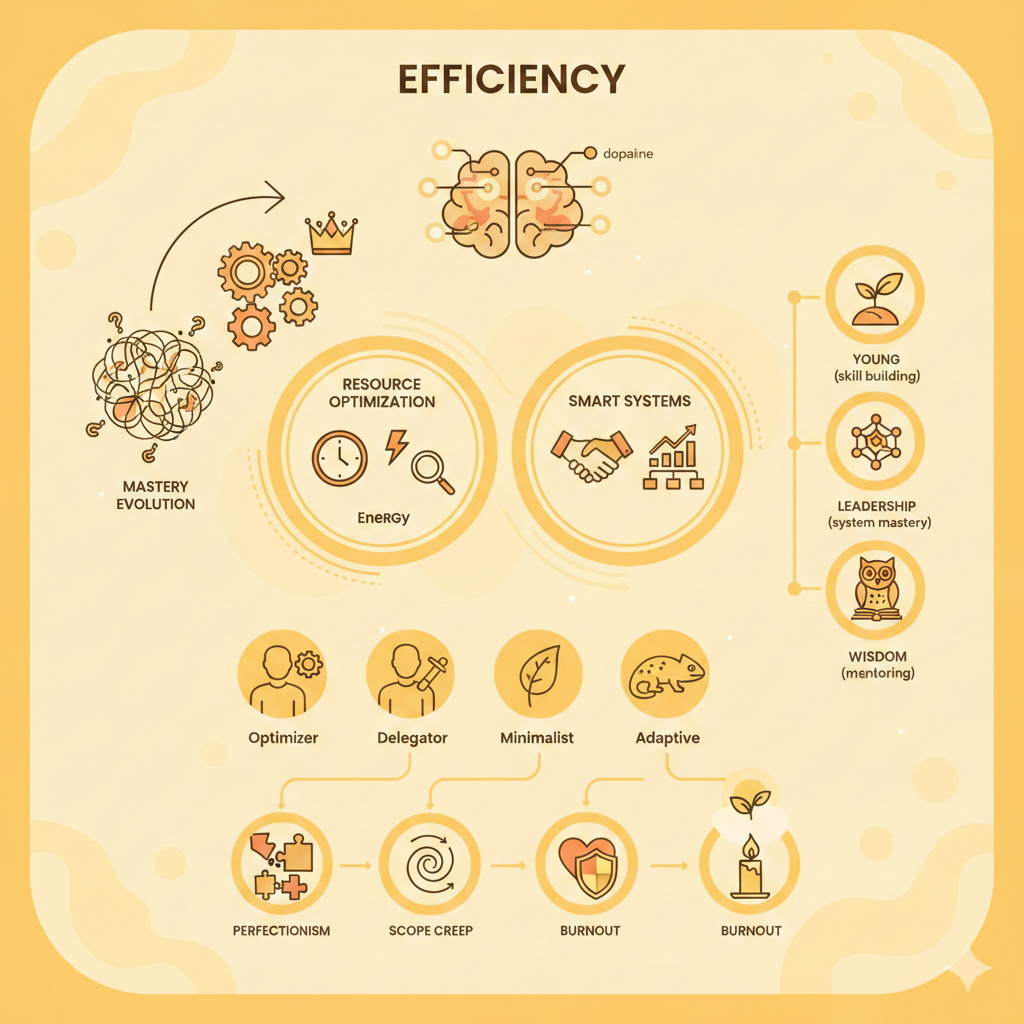
Imagine completing your most important work by noon, then having genuine free time to rest, connect with loved ones, or pursue what brings you joy. This isn't fantasy—it's the direct result of understanding and applying efficiency principles.
In 2026, efficiency has become personal. It's not one-size-fits-all corporate mandates. It's about designing your unique workflow, eliminating friction, and aligning effort with what truly matters to you.
What Is Efficiency?
Efficiency means accomplishing your goals with minimal wasted time, energy, and resources. It's the ratio between the results you achieve and the effort you invest. A highly efficient person doesn't work longer hours—they eliminate unnecessary steps, automate repetitive tasks, and focus intensely on high-impact activities that move them toward their goals.
Not medical advice.
Efficiency differs fundamentally from productivity. Productivity measures how much you do. Efficiency measures how well you do it relative to time invested. You can be very productive and still inefficient—churning out twelve hours of work when strategic focus could accomplish the same results in four hours. True efficiency combines both: completing meaningful work in the shortest possible timeframe.
Surprising Insight: Surprising Insight: Research shows that spending just 10-12 minutes planning your day saves nearly 2 hours in actual work time—a 25% boost in productivity with less effort.
Efficiency vs. Productivity vs. Effectiveness
Shows how these three related concepts interact. Productivity is volume output. Efficiency is output per unit of effort. Effectiveness is whether you're working on the right things.
🔍 Click to enlarge
Why Efficiency Matters in 2026
Modern work moves faster than ever. Digital tools multiply. Notifications interrupt constantly. Information overload creates decision fatigue. In this environment, efficiency isn't optional—it's survival. People who master efficiency experience less stress, perform better, and maintain healthier work-life boundaries. They accomplish more while burning out less.
Efficiency also fundamentally changes your relationship with time. When you feel in control of your schedule, you naturally experience lower anxiety and greater life satisfaction. Research shows that workers who received time management training reported significantly reduced stress and improved perception of personal control. This sense of control translates directly to happiness and contentment.
Furthermore, efficiency enables purpose-driven living. By eliminating time wasters, you free bandwidth for what matters: deep work on meaningful projects, quality time with family, personal learning, or creative pursuits. Efficiency isn't about maximizing output to exhaustion—it's about optimizing effort so you can invest more fully in what brings genuine fulfillment.
The Science Behind Efficiency
Neuroscience reveals why efficiency works. Your brain has limited cognitive capacity. Decision fatigue sets in after making many choices. When you streamline workflows and eliminate unnecessary decisions, you preserve mental energy for high-value work. Studies on multitasking show that switching attention between tasks creates significant cognitive drag, reducing speed and increasing errors. Efficient people minimize context-switching by batching similar work together.
Psychology demonstrates that perceived control over time directly impacts wellbeing. When you feel rushed and overwhelmed, your stress hormones spike, impairing memory, decision-making, and immune function. When you feel organized and in control, your nervous system settles, enabling calm focus. Time management training improves both objective performance and subjective wellbeing—people feel more empowered and less stressed.
How Efficiency Reduces Stress and Boosts Wellbeing
Flowchart showing the chain: efficiency creates perceived control → reduces stress hormones → improves focus and mood → better results → increased confidence → sustained wellbeing
🔍 Click to enlarge
Key Components of Efficiency
1. Goal Clarity
You cannot be efficient toward a vague target. Efficiency begins with crystalline clarity about what you're actually trying to accomplish. Not general aspirations, but specific, measurable outcomes. Without this clarity, you default to reacting to urgent-but-unimportant tasks. With clear goals, every action becomes directional or cut-able.
2. Task Prioritization
Not all tasks matter equally. The 80/20 rule suggests 80% of results come from 20% of efforts. Efficient people identify which tasks produce disproportionate impact and protect those for their peak energy hours. They batch low-impact administrative work into defined blocks rather than scattering it throughout the day.
3. Workflow Optimization
Efficiency lives in systems and routines. When you automate routine decisions (same breakfast, same morning sequence, same workspace setup), you conserve mental energy for complex work. When you eliminate unnecessary approvals, redundant meetings, or duplicated data entry, you recover hours weekly. Workflow optimization removes friction from your processes.
4. Recovery and Renewal
Efficiency isn't about grinding harder. It's about recovering smarter. Your brain performs best in cycles: focused work followed by genuine rest. Taking proper breaks, sleeping adequately, and building in recovery time paradoxically increases total output. A rested brain works faster and more creatively than an exhausted one pushing through fatigue.
| Component | What It Means | Impact on Wellbeing |
|---|---|---|
| Goal Clarity | Crystal-clear outcomes driving all decisions | Reduces decision fatigue and anxiety |
| Task Prioritization | Identifying and protecting high-impact work | Increases sense of accomplishment |
| Workflow Optimization | Removing friction and automating routines | Lowers daily stress and cognitive load |
| Recovery & Renewal | Strategic rest and restoration cycles | Prevents burnout and sustains performance |
How to Apply Efficiency: Step by Step
- Step 1: Audit your current time usage. Spend three days tracking where your time actually goes. Most people discover they lose hours daily to hidden time sinks (social media, unnecessary emails, unproductive meetings). Awareness precedes change.
- Step 2: Define your top three annual goals. Not twenty goals. Three. These become your north star. Every major decision gets evaluated against these three targets. If an opportunity doesn't advance one of them, consider declining it.
- Step 3: Map your energy rhythms. Notice when you naturally have peak mental energy and deepest focus. Schedule your most important work during these peak hours. Protect these blocks like they're client meetings—they are your most valuable work.
- Step 4: Create your shutdown sequence. Define when work stops and personal time begins. This might be a five-minute review of tomorrow's priorities, closing your email, or a walk outside. Consistent shutdown prevents work from bleeding into evenings and disrupting sleep.
- Step 5: Batch similar tasks together. Instead of checking email throughout the day, check it at specific times. Instead of switching between projects constantly, work in focused blocks. Context-switching drains cognitive energy far more than you realize.
- Step 6: Identify your top time-wasters. Be brutally honest. Is it excessive social media? Unstructured meetings? Email volume? Perfectionism on low-impact tasks? Choose one to eliminate or dramatically reduce this week.
- Step 7: Implement the two-minute rule. If a task takes less than two minutes, do it immediately rather than adding it to your list. This prevents list clutter and psychological burden of tracking micro-tasks.
- Step 8: Schedule deep work in advance. Block calendar time specifically for your high-impact work. Treat these blocks as unmovable appointments. Protect them from meetings, messages, and interruptions.
- Step 9: Delegate or eliminate low-value tasks. Identify activities that consume time but produce minimal impact. Can you automate them? Delegate them? Eliminate them entirely? Every hour spent on low-value work steals time from high-value work.
- Step 10: Review and adjust weekly. Every Sunday evening, review what worked, what didn't. Adjust your systems. Efficiency improves through iteration, not perfection.
Efficiency Across Life Stages
Young Adulthood (18-35)
Young adults often struggle with efficiency because they lack experience discerning what truly matters. They might sprint on every task with equal intensity. The opportunity here is developing foundational time management habits early. Students and early-career professionals who learn to prioritize, plan ahead, and work in focused blocks build neural pathways that serve them for decades. This stage is when to establish routines that stick.
Middle Adulthood (35-55)
Mid-career professionals juggle multiple demands: advancing careers, raising families, maintaining relationships, managing health. Efficiency becomes survival. Those who've mastered prioritization and workflow optimization actually reduce their work stress despite increased responsibility. This stage reveals whether foundational habits are strong—if not, overwhelm often peaks here. The efficiency opportunity is ruthless simplification: saying no more, eliminating low-value responsibilities, and delegating more substantially.
Later Adulthood (55+)
Later years offer the freedom to recalibrate efficiency toward what matters most. Rather than organizational pressure, self-determined priorities guide time allocation. Many people report greater satisfaction and lower stress because they're finally working on their own terms. Efficiency in this stage means protecting time for legacy work, relationships, and pursuits that bring genuine meaning.
Profiles: Your Efficiency Approach
The Optimizer
- Systems and frameworks to follow
- Clear metrics to measure progress
- Continuous improvement opportunities
Common pitfall: Becomes so focused on optimization that endless tweaking prevents actual work completion. Over-engineers simple solutions.
Best move: Set a rule: optimize monthly, not daily. Give systems 30 days before adjusting. Accept 80% solutions rather than perfecting 100%.
The Creator
- Uninterrupted deep work blocks
- Minimal administrative overhead
- Freedom from rigid schedules
Common pitfall: Avoids planning because it feels constraining. Ends up reacting to urgencies rather than advancing important projects. Creative energy gets fragmented.
Best move: Create a simple planning system specific to your process: morning intention, evening reflection. Protect deep work blocks fiercely. Batch admin work into one day weekly.
The Connector
- Collaborative frameworks
- Regular team synchronization
- Relationship time protected
Common pitfall: Fills calendar with meetings because they value connection, then rushes individual work into evening hours. Becomes exhausted from always-on mentality.
Best move: Design meeting-free blocks for focused work. Schedule collaboration intentionally rather than reactively. Build in genuine breaks between meetings.
The Pressure-Responder
- External accountability structures
- Clear deadlines for all work
- Regular progress check-ins
Common pitfall: Without external pressure, procrastinates and underperforms. Creates artificial urgency by delaying starts. Thrives on crisis but burns out from constant adrenaline.
Best move: Build accountability structures: public commitments, regular reviews, partner check-ins. Create intermediate deadlines before final ones. Channel your pressure-response into momentum, not panic.
Common Efficiency Mistakes
The first major mistake is confusing busyness with importance. Many people optimize their calendar to the maximum, squeezing every hour full of activity. Then they crash because they never built in recovery time. They're efficient at being busy but inefficient at achieving meaningful results and maintaining wellbeing. True efficiency includes strategic emptiness—time for thinking, reflection, and rest.
The second mistake is trying to optimize everything simultaneously. People read productivity books, try five new systems at once, and become exhausted managing their own management systems. This creates decision fatigue. Instead, choose one small change weekly. Master it. Then add another. Cumulative small improvements compound into dramatic transformation over months.
The third mistake is ignoring energy and rhythm. Some people try to force themselves into schedules that clash with their natural energy patterns. Night-owls force early morning work. Creative introverts schedule back-to-back meetings. This creates constant friction. Working with your natural rhythms, not against them, produces both better results and greater ease.
Efficiency Mistakes and Their Antidotes
Common pitfalls and how to redirect toward sustainable efficiency
🔍 Click to enlarge
Science and Studies
Research across multiple disciplines confirms that time management and efficiency directly impact both productivity and wellbeing. Time management training produces measurable improvements in academic performance, job performance, psychological wellbeing, and life satisfaction. One striking finding: spending 10-12 minutes planning your day delivers nearly two hours of recovered time—a 25% efficiency boost from one simple practice.
- Frontiers in Psychology (2025): Research on time management strategies in higher education found that structured planning, prioritization, and goal-setting significantly enhance academic achievement and psychological wellbeing.
- Global Wellness Institute (2025): Workplace wellbeing initiative research shows that employees who manage time effectively report lower stress, greater life satisfaction, and improved job performance.
- ScienceDirect (2024): Four-day workweek studies demonstrate that better rest improves both performance and motivation through recovery mechanisms, with 81% of employees reporting increased happiness.
- NIH/PMC: Meta-analysis of time management interventions confirmed that workers receiving training showed improved perceived control over time, reduced stress, and enhanced wellbeing outcomes.
- Frontiers in Education (2025): Multitasking research documents that task-switching impairs learning retention and increases completion time, while focused work in single-task blocks dramatically improves both speed and quality.
Your First Micro Habit
Start Small Today
Today's action: Tomorrow morning, spend 10 minutes planning your day. Write down your three most important outcomes. Use the remaining time to map when you'll work on each. Do this every morning for one week.
This micro habit creates immediate clarity, eliminates decision fatigue, and—according to research—recovers nearly two hours of wasted time daily. The act of writing activates commitment. Consistency over these seven days builds momentum without requiring willpower. Your brain learns new neural pathways through repeated action, not occasional effort.
Track your daily planning habit and receive personalized AI guidance as you build consistent routines. The Bemooore app helps you overcome procrastination on habit-building by providing reminders, progress visualization, and adaptive coaching based on your actual behavior patterns.
Quick Assessment
How would you currently describe your approach to managing your time and workload?
Your current relationship with time management shapes both your stress levels and available energy for what matters most. Understanding where you are now is the first step toward the rhythm and control you desire.
What's your biggest barrier to working more efficiently right now?
Most efficiency gains don't come from working harder. They come from removing specific barriers unique to your situation. Identifying your primary obstacle reveals your highest-leverage opportunity.
When you imagine your ideal day, what stands out most?
Your answer reveals what efficiency truly means for you. For some, it's completion. For others, it's space. For many, it's both. Efficiency isn't one-size-fits-all. It's designed around your actual values.
Take our full assessment to get personalized recommendations for your unique efficiency approach.
Discover Your Style →Next Steps
Your transformation toward genuine efficiency begins with honest self-assessment. Which component matters most right now—goal clarity, prioritization, workflow optimization, or recovery? Choose that one area. Choose one small change you can implement this week. Not five changes. One. Implement it consistently. Notice the difference. Then build from there.
The deeper invitation is to reimagine what efficiency means for you personally. Not productivity culture's definition. Not what your boss expects. Not what social media glorifies. Your definition. Efficiency serves your values and your wellbeing. When it does, you stop forcing yourself forward through willpower alone and start gliding forward because your systems support both your ambitions and your humanity.
Get personalized guidance with our AI coach to design your unique efficiency approach.
Start Your Journey →Research Sources
This article is based on peer-reviewed research and authoritative sources. Below are the key references we consulted:
Related Glossary Articles
Frequently Asked Questions
Isn't efficiency just about working faster?
Not at all. Efficiency is about achieving your goals with minimal wasted time and energy. Sometimes that means slowing down—taking time to plan properly, delegate effectively, or eliminate unnecessary tasks. A person working four focused hours might be more efficient than someone grinding eight unfocused hours. Speed matters less than direction and impact.
Won't planning and systems take too much time?
Initially, yes. But research shows that 10-12 minutes of daily planning recovers nearly two hours of wasted time. The investment pays for itself within days. After establishing systems, they run on autopilot, requiring minimal ongoing effort. Most people find their total time investment decreases significantly once systems are in place.
What if I'm naturally disorganized or not a planner?
Efficiency doesn't require perfection or complex systems. Start tiny: one simple rule, one small routine, one clear priority. Build from there. Many highly efficient people are naturally creative and spontaneous—they just protect their spontaneity by automating everything else. Find what works with your nature, not against it.
Can efficiency coexist with work-life balance?
Absolutely. In fact, efficiency enables balance. When you work smartly, you accomplish more in less time, freeing hours for personal life, relationships, and rest. The alternative—struggling to accomplish goals while working endlessly—creates imbalance. Efficiency is actually the foundation of sustainable balance.
How long before I see results from changing my approach?
You'll notice immediate differences in mental clarity and sense of control from better planning—within days. Measurable productivity gains appear within 1-2 weeks as systems take hold. Deeper wellbeing shifts, including reduced stress and increased satisfaction, typically emerge over 4-8 weeks as new habits solidify and compound.
Take the Next Step
Ready to improve your wellbeing? Take our free assessment to get personalized recommendations based on your unique situation.
- Discover your strengths and gaps
- Get personalized quick wins
- Track your progress over time
- Evidence-based strategies