Flexibility
Imagine touching your toes without strain, bending down to pick something up without stiffness, or moving through your day with complete freedom in every direction. Flexibility is the hidden key that unlocks this freedom in your body. It's not just about yoga poses or circus-level contortions—it's about maintaining the natural range of motion your joints need to function optimally. Whether you're a young professional spending hours at a desk, a parent chasing kids around the house, or someone entering your later years, flexibility directly impacts your ability to move, prevent injury, and maintain independence. Recent research shows that regular flexibility training can improve your quality of life, reduce pain, enhance athletic performance, and even contribute to better cardiovascular health. This guide reveals the science behind flexibility, shows you exactly how to build it safely, and helps you discover the approach that works best for your unique body and lifestyle.
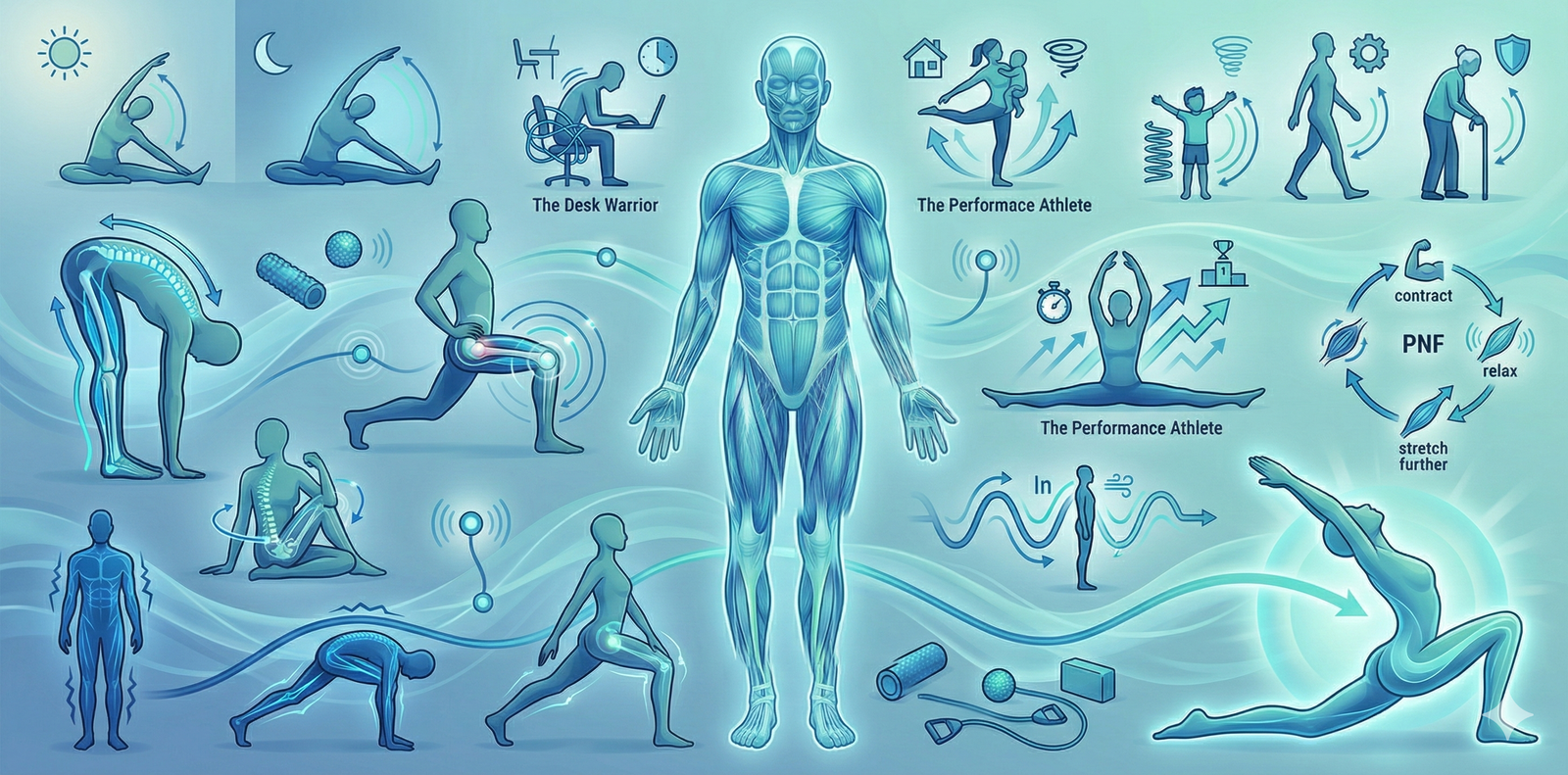
You'll discover that flexibility isn't mysterious or age-dependent—it responds predictably to consistent training, regardless of where you start.
The surprising truth: people who claim to be "naturally inflexible" can often double their range of motion in just 4-6 weeks with proper training.
What Is Flexibility?
Flexibility is the ability of your joints and muscles to move through their full range of motion comfortably and without restriction. It represents how far you can stretch your muscles and how freely your joints can move. Unlike mobility (which also includes strength and coordination), flexibility specifically measures the length and extensibility of your muscles and connective tissues. When your muscles are flexible, they're more supple and elastic, allowing your joints to move through wider ranges without limitation. This is different from general physical fitness—you can be strong or have excellent cardio capacity while lacking flexibility. Think of flexibility as the muscle version of a rubber band that can stretch and return to its resting state, versus one that's become brittle and lost its elasticity.
Not medical advice.
Flexibility varies significantly between individuals due to genetics, age, training history, and lifestyle factors. Some people are naturally more flexible due to longer muscle bellies and elastic connective tissues, while others need to invest more effort. What matters isn't your starting point—it's that flexibility consistently improves with targeted training. Your age doesn't determine your flexibility potential; a 60-year-old can develop excellent flexibility if they commit to regular practice. Your body type, previous injuries, and daily habits all influence your current flexibility, but none of these factors are fixed or irreversible. The research is clear: static stretching for at least 2 weeks chronically increases range of motion, with even better results over months and years of consistent practice.
Surprising Insight: Surprising Insight: Recent meta-analysis data shows that women typically develop greater range of motion improvements from stretching than men, with some studies showing female participants gaining 15-25% more flexibility over the same training period—suggesting differences in muscle fiber composition, hormonal factors, or training response patterns.
How Flexibility Improves in Your Body
Visual representation of the physiological changes that occur when you train flexibility consistently
🔍 Click to enlarge
Why Flexibility Matters in 2026
In today's world, flexibility has become more important than ever. The average person sits for 7-10 hours daily, creating tight hip flexors, compressed spines, and rounded shoulders. This sedentary lifestyle creates what experts call "movement poverty"—your body loses flexibility and mobility when it's not used through a full range of motion. Flexibility directly counteracts this trend by maintaining the length and elasticity your muscles need for daily function. Whether you work at a desk, spend time on your phone, or lead an active lifestyle, your flexibility determines how well your body adapts to these demands without developing pain or dysfunction.
Flexibility also plays a crucial role in injury prevention. When your muscles and joints can move freely through their intended ranges, you're less likely to compensate with poor movement patterns that lead to strain and injury. Research from physical therapists shows that athletes with better flexibility experience fewer muscle strains, joint sprains, and overuse injuries. But this matters equally for non-athletes—maintaining flexibility as you age helps you avoid falls, reduces chronic pain, and preserves your independence in daily activities like climbing stairs, reaching overhead, or bending down.
Beyond physical benefits, flexibility training provides mental and emotional advantages. Practices like yoga and mindful stretching activate your parasympathetic nervous system, reducing stress and promoting relaxation. Flexibility work often becomes a form of active meditation, giving you time to reconnect with your body and release accumulated tension. In a world of constant stimulation and stress, this mind-body integration is invaluable for overall wellbeing.
The Science Behind Flexibility
Your muscles contain specialized sensory receptors called muscle spindles that detect changes in length and the rate of that change. When you stretch, these receptors send signals to your central nervous system. If you stretch too aggressively or bounce, these spindles trigger a protective reflex that actually contracts your muscles—the opposite of what you want. This is why ballistic (bouncing) stretching is less effective than static or controlled stretching. With static stretching held for 20-30 seconds, your nervous system gradually adapts and reduces this protective response, allowing your muscles to lengthen safely.
The research reveals two main mechanisms through which stretching improves flexibility. First, acute stretching (a single stretch session) reduces overall muscle stiffness immediately, allowing greater range of motion in that moment. Second, chronic stretching (consistent training over weeks and months) produces longer-lasting adaptations. Studies show that chronic static stretching increases your maximum tolerable pressure—meaning you can stretch further before feeling discomfort—suggesting that your nervous system adapts to accept greater ranges as normal. Additionally, the elastic properties of your connective tissues (fascia, tendons, ligaments) gradually change with consistent stretching, becoming more compliant and extensible. These neural and tissue adaptations combine to create lasting improvements in flexibility that persist even on rest days.
Stretching Mechanisms: How Your Muscles Adapt
The neural and tissue changes that occur during acute and chronic stretching
🔍 Click to enlarge
Key Components of Flexibility
Static Stretching
Static stretching involves holding a stretch in a fixed position for 20-60 seconds without movement. This is the most researched and effective form of stretching for improving long-term flexibility. Static stretches target specific muscles and connective tissues, allowing your nervous system to adapt gradually to increased length. Research confirms that static stretching produces superior range of motion improvements compared to other methods. The key is consistency—performing static stretches 2-3 times weekly, focusing on all major muscle groups, produces measurable improvements within 2-4 weeks. Common static stretches include hamstring stretches, hip flexor stretches, chest stretches, and shoulder stretches. When holding a stretch, you should feel gentle tension in the target muscle—never sharp pain or discomfort. Each stretch should be held for about 30 seconds on each side.
Dynamic Stretching
Dynamic stretching involves moving through a range of motion in controlled ways, gradually increasing the range with each repetition. Unlike static stretching, dynamic stretches include movement and are excellent as warm-up activities. Examples include walking lunges, leg swings, arm circles, hip circles, and butt kicks. Dynamic stretches prepare your muscles for activity by increasing blood flow, warming tissues, and activating your nervous system. Research shows that dynamic stretching improves flexibility while also enhancing performance and reducing injury risk during subsequent exercise. You should perform dynamic stretches for 5-10 repetitions on each side before workouts or physical activity. The controlled movement prepares your body better than static stretching alone, making dynamic stretches ideal as part of your pre-workout routine.
Proprioceptive Neuromuscular Facilitation (PNF)
PNF stretching is an advanced technique that combines passive stretching with isometric contractions to achieve rapid improvements in flexibility. The typical PNF protocol involves stretching a muscle to mild discomfort, then contracting it isometrically against resistance for 6 seconds, then relaxing and stretching deeper. This technique takes advantage of your nervous system's autogenic inhibition reflex, which naturally relaxes muscles after contraction. Research shows that PNF stretching produces greater range of motion improvements than static stretching alone, making it highly effective for people with significant tightness or those training for sports. PNF stretching typically requires a partner or trainer, making it less accessible than self-directed static stretching, but it's invaluable for rapid progress. If you have access to a physical therapist or trained professional, PNF stretching can accelerate your flexibility development significantly.
Yoga and Mind-Body Flexibility
Yoga integrates flexibility training with breath awareness, balance, and mindfulness, creating a comprehensive approach to improving range of motion while reducing stress. Different yoga styles emphasize flexibility differently—Yin yoga targets deep connective tissues with long holds (3-5 minutes), while Vinyasa flow integrates dynamic stretching with strength and coordination. Research shows that regular yoga practice improves flexibility comparable to traditional stretching programs, while also providing mental clarity, stress reduction, and improved body awareness. Many people find yoga more sustainable than isolated stretching because it's inherently engaging and meditative. Yoga classes also provide professional guidance to ensure proper form and safety. Studies on yoga show improvements in balance, functional movement, strength, and flexibility within 6-8 weeks of regular practice, with mental health benefits appearing even faster.
| Stretching Method | Timeline for Results | Best For |
|---|---|---|
| Static Stretching | 2-4 weeks of consistent practice | Building long-term flexibility, post-workout recovery |
| Dynamic Stretching | Immediate warm-up effects | Pre-workout preparation, injury prevention |
| PNF Stretching | 1-2 weeks with regular sessions | Rapid flexibility gains, addressing significant tightness |
| Yoga Practice | 6-8 weeks for noticeable improvement | Holistic flexibility plus mental wellness |
How to Apply Flexibility: Step by Step
- Step 1: Assess your current flexibility baseline by noting which movements feel restricted or uncomfortable—this helps you track progress over weeks
- Step 2: Begin with 5-10 minutes of light movement like walking, gentle arm circles, or marching in place to warm your muscles
- Step 3: Warm up your entire body with dynamic stretches like leg swings, walking lunges, and hip circles—5-10 controlled repetitions on each side
- Step 4: Move into static stretches, targeting all major muscle groups systematically: calves, hamstrings, hip flexors, glutes, chest, shoulders, and back
- Step 5: Hold each static stretch for 20-30 seconds on each side, breathing deeply and relaxing into the stretch—never force or bounce
- Step 6: Pay attention to areas of significant tightness or restriction; these need extra attention and longer stretching durations
- Step 7: Stretch consistently 3-5 times weekly for best results; daily stretching accelerates progress but isn't necessary for beginners
- Step 8: Track your improvements by retesting your baseline movements monthly—you'll notice greater range within 2-4 weeks
- Step 9: Combine stretching with strength training and cardio for comprehensive fitness; flexibility is one component of complete physical fitness
- Step 10: Adjust your routine based on what you discover about your body—some people need more hip work, others need more shoulder flexibility
Flexibility Across Life Stages
Young Adulthood (18-35)
Young adults typically have good natural flexibility but often neglect it while focusing on strength or cardio. This is the ideal time to establish healthy flexibility habits that will serve you for decades. Many young adults sit extensively for work or school, gradually losing flexibility without noticing. Incorporating flexibility training 2-3 times weekly prevents this loss and improves athletic performance and injury prevention. Young adults benefit from dynamic stretching before workouts and static stretching after, plus one dedicated flexibility session weekly. Sports-specific flexibility training at this age addresses the demands of your chosen activities—runners need excellent hip and hamstring flexibility, while desk workers need thorough upper back and chest stretching.
Middle Adulthood (35-55)
Middle-aged adults often experience increased stiffness and pain due to accumulated sitting, stress, and reduced activity levels. This is when flexibility training becomes medically protective—research shows that flexibility maintenance reduces injury risk, improves daily function, and helps prevent chronic pain conditions. Many middle-aged adults find that consistent flexibility training directly reduces or eliminates back pain, neck tension, and hip stiffness that previously seemed inevitable. This life stage benefits from combining static stretching with practices like yoga or Pilates that build both flexibility and functional strength. Gentle, consistent stretching becomes more important than aggressive pushing—listening to your body and working at 70% of your maximum range prevents overstretching and injury. Three to four flexibility sessions weekly at this age produces noticeable improvements in mobility and quality of life within 3-4 weeks.
Later Adulthood (55+)
Flexibility becomes critically important in later adulthood for maintaining independence and preventing falls. Research shows that improved flexibility combined with balance training significantly reduces fall risk—a major health concern for older adults. Flexibility work in this life stage should be gentle, controlled, and consistent, focusing on functional movements that support daily activities. Exercises should include hip flexibility for walking and climbing stairs, ankle flexibility for stability, shoulder flexibility for reaching and grooming, and spinal flexibility for looking around and bending. Yoga and tai chi are particularly valuable for this age group because they combine flexibility work with balance training and mental focus. Consistency matters more than intensity—daily 10-15 minute flexibility sessions provide more benefit than occasional longer sessions. Working with a physical therapist or certified instructor ensures safe progression and prevents injury.
Profiles: Your Flexibility Approach
The Desk Warrior
- Relief from tight hip flexors and rounded shoulders
- Frequent movement breaks throughout the day
- Stretching that targets computer-posture tightness
Common pitfall: Stretching only on weekends instead of daily, creating inconsistent progress
Best move: Three 5-minute stretching breaks daily plus one longer 20-minute flexibility session weekly for rapid results
The Performance Athlete
- Sport-specific flexibility for injury prevention
- Dynamic pre-workout stretching for performance
- Advanced techniques like PNF for competitive advantage
Common pitfall: Neglecting flexibility thinking strength is more important, or bouncing through stretches dangerously
Best move: Combine dynamic pre-workout stretching with 2-3 dedicated flexibility sessions weekly using static and PNF techniques
The Busy Parent
- Quick, efficient stretching routines they can do at home
- Family activities that build flexibility together
- Flexibility work that reduces stress and tension
Common pitfall: Abandoning flexibility training completely due to time constraints
Best move: Three 10-minute YouTube flexibility routines weekly plus family activities like active play and yoga
The Wellness Explorer
- Mind-body integration and stress reduction
- Flexible routines that feel meditative and relaxing
- Community and guidance from instructors
Common pitfall: Overcommitting to complex routines and burning out, or expecting immediate dramatic results
Best move: Consistent gentle yoga or tai chi 3-4 times weekly, building gradually as flexibility improves
Common Flexibility Mistakes
The most common flexibility mistake is stretching cold muscles before any warm-up. When your muscles are cold, they're stiff and more prone to injury. You should always begin with 5-10 minutes of light movement that increases your heart rate and body temperature before attempting flexibility work. A cold stretch won't improve flexibility and risks injury—consistency matters far more than intensity, and forcing a stretch on cold muscles is counterproductive and potentially harmful.
The second major mistake is bouncing during stretches, which triggers the protective stretch reflex in your muscles, making them contract rather than relax. Bouncing actually reduces flexibility and increases injury risk. Modern flexibility research clearly shows that gentle, static holds without bouncing produce superior results. Hold each stretch without movement for 20-30 seconds, breathe deeply, and let gravity and your own relaxation deepen the stretch gradually. Patience produces better results than aggression in flexibility training.
A third common mistake is stretching your maximum range immediately after a workout when your muscles are fatigued and vulnerable. Post-workout stretching should be gentle and conservative, helping your muscles relax and recover. Save your deeper, more aggressive stretching for when your body is fresh and you have more control. Additionally, many people expect flexibility improvements to happen overnight. Flexibility responds to consistent training over weeks, not days—expect noticeable improvements within 2-4 weeks of consistent practice, with significant changes over 8-12 weeks. Setting this realistic expectation prevents frustration and dropout.
Flexibility Training: What Works vs. What Doesn't
Visual comparison of effective flexibility practices versus common mistakes
🔍 Click to enlarge
Science and Studies
Recent peer-reviewed research confirms that flexibility training produces measurable, predictable improvements across diverse populations. Meta-analyses examining hundreds of studies show consistent results: chronic stretching for at least 2 weeks increases range of motion significantly, with greater improvements from long-term stretching over months. Studies comparing stretching methods confirm that static stretching produces superior long-term flexibility gains compared to ballistic stretching, with effect sizes ranging from small to moderate. Importantly, research demonstrates that both males and females improve substantially with training, with some studies noting greater flexibility gains in female participants. Studies on different age groups show that flexibility improvement is possible at any age—a 70-year-old can achieve flexibility improvements comparable to a 40-year-old with consistent training.
- 2025 meta-analysis published in Sports Medicine showing resistance training increases range of motion, suggesting that combining strength and flexibility creates optimal results
- 2024 systematic review confirming chronic effects of stretching on range of motion, with training durations of 2+ weeks producing clinically significant improvements
- 2023 research on sit-and-reach test validity showing that hamstring flexibility assessment correlates with functional movement and injury prevention
- Evidence from Harvard Medical School demonstrating that regular stretching improves blood vessel function and blood pressure, providing cardiovascular benefits beyond flexibility
- Research showing yoga and flexibility training activate parasympathetic nervous system, reducing cortisol and providing stress reduction benefits
Your First Micro Habit
Start Small Today
Today's action: Spend 2 minutes before bed performing three simple stretches: forward bend, figure-four hip stretch, and shoulder rolls. Hold each 20-30 seconds, breathing deeply.
Evening stretching signals your body to relax, improves sleep quality, and builds consistency without requiring time changes. Two minutes is sustainable for everyone, and this habit compounds into significant flexibility gains within weeks.
Keep quitting habit apps after a missed day? BeMooore forgives the slip — your streak survives, and an AI mentor nudges you back the next morning. Free on iOS.
Quick Assessment
How would you describe your current flexibility based on daily movements?
Your baseline flexibility determines where to start. If you're noticeably tight, consistent gentle stretching will provide the most dramatic improvements in 4-6 weeks.
What's your primary motivation for improving flexibility?
Your motivation shapes which flexibility approach works best—athletes need sport-specific training, while wellness-focused people thrive with yoga or gentle practices.
How much time can you realistically dedicate to flexibility training weekly?
Consistency matters more than intensity. Even 10 minutes daily creates better results than sporadic longer sessions. Choose what you'll actually maintain.
Take our full assessment to get personalized recommendations.
Discover Your Style →Next Steps
Start with a single 2-minute micro habit before bed tonight. Pick one or two simple stretches from the video and commit to holding them for 30 seconds while breathing deeply. This initial step costs almost nothing but creates a foundation for building a complete flexibility practice. Track this micro habit daily for one week, and you'll likely notice that your body begins responding—mild improvements in range of motion and reduced evening stiffness. This small success builds motivation for expanding to more comprehensive training.
Once your micro habit is established, expand to a 10-15 minute flexibility session 2-3 times weekly using the Yoga with Adriene video or similar resources. Within 2-4 weeks, you should notice measurable improvements in how freely your body moves. Pay attention to activities that felt restricted before—you'll feel the difference in your daily life as flexibility improvements emerge. Consider combining your flexibility work with other aspects of holistic wellness like stress reduction, quality sleep, and proper nutrition to accelerate overall health improvements.
Get personalized guidance with AI coaching.
Start Your Journey →Research Sources
This article is based on peer-reviewed research and authoritative sources. Below are the key references we consulted:
Related Glossary Articles
Frequently Asked Questions
Is it ever too late to improve flexibility?
No—flexibility improves at any age with consistent training. Research shows that 50-year-olds, 70-year-olds, and people at every life stage can develop significant flexibility improvements within 4-6 weeks of consistent practice. Age is not a barrier; consistency is what matters.
How long should I hold a stretch?
Research supports holding static stretches for 20-60 seconds. For most people, 30 seconds per stretch provides an excellent balance between effectiveness and time efficiency. Holding longer doesn't proportionally increase benefits, so 30 seconds on each side is optimal for most situations.
Should I stretch before or after workouts?
Dynamic stretching is best before workouts as part of warm-up, improving performance and injury prevention. Static stretching is best after workouts or during dedicated flexibility sessions. Gentle post-workout stretching helps with recovery, while intense stretching after exhausting exercise risks injury.
Can flexibility training alone improve performance or prevent injuries?
Flexibility contributes to injury prevention and performance, but it works best combined with strength training, cardiovascular fitness, and proper movement technique. A comprehensive fitness approach includes flexibility, strength, endurance, and skill development. Flexibility alone isn't sufficient but is an essential component.
How often should I do flexibility training?
Research shows that 2-3 flexibility sessions weekly produces significant improvements. Daily 10-15 minute sessions accelerate progress, but aren't necessary for beginners. Consistency matters more than frequency—three reliable weekly sessions beat sporadic daily attempts. Find a frequency you can sustain indefinitely.
Take the Next Step
Ready to improve your wellbeing? Take our free assessment to get personalized recommendations based on your unique situation.
- Discover your strengths and gaps
- Get personalized quick wins
- Track your progress over time
- Evidence-based strategies