Innovation
Innovation is the process of turning creative ideas into valuable, practical solutions that create meaningful change. But here's what most people get wrong: innovation isn't just about having brilliant ideas in brainstorming sessions. It's about the courage to implement those ideas, test them in the real world, and refine them based on feedback. In 2026, innovation has become essential not just for businesses seeking competitive advantage, but for individuals wanting to solve personal problems, advance their careers, and create lasting impact in their lives and communities.
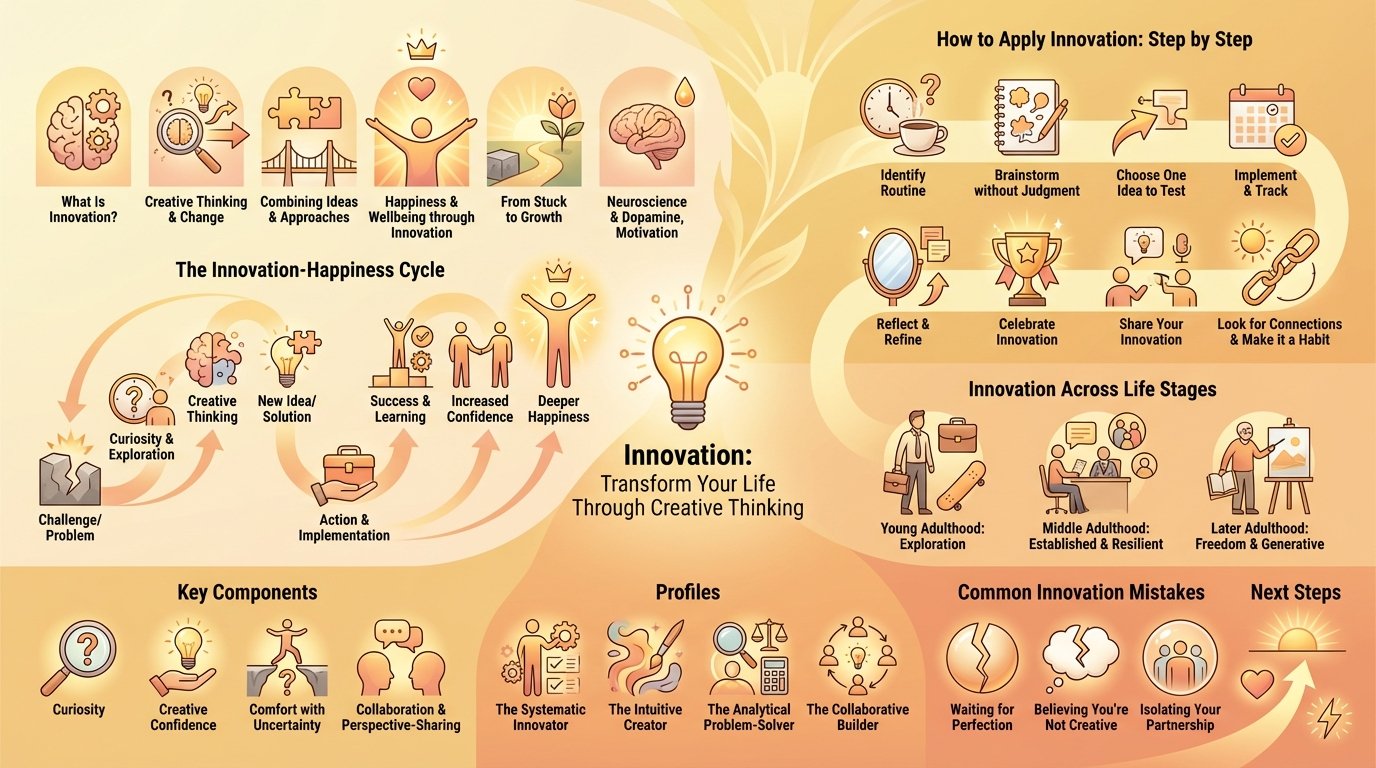
Think of innovation as applied creativity. You might daydream about a new product or service, but that's just the creative spark. Innovation happens when you take that spark and build something tangible that solves a real problem and delivers genuine value to others.
The real power of innovation lies in understanding that it's both a skill and a mindset. You can learn the innovation process step by step, but you also need to cultivate the psychological resilience to embrace failure, persist through obstacles, and maintain the confidence that your ideas matter. Whether you're an entrepreneur launching a startup, a corporate leader modernizing your organization, or someone simply looking to improve your daily routines, innovation applies to you.
What Is Innovation?
Innovation is the implementation of new ideas, methods, or technologies that create value and produce meaningful change. The term comes from the Latin 'innovare,' meaning to make new. In business and personal development contexts, innovation specifically refers to introducing something novel that is both original and useful—it solves a problem better than existing solutions, or it creates entirely new markets where none existed before.
Not medical advice.
The relationship between creativity and innovation is often misunderstood. Creativity is the ability to generate novel ideas and see connections others might miss. Innovation, by contrast, is creativity that has been implemented. You can brainstorm hundreds of creative ideas without producing a single innovation. Innovation requires moving from imagination to action, from concept to reality. This distinction matters because it shapes how we approach problem-solving in our personal and professional lives.
Surprising Insight: Surprising Insight: Intuitive processing outperforms deliberative processing in creative idea selection. Research shows that when choosing between ideas, our gut instinct often identifies which ideas have the highest potential, even before logical analysis catches up.
From Creativity to Innovation
This diagram shows the pathway from creative thinking through evaluation to successful implementation
🔍 Click to enlarge
Why Innovation Matters in 2026
In 2026, the pace of change is faster than ever. Technological disruption, shifting consumer preferences, and evolving workplace expectations mean that standing still is essentially moving backward. Innovation is no longer optional—it's survival. Companies that fail to innovate lose market share to more agile competitors. Employees who don't develop innovative thinking get left behind in career advancement. And individuals who don't apply innovation to their personal challenges struggle to adapt to changing circumstances.
The innovation imperative affects every sector. Healthcare innovators develop new treatments for previously incurable conditions. Financial services innovators create new investment vehicles and payment systems. Educational innovators reimagine how people learn and develop skills. Even personal wellness benefits from innovation—whether that's discovering new exercise methods, optimizing nutritional science, or creating mental health practices tailored to individual differences.
Moreover, innovation has become democratized. You don't need massive budgets or corporate infrastructure to innovate. Individuals with smartphones and internet access can identify problems, research solutions, prototype ideas, and bring them to market. This creates unprecedented opportunity for personal and financial growth through innovation-driven thinking.
The Science Behind Innovation
Innovation emerges from specific patterns of thinking and brain function. Neuroscience research reveals that creative cognition involves the interaction of different neural systems—the default mode network (associated with imagination and abstract thinking) and the executive control network (associated with focused attention and planning). The most innovative thinking occurs when these systems work together: you imagine possibilities freely, then critically evaluate which ones are feasible and valuable.
Psychology research identifies personality traits that predict innovative capacity. Openness to experience—characterized by intellectual curiosity, comfort with ambiguity, and willingness to explore new ideas—is the strongest predictor of creative and innovative output. But personality is only part of the equation. Environmental factors matter enormously. Organizations and individuals that create psychological safety (where people feel safe to voice ideas without fear of ridicule), encourage calculated risk-taking, and tolerate intelligent failures produce far more innovation than those with punitive cultures. Collaboration amplifies innovation: when diverse perspectives combine, the ideas generated tend to be both more novel and more practically useful.
The Innovation Ecosystem
Key factors that enable innovation to emerge: mindset, environment, process, and resources
🔍 Click to enlarge
Key Components of Innovation
Ideation and Idea Generation
The foundation of innovation is generating a diverse pool of ideas. Ideation involves structured and unstructured techniques to expand the possibility space. Brainstorming sessions leverage group thinking to multiply ideas. Individual research and exploration uncover problems worth solving. Cross-domain thinking—applying solutions from one field to problems in another—often produces breakthrough innovations. The key is volume combined with diversity: you need many ideas because most won't work, and you need diverse ideas because the best innovations often come from unexpected combinations.
Evaluation and Selection
Not every idea deserves development. Evaluation involves assessing ideas against criteria like: Does it solve a real problem? Is there a market or audience for it? Can we realistically implement it with available resources? What are the potential risks? Effective evaluation balances critical analysis with optimism. Too much criticism kills promising ideas prematurely; too little optimism means pursuing impractical fantasies. The most successful organizations use structured evaluation frameworks that make selection criteria transparent and allow for both analytical and intuitive input.
Prototyping and Testing
Before scaling an innovation, you test it in small ways to gather real-world feedback. Prototyping doesn't require perfection—it requires speed and learning. A prototype might be a rough product mockup, a pilot program with limited users, a small-scale experiment, or a proposal shared with potential stakeholders. The purpose is to learn what works, what doesn't, and what you didn't anticipate. This feedback loop is where many promising ideas fail to launch—but that's a feature, not a bug. Learning what doesn't work prevents massive waste later.
Implementation and Scale
Once testing validates the core concept, implementation involves scaling from small to larger scope. This phase requires attention to operations, resources, timelines, and change management. Many innovations stall here because implementation is harder and less exciting than ideation. But disciplined execution is what transforms promising ideas into sustainable change. Successful implementation includes ongoing iteration—you continue learning and refining even as you scale.
| Innovation Type | Definition | Examples |
|---|---|---|
| Product Innovation | Creating new or significantly improved products or services | New smartphone, medical treatment, app |
| Process Innovation | Improving how things are made or delivered | Manufacturing technique, supply chain method, customer service process |
| Business Model Innovation | Changing how value is created and captured | Subscription service, open-source approach, platform economy |
| Incremental Innovation | Small improvements to existing solutions | Adding features, improving efficiency, reducing costs |
| Breakthrough Innovation | Revolutionary changes creating entirely new categories | Smartphones, streaming media, artificial intelligence |
How to Apply Innovation: Step by Step
- Step 1: Identify the problem: Start by clearly defining what's not working or what opportunity exists. Talk to people affected by the problem. Understand the real pain points, not just surface symptoms.
- Step 2: Research thoroughly: Study how others have tackled similar problems. Look across industries and fields. Understand the constraints and requirements your innovation must meet.
- Step 3: Generate multiple ideas: Use diverse brainstorming techniques. Aim for quantity initially—quantity leads to quality. Combine ideas in unexpected ways. Involve people with different backgrounds and expertise.
- Step 4: Evaluate ideas critically: Apply objective criteria. Assess feasibility, market potential, and alignment with your goals. Use both data and intuition. Don't kill ideas too quickly but also don't pursue fantasy.
- Step 5: Prototype quickly: Build a minimal version to test core assumptions. Use low-cost materials or digital mockups. Focus on learning, not perfection. Fail fast and cheap.
- Step 6: Test with real users: Show your prototype to people in your target audience. Observe how they actually use it. Listen to their feedback without defensiveness. Identify what assumptions were wrong.
- Step 7: Gather feedback systematically: Create structured ways to collect feedback. Use surveys, interviews, observation, and usage data. Look for patterns in the feedback, not just individual comments.
- Step 8: Iterate based on learning: Update your innovation based on what you learned. Sometimes this means small tweaks; sometimes it means going back to the drawing board. Iteration is normal and expected.
- Step 9: Plan for scale: Once testing validates the concept, develop an implementation plan. Identify resources needed, timeline, risks, and success metrics. Plan how to reach your full target audience.
- Step 10: Launch and monitor: Release your innovation to the market or organization. Track how it performs against expectations. Continue gathering feedback. Be prepared to adjust as real-world complexity emerges.
Innovation Across Life Stages
Young Adulthood (18-35)
Young adults typically have high energy and fewer established commitments, making this an ideal time to experiment with innovative thinking. The challenge is channeling this energy strategically. Young adults benefit from exploring diverse fields to identify where their natural curiosity and talent intersect with real market needs. This is the ideal time to launch ventures, pursue unconventional career paths, or develop new skills before more substantial obligations require stability. The mindset should be: 'I have the freedom to experiment now—what can I learn that will compound over time?'
Middle Adulthood (35-55)
Middle-aged adults often have significant expertise, resources, and networks—the building blocks of effective innovation. Many successful ventures are launched by people in this stage who have deep domain knowledge combined with access to capital and relationships. The challenge is staying mentally flexible in a phase when established routines and orthodoxies feel comfortable. Effective innovation in middle adulthood often means applying accumulated wisdom in new ways. This stage offers the opportunity to mentor and sponsor innovation in others, multiplying your impact beyond your individual efforts.
Later Adulthood (55+)
Later-life innovators bring the advantage of long-term perspective and freedom from early-career pressures. Many successful later-life innovations address problems that only become obvious from decades of experience. Whether in business, community development, or personal wellness, later adults can innovate in ways that create legacy and meaning. The key is leveraging experience while maintaining openness to new technologies and approaches. Mentoring younger innovators is a high-impact innovation strategy in this life stage.
Profiles: Your Innovation Approach
The Visionary Pioneer
- Freedom to explore unconventional ideas
- Access to early adopters who trust their judgment
- Tolerance for being ahead of the market
Common pitfall: Getting so focused on the big vision that execution and practical details get neglected
Best move: Partner with operationally-gifted people who can bring visions to life. Use your strength to inspire and direction-set, not to manage day-to-day operations.
The Pragmatic Improver
- Clear definition of what's not working
- Permission to make incremental changes
- Metrics showing whether improvements are working
Common pitfall: Settling for small improvements when breakthrough innovation is possible
Best move: Don't limit yourself to incremental thinking. Occasionally ask: 'What if we reimagined this from scratch?' Sometimes pragmatism and breakthrough thinking together create powerful innovations.
The Collaborative Connector
- Diverse people and perspectives to work with
- Explicit permission to involve others in ideation
- Credit and recognition that is shared
Common pitfall: Innovation stalling because consensus-seeking slows decision-making
Best move: Develop clarity on when you need consensus and when you need to decide and move forward. Collaboration is powerful but can become decision-making paralysis.
The Systems Thinker
- Understanding of how parts interact in complex systems
- Tools to model and test system changes
- Patience as system innovations take longer to show results
Common pitfall: Overcomplicating solutions or waiting for perfect understanding before acting
Best move: Use your systems perspective to identify high-leverage intervention points. Innovation doesn't require understanding everything—it requires understanding what matters most.
Common Innovation Mistakes
The first common mistake is confusing novelty with innovation. Just because something is new doesn't mean it's valuable. True innovation solves a real problem or meets a genuine need. Inventing something no one wants is not innovation—it's wasted effort. Avoid this by staying grounded in actual user needs and validating demand before investing heavily.
The second mistake is underestimating the importance of testing and learning. Many people rush from ideation straight to full-scale implementation. This wastes resources and often fails. Innovation requires a disciplined testing phase where you deliberately seek evidence that your assumptions are wrong. The goal is to fail small and cheap, learning what doesn't work before scaling. Embrace testing, not as validation that you're right, but as a learning tool.
The third mistake is innovation in isolation. The best innovations emerge from collaboration and diverse perspectives. If you're innovating alone in a silo, you're missing insights that would make your innovation stronger. Seek feedback from different types of people—experts in your field, people outside your field, potential users, skeptics. Their input will refine your thinking and make your innovation more robust.
The Innovation Failure Points
Where innovations typically fail and how to avoid those failure modes
🔍 Click to enlarge
Science and Studies
The research literature on innovation spans psychology, organizational behavior, economics, and neuroscience. These studies consistently show that innovation is not a mysterious gift possessed by rare individuals—it's a learnable process that can be systematically improved through practice and the right environmental conditions.
- Rietzschel et al. (2010) showed in their British Journal of Psychology research that intuitive processing outperforms deliberative processing when selecting which creative ideas to pursue, suggesting that immediate gut reactions often identify high-potential ideas better than extended logical analysis.
- The Stanford Online guides on innovation management identify that organizations with explicit innovation processes and psychological safety cultures produce 3-5x more useful innovations than those without structured approaches.
- Research on openness to experience (one of the Big Five personality traits) demonstrates that this trait is the strongest predictor of creative and innovative output across studies, suggesting that cultivating curiosity and comfort with novelty directly increases innovative capacity.
- Neuroscience research has identified that the default mode network and executive control network must work together for optimal creative problem-solving—imagination combined with critical evaluation, not either one alone.
- A Harvard Business School study found that the most innovative companies integrate three elements: clear innovation strategy and process, sufficient resources allocated to innovation (time and budget), and a culture that tolerates intelligent failure.
Your First Micro Habit
Start Small Today
Today's action: Today, spend 15 minutes identifying one problem in your work or personal life that bugs you. Write down three wild, impractical ways to solve it—the more unrealistic the better. This isn't about implementation; it's about expanding your thinking. Tomorrow, look at what you wrote and ask: 'Is there a kernel of something useful in the wild ideas?'
This micro habit builds your innovation muscle. It separates idea generation from evaluation, which are two different cognitive processes. Most people try to do both simultaneously, which kills creativity. By deliberately generating impractical ideas first, you interrupt the pattern of immediate critical judgment. Your brain learns that it's safe to imagine. After a week of this practice, you'll notice you have more ideas overall—and more of them are usable.
Wild ideas come faster than fingers. Say your three solutions out loud instead of typing them: VoxFlow turns your voice into text on your iPhone, offline, in 99 languages. Free on the App Store.
Keep quitting habit apps after a missed day? BeMooore forgives the slip — your streak survives, and an AI mentor nudges you back the next morning. Free on iOS.
Quick Assessment
When you encounter a problem, what's your natural first move?
Your approach reveals your natural innovation style. Idea generators excel at breadth; root-cause thinkers excel at depth; pattern-seekers excel at leverage; intuitive thinkers move fast. The most effective innovators blend all four approaches.
How comfortable are you with the possibility that your idea might not work?
Your comfort with failure directly predicts how innovative you'll be. High-innovation people view failure as feedback. They test frequently and fail cheaply. If you're uncomfortable with failure, consider smaller experiments first to build tolerance.
When developing a new idea, who do you most want involved?
This reveals your collaboration style. Solo thinkers excel at clarity and focused vision. Expert partners provide validation and expertise. Diverse teams generate richer ideas. Team integration ensures adoption. All approaches can work—the key is being intentional about it.
Take our full assessment to get personalized recommendations.
Discover Your Style →Next Steps
Innovation starts with a single step. Identify one problem you care about solving—something small is fine, it doesn't need to be world-changing. Spend one week researching how others approach this problem. Generate 20 possible solutions, no matter how wild. From those 20, pick the three most promising and create a simple test plan. The goal isn't perfection—it's movement. The innovation process is learned by doing, and the best time to start is now.
Remember: Innovation is not a rare gift. It's a skill that improves with practice. Every attempt teaches you something. Every failure informs your next try. By practicing the innovation process regularly, you develop a capacity that becomes increasingly valuable across every area of your life—work, relationships, health, finances, and personal growth.
Get personalized guidance with AI coaching.
Start Your Journey →Research Sources
This article is based on peer-reviewed research and authoritative sources. Below are the key references we consulted:
Related Glossary Articles
Frequently Asked Questions
Do I need to be naturally creative to be innovative?
Creativity is helpful, but innovation is more about systematic thinking and persistence than raw creative talent. You can develop innovative capacity through practice, learning the process, and building environments that support innovation. Many successful innovators describe themselves as ordinary people who followed a structured approach.
How much of innovation is planning vs. just getting started?
Both matter, but the balance shifts based on context. For lower-risk innovations, getting started and learning through iteration is better than extensive planning. For innovations with high costs or risks, thoughtful planning prevents wasted resources. The key is matching your planning depth to the stakes of failure.
What's the difference between innovation and improvement?
Improvement makes something better (faster, cheaper, higher quality). Innovation creates something new that didn't exist before. Some innovations are big (like smartphones); some are small (like post-it notes). Both require the same process—identify the problem, test solutions, iterate, and implement.
Can innovation happen in established organizations, or is it just for startups?
Both. Startups innovate because they must. Established organizations innovate because they need to stay competitive. The difference is that large organizations face more organizational inertia and politics. Successful corporate innovation requires dedicated innovation teams, protected resources, and leadership commitment to change.
How do I know if my innovation idea is actually good?
Talk to potential users before fully committing. Show them your prototype. Ask specific questions: Would you buy this? Would you use this? What would make this valuable for you? Their enthusiasm and specific feedback is far more reliable than your internal certainty.
Take the Next Step
Ready to improve your wellbeing? Take our free assessment to get personalized recommendations based on your unique situation.
- Discover your strengths and gaps
- Get personalized quick wins
- Track your progress over time
- Evidence-based strategies