Inspiration
That sudden spark when an idea electrifies your mind. That moment when you see someone achieve the impossible and feel your own possibilities expand. Inspiration is the force that transforms dormant potential into compelling action. It arrives unbidden, yet you can learn to invite it regularly. Inspiration isn't just a fleeting emotion—it's a documented psychological state that rewires your brain, elevates your mood, and propels you toward meaningful goals. When you're inspired, you access intrinsic motivation, creativity, and resilience you didn't know you possessed.
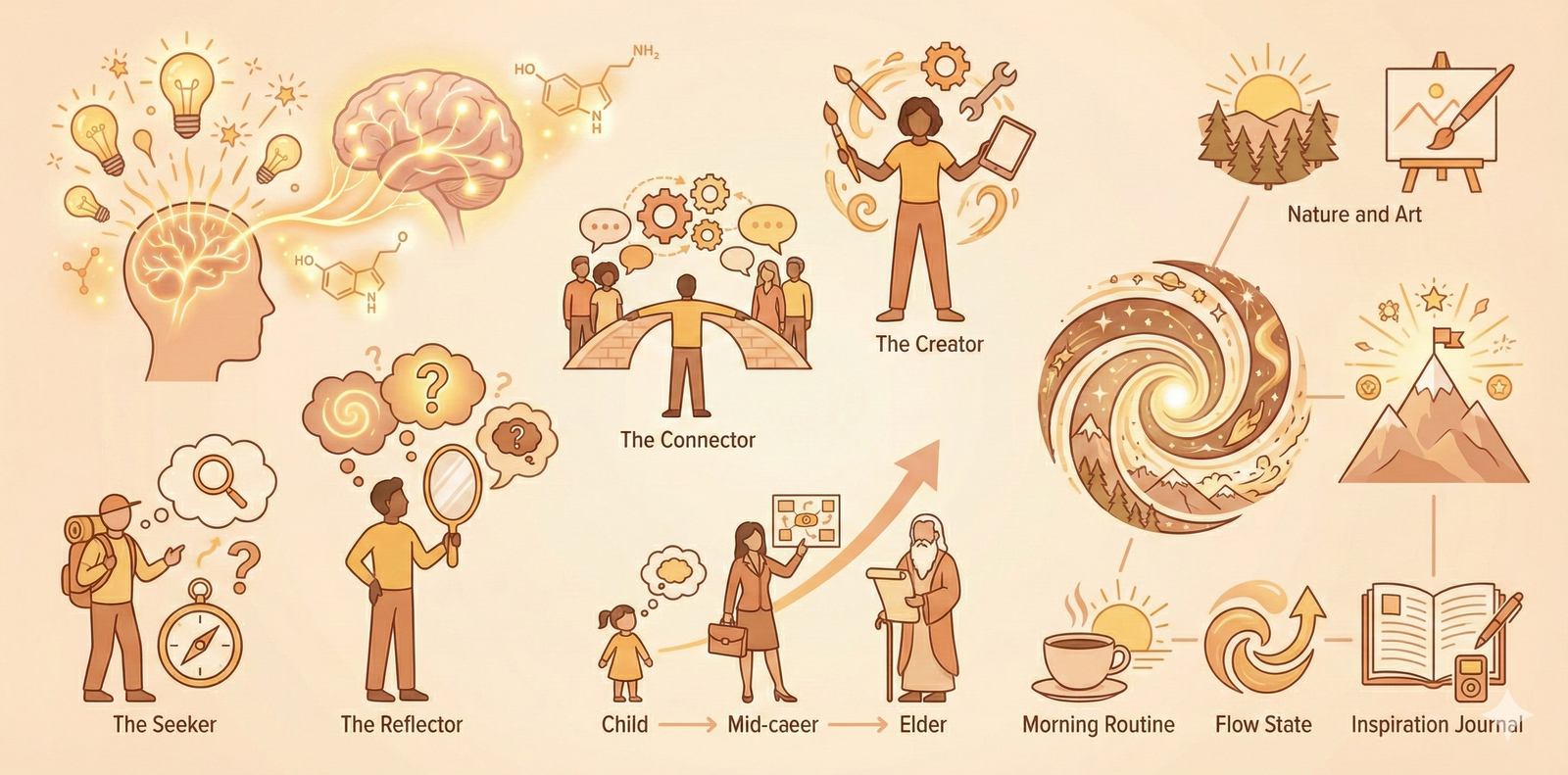
Imagine waking up with crystal clarity about your purpose and feeling unstoppable energy to pursue it.
That's what inspiration feels like in action—and science shows it's reproducible, learnable, and contagious.
What Is Inspiration?
Inspiration is a psychological state characterized by transcendence of self-serving concerns and activation of approach motivation toward meaningful goals. Coming from the Latin 'inspirare' meaning to breathe into, inspiration historically described a mystical animating force. Today, neuroscience reveals it as a measurable, replicable mental state involving the brain's reward and motivation systems. Inspiration combines cognitive clarity about new possibilities with emotional elevation and the drive to actualize those possibilities into reality.
Not medical advice.
The essence of inspiration is dual: being inspired by something involves appreciation of its intrinsic value, while being inspired to involves motivation to extend those valued qualities to new domains. You might be inspired by a sunrise's beauty (being inspired by) and then be inspired to create a painting that captures that beauty (being inspired to). This two-part process distinguishes inspiration from mere motivation or emotion. Inspiration transcends self-interest. When you're truly inspired, you focus outward on the intrinsic value of something, then channel that awareness into action that mirrors that value.
Surprising Insight: Surprising Insight: Inspired brains exhibit increased alpha wave activity, creating a calm-yet-alert state that precedes moments of genuine insight and creative breakthrough. This is measurable, reproducible, and trainable.
The Two Dimensions of Inspiration
Shows how inspiration involves both appreciation of external value and internal activation toward action
🔍 Click to enlarge
Why Inspiration Matters in 2026
In 2026, inspiration has become a critical wellbeing skill. Research shows that inspiration is a powerful mediator between emotions and effective coping strategies. When you face adversity, inspired thinking leads to approaching coping (moving toward solutions) rather than avoidant coping (withdrawing or numbing). This difference determines resilience. Studies from 2024 demonstrate that deliberate cultivation of inspirational experiences directly increases subjective wellbeing and reduces burnout risk.
Inspiration also drives intrinsic motivation—the deeper, more sustainable form of drive that comes from internal values rather than external rewards. People motivated intrinsically show greater creativity, persistence, and life satisfaction. In a world of increasing complexity and change, the ability to regularly access inspiration has become a protective factor for mental health. It counters the flatness of digital life and provides antidote to decision paralysis and purposelessness.
Beyond individual benefit, inspiration is contagious. When one person is inspired, others nearby experience enhanced creativity and openness. Teams with inspired leaders show higher engagement and innovation. In 2026's hybrid work landscape, fostering inspiration is essential for maintaining connection and forward momentum. Inspiration remediates the erosion of purpose that comes from routine and monotony.
The Science Behind Inspiration
Inspiration activates specific neural pathways involving your brain's reward system, motivation centers, and networks responsible for seeing new possibilities. When you experience inspiration, your brain releases dopamine and norepinephrine, chemicals that enhance focus, memory, and goal-directed behavior. Research shows inspiration involves interactions between your prefrontal cortex (future planning), temporal lobes (meaning-making), and dopaminergic systems that drive persistence toward valued goals.
The dopamine system is central. Dopamine doesn't just create pleasure—it modulates executive functions like working memory and cognitive flexibility, both essential for turning inspiration into creative output. When dopamine rises through inspiration, you think more clearly, associate ideas more freely, and persist longer in pursuing challenging goals. The brain state accompanying inspiration has measurable characteristics: increased alpha wave activity (calm alertness), coherent communication between brain regions, and heightened network integration. This is the neuroscience of breakthrough thinking.
Neural Pathways Activated During Inspiration
Illustrates how multiple brain systems coordinate to create the experience of inspiration
🔍 Click to enlarge
Key Components of Inspiration
Spontaneity and External Trigger
Inspiration typically arrives unbidden through exposure to something—a person, an idea, nature, art, or a moment of beauty. You cannot force inspiration through willpower alone, but you can increase exposure to triggering situations. The spontaneous quality makes inspiration feel special; it's not manufactured but discovered. Yet this apparent randomness masks predictable patterns. Certain environments, people, and practices increase inspiration probability significantly.
Transcendence of Self-Interest
True inspiration moves you beyond self-serving concerns. When inspired, you focus on values larger than immediate personal gain—beauty, service, growth, connection, excellence. This transcendent quality distinguishes inspiration from ordinary motivation driven by external rewards or avoidance of punishment. Research shows that inspiration-driven goals are more persistently pursued and provide deeper satisfaction than extrinsically motivated goals. Transcendence connects you to something meaningful beyond yourself.
Approach Activation and Transmissive Drive
Inspiration creates approach motivation—the drive to move toward something desirable. Unlike avoidance motivation (running from something unwanted), approach motivation is sustained and creative. Inspiration also contains a transmissive quality: you want to share, extend, or actualize what you've been inspired by. You're inspired to create, teach, innovate, or connect others to what moved you. This transmissive drive is key to inspiration's ripple effects and social power.
Clarity and Possibility Consciousness
Inspiration brings clarity. Suddenly you see possibilities you hadn't noticed before. Problems that seemed insurmountable reveal hidden paths. This expanded possibility consciousness accompanies shifts in brain chemistry and neural integration. Your mind accesses wider solution spaces and makes novel associations between previously unrelated concepts. This clarity is accompanied by emotional elevation—a sense that the future is brighter and more open than it seemed moments before.
| Component | Characteristic | Observable Sign |
|---|---|---|
| Spontaneity | Arrives unbidden, not forced | Sudden onset with no deliberate trigger |
| Transcendence | Moves beyond self-interest | Focus on values and intrinsic meaning |
| Approach Drive | Propels forward movement | Energy and motivation to act |
| Clarity | Expanded possibility awareness | New solutions and creative insights |
| Elevation | Emotional lifting and expansion | Sense of hope and forward momentum |
How to Apply Inspiration: Step by Step
- Step 1: Create an Inspiration Triggers List: Identify 5-10 specific people, places, activities, or ideas that reliably inspire you. This might include nature walks, certain books, mentors, art museums, or communities aligned with your values. Write them down and refer to this list when you're feeling stuck.
- Step 2: Establish Regular Exposure: Schedule deliberate exposure to inspiration sources. Visit that museum monthly. Read from that author weekly. Spend time with that mentor. Consume inspiring content (podcasts, videos, articles) from trusted sources daily. Consistency matters more than intensity.
- Step 3: Reduce Friction in Your Environment: Remove distractions and clutter that suppress possibility consciousness. Organize your space to surface meaningful work and remove low-value stimuli. Create an inspiration corner with images, quotes, or objects that trigger clarity. Your environment either cultivates or dampens inspiration.
- Step 4: Practice Reflective Pausing: When you encounter something inspiring, pause for 30 seconds and consciously absorb it. Notice what specifically moved you. Name the value or possibility it represents. This reflection deepens neural encoding of the inspiration moment and increases learning.
- Step 5: Externalize Your Clarity: Immediately write down, sketch, or voice-record insights that arise when inspired. Don't rely on memory—inspiration clarity fades quickly without capture. This step moves inspiration from transient emotion to actionable form.
- Step 6: Share Your Inspiration: Tell others what inspired you. Discuss the insights that emerged. Create something inspired. Research shows that transmitting inspiration deepens your own connection to it and spreads its benefits to others.
- Step 7: Take One Small Action: Identify the smallest first step toward actualizing your inspiration. This might be researching, sketching, contacting someone, or learning one skill. Action anchors inspiration and prevents it from becoming mere daydream.
- Step 8: Connect to Larger Purpose: Explicitly link your inspired insight to your larger life direction. How does this inspiration align with or advance your values? This connection sustains momentum when initial enthusiasm fades.
- Step 9: Cultivate Inspiration Literacy: Learn to recognize inspiration's early signs in your body and mind. Early detection allows you to protect the inspired state from distraction and leverage it maximally. Some people feel warmth, tingling, or aliveness. Others notice mental clarity or rapid idea flow.
- Step 10: Revisit Often: When you've captured inspiration-generated insights, return to them repeatedly. Review your notes. Reflect on what you learned. Build on previous inspiration. This creates a cumulative practice where each inspiration compounds previous ones.
Inspiration Across Life Stages
Young Adulthood (18-35)
Young adulthood is naturally inspiration-rich. Identity formation is ongoing, possibilities seem limitless, and exposure to new ideas and people is high. Yet this stage also carries vulnerability: inspiration can scatter across too many directions without focus. The task is channeling inspiration into commitments and developing enough discipline to actualize insights. Mentorship is valuable here; inspired mentors provide models of sustained inspiration across time and help young adults learn to discern genuine calls from passing enthusiasms.
Middle Adulthood (35-55)
Middle adulthood brings responsibility that can occlude inspiration if not managed intentionally. Routine and obligation easily displace possibility consciousness. Yet this stage also offers deepening wisdom and expanded perspective. The task becomes reclaiming inspiration through deliberate cultivation: seeking new teachers, revisiting meaningful creative pursuits, exploring novel domains, and allowing what you've learned to inspire fresh directions. Many people report renewed inspiration in this phase when they consciously refresh their environments and connections.
Later Adulthood (55+)
Later adulthood holds unique inspiration potential. With time scarcity increasing, inspiration becomes clarifying: What truly matters? What contributions feel most meaningful? Many people report that inspiration becomes more stable and profound in this stage, less dependent on novelty and more rooted in values. The task is leveraging this clarity. Legacy thinking—how to transmit what you've learned and been inspired by—often emerges. Mentoring others and synthesizing life experience into wisdom become powerful inspiration sources.
Profiles: Your Inspiration Approach
The Seeker
- Regular exposure to new ideas and perspectives
- Communities that celebrate curiosity and exploration
- Permission to change directions when inspiration redirects
Common pitfall: Constant seeking without deepening—collecting inspiration without actualizing it or building mastery
Best move: Choose one inspiration source per quarter and commit fully to exploring its depths before moving to the next
The Reflector
- Quiet time and solitude for processing
- Spaces for journaling, writing, or contemplative practice
- Reassurance that inspiration often comes through stillness, not activity
Common pitfall: Getting lost in endless reflection without moving to action or implementation
Best move: Combine reflection with a specific creative or service outlet that channels insight into tangible form
The Connector
- Meaningful relationships and community involvement
- Collaborative projects and team endeavors
- Exposure to diverse perspectives that challenge and expand thinking
Common pitfall: Seeking inspiration primarily through others, losing touch with personal authenticity and interior voice
Best move: Balance group inspiration sources with solitary practices that reconnect you to your own values and vision
The Creator
- Regular making time and creative expression outlets
- Spaces and tools that support your particular creative practice
- Feedback loops that show how your work affects others
Common pitfall: Inspiration-addiction where you're endlessly inspired but afraid to commit to full projects
Best move: Set boundaries around inspiration consumption and dedicate specific time to completing work, not just starting it
Common Inspiration Mistakes
The first common mistake is waiting passively for inspiration to strike. While inspiration can arrive spontaneously, waiting is a poor strategy. Research on inspiration from 2024 shows that people who actively cultivate inspiration sources experience it 3-4 times more frequently than passive people. The solution is deliberate practice: regular engagement with your inspiration triggers, not hoping lightning will randomly strike.
The second mistake is confusing inspiration with motivation from external rewards. Inspiration-driven goals and externally-motivated goals feel different and have different outcomes. Chasing money, status, or external validation may create drive but not inspiration. True inspiration moves toward intrinsic values: growth, beauty, service, excellence, connection. When your goals shift to these deeper values, inspiration naturally increases. When you're chasing others' expectations or external prizes, inspiration withers.
The third mistake is becoming inspiration-dependent without building the skills to actualize it. Inspiration is useless without capability. An inspired vision requires learning, practice, and persistence to manifest. People who experience inspiration without developing discipline often become chronically unfulfilled—they have great ideas but can't execute. The path forward is pairing inspiration cultivation with skill-building. Each inspiration should launch a learning phase where you develop capabilities to actualize it.
The Inspiration-to-Impact Pathway (and Where It Breaks Down)
Shows the complete journey from inspiration to meaningful impact and common failure points
🔍 Click to enlarge
Science and Studies
The scientific understanding of inspiration has advanced dramatically over the past five years. Research from major psychology journals demonstrates that inspiration is not mystical but measurable and trainable. Studies show that inspiration experiences are correlated with higher life satisfaction, increased creativity, stronger resilience, and better mental health outcomes. The research cited below represents the leading edge of inspiration science from 2023-2026.
- Inspired in Adversity: How Inspiration Mediates the Effects of Emotions on Coping Strategies (PMC, 2024). This research demonstrates that inspiration is a powerful bridge between how we feel and how we respond to difficulty. When people are in inspired states, they employ approach coping strategies—moving toward solutions—rather than avoidant coping. This directly impacts resilience and wellbeing outcomes.
- Positive Emotions and Intrinsic Motivation (Taylor & Francis Online, 2017-2023 follow-ups). Research shows that positive emotions, particularly inspiration, facilitate intrinsic motivation. People motivated by intrinsic factors (growth, mastery, contribution) rather than external rewards show greater persistence, creativity, and life satisfaction. Inspiration activates these deeper motivation systems.
- The Neuroscience of Inspiration: How Inspiration Activates Reward Systems (Brain Health University, 2024). This review explains how inspiration engages the dopaminergic reward system, increasing cognitive flexibility and persistence. When inspired, the brain shows increased alpha wave activity—a state associated with creative breakthrough and insight.
- Dopamine and the Biology of Creativity (Frontiers in Neurology, 2024). This research clarifies that dopamine is central to creative inspiration. Dopamine modulates the executive functions needed for turning inspiration into innovative output. The paper explains why inspired states correlate with creative achievement.
- The Psychology of Inspiration (Inspiration is Purple, 2023-2024). This comprehensive psychological review identifies the three core qualities of inspiration: spontaneous evocation, transcendence of self-serving concerns, and approach motivation. The research shows these qualities are measurable and distinguishable from related states like motivation or excitement.
Your First Micro Habit
Start Small Today
Today's action: Identify one person, place, book, or activity that has inspired you in the past. Block 15 minutes this week to experience it again. Notice exactly what about it moves you. Write down one insight that emerges.
Small inspiration practices compound. This 15-minute act reconnects you to what matters, generates a small dopamine boost that increases cognitive function, and begins training your brain to seek inspiration deliberately. Consistency matters more than intensity. Weekly micro-practices of reconnecting with inspiration sources create monthly compounding that shifts your baseline experience.
Track your inspiration micro-habits with the Bemooore app and receive personalized AI coaching on deepening them. The app helps you identify new inspiration sources, remembers what has worked before, and builds accountability for following through. Get guidance tailored to your inspiration profile.
Quick Assessment
How often do you currently experience moments of inspiration in your daily life?
Your frequency of inspiration reflects both natural predisposition and current practice. If you're in the first two categories, deliberate cultivation practices will expand your experience significantly. People in the latter categories have established practices that work—the next step is deepening them.
When you feel inspired, what's your typical response?
Your response pattern shows where to focus. If you feel inspired without acting, focus on converting clarity into one small first step. If you act immediately but don't sustain, build accountability and skill-building into your process. If you're already building ongoing practice, the growth is deepening and transmitting your inspiration to others.
What circumstances tend to inspire you most?
Your answer reveals your inspiration triggers. Once you identify your specific triggers, you can engineer more frequent exposure to them. If inspiration feels random, start tracking it: notice what circumstances preceded inspired moments. After two weeks, patterns will emerge. With patterns identified, you can deliberately seek those circumstances weekly.
Take our full assessment to get personalized recommendations.
Discover Your Style →Next Steps
Your journey with inspiration begins by identifying what has moved you in the past. Look back over the last year and notice moments when you felt truly alive, engaged, or purposeful. What triggered those moments? Was it a person, a challenge, an experience, a piece of art? Write down 5-10 inspiration triggers. This list is your starting map. Each item represents a door you can deliberately walk through to access inspired states more regularly.
This week, commit to one small action: spend 15 minutes with one of your inspiration sources. Notice what specifically moves you. Write down one insight that emerges. Take one tiny step toward actualizing that insight. Then do it again next week. Inspiration compounds through repetition. The person who spends an hour weekly with inspiration sources will experience transformation in months that others spend years seeking.
Get personalized guidance with AI coaching.
Start Your Journey →Research Sources
This article is based on peer-reviewed research and authoritative sources. Below are the key references we consulted:
Related Glossary Articles
Frequently Asked Questions
Can I force myself to feel inspired, or does it always arrive naturally?
Inspiration feels spontaneous but arrives in response to specific conditions. You cannot manufacture the feeling through willpower alone, but you can reliably increase its frequency through deliberate cultivation. Expose yourself regularly to your inspiration triggers, create environments that support expansive thinking, and practice the reflective habits that deepen inspiration moments. Studies show that people with active inspiration practices experience inspiration 3-4 times more frequently than those waiting passively.
How long does an inspiration moment last, and what can I do to prolong it?
Raw inspiration moments typically last 30 seconds to several minutes. The feeling is fleeting, but the clarity and momentum can extend much longer. To prolong the effects: immediately externalize what you've received through writing, recording, or sketching. Reflection and sharing deepen neural encoding. Take a small action within hours. Each of these steps extends the inspiration's impact from transient emotion to sustained change.
Is inspiration different from motivation, and if so, how?
Yes, they're distinct. Motivation is the general drive to take action, often in response to goals, rewards, or obligations. Inspiration is a specific psychological state involving recognition of meaningful value, transcendence of self-interest, and clarity about new possibilities. Motivation can be driven by external rewards or avoidance. Inspiration emerges from connection to intrinsic values. Inspired motivation is more sustainable and creative than reward-driven or obligation-driven motivation.
Why do I sometimes feel inspired but nothing happens? How do I turn inspiration into results?
Inspiration without actualization is a common experience. It happens because inspiration provides clarity but not always capability. The solution is pairing each inspiration with deliberate learning and action. Identify one small first step you can take within 24 hours. Commit to building one skill that moves you toward your inspired vision. Join a community of people working on similar goals for accountability. Track progress weekly. Many people have dozens of inspiring ideas but never develop the discipline to complete projects—the answer is building execution capability alongside inspiration seeking.
Can I be inspired too much? Is there such a thing as inspiration overload?
Yes, it's possible to become inspiration-addicted in a way that limits depth. Some people constantly seek new inspiration sources but never fully explore or develop any of them. Others become dependent on inspiration to feel alive, becoming frustrated and depressed when they're not in inspired states. The healthy path is balancing inspiration seeking with sustained focus, pairing inspiration cultivation with skill-building, and developing contentment with ordinary, non-inspired moments. Inspiration is powerful but not the only valid state. Meaning comes from completed work, not just inspired visions.
Take the Next Step
Ready to improve your wellbeing? Take our free assessment to get personalized recommendations based on your unique situation.
- Discover your strengths and gaps
- Get personalized quick wins
- Track your progress over time
- Evidence-based strategies