Purpose-Driven Life
Imagine waking up every morning knowing exactly why you're here—not in some existential, abstract way, but as a concrete direction that guides your decisions, relationships, and goals. A purpose-driven life isn't about finding one grand ambition; it's about understanding what matters most to you and organizing your existence around those values. Research shows that people who live with purpose experience significantly less stress, live longer healthier lives, and report greater overall happiness and life satisfaction. Whether you're searching for meaning after a major life transition, feeling stuck in a career that doesn't align with your values, or simply wanting to feel more connected to your daily activities, this article explores how to discover, clarify, and live your life's purpose.
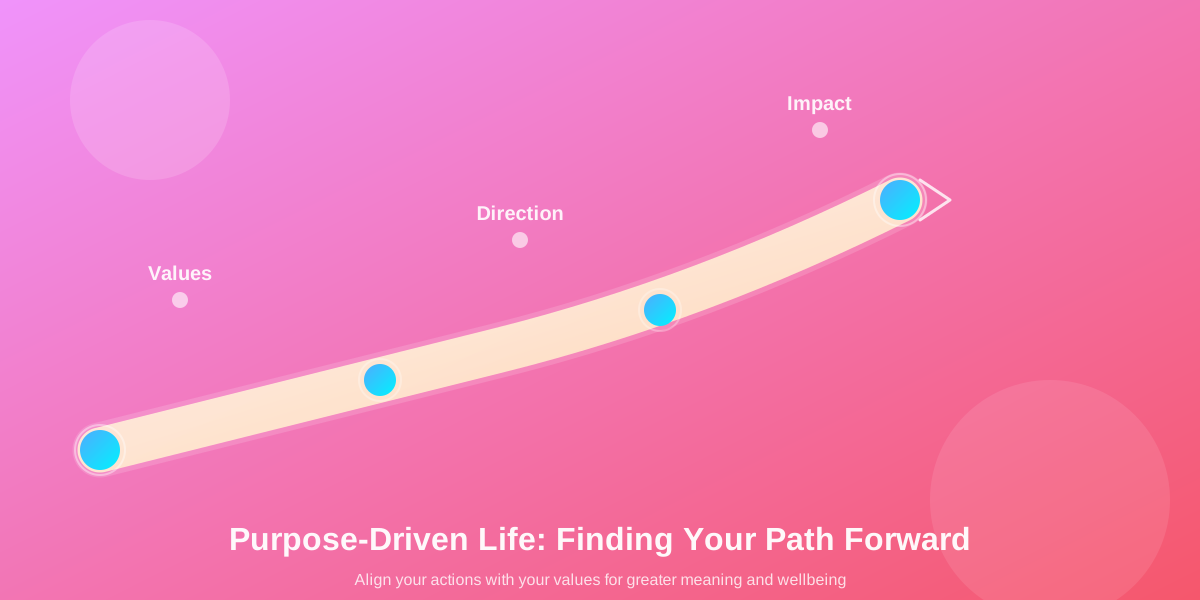
The science is clear: purpose isn't a luxury for the spiritually enlightened or the philosophically inclined—it's a fundamental human need that impacts your mental health, physical health, relationships, and longevity.
This guide will help you understand what purpose-driven living really means, why it matters for your wellbeing, and the practical steps to align your life with your deepest values.
What Is a Purpose-Driven Life?
A purpose-driven life is an existence organized around meaningful goals and values that extend beyond personal comfort or achievement. It's the sense that your life has direction and significance—that what you do matters, both to you and to something larger than yourself. Purpose in life refers to sources of meaning that are both goal-oriented and motivated by a desire to make a difference in the world beyond the self. This distinguishes purpose from simple goal-setting or personal ambition; it involves a commitment to something that extends beyond individual interests alone.
Not medical advice.
Purpose can come from many sources: raising children, creating art, building a business, helping others through a profession, contributing to a cause you believe in, or maintaining deep relationships. What matters is that your purpose feels authentic to you and creates a coherent narrative for your life. Viktor Frankl, a Holocaust survivor and psychologist, discovered through his experiences that humans can endure almost any suffering if they have a sense of purpose or meaning. His work gave rise to logotherapy, which emphasizes that a 'will to meaning' exists in all of us and impacts our behavior and mental health significantly.
Surprising Insight: Surprising Insight: People who feel their lives have purpose tend to be healthier, happier, age better, and generally have a better quality of life than people who don't. In fact, having a strong sense of purpose is associated with a 46% lower risk of mortality over four years in older adults.
The Purpose-Driven Life Framework
A visual representation of how purpose integrates values, goals, actions, and wellbeing into a coherent life direction
🔍 Click to enlarge
Why Purpose-Driven Life Matters in 2026
In an era of unprecedented choice, constant connectivity, and rapid change, the need for a clear sense of purpose has never been greater. Many people report feeling lost, overwhelmed, or unfulfilled despite achieving external success—the 'success paradox' where accomplishment doesn't automatically translate to meaning. The 2025-2026 landscape presents unique challenges: career paths are less linear, social media creates artificial measures of success, and global uncertainty can leave us questioning what's worth working for.
Living with purpose provides an anchor during uncertainty and a filter for decision-making amid infinite options. When you know your purpose, you can distinguish between opportunities that align with your values and those that simply distract you. This clarity reduces decision fatigue, increases motivation, and helps you build a life that feels genuinely yours rather than one shaped entirely by external expectations or cultural scripts.
Beyond personal fulfillment, purpose-driven living has measurable health benefits. Research indicates that individuals with a strong sense of purpose experience less stress, maintain better health behaviors, and recover more quickly from illness or trauma. For every one-point increase on a six-point scale measuring purpose in life, adults with heart disease have a 27% decreased risk of having a heart attack over a two-year period.
The Science Behind Purpose-Driven Life
The relationship between purpose and wellbeing isn't anecdotal—it's documented across decades of psychological and medical research. Studies from prestigious institutions like Harvard, Johns Hopkins, and the University of Michigan consistently show that purpose functions as a protective factor for both mental and physical health. Neuroscience research reveals that when we engage in purposeful activity, our brains release neurochemicals associated with reward, motivation, and resilience.
The mechanisms are multifaceted: purpose reduces the stress hormone cortisol, increases immune function, promotes positive coping strategies, and creates what psychologists call 'psychological resilience'—the ability to bounce back from adversity. People with greater purpose in life experience less stress, with this association similar across age, sex, race, ethnicity, and education. Additionally, a higher sense of purpose in life can help ward off depression by acting to soften the blow of adverse life events, including trauma. Those with a strong sense of purpose were more likely to develop more positive coping strategies and engage in less rumination in the aftermath of negative events.
How Purpose Impacts Health Outcomes
A flowchart showing the biological and psychological pathways through which purpose improves health and longevity
🔍 Click to enlarge
Key Components of a Purpose-Driven Life
Core Values Clarity
The foundation of living with purpose is understanding what actually matters to you—not what should matter according to parents, society, or your peer group. Your core values are the principles and qualities that feel most important when you strip away external validation. These might include creativity, family, helping others, learning, integrity, justice, adventure, or contribution. Clarity on values acts as a personal compass that makes decision-making easier and life more coherent.
Meaningful Goals and Direction
Purpose requires direction—a sense of what you're moving toward. This doesn't mean a rigid five-year plan, but rather a general trajectory aligned with your values. Meaningful goals are those that feel important to you personally and contribute beyond just personal gain. They might evolve as you grow, but they create the scaffolding for daily decisions and long-term planning. Goals tied to purpose tend to be more motivating and sustainable than goals pursued purely for external reward.
Regular Reflection and Adjustment
Purpose isn't static—it evolves as you gain experience, face challenges, and develop deeper self-knowledge. Regular reflection allows you to check whether your current life aligns with your stated values and purpose. This might involve journaling, meditation, conversations with trusted friends or mentors, or therapeutic work. As you move through life stages, your expression of purpose may change even if your core values remain consistent.
Integration Across Life Domains
Living with purpose means integrating your sense of meaning across different areas of life—work, relationships, health, creativity, contribution. Rather than compartmentalizing (being one person at work, another at home, another in leisure), purpose-driven living seeks coherence and meaning in all domains. This doesn't mean having the same goals everywhere, but rather ensuring your values remain consistent and your various commitments align rather than conflict.
| Component | Definition | Impact on Wellbeing |
|---|---|---|
| Core Values | Principles most important to you personally | Creates decision clarity and internal alignment |
| Meaningful Goals | Objectives aligned with values that extend beyond self-interest | Increases motivation and provides direction |
| Regular Reflection | Conscious assessment of life-purpose alignment | Allows course correction and deepens self-knowledge |
| Life Integration | Coherence between values across work, relationships, health | Reduces internal conflict and increases authenticity |
How to Apply Purpose-Driven Life: Step by Step
- Step 1: Identify your core values by reflecting on moments when you felt most alive, fulfilled, or aligned. Think about what qualities matter most to you and when you've felt most like yourself.
- Step 2: Write down 3-5 core values that resonate most deeply. Examples include: family, creativity, integrity, learning, helping others, health, adventure, contribution, growth, or justice.
- Step 3: Audit your current life against these values. Spend time honestly assessing how much of your time, energy, and resources currently go toward living out these values versus other priorities.
- Step 4: Identify gaps between stated values and actual life allocation. Where are you spending time and effort on things that don't align with what matters most? Be specific.
- Step 5: Start small with one area. Choose one domain of life (work, relationships, health, or creative expression) where you can make a meaningful shift toward your purpose.
- Step 6: Set a specific, measurable goal for that area that aligns with your values. For example: 'Deepen family connection by having one meaningful conversation weekly' rather than vague intentions.
- Step 7: Track your progress and notice how alignment feels. Over weeks and months, pay attention to changes in stress levels, energy, mood, and sense of fulfillment as you align life with purpose.
- Step 8: Gradually expand to other life domains. As one area becomes more aligned, extend the same process to another area requiring adjustment.
- Step 9: Revisit and refine annually. Purpose evolves, so commit to annual reflection on whether your current direction still feels authentic and meaningful.
- Step 10: Connect with others around shared purpose. Whether through community, relationships, or group activities, sharing purpose with others deepens meaning and creates accountability.
Purpose-Driven Life Across Life Stages
Young Adulthood (18-35)
Young adulthood is the exploration phase—a time when defining purpose through experimentation is not only acceptable but beneficial. This stage often involves trying different careers, relationships, and activities to understand what resonates. The challenge is balancing exploration with the need for some direction, and avoiding the trap of constant sampling without commitment. This is an ideal time to identify core values and test them in real situations, to experience different types of work and relationships, and to develop self-knowledge. Young adults benefit from mentors, diverse experiences, and permission to revise their sense of purpose as they learn more about themselves.
Middle Adulthood (35-55)
Middle adulthood is often when purpose becomes urgent—when the question 'Is this what I want my life to be?' becomes pressing and less theoretical. This stage frequently involves deepening commitment to chosen paths while grappling with trade-offs inherent in choices made. Some people experience a recalibration phase, realizing their earlier choices don't reflect their actual values, prompting significant life changes. This is also when many experience what's called the 'generativity crisis'—a need to contribute beyond themselves, whether through parenting, mentoring, creative work, or community involvement. Purpose work in middle adulthood often involves accepting certain limitations while fully embracing chosen commitments.
Later Adulthood (55+)
Later adulthood presents both challenges and opportunities for purpose. Retirement, changing health, and mortality awareness can challenge previous sources of meaning tied to career or productivity. However, research shows that older adults who maintain a strong sense of purpose experience significantly better health outcomes, greater life satisfaction, and more effective coping with health challenges. This stage allows for wisdom-sharing, legacy-building, and shifting to purposes centered on relationships, learning, creative expression, or community contribution. Later adulthood can be profoundly purposeful when individuals intentionally design this phase rather than viewing it as diminishment.
Profiles: Your Purpose-Driven Life Approach
The Searcher
- Permission to explore without judgment
- Multiple experiences to test values
- Mentors to help make sense of exploration
Common pitfall: Getting stuck in endless searching without committing to any path, leading to chronic dissatisfaction and lack of grounding.
Best move: Set a timeline for exploration in a particular domain, then consciously commit to testing that choice more deeply before jumping to the next option. Create mini-commitments that allow both exploration and depth.
The Aligned Achiever
- Regular purpose reflection to ensure achievements align with values
- Permission to say no to opportunities that don't fit
- Celebration of values-aligned success, not just external wins
Common pitfall: Achieving impressive external success while losing connection to personal values, resulting in achievement without fulfillment or experiencing burnout from misaligned effort.
Best move: Implement quarterly reviews assessing alignment rather than just outcomes. Build in reflection alongside achievement. Consider what success actually means beyond metrics.
The Reconnector
- Permission to revise earlier choices
- A clear vision of desired realignment
- Support through the transition process
Common pitfall: Recognizing misalignment but staying stuck from fear of change, regret about past choices, or overwhelming complexity of realignment.
Best move: Start with small adjustments while maintaining stability. Identify one domain for change while others remain stable. Create a transition plan with milestones rather than attempting complete life overhaul simultaneously.
The Purposeful Parent/Caregiver
- Recognition that caregiving itself can be a primary purpose
- Integration of caregiving with other meaningful activities
- Strategies for maintaining identity beyond the caregiver role
Common pitfall: Becoming so defined by caregiving that personal values and growth are neglected, leading to resentment or identity loss when caregiving roles change.
Best move: Explicitly name caregiving as purposeful work while protecting time for other value-aligned activities. Plan for transitions in caregiving intensity to ensure identity remains multifaceted.
Common Purpose-Driven Life Mistakes
One of the biggest mistakes is confusing purpose with grand passion or a singular life calling. This leads people to dismiss their actual meaningful work because it doesn't feel dramatic or 'calling-like.' In reality, purpose can be quiet, practical, and involve maintenance of what matters rather than constant growth or novelty. Expecting purpose to provide all your happiness is another common error—purpose contributes significantly to wellbeing, but relationships, health, and basic satisfaction matter too. A meaningful career in isolation cannot compensate for loneliness or neglected health.
Another frequent mistake is adopting someone else's purpose or values without genuinely examining whether they're authentically yours. This creates the feeling of 'going through the motions' and lacking genuine engagement. Many people feel obligated to live out their parents' dreams, their partner's goals, or cultural prescriptions of what success should look like, never examining their own authentic values. Additionally, people often become too rigid with their purpose statement, treating it as immutable rather than allowing for evolution as they grow and circumstances change.
Finally, many people make the mistake of waiting for perfect clarity before taking action toward purpose. The belief that they need to 'figure it all out first' keeps them paralyzed. In reality, purpose often clarifies through action and experience, not through thought alone. Starting small with values-aligned actions while being open to refinement creates forward momentum and generates the self-knowledge needed for deeper clarity.
Common Purpose Mistakes and Paths Forward
A visualization of frequent obstacles people encounter when pursuing purpose-driven living and strategies to overcome them
🔍 Click to enlarge
Science and Studies
The scientific foundation for purpose-driven living extends across psychology, neuroscience, medicine, and gerontology. Major longitudinal studies have tracked thousands of people over decades, consistently demonstrating that purpose is a significant predictor of health, longevity, and wellbeing. These findings hold across different cultures, socioeconomic levels, and age groups, suggesting purpose is a fundamental human need.
- Harvard Study of Adult Development (80+ years): Found that meaningful relationships and purposeful living are among the strongest predictors of longevity and life satisfaction, surpassing wealth, status, and even health behaviors.
- Journal of Health Psychology Meta-Analysis (2024): Demonstrated that people with greater purpose in life experience significantly less stress, with associations consistent across age, sex, race, ethnicity, and education levels.
- JAMA Network Open Study (2019): Among nearly 7,000 adults over age 50, those who scored highest on a scale measuring 'life purpose' were less likely to die during the four-year study period, with 46% lower mortality risk for those with highest versus lowest purpose scores.
- American Journal of Health Education (2024): Identified purpose in life, reduced stress, and social connection as protective factors for longevity, with mechanisms involving both physiological stress regulation and behavioral health choices.
- University of Michigan Research on Life Purpose and Brain Health: Found that having purpose and meaning in life is more significantly associated with lower chance of dementia than other positive constructs like optimism and happiness alone.
Your First Micro Habit
Start Small Today
Today's action: Spend 5 minutes identifying one core value (what matters most to you) and one small action today that aligns with it. For example: if connection is a value, text someone you care about; if health is a value, take a 10-minute walk; if learning is a value, read one article on a topic you're curious about.
This micro habit builds the foundation for purpose-driven living by creating awareness of alignment between values and actions. Small, consistent actions aligned with values create the felt experience of living meaningfully, which reinforces commitment to purpose-driven living. Over time, these tiny adjustments accumulate into a genuinely purpose-aligned life.
Keep quitting habit apps after a missed day? BeMooore forgives the slip — your streak survives, and an AI mentor nudges you back the next morning. Free on iOS.
Quick Assessment
When you think about your typical week, how much of your time do you spend on activities that feel meaningful and aligned with your core values?
Your answer reveals how much your current life already reflects purpose-driven living. High alignment suggests you're on track; moderate alignment shows where adjustments could increase fulfillment; low alignment indicates opportunity for meaningful realignment. Not knowing your values is the starting point—clarity around what matters most is foundational.
When facing a difficult decision, what guides you most?
Values-based decision making indicates well-developed purpose awareness. Comfort-focused or externally-guided decisions suggest purpose might be less clear. Building clarity around your values creates a personal decision-making framework that reduces stress and increases confidence.
How do you prefer to develop your sense of purpose?
Different people clarify purpose differently. Reflective types might benefit from journaling or meditation. Experiential learners need to try different paths. Relational types benefit from mentorship and discussion. Your preferred approach is valid—use it to design your purpose clarification process.
Take our full assessment to get personalized recommendations.
Discover Your Style →Next Steps
Start your purpose-driven life journey by clarifying what truly matters to you. Spend time this week reflecting on moments when you felt most alive, most like yourself, or most fulfilled. What values were operating in those moments? What were you doing, who were you with, and what about the situation felt meaningful? Write down your reflections—this becomes your starting point.
Once you have some clarity on values, examine one area of your current life (work, relationships, health, creative expression) and ask honestly: how much does this area reflect what I actually value? Where are the gaps? Choose one small, concrete action you can take this week that moves you slightly toward greater alignment. Purpose-driven living builds through consistent small adjustments, not dramatic overhauls. Progress matters more than perfection.
Get personalized guidance with AI coaching.
Start Your Journey →A goal you see every morning gets acted on more often than one that lives in a note app. Build a vision board free in your browser, no account, and export a phone wallpaper you can set tonight.
Build a free vision board →Research Sources
This article is based on peer-reviewed research and authoritative sources. Below are the key references we consulted:
Related Glossary Articles
Frequently Asked Questions
What if I don't have a clear life purpose? Does that mean something is wrong with me?
Not at all. Many people, especially younger adults and those in transition, don't have crystallized purpose yet. Purpose often develops through experience, reflection, and trying different paths. If you're feeling lost, start by identifying 2-3 values that resonate with you, then look for ways to express those values in your daily life. Purpose clarity usually emerges gradually through action and reflection, not suddenly from inspiration.
Can my purpose change throughout my life, or should I have one permanent purpose?
Purpose absolutely evolves. While core values might remain consistent, how you express them and what feels most important can shift as you gain experience, grow, face challenges, or enter different life stages. Expecting one unchanging purpose often creates rigidity that prevents adaptation to new circumstances. The healthiest approach treats purpose as dynamic—review it annually and allow it to evolve while maintaining connection to your fundamental values.
Isn't pursuing purpose selfish if it doesn't directly help others?
Not necessarily. While some people find purpose through direct service or helping, others find deep purpose through creative work, learning, building relationships, or maintaining health and wellness. Even purposes that seem self-directed—becoming healthy, learning a skill, being present in relationships—contribute to a meaningful life and ultimately make you more capable of benefiting others. The key isn't whether your purpose helps others directly, but whether it feels authentically meaningful to you and aligns with your values.
How long does it actually take to feel like you're living a purpose-driven life?
That varies considerably based on how clear your values are and how much your current life already aligns with them. Some people feel shifts within weeks of making small alignment changes; others take months or years of gradual realignment. The good news is that benefits begin immediately—even small steps toward values alignment increase sense of meaning and reduce stress. Rather than waiting for perfect alignment, focus on direction and momentum. Progress toward purpose creates meaning even before arrival.
What if my purpose conflicts with financial security or other practical needs?
This is common and requires thoughtful integration rather than either-or thinking. Start by exploring whether the conflict is absolute or whether creative solutions exist. For example, could a passion for art support itself partially through teaching or freelance work? Could meaningful work in a lower-paying field be balanced with a part-time 'financial security' job? Could you redirect part of a lucrative but misaligned career toward meaningful volunteer work? Often the friction comes from wanting everything immediately. Sometimes you need to secure stability first, then gradually transition. The key is making conscious choices and progress toward integration rather than staying indefinitely in misalignment.
Take the Next Step
Ready to improve your wellbeing? Take our free assessment to get personalized recommendations based on your unique situation.
- Discover your strengths and gaps
- Get personalized quick wins
- Track your progress over time
- Evidence-based strategies