Core Values
What if the secret to lasting happiness wasn't about achieving more, earning more, or becoming more—but simply about living more authentically? Core values are the fundamental beliefs and principles that define who you are at your deepest level. They're the internal compass that guides your decisions, shapes your relationships, and determines whether your life feels meaningful or hollow. When you live aligned with your core values, something shifts. You feel more confident, more purposeful, more genuinely happy. Yet most people never take the time to discover what their core values actually are. Instead, they drift through life chasing goals that never quite satisfy, following paths laid out by others, and wondering why success doesn't feel like enough.
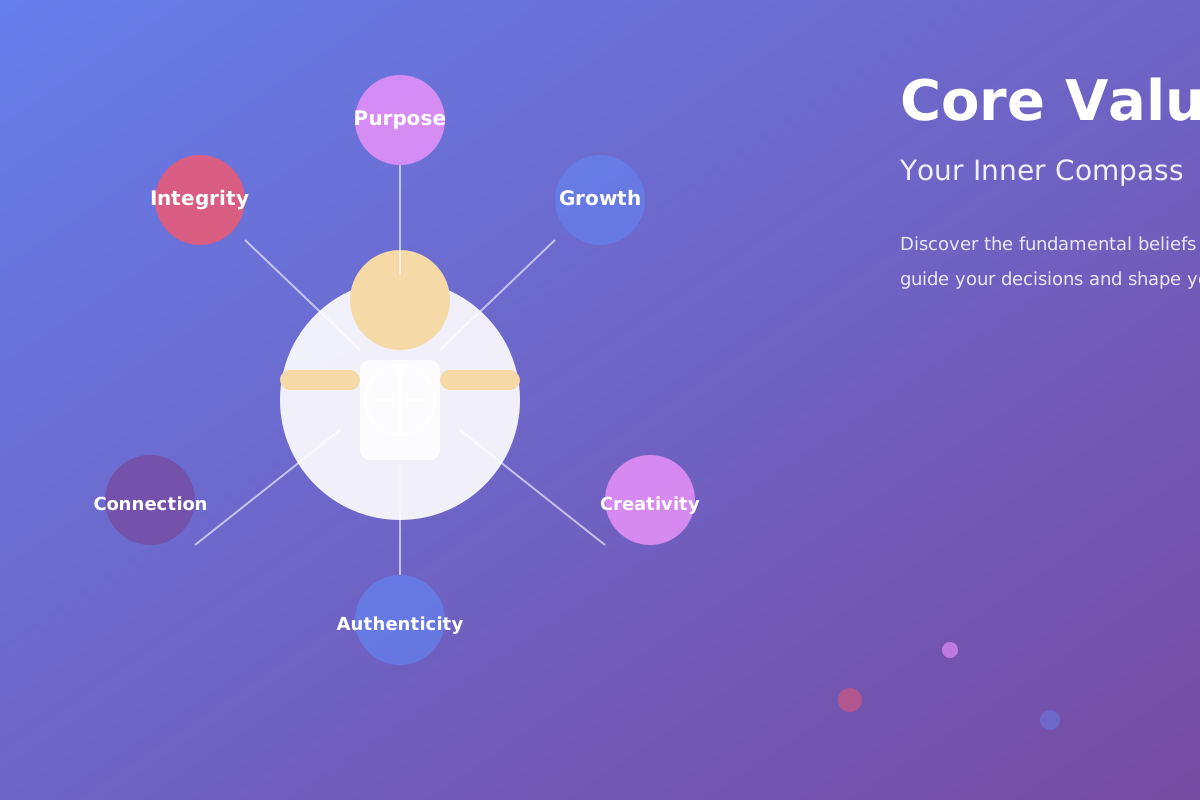
This gap between who you are and how you're living creates invisible friction. Research shows that values dissonance—the misalignment between your actions and beliefs—leads to chronic stress, anxiety, and emotional exhaustion. But discovering and living your core values is profoundly transformative. It's not a luxury for the introspective. It's a practical, evidence-based foundation for the life you actually want.
In this comprehensive guide, you'll learn what core values truly are, why they matter more than you think, and exactly how to identify and implement them in every area of your life. Whether you're searching for greater meaning, feeling stuck in a career that doesn't fit, or simply want to feel more authentic, this article will show you the pathway forward.
What Are Core Values?
Core values are the central beliefs and principles that matter most to you as a person. They are the standards you hold for yourself—your moral compass, your priorities, and the qualities you aspire to embody. Unlike opinions or preferences, which can shift easily, core values are stable, meaningful, and deeply personal. They influence how you make decisions, relate to others, and measure your own success.
Not medical advice. Psychology research defines values as trans-situational goals that serve as guiding principles in life, with importance varying from person to person. Your core values might include integrity, family, creativity, growth, compassion, independence, adventure, or service. What matters is that they resonate with your authentic self—not what you think you should value, but what you genuinely do.
The distinction between core values and other concepts is important. Goals are objectives you achieve. Values are principles you live by. Habits are behaviors you repeat. Values are the deeper why behind those habits. Integrity, for example, is a value. Being honest in a difficult conversation is how you express that value. Understanding this distinction helps you see values not as abstract concepts but as practical guides for daily living.
Surprising Insight: Surprising Insight: Research from positive psychology shows that individuals who identify and actively live in alignment with their core values report significantly higher life satisfaction, resilience, and psychological well-being—often more so than those pursuing external achievements like wealth or status.
The Anatomy of Core Values
Core values as the foundation of personality, behavior, and decision-making
🔍 Click to enlarge
Why Core Values Matter in 2026
We live in an unprecedented age of choice, distraction, and competing demands. Social media shows us endless versions of success. Career opportunities multiply. Relationships demand constant attention. In this complexity, core values serve as an anchor—a way to cut through the noise and say with certainty: this is what matters to me, and this is how I'll live.
Values-aligned living has measurable benefits for your well-being. When your daily actions reflect your core values, your brain's reward systems activate more consistently. You experience what psychologists call intrinsic motivation—doing things because they genuinely matter to you, not because of external pressure or reward. This type of motivation is far more sustainable and satisfying than chasing external validation.
In 2026, as workplaces become more distributed and personal lives more complex, the ability to define and commit to your own values is a superpower. It helps you say no to opportunities that don't align with what matters. It enables you to make career changes with clarity. It allows you to build relationships based on genuine compatibility rather than convenience. It helps you navigate ethical dilemmas with confidence.
The Science Behind Core Values
The scientific study of human values began in earnest with Shalom Schwartz's groundbreaking research, which identified that human values form a motivational continuum. His theory reveals that values aren't random—they have underlying purposes. Some values reflect openness to change (creativity, freedom), others reflect conservation (tradition, security). Some emphasize self-enhancement (achievement, power), while others emphasize self-transcendence (helpfulness, universalism).
Neuroscience research shows that when people live aligned with their values, the prefrontal cortex (your decision-making brain) shows greater activation, while your amygdala (fear center) shows reduced activity. This means values-aligned living literally calms your nervous system. Conversely, values dissonance—living against your values—creates chronic low-grade stress that accumulates over time.
Schwartz's Values Continuum
The four higher-order value dimensions that guide human motivation and behavior
🔍 Click to enlarge
Key Components of Core Values
Self-Discovery and Authenticity
Your core values emerge from your unique combination of experiences, personality, relationships, and aspirations. They're not inherited—you can't simply adopt your parents' values and expect them to feel authentic. Instead, they emerge through reflection and honest self-examination. The process of discovering your values is itself transformative because it forces you to ask: What do I actually believe? What makes me feel alive? What impact do I want to have?
Consistency and Integrity
Living with core values requires consistency. This doesn't mean rigidity—your values can evolve as you grow. But it means making decisions aligned with those values across all areas of your life. A person who values honesty must practice it in casual conversations, not just in high-stakes moments. A person who values family must prioritize that in their schedule and choices. Consistency builds self-trust and credibility with others.
Motivation and Direction
Core values provide intrinsic motivation—they push you forward because pursuing them feels inherently meaningful. Unlike external motivations (making money, gaining status), values-based motivation is renewable and resilient. It survives failures and setbacks because the value itself transcends any single outcome. A person motivated by growth will continue learning even after a business failure. A person motivated by connection will rebuild relationships after conflict.
Decision-Making Framework
When facing a choice—whether about a job, a relationship, a purchase, or how to spend your time—your core values provide a clear framework. Instead of being paralyzed by options, you can ask: Which choice aligns most closely with what I value? This makes decisions faster, easier, and more satisfying because you're choosing based on what matters, not on external pressure or short-term impulses.
| Value | Core Belief | Daily Expression |
|---|---|---|
| Integrity | Honesty and ethical behavior matter most | Speaking truth even when uncomfortable; keeping promises |
| Family | Close relationships are primary | Scheduling quality time; being present and engaged |
| Growth | Learning and improvement drive fulfillment | Seeking challenges; reflecting on progress |
| Compassion | Caring for others is central | Listening deeply; offering support; considering others' needs |
| Independence | Self-sufficiency and autonomy are essential | Making own decisions; taking responsibility; trusting self |
| Creativity | Expressing and creating is vital | Trying new approaches; making space for experimentation |
How to Apply Core Values: Step by Step
- Step 1: Pause and reflect on your life. Before identifying values, create space to think. Spend 15-30 minutes alone without distractions, remembering moments when you felt most alive, most proud, or most authentically yourself.
- Step 2: Recall peak experiences. Write about 3-5 times you felt genuinely fulfilled—these weren't necessarily happy moments, but moments when you felt aligned and purposeful. What values were you honoring in those moments?
- Step 3: Identify patterns across stories. Look at your reflections and notice themes. Did service appear in multiple stories? Did creativity? Did autonomy? These patterns point toward your genuine values.
- Step 4: Review a comprehensive values list. Use resources that present 50-100 values so you don't accidentally miss something important. Sort them into categories: values that matter a lot, values that matter somewhat, values that don't matter much.
- Step 5: Narrow to your top 5-7 values. Ruthlessly prioritize. If everything is important, nothing is. Ask yourself: If I could only live by 5 values, which would they be? Which ones feel non-negotiable?
- Step 6: Articulate your values in personal language. Don't just write 'integrity'—explain what integrity specifically means to you. Is it radical honesty? Keeping promises? Standing up for what's right? Make it personal and specific.
- Step 7: Test your values for authenticity. Your core values should feel like freedom, not obligation. If a value feels like something you should want rather than something you genuinely do want, reconsider it.
- Step 8: Identify where you're currently misaligned. Honestly assess: In which areas of my life am I NOT living according to my values? This gap often reveals the source of frustration, stress, or dissatisfaction.
- Step 9: Create a concrete alignment plan. For each misalignment, identify one specific action you could take this week. If family is a value but you're working 60-hour weeks, what boundaries could you set? Be practical.
- Step 10: Track your progress weekly. Every Sunday, review: Did I live aligned with my values this week? In which moments did I honor them? In which moments did I compromise? Use this data to adjust your approach.
Core Values Across Life Stages
Young Adulthood (18-35)
During young adulthood, discovering your core values is the central developmental task. This is when you're separating from family influence and determining who you actually are independent of others' expectations. Your values during this stage often involve independence, adventure, growth, and contribution. Many people in this stage are still experimenting with different values, trying them on to see what fits. It's healthy to be somewhat fluid here. Use this time to genuinely explore what matters to you.
Middle Adulthood (35-55)
In middle adulthood, many people experience a values shift. Early-career priorities like achievement and status may give way to deeper values like meaning, balance, and legacy. If you haven't clarified your values before this stage, a 'values crisis' is common—suddenly the achievements you've been pursuing don't feel satisfying. This is actually an opportunity to realign your life. Your middle years are often when you have the resources and influence to actually implement the values you've discovered.
Later Adulthood (55+)
As you move into later adulthood, legacy and wisdom become increasingly important values. People often become clearer about what truly matters and less concerned with external judgment. This clarity is powerful—it allows for authenticity and purposefulness. Your life experience gives you credibility in sharing your values with younger generations. This stage is ideal for mentoring and ensuring your values ripple beyond your own life.
Profiles: Your Core Values Approach
The Authentic Seeker
- Time for deep reflection
- Permission to question inherited beliefs
- Validation that their emerging values are valid
Common pitfall: Spending so long in reflection that they never commit to actual values; endlessly second-guessing their choices
Best move: Set a deadline for your discovery process. Commit to 5 core values by a specific date, then spend the next 90 days testing those values through action
The Pragmatic Implementer
- Clarity on how values translate to actions
- Measurable ways to track alignment
- Quick frameworks for decision-making
Common pitfall: Identifying values but never actually changing behavior; treating values as intellectual exercises rather than lived experiences
Best move: For each value, create a specific weekly action that honors it. Track completion daily. You'll see values become real when you embody them consistently
The Values Questioner
- Reassurance that values can evolve
- Permission to critique inherited values
- Evidence that values alignment actually improves well-being
Common pitfall: Getting stuck in analysis, forever examining values without committing to any; fear that committed values are limiting
Best move: Remember: living by values creates freedom, not constraint. Committing to even one value (integrity, for example) liberates you from the exhaustion of endless choice
The Social Influencer
- Values that allow meaningful contribution
- Community and shared purpose
- Confidence that their values matter beyond themselves
Common pitfall: Adopting others' values to maintain relationships; losing authenticity in the pursuit of connection
Best move: Identify 2-3 core values that are non-negotiable for you. Then find communities that genuinely share those values. This creates real connection, not surface-level belonging
Common Core Values Mistakes
One of the most frequent mistakes is identifying values you think you should have rather than values you genuinely hold. You might believe family is important because society says it should be, but your actual behavior shows you prioritize achievement. This disconnect creates internal conflict. Instead, get radically honest about what you actually care about, not what you wish you cared about.
Another common error is having too many core values. If you have 15 values, they're not core—they're a list of nice qualities. Core values are the 5-7 principles that are truly non-negotiable for you. Everything else is secondary. The constraint of having to choose forces you to get specific about what actually matters.
A third mistake is discovering your values but never actualizing them. Many people spend time identifying values, feel inspired, and then return to their regular lives without changing anything. Values require implementation. If you've identified that creativity is core but never create, that's not living your values—that's just having them as abstract ideals.
From Values to Lived Experience
The pathway from identifying values to embodying them in daily life
🔍 Click to enlarge
Science and Studies
The research on core values and well-being is compelling and extensive. Multiple studies have documented that values alignment significantly improves life satisfaction, reduces anxiety and depression, and increases resilience. A landmark study published in the Journal of Positive Psychology found that individuals who were able to identify and live in accordance with their core values experienced substantially higher levels of well-being and life satisfaction than those living misaligned with their values.
- Schwartz (2012) - Theory of Basic Individual Values establishes the foundational framework for understanding how values motivate behavior across cultures, with validation in 2024 through updated measurement scales (Measuring the Four Higher-Order Values in Schwartz's Theory)
- Park & Peterson (2009) - Journal of Positive Psychology research showing that values identification and values-aligned living correlates with higher well-being and life satisfaction
- Fledderus et al. (2013) - Journal of Contextual Behavioral Science study demonstrating that connecting actions with core values reduces anxiety and depression symptoms
- OECD Guidelines (2025 Update) - New evidence on subjective well-being measurement emphasizing that calm and peace show greater correlation with values-based living than happiness alone
- Values Clarification in Cognitive Behavioral Therapy (CBT) - Research showing that values clarification exercises are among the most effective psychological interventions ever studied, improving sense of control and empowerment
- Braunstein (2024) - Studies on values-based living and resilience indicating that intrinsic motivation from values alignment creates sustainable well-being independent of external outcomes
Your First Micro Habit
Start Small Today
Today's action: Identify one core value that resonates most with you right now. Write it down in one sentence explaining what it means to you personally. Then, today, take one small action that honors that value—even if it's just 10 minutes.
This micro habit bridges the gap between intellectual discovery and embodied living. By naming a value and immediately acting on it, your brain forms a connection between belief and behavior. One tiny action creates momentum and proves that living your values is possible starting right now, not after perfect planning.
Track your daily values-aligned actions with our AI mentor app. Building a consistent record of living your values creates motivation and helps your AI coach identify patterns in what makes you feel most fulfilled and authentic.
Quick Assessment
When you think about your current life, how aligned do your daily actions feel with what you believe matters most?
Your answer reflects how intentionally you've examined and implemented your values. Those uncertain are at the beginning of a powerful journey. Those misaligned often experience frustration—the good news is that identifying and realigning with your values is highly actionable.
Which aspect of discovering your core values would be most valuable for you right now?
Different people need support at different stages. There's no wrong answer—this helps you focus on the exact next step that would serve you most.
When you've felt most authentic, happy, and true to yourself, what were you doing or being?
Your instinctive answer often points toward genuine core values. The moments when you feel most alive reveal what truly motivates you. Use these insights to validate the values you're discovering.
Take our full assessment to get personalized recommendations.
Discover Your Style →Next Steps
Start where you are. You don't need perfect clarity to begin living more aligned with your values. Even identifying one core value and making one small choice based on that value is a powerful start. The person who values integrity and tells one difficult truth is living their values more than someone with a long list of values they don't actually embody.
Remember that discovering and living your core values is not a one-time exercise. It's an ongoing practice that deepens throughout your life. Each time you choose alignment over comfort, you strengthen that value. Each time you notice misalignment, you have information for course correction. This is how you gradually build a life that feels authentically yours—not perfect, but genuinely yours.
Get personalized guidance with AI coaching.
Start Your Journey →Research Sources
This article is based on peer-reviewed research and authoritative sources. Below are the key references we consulted:
Related Glossary Articles
Frequently Asked Questions
Can my core values change over time?
Yes, your core values can evolve as you grow, learn, and have new experiences. However, true core values tend to have remarkable stability. What often changes is your understanding of what a value means or how to express it. For example, a value of independence might evolve from financial independence in your 20s to intellectual independence in your 40s, but independence remains central. Be open to evolution while not constantly abandoning values at the first challenge.
What if my core values conflict with my current career or relationships?
Values conflicts are incredibly common, especially for people who discover their values later in life. This is actually valuable information—it reveals that change is needed. You have options: (1) Renegotiate your role or expectations in your current situation to better align with your values; (2) Gradually transition toward a different career, relationship, or community that better matches your values; (3) Deepen your commitment to the values you do live out, which often shifts perspective. The key is not to ignore the misalignment.
How do I know if I've identified my real values or just what I wish were true?
Real values feel like freedom and authenticity when you honor them. Aspirational values feel like obligation or should. Test this by noticing: When you act on what you think is a value, do you feel energized or drained? When you don't honor it, do you feel genuinely bothered or mildly disappointed? Your emotional reactions reveal truth. Also look at your actual behavior and choices—your real values are showing up in how you actually spend your time and money.
Is it better to focus on a few core values or try to embody many?
Focus on 5-7 core values maximum. This constraint forces specificity and makes implementation possible. When you have too many, none of them guide your behavior effectively. You can appreciate and respect many values without making them core. The difference between core and non-core is that core values actively shape your decisions and daily life, while non-core values are nice qualities that don't drive your choices.
How do I help others (family, friends, colleagues) understand my core values?
The best way to help others understand your values is to live them consistently. People understand values through witness, not explanation. However, you can also communicate directly: 'One of my core values is honesty, which means I will tell you the truth even when it's uncomfortable.' Clear communication prevents misunderstandings. Remember that sharing your values might invite others to examine their own, which can feel threatening to some people. You can stay true to your values while being gentle with others in their process.
Take the Next Step
Ready to improve your wellbeing? Take our free assessment to get personalized recommendations based on your unique situation.
- Discover your strengths and gaps
- Get personalized quick wins
- Track your progress over time
- Evidence-based strategies