Procrastination
You know that feeling when a deadline approaches and panic sets in? That's procrastination—the voluntary delay of a planned action despite knowing it might lead to negative consequences. For most of us, procrastination feels like a willpower problem. But neuroscience reveals something surprising: it's not about laziness or poor time management. It's about your brain's emotional regulation system fighting for control. Understanding this battle can transform how you approach delayed tasks.
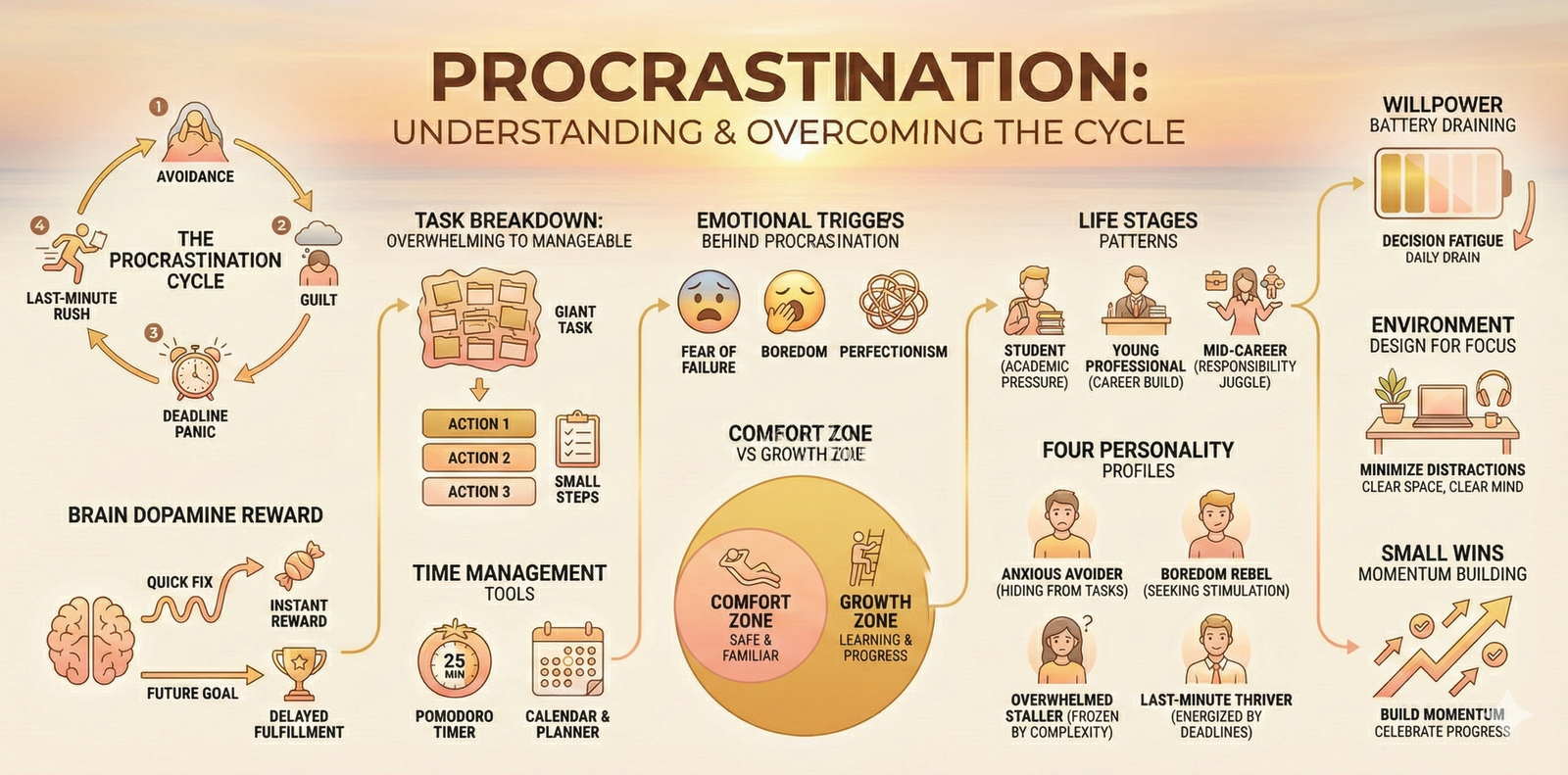
Procrastination affects nearly 95% of students and up to 25% of adults chronically. It's not a character flaw. It's a brain science issue rooted in how your limbic system manages emotions.
The good news? There are proven strategies based on behavioral psychology that work regardless of your personality type or past patterns.
What Is Procrastination?
Procrastination is the conscious delay of an intended course of action, despite expecting potential negative consequences. It's not simply poor time management or laziness—it's a complex emotional regulation problem where you prioritize short-term mood management over long-term goals.
Not medical advice.
When facing a task that triggers negative emotions (anxiety, boredom, frustration, or fear), your brain attempts to regulate those emotions by avoiding the task. This creates temporary relief but increases stress and guilt over time. The procrastination cycle perpetuates itself as delayed work compounds emotional pressure, making tasks feel even more overwhelming.
Surprising Insight: Surprising Insight: Procrastination is fundamentally about mood management, not time management—your brain delays tasks primarily to escape negative emotions rather than due to poor planning skills.
The Procrastination Emotion Cycle
Visual representation of how negative emotions trigger task avoidance, which leads to guilt and increased stress
🔍 Click to enlarge
Why Procrastination Matters in 2026
In 2026, procrastination affects productivity, mental health, and achievement across all life stages. Academic procrastination remains a major barrier for students, with research showing it increases anxiety and reduces academic performance. For professionals, procrastination costs organizations billions in lost productivity annually.
Beyond productivity, chronic procrastination correlates with higher stress, depression, and anxiety. It impacts relationships as well—unfinished commitments create tension and erode trust. Understanding procrastination's root causes in 2026 means recognizing it as an emotional regulation challenge, not a motivation problem.
Modern life intensifies procrastination triggers. Constant digital distractions, complex task environments, and information overload make it harder to initiate action. However, new research into behavioral interventions, including cognitive-behavioral therapy and personalized tech tools, offers unprecedented opportunities for breakthrough change.
The Science Behind Procrastination
Neuroscience reveals that procrastination involves a constant battle between two brain systems. The limbic system (emotional brain) governs behavioral and emotional responses, while the prefrontal cortex (rational brain) handles planning, decision-making, and impulse control. When a task feels emotionally aversive, the limbic system wins, driving avoidance behavior.
Research published in Nature Communications identifies a key mechanism: temporal discounting. Chronic procrastinators show heightened brain signals reflecting difficulty weighing immediate versus future costs and benefits. This neurological pattern means your brain genuinely undervalues future consequences compared to present discomfort. It's not willpower weakness—it's how your brain is processing value and effort.
Brain Systems in Procrastination
Comparison of how the limbic system (emotional response) and prefrontal cortex (rational planning) interact during procrastination
🔍 Click to enlarge
Key Components of Procrastination
Emotional Dysregulation
The primary driver of procrastination is poor control over emotions and thoughts when facing difficult or aversive tasks. Research shows that procrastinators struggle with attentional control—they can't sustain focus when tasks feel emotionally overwhelming. This isn't about discipline; it's about the brain's emotional management system being underdeveloped or overwhelmed.
Temporal Discounting
Your brain's difficulty valuing future outcomes compared to present discomfort creates the procrastination trap. Immediate relief from avoiding a task feels more valuable than future benefits from completing it. This temporal distortion is neurologically measurable and explains why procrastinators consistently underestimate task importance.
Executive Function Deficits
Procrastination associates with weaknesses across multiple executive function domains: impulsivity, poor self-monitoring, weak planning skills, difficulty shifting between tasks, delayed task initiation, inconsistent task monitoring, emotional control challenges, limited working memory, and poor organization. These interconnected weaknesses compound the procrastination problem.
Fear-Based Avoidance
When procrastinators explain their delays, most cite fear of failure as the primary cause. Perfectionism, anxiety about performance, and worry about judgment drive task avoidance more powerfully than laziness. This fear creates a vicious cycle: delaying increases perceived task difficulty, which intensifies fear.
| Trigger Type | Common Emotions | Brain System Involved |
|---|---|---|
| Difficult/Complex Tasks | Frustration, Overwhelm | Prefrontal Cortex |
| Fear of Failure | Anxiety, Shame | Amygdala |
| Boring/Repetitive Work | Boredom, Restlessness | Reward System |
| Unclear Instructions | Confusion, Uncertainty | Dorsolateral Prefrontal |
| Perfectionism Standards | Fear, Self-Doubt | Anterior Cingulate |
| Time Pressure | Panic, Urgency | Sympathetic Nervous |
How to Apply Procrastination Relief: Step by Step
- Step 1: Identify Your Specific Trigger: Name whether the task feels boring, frustrating, difficult, unclear, or meaningless. Different triggers require different solutions. Write down exactly what emotion the task triggers.
- Step 2: Lower the Activation Energy: Commit to just 2 minutes of work on the task. Research shows that starting is the hardest part. Once you begin, momentum builds naturally. Reduce the initial barrier to entry.
- Step 3: Address the Emotional Component: Use cognitive reframing to reappraise the task. Ask: What's meaningful about this? How does completion serve me? Find a personal connection to reduce emotional aversion.
- Step 4: Break Into Micro-Steps: Divide the task into the smallest possible next actions. Instead of 'write report,' try 'open document and write one paragraph.' Tiny steps feel manageable and build confidence.
- Step 5: Use Self-Compassion: Stop the shame spiral. Research shows self-blame intensifies procrastination. When you slip, respond with kindness: 'This is hard. Many people struggle. I can try again.'
- Step 6: Create Accountability: Tell someone your deadline, or use a commitment device like a public pledge. External accountability activates different neural pathways than self-motivation.
- Step 7: Regulate Your Environment: Remove digital distractions. Use app blockers during work sessions. Make the desired action (working) easier than the avoidance action (scrolling).
- Step 8: Use Behavioral Activation: Move your body. Physical activity boosts dopamine and mood regulation capacity. Even 10 minutes of walking or stretching improves task initiation ability.
- Step 9: Schedule Task Work During Peak Hours: Identify when your executive function is strongest (usually morning for most people). Schedule demanding tasks then, leaving low-energy periods for simple work.
- Step 10: Build a Pre-Task Ritual: Create a consistent 2-3 minute routine before starting difficult work—same music, same location, same warmup activity. This ritual signals your brain it's time to focus.
Procrastination Across Life Stages
Young Adulthood (18-35)
Young adults face peak procrastination challenges due to competing demands, identity formation anxiety, and fear of inadequacy. Academic and early career pressures trigger perfectionism-driven avoidance. This age group benefits most from understanding that task initiation challenges are neurological, not personal failures. Establishing micro-habits and environmental controls during this stage creates lifelong patterns that protect against procrastination.
Middle Adulthood (35-55)
Middle adults often experience procrastination through a lens of responsibility and consequence awareness. Work demands, family obligations, and health-related tasks create complex emotional landscapes. For this stage, procrastination often masks deeper issues like burnout, overwhelm, or misalignment with values. Addressing procrastination requires examining whether tasks align with life priorities and whether energy management is adequate.
Later Adulthood (55+)
Later adults may experience procrastination differently—sometimes less in some areas (career pressure reduces) but potentially more in health-related tasks (medical appointments, medication management). Cognitive changes affecting executive function may increase procrastination vulnerability. Success at this stage often involves simplification, automatization of routines, and reconnecting tasks to meaningful purposes.
Profiles: Your Procrastination Approach
The Anxious Avoider
- Permission to be imperfect
- Smaller task chunks with clear success criteria
- Emotional validation and self-compassion practice
Common pitfall: Perfectionism and fear of failure drive task avoidance. Anxiety about not doing it well enough leads to continued delay and stress spirals.
Best move: Define 'good enough' standards explicitly. Reframe mistakes as learning data. Practice 2-minute commitments to interrupt the anxiety feedback loop.
The Boredom Rebel
- Task novelty and creative approaches
- Variety in work environment and methods
- Connection to meaningful purpose or impact
Common pitfall: When tasks feel repetitive or meaningless, motivation vanishes instantly. Struggle with routine and structured work. High energy for novel projects, zero for maintenance tasks.
Best move:
The Overwhelmed Staller
- Clear prioritization and direction
- Help breaking complex tasks into concrete steps
- Permission to do less than everything at once
Common pitfall: Too many options or unclear expectations trigger paralysis. Difficulty distinguishing important from urgent. Gets stuck in analysis without action.
Best move:
The Last-Minute Thrriver
- Awareness of real costs of deadline pressure
- Strategies to self-generate urgency earlier
- Understanding that performance quality suffers without buffer time
Common pitfall: Adrenaline-fueled work feels productive but creates chronic stress, poor quality output, and relationship strain. Genuinely believes they work better under pressure despite evidence to the contrary.
Best move:
Common Procrastination Mistakes
The biggest mistake is treating procrastination as a willpower or motivation problem. When traditional motivation strategies fail, many people assume they lack discipline and add shame on top of existing stress. This intensifies the procrastination cycle. Procrastination is an emotional regulation challenge, not a character flaw.
Another critical error is attempting change without environmental modification. You can't will yourself to focus when distractions are readily available. Willpower is a limited resource. Instead, redesign your environment to make desired behavior effortless and avoidance behavior impossible.
Many procrastinators underestimate how much starting difficulty derives from unclear task parameters. When next steps aren't crystal clear, your brain defaults to avoidance. Specificity matters enormously. Instead of 'work on project,' define 'open project file and outline section 1' as the exact starting action.
Procrastination Recovery Pathway
How moving from shame to emotional regulation to action creates positive procrastination recovery
🔍 Click to enlarge
Science and Studies
Contemporary procrastination research combines neuroscience, behavioral psychology, and cognitive science to explain why we delay tasks and what interventions actually work. The following studies represent 2024-2025 research and demonstrate the evidence base for procrastination understanding and treatment.
- Academic procrastination: A systematic review (2025) - ScienceDirect: Examines causal factors and intervention effectiveness across student populations, identifying emotional dysregulation as primary pathway
- Procrastination and temporal discounting (2022) - Nature Communications: Neuro-computational study showing brain signals reflecting temporal discounting relate directly to procrastination behavior in lab and home settings
- Emotional dysregulation and procrastination (2025) - British Journal of Psychology: Establishes link between poor emotion regulation, attention control, and procrastination severity across adult samples
- Group cognitive behavioral therapy trial (2025) - Taylor & Francis Online: Randomized controlled trial demonstrating significant procrastination reduction through structured CBT in college students with sustained improvements
- Psychological needs and academic procrastination (2025) - Frontiers in Psychology: Shows unfulfilled psychological needs increase anxiety which mediates procrastination through compromised self-control
Your First Micro Habit
Start Small Today
Today's action: Choose one task that triggers procrastination. Set a timer for 2 minutes and work only on that task until the timer ends. No commitment beyond 2 minutes. Notice what happens after 2 minutes—most people discover momentum and continue.
This micro-habit breaks the initiation barrier, your brain's biggest hurdle. Two minutes bypasses the emotional resistance that stops you before starting. Once started, momentum builds naturally through dopamine release from progress, making continued work feel easier. Research shows consistent 2-minute starts create neural pathways that eventually make initiation automatic.
Track your micro habits and get personalized AI coaching with our app. The Bemooore app helps you break procrastination patterns by providing daily nudges, celebrating small wins, and building accountability without judgment.
Related guides: a habit tracker that forgives missed days, habit trackers without streaks and the best habit tracker approach for ADHD.
Quick Assessment
How do you typically respond when facing a task that makes you anxious or uncertain?
Your response style reveals how your emotional system interacts with task initiation. Understanding your pattern helps you select strategies that work for your brain.
When you successfully complete a difficult task, what motivated you most?
What activates your action system varies by person. Matching motivation source to task type dramatically increases follow-through success.
What emotion most often accompanies your procrastination?
Identifying your primary procrastination emotion allows you to deploy the right emotional regulation strategy. Different emotions need different interventions.
Take our full assessment to get personalized recommendations for your unique procrastination patterns.
Discover Your Style →Next Steps
Begin by identifying your specific procrastination trigger and emotional driver. Is it fear of failure, boredom, overwhelm, or unclear expectations? Name it specifically. Once identified, select one evidence-based strategy from the step-by-step section that addresses your particular emotional challenge.
Start with the 2-minute micro-habit today. Don't wait for motivation to appear or the perfect time to begin. Task yourself with just 120 seconds of focused work. This single small action activates the neural pathways that overcome procrastination inertia and builds momentum for larger change.
Get personalized guidance with AI coaching on managing procrastination patterns and building lasting change.
Start Your Journey →Research Sources
This article is based on peer-reviewed research and authoritative sources. Below are the key references we consulted:
Related Glossary Articles
Frequently Asked Questions
Is procrastination the same as laziness?
No. Laziness is not wanting to do something. Procrastination is wanting to do something but being unable to initiate action due to emotional regulation challenges. Procrastinators often feel distressed by their delays—true laziness doesn't involve this internal conflict.
Can medication help with procrastination?
Medication addresses specific conditions that sometimes contribute to procrastination, like ADHD, anxiety, or depression. However, procrastination itself is primarily a behavioral issue requiring behavioral intervention. If underlying conditions exist, treating them may reduce procrastination as a secondary benefit.
Why do I procrastinate more on important tasks?
Higher stakes tasks trigger stronger emotions (anxiety, fear of failure, perfectionism), which intensifies emotional avoidance. Your brain's limbic system activates more intensely for high-stakes tasks, making emotional regulation more difficult. This is neurologically normal, not a character flaw.
Does procrastination run in families?
Procrastination shows some heritability, but primarily through inherited executive function patterns and emotional regulation capacity rather than procrastination genes. Environmental factors—parenting style, stress exposure, behavioral modeling—significantly shape procrastination tendencies.
How long does it take to stop procrastinating?
Behavioral change typically requires 4-8 weeks of consistent practice for new neural pathways to strengthen. However, first improvements often appear within 1-2 weeks. Lasting change requires ongoing use of strategies; procrastination can return if management practices lapse.
Take the Next Step
Ready to improve your wellbeing? Take our free assessment to get personalized recommendations based on your unique situation.
- Discover your strengths and gaps
- Get personalized quick wins
- Track your progress over time
- Evidence-based strategies