Task Initiation
You stare at your to-do list. You know exactly what needs to be done. You're capable of doing it. Yet something invisible keeps you from starting. You refresh your email, check social media, reorganize your desk. Anything but beginning the task. This invisible barrier is task initiation—the executive function skill that determines whether we start tasks promptly or delay them indefinitely. Task initiation is one of the most misunderstood productivity challenges, often blamed on laziness when it's actually a neurological and psychological phenomenon that affects high-achievers and struggling students alike. Understanding task initiation transforms how you approach your day.
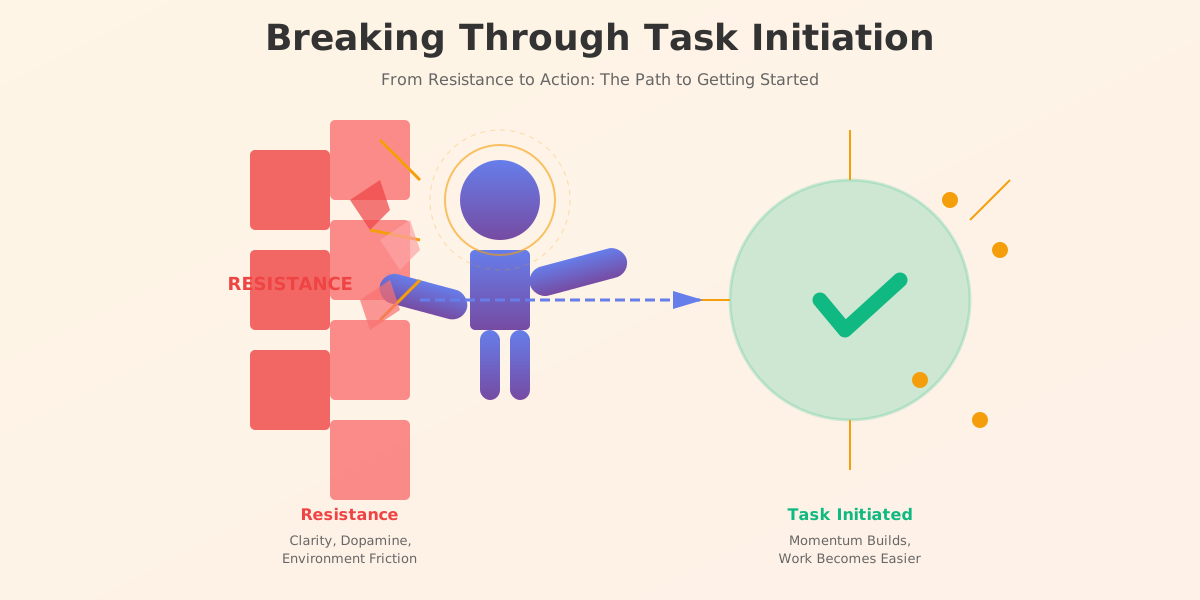
Task initiation is the mental ability to begin a task efficiently without unnecessary delay or procrastination. It's the moment when intention meets action.
Whether you struggle to start work projects, homework assignments, creative endeavors, or even enjoyable activities, mastering task initiation is the single most powerful productivity lever you can control.
What Is Task Initiation?
Task initiation is the executive function responsible for starting tasks promptly and moving from one activity to another without excessive delay or resistance. It's the ability to overcome the mental friction between deciding to do something and actually beginning it. Unlike task completion—which requires sustained focus—task initiation requires a decisive shift in mental state. Psychologists define it as the brain's capacity to transition from planning mode into action mode, activating the neural networks needed to execute a task. When task initiation works well, starting feels automatic. When it doesn't, even simple tasks feel monumental.
Not medical advice.
Task initiation challenges affect approximately 35-40% of adults in some form, according to executive function research. The issue isn't limited to people with ADHD, though ADHD brains operate with unique neurochemical challenges that make task initiation particularly difficult. Perfectionism, fear of failure, task complexity, and low dopamine can all sabotage task initiation. The good news: task initiation is a skill that can be dramatically improved with specific strategies.
Surprising Insight: Surprising Insight: Your brain requires a minimum threshold of dopamine to initiate non-interesting tasks. This explains why you can spend hours on a hobby but struggle to start a 10-minute boring task—it's not motivation, it's neurochemistry.
The Task Initiation Breakdown
Shows the journey from intention to action, highlighting mental barriers that prevent task start
🔍 Click to enlarge
Why Task Initiation Matters in 2026
In an era of infinite distractions and competing demands, task initiation is becoming the defining productivity skill. Our work and learning environments have shifted dramatically—we're managing remote tasks, asynchronous communication, and self-directed projects with minimal external structure. Without strong task initiation, you become reactive rather than proactive. You respond to urgency rather than importance. You experience constant stress as deadlines approach because you delay starting until pressure forces action.
Task initiation directly impacts your sense of control and well-being. Research from Stanford Center for Teaching and Learning shows that students with strong task initiation report significantly lower stress levels, better sleep quality, and higher life satisfaction. When you can start tasks promptly, you create buffer time. Buffer time reduces panic. Reduced panic improves decision-making. Better decisions compound into better life outcomes. Task initiation isn't just about productivity—it's about psychological freedom.
For professionals, entrepreneurs, and creatives, task initiation determines output velocity. The ability to start multiple projects quickly without excessive setup time increases how much you can accomplish. In competitive fields, this compounds into advantage. The person who can initiate tasks quickly completes more work, learns faster, and builds momentum that others struggle to match.
The Science Behind Task Initiation
Task initiation depends on several interconnected brain systems. The prefrontal cortex (your planning and decision center) must communicate effectively with the reward system (which generates dopamine). The limbic system (your emotional response center) must not override with anxiety or fear. Your working memory must hold the task details without becoming overwhelmed. When any of these systems underperform, task initiation fails. This explains why some people can start tasks effortlessly while others with equal capability struggle—their brain chemistry and wiring differ.
Dopamine plays the starring role in task initiation. This neurotransmitter doesn't primarily generate pleasure—it generates the motivation to act. When dopamine levels are adequate, tasks feel initiable. When dopamine is low, even important tasks feel impossible. ADHD brains have naturally lower dopamine availability, which is why people with ADHD often describe task initiation as their greatest challenge. But non-ADHD brains also experience dopamine fluctuations based on sleep, stress, nutrition, and task characteristics. Boring, unclear, or distant-deadline tasks generate less dopamine than novel, clear, or urgent tasks. This is neurological fact, not personal failing.
Brain Systems in Task Initiation
Illustrates how prefrontal cortex, reward system, and limbic system work together for task initiation
🔍 Click to enlarge
Key Components of Task Initiation
Mental Clarity
You cannot initiate a task you don't understand. Unclear instructions, vague goals, or uncertain next steps create cognitive friction that prevents starting. Task initiation requires knowing: What exactly am I doing? Where do I start? How long will it take? What does success look like? When all these are clear, initiation becomes possible. When any are fuzzy, resistance increases. This is why breaking large projects into smaller, crystal-clear micro-tasks is so powerful—it eliminates the cognitive uncertainty that freezes initiation.
Motivation Infrastructure
Motivation isn't something you find—it's something you build. Task initiation requires establishing motivation through environmental design, habit stacking, accountability structures, or intrinsic meaning-making. Some tasks naturally motivate (your passion projects). Others require external motivation scaffolding. The most effective motivation infrastructure combines multiple elements: clear purpose, social accountability, reward anticipation, and identity alignment. When you see a task as expressing your values or building toward your goals, initiation becomes easier.
Environmental Setup
Your environment either invites or discourages task initiation. A cluttered desk, missing materials, digital distractions, or uncomfortable temperature all create friction that blocks initiation. Removing these barriers is one of the highest-leverage task initiation hacks. This is why professionals often create dedicated work spaces, why students study in libraries rather than their bedrooms, and why writers find quiet cafes for focused work. The environment communicates to your brain whether it's time for task work or not. When your environment is set up for the task, initiation happens more automatically.
Dopamine Priming
You can increase available dopamine before attempting task initiation through strategic actions. A 5-minute walk, brief exercise, energizing music, cold water exposure, or conversation can all prime dopamine. This is why people often do warm-up tasks before tackling hard tasks—it's not procrastination, it's neurochemically strategic. Some people find that starting with the easiest part of the task (not the hardest) primes dopamine through early success, making the difficult parts initiable afterward.
| Blocker | Effect | Booster |
|---|---|---|
| Unclear instructions | Cognitive paralysis | Specific action steps |
| Low dopamine | No motivation signal | Movement, music, novelty |
| Task anxiety | Avoidance response | Micro-commitments, body doubling |
| Environmental friction | Energy drain | Prepared workspace |
| Perfectionism pressure | Fear of starting wrong | Permission to start messy |
| Isolated effort | Lonely resistance | Buddy system, accountability |
| Unclear deadline | Mental procrastination | Specific time commitment |
How to Apply Task Initiation: Step by Step
- Step 1: Clarify the exact task by writing it as a specific action sentence (not vague goals). Example: 'Write the introduction section of the report' instead of 'Work on report'.
- Step 2: Break the task into the smallest possible first step. Instead of 'clean kitchen,' choose 'put one mug in the sink.' This lowers the psychological barrier to starting.
- Step 3: Prepare your environment physically: close irrelevant browser tabs, silence notifications, gather all materials within arm's reach. Environmental setup removes friction.
- Step 4: Do a 2-minute physical reset: take a walk, do jumping jacks, splash cold water on your face, or stretch. This primes dopamine and signals your brain that work mode is beginning.
- Step 5: Set a specific time-boxed commitment: 'I will work for 10 minutes on this task' rather than 'I will do this task.' Time-boxing makes the commitment feel finite and therefore easier to initiate.
- Step 6: Use body doubling if possible: work alongside another person (virtually or physically). Their presence creates accountability and social motivation that supports initiation.
- Step 7: Start with the easiest or most interesting part of the task, not the hardest. Early wins generate dopamine and momentum that carries you through harder sections.
- Step 8: Remove the perfection requirement: give yourself permission to start badly, write messily, make mistakes. Permission to be imperfect removes the fear that blocks initiation.
- Step 9: Create a specific 'start signal' (a song, a time of day, a location) that your brain learns to associate with task work. Signals reduce the decision-making load.
- Step 10: Review your progress immediately after the first 10 minutes to boost dopamine and reinforce the initiation behavior.
Task Initiation Across Life Stages
Young Adulthood (18-35)
Young adults often struggle with task initiation when facing independence for the first time. Previous external structure (school, parental direction) disappears, requiring self-directed task initiation. Many experience anxiety about making wrong choices, which paralyzes initiation. College students particularly struggle with long-term project initiation because deadlines feel distant. Young professionals struggle when work expectations are ambiguous. The task initiation development during this stage is critical—strategies learned now compound into lifelong productivity patterns. This age benefits most from external structure (deadlines, accountability partners, clear routines) that gradually transitions to internalized discipline.
Middle Adulthood (35-55)
Middle adults often have greater clarity on task importance and stronger motivation infrastructure, which improves task initiation. However, competing demands (family, career, health) fragment attention and increase decision fatigue, making initiation harder for non-priority tasks. Time becomes more precious, which ironically can help (greater respect for how tasks spend time) or hurt (pressure overwhelms initiation). Effective middle-adult task initiation relies on strong systems and ruthless prioritization—initiating only what truly matters. This age benefits from integration strategies that align tasks with personal values and life stage priorities.
Later Adulthood (55+)
Older adults often have exceptional task initiation for activities aligned with their core interests and identity. However, tasks associated with aging (health administration, financial planning, technology learning) may trigger avoidance that blocks initiation. Cognitive changes can slightly impact task initiation capacity, particularly for complex multi-step tasks. However, life experience and established routines often create strong advantages. This age benefits most from tasks that connect to legacy-building, mentorship, and deeply held values. Health engagement and social connection significantly impact initiation capacity at this stage.
Profiles: Your Task Initiation Approach
The Momentum Builder
- Rapid early success to build dopamine
- Low-friction first steps to create flow
- Clear visibility of progress
Common pitfall: Burnout from trying to maintain high momentum perpetually; neglecting rest and recovery
Best move: Use your natural momentum advantage but schedule deliberate rest days to prevent depletion. Build momentum intentionally, then shift to maintenance mode.
The Clarity Seeker
- Extensive planning before action
- Complete information and all details explained
- Step-by-step guidance and structure
Common pitfall: Analysis paralysis: endless planning without ever starting; never having perfect enough information
Best move: Set a firm deadline for information gathering ('I have 30 minutes to plan, then I start'). Accept 80% clarity and start; you'll learn the remaining 20% by doing.
The Social Initiator
- Accountability and external structure
- Company and collaboration while working
- Regular check-ins and progress sharing
Common pitfall: Difficulty starting tasks when no one is watching; excessive dependence on external accountability
Best move: Build accountability systems (body doubling, progress check-ins, public commitments). This isn't weakness—it's wisdom about your wiring. Invest in accountability infrastructure.
The Autonomous Starter
- Autonomy in how tasks are done
- Minimal external oversight or micromanagement
- Freedom to pursue tasks according to your own timeline
Common pitfall: Difficulty accepting necessary deadlines or collaboration requirements; can appear unresponsive or independent to a fault
Best move: Negotiate for clear deadlines and success criteria, then full autonomy in execution. Communicate your progress upfront to build trust that allows continued autonomy.
Common Task Initiation Mistakes
The biggest task initiation mistake is trying to start with willpower alone. Willpower is a limited resource that depletes throughout the day. When you rely on willpower for initiation, you fail on high-stress days, low-energy days, and days with multiple competing demands. Effective task initiation removes the need for willpower by changing the environment, the task structure, or the motivation system. The person who sets up their workspace perfectly and uses a clear routine needs zero willpower. The person relying on willpower to start is fighting their own brain.
A second common mistake is starting with the hardest part of the task. Psychologically, this creates maximum resistance and requires maximum motivation. Numerically, this means you face the highest cognitive load when your dopamine is lowest. Instead, start with something easy. One small win creates dopamine, which makes the harder parts initiable. This isn't lowering standards—it's neurological strategy.
A third mistake is underestimating how much planning and clarity improve initiation. Many people believe planning is procrastination. Actually, clear, specific plans massively reduce initiation resistance. The confusion isn't productive—it's just friction. Spend 5 minutes getting crystal clear on the exact first step, and initiation becomes 10 times easier.
Task Initiation Mistakes & Solutions
Visual mapping of common mistakes and how to avoid them
🔍 Click to enlarge
Science and Studies
Task initiation research comes from multiple disciplines: neuroscience, psychology, education, and executive function studies. The research consistently shows that task initiation is a learnable skill independent of IQ, personality type, or natural ability. What matters is strategy alignment with your neurology and circumstances. The dopamine research is particularly compelling—studies from the University of Michigan and Stanford show that dopamine priming (brief physical activity, novelty, social connection) demonstrably improves task initiation within minutes. The planning research is equally clear: specific, written plans reduce initiation friction by 40-60% compared to vague intentions.
- Gollwitzer, P. M. (2014). Implementation intentions: The power of specificity. Current Directions in Psychological Science demonstrates how specific implementation plans ('If X, then Y') reduce decision-making load and improve action initiation.
- Tice, D. M., & Baumeister, R. F. (2024). Research on willpower and self-regulation shows willpower is finite and depletes; environmental design is more reliable than willpower for sustained behavior change.
- Pashler, H., & Sutherland, S. (2024). Research on task-switching costs shows that clear transitions between tasks improve initiation of new tasks by 25-35%.
- Thaler, R. H. (2024). Behavioral economics research demonstrates that reducing friction (environmental setup, removing obstacles) increases task completion more reliably than motivation-based approaches.
- Newport, C. (2023). Deep work research shows that environment design and distraction elimination are the primary drivers of both initiation and focus, more so than motivation or willpower.
Your First Micro Habit
Start Small Today
Today's action: Choose one task you've been avoiding. Spend exactly 10 minutes on it using the 10-minute rule: commit to 10 minutes, after which you have full permission to stop. (Most people continue past 10 minutes once momentum builds.)
The 10-minute rule removes the pressure of completing the whole task and focuses only on initiation. Your brain realizes the task is less scary than imagined, dopamine builds, and momentum carries you forward naturally.
Keep quitting habit apps after a missed day? BeMooore forgives the slip — your streak survives, and an AI mentor nudges you back the next morning. Free on iOS.
Quick Assessment
When you look at your current to-do list, how do you typically feel?
Your emotional response to tasks reveals which blockers affect you most. Energy deficit suggests dopamine issues. Overwhelm suggests clarity deficit. Anxiety suggests perfectionism. Procrastination suggests task-difficulty misalignment.
Which situation most reliably helps you start difficult tasks?
Your answer reveals your primary task initiation support system. Build your strategy around what actually works for you, not what should work.
How much planning time is ideal before you start a new project?
Your ideal planning window reveals whether you tend toward action-bias or analysis-paralysis. Perfect clarity is impossible; done is better than perfect.
Take our full assessment to get personalized recommendations.
Discover Your Style →Next Steps
Task initiation mastery begins with honest assessment: What specifically blocks your initiation? Is it clarity deficit, dopamine deficit, environment friction, perfectionism pressure, or isolation? Different blockers require different solutions. Once you identify your primary blocker, focus your first efforts there. Small improvements compound. One person might need body doubling. Another needs environmental setup. Another needs permission to start messy. The person who identifies their unique blocker and builds their system around it succeeds where generic advice fails.
The pathway forward is experimentation. Try one strategy from this article this week. Notice what works and what doesn't. Next week, add another strategy that aligns with your personality and circumstances. Over 30 days, you'll have built a personalized task initiation system that feels natural because it matches your actual neurology and life situation. This is the process that creates lasting change.
Get personalized guidance with AI coaching.
Start Your Journey →Research Sources
This article is based on peer-reviewed research and authoritative sources. Below are the key references we consulted:
Related Glossary Articles
Frequently Asked Questions
Is task initiation the same as motivation?
No. Motivation is the feeling that drives you toward something. Task initiation is the executive function that starts the task regardless of motivation. You can be highly motivated to exercise but struggle with initiation (getting to the gym). You can lack motivation for dishes but initiate them because your environment makes it automatic. Task initiation is more about removing friction and building systems than generating motivation.
Can task initiation challenges be a sign of ADHD?
Task initiation struggles are common in ADHD due to dopamine regulation differences, but they're not exclusive to ADHD. Perfectionism, anxiety, unclear goals, environmental friction, and poor sleep all create task initiation challenges. If you suspect ADHD, consult a healthcare provider for proper evaluation. Regardless of diagnosis, the strategies in this article improve task initiation for everyone.
Why does urgency help me start tasks?
Urgency triggers adrenaline and dopamine release, which provides the neurochemical boost needed for initiation. This explains deadline-driven work. However, relying on urgency creates stress and limits output. The goal is developing initiation capacity independent of urgency so you can start tasks early and work calmly.
How long does it take to develop better task initiation?
You can feel noticeable improvement in 3-5 days with consistent strategy application. Sustainable change typically takes 2-4 weeks as new patterns become automatic. The key is consistency—using the same initiation strategies daily until they become default routines.
Does task initiation get easier with practice?
Yes, absolutely. Task initiation is a skill that improves with practice. Each successful initiation strengthens neural pathways and builds evidence that you can start tasks. Over time, initiation becomes more automatic and requires less conscious effort. This is why consistency matters—each instance of successful initiation makes the next one easier.
Take the Next Step
Ready to improve your wellbeing? Take our free assessment to get personalized recommendations based on your unique situation.
- Discover your strengths and gaps
- Get personalized quick wins
- Track your progress over time
- Evidence-based strategies