Psychology & Behavioral Science
Psychology and behavioral science explore how human behavior shapes our happiness, decisions, and relationships. By understanding the science of why we act, think, and feel the way we do, you can make intentional choices that improve your wellbeing and life satisfaction. Whether it's managing emotions, building stronger connections, or making better decisions, behavioral psychology provides evidence-based strategies proven to enhance every aspect of your life.
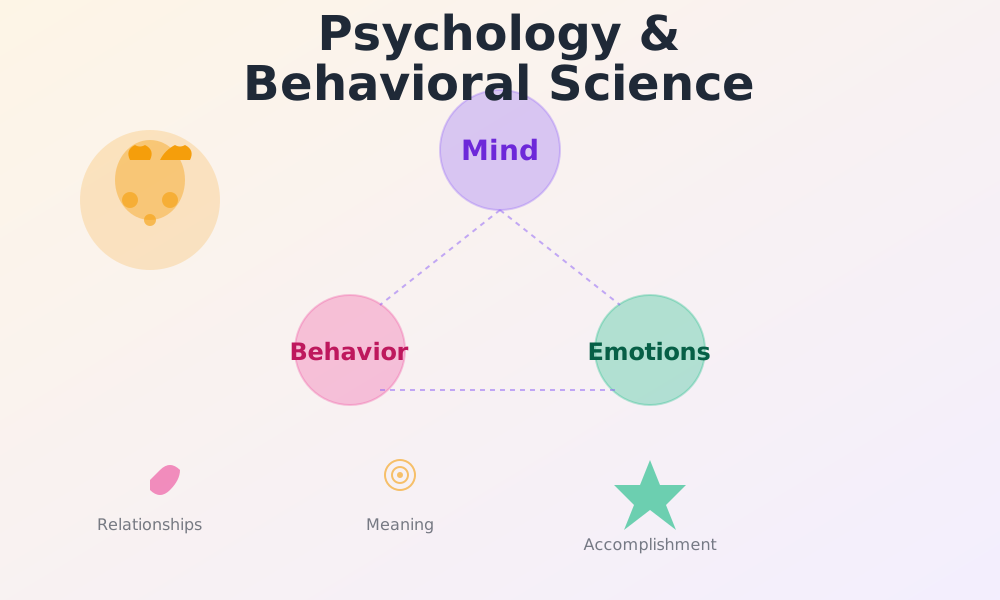
Psychology and behavioral science combine research, brain science, and practical applications to help you understand yourself and others better.
Many people feel stuck making the same mistakes repeatedly. Understanding the psychological principles behind behavior transformation can break unhelpful patterns and create lasting positive change.
What Is Psychology and Behavioral Science?
Psychology is the scientific study of human behavior and mental processes. Behavioral science extends this by examining how people actually behave in real-world situations, informed by psychology, neuroscience, economics, and anthropology. Together, they explain why we make the choices we make, how emotions influence decisions, and what drives happiness and fulfillment in life. Psychology and behavioral science are complementary fields that help us understand both the internal mental processes and external observable behaviors that shape our experiences.
Not medical advice.
Psychology examines cognitive processes like memory, attention, and perception, while behavioral science focuses on observable actions and patterns. Together, they reveal how biology, environment, and personal choices influence wellbeing. From understanding cognitive biases to recognizing emotional patterns, these sciences provide tools for personal growth and improved relationships. The integration of psychology and behavioral science has revolutionized how we approach mental health, education, and personal development in the 21st century.
Surprising Insight: Surprising Insight: Research shows that approximately 50% of happiness is determined by genetics, 10% by life circumstances, and 40% by personal choices and intentional actions—meaning you have significant control over your wellbeing.
The Three Pillars of Psychological Wellbeing
This diagram illustrates the foundational components that create lasting happiness and life satisfaction according to behavioral science research.
🔍 Click to enlarge
Why Psychology and Behavioral Science Matters in 2026
In 2026, mental health challenges have reached unprecedented levels, particularly among younger generations. Understanding psychology and behavioral science provides practical tools to navigate increasing stress, complex relationships, and life decisions. The science offers evidence-based strategies that actually work, backed by decades of research and modern neuroscience discoveries.
The practical applications of behavioral science have expanded beyond therapy into business, education, technology, and personal development. Organizations worldwide now use behavioral insights to improve employee wellbeing, increase productivity, and foster positive workplace cultures. Understanding these principles helps you make smarter personal decisions, build stronger relationships, and create sustainable happiness.
Digital wellness, decision-making in complex environments, and managing attention in an overstimulated world make psychological literacy essential. The intersection of psychology, neuroscience, and technology creates new opportunities to understand and improve human behavior. As artificial intelligence and automation reshape society, understanding human psychology becomes increasingly valuable for maintaining mental health and finding meaning.
The Science Behind Psychology and Behavioral Science
Behavioral science research has identified that people make decisions through two thinking systems: System 1 (fast, intuitive, emotional) and System 2 (slow, deliberate, logical). Most daily decisions rely on System 1, which is efficient but susceptible to cognitive biases. Understanding these systems helps you recognize when emotions are influencing decisions and when you need to engage deliberate thinking for important choices. This awareness alone dramatically improves decision quality across relationships, finances, and career decisions.
Behavioral psychology also reveals that happiness involves five key components: positive emotion, engagement (flow), relationships, meaning, and accomplishment. Research from the longest study on happiness—spanning 85 years—found that warm relationships with family, friends, and community are the strongest predictors of a long and happy life. Additionally, neuroscience shows that our brains are neuroplastic, meaning we can rewire thought patterns and behaviors through consistent practice, making positive change achievable for everyone.
How Behavioral Science Shapes Happiness
This diagram shows the interconnected mechanisms through which psychological insights create sustained wellbeing and life satisfaction.
🔍 Click to enlarge
Key Components of Psychology and Behavioral Science
Cognitive Biases and Decision Making
Cognitive biases are systematic patterns in how we process information and make decisions. Common biases include confirmation bias (seeking information that confirms existing beliefs), availability heuristic (overweighting recent or memorable examples), and anchoring bias (relying too heavily on initial information). Recognizing these biases in yourself prevents poor decisions in finances, relationships, and career choices. Once aware of your tendencies, you can implement decision-making strategies that counteract bias, leading to better outcomes aligned with your values.
Emotional Intelligence and Self-Awareness
Emotional intelligence—the ability to recognize, understand, and manage emotions in yourself and others—is a cornerstone of psychological wellbeing. People with high emotional intelligence navigate relationships more successfully, make better decisions under stress, and experience greater life satisfaction. Developing emotional intelligence involves practicing self-awareness (noticing emotions as they arise), self-regulation (managing emotional responses), empathy (understanding others' emotions), and social skills (building positive relationships). Research shows that emotional intelligence can be developed through intentional practice and reflection.
Habit Formation and Behavior Change
Behavioral science reveals that habits form through a loop: cue (trigger), routine (behavior), and reward (consequence). Understanding this loop allows you to intentionally design habits that support your wellbeing. Rather than relying on willpower, successful behavior change works with your brain's natural reward systems. By identifying the cue and desired reward, you can experiment with new routines to achieve lasting change. Small daily habits—called micro-habits—accumulate into significant improvements in mental health, physical health, and life satisfaction over time.
Social Connection and Relationships
Psychology demonstrates that humans are fundamentally social creatures whose wellbeing depends critically on quality relationships. Strong social connections predict better mental health, longevity, and happiness. The power of relationships extends beyond family and friends to include community, meaningful work, and authentic connection. Behavioral science also reveals principles of effective communication, conflict resolution, and trust-building that strengthen relationships. Investing in social connection is one of the highest-impact wellbeing practices, supported by over 75 years of research.
| Component | What It Is | How to Cultivate It |
|---|---|---|
| Positive Emotion | Pleasant feelings, joy, contentment in daily life | Gratitude practice, savoring positive moments, laughter with others |
| Engagement | Flow state; being fully absorbed in meaningful activities | Find work aligned with strengths, pursue hobbies, challenge yourself appropriately |
| Relationships | Quality connections with family, friends, community | Invest time in relationships, active listening, vulnerability, regular contact |
| Meaning | Sense of purpose and contribution beyond yourself | Volunteer work, support others, align life with values, set purpose-driven goals |
| Accomplishment | Progress toward personal goals and mastery | Set meaningful goals, track progress, celebrate wins, embrace challenges for growth |
How to Apply Psychology and Behavioral Science: Step by Step
- Step 1: Assess your current state: Use a journal to observe your patterns over one week. Notice what triggers positive emotions, what creates stress, and which relationships energize you. This baseline awareness is essential for meaningful change.
- Step 2: Identify your cognitive biases: Write down a recent decision you regret. Analyze it using the cognitive biases framework—did confirmation bias, anchoring, or emotional thinking influence your choice? This prevents future mistakes.
- Step 3: Map your habit loops: Choose one habit you want to change. Identify the cue (what triggers it), the routine (what you currently do), and the reward (what you get from it). Understanding this loop is the first step to changing it.
- Step 4: Build emotional awareness: Start a daily emotion check-in. Spend two minutes identifying what you felt, what triggered it, and how you responded. This builds emotional intelligence and self-regulation.
- Step 5: Practice the STOP technique: When facing a decision, STOP—Slow down, Think about your options, Observe your emotions, Proceed with intention. This creates space between stimulus and response where wisdom lives.
- Step 6: Strengthen one key relationship: Choose one important relationship and invest in it intentionally. Have a meaningful conversation, practice active listening, or spend quality time together. Relationships are the foundation of wellbeing.
- Step 7: Design your environment: Remove friction from good behaviors and add friction to unhelpful ones. Place workout clothes by your bed, keep phone in another room during focus time, arrange social calendar to include regular gatherings.
- Step 8: Implement a micro-habit: Start with one tiny behavior aligned with your values—five minutes of meditation, ten minutes of walking, two minutes of gratitude. Small, consistent actions create lasting change.
- Step 9: Experiment and track: Try new approaches for at least two weeks. Track what works using a simple chart or app. Behavioral science is about testing and learning what works for your unique brain and circumstances.
- Step 10: Build accountability and community: Share your goals with someone, join a group with shared values, or find an accountability partner. Social commitment increases follow-through and makes change sustainable.
Psychology and Behavioral Science Across Life Stages
Young Adulthood (18-35)
Young adults benefit from understanding habit formation and decision-making patterns early. This life stage involves critical decisions about career, relationships, and identity. Applying behavioral science to establish healthy habits—sleep, exercise, social connection, financial discipline—creates a foundation for decades of wellbeing. Young adults are also particularly vulnerable to social comparison and FOMO (fear of missing out) due to social media. Understanding these psychological pressures helps young adults make choices aligned with their authentic values rather than external expectations.
Middle Adulthood (35-55)
Middle adults often experience stress from competing demands of career, family, and aging parents. Psychology and behavioral science provide tools for managing stress, setting boundaries, and finding meaning amid complexity. This stage benefits from deepening emotional intelligence, improving communication skills, and strengthening relationships. Understanding motivation psychology helps middle adults overcome burnout by reconnecting with purpose. Behavioral science also helps with managing the psychological weight of accumulated life decisions and reorienting toward what actually matters for long-term wellbeing.
Later Adulthood (55+)
Later adulthood benefits from psychology's insights about meaning-making, legacy, and successful aging. Understanding cognitive changes with age helps older adults compensate and maintain mental sharpness. Strong social connections become even more critical for health and longevity. Behavioral science supports successful aging by encouraging continued learning, purposeful activity, and connection. Older adults often have increased wisdom and perspective, making this an ideal time to mentor others and find deep satisfaction through contribution and generativity.
Profiles: Your Psychology and Behavioral Science Approach
The Analytical Optimizer
- Data and research to understand why behavior change works
- Structured frameworks for decision-making and habit change
- Clear metrics to track progress and measure impact
Common pitfall: Overthinking instead of taking action; waiting for perfect information before starting
Best move: Choose one small experiment, track results for two weeks, then adjust. Action creates understanding faster than analysis alone.
The Relationship-Focused Person
- Recognition that relationships are the foundation of wellbeing
- Communication and conflict resolution skills from behavioral science
- Community and accountability to sustain positive changes
Common pitfall: Neglecting personal needs and boundaries in pursuit of harmony with others
Best move: Apply emotional intelligence to communicate your needs clearly. Healthy boundaries strengthen relationships rather than weaken them.
The Implementation Strugggler
- Habit design that works with their brain rather than against it
- Environmental design to reduce friction for good behaviors
- Compassion for setbacks as part of the learning process
Common pitfall: Giving up after initial failures; trying to change too much at once
Best move: Start with one micro-habit so small it feels almost silly. Consistency beats intensity. Build from there.
The Meaning Seeker
- Understanding of how meaning and purpose fuel sustained wellbeing
- Connection between daily actions and bigger life values
- Ways to contribute beyond themselves and find fulfillment
Common pitfall: Seeking purpose externally rather than defining it personally; becoming lost in others' expectations
Best move: Conduct a values clarification exercise. What matters most? Design your days to reflect those priorities. Purpose emerges through alignment.
Common Psychology and Behavioral Science Mistakes
One major mistake is believing that understanding alone creates change. Intellectual knowledge about psychology doesn't automatically improve behavior. The gap between knowing and doing is where most people fail. Recognizing a cognitive bias doesn't eliminate it. Understanding the importance of relationships doesn't automatically improve them. Real change requires consistent behavioral practice, not just mental agreement. You must translate insights into daily actions through deliberate practice.
Another common error is underestimating the power of small, consistent actions. People often abandon healthy changes because they expect dramatic transformation quickly. Behavioral science shows that tiny habits—reading for ten minutes daily, five-minute meditation, weekly meaningful conversation—compound into profound changes over months and years. The mistake is impatience; the success formula is consistency over intensity. Starting small and building momentum is far more effective than grandiose changes that you can't sustain.
A third mistake is trying to change behavior without changing your environment. Your surroundings powerfully influence behavior through what psychologists call "choice architecture." Trying to improve diet willpower while keeping junk food readily visible is fighting your own design. Behavioral science emphasizes that sustainable change requires designing your physical and social environment to make good behaviors easier and unhelpful behaviors harder. Environment shapes behavior more than willpower does.
The Change Trap: Why Most People Fail at Behavior Change
This diagram illustrates the common reasons behavior change fails and how behavioral science principles can overcome them.
🔍 Click to enlarge
Science and Studies
Decades of research from leading institutions—Harvard Medical School, Stanford, Oxford, and the American Psychological Association—validate the core principles of psychology and behavioral science. Long-term longitudinal studies tracking thousands of people over decades reveal consistent patterns about what creates happiness and wellbeing. Modern neuroscience confirms that our brains are neuroplastic, meaning deliberate mental practice literally rewires neural pathways. This research demonstrates that behavior change, habit formation, and emotional development are achievable for everyone, regardless of starting point or age.
- Harvard Study of Adult Development: Tracked over 700 people for 85+ years, finding that quality relationships are the strongest predictor of happiness and longevity.
- Stanford Behavioral Science Research: Demonstrates that environmental design and choice architecture powerfully influence behavior more than motivation or willpower.
- American Psychological Association Research: Confirms that cognitive-behavioral approaches and intentional habit formation produce lasting behavior change.
- Neuroscience of Neuroplasticity: Modern brain imaging shows that consistent practice and deliberate mental engagement create new neural pathways and increase gray matter density.
- Positive Psychology Research: Meta-analyses show that interventions like gratitude practice, strength-based work, and meaning cultivation significantly improve wellbeing and life satisfaction.
Your First Micro Habit
Start Small Today
Today's action: Spend five minutes journaling about one thing you did well today and one thing you learned. This builds emotional awareness and self-compassion.
Journaling activates multiple brain regions, strengthens memory, and cultivates gratitude. Five minutes is small enough to build consistently but substantial enough to create neurological change. This micro-habit directly applies behavioral science by creating a positive association with self-reflection and building the foundation for emotional intelligence.
Keep quitting habit apps after a missed day? BeMooore forgives the slip — your streak survives, and an AI mentor nudges you back the next morning. Free on iOS.
Quick Assessment
How would you describe your current approach to understanding your own behavior and emotions?
Your level of self-awareness is the foundation for applying behavioral science. Higher awareness enables faster, more effective change.
What area would benefit most from applying psychological insights right now?
Your answer reveals your highest-impact priority. Psychology and behavioral science offer proven strategies for every area.
How do you typically approach behavior change?
Behavioral science emphasizes that small, consistent, environment-supported actions outperform willpower-based approaches. Your answer shows your current approach and highlights where psychology can help most.
Take our full assessment to get personalized recommendations.
Discover Your Style →Next Steps
Start with one concrete action this week. Choose from: identify one cognitive bias in a recent decision, have a meaningful conversation with someone important to you, or implement the five-minute journaling micro-habit. Don't try to overhaul everything. Behavioral science shows that single, consistent actions compound into transformation. Pick what resonates most and begin today.
Beyond this article, continue learning from research-backed sources. Read foundational books like "Thinking, Fast and Slow" by Daniel Kahneman on decision-making, "The Power of Habit" by Charles Duhigg on behavior change, or "Emotional Intelligence" by Daniel Goleman. Join communities focused on wellbeing, personal growth, or specific interests. Remember that understanding is only half the equation—consistent behavioral practice creates real change. Your wellbeing journey begins with one small decision and one small action today.
Get personalized guidance with AI coaching.
Start Your Journey →Research Sources
This article is based on peer-reviewed research and authoritative sources. Below are the key references we consulted:
Related Glossary Articles
Frequently Asked Questions
Can I really change my behavior, or am I stuck with my personality?
Absolutely you can change. Behavioral science confirms that while personality has some genetic basis, behavior is highly malleable. Your brain is neuroplastic—capable of rewiring through deliberate practice. Habits, thought patterns, and emotional responses can all be changed through consistent, intentional action. Personality traits themselves can shift over time with sustained effort.
How long does it take to form a new habit?
The popular "21 days" myth is incorrect. Research shows habit formation takes 40-60 days for simple behaviors and much longer for complex habits like fitness routines. More importantly, the variation is enormous depending on behavior complexity and individual factors. Rather than fixating on a timeline, focus on consistency. If you maintain a behavior for two months, it becomes significantly more automatic.
What's the difference between psychology and behavioral science?
Psychology studies mental processes like thoughts, emotions, and consciousness. Behavioral science focuses on observable actions and decisions. They complement each other: psychology explains internal processes while behavioral science reveals actual behavior in real-world contexts. Together, they provide a complete picture of why people act as they do.
How can I overcome cognitive biases?
You can't eliminate biases entirely—they're built into human cognition—but you can counteract them. Awareness is the first step: recognize when you might be biased. For important decisions, use deliberate thinking strategies: consider opposite viewpoints, write down assumptions, seek contrary evidence, and involve others who think differently. Environmental design helps too: remove temptations, set up defaults aligned with your values, and create systems that bypass bias.
Is emotional intelligence something I'm born with, or can I develop it?
Emotional intelligence can absolutely be developed. It requires practice in four areas: self-awareness (noticing your emotions), self-regulation (managing emotional responses), empathy (understanding others' feelings), and social skills (navigating relationships). Journaling, therapy, meditation, and intentional relationship work all develop emotional intelligence. Research shows measurable improvements even in people who start with low emotional intelligence.
Take the Next Step
Ready to improve your wellbeing? Take our free assessment to get personalized recommendations based on your unique situation.
- Discover your strengths and gaps
- Get personalized quick wins
- Track your progress over time
- Evidence-based strategies