Entendiendo in Relationships
You have likely experienced the profound relief of being truly understood by another person. When someone grasps not just your words but the emotions and intentions behind them, something shifts in the relationship. That moment of genuine understanding creates a connection that transcends ordinary conversation.
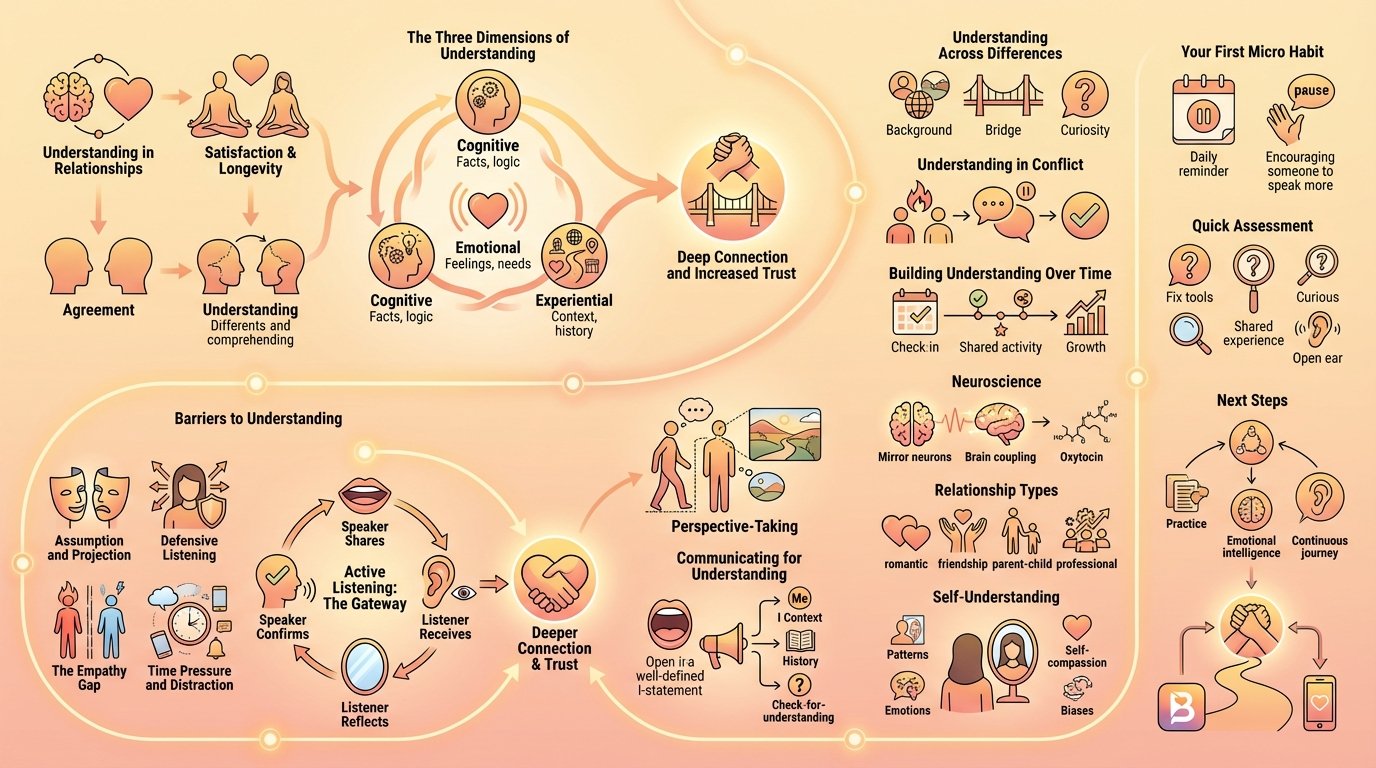
Research shows that understanding forms the foundation of healthy relationships. Studies from the Gottman Institute indicate that couples who demonstrate high levels of mutual understanding report significantly greater relationship satisfaction and longevity. Yet many people confuse understanding with agreement, missing the subtle but crucial distinction.
This guide explores how understanding works in relationships, why it matters more than you might realize, and how to cultivate this essential skill. Later, you will discover practical techniques backed by psychology research that help you understand others more deeply while feeling more understood yourself.
What Is Understanding? The Psychology Behind Connection
Understanding represents the cognitive and emotional process of grasping another person's perspective, feelings, motivations, and experiences. It requires both intellectual comprehension and emotional attunement, creating a bridge between separate subjective realities.
Surprising Insight: Surprising Insight: Neuroscience research reveals that understanding activates similar brain regions in both the speaker and listener. When you truly understand someone, your neural patterns literally begin to synchronize with theirs, creating what researchers call brain-to-brain coupling. This biological resonance explains why deep understanding feels so powerful.
Psychologist Carl Rogers distinguished between two types of understanding. Surface understanding involves grasping the literal meaning of words and basic facts. Deep understanding, which he called empathic understanding, involves perceiving the emotional and experiential world of another person as if it were your own while maintaining awareness that it remains their experience, not yours.
This distinction matters because many conflicts arise not from lack of information but from failure to achieve emotional understanding. Your partner might explain why they feel hurt, and you might intellectually comprehend their explanation without emotionally understanding their pain. This gap between cognitive and emotional understanding creates disconnection even when both people are technically communicating clearly.
Understanding differs fundamentally from agreement. You can deeply understand someone's perspective without sharing it. This separation allows for genuine connection across differences, making understanding more flexible and powerful than consensus.
The Three Dimensions of Understanding
Complete understanding operates across multiple dimensions simultaneously. Mastering all three creates the deepest form of interpersonal connection.
The Three Dimensions of Deep Understanding
🔍 Click to enlarge
Cognitive understanding involves grasping the factual and logical aspects of what someone communicates. When your friend explains their career decision, cognitive understanding means you comprehend the reasoning, timeline, and practical considerations they describe.
Emotional understanding requires perceiving the feelings and motivations beneath surface communication. Beyond understanding why your friend chose a new career path, emotional understanding means sensing their excitement, anxiety, relief, or uncertainty about this transition.
Experiential understanding involves recognizing how someone's unique background, culture, history, and current circumstances shape their perspective. This dimension acknowledges that your friend's career decision makes sense within their particular life context, even if different from choices you would make.
Most people develop strength in one or two dimensions while neglecting the third. Analytical thinkers excel at cognitive understanding but sometimes miss emotional cues. Highly empathetic individuals tune into emotions but may overlook logical considerations. Complete understanding requires cultivating all three dimensions.
Why Understanding Matters More Than You Think
Understanding serves as the foundation for virtually every positive relationship outcome. Research across psychology, neuroscience, and relationship science demonstrates its far-reaching effects.
The Gottman Institute's decades of relationship research identified understanding as one of the strongest predictors of relationship success. Couples who demonstrate mutual understanding navigate conflicts more constructively, maintain intimacy during stressful periods, and report higher relationship satisfaction over time.
Understanding reduces conflict intensity and duration. When people feel understood, they experience less defensiveness and more openness to alternative perspectives. This shift transforms potential arguments into productive conversations. A study published in the Journal of Personality and Social Psychology found that simply feeling understood reduced relationship conflict by nearly 40 percent.
In workplace settings, understanding improves team performance and innovation. Research from Google's Project Aristotle identified psychological safety, which depends heavily on mutual understanding, as the most important factor distinguishing high-performing teams. When team members feel understood, they contribute more ideas, take appropriate risks, and collaborate more effectively.
Understanding also affects physical health. Studies show that people who feel understood by their partners experience lower blood pressure, reduced stress hormones, and better immune function. The health benefits of feeling understood rival those of exercise and healthy eating, highlighting understanding's biological importance.
Perhaps most importantly, understanding creates the conditions for personal growth. When someone truly understands you, they see possibilities you cannot yet perceive in yourself. This witnessing allows for transformation that rarely occurs in isolation.
The Barriers to Understanding Others
Despite understanding's importance, numerous obstacles prevent it. Recognizing these barriers represents the first step toward overcoming them.
Assumption and Projection
People naturally assume others think, feel, and experience the world similarly to themselves. This cognitive shortcut, called projection, creates invisible barriers to understanding. You assume your partner needs space when stressed because you need space when stressed, missing that they actually crave connection during difficult times.
Neuroscience research shows that your brain automatically uses your own mental models to interpret others' behavior. Overcoming this requires conscious effort to question your assumptions and seek clarification rather than relying on automatic interpretations.
Defensive Listening
When conversations trigger defensiveness, understanding becomes nearly impossible. Defensive listening involves scanning for threats, preparing counterarguments, and protecting your self-image rather than genuinely absorbing what someone communicates.
This happens automatically when you feel criticized, misunderstood, or attacked. Your nervous system shifts into self-protection mode, reducing your capacity for the openness understanding requires. Recognizing when you have become defensive allows you to pause and reset before responding.
The Empathy Gap
Psychological research identifies a phenomenon called the empathy gap, where people systematically underestimate how differently they think and feel in different emotional states. When calm, you cannot fully grasp how you think when angry. When content, you struggle to understand what you need when lonely.
This creates barriers between people in different emotional states. Your partner's distress seems irrational when you feel fine, making genuine understanding challenging. Awareness of the empathy gap helps you extend more compassion toward perspectives that seem foreign from your current state.
Time Pressure and Distraction
Understanding requires presence and attention. Modern life's constant distractions and time pressures undermine the sustained focus genuine understanding demands. You cannot deeply understand someone while checking your phone, planning your response, or thinking about your next meeting.
Research shows that multitasking during conversations reduces comprehension by up to 50 percent. Creating protected time for important conversations without distractions becomes essential for building understanding.
Active Listening: The Gateway to Understanding
Active listening forms the primary skill for developing understanding. Unlike passive hearing, active listening involves deliberate attention, engagement, and reflection that helps you grasp both content and emotional meaning.
The Active Listening Cycle
🔍 Click to enlarge
Active listening begins with full presence. This means eliminating distractions, making eye contact, and orienting your body toward the speaker. These physical cues signal your engagement while also helping your brain focus more completely.
Reflective listening techniques help verify understanding. After someone shares, paraphrase what you heard in your own words. This reflection serves multiple purposes. It confirms you understood correctly, shows the speaker you paid attention, and gives them opportunity to clarify any misunderstandings.
Effective reflections capture both content and emotion. Instead of simply repeating facts, include the feelings you detected. When your friend says they are considering leaving their job, respond with something like: So you are thinking about moving on from your current role, and it sounds like you are feeling both excited about new possibilities and anxious about making such a big change. Am I understanding that right?
Questions deepen understanding when used skillfully. Open-ended questions invite elaboration and clarification. What matters most to you about this decision? How are you feeling as you think about these options? What would make this situation feel more manageable?
Avoid disguised advice or judgments framed as questions. Why would you even consider that? or Have you thought about just talking to your boss? shift focus away from understanding toward fixing or evaluating. Genuine questions explore rather than direct.
Silence supports understanding. Pausing after someone shares gives them space to go deeper, signals you are processing rather than rushing to respond, and allows emotions to settle. Many breakthrough moments of understanding emerge from comfortable silence rather than continuous talking.
Perspective-Taking: Seeing Through Another's Eyes
Perspective-taking involves mentally stepping into someone else's position to view situations from their vantage point. This cognitive and emotional exercise expands understanding beyond what surface conversation reveals.
Research distinguishes between two types of perspective-taking. Cognitive perspective-taking involves understanding someone's thoughts, beliefs, and reasoning. Emotional perspective-taking, also called empathic concern, involves sharing their emotional experience.
Effective perspective-taking requires temporarily setting aside your own viewpoint without abandoning it entirely. You maintain awareness that this represents their perspective while fully exploring what the world looks like from their position.
A powerful technique involves asking yourself specific questions. What might they be seeing that I am missing? What values or priorities might make their response make perfect sense? What fears or hopes might be driving their behavior? What has their past experience taught them that shapes how they see this situation?
Written perspective-taking exercises deepen understanding in difficult relationships. Write several paragraphs from the other person's point of view, describing the situation and your behavior as they might experience it. This often reveals blind spots and generates compassion for perspectives you initially found baffling.
Cultural humility enhances perspective-taking across differences. This involves recognizing that your own cultural background, identity, and experiences create a particular lens through which you view the world, not an objective or universal perspective. Approaching cross-cultural understanding with curiosity rather than assumptions prevents misunderstandings.
Communicating for Understanding: Making Yourself Understood
Understanding flows both directions. While this guide emphasizes understanding others, being understood matters equally for relationship health and personal wellbeing.
Clear self-expression forms the foundation for being understood. This means knowing what you think, feel, need, and want before trying to communicate it. Journaling or quiet reflection helps clarify your internal experience so you can share it more coherently.
I-statements reduce defensiveness while promoting understanding. Instead of You never listen or You always criticize, frame observations from your perspective: I feel unheard when I share something important and you stay on your phone or I feel hurt when you point out mistakes without acknowledging what went well.
Separating observation, feeling, need, and request creates clearer communication. This framework from Nonviolent Communication helps others understand precisely what you experience and want. When you did not call when you said you would yesterday, I felt worried and frustrated because I need reliability and consideration in our relationship. Would you be willing to send a quick text if plans change?
Providing context helps others understand your reactions. When you share background that shapes your perspective, people grasp why particular situations matter to you. I know this might seem like a small thing, but I grew up in a family where people often made promises they did not keep, so reliability feels really important to me in relationships.
Check for understanding after sharing something important. Ask the other person to reflect back what they heard. This verification step catches misunderstandings early and gives you opportunity to clarify before assumptions take root.
Accept that perfect understanding remains impossible. No one will ever fully grasp your internal experience. Releasing the expectation of complete understanding reduces frustration while helping you appreciate the understanding that does occur.
Understanding Across Differences
Understanding becomes more challenging yet more valuable when people differ significantly in background, values, identity, or experience. Specific strategies help bridge these gaps.
Curiosity replaces judgment as the foundation for cross-difference understanding. When someone's perspective confuses or troubles you, genuine questions help more than conclusions. What experiences led you to see it this way? or Help me understand what this means from your perspective opens dialogue that assumptions close.
Acknowledging your own limited perspective creates openness to learning. Statements like I have not experienced what you are describing, so I might not fully understand or My background gives me blind spots here, so please let me know if I miss something signal humility that invites deeper sharing.
Looking for common ground beneath surface differences often reveals shared humanity. While specific beliefs, practices, or choices differ, underlying needs, values, and concerns frequently overlap. You might disagree about political solutions while sharing concern for community wellbeing and children's futures.
Educating yourself about others' contexts and experiences demonstrates respect and builds understanding. Reading, watching documentaries, or exploring others' cultural practices outside of direct conversations reduces the burden on individuals to constantly explain their perspective.
Accepting discomfort helps you stay present during difficult conversations about difference. Understanding perspectives that challenge your worldview often feels uncomfortable. Recognizing that discomfort does not equal danger allows you to remain engaged rather than shutting down or attacking.
Understanding in Conflict: When Stakes Feel Highest
Conflict presents both the greatest barrier and the greatest opportunity for understanding. When tensions rise, understanding typically decreases precisely when you need it most.
The Gottman method for conflict resolution places understanding at its center. Before attempting to solve any problem, partners must demonstrate that they fully understand each other's perspective. This requirement transforms arguments by shifting focus from winning to comprehending.
A structured understanding dialogue helps during heated disagreements. One person shares their perspective for several minutes without interruption. The listener then reflects back what they heard, focusing on understanding rather than agreeing or disagreeing. Only after the speaker confirms they feel understood does the listener share their own perspective, receiving the same careful listening in return.
This process feels artificial initially but creates breakthrough moments. Many conflicts dissolve when both people feel genuinely understood, even when initial positions seemed incompatible. Understanding often reveals that apparent disagreements mask underlying compatible needs or values.
Separating understanding from problem-solving prevents premature solutions. Jumping to fixes before establishing understanding usually creates additional conflict. Take time to thoroughly understand each perspective before brainstorming solutions. Solutions generated from mutual understanding tend to satisfy everyone more completely.
Repair attempts matter when understanding breaks down during conflict. Research shows that successful couples frequently attempt to restore connection during disagreements through humor, affection, or explicitly requesting a fresh start. I am sorry, I am not doing a good job understanding you right now. Can we slow down so I can really hear what matters to you? often shifts unproductive arguments toward productive dialogue.
Building Understanding Over Time
Deep understanding develops gradually through consistent small interactions rather than occasional deep conversations. Daily practices compound into profound mutual knowledge.
Regular check-ins create opportunities for ongoing understanding. Asking How are you really doing? with genuine interest and time to listen builds connection. These conversations work best when they become routine rather than only occurring during crises.
Shared experiences deepen understanding by creating common reference points. Engaging in new activities together, facing challenges as a team, or simply spending unstructured time together generates mutual understanding that direct conversation cannot fully capture.
Noticing and naming positive moments strengthens understanding. When you recognize something about how your partner thinks, feels, or experiences the world, acknowledge it. I noticed you seemed more relaxed after spending time gardening. It seems like working with plants really helps you unwind. These observations demonstrate attentiveness that builds understanding over time.
Creating psychological safety allows understanding to flourish. When people trust that sharing vulnerably will not result in judgment, criticism, or having information used against them later, they open more fully. Protecting confidences, responding compassionately to difficult disclosures, and avoiding weaponizing past sharing builds this essential safety.
Updating your understanding as people change prevents outdated assumptions. The person you knew five years ago differs from who they are today. Regular curious exploration, even in long-term relationships, acknowledges ongoing growth and change rather than freezing people in past versions of themselves.
The Neuroscience of Understanding
Recent brain research reveals the biological mechanisms underlying understanding and explains why it feels so powerful when it occurs.
Mirror neurons fire both when you perform an action and when you observe someone else performing that action. This neural mirroring creates the foundation for understanding others' intentions and emotions. When you watch someone reach for a cup, mirror neurons activate similar patterns as if you were reaching yourself.
The same system activates for emotions. Observing someone's emotional expression triggers neural patterns associated with experiencing that emotion yourself. This biological resonance explains why emotions feel contagious and why empathic understanding involves literally sharing aspects of another's neural state.
Brain-to-brain coupling occurs during successful communication. Neuroscientist Uri Hasson's research shows that when a speaker and listener achieve understanding, their brain activity synchronizes. The listener's neural patterns begin to mirror the speaker's with a slight delay, creating what researchers call neural alignment.
This coupling predicts comprehension. The more closely brain patterns align, the better the listener understands and remembers what was shared. This biological synchronization explains why deep understanding feels like resonance or clicking with someone.
Oxytocin, often called the bonding hormone, facilitates understanding by reducing fear and increasing trust. This neurochemical makes people more willing to be vulnerable, more receptive to others' perspectives, and better at reading emotional cues. Positive physical touch, eye contact, and feeling understood all increase oxytocin, creating an upward spiral of connection.
Understanding these biological foundations helps explain why understanding matters so profoundly. You are not just exchanging information but literally synchronizing your neural activity with another human being, creating connection at the most fundamental biological level.
Understanding in Different Relationship Types
While understanding principles remain consistent across relationships, specific applications vary depending on relationship type and context.
Romantic Relationships
Romantic partnerships require both everyday understanding and deep knowledge of your partner's inner world. Understanding your partner's love language, attachment style, values, dreams, fears, and triggers allows you to show love in ways they can receive and navigate challenges with compassion.
Emotional bids represent crucial moments for understanding. When your partner shares something, they make a bid for connection. Turning toward these bids with interest and engagement builds understanding and intimacy. Turning away or against them erodes connection over time.
Friendships
Understanding in friendships centers on acceptance and validation. Friends offer understanding without the negotiation and compromise romantic relationships require. This makes deep understanding both easier and more essential for friendship satisfaction.
Friends who feel understood report greater friendship quality and longevity. Understanding also allows friendships to survive life transitions and changing circumstances by maintaining connection despite surface-level changes.
Parent-Child Relationships
Parental understanding profoundly impacts child development. Children who feel understood by caregivers develop better emotional regulation, higher self-esteem, and stronger relationship skills. Understanding involves seeing beneath behavior to the needs, emotions, and experiences driving it.
Understanding differs from permissiveness. You can deeply understand why your child feels angry about bedtime while maintaining the boundary. Your limit stays firm, but your understanding helps the child feel seen and develops their emotional awareness.
Professional Relationships
Workplace understanding improves collaboration, reduces conflict, and increases productivity. Understanding colleagues' working styles, motivations, and pressures helps you work together more effectively. Managers who understand their team members' strengths, growth edges, and personal circumstances lead more successfully.
Professional understanding maintains appropriate boundaries while creating genuine connection. You need not share or understand everything about coworkers' personal lives, but understanding their professional perspectives, goals, and challenges enhances workplace relationships.
Self-Understanding: The Foundation for Understanding Others
Your capacity to understand others connects directly to how well you understand yourself. Self-awareness illuminates your own patterns, making you more attuned to similar dynamics in others.
Self-reflection practices build self-understanding. Journaling, meditation, therapy, and honest conversations with trusted friends help you recognize your patterns, motivations, triggers, and growth edges. This awareness prevents you from unconsciously projecting your own experience onto others.
Understanding your emotional landscape helps you read others more accurately. When you have named and worked with your own anxiety, anger, grief, or joy, you recognize these emotions more readily in others. Emotional granularity, the ability to distinguish between subtle emotional states, increases both self-understanding and understanding of others.
Recognizing your biases and assumptions allows you to question them when understanding others. Everyone carries cognitive biases, cultural conditioning, and personal experiences that shape perception. Knowing your particular biases helps you compensate for them rather than mistaking them for objective truth.
Self-compassion paradoxically improves your ability to understand others. Research shows that people who treat themselves with kindness demonstrate more compassion and understanding toward others. When you accept your own imperfections, you more easily accept others' as well.
Technology and Understanding in Modern Relationships
Digital communication creates both opportunities and challenges for understanding. Awareness of these dynamics helps you navigate relationships in an increasingly digital world.
Text-based communication removes tone, facial expression, and body language that convey much of emotional meaning. This makes misunderstanding more likely while reducing opportunities to catch and repair miscommunication. Using video calls for important conversations preserves more communication channels than texting or email.
The permanence of digital communication creates advantages and risks. You can review written exchanges to better understand someone's perspective or notice patterns over time. However, messages stripped of context can be reinterpreted negatively, and digital records of conflicts can reinforce grievances rather than allowing them to fade.
Social media presents curated versions of life that rarely represent complete reality. Understanding others based primarily on social media content creates distorted perceptions. In-person interaction remains essential for genuine understanding despite digital tools' convenience.
Technology can support understanding when used intentionally. Sharing articles, podcasts, or videos that articulate your perspective helps others understand your thinking. Using collaborative documents to work through disagreements gives both people time to reflect and articulate thoughts more clearly than heated real-time discussions allow.
When Understanding Alone Is Not Enough
Understanding represents a crucial relationship component but does not solve every problem or meet every need. Recognizing understanding's limitations prevents unrealistic expectations.
Some conflicts involve genuinely incompatible needs or values where understanding reveals rather than resolves the incompatibility. Understanding why your partner wants children while you do not eliminates the fundamental disagreement. In such cases, understanding helps you make informed decisions about the relationship's future.
Harmful behavior requires boundaries regardless of understanding. You might understand the childhood trauma driving someone's emotional abuse while still needing to protect yourself by ending the relationship. Compassion and self-protection coexist.
Professional support becomes necessary when relationship patterns persist despite mutual understanding and good-faith efforts. Therapists help identify invisible dynamics, teach specific skills, and provide structured support for building understanding when couples feel stuck.
Understanding cannot substitute for other relationship essentials like trust, respect, commitment, and action. Someone might understand your needs perfectly while choosing not to meet them. Understanding informs choices but does not guarantee particular outcomes.
Tu primer micro hábito
Start Building Understanding Today
Today's action: Once daily during any conversation, pause after the other person speaks and say Tell me more about that before responding with your own thoughts. Use this simple phrase to invite deeper sharing and practice genuine curiosity.
This tiny habit interrupts the automatic pattern of immediately responding with your own perspective. By consistently inviting elaboration, you train yourself to prioritize understanding over being understood. The phrase Tell me more creates space for deeper sharing while signaling genuine interest. Over time, this micro habit transforms how you listen and how deeply others share with you.
Track your daily understanding practice and discover your unique communication patterns with our AI relationship coach.
Evaluación rápida
Discover your understanding style with these self-reflection questions. Your answers reveal which aspects of understanding come naturally and which areas offer growth opportunities.
When someone shares a problem with you, what is your first instinct?
Your automatic response reveals whether you prioritize fixing, understanding, connecting through similarity, or emotional attunement. Each approach has value, but understanding benefits from leading with curiosity before other responses.
How do you typically respond when someone's perspective confuses or frustrates you?
This reveals your default stance toward perspectives different from yours. Understanding flourishes when confusion triggers curiosity rather than judgment or avoidance.
What matters most to you in conversations about differences or disagreements?
Your priorities shape how you approach understanding. While all these goals have merit, deep understanding often requires temporarily prioritizing being heard over agreement, solutions, or comfort.
Take our complete wellbeing assessment to get personalized insights about your relationship patterns and communication approach.
Discover Your Communication Style →Deep Dive: Watch and Learn
For a comprehensive exploration of how understanding functions in relationships and the psychology behind genuine connection, watch this educational video that brings research to life with practical examples.
Preguntas frecuentes
Next Steps on Your Understanding Journey
You now understand how understanding works, why it matters, and specific practices for developing this essential relationship skill. This knowledge empowers you to create deeper connections across all areas of life.
Start with the Tell me more micro habit this week. This simple practice immediately improves how people experience conversations with you while training you to prioritize understanding. Notice how this small shift affects the depth and quality of your interactions.
Explore related topics like communication for essential verbal skills, emotional intelligence for better emotional attunement, empathy for developing feeling-based understanding, and active listening for deeper engagement. These interconnected skills reinforce each other, creating upward spirals of connection.
Remember that understanding represents an ongoing practice rather than a destination. Even after decades of relationship, new depths of understanding remain possible. Approach understanding with curiosity, patience, and compassion for yourself and others as you develop this transformative capacity.
Author Bio
Research Sources
This article is based on peer-reviewed research and authoritative sources. Below are the key references we consulted:
Related Glossary Articles
Frequently Asked Questions
How can I get someone to understand me better?
Focus first on understanding them. Research shows that people become dramatically more receptive to understanding you after they feel understood themselves. Use clear I-statements to express your experience, provide relevant context that helps them see where you are coming from, and verify understanding by asking them to reflect back what they heard. Remember that being understood is a collaborative process that requires both clear communication from you and genuine receptivity from them.
Is it possible to understand someone without agreeing with them?
Absolutely. Understanding and agreement are separate processes. You can deeply grasp someone's perspective, emotions, and reasoning while maintaining a different viewpoint yourself. This distinction allows for connection across differences and prevents the false choice between understanding and abandoning your own perspective. Saying I understand why you see it that way does not mean I agree with your conclusion.
What should I do when someone refuses to try to understand my perspective?
First, ensure you have genuinely understood their perspective, as people typically open to understanding others only after feeling understood themselves. If someone consistently refuses to understand you despite your efforts to understand them, this reveals important information about the relationship's health and their capacity for connection. You might need to adjust your expectations, seek support from others who do offer understanding, or evaluate whether the relationship serves your wellbeing.
How long does it take to really understand someone?
Deep understanding develops gradually over time and never fully completes. You can understand important aspects of someone quickly, while other dimensions emerge only through years of interaction. People also change continuously, requiring ongoing effort to update your understanding. Rather than seeking complete understanding, focus on building progressively deeper understanding through consistent attention and genuine curiosity.
Can too much understanding be a problem?
Understanding itself rarely creates problems, but certain responses to understanding can. Over-identifying with someone else's experience while losing connection to your own needs creates unhealthy enmeshment. Using understanding to excuse harmful behavior prevents necessary boundaries. Understanding someone's perspective so thoroughly that you abandon your own constitutes losing yourself rather than genuine connection. Healthy understanding maintains awareness of both your perspective and theirs simultaneously.
Take the Next Step
Ready to improve your wellbeing? Take our free assessment to get personalized recommendations based on your unique situation.
- Discover your strengths and gaps
- Get personalized quick wins
- Track your progress over time
- Evidence-based strategies