Emotional Granularity
Have you ever felt something you couldn't quite name? Perhaps a blend of disappointment, frustration, and sadness all rolled into one? Most people label this complex emotional state simply as 'bad' or 'upset.' But what if you could distinguish the precise shades of emotion the same way an artist perceives subtle variations in color? This ability to experience and articulate fine-grained emotional distinctions is called emotional granularity, and neuroscience shows it fundamentally changes how your brain regulates emotions, handles stress, and maintains mental health. Lisa Feldman Barrett's groundbreaking research reveals that people who can differentiate among specific emotional states—rather than lumping them all into broad categories—visit doctors less frequently, use fewer medications, experience fewer hospitalizations, and demonstrate remarkable resilience when facing life challenges.
The science is compelling: individuals with high emotional granularity are 30 percent more flexible in emotion regulation, less likely to drink excessively under stress, and significantly less prone to aggression or self-injurious behavior.
Your emotional vocabulary literally shapes your brain circuits and your capacity to thrive. In this comprehensive guide, you'll discover what emotional granularity is, why it matters for your health, and practical techniques to build this transformative skill starting today.
What Is Emotional Granularity?
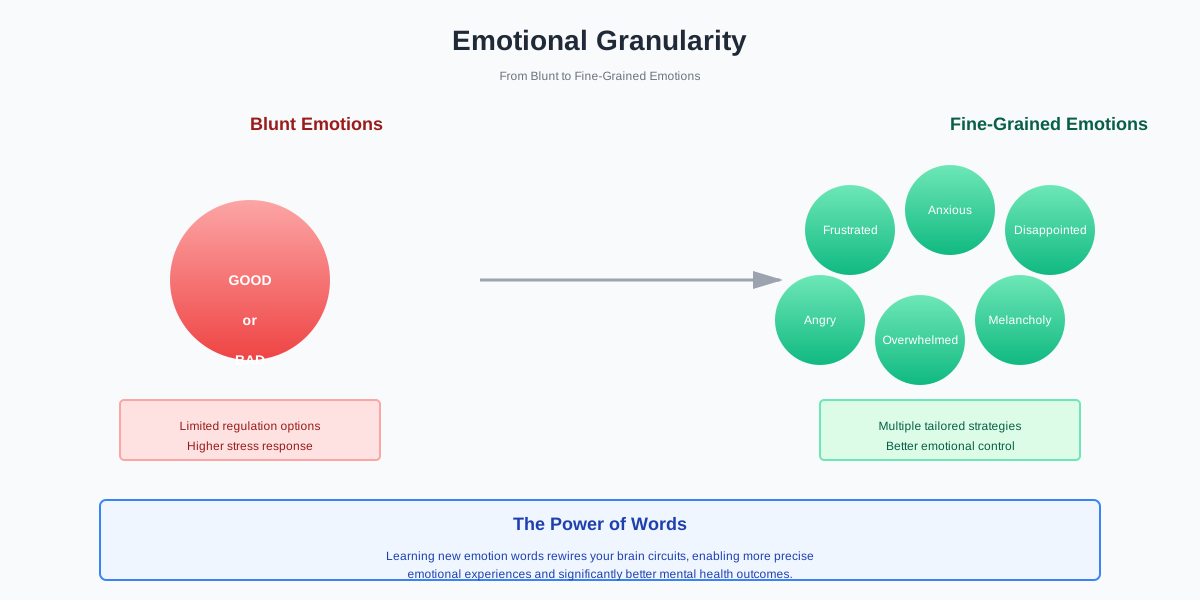
Emotional granularity is the individual ability to create differentiated, nuanced, and context-specific emotional experiences. It refers to how finely you can distinguish among different emotional states and assign them precise labels. Rather than experiencing emotions on a simple scale from 'good' to 'bad,' individuals with high emotional granularity recognize subtle distinctions: frustration versus annoyance, contentment versus excitement, melancholy versus despair. This concept was developed and popularized by neuroscientist Lisa Feldman Barrett and represents a fundamental shift in how we understand emotional intelligence and mental health.
Not medical advice.
Think of emotional granularity like the difference between seeing color and experiencing the full spectrum. An interior designer perceives dozens of distinct blue shades—navy, cobalt, periwinkle, cerulean—where others see simply 'blue.' Similarly, someone with high emotional granularity experiences 'frustrated' as distinct from 'disappointed,' and 'anxious' as different from 'worried,' even though these all fall within the category of unpleasant feelings. This precision has profound implications for how your brain processes emotions and responds to life's challenges.
Surprising Insight: Surprising Insight: People with high emotional granularity go to the doctor 30% less often, use medications less frequently, and experience fewer hospitalization days—demonstrating that emotional vocabulary literally impacts physical health
From Blunt to Granular: The Emotional Spectrum
Shows how emotional granularity transforms broad emotional categories into precise distinctions
🔍 Click to enlarge
Why Emotional Granularity Matters in 2026
In our fast-paced, high-stress world of 2026, emotional granularity has become a crucial skill for mental health and resilience. The modern environment bombards us with competing demands, social media comparisons, and uncertainty that trigger emotional responses daily. Research shows that individuals unable to distinguish between specific emotions are more likely to employ maladaptive coping mechanisms—excessive drinking, aggressive behavior, or avoidance—when stressed.
By contrast, those with high emotional granularity can identify precisely what they're feeling and select targeted, effective emotion regulation strategies appropriate to their specific emotional state. This granularity serves as a protective factor against depression and anxiety disorders.
Moreover, enhanced emotional granularity improves decision-making and relationships. When you understand your emotions with precision, you respond more thoughtfully rather than reactively. You communicate more effectively about your internal states, making emotional granularity a cornerstone of wellbeing across all life domains. This connects directly to broader self-awareness and emotional intelligence development.
In our fast-paced, high-stress world of 2026, emotional granularity has become a crucial skill for mental health and resilience. The modern environment bombards us with competing demands, social media comparisons, and uncertainty that trigger emotional responses daily. Research shows that individuals unable to distinguish between specific emotions are more likely to employ maladaptive coping strategies—excessive drinking, aggressive behavior, or avoidance—when stressed. By contrast, those with high emotional granularity can identify precisely what they're feeling and select targeted, effective regulation strategies appropriate to their specific emotional state.
Moreover, emotional granularity serves as a protective factor against depression and anxiety disorders. Multiple NIH studies demonstrate that the ability to differentiate among negative emotions correlates with reduced severity of anxiety and depressive symptoms. When you can name your emotions with precision, you gain psychological control and clarity—essential elements for navigating contemporary mental health challenges where stress-related disorders continue rising globally.
Additionally, enhanced emotional granularity improves decision-making and relationships. When you understand your emotions with precision, you respond more thoughtfully rather than reactively. You communicate more effectively about your internal states to partners, colleagues, and friends. This clarity transforms conflict resolution and deepens emotional connections, making emotional granularity a cornerstone of wellbeing across all life domains.
The Science Behind Emotional Granularity
Neuroscience reveals that emotional granularity operates through the brain's predictive architecture. Rather than emotions being fixed, innate responses, neuroscientist Lisa Feldman Barrett's theory of constructed emotion demonstrates that your brain actively constructs emotional experiences using prior knowledge, conceptual frameworks, and learned associations. Your emotion vocabulary literally seeds your emotional concepts. Words you know shape the predictions your brain generates, which in turn determine how you experience and regulate emotions through mindfulness and conscious practice.
Research from the NIH demonstrates that learning new emotion words directly increases emotional granularity. In controlled interventions, participants who completed emotion knowledge training showed significant increases in their ability to distinguish among emotions, particularly negative emotions. This finding proves emotional granularity is not fixed at birth but rather a trainable skill that improves with practice and expanded vocabulary, similar to building stress management skills.
How Emotion Words Build Brain Circuits
Illustrates the pathway from vocabulary to brain predictions to emotional experience
🔍 Click to enlarge
Key Components of Emotional Granularity
Emotion Differentiation
Emotion differentiation is your capacity to distinguish one emotion from another, particularly among emotions that share similar valence (pleasantness) or arousal (activation level). High differentiation means you recognize that 'frustration' differs from 'irritation,' that 'contentment' differs from 'joy,' and that 'loneliness' differs from 'sadness.' This distinction is crucial because each emotion signals different information about your environment and suggests different appropriate responses. Frustration might call for persistence and problem-solving, while irritation might call for a break. Research shows that negative emotion differentiation predicts better coping strategies and fewer maladaptive behaviors when stressed.
Emotional Vocabulary
Your emotional vocabulary—the collection of emotion words you regularly use and understand—forms the foundation of emotional granularity. Research proves that expanding your emotion vocabulary directly improves your ability to distinguish emotional states. People who know dozens of emotion words and use them regularly develop more sophisticated emotional concepts than those with limited vocabulary. This is why emotion knowledge interventions that teach new emotion words consistently produce measurable improvements in emotional granularity and mental health outcomes. Your vocabulary literally expands your emotional world.
Interoceptive Awareness
Interoceptive awareness is your ability to sense internal bodily states—heart rate, breathing, tension, temperature—and accurately interpret these sensations. Emotional granularity depends partly on interoceptive awareness because emotions manifest as physical sensations. When you're aware of subtle differences in your bodily state, you can link these physical signals to specific emotions. Someone with high interoceptive awareness notices the particular quality of tension associated with 'apprehension' differs from the tension of 'determination.' This embodied awareness grounds emotional granularity in somatic reality rather than abstract concepts alone.
Emotion Regulation Flexibility
Emotional granularity enables regulation flexibility—the ability to select and apply different emotion regulation strategies based on which specific emotion you're experiencing. If you experience all negative emotions as simply 'bad,' you might apply the same regulation strategy (perhaps avoidance or distraction) to every unpleasant feeling. But if you can distinguish that you're feeling 'overwhelmed' rather than 'angry,' you might choose a calming strategy instead of an energizing one. Research shows that people with high emotional granularity are 30% more flexible in selecting appropriate emotion regulation strategies, which contributes to their superior mental health outcomes.
| Dimension | Low Granularity (Blunt) | High Granularity (Fine-Grained) |
|---|---|---|
| Emotion Recognition | Broad categories (good/bad) | Precise distinctions (frustrated vs. disappointed) |
| Vocabulary Size | 5-10 emotion words | 40+ emotion words |
| Regulation Strategy | One default strategy (avoidance) | Multiple tailored strategies |
| Doctor Visits | 15+ annually on average | 10 or fewer annually |
| Medication Use | Higher frequency | Lower frequency |
| Coping with Stress | Maladaptive (drinking, aggression) | Adaptive strategies |
How to Apply Emotional Granularity: Step by Step
- Step 1: Pause when you notice an unpleasant emotion and resist the urge to label it simply as 'bad' or 'upset.' Instead, take five seconds to observe the emotional state more carefully.
- Step 2: Notice your physical sensations: Is your chest tight? Is your jaw clenched? Are you restless? These bodily signals contain clues about which specific emotion you're experiencing.
- Step 3: Ask yourself clarifying questions: Am I frustrated because something is taking longer than expected? Am I disappointed because an outcome didn't match my hopes? Am I anxious about an upcoming event? Am I angry about an injustice?
- Step 4: Consult an emotion wheel or emotion vocabulary list to find precise words that match your experience. Look for words like 'exasperated,' 'deflated,' 'apprehensive,' or 'indignant' rather than generic labels.
- Step 5: Say the precise emotion word out loud or write it down. This activates your brain's language circuits and strengthens the association between your emotional experience and that specific word.
- Step 6: Reflect on what this specific emotion is signaling. Frustration signals that you care about an outcome. Disappointment signals that your expectations weren't met. Anxiety signals potential threat. Each emotion carries distinct information.
- Step 7: Select a regulation strategy matched to your specific emotion. Frustration might call for breaking down a problem into steps. Disappointment might call for self-compassion. Anxiety might call for grounding exercises.
- Step 8: Practice this differentiation daily for at least two weeks. Neuroscience shows that consistent practice rewires emotion-processing brain circuits. The more frequently you distinguish emotions, the more automatic this skill becomes.
- Step 9: Gradually expand your emotion vocabulary by learning three new emotion words each week. Keep a vocabulary journal where you note new words and how they differ from similar emotions you already know.
- Step 10: Notice changes in your emotional flexibility, your relationships, and your stress response. As emotional granularity improves, most people report greater calm, better decision-making, and more effective conflict resolution.
Emotional Granularity Across Life Stages
Young Adulthood (18-35)
In young adulthood, emotional granularity is still developing. Research shows that emotional differentiation increases substantially throughout the late teens and twenties as the prefrontal cortex matures. This life stage often involves navigating identity formation, career decisions, romantic relationships, and social group changes—all of which generate complex emotional experiences. Young adults with developing emotional granularity tend to experience significant emotional volatility, sometimes labeled as 'drama.' However, this same period offers exceptional opportunity to build emotional granularity skills through deliberate practice. Young adults who invest in expanding their emotion vocabulary and practicing emotion differentiation during these formative years develop stronger emotional foundations for later life. They're also more likely to avoid the self-medication and maladaptive coping patterns that sometimes emerge when emotions feel overwhelming and incomprehensible.
Middle Adulthood (35-55)
Middle adulthood typically represents a peak period for emotional granularity. By this life stage, most people have accumulated decades of emotional experience and typically demonstrate higher emotional differentiation than younger adults. Middle-aged adults often report greater emotional stability and clearer understanding of their emotional patterns. However, this period also brings new emotional challenges: career plateau anxiety, parental responsibility stress, aging parent concerns, and identity reassessment. Those with strong emotional granularity navigate these complex life transitions more effectively because they understand their emotional responses with precision. They can distinguish, for example, between 'grief' about aging parents and 'relief' when caregiving responsibilities ease—emotions that might otherwise blur together. Middle adulthood is an excellent time to deepen emotional granularity further by exploring subtle emotional distinctions you may not have examined before.
Later Adulthood (55+)
In later adulthood, emotional granularity often remains stable or even increases as people gain perspective on their long life experiences. Research shows that older adults with high emotional granularity report better life satisfaction, stronger relationships, and better health outcomes than those with lower granularity. This life stage brings distinct emotional challenges: grief from losses, health concerns, mortality awareness, and role transitions as work ends. Paradoxically, while emotional capacity may be challenged by these life events, the emotional wisdom accumulated over decades often enables finer emotional differentiation. Older adults who maintain intellectual and social engagement tend to preserve or expand emotional granularity. Conversely, social isolation, health crises, or depression can reduce emotional granularity in later life. Actively maintaining emotional granularity through continued learning, social engagement, and mindful emotion practice supports wellbeing and resilience through the later life course.
Profiles: Your Emotional Granularity Approach
The Blunt Namer
- Expandable emotion vocabulary (start with feeling wheels)
- Permission to take time recognizing emotions precisely
- Simple frameworks to connect bodily sensations to specific emotion words
Common pitfall: Dismissing emotions as 'just being bad' and applying the same avoidance strategy to all feelings
Best move: Start a weekly practice: whenever you feel 'bad,' pause and spend five minutes using an emotion wheel to find more specific labels. Track your discoveries.
The Over-Analyzer
- Permission to feel emotions without constantly analyzing them
- Balance between intellectual understanding and embodied experience
- Recognition that over-thinking emotions can prevent regulation
Common pitfall: Spending so much time analyzing emotions that you never actually regulate them or move forward
Best move: Set a 'differentiation timer': spend exactly five minutes naming your emotion precisely, then move to action. Don't ruminate beyond the timer.
The Emotionally Avoidant
- Safe, gradual exposure to naming emotions (start with neutral situations)
- Understanding that emotional granularity increases emotional agency, not overwhelm
- Support for processing emotions that feel too large to confront
Common pitfall: Using numbness or distraction to avoid emotions entirely, which prevents emotional development and insight
Best move: Partner with a therapist or trusted friend. Start naming emotions in low-stakes situations (what did you feel watching that movie?), then gradually practice in higher-stakes moments.
The Emotionally Sensitive
- Recognition that emotional granularity is not about having fewer emotions but understanding them better
- Validation that emotional sensitivity is a strength when paired with regulation skills
- Frameworks for moving from overwhelm to precision
Common pitfall: Being flooded by emotional intensity and collapsing all intense feelings into overwhelm without differentiation
Best move: Use grounding techniques first (breathe, sense your feet), then practice emotion differentiation from a calmer state. Your sensitivity is an asset once you name emotions precisely.
Building Your Emotional Granularity Practice
Developing emotional granularity is not complicated, but it does require consistent, deliberate practice. The most effective approach combines three elements: expanding your emotion vocabulary, practicing emotion differentiation daily, and reflecting on how your improved granularity changes your regulation capacity. Start this week by downloading an emotion wheel (free resources available online) and spending five minutes each day practicing the ten-step process outlined earlier. When you notice any emotion, pause and use the wheel to find more specific labels than your default. Notice how naming emotions precisely shifts your sense of agency and control.
Over the coming weeks, gradually expand this practice. Learn three new emotion words each week and notice opportunities to use them. As your vocabulary grows, your capacity to distinguish emotions grows correspondingly. Within four to eight weeks of consistent practice, most people report noticeable improvements in emotional clarity, regulation flexibility, and overall wellbeing. The neuroplasticity of your emotion circuits ensures that sustained practice rewires your brain's emotional architecture, making fine-grained emotion differentiation increasingly automatic.
Remember: emotional granularity is not a destination but an evolving skill. Even people with naturally high emotional granularity continue refining their emotional distinctions throughout their lives. By investing in this foundational wellbeing skill now, you're building a capacity that will serve your mental health, relationships, and decision-making for decades to come. Your emotional world is far richer and more nuanced than the simple 'good' or 'bad' categories you may have inherited. Emotional granularity unlocks this fuller palette of human experience.
What does emotional granularity primarily refer to?
Like an artist perceiving subtle color variations, emotional granularity is about seeing the nuances in your emotional world.
According to research, people with high emotional granularity visit doctors how much less frequently?
Emotional precision translates into better physical health through improved coping and stress management.
What role does emotional vocabulary play in developing emotional granularity?
Words literally shape your brain. Learning emotion words rewires your neural circuits for better emotional understanding.
Related Glossary Articles
Frequently Asked Questions
Is emotional granularity the same as emotional intelligence?
Emotional granularity is one component of emotional intelligence. Emotional intelligence encompasses multiple skills: self-awareness, self-regulation, motivation, empathy, and relationship skills. Emotional granularity specifically refers to your ability to distinguish among emotional states with precision. You can have high emotional granularity (excellent emotion recognition) but lower emotional intelligence if you can't regulate emotions effectively. Conversely, someone might have good overall emotional intelligence but lower granularity if they recognize emotions broadly but struggle with fine distinctions.
Can I increase emotional granularity at any age?
Yes. Research proves emotional granularity is trainable throughout the lifespan. While it naturally develops somewhat through maturation (particularly in late teens and twenties), deliberate practice increases emotional granularity at any age. Older adults can develop improved emotional differentiation through consistent practice. The key is sustained engagement: learning new emotion words, practicing distinction regularly, and expanding vocabulary over weeks and months. Your brain's neuroplasticity allows emotional circuits to rewire throughout life in response to practiced skills.
Why does emotional vocabulary matter if I already understand my feelings?
Your brain's architecture depends on language for emotional construction. Multiple neuroscience studies show that learning new emotion words actually changes how your brain predicts and generates emotions. Words are not just labels for pre-existing emotions; they are the building blocks your brain uses to construct emotional experiences. When you know more words, your brain can make finer-grained predictions about your emotional states. Additionally, research shows that people who can articulate emotions precisely are more likely to select effective emotion regulation strategies and are less likely to resort to maladaptive coping behaviors. Expanding emotional vocabulary is not redundant; it literally enhances your emotional capabilities.
Does emotional granularity mean I'll be more emotional or less emotional?
Emotional granularity does not change the quantity of emotions you experience; it changes your precision in recognizing and responding to them. Some people worry that developing emotional granularity means becoming 'overly emotional,' but research shows the opposite pattern. When you can distinguish emotions precisely and select targeted regulation strategies, you typically experience greater emotional stability and calm, not increased emotional turmoil. You're not generating more emotions; you're generating the same emotions but with clearer understanding and better regulation options. Most people report feeling more emotionally regulated and stable as their granularity increases.
What's the relationship between emotional granularity and mental health disorders?
Research shows that individuals with depression, anxiety, and other mental health conditions often exhibit lower emotional granularity compared to healthy controls. For some conditions, this lower granularity appears to be a symptom or consequence of the disorder. For others, it may contribute to the disorder's development or maintenance. Importantly, interventions that increase emotional granularity have demonstrated therapeutic benefits for depression and anxiety. NIH studies show that teaching emotion differentiation to depressed individuals improved their condition, independent of other treatments. This suggests that emotional granularity can serve both as a marker of mental health and as a therapeutic target for improvement.
Take the Next Step
Ready to improve your wellbeing? Take our free assessment to get personalized recommendations based on your unique situation.
- Discover your strengths and gaps
- Get personalized quick wins
- Track your progress over time
- Evidence-based strategies
About the Author
Keep quitting habit apps after a missed day? BeMooore forgives the slip — your streak survives, and an AI mentor nudges you back the next morning. Free on iOS.