Kindness
A single act of kindness ripples outward in ways you may never fully witness. When you smile at a stranger, listen deeply to a friend's struggle, or offer genuine help without expectation of return, something profound shifts. Not just in the recipient, but measurably in your own brain and body. Modern neuroscience reveals that kindness is not merely moral behavior—it is a biological superpower that reduces stress, strengthens immunity, extends longevity, and creates a sense of meaning that transcends temporary happiness.
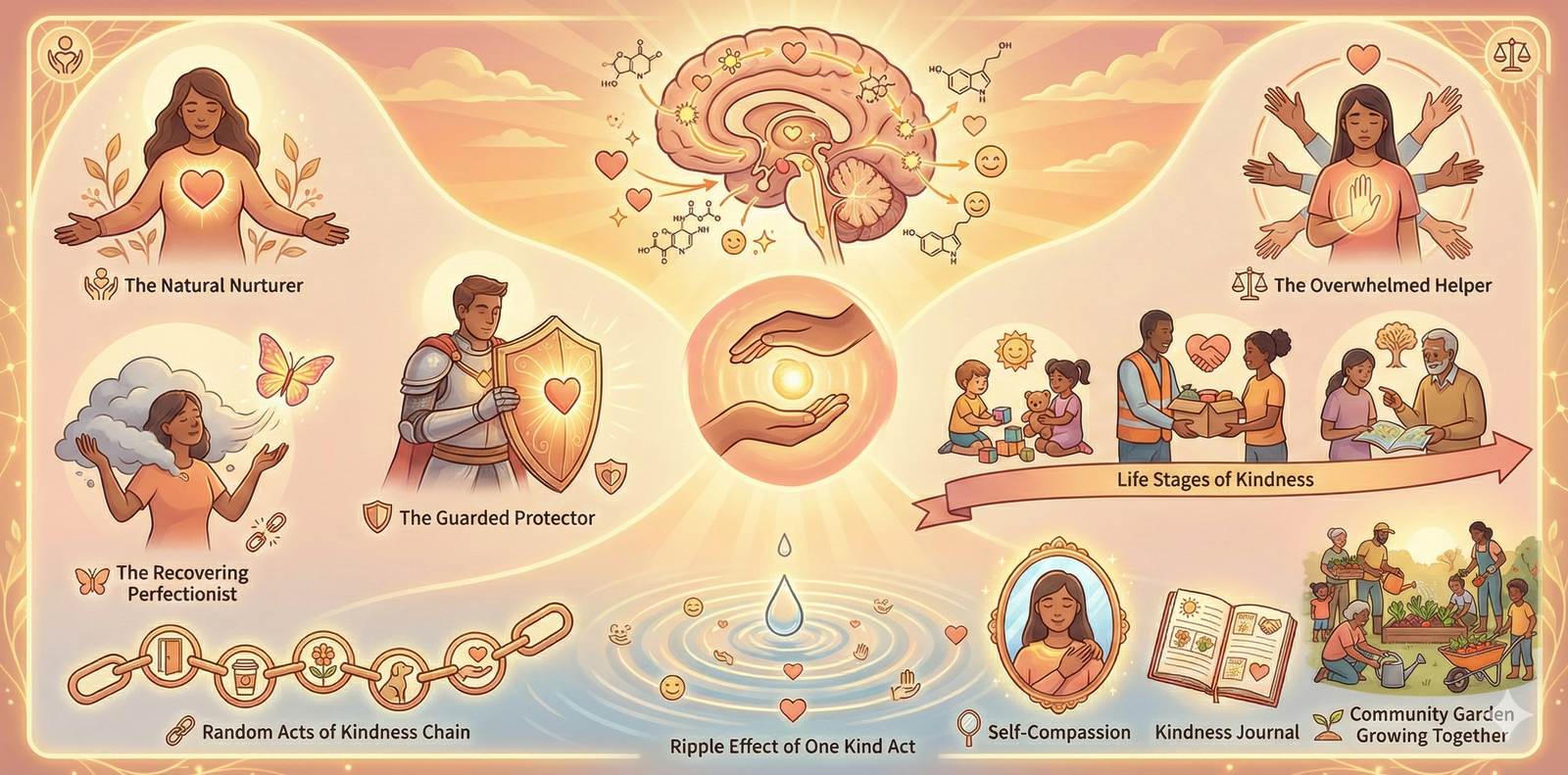
Yet in 2026, many people wrestle with kindness paradoxes: they want to help but fear becoming depleted; they value compassion but struggle with self-criticism; they sense isolation despite digital connection. Understanding kindness—its different expressions, its neurological mechanisms, and its life-stage variations—unlocks a path to sustainable well-being.
This guide explores what kindness truly is, why it matters, and how to practice it in ways that serve both others and yourself.
What Is Kindness?
Kindness is the intentional choice to show care, consideration, and compassion toward others and yourself. It goes beyond politeness or fleeting niceness. Genuine kindness stems from recognizing shared humanity—the understanding that all people experience pain, fear, hope, and longing. It manifests as small gestures (listening without judgment), meaningful actions (helping a neighbor), and internal shifts (extending patience to yourself during difficult moments).
Not medical advice.
Kindness operates across three levels: toward others (offering support, forgiveness, time), toward communities (volunteering, mentoring, generosity), and toward self (self-compassion, personal boundaries, realistic expectations). Most people excel at one level but struggle with another. Someone might volunteer enthusiastically yet harshly criticize themselves. Another person might offer endless patience to friends while neglecting their own needs. Integrated kindness means developing all three.
Surprising Insight: Surprising Insight: Research by UC San Francisco found that people who practice kindness show lower cortisol levels and reduced inflammatory markers—measurable biological markers of stress. The effect is stronger than many pharmaceutical interventions, without side effects.
The Kindness Biology Cycle
How kindness triggers physiological responses that reinforce motivation to be kind again
🔍 Click to enlarge
Why Kindness Matters in 2026
Modern life paradoxically increases both the need for kindness and the barriers to practicing it. Digital communication can feel transactional. Political polarization creates tribal divisions. Pandemic aftermath left many with lingering loneliness and social anxiety. Economic pressures make people feel they lack time or energy to care for others. Yet the 2025 World Health Organization report identified isolation and disconnection as leading contributors to mental health crises in developed nations.
Kindness is not a luxury—it is foundational mental health infrastructure. People embedded in reciprocal relationships of genuine care show 30-40% lower rates of depression and anxiety. They report higher life satisfaction and experience greater resilience during hardship. From an evolutionary perspective, kindness is the neurological mechanism that bound humans into cooperative groups capable of surviving and thriving.
Beyond individual benefits, kindness practices reshape communities. Neighborhoods where people know and help each other report lower crime, better schools, and higher civic participation. Workplaces with cultures of psychological safety and mutual respect show higher innovation, retention, and productivity. Kindness is not soft—it is the structural foundation of resilient communities.
The Science Behind Kindness
When you witness someone experience pain, your brain activates mirror neurons—the same neural networks that fire when you experience pain yourself. This is why empathy feels real: neurologically, you are partially re-experiencing their emotion. This activation of mirror neurons triggers release of oxytocin, a hormone that increases trust, reduces fear, and creates bonding. Research at Stanford Medical School found that oxytocin increases vagal tone, the activity of your vagus nerve—the primary nerve of the parasympathetic nervous system responsible for calm, recovery, and social engagement.
The kindness cycle creates measurable biological shifts. Cortisol (stress hormone) decreases. Blood pressure normalizes. Inflammatory markers drop. Heart rate variability improves. These changes persist for hours after a single act of kindness. Practicing kindness regularly—even briefly, like 10 minutes of compassion meditation—produces structural brain changes visible on fMRI scans within weeks. The anterior insula (emotion processing), anterior cingulate cortex (empathy), and prefrontal cortex (decision-making) show increased gray matter density.
Neurological Pathways of Kindness
Brain regions activated during kind acts and their functional significance
🔍 Click to enlarge
Key Components of Kindness
Self-Kindness and Self-Compassion
Self-kindness is the willingness to treat yourself with the same patience and understanding you would offer a struggling friend. It means acknowledging your pain without judgment, setting realistic expectations, and extending grace during failures. Research shows that people with high self-compassion actually take MORE responsibility for mistakes—because they address problems from a position of support rather than defensiveness. They bounce back faster from setbacks, try harder to improve, and show greater resilience. Counter-intuitively, self-criticism often creates avoidance and shame spirals that perpetuate the very problems someone is trying to fix.
Empathy and Perspective Taking
Empathy is the ability to understand and feel what others experience. It differs from sympathy (feeling sorry for someone) and requires active perspective-taking: genuinely attempting to understand their reality from inside their experience. This activates mirror neurons and builds connection. High-empathy people show better relationships, are more likely to help, and create environments where others feel seen and valued. The practice involves curiosity without judgment, asking questions to understand rather than to respond.
Compassion and Altruism
Compassion is empathy plus motivation—you understand someone's suffering and feel moved to help. Altruism is acting on that compassion without expectation of return. Research shows that true altruism (helping others with no awareness of receiving credit) produces the greatest well-being benefits. Yet many people get stuck in performative kindness (helping primarily for recognition) or resentful helping (feeling obligated rather than genuinely moved). Sustainable kindness emerges when your actions flow from authentic care rather than external pressure or internal guilt.
Forgiveness and Acceptance
Kindness toward others often requires forgiveness—the willingness to release resentment and see someone's harmful behavior within the context of their full humanity. This does not mean condoning harm or remaining in unsafe situations. Rather, it means releasing the emotional grip of grudges, which evidence shows damages the holder more than the target. Forgiveness lowers blood pressure, reduces chronic pain, and decreases depression. It also creates possibility for relationship repair when the other person is genuinely remorseful.
| Kindness Practice | How to Practice | Primary Benefits |
|---|---|---|
| Loving-kindness meditation | Spend 5-10 minutes silently sending wishes of well-being to yourself, loved ones, neutral people, and difficult people | Increased positive emotion, reduced self-criticism, improved social connection, lower anxiety |
| Active listening | Give undivided attention during conversations; listen to understand rather than to respond; reflect back what you hear | Deeper relationships, reduced loneliness for both parties, increased feelings of being valued, stronger trust |
| Acts of service | Identify something someone needs and offer help without being asked; prioritize their convenience, not yours | Increased sense of agency and purpose, improved mood (helper's high from endorphins), strengthened community bonds |
| Gratitude expression | Tell people specifically why you appreciate them; write gratitude letters or messages | Increased life satisfaction, stronger relationships, improved resilience, reduced anxiety and depression |
| Boundary setting | Practice saying no to requests that drain you; communicate limits clearly and with compassion | Decreased burnout and resentment, improved self-respect, more sustainable helping (preventing compassion fatigue) |
| Forgiveness practice | When hurt, write about the person's full humanity; practice letting go of resentment through journaling or meditation | Reduced blood pressure and inflammation, decreased depression, increased peace of mind, possibility for relationship repair |
How to Apply Kindness: Step by Step
- Step 1: Assess your current kindness baseline: Notice which direction feels easiest (toward others, toward self, toward groups). Which feels most difficult? This reveals where growth matters most.
- Step 2: Start with self-kindness: Identify one area of self-criticism. When that critical voice activates, pause and ask: 'How would I respond to a friend in this situation?' Respond to yourself that way. Practice this for one week.
- Step 3: Practice daily listening: In your next five conversations, commit to listening with full attention without planning your response. Notice what shifts in the other person's openness.
- Step 4: Identify one person who needs support: Not the neediest person on your list, but someone specific whose situation you understand. Make one meaningful offer of help this week.
- Step 5: Establish boundaries clearly: Identify one area where you over-give or feel resentful. Practice saying 'I care about you and I can't help with that right now' or 'I love you and I need to protect my energy for my family.' Notice that kindness and boundaries coexist.
- Step 6: Practice loving-kindness meditation: Spend 5 minutes tonight. Start by visualizing yourself and silently saying: 'May I be safe, may I be well, may I be happy, may I be at peace.' Then extend these wishes to others. Build to 10 minutes over two weeks.
- Step 7: Track your energy after helping: Notice whether specific acts of kindness energize or drain you. Sustainable kindness involves choices that match your capacity and season of life.
- Step 8: Address a past hurt: Identify one person whose behavior hurt you. Write about their full context without excusing the behavior. What pain in them might have contributed? What can you release?
- Step 9: Create a kindness anchor: Choose a specific time or trigger for daily kindness (e.g., 'Every time I pour my morning coffee, I'll send one person a genuine message'). Micro-habits work better than ambitious overhauls.
- Step 10: Reflect and adjust: After two weeks, notice what kindness practices felt aligned versus obligatory. Keep aligned practices. Release the rest. Kindness should feel like coming home, not performing.
Kindness Across Life Stages
Young Adulthood (18-35)
Young adults often experience kindness as aspirational but challenging. Social media creates comparison and competition. Career building emphasizes individual achievement. Romantic relationships involve figuring out interdependence. The key task is building kindness habits before they calcify into patterns of self-criticism, perfectionism, or transactional relating. Young adults benefit from learning that kindness to themselves (including rest, play, and self-acceptance) is not weakness but foundation. Practicing kind listening in friendships and early partnerships prevents resentment patterns from developing. Volunteering or community involvement at this stage creates social connection while establishing a habit of contribution that sustains well-being.
Middle Adulthood (35-55)
Middle adults often experience kindness-related stress from competing demands. Caring for aging parents while raising children. Supporting struggling friends while managing career responsibilities. The risk is compassion fatigue—feeling emotionally depleted, resentful, or unable to give anymore. The solution is not to give more but to give more wisely. Middle adults need explicit permission to set boundaries, prioritize self-care, and acknowledge that sustainable helping requires protecting their own capacity. This life stage benefits from understanding that saying 'no' to non-essential requests is kindness to oneself and ultimately to others (you cannot pour from an empty cup, and you will eventually resent relationships where you consistently overflow). Kindness to self looks like sleep, exercise, solitude, therapy, and admitting limitations.
Later Adulthood (55+)
Later adults often discover that kindness becomes a primary source of meaning. Many experience natural shifts in what matters: legacy, wisdom-sharing, and contribution to younger generations. The specific work is integrating a lifetime of experiences (including failures and regrets) into compassion rather than bitterness. Later adults benefit from mentoring, storytelling, forgiveness work, and generosity. Many find that helping others (especially grandchildren or community mentees) provides purpose during potential identity transitions from work role. The gift of later adulthood can be freedom from performance pressure and deep empathy earned through decades of living. Kindness at this stage becomes wisdom-in-action.
Profiles: Your Kindness Approach
The Natural Nurturer
- Permission to receive help and care, not just give it
- Boundaries to prevent depletion and resentment
- Recognition that helping is not the only valid way to exist
Common pitfall: Overextending until exhausted, then resenting the people they care about. Neglecting their own needs while hyper-focused on others' comfort.
Best move: Establish one clear boundary per month. Practice saying no to requests that don't align with current capacity. Schedule regular solitude and activities just for you. Remember: taking care of yourself is not selfish, it is required maintenance for sustainable kindness.
The Recovering Perfectionist
- Self-compassion practices to counter harsh inner critic
- Understanding that imperfect help is better than no help
- Permission to make mistakes and be human
Common pitfall: Waiting until they can help perfectly, so they help rarely. Intense guilt about not doing enough. Extending criticism toward others for their imperfections.
Best move: Practice micro-gestures: one imperfect act of kindness daily (the text with typos, the meal that is not gourmet, the time you could only give 30 minutes when they needed more). Notice that humans connect through vulnerability and real effort, not perfection. Start a self-kindness practice where you deliberately do things 'good enough' and observe that the world does not collapse.
The Guarded Protector
- Safe relationships where vulnerability is honored
- Understanding that kindness can coexist with protective boundaries
- Gradual trust-building rather than pressure to open up
Common pitfall: Keeping people at distance, appearing cold or selfish when actually protecting against past hurt. Missing opportunities for connection because openness feels dangerous.
Best move: Choose one person you partially trust. Practice small vulnerabilities: share one feeling, ask for one small favor, receive one gesture of care. Notice that it does not destroy you. Expand gradually. Recognize that kindness includes honest communication about your needs and limitations. The right people will respect these boundaries.
The Overwhelmed Helper
- Clear criteria for what they can and cannot help with
- Support from other helpers to distribute load
- Integration of receiving help, not just giving it
Common pitfall: Saying yes to everything and everyone, resulting in chronic stress, health problems, and eventual collapse or burnout-fueled cruelty.
Best move: Create a personal helping policy: identify 2-3 causes or people you genuinely care about. Direct other requests kindly: 'I love you and I can't take this on, but I bet [person/organization] could help.' Build a team. Learn to delegate. Practice receiving support from friends. Remember: you are not responsible for solving everyone's problems, and attempting to do so harms both you and them.
Common Kindness Mistakes
The first mistake is conflating kindness with martyrdom. Many people believe that being kind means endlessly giving, never disappointing anyone, and sacrificing their own well-being. This creates burnout, resentment, and paradoxically, less actual kindness over time. True kindness requires boundaries. Saying no clearly and compassionately is kind—to yourself and to the other person, who then knows your real availability rather than relying on unsustainable commitments.
The second mistake is conditional kindness. Some people are kind when the other person is deserving, grateful, or likely to reciprocate. This is not kindness, it is transaction. Authentic kindness extends toward people who are difficult, ungrateful, or unlikely to return it. This does not mean staying in harmful relationships or accepting abuse. It means offering respect even when disengaging from someone.
The third mistake is using kindness to avoid honesty. Some people are 'too kind' to give necessary feedback, to state their actual needs, or to say things the other person needs to hear. This creates false intimacy and prevents real growth. Kindness includes respectful honesty: 'I care about you and I need to tell you that I'm hurt by...' or 'I love you and I notice you might be heading toward a difficult situation.' The most loving thing is sometimes the truth told with compassion.
Compassion Fatigue Prevention Cycle
How to maintain sustainable kindness without burnout through protective practices
🔍 Click to enlarge
Science and Studies
Decades of research confirm what contemplative traditions have long taught: kindness is transformative. A 2023 Stanford study found that people who practiced 10 minutes of loving-kindness meditation daily for six weeks showed measurable increases in empathy, reduced self-judgment, and improved social connection. A 2024 Harvard Aging Study tracking adults for over 80 years found that quality relationships and generosity toward others were the strongest predictors of longevity and life satisfaction—more than exercise, diet, or genetics alone.
- Ricard et al. (2015, Emotion Review): Compassion meditation increases activity in brain regions associated with empathy and positive emotion while reducing activation of fear centers.
- Barbara Fredrickson et al. (2008, Psychological Science): Loving-kindness meditation increases positive emotions, social connection, and sense of purpose in both beginners and experienced meditators.
- Weng et al. (2013, Social Cognitive & Affective Neuroscience): Six weeks of compassion training increases activation in reward centers of the brain and creates greater sensitivity to others' suffering.
- Seneca et al. (2024, Journal of Happiness Studies): Acts of kindness produce 'helper's high'—increased dopamine and endorphins—with effects lasting hours and creating motivation for repeated helping.
- Waldinger et al. (2023, Harvard Aging Study): The quality of relationships and contribution to community, not wealth or achievement, predict well-being and longevity across lifespan.
Your First Micro Habit
Start Small Today
Today's action: Send one message of genuine appreciation to someone in your life today. Specify exactly why you appreciate them. Example: 'I wanted to tell you how much your calm presence meant to me when I was stressed last week. It helped me feel less alone.'
This micro-habit requires less than 5 minutes but creates multiple benefits: it strengthens your relationship, increases the receiver's sense of being valued, activates your own gratitude and connection, and sets a pattern for noticing what you appreciate rather than defaulting to complaint. The specificity (not just 'you're great' but 'your calmness helped me') makes it land authentically.
Keep quitting habit apps after a missed day? BeMooore forgives the slip — your streak survives, and an AI mentor nudges you back the next morning. Free on iOS.
Quick Assessment
How would you describe your current relationship with kindness?
Your answer reveals your kindness baseline. Those who over-give need boundary practice. Those who prioritize themselves need vulnerability practice. Natural nurturers benefit from exploring what drives their warmth. The guarded might explore one small trust-building gesture.
What holds you back from being as kind as you want to be?
This reveals your specific kindness barrier. Fear of depletion suggests boundary-building. Uncertainty suggests asking and listening more. Past hurt suggests gradual trust-rebuilding. Perfectionism suggests practicing 'good enough' help.
Which kindness dimension feels most important to develop?
Focus your practice on whichever dimension you selected. Self-kindness practices include daily self-compassion statements. Empathy practices include active listening and perspective-taking. Boundary practices include saying no and protecting your energy. Forgiveness practices include journaling and loving-kindness meditation.
Take our full assessment to get personalized recommendations.
Discover Your Style →Next Steps
Kindness is not something you master and complete. It is a practice that evolves across your lifespan. Situations change, relationships shift, and your capacity fluctuates. The goal is not perfect kindness but consistent, authentic kindness that aligns with your values and capacity. Begin with one micro-practice this week. Notice what shifts in yourself and your relationships.
Track your kindness journey with our app: monitor which practices energize versus drain you, receive personalized recommendations based on your profile, and connect with others building kindness into their lives. The path from isolation to belonging, from self-criticism to self-acceptance, and from transaction to genuine connection begins with small acts of kindness—toward others and toward yourself.
Get personalized guidance with AI coaching.
Start Your Journey →Research Sources
This article is based on peer-reviewed research and authoritative sources. Below are the key references we consulted:
Related Glossary Articles
Frequently Asked Questions
Is kindness the same as being nice or agreeable?
No. Kindness is motivated by genuine care and can include difficult honesty. Niceness is often a social performance designed to avoid conflict. Someone can be kind while disagreeing with you, setting a boundary, or giving feedback you need to hear. Kindness requires authenticity, while niceness sometimes requires pretense. True kindness sometimes involves saying hard things in compassionate ways.
How do I help someone without enabling harmful behavior?
Compassion for someone's struggle does not mean solving their problem or removing consequences of their choices. You can understand why someone drinks while refusing to enable their drinking. You can care about someone without fixing them. Ask: 'What help would actually serve their growth?' not 'What help would make their pain go away?' Sometimes the kindest thing is loving them from a distance while they find their own way.
What if I practice kindness but people don't appreciate it?
Authentic kindness is independent of external validation. If you are practicing kindness to receive gratitude, it is not kindness—it is transaction. The people you help may be too overwhelmed to respond. They may have different communication styles. The appreciation you need may come in unexpected forms. Practice extending kindness and releasing attachment to how it is received. The reward is internal: the alignment with your values and the neurological benefits.
Can kindness be practiced toward people who have hurt me?
Yes, but with important clarifications. Kindness toward someone who hurt you does not mean staying in relationship, permitting further harm, or pretending the hurt did not happen. It means releasing the grip of resentment and seeing their full humanity without condoning their behavior. You can be kind while maintaining distance. You can wish someone well while protecting yourself. Forgiveness is kindness toward yourself—releasing the weight of anger—not permission for reconciliation.
How do I know when I need to take a break from helping others?
Watch for these signs: resentment when people ask for help, fatigue that sleep does not resolve, emotional numbness, physical symptoms (tension, headaches), difficulty accessing joy, fantasies about disappearing, or a sense that your own needs are irrelevant. These signal compassion fatigue. The kindest response is to pause and restore yourself. Tell people honestly: 'I care about you and I need to pause helping right now while I recover.' This models healthy boundaries and prevents burnout.
Take the Next Step
Ready to improve your wellbeing? Take our free assessment to get personalized recommendations based on your unique situation.
- Discover your strengths and gaps
- Get personalized quick wins
- Track your progress over time
- Evidence-based strategies