Heart Rate Variability
Your heartbeat isn't perfectly regular. Between one beat and the next, milliseconds vary—and this natural fluctuation holds profound information about your health, stress resilience, and recovery capacity. Heart rate variability (HRV) is the measure of these subtle timing differences, reflecting how well your autonomic nervous system adapts to life's demands. When HRV is high, your body demonstrates flexibility to switch between stress response and relaxation. When it drops, it often signals that your system is working harder than it should. Understanding HRV transforms how you monitor your internal state and build genuine resilience.
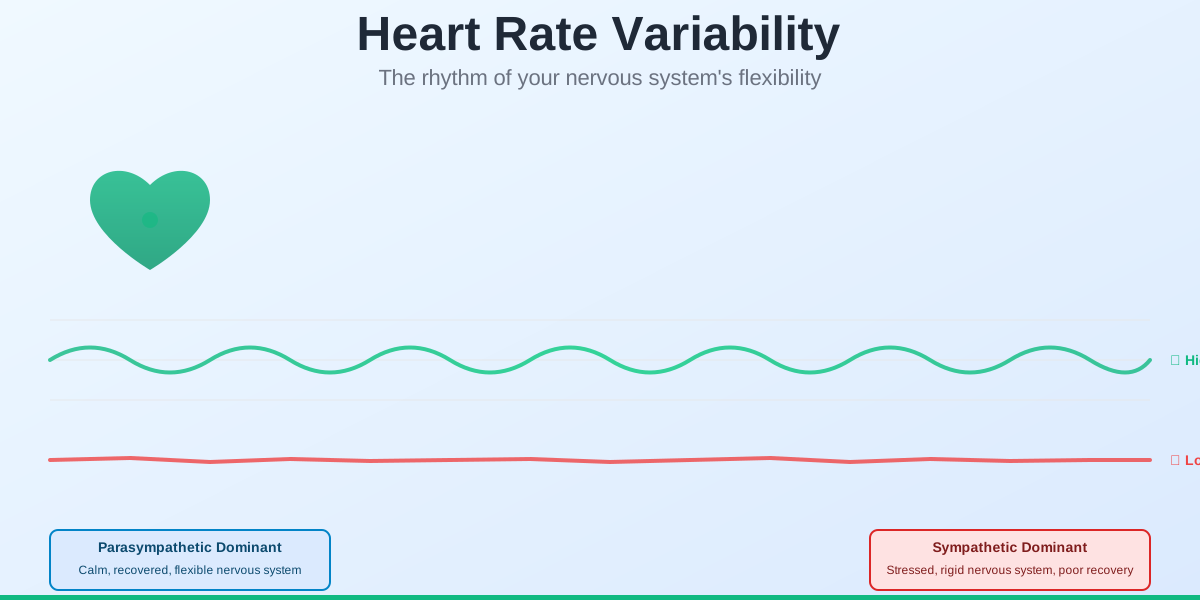
HRV isn't just a number on your wearable device—it's a window into the bidirectional conversation between your brain and heart, revealing whether your nervous system is in balance or struggling under cumulative load.
This guide explores the science of heart rate variability, how to measure it accurately, practical strategies to strengthen it, and why it matters for both physical recovery and emotional resilience across every life stage.
What Is Heart Rate Variability?
Heart rate variability is the variation in time intervals between consecutive heartbeats, measured in milliseconds. If your resting heart rate is 60 beats per minute, the intervals between beats don't occur at perfectly regular 1-second intervals; they fluctuate—perhaps 950ms between one beat and the next, then 1050ms after that. This natural variability is normal and healthy. HRV quantifies these fluctuations and serves as a non-invasive biomarker of autonomic nervous system function.
Not medical advice.
The autonomic nervous system (ANS) operates without conscious control, managing heart rate, digestion, breathing, and stress response through two primary branches: the sympathetic nervous system (activate, accelerate) and the parasympathetic nervous system (calm, recover). HRV reflects the dynamic balance between these branches. Your vagus nerve, the body's longest cranial nerve, carries parasympathetic signals and directly influences heart rate variation. A higher HRV suggests that your parasympathetic system has capacity and can effectively calm your physiology when needed. Lower HRV often indicates sympathetic dominance—a state where your body remains in elevated alert, characteristic of chronic stress, poor recovery, or certain health conditions.
Surprising Insight: Surprising Insight: A completely regular heartbeat—with zero variability—is actually a sign of poor autonomic health. Paradoxically, a perfectly steady heartbeat can indicate that your nervous system lacks the flexibility to respond to demands. Healthy hearts are adaptive hearts.
Autonomic Nervous System & Heart Rate Variability
Shows the relationship between parasympathetic (vagal) and sympathetic activation and their effects on HRV
🔍 Click to enlarge
Why Heart Rate Variability Matters in 2026
In our hyperconnected, always-on world, chronic stress has become normalized. Your nervous system remains partially activated from work notifications, social media, relationship tensions, and financial pressures. HRV is one of the few measurable indicators that reveals whether your body is actually recovering or simply masking fatigue. Recent research from 2025 shows that HRV declines predictably with chronic stress, depression, anxiety, and burnout—often before people consciously recognize they're struggling. By monitoring HRV, you can catch these signals early.
Wearable technology has democratized HRV measurement. Smartwatches and rings now estimate HRV overnight, giving you daily feedback without needing clinical equipment. This accessibility means you can track how sleep quality, exercise timing, caffeine intake, stress levels, and breathing practices directly affect your autonomic function. The personalization available in 2026 allows you to experiment scientifically with your own physiology and discover what actually works for your unique nervous system.
Mental health professionals increasingly recognize HRV biofeedback as an evidence-based intervention for anxiety, depression, PTSD, and substance use recovery. Unlike medications that take weeks to show benefit, HRV-targeted breathing can produce measurable autonomic shifts within minutes. For someone feeling overwhelmed or trapped in anxiety, this immediate capability offers genuine agency—proof that their nervous system can change.
The Science Behind Heart Rate Variability
The heart is controlled by multiple neural inputs. The sinoatrial node (your heart's natural pacemaker) receives constant signals from both sympathetic nerves (via norepinephrine) that speed heart rate and parasympathetic nerves (via acetylcholine through the vagus) that slow it. The ongoing negotiation between these competing signals creates beat-to-beat variability. During parasympathetic dominance (rest, digestion, meditation), these competing inputs create greater variation in the RR interval. During sympathetic dominance (fight-flight, stress, exercise), the sympathetic signal overpowers parasympathetic input, creating more uniform, rapid beats with lower variability.
This physiology connects directly to your mental state through the polyvagal theory and brain-heart axis research. Your prefrontal cortex (rational, planning brain) communicates with your heart through vagal pathways. When you're feeling safe and socially engaged, vagal tone increases, HRV rises, and your system can think clearly. When sensing threat, the vagal brake releases, sympathetic activation rises, and your focus narrows toward survival. Chronic activation of this threat response—from ongoing stress, trauma, or belief patterns—keeps HRV suppressed even during rest. This explains why some high-achieving, anxious individuals have low HRV despite excellent fitness.
The Vagal Pathway: Brain-to-Heart Communication
Illustrates how the vagus nerve connects brain states to heart rate variability and autonomic response
🔍 Click to enlarge
Key Components of Heart Rate Variability
RMSSD (Root Mean Square of Successive Differences)
RMSSD measures beat-to-beat variability in milliseconds and is the most commonly used HRV metric. It reflects parasympathetic activity and vagal tone. Because RMSSD focuses on short-term fluctuations, it requires minimal measurement time (even 5 minutes yields meaningful data), making it ideal for daily tracking on wearables. Typical resting RMSSD for adults ranges from 20-100ms depending on age, fitness, and baseline autonomic state. Higher values correlate with better emotional regulation, lower stress perception, and faster recovery after stressful events.
SDNN (Standard Deviation of Normal-to-Normal Intervals)
SDNN captures total variability across all time scales over a measurement period. While RMSSD emphasizes short-term parasympathetic function, SDNN reflects both short-term and long-term regulatory mechanisms. Clinical research shows that 24-hour SDNN is the gold standard for predicting cardiovascular risk and all-cause mortality. Unlike RMSSD, SDNN requires longer measurement periods (ideally 24 hours or at minimum 5 minutes) to capture meaningful variability. For daily wellness tracking, SDNN is less practical, but for comprehensive health assessment, it provides crucial prognostic information.
LF/HF Ratio (Low Frequency to High Frequency Power)
Frequency-domain analysis uses Fourier transformation to decompose heart rate patterns into frequency components. Low Frequency (0.04-0.15 Hz) roughly correlates with sympathetic and parasympathetic influence combined. High Frequency (0.15-0.4 Hz) closely tracks parasympathetic (vagal) activity and is synchronized with breathing. The LF/HF ratio was historically used to estimate sympathovagal balance, though newer research questions whether this ratio has clinical validity beyond its component parts. Most modern HRV apps have moved away from ratio reporting toward RMSSD and other time-domain measures.
Measurement Context and Validity
HRV varies dramatically with posture, time of day, breathing pattern, caffeine, sleep debt, and recent activity. Overnight HRV (measured during sleep) is most stable and meaningful for daily tracking. Morning measurements (before getting out of bed) represent parasympathetic dominance without confounding factors. Activity-specific HRV (during or immediately after exercise) requires understanding that sympathetic activation temporarily lowers HRV—this is normal physiology, not a sign of poor health. Wearables estimate HRV from photoplethysmography (light-based heart rate detection), which is less accurate than ECG but sufficient for trend tracking. Consistency matters more than absolute values.
| Method | Accuracy Level | Best For |
|---|---|---|
| ECG (12-lead or portable) | Gold standard | Clinical assessment, research |
| Smartwatch/ring (PPG-based) | Moderate (±10%) | Daily trend tracking, wellness |
| Smartphone camera | Low-moderate | Quick estimates, educational |
How to Apply Heart Rate Variability: Step by Step
- Step 1: Get your baseline: Use a wearable device (Apple Watch, Oura Ring, or Whoop) to track overnight HRV for 2-3 weeks. Write down the numbers to establish your personal baseline range rather than comparing yourself to population averages.
- Step 2: Understand your patterns: Notice how HRV changes with sleep duration, caffeine, stress levels, and exercise timing. You'll see that poor sleep drops HRV by 10-30%, while one stressful day might lower it 15-20%. This pattern recognition is more valuable than any single number.
- Step 3: Practice resonant breathing (5.5-6 breaths per minute): Set a breathing app to 5.5 breaths/min (inhale 5 seconds, exhale 5.5 seconds) for 10 minutes daily. This frequency maximizes the heart rate variation caused by your natural respiratory-cardiac synchronization and directly increases HRV.
- Step 4: Track your response: Measure HRV in the 20 minutes immediately after resonant breathing ends. You'll likely see a 10-20% increase. This proves your nervous system can shift voluntarily—it's not stuck.
- Step 5: Build a micro habit: Practice resonant breathing every morning for 1 week, then track whether your baseline HRV increases. Adding it once daily is more effective than sporadic 30-minute sessions.
- Step 6: Address sleep quality first: HRV reflects accumulated sleep debt more than any other factor. If your HRV is consistently low, examine sleep duration, consistency, and environment before trying other interventions. One excellent night of sleep increases next-morning HRV.
- Step 7: Minimize caffeine timing: Caffeine reduces HRV for 8-10 hours after consumption. If tracking morning HRV, delay caffeine past your measurement window. If evening HRV is important, limit caffeine after noon.
- Step 8: Use HRV as a recovery signal: During intense training weeks, HRV naturally drops. Rather than ignoring this, use it as legitimate data to take extra recovery days. Low HRV is your system saying 'I need rest'—not weakness.
- Step 9: Combine with heart rate context: Low HRV during elevated resting heart rate (>5 bpm above baseline) indicates genuine stress. Low HRV with normal resting heart rate is usually just recovery fluctuation. Context matters.
- Step 10: Re-measure every 12 weeks: Your HRV baseline shifts as fitness improves, stress decreases, and age progresses. Update your target ranges quarterly to keep baselines relevant and avoid chasing outdated numbers.
Heart Rate Variability Across Life Stages
Young Adulthood (18-35)
Young adults typically have the highest HRV values (40-100 ms RMSSD), reflecting high parasympathetic capacity and rapid autonomic recovery. However, modern life pressures—achievement expectations, social comparison, early-career stress—increasingly suppress HRV even in this age group. Building HRV awareness early prevents the autonomic dysregulation that accumulates into middle age. Young adults benefit most from establishing strong sleep foundations, stress awareness practices, and baseline HRV tracking before chronic patterns solidify. If HRV is already declining in this stage, it signals that stress load exceeds current recovery capacity.
Middle Adulthood (35-55)
HRV typically declines 5-10% per decade in this stage (from multiple cumulative factors: increased chronic stress, reduced sleep consistency, decreased physical activity for many, hormonal shifts, and metabolic changes). Cardiovascular disease risk emerges in this window, and HRV becomes a valuable early warning indicator. Research shows that people maintaining high HRV through this stage have significantly lower rates of heart disease, depression, and metabolic dysfunction. Middle-aged adults who prioritize HRV through deliberate recovery practices often see their HRV stabilize or even improve despite aging, proving the power of behavioral intervention.
Later Adulthood (55+)
Age-related HRV decline accelerates, though this is not inevitable. Sedentary older adults see dramatic HRV drops, while active elders maintain surprisingly high variability. HRV becomes an especially valuable health monitoring tool because changes often precede clinical symptoms. A sudden HRV drop in an older adult can indicate infection, medication changes, sleep disruption, or cardiovascular events before other markers appear. Maintaining vagal tone through light exercise, meditation, and breathing practices provides both autonomic benefit and cognitive advantages—high HRV in older adults correlates with better memory and executive function.
Profiles: Your Heart Rate Variability Approach
The Anxious Optimizer
- Immediate proof that their nervous system can shift
- Simple, reproducible techniques that work within 10 minutes
- Permission to rest without guilt when HRV signals recovery need
Common pitfall: Obsessively checking HRV multiple times daily, treating small fluctuations as failures, pushing harder when already depleted
Best move: Use HRV biofeedback breathing once daily for 10 minutes, then check overnight HRV weekly (not daily). Let device handle continuous tracking while you focus on resilience-building habits.
The High Performer
- Objective data that validates their recovery is genuinely working
- Clear cause-effect patterns between interventions and HRV response
- Evidence that pushing recovery hard improves performance metrics
Common pitfall: Treating HRV like another metric to optimize rather than a signal to honor; maintaining intense training even when HRV signals insufficient recovery
Best move: Use HRV as your recovery ceiling, not performance floor. Schedule deload weeks when HRV drops >20% from baseline. Track correlation between HRV quality and actual performance outcomes (work output, athletic results, mood).
The Sleep-Deprived Parent
- Realistic expectations given that their sleep is fragmented
- 5-minute interventions that fit chaotic schedules
- Understanding that HRV will be naturally lower—and that's okay
Common pitfall: Abandoning HRV tracking altogether because they can't meet conditions for optimal measurement; feeling like failures because numbers are below 'healthy' ranges
Best move: Accept your baseline as valid in your life context. Use HRV to track whether you're getting incrementally better sleep or more stressed, not to compare yourself to well-rested people. Do resonant breathing during your first quiet moment of day, even if it's irregular.
The Preventive Health Seeker
- Understanding that HRV is one marker among many health indicators
- Clear interpretation of what HRV changes actually mean clinically
- Integration with other health metrics rather than isolated HRV focus
Common pitfall: Over-interpreting HRV changes as indicators of serious disease; chasing single-number optimization while ignoring overall lifestyle
Best move: View HRV as one part of comprehensive health monitoring alongside blood pressure, sleep data, activity, and stress perception. Use it as motivation for foundational practices (sleep, movement, stress management) rather than a diagnostic tool.
Common Heart Rate Variability Mistakes
Comparing your HRV to published 'healthy ranges' from population studies. These ranges (often 20-100 ms RMSSD for adults) obscure huge variations based on age, fitness level, genetics, and baseline autonomic state. A 40-year-old athlete might have 80+ ms RMSSD while a 40-year-old with anxiety might have 25 ms—both numbers can be meaningful within their own context. Compare yourself only to your own baseline, not population norms. Track trends in your personal HRV over weeks and months, not absolute values against external standards.
Measuring HRV inconsistently (sometimes overnight, sometimes after coffee, sometimes after exercise) and then expecting to see clear patterns. HRV is context-dependent. For meaningful tracking, measure under the same conditions—ideally overnight or first thing in morning before activity or caffeine. If you measure at different times, you're comparing different things. Most wearables handle this automatically, but if manually measuring, establish a consistent protocol.
Ignoring the obvious causation and chasing micro-interventions. Low HRV from two nights of insufficient sleep won't improve from a breathing app; it needs actual sleep. Low HRV from chronic anxiety won't resolve from one meditation session; it requires ongoing stress management and likely professional support. Use HRV to diagnose the root issue (sleep, stress, overtraining, health issues), then address that root cause rather than just trying to boost numbers.
HRV Optimization Mistakes & Corrections
Common errors in HRV tracking and how to correct them
🔍 Click to enlarge
Science and Studies
Recent research from 2024-2026 has established HRV as a reliable biomarker across multiple health domains. Meta-analyses show robust associations between lower HRV and cardiovascular disease risk, depression, anxiety, poor sleep quality, and accelerated aging. Large-scale studies in clinical settings demonstrate that HRV biofeedback significantly reduces anxiety symptoms (medium effect size), improves depression outcomes, enhances cognitive recovery after traumatic brain injury, and supports substance use disorder treatment when combined with behavioral interventions. The consistency of findings across diverse populations strengthens confidence in HRV as a valid health indicator.
- Heart rate variability: multidimensional perspective from physiological marker to brain-heart axis disorders prediction (Frontiers in Cardiovascular Medicine, 2025)
- Heart rate variability and autonomic nervous system imbalance: potential biomarkers of aging and inflammaging (ScienceDirect, 2024)
- Harnessing non-invasive vagal neuromodulation: HRV biofeedback and nervous system regulation (PMC, 2025)
- Meta-analysis of HRV biofeedback for depression and anxiety outcomes (Nature/Scientific Reports, 2025)
- Real-time HRV biofeedback in digital mental health interventions across age and gender (PubMed, 2024)
Your First Micro Habit
Start Small Today
Today's action: Tomorrow morning, before getting out of bed, take 6 slow breaths (5 seconds in, 5 seconds out). Notice your heart rate or simply notice the feeling of your chest rising and falling. Don't measure anything—just breathe. Do this for one week.
This 30-second practice resets your nervous system before daily stress accumulates and builds awareness of vagal tone without performance pressure. The in-bed consistency ensures you'll actually do it. Breath focus is the single fastest way to activate parasympathetic response, and doing it immediately upon waking sets a calm baseline for your day.
Keep quitting habit apps after a missed day? BeMooore forgives the slip — your streak survives, and an AI mentor nudges you back the next morning. Free on iOS.
Quick Assessment
How often do you notice your stress affecting your sleep or recovery?
Your sleep-stress relationship reveals HRV patterns. Constant stress-sleep disruption indicates low parasympathetic capacity. Starting with breathing practices and sleep hygiene will likely improve both rest and HRV.
What's your primary goal with understanding heart rate variability?
Athletes benefit most from HRV trend tracking and recovery-guided training. Anxious individuals gain most from HRV biofeedback breathing. Sleep-focused people should prioritize consistency over measurement. Preventive health seekers should integrate HRV with broader health markers.
Which recovery practice sounds most realistic for you to sustain?
Your answer reveals which intervention will actually move your HRV. Sleep consistency returns the highest HRV improvement for effort. Breathing practices show fastest acute shifts. Exercise requires patience but compounds beautifully. Support addressing root stress is foundational.
Take our full assessment to get personalized recommendations.
Discover Your Style →Next Steps
Your nervous system is more trainable than you likely believe. HRV proves it—measurable shifts in your heart's beat-to-beat timing reflect genuine changes in your stress resilience, recovery capacity, and emotional flexibility. You don't need perfect sleep, zero stress, or elite fitness to build HRV. You need awareness, consistency, and permission to prioritize recovery as seriously as you prioritize achievement.
Start with one practice this week: either morning breathing (6 slow breaths in bed before rising) or better sleep consistency (same bedtime 5 nights this week). Measure HRV overnight if you have a device, or simply notice whether you feel more recovered within days. The goal is to prove to yourself that your autonomic system responds to intentional practices. Once you feel that proof, you'll naturally expand the practices because they work.
Get personalized guidance with AI coaching.
Start Your Journey →Research Sources
This article is based on peer-reviewed research and authoritative sources. Below are the key references we consulted:
Related Glossary Articles
Frequently Asked Questions
What's a 'good' HRV score?
There's no universal 'good' number—HRV varies dramatically by age, fitness, genetics, and baseline autonomic state. A meaningful HRV is one that's stable for you and trends upward with positive lifestyle changes. Your baseline from weeks 1-3 of tracking is your personal 'good' reference point. Compare yourself to yourself, not population averages.
Can wearables accurately measure HRV?
Smartwatches and rings (using light-based heart rate detection) have ±10% accuracy compared to ECG gold standard. For clinical diagnosis, ECG is needed. For wellness tracking and trend analysis, wearables are sufficient. Consistency and same-condition measurement matters more than absolute accuracy.
How long does it take to improve HRV?
Overnight HRV can shift 10-20% within 1-2 days with better sleep or stress reduction. Sustained improvement (lasting baseline elevation) typically appears within 2-4 weeks of consistent practice like daily breathing, improved sleep, or regular exercise. Dramatic improvements (30%+ increases) usually require addressing root causes (chronic stress, poor sleep, high training load) for 4-12 weeks.
Does low HRV mean I'm unhealthy?
Low overnight HRV can simply mean yesterday was stressful, you slept poorly, or you exercised intensely. Context matters enormously. Consistently low HRV combined with poor sleep, high stress perception, low fitness, or health symptoms warrants assessment. A single low number is data, not diagnosis.
Can I improve HRV without a wearable device?
Yes—wearables accelerate progress by providing feedback, but HRV improvements happen through underlying practices: better sleep, stress reduction, breathing exercises, and regular movement. You can feel the effects directly (better sleep depth, less anxiety, easier recovery) without numbers. Measurement simply makes the progress visible.
Take the Next Step
Ready to improve your wellbeing? Take our free assessment to get personalized recommendations based on your unique situation.
- Discover your strengths and gaps
- Get personalized quick wins
- Track your progress over time
- Evidence-based strategies