Nervous System Regulation
Your heart races before a meeting. Your jaw clenches while scrolling the news. You snap at someone you love for no clear reason. These moments are not character flaws. They are signals from a <a href="/g/body-systems.html">body system</a> that has lost its ability to shift between alert and calm. Nervous system regulation is the process of restoring that flexibility, and when you understand it, the way you handle <a href="/g/stress-management.html">stress</a>, <a href="/g/emotional-regulation.html">emotions</a>, and <a href="/g/energy-management.html">energy</a> changes completely.
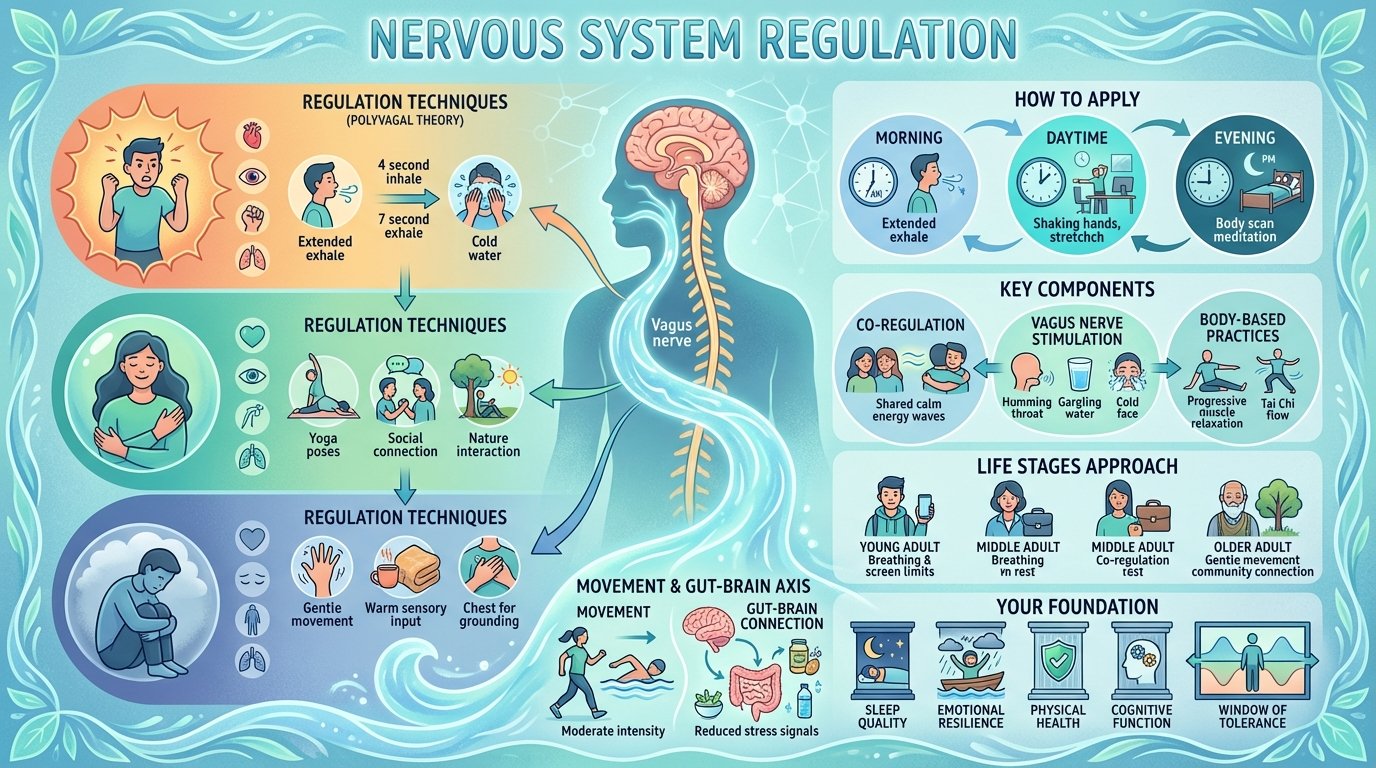
In the sections ahead, you will learn the science behind your autonomic nervous system, discover how <a href="/g/breathing-techniques.html">breathing techniques</a> and vagus nerve exercises reset your baseline, and walk away with a daily practice you can start today.
Whether you are dealing with chronic tension, anxiety, or simply want to feel more grounded, this guide gives you a clear path from understanding to action, backed by polyvagal theory and peer-reviewed research.
What Is Nervous System Regulation?
Nervous system regulation refers to the body's ability to move smoothly between states of activation and rest. Your autonomic nervous system (ANS) operates in two main branches: the sympathetic branch, which triggers the fight-or-flight response, and the parasympathetic branch, which supports rest, digestion, and recovery. True regulation means your system can ramp up when needed and settle down afterward without getting stuck in either extreme. This process directly influences your brain health, emotional health, and overall body wellness.
Not medical advice.
Stephen Porges, a neuroscientist at Indiana University, introduced polyvagal theory in 1994 to explain why the vagus nerve plays such a central role in this process. The theory describes three hierarchical states: the ventral vagal state (social engagement and calm), the sympathetic state (mobilization and stress), and the dorsal vagal state (shutdown and freeze). A well-regulated nervous system can shift between these states fluidly. A dysregulated one gets stuck, leading to chronic anxiety, fatigue, digestive problems, and difficulty connecting with others. Understanding these states is the first step toward improving your cognitive function and emotional resilience.
Surprising Insight: Surprising Insight: The vagus nerve is the longest cranial nerve in your body, running from your brainstem all the way to your gut. It carries about 80 percent of its signals upward from the body to the brain, meaning your body often tells your brain how to feel before your mind has a chance to decide.
The Three States of the Autonomic Nervous System
Polyvagal theory describes three hierarchical autonomic states that govern how we respond to safety and threat.
🔍 Click to enlarge
Why Nervous System Regulation Matters in 2026
Modern life bombards your nervous system with stimuli it was never designed to handle. Constant notifications, 24-hour news cycles, social media comparison, and the blur between work and rest keep many people locked in a sympathetic (fight-or-flight) state for hours each day. Research from the American Institute of Stress reports that chronic stress contributes to six of the leading causes of death. Nervous system regulation provides a practical antidote, giving you tools to break the cycle of chronic disease triggers before they take root.
The growing interest in biohacking, holistic health, and functional health has brought nervous system work into mainstream wellness conversations. Clinicians now use polyvagal-informed interventions in therapy settings, recognizing that cognitive strategies alone often fail when the body is stuck in a state of threat. By learning to regulate your nervous system, you create a foundation for better sleep quality, stronger immune function, and more stable emotional wellness.
Regulation is also essential for mental health outcomes. Studies published in Frontiers in Neuroscience confirm that vagal tone, a measure of vagus nerve activity, correlates with better emotion regulation, lower inflammation, and improved cardiovascular health. Whether you are a student managing academic pressure, a parent navigating family stress, or a professional dealing with burnout, nervous system regulation is the underlying skill that supports everything else.
The Science Behind Nervous System Regulation
Polyvagal theory rests on the concept of neuroception, a term coined by Stephen Porges to describe how your nervous system evaluates risk without conscious awareness. Your brain constantly scans your environment, your internal body signals, and social cues from other people to determine whether you are safe, in danger, or overwhelmed. This process happens below the level of thought, which is why you can feel anxious in a perfectly safe room or calm in a busy crowd. Neuroception is the gatekeeper that decides which autonomic state you enter, and it directly affects your brain function and brain optimization capacity.
The ventral vagal complex, located in the brainstem, governs the social engagement system. When this system is active, your facial muscles relax, your voice has natural prosody, your heart rate is steady, and you can think clearly. The sympathetic branch mobilizes you for action, increasing heart rate, redirecting blood flow to muscles, and sharpening focus. The dorsal vagal complex, the oldest part of the autonomic system, triggers a shutdown response when the brain perceives that fight or flight has failed. Each of these states serves a purpose, but problems arise when the system gets stuck. Chronic sympathetic activation leads to anxiety disorders, heart health risks, and impaired gut health. Chronic dorsal vagal activation can look like depression, dissociation, or emotional numbness.
Vagal Tone and Health Outcomes
How vagal tone connects to different aspects of physical and mental health through the autonomic nervous system.
🔍 Click to enlarge
Key Components of Nervous System Regulation
Vagus Nerve Stimulation
The vagus nerve acts as an information highway between your brain and your organs. Stimulating it activates the parasympathetic response, slowing your heart rate, reducing cortisol, and promoting a sense of calm. Practical vagus nerve exercises include cold water face immersion, humming, gargling, and slow diaphragmatic breathing. Cleveland Clinic research confirms that these techniques help improve autonomic balance and support healing and repair processes throughout the body. Regular vagus nerve stimulation also supports better deep sleep and rest and recovery.
Breathwork and Respiratory Regulation
Breathing is one of the few autonomic functions you can control consciously, making it a powerful entry point for nervous system regulation. Deep breathing techniques that emphasize longer exhales activate the parasympathetic branch. The box breathing technique (inhale for four counts, hold for four, exhale for four, hold for four) is used by military personnel and athletes for rapid state regulation. Extended exhale breathing, where you breathe out for twice as long as you breathe in, directly stimulates the vagus nerve and shifts you toward calm. These practices form a cornerstone of relaxation and coping strategies.
Co-Regulation and Social Connection
Polyvagal theory emphasizes that regulation is not just an individual process. Co-regulation occurs when your nervous system attunes to another person's calm, regulated state. This is why a soothing voice, eye contact, or a warm hug can settle your body faster than any solo technique. Infants learn to regulate almost entirely through co-regulation with caregivers, and adults continue to depend on safe social connections throughout life. Building strong emotional connections and investing in friendships are practical forms of nervous system care. Co-regulation is also central to emotional bonding and attachment styles.
Somatic Awareness and Body-Based Practices
Your body stores stress in patterns of tension, posture, and movement. Somatic practices like progressive muscle relaxation, yoga, tai chi, and body scanning help you notice where you hold activation and release it deliberately. These approaches work because they address the bottom-up pathway of regulation, sending safety signals from the body to the brain rather than trying to think your way out of a stress response. Mindfulness meditation that includes body awareness components has been shown to increase vagal tone over time. Somatic practices complement meditation and emotional healing by engaging the body directly.
| Current State | Signs You Are In It | Best Regulation Technique |
|---|---|---|
| Sympathetic (Fight-or-Flight) | Racing heart, shallow breathing, muscle tension, irritability | Extended exhale breathing, cold water face splash, grounding exercises |
| Dorsal Vagal (Shutdown) | Numbness, fatigue, disconnection, brain fog, low motivation | Gentle movement, orienting to the room, social engagement, warm drink |
| Ventral Vagal (Safe and Social) | Calm, curious, connected, clear thinking, relaxed body | Maintain with daily practices: yoga, breathwork, nature, connection |
How to Apply Nervous System Regulation: Step by Step
- Step 1: Map your state: Pause three times today and notice whether you feel activated (sympathetic), shut down (dorsal vagal), or calm and connected (ventral vagal). This builds <a href="/g/emotional-awareness.html">emotional awareness</a> and sets the baseline for change.
- Step 2: Start with your breath: Practice five minutes of extended exhale breathing each morning. Inhale through your nose for four counts, then exhale slowly through your mouth for six to eight counts. This directly stimulates vagal tone.
- Step 3: Use cold exposure wisely: Splash cold water on your face for thirty seconds or hold an ice cube in your hand. This triggers the dive reflex, which activates the parasympathetic branch and lowers heart rate rapidly.
- Step 4: Add gentle movement: When you notice you are in a freeze or shutdown state, start with small movements like shaking your hands, rolling your shoulders, or walking slowly. Movement helps discharge stored activation and restore <a href="/g/energy-levels.html">energy levels</a>.
- Step 5: Practice orienting: Look around your space slowly. Notice five things you can see. Feel your feet on the floor. This grounding exercise tells your nervous system that you are safe in the present moment and supports <a href="/g/focus.html">focus</a>.
- Step 6: Build co-regulation into your day: Spend time with someone who makes you feel safe. Make eye contact during conversation. Share a meal without screens. Your nervous system learns regulation through safe social connection.
- Step 7: Try humming or singing: Vibrations from humming stimulate the vagus nerve where it passes through the throat. Even two minutes of humming can shift your state noticeably and improve <a href="/g/emotional-coping.html">emotional coping</a>.
- Step 8: Add a body scan before bed: Lie down and slowly bring attention to each part of your body from feet to head. Notice tension without trying to fix it. This practice improves <a href="/g/sleep-quality.html">sleep quality</a> and trains your system to release activation.
- Step 9: Track your patterns: Keep a simple journal of your autonomic states throughout the day. Note what triggers shifts and what helps you return to calm. Pattern awareness accelerates regulation over weeks.
- Step 10: Build a regulation toolkit: Combine two to three techniques that work best for you, such as breathing plus movement plus co-regulation, and use them consistently. Nervous system regulation is a skill that strengthens with daily practice, much like building <a href="/g/resilience.html">resilience</a> or <a href="/g/mental-toughness.html">mental toughness</a>.
Nervous System Regulation Across Life Stages
Young Adulthood (18-35)
Young adults often face nervous system challenges from academic pressure, career uncertainty, social media overstimulation, and the transition to independence. The sympathetic branch tends to dominate in this phase, leading to chronic low-grade activation that manifests as anxiety, insomnia, and difficulty concentrating. Building a daily breathwork practice and limiting screen time before bed are high-impact starting points. Learning to recognize the difference between healthy activation (excitement before a presentation) and dysregulation (panic without a clear trigger) is an essential skill during this stage that supports long-term behavioral health.
Middle Adulthood (35-55)
This stage often brings accumulated stress from careers, parenting, and caretaking responsibilities. Many people in midlife operate in a chronic sympathetic state without realizing it, mistaking constant vigilance for productivity. The consequences show up as digestive issues, cardiovascular strain, weight gain, and emotional exhaustion. Co-regulation becomes especially important during this phase, both giving and receiving it within family and community relationships. Practices like yoga, nature walks, and regular rest and recovery help counter the cumulative effects of years of high activation. Prioritizing circadian rhythm alignment through consistent sleep and wake times also supports autonomic balance.
Later Adulthood (55+)
Aging naturally reduces vagal tone, making nervous system regulation increasingly important. Older adults may experience more dorsal vagal activation, presenting as withdrawal, low energy, or emotional flatness. Social isolation, a significant risk factor for older adults, further undermines co-regulation opportunities. Gentle somatic practices, community engagement, and meditation help maintain autonomic flexibility. Research published in Psychophysiology shows that mindfulness meditation can improve vagal tone even in older adults, supporting both cognitive health and disease prevention. Maintaining strong emotional connections becomes a form of nervous system medicine during this life phase.
Profiles: Your Nervous System Regulation Approach
The Hyper-Vigilant Achiever
- Scheduled downtime that feels productive (walking, journaling)
- Extended exhale breathing between tasks to prevent cumulative activation
- Permission to rest without linking rest to laziness
Common pitfall: Interpreting calm as boredom and unconsciously seeking stimulation to stay in a familiar sympathetic state.
Best move: Set a timer for three five-minute breathing breaks during your workday. Track how your afternoon energy and focus improve within one week.
The Emotional Absorber
- Clear boundaries to prevent absorbing others' stress
- Somatic practices to discharge activation that does not belong to you
- Regular alone time for self-regulation without external input
Common pitfall: Confusing co-regulation with people-pleasing and neglecting your own nervous system needs.
Best move: Practice a two-minute body scan after every emotionally intense conversation to release stored tension and return to your own baseline.
The Freeze-and-Withdraw Type
- Gentle activation through small movements rather than intense exercise
- Safe social contact that does not demand performance or output
- Warm sensory input such as a heated blanket, warm drink, or gentle music
Common pitfall: Forcing yourself into high-intensity activities that push you deeper into shutdown instead of helping you surface gradually.
Best move: Start each morning with two minutes of gentle shaking or stretching before checking your phone. Build upward from micro-movements.
The Resilient Regulator
- Maintenance practices to preserve existing regulation capacity
- Awareness of subtle signs that regulation is slipping before a full shift occurs
- Support systems for high-stress periods when solo regulation is not enough
Common pitfall: Overconfidence in your regulation skills and ignoring early warning signs of accumulated stress.
Best move: Keep a weekly regulation check-in where you honestly assess your sleep, digestion, mood, and social engagement as markers of autonomic health.
Common Nervous System Regulation Mistakes
One of the most common mistakes is treating nervous system regulation as a quick fix rather than a daily practice. Doing one breathing exercise during a panic attack and then ignoring your nervous system for the rest of the week does not build lasting change. Regulation is a skill that requires consistent training, much like building psychological flexibility or emotional regulation. The goal is not to eliminate stress responses but to improve your ability to recover from them.
Another mistake is using only top-down strategies like positive thinking or cognitive reframing when your body is stuck in a threat state. When your nervous system is in full sympathetic activation, your prefrontal cortex (the thinking brain) goes partially offline. Trying to think your way out of a panic state is like trying to steer a car with the engine off. Bottom-up strategies like breathwork, cold exposure, and movement must come first to bring the body back to a state where thinking clearly is possible. This is why comprehensive health approaches integrate both body and mind.
A third mistake is pushing yourself into intense regulation practices when you are in a dorsal vagal (shutdown) state. High-intensity breathwork, ice baths, or vigorous exercise can feel threatening to a nervous system that is already overwhelmed. The key principle is titration: start with the smallest intervention that creates a noticeable shift. Gentle movement, warm sensory input, and safe social contact are more effective starting points for someone in shutdown than aggressive techniques. Matching your practice to your current state is what separates effective regulation from generic health tips.
Daily Nervous System Regulation Cycle
A practical daily cycle showing how to integrate regulation practices into your morning, afternoon, and evening routines.
🔍 Click to enlarge
Nervous System Regulation and Trauma
Trauma fundamentally alters the way your nervous system processes safety and threat. People who have experienced trauma often have a narrowed window of tolerance, meaning they shift more quickly between hyperactivation and shutdown. The concept of the window of tolerance, developed by Daniel Siegel, describes the range of autonomic arousal within which a person can function effectively. Nervous system regulation practices help gradually widen this window, increasing your capacity to handle stress without becoming overwhelmed.
For individuals with trauma histories, including those dealing with PTSD, regulation work should be approached with care and ideally with professional support. Polyvagal-informed therapy helps people learn to recognize their autonomic state, understand their triggers, and build a toolkit of regulation practices that feel safe. Techniques like pendulation, where you alternate attention between a sensation of distress and a sensation of comfort, can help the nervous system learn that activation does not have to lead to overwhelm. This approach supports deeper emotional healing and builds lasting resilience.
The Gut-Brain Connection and Regulation
Your gut health and nervous system are intimately connected through the vagus nerve. Approximately 80 percent of vagal nerve fibers carry information from the gut to the brain, making your digestive system a major input for autonomic regulation. An inflamed or imbalanced gut sends distress signals upward, contributing to anxiety, mood instability, and cognitive fog. This is why people with chronic digestive issues often struggle with emotional wellness and cognitive function.
Supporting gut health through a diverse, fiber-rich diet, reducing processed foods, and managing stress directly improves vagal tone and nervous system regulation. Fermented foods, adequate hydration, and regular eating schedules help stabilize the gut-brain axis. When you combine nutritional strategies with breathwork and somatic practices, you address regulation from multiple angles. This integrated approach reflects the principles of holistic health and functional health that recognize the body as an interconnected system.
Movement, Exercise, and the Nervous System
Physical movement is one of the most effective tools for nervous system regulation, but the type and intensity of movement matter. When your system is stuck in sympathetic overdrive, high-intensity exercise can actually increase activation rather than relieve it. Moderate aerobic activity like walking, swimming, or cycling helps the body complete the stress cycle and return to a regulated state. This is because movement metabolizes the stress hormones (cortisol and adrenaline) that build up during periods of activation, supporting recovery optimization.
Yoga is particularly effective for nervous system regulation because it combines controlled breathing, gentle movement, and interoceptive awareness. Studies published in the Journal of Alternative and Complementary Medicine show that regular yoga practice increases heart rate variability, a key marker of vagal tone and autonomic flexibility. Restorative yoga, which uses supported postures held for extended periods, is especially beneficial for people who spend most of their time in a sympathetic state. Pairing movement with mindfulness creates a dual pathway for regulation that engages both body and brain.
Science and Studies
Research on nervous system regulation and polyvagal theory continues to grow across neuroscience, psychology, and integrative medicine. Multiple peer-reviewed studies confirm the relationship between vagal tone, emotional regulation, and physical health outcomes. The following sources represent key findings from the health science literature.
- Porges, S.W. (2011). The Polyvagal Theory: Neurophysiological Foundations of Emotions, Attachment, Communication, and Self-regulation. Norton Series on Interpersonal Neurobiology.
- Laborde, S., Mosley, E., and Thayer, J.F. (2017). Heart rate variability and cardiac vagal tone in psychophysiological research. Frontiers in Psychology, 8, 213.
- Breit, S., Kupferberg, A., Rogler, G., and Hasler, G. (2018). Vagus nerve as modulator of the brain-gut axis in psychiatric and inflammatory disorders. Frontiers in Psychiatry, 9, 44.
- Sullivan, M.B., Erb, M., Schmalzl, L., Moonaz, S., Noggle Taylor, J., and Porges, S.W. (2018). Yoga therapy and polyvagal theory. Frontiers in Human Neuroscience, 12, 67.
- Gerritsen, R.J.S. and Band, G.P.H. (2018). Breath of life: The respiratory vagal stimulation model of contemplative activity. Frontiers in Human Neuroscience, 12, 397.
Your First Micro Habit
Start Small Today
Today's action: Three times today, pause for 60 seconds and take five slow breaths with a longer exhale (inhale 4 counts, exhale 6 counts). Do this before meals, meetings, or transitions between activities.
Extended exhale breathing directly stimulates the vagus nerve, shifting your autonomic state toward parasympathetic calm. Anchoring it to existing daily events makes it automatic within days.
Keep quitting habit apps after a missed day? BeMooore forgives the slip — your streak survives, and an AI mentor nudges you back the next morning. Free on iOS.
Quick Assessment
When you experience unexpected stress, what does your body do first?
Recognizing your default autonomic response is the first step in nervous system regulation. Each pattern requires a different starting technique.
What is your primary goal with nervous system regulation?
Your goal determines which practices to prioritize. Anxiety responds best to breathwork, numbness to gentle movement, and recovery to evening protocols.
Which regulation practice appeals to you most right now?
Starting with the practice that feels most accessible increases consistency. You can add other techniques once your foundation is established.
Take our full assessment to get personalized recommendations for your nervous system health.
Discover Your Regulation Style →Next Steps
You now have a clear understanding of what nervous system regulation is, why it matters, and how to practice it daily. Start with the micro habit of three 60-second breathing pauses today. Within a week, you will begin noticing how your body responds differently to stress. From there, explore breathing techniques in more depth, build a meditation practice for vagal toning, and invest in emotional connections that support co-regulation.
Your nervous system is the operating system beneath every thought, emotion, and decision. When you learn to regulate it, you do not just manage stress better. You transform the way you show up in your health, your relationships, and your life. Explore related topics like brain optimization, emotional resilience, and psychological flexibility to continue building your foundation.
Get personalized guidance with AI coaching for nervous system health.
Start Your Regulation Journey →Research Sources
This article is based on peer-reviewed research and authoritative sources. Below are the key references we consulted:
Related Glossary Articles
Frequently Asked Questions
How long does it take to regulate a dysregulated nervous system?
Acute regulation through breathwork or cold exposure can shift your state within minutes. Building lasting regulation capacity, where your baseline shifts and your window of tolerance widens, typically takes consistent daily practice over several weeks to months. The timeline varies based on individual history, stress load, and the presence of trauma.
What are the signs of a dysregulated nervous system?
Common signs include chronic anxiety, difficulty sleeping, digestive problems, emotional reactivity, brain fog, fatigue despite adequate rest, muscle tension, and difficulty feeling safe in social situations. If you frequently feel stuck in fight-or-flight mode or emotionally numb, your nervous system may need regulation support.
Can you regulate your nervous system without a therapist?
Many regulation techniques like breathwork, cold exposure, gentle movement, and body scans can be practiced independently. However, if you have a significant trauma history or find that self-regulation practices trigger distress, working with a polyvagal-informed therapist provides essential safety and guidance.
What is the fastest way to activate the vagus nerve?
Splashing cold water on your face triggers the dive reflex, which rapidly activates the vagus nerve and slows heart rate. Extended exhale breathing, where your exhale is longer than your inhale, is another fast and accessible technique. Humming and gargling also stimulate the vagus nerve within seconds.
Is polyvagal theory scientifically proven?
Polyvagal theory has generated significant clinical interest and practical applications. Some aspects of the theory, particularly the hierarchical model of autonomic states, have faced scientific criticism. However, the core principles regarding vagal tone, the social engagement system, and the relationship between autonomic state and behavior are well-supported by research in psychophysiology and neuroscience.
How does nervous system regulation affect mental health?
Nervous system regulation directly impacts mental health by improving your ability to manage emotional responses, reducing chronic stress activation, and supporting clearer thinking. Higher vagal tone is associated with lower rates of anxiety and depression, better emotional resilience, and improved capacity for social connection.
What is the difference between self-regulation and co-regulation?
Self-regulation involves using your own internal resources, such as breathwork, movement, and mindfulness, to manage your autonomic state. Co-regulation happens when your nervous system attunes to another person's calm presence, helping you settle through safe social interaction. Both are essential, and most effective regulation combines both approaches.
Take the Next Step
Ready to improve your wellbeing? Take our free assessment to get personalized recommendations based on your unique situation.
- Discover your strengths and gaps
- Get personalized quick wins
- Track your progress over time
- Evidence-based strategies