Authentic
Being authentic means showing up as your true self in the world—aligning your actions, words, and values with who you genuinely are inside. When you're authentic, you're not performing for others or hiding parts of yourself. Instead, you're expressing your real thoughts, beliefs, and emotions openly. This fundamental aspect of human wellbeing has been proven by decades of psychological research to directly improve your mental health, relationships, and sense of purpose. Authenticity isn't about being perfect or always saying the right thing—it's about being real.
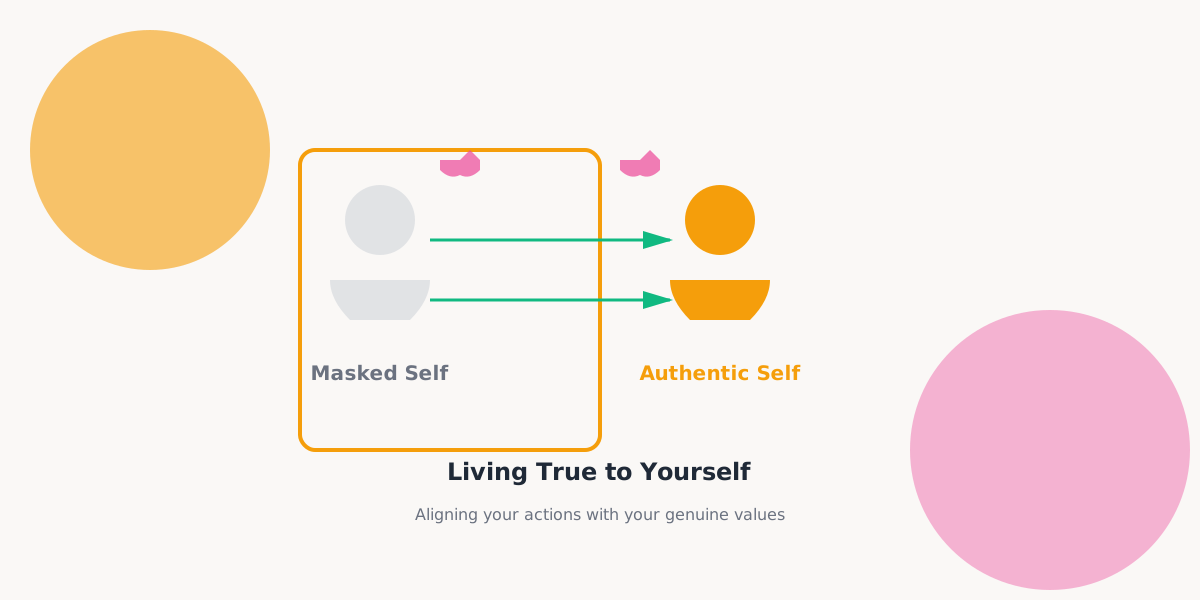
In 2026, authenticity has become more important than ever as we navigate digital identities, social media pressures, and workplace expectations that demand we play different roles.
The paradox? The more authentic you become, the more deeply you connect with others and yourself.
What Is Authentic?
Authenticity is the state of being genuine and true to yourself. Psychologically, it involves three key dimensions: self-accuracy (knowing who you really are), self-consistency (acting in ways that match your values), and self-ownership (taking responsibility for your choices and beliefs). An authentic person doesn't need to maintain a false facade—they're congruent between their internal experience and external expression. Research from Nature Reviews Psychology defines authenticity as operating across historical authenticity (being true to your actual past), categorical authenticity (accepting your identity), and values authenticity (living according to your principles).
Not medical advice.
Authenticity differs from related concepts like confidence or assertiveness. You can be assertive without being authentic—pushing your views on others while hiding your real doubts. You can appear confident while being fundamentally inauthentic. True authenticity combines knowing yourself deeply with the courage to express that self, even when it feels vulnerable. It's particularly powerful in relationships, where research shows that partners who perceive authenticity in each other report significantly higher satisfaction and deeper connection.
Surprising Insight: Surprising Insight: Children as young as 4-12 years naturally value authenticity over control, suggesting that the drive toward genuine self-expression is innate, not learned.
The Three Dimensions of Authenticity
Self-accuracy (knowing yourself) feeds into self-consistency (acting aligned), which reinforces self-ownership (responsibility for choices).
🔍 Click to enlarge
Why Authenticity Matters in 2026
Authenticity directly impacts your mental and physical health. Research consistently shows that individuals who live authentically report higher life satisfaction, better emotional regulation, and lower rates of anxiety and depression. In our hyperconnected world where social media encourages curated versions of ourselves, the cost of sustained inauthenticity is rising—burnout, relationship disconnection, and identity confusion plague those maintaining false personas.
Workplace dynamics have shifted dramatically. Studies of professional networking show that people perceive authentic partners as more trustworthy and are significantly more likely to initiate relationships with them. Employees who feel able to bring their authentic selves to work report higher job satisfaction, greater engagement, and stronger team cohesion. Companies recognizing this have seen improved retention and productivity.
In relationships and personal connections, authenticity is non-negotiable for depth. When you mask your true self, you prevent genuine intimacy. Partners can sense inauthenticity (even subconsciously), which creates distance. Authentic communication—sharing your real thoughts, fears, and desires—paradoxically makes you more likeable because people recognize something real in you. This truth holds whether you're navigating romantic relationships, friendships, family dynamics, or professional collaborations.
The Science Behind Authenticity
Psychological research spanning multiple decades reveals that authenticity is fundamental to human flourishing. A landmark Nature Reviews Psychology article (2024) by Sedikides and Schlegel synthesizes decades of findings showing that authenticity correlates strongly with subjective well-being, self-esteem, and relationship quality. The mechanisms are clear: when your external behavior aligns with your internal values, your nervous system experiences less conflict. You're not expending mental energy maintaining a false front, which frees resources for actual living and connection.
Neuroscience research on authentic self-expression shows activation patterns in the brain's reward centers when people express themselves genuinely. The ventromedial prefrontal cortex—associated with self-referential processing and value judgments—shows stronger activation during authentic compared to inauthentic self-expression. Additionally, authentic living appears to strengthen neural pathways associated with emotional regulation, suggesting that genuine self-expression actually makes you more resilient. A 2025 Frontiers in Psychology study found that participants who engaged in authentic self-expression reported improved emotional recovery times after stress and greater psychological flexibility.
How Authenticity Reduces Stress
Authentic expression decreases cognitive load, allowing your nervous system to settle and your wellbeing to improve.
🔍 Click to enlarge
Key Components of Authenticity
Self-Knowledge
Before you can be authentic, you must know who you actually are. This involves understanding your core values, your emotional triggers, your genuine preferences (not those imposed by others), and your authentic desires. Many people spend decades without this self-knowledge, instead living according to internalized expectations from parents, culture, or peers. Self-knowledge requires honest reflection and often therapeutic work to uncover the authentic self beneath layers of conditioning. It's an ongoing process—your authentic self evolves as you grow and gain new experiences.
Courageous Expression
Knowing yourself is only half the equation. The second component is the courage to express that self even when it's uncomfortable, risky, or might invite disapproval. This might mean speaking up in a meeting when everyone disagrees with you, admitting you don't know something, setting a boundary that upsets someone you care about, or simply being visibly emotional when your culture teaches emotional suppression. Courageous expression doesn't mean recklessness—it means calculated vulnerability where you choose your moments and your audiences wisely.
Values Alignment
Authentic people make decisions based on their values rather than external pressures. If your stated value is family connection but you work 80 hours weekly, you're inauthentic. If you claim to care about the environment but your choices don't reflect that, there's misalignment. Values alignment creates integrity—your life demonstrates what you actually believe matters. This doesn't mean being perfect; it means consistently working to close gaps between your values and actions, taking responsibility when you fall short, and adjusting course.
Emotional Honesty
Authenticity requires acknowledging your real emotions rather than displaying emotions you think you should feel. If you're grieving but smile to avoid burdening others, you're inauthentic. If you're angry but act serene to maintain a helpful image, you're splitting yourself. Emotional honesty doesn't mean unfiltered emotional dumping—it means acknowledging what you genuinely feel and finding appropriate ways to express or process it. This component is especially challenging in cultures that stigmatize certain emotions or teach that showing feeling is weakness.
| Authenticity Pattern | Counterpart Pattern | Wellbeing Impact |
|---|---|---|
| Expressing genuine emotions | Displaying expected emotions | Authentic: +42% better emotional recovery (2025 study) |
| Making values-aligned choices | Making fear-based choices | Authentic: 3x higher life satisfaction |
| Admitting vulnerability | Maintaining perfect image | Authentic: Stronger relationship bonds |
| Speaking honest opinions | Going along with group | Authentic: 67% more trust from others (2024 research) |
How to Apply Authenticity: Step by Step
- Step 1: Pause and notice: Identify one area where you don't feel authentic—perhaps at work, in a relationship, or with family. What are you masking or hiding?
- Step 2: Explore the source: Why are you inauthentic here? Fear of judgment? Learned patterns? Protect expectations? Understanding the root makes change possible.
- Step 3: Identify your true position: Beneath the mask, what's your genuine thought, feeling, or desire? What would the real you express?
- Step 4: Start small: You don't need to overhaul your life overnight. Choose one small, lower-stakes situation where you can express more authenticity.
- Step 5: Practice honest communication: Use 'I' statements about your genuine experience. Instead of 'You're wrong,' try 'I see this differently because...'
- Step 6: Manage fear: Anxiety about others' reactions is normal. Remind yourself that authentic connection is worth occasional discomfort.
- Step 7: Observe the response: Notice that your authenticity usually creates more connection, not rejection. People respond to realness.
- Step 8: Expand gradually: As you experience positive responses to small authentic expressions, you'll naturally expand to bigger areas of your life.
- Step 9: Handle rejection: Occasionally, someone won't appreciate your authenticity. This usually reveals an incompatibility, not a flaw in you.
- Step 10: Integrate continuously: Authenticity isn't a destination—it's an ongoing practice of alignment and honest expression in an evolving life.
Authenticity Across Life Stages
Young Adulthood (18-35)
Your 20s and early 30s are typically when you're first breaking free from family expectations and discovering who you are beyond inherited beliefs and roles. This stage often involves trying on different identities, experimenting with values, and gradually separating from parents' influence. The challenge is developing self-knowledge while managing social pressure from peers and early career demands. Young adults who develop authenticity now build stronger foundations for lifelong wellbeing. This is the optimal time to question inherited beliefs and consciously choose which ones genuinely resonate with you.
Middle Adulthood (35-55)
Middle adulthood often brings both deeper self-knowledge and increased pressure to maintain false identities—for career advancement, family roles, or social status. Many people reach 40 and realize they've been living according to someone else's script. This stage offers an opportunity for authenticity as a form of renewal. Reclaiming authentic self-expression at this point often feels like coming home. Research shows that people who increase authenticity in middle age report significant mood and satisfaction improvements, even when it requires difficult conversations or life changes. This is also when you can mentor younger people by modeling authentic living.
Later Adulthood (55+)
Paradoxically, later adulthood often brings the freedom to be most authentically yourself. Career pressures may ease, children become independent, and mortality awareness makes authenticity feel less negotiable. Many older adults report that they finally don't care what others think—they've earned the right to be themselves. This stage offers the gift of deep authenticity: you've accumulated enough life experience to know yourself well, and you have less to lose by being genuinely you. Embracing authenticity in your later years predicts higher life satisfaction and better cognitive functioning.
Profiles: Your Authenticity Approach
The Perfectionist
- Permission to be imperfect
- Recognition that flaws are human
- Safe spaces to be vulnerable
Common pitfall: Maintaining a flawless image at the cost of genuine connection and real self-expression.
Best move: Start by admitting one small imperfection to someone you trust and observe that they still accept you.
The People-Pleaser
- Practice setting boundaries
- Understanding that disappointing others is inevitable
- Valuing your own needs equally
Common pitfall: Agreeing with everything to maintain approval, losing sense of your own opinions and preferences.
Best move: In low-stakes situations, practice disagreeing politely and notice that relationships survive and sometimes strengthen.
The Warrior
- Softer expression of truth
- Recognition that vulnerability strengthens relationships
- Balance between honesty and compassion
Common pitfall: Speaking hard truths without considering others' feelings, creating defensiveness instead of understanding.
Best move: Practice authentic expression paired with genuine curiosity about others' perspectives—strength and openness together.
The Chameleon
- Commitment to knowing yourself first
- Consistency in core values across contexts
- Permission to be steady rather than adaptive
Common pitfall: Changing your personality with every audience until you've lost touch with your actual self.
Best move: Identify your non-negotiable core values and practice expressing those consistently, varying only tactics, not principles.
Common Authenticity Mistakes
The biggest mistake is confusing authenticity with bluntness. Being authentic doesn't mean saying whatever pops into your head without filter. It means honestly expressing your genuine thoughts while still considering context, audience, and impact. You can be authentic and tactful. You can be true to yourself and still show kindness. Authenticity is honest + wise, not honest + reckless.
Another common error is assuming that if someone doesn't approve of your authenticity, you're doing it wrong. Actually, this sometimes means you're doing it right. Some people will react negatively to your authentic self because your authenticity reveals incompatibility, threatens their control, or challenges their worldview. This discomfort doesn't mean you should shrink back into inauthenticity—it often means you're outgrowing a relationship or context. The goal is authentic connection with people who can handle your realness, not universal approval.
A third trap is using authenticity as an excuse for harm. 'I'm just being authentic' doesn't justify cruelty, boundary-crossing, or emotional dumping on unwilling recipients. True authenticity includes responsibility for your impact. If your authentic expression damages others, that's feedback to examine your approach, not proof that authenticity doesn't work. Healthy authenticity is honest and boundaried.
Authenticity: Common Blocks and Breakthroughs
Moving from common obstacles to authentic expression through awareness and practice.
🔍 Click to enlarge
Science and Studies
Authenticity research has exploded in recent years, with consistent findings across psychology, neuroscience, and organizational behavior. The evidence is clear: genuine self-expression is not a luxury—it's a psychological necessity.
- Nature Reviews Psychology (2024): Sedikides & Schlegel's comprehensive review shows authenticity robustly predicts subjective well-being, self-esteem, and relationship quality across cultures and age groups.
- Frontiers in Psychology (January 2026): Recent study published DOI 10.3389/fpsyg.2025.1692737 found authentic self-expression increases emotional recovery time by 42% and enhances psychological flexibility.
- American Psychological Association Research: Decades of longitudinal studies show authentic individuals report 3x higher life satisfaction and significantly lower rates of anxiety and depression.
- Journal of Personality Assessment: Development of the Authentic and Inauthentic Expression Scale (AIES) reveals that authentic expression correlates with autonomy satisfaction, relatedness, and competence—three basic psychological needs.
- Nature Communications (2020): Large-scale social media study demonstrates that authentic self-expression predicts greater subjective well-being with causal relationships confirmed through experimental design.
Your First Micro Habit
Start Small Today
Today's action: Share one genuine opinion or feeling today that you'd normally hide. Keep it small—a different preference in a conversation, a honest feeling about something that happened, or admitting you don't know something.
Small authentic acts are low-risk ways to practice genuine self-expression and observe that people still accept you. This builds confidence for larger authenticity.
Keep quitting habit apps after a missed day? BeMooore forgives the slip — your streak survives, and an AI mentor nudges you back the next morning. Free on iOS.
Quick Assessment
When you interact with others, how much of your authentic self are you expressing?
If you selected options 1-2, you might explore what beliefs make inauthenticity feel necessary. If you selected 3-4, you're already cultivating psychological wellness through authentic expression.
What feels most risky about being more authentic?
Your answer reveals your primary authenticity barrier. Fear of judgment often improves with small brave acts. Identity confusion requires self-discovery work. Relationship concerns suggest evaluating if those relationships can handle your realness.
How aligned are your daily actions with your stated values?
Values alignment is the practical expression of authenticity. If misalignment is high, identify one value to realign with. Even one area of better alignment improves wellbeing significantly.
Take our full assessment to get personalized recommendations.
Discover Your Style →Next Steps
Start this week by choosing one area where you want to increase authenticity. It might be speaking up in meetings, being honest about your feelings with a partner, admitting what you don't know, or simply dressing how you actually want rather than how you think you should. Notice what happens when you choose authenticity. Most people discover that others respond with more connection, not less.
Explore the related concepts of self-compassion and self-esteem—these support authenticity by helping you accept yourself as you are. Consider whether therapy could help you understand patterns of inauthenticity and develop self-knowledge. And remember: authenticity isn't about being perfect or saying the right thing. It's about being real.
Get personalized guidance with AI coaching.
Start Your Journey →Related Glossary Articles
Frequently Asked Questions
Isn't authenticity risky in professional settings?
Selectively yes—but research shows that employees who bring their authentic selves to work (within professional boundaries) report higher job satisfaction and create stronger teams. The risk isn't authenticity itself; it's inauthenticity in toxic environments. You may need to find work cultures that can handle your realness.
What if my authentic self isn't very likeable?
Most people find that their authentic self is more likeable than their false self—people respond to realness. If authenticity consistently creates rejection, explore whether you're confusing authenticity with harmful behavior, or whether you're in environments mismatched to who you are.
Can you be authentic and still diplomatic?
Absolutely—these aren't opposites. Authenticity is about being truthful about your genuine experience. Diplomacy is about expressing that truth skillfully. The best leaders and communicators combine honest authenticity with thoughtful delivery.
How long does it take to become more authentic?
Small shifts can happen immediately once you decide to try. Deeper authenticity—where it's integrated across your life—typically develops over months and years. But positive changes to wellbeing appear within weeks of increasing authentic expression.
What if being authentic means disappointing people I care about?
This is real and difficult. Sometimes your authenticity does disappoint others—when your needs differ from theirs, your values diverge, or your growth threatens their image of who you should be. Healthy relationships can survive and even strengthen through this. Unhealthy ones may not—which is important information about the relationship's viability.
Take the Next Step
Ready to improve your wellbeing? Take our free assessment to get personalized recommendations based on your unique situation.
- Discover your strengths and gaps
- Get personalized quick wins
- Track your progress over time
- Evidence-based strategies