Networking
Networking feels intimidating to many people. The image of forced small talk, endless handshakes, and transactional conversations makes it sound exhausting. But here's the truth: networking isn't about collecting business cards or climbing the corporate ladder. It's about building genuine human connections with people who share your interests, values, and ambitions. When done authentically, networking becomes one of the most rewarding parts of professional and personal life. It opens doors to opportunities you never knew existed, helps you grow as a person, and creates a support system of people who genuinely care about your success. The research is clear: strong relationships are a foundation for happiness, career satisfaction, and life fulfillment.
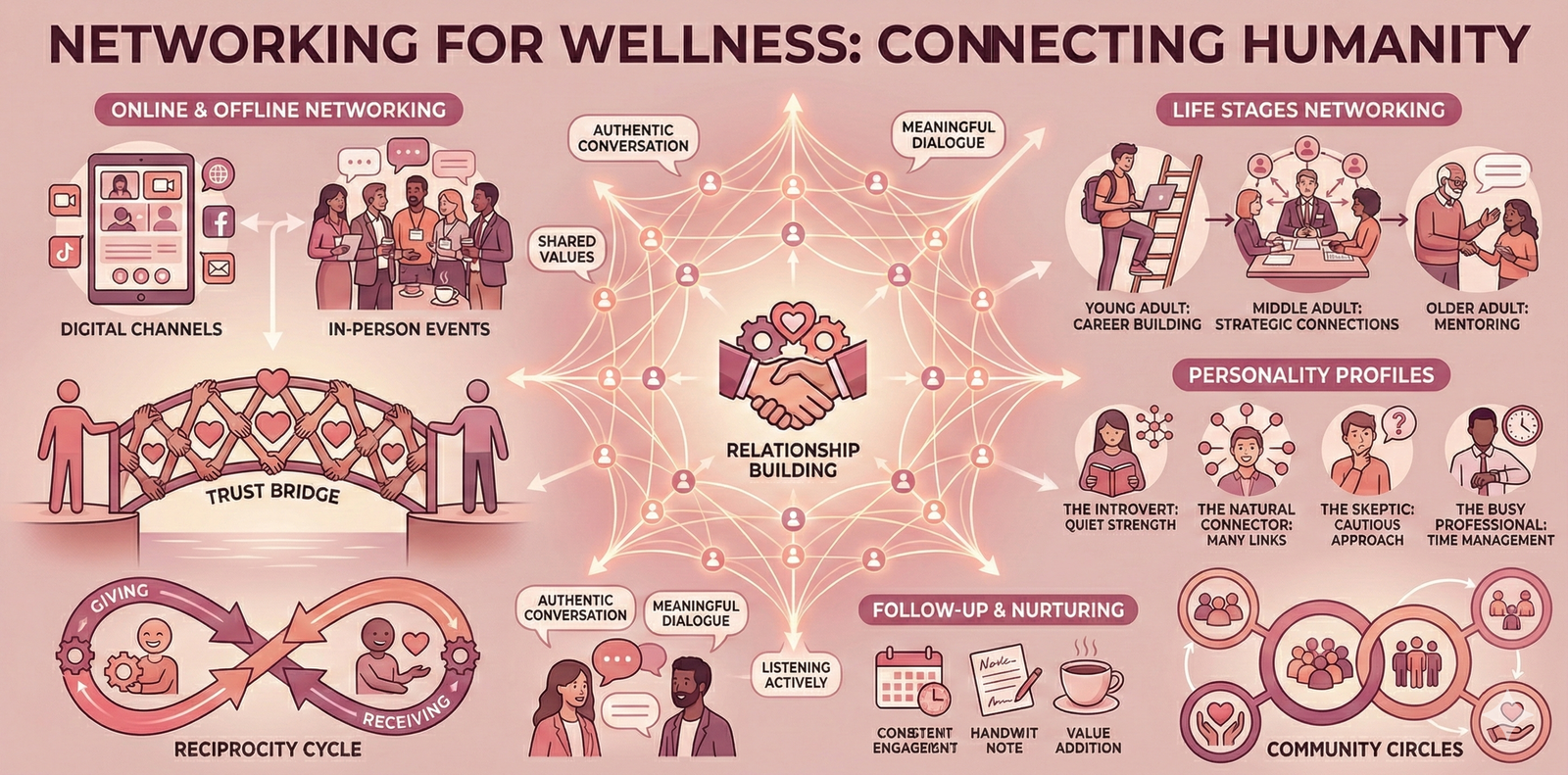
Networking is fundamentally about creating mutual value and building relationships based on trust and shared interests.
In 2026, the most successful networkers understand that meaningful connections beat transactional relationships every single time.
This guide explores what effective networking truly means, why it matters more than ever, and specific strategies anyone can use—whether you're an outgoing extrovert or a quiet introvert. You'll discover that authentic networking isn't about having an enormous Rolodex or being the most charismatic person in the room. It's about showing genuine interest in others, creating mutual value, and building relationships based on trust and shared interests. When you approach networking this way, opportunities naturally flow to you.
What Is Networking?
Networking is the intentional process of building and maintaining professional and personal relationships with others for mutual benefit and growth. It's not a one-time activity but an ongoing practice of connecting with people, sharing knowledge, offering support, and creating opportunities for collaboration. Effective networking goes beyond surface-level interactions—it involves finding genuine common ground, understanding what matters to the other person, and looking for ways to create value in the relationship.
Not medical advice.
Networking encompasses both formal settings like conferences and professional events, and informal contexts like casual conversations, social gatherings, and online communities. The core principle remains the same: authentic connection. Whether you're at a industry conference, connecting on LinkedIn, or meeting a colleague for coffee, effective networking means showing genuine interest in other people and building relationships that are based on mutual respect rather than pure self-interest.
Surprising Insight: Surprising Insight: Research from Stanford shows that strong social connections improve physical health and can add years to your lifespan, with isolation being as harmful as smoking 15 cigarettes daily.
The Networking Relationship Spectrum
Shows how networking relationships evolve from initial contact through different stages of connection depth, from acquaintance to trusted advisor, with each stage requiring different engagement strategies.
🔍 Click to enlarge
Why Networking Matters in 2026
In today's interconnected world, your network is genuinely your net worth. Career opportunities, business deals, and meaningful friendships come through people you know. LinkedIn's research shows that relationship building is one of the fastest-growing workplace skills, yet many professionals still overlook it. The job market has changed dramatically—most positions aren't advertised publicly. They're filled through personal connections and referrals. Beyond career benefits, networking provides emotional support, mentorship, collaboration opportunities, and a sense of belonging that contributes to overall life satisfaction and wellbeing.
Mental health professionals recognize that loneliness is an epidemic in modern society. Strong social connections—which networking helps build—are protective factors against depression, anxiety, and burnout. When you invest in authentic relationships, you're not just advancing your career; you're investing in your mental health and life satisfaction.
The shift toward remote and hybrid work has made intentional networking even more important. Without the casual hallway conversations and office interactions, you need to be more deliberate about building and maintaining relationships. The good news: online networking has made it possible to build meaningful connections across geographic boundaries, connecting you with mentors, collaborators, and friends worldwide.
The Science Behind Networking
Neuroscience research reveals that human brains are wired for connection. When we interact with others, especially in authentic, vulnerable ways, our brains release oxytocin—the bonding hormone. This creates a neurological foundation for trust. The prefrontal cortex, responsible for complex social interaction and relationship building, develops throughout our lives and becomes more sophisticated with experience. Every meaningful conversation strengthens the neural networks associated with empathy and social understanding. Brain imaging studies show that when people feel socially connected, their amygdala (fear center) shows reduced activity, suggesting that strong relationships actually make us feel safer and more capable.
Social psychology research confirms what many intuitively understand: people help those they like and respect. The principles of reciprocity (we naturally want to return favors), consistency (we want to be aligned with our values), and liking (we prefer to help those similar to us) all play roles in networking. When you genuinely help others first, without expecting immediate return, you create a positive obligation that naturally encourages them to help you eventually. This isn't manipulation—it's human nature. Studies show that generous networkers actually achieve their goals faster than selfish ones because people want to support them.
Mirror neurons in our brains literally fire when we observe others' experiences, creating a neurological basis for empathy. When we listen deeply to someone, our mirror neurons activate their experience, creating actual neural synchrony between us. This is the foundation of genuine connection and understanding. This explains why active listening is so powerful in networking—it's not just a technique; it's a neurological phenomenon that creates real connection at the brain level. Understanding this science helps us appreciate why showing genuine interest in others isn't just nice—it's fundamentally rewiring our brains for better relationships and connection.
Research on network density shows that people with diverse networks—connections across different industries, backgrounds, and demographics—have more access to new information and opportunities. The most valuable network connections are 'weak ties'—people who aren't in your immediate circle but move in different circles. These bridging relationships expose you to perspectives and opportunities you'd never encounter in your close circle. This counterintuitive finding explains why breadth matters alongside depth in networking. You need deep relationships you can trust, but you also benefit from maintaining loose connections across diverse groups.
How Authentic Networking Creates Opportunities
Illustrates the process of building trust through genuine interest and value creation, leading to stronger relationships and organic opportunity generation.
🔍 Click to enlarge
Key Components of Networking
Authentic Presence
Being fully present in conversations is fundamental to networking. This means putting away your phone, making genuine eye contact, and showing real interest in what the other person is saying. Authenticity means being yourself rather than adopting a fake persona. People can sense when someone is being genuine versus performative. The most successful networkers don't try to be someone they're not—they show up as themselves, vulnerabilities and all. This creates immediate rapport because it gives others permission to be authentic too. Research in social psychology shows that when we perceive someone as genuine, we're more likely to trust them and want to maintain the relationship. Your authentic self is your greatest networking asset because it's unique to you and creates memorable, meaningful connections.
Authentic presence also means being honest about your experience level, challenges, and goals. Saying 'I'm new to this field and eager to learn' is far more powerful than pretending to expertise you don't have. People respect honesty and vulnerability. They want to help others who are genuinely trying to grow. When you show your true self, you attract people who value the real you, not a manufactured version. This creates the foundation for genuine relationships that withstand time and serve both parties well.
Active Listening
Most people listen with the intention to respond, not to understand. Active listening—focusing completely on understanding the other person's perspective, needs, and challenges—is a superpower in networking. When you ask thoughtful questions and really listen to the answers, you gather valuable information about how you might help. You also make the other person feel valued and understood, which is the foundation of meaningful relationships. Active listening involves asking follow-up questions, remembering details they share, and referencing those details in future conversations. Studies show that people who feel truly heard and understood are significantly more likely to reciprocate support and help.
Practical active listening techniques include: pausing before responding to ensure you've fully understood, asking clarifying questions like 'What did you do next?' or 'How did that make you feel?', and acknowledging what you heard with phrases like 'So what I'm hearing is...' Active listening requires discipline in our distraction-filled world. It means resisting the urge to think about what you want to say next, or to mentally jump ahead to how this person might help you. The irony is that focusing entirely on understanding them actually makes you more memorable and likeable, which naturally leads to them wanting to help you.
Value Creation
The principle of reciprocity suggests that we naturally want to return favors. But the key is giving first, without expectation of immediate return. Look for ways to create value for others: introduce them to someone they should know, share a relevant article or resource, offer your expertise on a problem they're facing, or simply offer a thoughtful perspective. When you consistently show up as someone who creates value, people remember you and naturally want to help you when opportunities arise. This isn't manipulation—it's how human relationships naturally work. When someone helps us, we feel indebted and want to find ways to reciprocate.
Value creation in networking looks different depending on your relationship stage. With someone you just met, value might be as simple as a great conversation, a helpful resource, or introducing them to someone in your network. With established relationships, value might be regular check-ins, collaboration on projects, or ongoing support. The key is being attentive to what matters to the other person and looking for genuine ways to help. This might mean connecting them with a job opportunity, introducing them to a potential partner or client, or simply being a sounding board when they're facing challenges.
Consistency and Follow-Up
Relationships aren't built in a single conversation. They develop over time through consistent interaction and follow-up. After meeting someone new, send a thoughtful message within 48 hours referencing something you discussed. In subsequent weeks and months, occasionally check in—share an article relevant to their interests, congratulate them on a promotion you saw on LinkedIn, or invite them to something aligned with their passions. Consistency shows genuine care rather than transactional interest. Research on relationship maintenance shows that regular, low-pressure contact is far more important than occasional intensive interaction.
Consistency doesn't mean you need to stay in constant contact. Small, meaningful touch points are more effective than overwhelming communication. A brief message every 4-6 weeks is better than daily messages followed by months of silence. The key is reliability—being someone people can count on to stay connected. Over time, consistent relationships become your trusted network. These are the people you can call in times of need, who celebrate your wins, who offer honest feedback, and who remember you even if months pass between interactions. These relationships are priceless both professionally and personally.
| Context | Focus Area | Key Strategy |
|---|---|---|
| Professional Events | Building initial connections | Ask thoughtful questions and exchange contact info with follow-up plan |
| Online Networking | Expanding reach digitally | Engage authentically on social media and participate in online communities |
| One-on-One Meetings | Deepening relationships | Listen actively and look for ways to create mutual value |
| Industry Groups | Building expertise networks | Participate consistently and contribute knowledge to build credibility |
| Alumni Networks | Maintaining long-term connections | Stay engaged with shared identity and mutual support |
How to Apply Networking: Step by Step
Effective networking follows a logical progression from intention-setting through relationship maintenance. Each step builds on the previous one, creating momentum and authentic connection. The key is approaching networking as a long-term investment in mutually beneficial relationships rather than a transaction or one-time event. When you follow these steps consistently, you'll notice that opportunities seem to come to you more naturally because you've built a foundation of trust and genuine connection.
- Step 1: Identify your networking intention: Clarify what you want from networking—career opportunities, mentorship, collaboration, or friendship. Being clear on your goals helps you connect with people who share similar interests and values. Your intention shapes everything else. Someone looking for a new job will attend different events than someone seeking collaborators or industry peers. Knowing your purpose makes networking feel less random and more directed.
- Step 2: Map your existing network: List people you already know—former colleagues, classmates, friends, family, mentors. These warm connections are often the easiest to activate and strengthen. You likely have more network potential than you realize. Former colleagues, even casual acquaintances, and friends of friends represent opportunities for reconnection and expansion. Start here before trying to meet complete strangers.
- Step 3: Prepare your introduction: Develop a brief, genuine introduction that explains who you are and what matters to you professionally or personally. Avoid sounding robotic; instead, sound like a real human with genuine interests. Your elevator pitch should take about 30-60 seconds and include: your name, what you do, what you're interested in or passionate about, and ideally a question that invites conversation. Practice until it feels natural, not memorized.
- Step 4: Choose your networking environments: Select settings aligned with your goals—industry conferences, local professional groups, online communities, coffee meetups, or volunteer organizations. Choose environments where you'll naturally encounter people with shared interests. You don't need to love large networking events. Find settings where you feel comfortable and where you naturally meet people. Online communities, industry groups, volunteer organizations, hobby clubs, and small gatherings often feel less intimidating and yield better connections.
- Step 5: Master the art of questions: Prepare 5-7 open-ended questions about the other person's work, passions, and challenges. Questions like 'What's the most exciting project you're working on?' or 'What brought you to this event?' spark genuine conversation. Good questions show interest and invite people to talk about what matters to them. Avoid yes/no questions. Instead, ask questions that require thoughtful answers and help you understand what motivates them.
- Step 6: Listen more than you talk: Aim for an 80/20 ratio—listen 80% of the time, talk 20%. Focus on understanding the other person's perspective, challenges, and goals. Take mental notes of interesting details you can reference later. This is where many networkers fail. They talk too much about themselves or wait impatiently for their turn to speak. Instead, become fascinated with understanding the other person.
- Step 7: Create immediate value: During your conversation, look for one way you can help—an introduction you could make, a resource you could share, or expertise you could offer. Making someone's life easier creates immediate positive impression. This might be as simple as: 'Oh, you should talk to my friend Sarah—she has similar interests and might have helpful insights.' The fact that you're thinking about how to help, not what you need, changes the entire dynamic.
- Step 8: Exchange contact information thoughtfully: When the conversation flows naturally, exchange contact details with a clear next step: 'I'd love to continue this conversation. Can I send you that article I mentioned?' or 'Let's grab coffee next month to explore that collaboration idea.' Having a clear next step makes the follow-up feel natural, not random.
- Step 9: Follow up within 48 hours: Send a personal message referencing something specific you discussed. Make it personal and genuine, not generic. Mention the mutual introduction opportunity or resource you promised. This is critical. Following up quickly while the conversation is fresh keeps the momentum going and signals that you value the connection. Make it specific—reference something they said, not just 'great meeting you.'
- Step 10: Maintain relationships consistently: Schedule regular touchpoints with key network connections—monthly check-ins, quarterly coffee meetings, or periodic messages sharing relevant resources. Consistency builds trust over time. The relationship doesn't end with that first meeting. Long-term relationships require ongoing nurturing. Think of your key network connections as people worth investing in regularly, not just when you need something.
These steps aren't rigid rules but flexible guidelines. Different networking situations may require different approaches. A coffee meeting follows a different rhythm than a conference. Online networking has different norms than in-person events. The principles remain constant: authentic interest, genuine value creation, consistent follow-up, and relationship maintenance. The medium changes but the fundamentals don't.
Networking Across Life Stages
Young Adulthood (18-35)
In your early career, networking is about exploration and foundation-building. You're discovering what industries and roles align with your values. This is the perfect time to reach out to mentors in fields that interest you, attend industry events, join professional associations, and build your online presence. Don't underestimate the power of your peer network—many of your classmates and early colleagues will become collaborators, leaders, and lifelong friends. Being genuine and curious opens doors. People appreciate enthusiasm and the willingness to learn. Alumni networks, online communities, and informational interviews are goldmines during this stage.
The advantage of young adulthood is that people expect you to be learning and building. Asking for informational interviews, seeking mentorship, and saying 'I don't know, but I'm interested in learning' are all perfectly acceptable. Use this stage strategically to build connections in fields that interest you, volunteer for causes you care about, and engage genuinely in communities aligned with your values. The relationships you build now often become your core network for decades to come. Quality matters more than quantity—a few deep connections with people you genuinely like and admire are more valuable than numerous shallow ones.
Start building your online presence early during young adulthood. LinkedIn, professional blogs, and thoughtful social media engagement can position you as knowledgeable and accessible. Your digital presence becomes part of your professional identity and can attract opportunities. But remember: authenticity matters online just as much as in person. Share insights, ask questions, and engage genuinely with others' content rather than just broadcasting about yourself. Online networking follows the same principles as in-person networking—genuine interest, value creation, and consistent engagement.
Middle Adulthood (35-55)
By this stage, you likely have a substantial professional reputation and established network. The focus shifts from building initial connections to deepening existing relationships and leveraging your network to mentor others. You're in a powerful position to create opportunities for rising professionals while benefiting from their fresh perspectives. Cross-generational mentoring relationships become invaluable. Serving on boards, speaking at conferences, and hosting small gatherings can position you as a hub in your professional community. Many of life's most meaningful opportunities come through trusted relationships built over years.
Middle adulthood is when you transition from primarily asking for help to primarily offering it. This is when you have the experience, credibility, and often resources to genuinely lift others. Becoming known as someone who actively helps others, opens doors, and shares knowledge makes you a valuable node in professional networks. This isn't charity—it's enlightened self-interest. When you help others advance, they remember you, respect you, and want to help you in return. Consider formal mentoring programs, advisory roles, or simply making introductions and offering guidance to emerging professionals. The relationships you deepen during this stage become your trusted inner circle.
Later Adulthood (55+)
This life stage offers unique networking opportunities focused on legacy, wisdom-sharing, and community. Whether you're still working or transitioning into new chapters, your experience is valuable. Many organizations seek advisory board members, volunteer leaders, and mentors. Peer relationships become especially important for emotional support and shared meaning-making. Online communities of people in similar life transitions offer connection and perspective. Networking in this stage often focuses more on quality than quantity—nurturing a smaller circle of deeply meaningful relationships while contributing your wisdom to the broader community.
The privilege of this life stage is that you have decades of experience and perspective to offer. Organizations actively seek retired executives for boards, consulting, and volunteer leadership. Peer networks of people navigating similar life transitions become especially valuable—retirement, health changes, shifting roles, and meaning-making. Online communities, local clubs, and volunteer organizations offer both connection and purpose. Many people find this stage one of the most fulfilling from a relationship perspective—less pressure to 'network for success' and more opportunity to nurture relationships for their own sake, to mentor the next generation, and to be part of communities focused on shared values.
Profiles: Your Networking Approach
The Introvert
- One-on-one conversations over large events
- Time to process and recharge between interactions
- Online networking opportunities and smaller group settings
Common pitfall: Avoiding networking altogether because large events feel overwhelming, missing out on meaningful connections
Best move: Focus on deep one-on-one relationships, leverage online communities, attend smaller professional groups, schedule coffee meetings with individual connections rather than trying to work a large room
The Natural Connector
- Space to introduce people and build communities
- Permission to focus on quantity alongside quality
- Ways to channel networking energy productively
Common pitfall: Building broad networks that are shallow, getting overwhelmed trying to maintain hundreds of surface connections, not deepening key relationships
Best move: Balance introducing people and maintaining community with regular check-ins to deepen existing relationships, focus your genuine energy on the connections that matter most, create structured ways to help people
The Skeptic
- Evidence that networking creates real value
- Authentic connections rather than transactional relationships
- Permission to network in ways that feel natural
Common pitfall: Missing opportunities by dismissing networking as fake or shallow, underestimating the power of genuine relationships
Best move: Focus on the genuine value creation aspect—how you can help others—rather than what you'll gain, start with people you already trust, recognize that most successful people credit relationships as crucial to their achievements
The Busy Professional
- Efficient networking strategies that fit busy schedules
- Clear ROI for networking time investment
- Digital tools and methods to maintain connections
Common pitfall: Letting relationships fade due to lack of time, treating networking as another task to check off, losing authenticity due to rushing
Best move: Schedule specific networking time rather than trying to network spontaneously, use tools like LinkedIn for efficient relationship maintenance, focus on quality over quantity by prioritizing key relationships, remember that 15 minutes of genuine connection beats an hour of forced small talk
Common Networking Mistakes
One of the biggest networking mistakes is making it transactional. Immediately asking for favors, leads, or introductions without building genuine rapport first makes people feel used. Even if the ask is reasonable, the timing and framing matter enormously. People help those they genuinely care about and respect. Building that respect requires time, consistency, and genuine interest in their wellbeing, not just what they can do for you. The transactional approach might yield quick short-term results, but it doesn't build the kind of lasting relationships that create real opportunity. Over time, people who only reach out when they need something develop reputations as takers, not connectors, which limits their opportunities.
Another common mistake is poor follow-up or no follow-up at all. Meeting someone at an event means nothing if you don't nurture the connection afterward. People understand life is busy, but a simple message within 48 hours saying 'I really enjoyed our conversation about X. Here's that resource I mentioned' keeps the relationship alive. Months of silence followed by suddenly reaching out with a request signals that you only value the person when you need something. Consistent, low-pressure touch points build trust. The goal is to stay on someone's radar positively—not disappearing and reappearing only when you want something.
Many people also struggle with authenticity. They try to be someone they're not, adopt a fake persona, or hide aspects of themselves they think are 'unprofessional.' This backfires. People connect with people, not personas. The most memorable and valued connections are with people who are genuinely themselves. Showing vulnerability—acknowledging challenges you're facing or learning from mistakes—actually builds stronger relationships than projecting perfection. Research on vulnerability shows that people who can acknowledge their limitations and learning edges are seen as more trustworthy and relatable.
Another mistake is confusing networking with socializing. Some people avoid networking events because they don't enjoy parties or small talk. But networking doesn't require being the life of the party or making hundreds of connections. Quality conversations matter far more than quantity. One deep conversation with genuine interest and follow-up is more valuable than brief surface interactions with dozens of people. You also don't need to love large events—focus on one-on-one meetings, smaller groups, online communities, or volunteer settings where deeper connection is possible.
Finally, many people neglect to maintain their networks during good times, then suddenly activate them when desperate. The time to build relationships is when you don't immediately need them. When you consistently stay connected, help others, and show genuine interest, people are naturally willing to help you when real needs arise. Conversely, suddenly reaching out after months of silence, especially with a request, often falls on deaf ears or feels uncomfortable. Relationship maintenance is like tending a garden—regular attention keeps it healthy; neglect kills it.
From Networking Mistakes to Relationship Success
Contrasts ineffective networking approaches with their evidence-based alternatives, showing how mindset shifts lead to better outcomes.
🔍 Click to enlarge
Science and Studies
Decades of research confirm that social connections are fundamental to health and happiness. The Harvard Study of Adult Development, which followed individuals for over 80 years, found that strong relationships keep people happy and healthy throughout their lives. Loneliness and isolation are associated with increased mortality risk comparable to smoking and obesity. Beyond health, professional research shows that most jobs are filled through personal networks, and career satisfaction is closely tied to relationship quality at work. Studies on generosity and reciprocity show that people who give first, without keeping score, actually achieve more because others want to help them.
- Stanford Center for Compassion and Altruism Research: Research on how social connection improves both mental and physical health outcomes, with isolation being as harmful as major health risk factors
- LinkedIn's Skills on the Rise Report (2024): Identified relationship building as one of the fastest-growing workplace skills, indicating organizations recognize its critical importance
- Harvard Business School: Studies on informal networks showing that relationships, not titles, determine career advancement and opportunity access
- Psychology Today: Research on active listening and empathy showing how genuine attention in conversations builds stronger trust and connection
- Harvard Study of Adult Development: Longitudinal study demonstrating that strong relationships are one of the best predictors of health, happiness, and longevity
Your First Micro Habit
Start Small Today
Today's action: Send one authentic message to someone in your network today—not asking for anything, just checking in. Reference something specific you know about them (a project they mentioned, a recent achievement, a shared interest) and ask a genuine question about how they're doing.
This small action breaks the ice and activates your network without pressure. It practices authentic communication, creates value through genuine interest, and reminds someone you care. Done consistently, these micro-habits transform your relationships from dormant to active. You'll be surprised how many people respond positively to genuine, no-agenda check-ins.
Keep quitting habit apps after a missed day? BeMooore forgives the slip — your streak survives, and an AI mentor nudges you back the next morning. Free on iOS.
Quick Assessment
How comfortable are you currently with networking and building new professional relationships?
Your comfort level with networking reflects both past experience and current mindset. Many highly skilled professionals feel awkward networking, especially introverts. Recognizing your starting point helps you choose strategies that work with your natural style rather than against it.
What's your primary goal when networking?
Your networking goal shapes your strategy. Career advancement requires visibility and strategic relationships. Friendship-building benefits from smaller, deeper connections. Knowledge-seeking thrives in communities of practice. Business development needs consistent follow-up and trust-building. Understanding your primary motivation helps you focus your energy effectively.
Which networking approach feels most natural to you?
Everyone has a natural networking style. Extroverts often thrive at large events; introverts excel at one-on-one connection; digital natives leverage online platforms. Rather than forcing yourself into uncomfortable modes, optimize the approach that feels natural. You'll be more authentic, energized, and effective networking in your natural style.
Take our full assessment to get personalized recommendations.
Discover Your Style →Next Steps
Start building your networking practice today by identifying one person you've wanted to connect with and reaching out authentically. Whether it's a former colleague, someone whose work you admire, or a peer in your field, a genuine message goes a long way. Focus on creating value rather than extracting it—ask about their work, offer a helpful resource, or make an introduction that could benefit them. Consistency matters more than intensity; regular, authentic connection beats sporadic, transactional outreach. Remember that every successful person in your field started exactly where you are—they built their network one meaningful connection at a time.
Consider also auditing your current network. Who are the people who lift you up? Who do you genuinely care about? Which relationships feel one-sided? This awareness helps you decide where to invest energy. Strong relationships built on mutual respect and genuine care contribute to your overall life satisfaction, career fulfillment, and wellbeing. When you invest in authentic connections, you're not just advancing your career—you're building a support system that enriches every aspect of your life.
Finally, remember that networking is a lifelong practice. As you progress in your career and life, your network evolves. The principles remain constant: authenticity, genuine interest in others, value creation, and consistent follow-up create the kind of relationships that matter—both professionally and personally. Whether you're building trust with new colleagues, deepening relationships with mentors, or contributing wisdom to the next generation, networking remains the currency of human connection and opportunity. Make it a cornerstone of how you live and work.
Get personalized guidance with AI coaching.
Start Your Journey →Research Sources
This article is based on peer-reviewed research and authoritative sources. Below are the key references we consulted:
Related Glossary Articles
Frequently Asked Questions
I'm introverted and networking drains my energy. How can I network without burning out?
Focus on quality over quantity. One meaningful conversation where you genuinely connect is worth far more than working a room for an hour. Seek one-on-one meetings, smaller group settings, and online communities. Schedule networking time with built-in recovery time afterward. Remember that introverts often make excellent networkers because they listen deeply and form meaningful connections—your listening skills are an asset, not a limitation.
How do I follow up with someone I just met without seeming pushy or desperate?
Send a message within 48 hours that's personal and specific. Reference something you discussed and provide genuine value—share that article you mentioned, make an introduction, or simply say you enjoyed learning about their work. Keep it brief and genuine. A simple 'I really enjoyed our conversation about X. I found this article that relates to what you mentioned, thought you'd appreciate it' is perfect. No expectation of immediate response required.
What should I do if I haven't talked to someone in my network for months or years?
Don't let silence make it worse. Reach out with genuine warmth. Acknowledge the time gap naturally: 'It's been too long! I was thinking about our conversations about X and wanted to reconnect.' Share what you've been up to, ask about them, and suggest a coffee or call if appropriate. Most people appreciate genuine reconnection attempts. Life gets busy for everyone—good relationships can pick up after gaps in contact.
How do I build a network if I don't already know many people in my field?
Start where you are. Connect with classmates, colleagues, online community members, and people doing interesting work on social media. Attend industry events, join professional associations, participate in online forums, volunteer for causes you care about. Most networking happens through secondary connections—someone introduces you to someone who introduces you to someone important. Be genuinely curious and generous with people at your current level, and you'll naturally expand your circle over time.
Is it okay to network online, or do I need in-person connections?
Both matter, but they serve different purposes. In-person networking builds deeper rapport and allows nonverbal communication that strengthens trust. Online networking expands your reach and maintains relationships across distance. The best approach uses both. Online might be how you maintain regular contact and expand your circle; in-person deepens specific relationships. The authenticity of your engagement matters more than the platform.
Take the Next Step
Ready to improve your wellbeing? Take our free assessment to get personalized recommendations based on your unique situation.
- Discover your strengths and gaps
- Get personalized quick wins
- Track your progress over time
- Evidence-based strategies