Career Fulfillment
You spend roughly a third of your life at work. Yet many people feel like they're simply going through the motions, collecting paychecks without experiencing genuine satisfaction. Career fulfillment is the profound sense that your work matters, aligns with who you are, and contributes to your overall happiness. Unlike job satisfaction—which can depend on external factors like salary and benefits—real fulfillment runs deeper, touching your sense of purpose and identity.
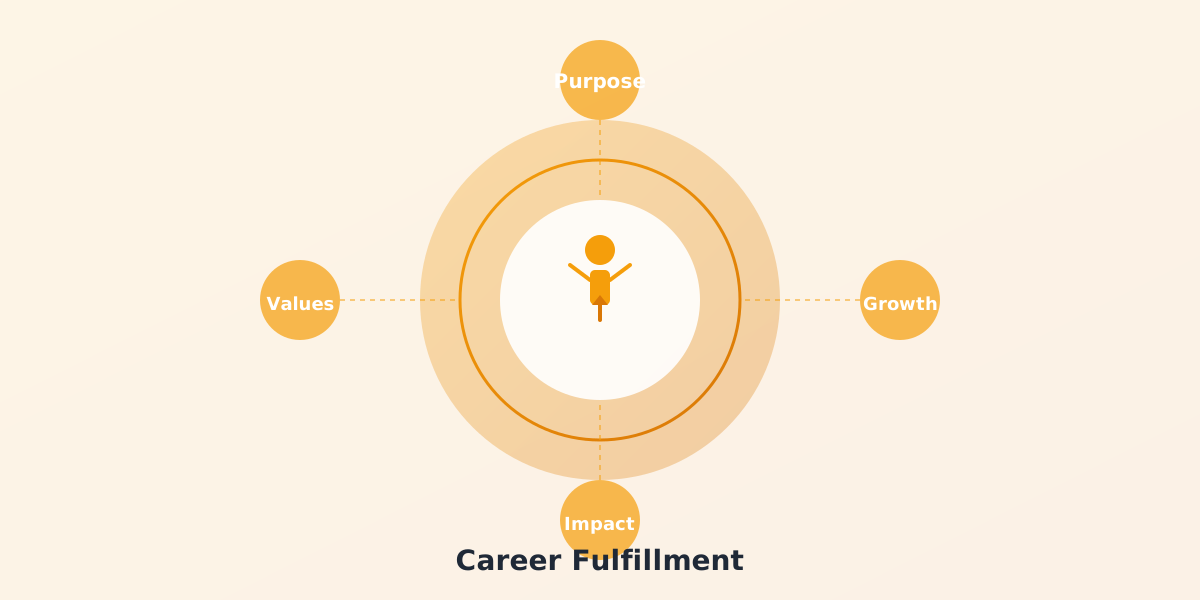
The gap between a job and a calling isn't just psychological. Research shows that fulfilling work correlates with better health outcomes, stronger relationships, and greater resilience during life challenges.
When your career aligns with your values and strengths, it becomes a source of pride, growth, and genuine wellbeing rather than a daily burden.
What Is Career Fulfillment?
Career fulfillment is an internal sense of meaning, purpose, and satisfaction in your work. It's the feeling that your professional life has value, contributes to something larger than yourself, and reflects who you truly are. This differs fundamentally from job satisfaction, which often focuses on external rewards and working conditions.
Not medical advice.
Career fulfillment emerges when your daily work engages your strengths, supports your growth, and aligns with your core values. It's personal and unique to each individual. For some, fulfillment comes from helping others directly. For others, it emerges through creative problem-solving, building something new, or leading teams.
Surprising Insight: Surprising Insight: Research from Perceptyx surveyed over 7,000 workers globally and found that autonomy and purpose ranked higher in determining fulfillment than compensation and job security.
The Career Fulfillment Spectrum
Shows how career satisfaction moves from external rewards (salary, benefits) to internal fulfillment (purpose, values alignment, growth).
🔍 Click to enlarge
Why Career Fulfillment Matters in 2026
In an era of increasing career uncertainty and rapid workplace change, fulfillment has become essential for sustained wellbeing. People who feel fulfilled in their work experience lower stress, better sleep, and improved mental health. They're more resilient when facing setbacks and more likely to maintain engagement throughout their careers.
The shift toward remote and hybrid work has created new opportunities for career fulfillment. Workers now have more autonomy in designing their workdays. Simultaneously, disconnection from physical workplaces has made finding community and shared purpose more challenging. Intentional career design has become a survival skill.
Organizations that prioritize employee fulfillment see measurable benefits: lower turnover, higher productivity, better innovation, and stronger company culture. In 2026, career fulfillment isn't just a personal wellness goal—it's a business imperative.
The Science Behind Career Fulfillment
Decades of research in organizational psychology, motivation science, and positive psychology reveal what actually drives lasting career satisfaction. Self-Determination Theory, developed by psychologists Deci and Ryan, identifies three core psychological needs: autonomy (control over your work), competence (mastery and skill development), and relatedness (connection and belonging).
When these three needs are met through your career, motivation becomes intrinsic rather than extrinsic. You work not just for external rewards but because the work itself feels meaningful. Studies tracking career satisfaction over decades show this intrinsic motivation predicts long-term success far better than initial job choice or salary level.
The Three Pillars of Career Fulfillment
Shows how autonomy, competence, and relatedness combine to create intrinsic motivation and lasting fulfillment.
🔍 Click to enlarge
Key Components of Career Fulfillment
Purpose and Meaning
Purpose is the ability to see how your work contributes to something larger than yourself. This might mean helping clients directly, creating products that improve lives, leading teams, advancing knowledge, or building something from nothing. Research shows that workers who perceive meaningful purpose in their roles experience significantly lower burnout and higher life satisfaction.
Values Alignment
Your career fulfillment depends on how well your daily work aligns with your core values. If you value integrity but work in an environment encouraging shortcuts, the conflict creates constant internal tension. Conversely, when your work reflects your values—whether that's excellence, service, creativity, or fairness—you experience deep satisfaction.
Growth and Development
Humans are wired for growth. A fulfilling career provides ongoing opportunities to develop new skills, face meaningful challenges, and progress toward mastery. Stagnation leads to boredom and disengagement, while excessive challenge without support creates overwhelm. The sweet spot is stretch—work that challenges you just beyond your current comfort zone.
Autonomy and Agency
You need meaningful control over how you do your work. This might mean flexible scheduling, decision-making authority, or the ability to shape your projects. Micromanagement and rigid processes undermine fulfillment, even in otherwise meaningful work. Autonomy signals trust and respects your professional judgment.
| Attribute | What It Means | Impact on Fulfillment |
|---|---|---|
| Purpose | Contributing to something larger than yourself | High—fundamental driver of meaning |
| Values Alignment | Work matches your core ethics and beliefs | High—prevents internal conflict |
| Autonomy | Control over your work and decisions | High—enables authentic contribution |
| Career Pride | Sense of accomplishment in your role | High—builds self-worth |
| Growth Opportunity | Ongoing learning and skill development | High—maintains engagement |
| Workplace Culture | Environment of trust and belonging | Medium-High—supports wellbeing |
| Leadership Quality | Management that enables and supports you | Medium-High—shapes daily experience |
| Work-Life Integration | Ability to balance professional and personal life | Medium-High—prevents burnout |
| Compensation Fairness | Pay reflects your contribution and market value | Medium—foundation, not driver |
| Career Identity | Professional role aligns with sense of self | High—creates coherence and pride |
How to Apply Career Fulfillment: Step by Step
- Step 1: Identify your core values by reflecting on when you've felt most alive and proud. What were you doing? Who were you helping? What principles mattered in that moment?
- Step 2: Audit your current role against your values. Rate each day or week: Did today align with my values? Did I use my strengths? Did I contribute meaningfully? Track patterns.
- Step 3: Clarify your unique strengths. What do you do better than most? What energizes you rather than drains you? Ask colleagues what they see as your superpowers.
- Step 4: Explore how your current role could be redesigned. Can you shift responsibilities? Shape a project? Volunteer for something meaningful? Small changes accumulate.
- Step 5: Research career paths aligned with your values and strengths. Talk to people in different roles. What excites you? What concerns you? Gather real information.
- Step 6: Develop one new skill this quarter that moves you toward greater fulfillment. It might support a future role or deepen impact in your current one.
- Step 7: Build community in your work through mentorship, collaboration, or leadership. Relatedness matters. Create meaningful connections with colleagues.
- Step 8: Set a fulfillment goal for the next 12 months. Not a promotion or salary target, but a meaningful goal: learn something, help someone, create something, lead something.
- Step 9: Review your work regularly and recalibrate. Career fulfillment isn't static. As you grow and your life circumstances change, your fulfillment blueprint evolves.
- Step 10: Take action on at least one element this week. The gap between knowing what fulfillment requires and experiencing it is action.
Career Fulfillment Across Life Stages
Young Adulthood (18-35)
Early career is about exploration and establishing your professional identity. You're testing different roles, industries, and work environments to understand what fits. Fulfillment in this stage often comes from learning, skill-building, and finding mentors who can guide you. You might prioritize growth opportunity over high salary or prestige. This is the time to experiment without excessive risk. Take assignments that stretch you. Change jobs if a role isn't aligned. Build your foundation.
Middle Adulthood (35-55)
Mid-career often brings deepening expertise and growing influence. You might shift from personal achievement to legacy—how you develop others, shape culture, or make lasting impact. Many experience a mid-career reassessment: Does my work still fulfill me? Have my values shifted? This is a powerful time to redesign your career intentionally. You have experience and credibility. Fulfillment often comes from mastery, mentoring, and visible impact on important work.
Later Adulthood (55+)
Later career brings opportunity for purposeful contribution and wisdom-sharing. You might transition toward advisory roles, consulting, part-time work, or entirely new ventures. Many find deeper fulfillment in this stage through mentorship, creating lasting works, or shifting to mission-driven organizations. Fulfillment often involves continuity, integration of your life experience, and leaving something meaningful behind.
Profiles: Your Career Fulfillment Approach
The Purpose-Driven Professional
- Clear connection to mission
- Autonomy in how to contribute
- Regular feedback on impact
Common pitfall: Pursuing meaning so intensely that they burnout or sacrifice practical needs.
Best move: Channel purposefulness into sustainable impact through mentorship, strategic projects, and community-building rather than martyrdom.
The Master Craftsperson
- Ongoing skill challenges
- Recognition for quality
- Continued learning opportunities
Common pitfall: Losing fulfillment when mastery plateaus or when organizational changes devalue their expertise.
Best move: Deepen expertise by teaching others, evolving with new tools, or taking on increasingly complex problems that keep them engaged.
The Connection Builder
- Meaningful relationships at work
- Collaboration and teamwork
- Feeling valued by colleagues
Common pitfall: Struggling in isolated roles or overly competitive environments that reward individual achievement over team success.
Best move: Seek roles emphasizing collaboration—team leadership, cross-functional projects, mentorship—where relationship-building drives success.
The Impact Accelerator
- Visible results and progress
- Authority to make decisions
- Recognition of contributions
Common pitfall: Becoming impatient with slow-moving organizations or feeling frustrated when impact is indirect or hard to measure.
Best move: Channel intensity into leadership roles, innovation projects, or entrepreneurial ventures where pace and impact align with their natural rhythm.
Common Career Fulfillment Mistakes
A common mistake is prioritizing external markers of success—title, salary, prestige—while ignoring internal fulfillment. You land the impressive job only to discover the work itself feels meaningless or conflicts with your values. The external validation never fills the internal void.
Another mistake is assuming fulfillment comes from the perfect job rather than from intentional career design. The truth: fulfillment is something you build through alignment of values, strengths, relationships, and growth—not something you stumble into. Even imperfect roles can become fulfilling through intentional redesign.
A third mistake is confusing fulfillment with passion. Not all meaningful work feels effortlessly passionate. Sometimes fulfillment comes from dedicated work where you're solving real problems, helping people, or creating excellence—even when it's challenging or sometimes frustrating. Passion fades. Fulfillment through purpose sustains.
From Unfulfilled to Fulfilled: The Transformation Path
Shows how recognizing misalignment, taking action, and building intentional elements gradually leads to greater career fulfillment.
🔍 Click to enlarge
Science and Studies
Career fulfillment research has evolved from focusing solely on job satisfaction (external factors) to understanding intrinsic motivation and wellbeing. Major studies tracking thousands of workers across decades reveal consistent patterns about what sustains long-term fulfillment and what leads to burnout.
- Perceptyx Center for Workforce Transformation surveyed over 7,000 workers globally identifying 10 key attributes of career fulfillment, finding autonomy and purpose outrank compensation in determining lasting satisfaction.
- Research published in the Journal of Organizational Psychology demonstrates that work-life integration (rather than strict separation) predicts greater fulfillment when boundaries are self-chosen.
- Harvard Study of Adult Development tracked individuals across decades, finding that fulfilling work relationships and sense of purpose predicted longevity and health outcomes as strongly as medical factors.
- Self-Determination Theory research by Deci and Ryan shows that intrinsic motivation (driven by autonomy, competence, relatedness) predicts sustained performance better than extrinsic rewards across industries.
- Positive Psychology research documents that happy, fulfilled workers earn higher salaries, receive better performance evaluations, and experience less illness over their careers.
Your First Micro Habit
Start Small Today
Today's action: Identify one element of your work this week that already aligns with your values or strengths. It might be one project, one collaboration, or one client interaction. Notice it. Appreciate it. This week, deliberately expand this element by just 10% (more time, more visibility, more ownership). Build momentum.
Fulfillment builds through accumulated small alignments, not through waiting for perfect job changes. Noticing what already works rewires your brain toward possibility. Expanding it deliberately creates momentum without requiring major life changes. Small wins compound into career transformation.
Track your fulfillment micro-habits and get personalized AI coaching on career alignment with our app. Get real-time suggestions for expanding meaningful work in your current role or finding roles that match your values.
Quick Assessment
How would you describe your current relationship with your work?
Your current fulfillment level helps determine which steps will most impact your wellbeing. Even if you're in stage one, small alignments can shift your experience.
When you imagine ideal work fulfillment, what matters most to you?
Different people find fulfillment through different pathways. Knowing your primary driver helps you design work that truly energizes you.
What's your biggest barrier to career fulfillment right now?
Every barrier has solutions. Knowing yours helps you take the most effective next steps toward greater fulfillment.
Take our full assessment to get personalized recommendations for career fulfillment.
Discover Your Style →Next Steps
Career fulfillment isn't a destination you reach but a practice you cultivate. Start this week by identifying one small way to increase alignment between your work and your values. It might be a conversation with your manager, a volunteer project, mentoring someone, or simply choosing to approach existing work with greater intention and authenticity.
Remember: career fulfillment develops through accumulated small alignments and intentional choices. You have more power to shape your work experience than you might think. This month, take one concrete action toward greater fulfillment. Next month, take another. Over a year, you'll be surprised how much shifts.
Get personalized guidance and track your path to greater career fulfillment with AI coaching.
Start Your Journey →Research Sources
This article is based on peer-reviewed research and authoritative sources. Below are the key references we consulted:
Related Glossary Articles
Frequently Asked Questions
Is career fulfillment realistic for everyone?
Yes, though it looks different for each person. Fulfillment doesn't require a dream job or perfect circumstances. It emerges from intentionally aligning your work with your values, strengths, and desires for impact. You build it through small, deliberate choices over time.
Do I need to change jobs to find fulfillment?
Not necessarily. Many people discover greater fulfillment in their current roles through intentional redesign: shifting responsibilities, building different relationships, volunteering for meaningful projects, or changing how they approach their work. Job changes sometimes help, but fulfillment is often something you build rather than find.
How does career fulfillment relate to work-life balance?
Fulfillment and balance are connected but distinct. Balance means adequate time and energy for all life domains. Fulfillment means your work itself feels meaningful. The combination is optimal, but fulfilling work often requires more time investment while feeling less draining than unfulfilling work consuming the same hours.
Can fulfillment coexist with career ambition?
Absolutely. Ambition and fulfillment aren't opposites. You can be ambitious about meaningful goals while maintaining fulfillment in your work. The key is ensuring your ambitions align with your values. Pursuing status that conflicts with your values creates emptiness even when achieved.
What if my workplace makes fulfillment impossible?
Sometimes workplaces genuinely undermine fulfillment through toxic culture, misalignment with values, or refusal to support growth. When redesigning your current role isn't possible, exploring alternatives becomes wise. The choice to leave for alignment often increases fulfillment more than staying in an impossible situation.
Take the Next Step
Ready to improve your wellbeing? Take our free assessment to get personalized recommendations based on your unique situation.
- Discover your strengths and gaps
- Get personalized quick wins
- Track your progress over time
- Evidence-based strategies