Conversaciones Honestas
You probably remember the last time you held back what you really wanted to say in an important conversation. Maybe you feared hurting someone's feelings, triggering conflict, or revealing too much of yourself. Yet that moment of silence may have created more distance than any difficult truth ever could.
Research from the University of Rochester shows that expresaed and perceived honestidad beneficios relaciones even when couples are not perfectly accurate in their perceptions. The simple act of being honest and being perceived as honest mejoras relationship wellbeing for both partners. This finding challenges the common fear that complete honestidad will damage our connections.
This guía reveals how to have conversaciones honestas that fuerzaen rather than strain your relaciones. You will descubre why vulnerability creates deeper bonds than perfection, and later you will aprende the specific communication frameworks that therapists use to help couples navigate difficult topics without triggering defensiveness or withdrawal.
What Are Conversaciones Honestas? Understanding Authentic Communication
Honest conversations involve sharing your genuine thoughts, feelings, needs, and experiences with another person in a way that invites connection rather than conflict. These exchanges move beyond surface pleasantries and social scripts to reveal what truly matters to you while remaining respectful of the other person.
Surprising Insight: Descubrimiento Sorprendente: John Gottman's research with thousands of couples found he could predict with 96 percent accuracy whether a relationship would last based on just the first three minutes of a difficult conversation. The way you start an honest conversation matters more than the topic itself.
Authenticity does not mean saying whatever comes to mind without filter or consideration. True honest communication balances transparency with compassion, directness with sensitivity. It requires both the courage to speak your truth and the wisdom to choose words that your listener can actually hear.
The opposite of honest conversation is not necessarily lying. It includes avoiding topics that matter, presenting a carefully curated version of yourself, agreeing when you disagree to keep the peace, or dancing around issues rather than addressing them directly. These patterns create what relationship researcher Brené Brown calls the illusion of connection without genuine vulnerability.
Understanding this distinction helps you recognize when you are truly connecting versus simply maintaining a comfortable facade that prevents real intimacy from desarrollaing.
Why Conversaciones Honestas Matter for Relaciones and Bienestar
The quality of your relaciones directly impacts your mental and physical health. According to the American Psychological Association, individuals with strong social support networks are 50 percent more likely to have better salud mental outcomes. Honest communication forms the foundation of these supportive connections.
Beneficios of Honest Communication
🔍 Click to enlarge
Research published in Community Salud Mental Journal found that adultez joven who share their stories and struggles can increase their wellbeing and feel less stigmatized. Randomized controlled studies of programs like Honest, Open, Proud showed that entrenamiento in honest communication reduces stigma-related estrés in adults, college estudiantes, and adolescents.
Trust desarrollas through consistent honest interactions over time. When partners communicate authentically, they create what researcher Dr. John Gottman calls an emotional bank account. Each moment of honest connection makes a deposit. Each moment of dishonestidad, avoidance, or dismissiveness makes a withdrawal. Relaciones thrive when deposits far outnumber withdrawals.
Physical health also mejoras with honest communication. Reduced estrés from authentic relaciones leads to better sleep, mejorad immune function, and lower risk of estrés-related illnesses. A study published in Communication Research suggests that having one honest conversation with a friend per day can significantly affect your salud mental.
Workplace research from Carnegie Mellon University found that honest behavior encompasses much more than simply telling the truth. It includes fostering accurate understanding through disclosure and communication, plus evaluating information for accuracy. This broader framework explains why conversaciones honestas mejora not just personal relaciones but also professional collaboration and organizational effectiveness.
The Science Behind Vulnerability and Honest Communication
Brené Brown's research spanning twelve years and over 1,280 participants revealed that vulnerability is the core, the heart, and the center of meaningful human experiences. Her work shows that vulnerability is the birthplace of love, belonging, joy, courage, empathy, and creativity.
Contrary to popular belief, vulnerability is not weakness. Brown's research indicated that courage is born out of vulnerability, not fuerza. This finding challenges cultural narratives that equate emotional guardedness with power and openness with fragility.
Neuroscience research using fMRI technology shows that perceiving active listening activates the brain's reward system. This means that when someone truly listens to you during an honest conversation, your brain experiences pleasure and feels rewarded. This creates a positive feedback loop that encourages more open communication.
The Vulnerability Cycle in Conversaciones Honestas
🔍 Click to enlarge
Dr. Amy Edmondson coined the term psychological safety in the 1990s to describe environments where people feel safe to speak up without fear of punishment or embarrassment. Her research revealed that hospital units with higher psychological safety did not make fewer mistakes. They reported more mistakes because staff felt safe to be honest, which allowed teams to aprende and mejora.
Google's famous Project Aristotle study identified psychological safety as the single most important factor behind high-performing teams. This research applies equally to personal relaciones. When you create safety for conversaciones honestas, you enable growth, problem-solving, and deeper connection.
The neurochemistry of connection involves oxytocin, often called the bonding hormone. Honest, vulnerable conversations trigger oxytocin release, which increases feelings of trust and connection. This biological response reinforces honest communication patterns and helps explain why authentic dialogue feels so rewarding despite initial discomfort.
Barriers That Prevent Conversaciones Honestas
Fear drives most communication avoidance. You might fear rejection, conflict, judgment, hurting someone you care about, being misunderstood, or descubreing uncomfortable truths about yourself or others. These fears feel protective but often create the very distance and disconnection you hope to avoid.
Cultural conditioning teaches many people to prioritize politeness over authenticity, harmony over honestidad. You aprende to say what others want to hear rather than what you genuinely think or feel. These patterns become so automatic that you may not even recognize when you are censoring yourself.
Past experiences shape current communication patterns. If previous attempts at honestidad led to punishment, abandonment, or ridicule, your nervous system aprendes to associate vulnerability with danger. This creates automatic defensive responses that activate before conscious awareness, making honest conversation feel impossible.
Lack of skills also prevents honest communication. Many people never aprendeed how to expresa difficult feelings, set boundaries, or navigate conflict constructively. Without these tools, even well-intentioned attempts at honestidad can escalate into arguments or shut down into silence.
Workplace research identified specific barriers including fear of judgment and recrimination, stigma, service structure limitations, and individual circumstances. Annual performance reviews often create defensive environments that discourage the conversaciones honestas needed for growth and mejorament.
The Gottman Method for Difficult Conversations
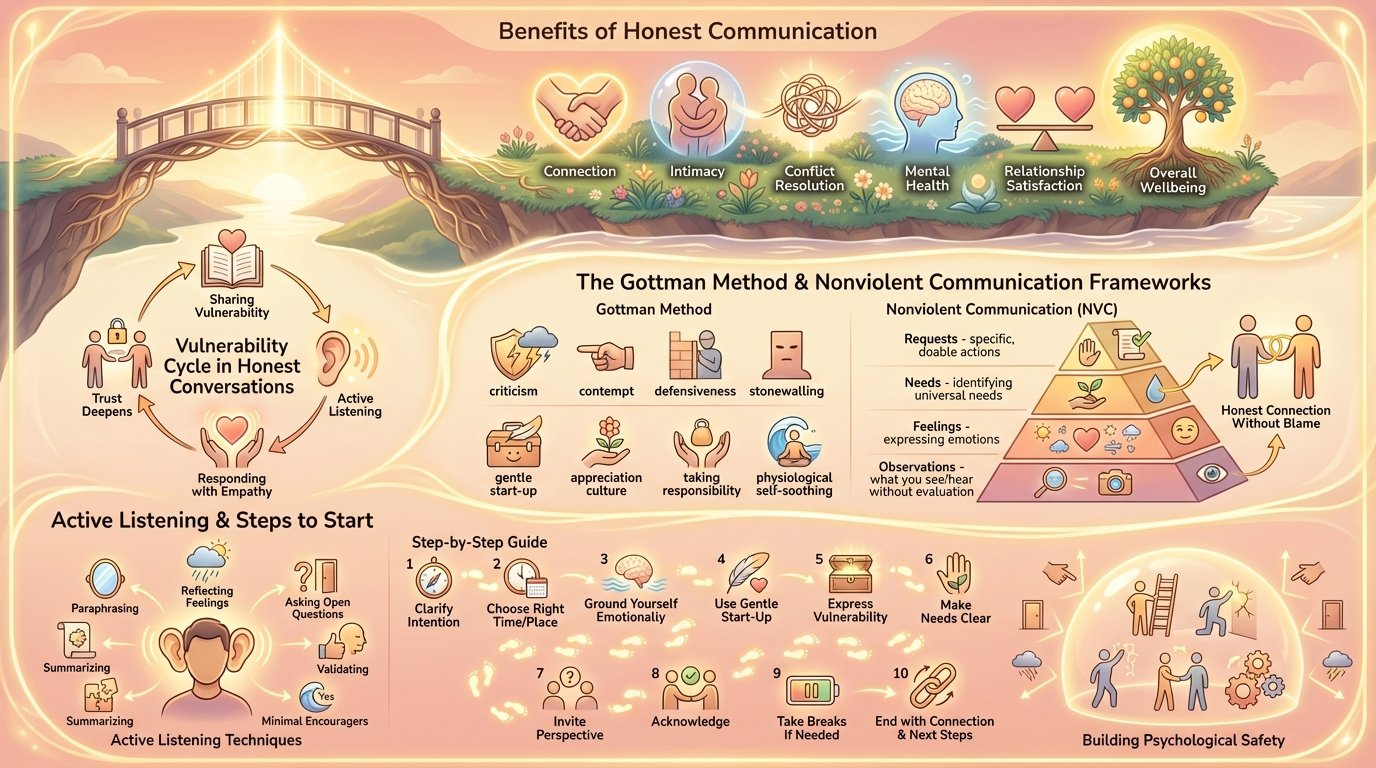
Dr. John Gottman's 47 years of research with over 3,000 couples provides the most comprehensive framework for conversaciones honestas. His method focuses on managing the Four Horsemen of relationship apocalypse: criticism, contempt, defensiveness, and stonewalling.
| Horseman | Description | Antidote | Example |
|---|---|---|---|
| Criticism | Attacking character rather than addressing specific behavior | Gentle Start-Up | Instead of 'You never listen,' try 'I felt hurt when you looked at your phone while I was talking' |
| Contempt | Treating partner with disrespect, mockery, or disgust | Construyeing Culture of Aprecio | Expresa gratitude daily. Focus on what your partner does right |
| Defensiveness | Making excuses or playing the victim | Taking Responsibility | Instead of 'That's not what happened,' try 'I can see why you felt that way' |
| Stonewalling | Withdrawing and shutting down emotionally | Physiological Self-Soothing | Take a 20-minute break when overwhelmed, then return to conversation |
The Soft Start-Up technique dramatically mejoras how conversaciones honestas begin. Gottman's research found that 96 percent of the time, the outcome of a conversation matches how it starts. A harsh start-up leads to a harsh ending. A gentle start-up creates space for connection even during difficult topics.
Repair attempts are specific phrases used to de-escalate tension during conflict. These include statements like 'I need to calm down,' 'Let me try again,' or 'I appreciate you.' La investigación muestra that successful couples make frequent repair attempts, while struggling couples either don't make them or their partners don't recognize them.
Flooding occurs when your nervous system becomes overwhelmed during conflict. Your heart rate rises above 100 beats per minute, estrés hormones flood your system, and your ability to think clearly shuts down. When flooded, take a minimum 20-minute break to allow your body to return to baseline before continuing the conversation.
The Gottman Method also emphasizes understanding your partner's perspective rather than winning arguments. This enfoque transformas conversaciones honestas from battles to be won into problems to be solved together.
Nonviolent Communication: A Framework for Honest Dialogue
Marshall Rosenberg desarrollaed Nonviolent Communication in the 1960s and 1970s based on principles of nonviolence and humanistic psychology. His method has reached over 60 countries and influenced millions including Microsoft CEO Satya Nadella, who asked his executives to read Rosenberg's work when reshaping company culture.
NVC holds that most conflicts arise from miscommunication about human needs due to coercive or manipulative language that induces fear, guilt, or shame. The framework teaches you to communicate in ways that increase empathy and reduce conflict.
Four Components of Nonviolent Communication
🔍 Click to enlarge
Observations describe what happened without judgment or interpretation. Instead of saying 'You were rude,' you might say 'When you left the room while I was mid-sentence.' This factual enfoque prevents the listener from becoming defensive.
Feelings expresa your emotional response using genuine emotion words, not thoughts disguised as feelings. 'I feel abandoned' states a feeling. 'I feel like you don't care' actually expresaes a thought about the other person.
Needs identify the universal human needs underlying your feelings. You might need respect, understanding, connection, or autonomy. When you name your needs clearly, others can understand what matters to you without having to guess.
Requests ask for specific actions that would meet your needs. Instead of demanding 'You need to be more present,' you request 'Would you be willing to put your phone away during dinner so we can talk?' Clear requests give others concrete ways to respond to your needs.
Active Listening: The Other Half of Conversaciones Honestas
Honest conversations require both authentic speaking and genuine listening. La investigación muestra that 65 percent of HR profesionales rate active listening as the most important communication skill, and it can enhance collaboration by 25 percent.
Active listening involves restating a paraphrased version of the speaker's message, asking questions when appropriate, and maintaining moderate to high nonverbal conversational involvement. This goes far beyond simply waiting for your turn to talk.
A 2025 study in the International Journal of Listening found that active listening entrenamiento for doctors significantly mejorad cultural competence, empathy, and communication skills, with beneficios sustained at three-week follow-up. Research also shows that employees with lower psychological estrés have supervisors who regularly use active listening.
Gestionars trained in active listening see a 30 percent increase in employee satisfaction. The World Economic Forum identified active listening as a vital skill for career success by 2030. These findings apply equally to personal relaciones where feeling heard determines relationship satisfaction.
Empathic listening involves reflecting back the emotions you hear, showing understanding, and encouraging the speaker to share more by validating them without judgment. This creates safety for the vulnerable sharing that defines conversaciones honestas.
| Technique | Description | Example |
|---|---|---|
| Paraphrasing | Restating the speaker's message in your own words | So what I'm hearing is that you felt excluded when... |
| Reflecting Feelings | Naming the emotions you notice | It sounds like you're feeling frustrated and maybe a bit hurt |
| Asking Open Questions | Questions that invite elaboration | Can you tell me more about what that was like for you? |
| Validating | Acknowledging the person's experience as real and understandable | That makes sense. I can see why you'd feel that way |
| Summarizing | Pulling together the main points | Let me make sure I understand. You're saying... |
| Minimal Encouragers | Small verbal and nonverbal signals that you're engaged | Mm-hmm, I see, nodding, maintaining eye contact |
Common listening mistakes include interrupting, jumping to solucións before understanding, making the conversation about yourself, preparing your response while the other person is still talking, and dismissing feelings as overreactions. Each of these behaviors shuts down honest communication.
How to Start Conversaciones Honestas: Step-by-Step Guía
Beginning an honest conversation requires preparation, timing, and skillful framing. Following this systematic enfoque increases the likelihood of productive dialogue rather than painful conflict.
- Step 1: Clarify your intention before speaking. Ask yourself what you hope to achieve through this conversation. Do you want to be understood, solve a problem, repair connection, or simply share something important? Clear intention guías your words.
- Step 2: Choose the right time and place. Avoid bringing up difficult topics when either person is tired, hungry, rushed, or already estrésed. Find a private, comfortable setting where you can talk without interruption.
- Step 3: Ground yourself emotionally. Take several deep breaths to calm your nervous system. If you start the conversation while angry or panicked, your tone will trigger defensiveness regardless of your words.
- Step 4: Use a gentle start-up following the Gottman Method. Begin with something positive or an expresaion of aprecio. State what you observe without criticism. Share your feelings using I-statements.
- Step 5: Expresa vulnerability rather than blame. Instead of attacking the other person's character, share the impact their behavior had on you. Vulnerability invites connection while blame creates distance.
- Step 6: Make your needs clear without demanding. State what would help you feel better or what you need to move forward. Requests differ from demands because the other person has genuine freedom to say no.
- Step 7: Invite the other person's perspective. Ask open-ended questions about their experience. Listen to understand rather than to defend yourself or prove your point.
- Step 8: Acknowledge what you hear even if you disagree. Validation does not require agreement. You can say 'I understand why you see it that way' while still holding your own perspective.
- Step 9: Take breaks if needed. If either person becomes flooded with emotion, pause the conversation. Agree on when you will reconvene rather than simply walking away.
- Step 10: End with connection and next steps. Thank the person for their willingness to have this conversation. Clarify any agreements you made and when you will follow up.
Navigating Emotional Intensity During Conversaciones Honestas
No es consejo médico. Seek professional support for serious salud mental concerns or relationship crises.
Strong emotions naturally arise during conversaciones honestas about topics that matter. Aprendeing to stay present with emotional intensity without becoming overwhelmed or shutting down enables deeper communication.
When you notice your heart racing, jaw clenching, hands shaking, or thoughts spiraling, your nervous system has activated a estrés response. This physiological reaction makes rational conversation nearly impossible. Recognize these signs as your cue to pause and regulate yourself before continuing.
The 20-minute rule comes from research on physiological flooding. It takes approximately 20 minutes for estrés hormones to clear your system enough for productive communication to resume. During this break, avoid rehearsing what you will say next or construyeing your case. Instead, focus on calming activities like walking, listening to music, or deep breathing.
Tears often surface during vulnerable sharing. Allow them rather than suppressing them. Crying releases estrés hormones and signals to your conversation partner the depth of what you are feeling. If the other person becomes uncomfortable with tears, you can simply say 'I just need a moment' while you collect yourself.
Anger deserves expresaion but not explosion. You can say 'I'm feeling really angry right now' without yelling or attacking. Naming your anger honestly often reduces its intensity because you feel heard rather than dismissed.
Construyeing Psychological Safety for Honest Communication
Amy Edmondson's research shows that psychological safety is not about being nice or lowering standards. It means giving candid feedback, openly admitting mistakes, and aprendeing from them. High psychological safety creates high aprendeing quotient through honest, engaged work.
Creating safety requires consistent patterns over time. One honest conversation will not instantly transforma a relationship where trust has eroded. Safety construyes through repeated experiences of sharing vulnerability and having it met with respect rather than ridicule or punishment.
Construyeing Psychological Safety Over Time
🔍 Click to enlarge
Leadership behaviors that promote safety include framing work as aprendeing opportunities, inviting participation, and responding productively to feedback. In personal relaciones, this translates to treating conversations as collaborative problem-solving rather than battles to win.
When someone takes the risk of being honest with you, your response shapes whether they will risk honestidad again. Reacting with criticism, mockery, or stonewalling teaches them that honestidad leads to pain. Responding with curiosity and aprecio teaches them that honestidad leads to connection.
Repair quickly when you make mistakes. If you respond poorly to someone's honestidad, acknowledge it as soon as you recognize what happened. Say something like 'I didn't respond well when you shared that with me. I appreciate you being honest and I want to try again.' This repair attempt restores safety.
Conversaciones Honestas in Different Relaciones
Romantic Partnerships
Research on romantic relaciones shows that honestidad beneficios couples even when they are not perfectly accurate in understanding each other. The study found that expresaing honestidad and being perceived as honest both predict greater wellbeing for both partners.
Intimate partnerships require ongoing conversaciones honestas about needs, desires, boundaries, and changing life circumstances. The School of Life emphasizes that even in very successful relaciones, there is only a tiny amount that a lover should ever be expected to know without explanation in language. Expecting your partner to read your mind creates resentment.
Sexual intimacy deepens through honest communication about what feels good, what boundaries you need, and what desires you have. Many couples struggle with these conversations due to shame or fear of judgment. Creating safety for sexual honestidad requires patience, curiosity, and freedom from criticism.
Parent-Child Relaciones
Age-appropriate honestidad with children construyes trust and teaches them to value authenticity. This does not mean burdening children with adult problems or sharing without filter. It means answering their questions honestly at a level they can understand and admitting when you make mistakes.
Adolescents especially need parents who can maneja difficult honestidad about their experiences, choices, and struggles. If adolescentes fear punishment or lectures when they share honestly, they will hide their lives from you. Creating space for hard conversations without immediate judgment keeps lines of communication open during crucial desarrollamental years.
Friendships
Deep friendships thrive on mutual honestidad and vulnerability. La investigación muestra that having one honest conversation with a friend per day significantly impacts salud mental. Yet many friendships remain superficial because both people fear disrupting the pleasant dynamic with real talk.
Honest conversations with friends might address boundaries that need setting, hurt feelings that need airing, or support you need to request directly rather than hoping they will notice and offer. These conversations may feel risky but they deepen friendship rather than threatening it.
Workplace Relaciones
Professional contexts require calibrated honestidad that considers power dynamics, cultural norms, and appropriate boundaries. Research from workplace psychology shows that open and honest dialogue requires psychological safety, strong relaciones, and organizational support from leadership.
Delivering honest feedback to colleagues or employees becomes easier when you focus on specific behaviors and their impact rather than making character judgments. The situation-behavior-impact model helps structure these conversations productively.
Errores Comunes in Conversaciones Honestas
Brutal honestidad differs from compassionate honestidad. Using honestidad as an excuse to be cruel, dismissive, or intentionally hurtful violates the spirit of authentic communication. True honestidad includes consideration for the other person's feelings while still expresaing your truth.
Over-explaining or justifying undermines your message. When you spend paragraphs defending why you feel something before stating what you actually feel, you invite argument. State your truth clearly and simply. If the other person needs more context, they can ask.
Timing mistakes include bringing up difficult topics at the worst possible moments. Ambushing someone with serious conversations when they are trying to leave for work, dealing with a crisis, or already emotionally depleted rarely goes well. Ask if now is a good time before lanzaing into important topics.
Making assumptions about what the other person thinks or feels instead of asking creates unnecessary conflict. Check your interpretations with questions like 'Is that accurate?' or 'Did I understand you correctly?' rather than treating your guesses as facts.
Giving up too quickly when initial attempts at honestidad feel awkward or fail. Construyeing new communication patterns takes practice. One difficult conversation does not mean honest communication will not work in your relationship. It means you are aprendeing together.
Practice Ejercicios for Construyeing Honest Communication Skills
Arthur Aron's research created a protocol for generating closeness in the research lab involving 36 increasingly revealing questions. This structured enfoque helps construye honest communication skills gradually. The ejercicio demonstrates how mutual self-disclosure creates connection.
Diario aprecio practice construyes the positive foundation needed for difficult honestidad. Each day, share one specific thing you appreciate about someone important to you. This regular positive communication makes occasional difficult conversations more tolerable.
Emotion labeling practice fuerzaens your ability to name feelings accurately. Several times throughout your day, pause and identify exactly what you are feeling using specific emotion words beyond just good or bad. This skill translates directly to conversaciones honestas.
The Five-Minute Journal entry can include reflection on conversations you avoided that day and what you feared would happen if you had been honest. This awareness helps you recognize your patterns and choose differently.
Role-playing difficult conversations with a trusted friend or therapist construyes skills without the high stakes of real situations. Practice your gentle start-ups, your I-statements, and your active listening before attempting conversations that matter most.
Science and Studies Behind Conversaciones Honestas
Extensive research validates the importance of honest communication for relationship health and individual wellbeing. Understanding this evidence base helps you trust the process even when conversaciones honestas feel uncomfortable.
The following sources informed this article and provide deeper exploration of honest communication research:
- Le et al. 2025 - University of Rochester research showing expresaed and perceived honestidad beneficios relaciones even when couples are not accurate
- Gottman Institute - 47 years of research on relationship communication including repair attempts and soft start-up techniques
- Brené Brown Research - 12 years studying vulnerability as core of meaningful connection with over 1,280 participants
- Marshall Rosenberg - Nonviolent Communication framework desarrollaed in 1960s now used in over 60 countries
- Amy Edmondson 1999 - Psychological safety and aprendeing behavior in work teams foundational research
- Carnegie Mellon University 2023 - New framework showing honestidad is process beyond not lying including relational and intellectual elements
- Psychology Today 2025 - Workplace conversations research on facilitating open and honest dialogue
- Greater Good Science Center Berkeley - Five reasons to share salud mental struggles including reduced stigma-related estrés
- Pew Research 2024 - Who Americans feel comfortable talking to about salud mental
- APA 2023 - Conversations as essential to wellbeing and salud mental outcomes
- Saludline - How one conversation per day with friends helps salud mental
- Positive Psychology - Active listening as art of empathetic conversation with evidence-based techniques
- International Journal of Listening 2025 - Active listening entrenamiento mejoras cultural competence and empathy in healthcare
- The School of Life - Communication philosophy emphasizing explanation over expectation in relaciones
- ScienceDiario 2025 - Truth may hurt but for couples it is worth it research on relationship honestidad
Tu primer micro hábito
Start Your Honest Communication Practice
Today's action: Each evening before bed, share one genuine feeling you had that day with someone you trust. Use the format: 'Today I felt [emotion] when [specific situation].' Keep it to one sentence. No explanation or justification needed.
Small daily honestidad construyes the neural pathways and emotional muscles needed for bigger conversations. Starting with low-stakes sharing creates safety and familiarity with vulnerability. The evening timing connects to your existing bedtime rutina, making the hábito automatic. The format provides structure that makes expresaion easier.
Track your daily honesty practice and receive personalized conversation prompts from our AI mentor. Build your authentic communication skills one micro habit at a time.
Evaluación rápida
Descubre your honest communication style with these self-reflection questions. Your answers reveal your natural enfoque to authentic dialogue and suggest specific skills to desarrolla.
How do you typically respond when you have something difficult to say?
Your default pattern reveals whether you need to desarrolla more sensitivity and timing awareness, supera perfectionism and fear, construye directness skills, or work on courage to initiate difficult conversations.
What happens in your body when conversations get emotionally intense?
Your physiological response indicates your window of tolerance for emotional intensity and suggests whether you need skills in emotional regulation, staying grounded during conflict, or expanding your capacity for vulnerability.
How do you prefer others to be honest with you?
Your receiving preference often mirrors how you naturally give honestidad and reveals your values around directness versus sensitivity, information versus inquiry, and autonomy versus guidance.
Take our complete wellbeing evaluación to understand your unique communication patterns and get personalized recommendations for construyeing authentic connection.
Descubre Your Communication Style →When Conversaciones Honestas Reveal Incompatibility
Sometimes honest communication clarifies that two people want fundamentally different things or hold incompatible values. This painful descubrey serves an important purpose. Better to know early than invest years in a relationship built on misunderstanding or avoidance.
Research on relationship satisfaction shows that some problems are perpetual. John Gottman found that 69 percent of relationship conflicts never fully resolve. Partners aprende to gestiona these differences rather than solve them. Honest communication helps you distinguish between solvable problems and perpetual differences you must decide whether to accept.
Ending a relationship after conversaciones honestas reveal incompatibility represents success, not failure. You honored yourself and the other person enough to speak truth. You gathered accurate information to make informed choices about your life. This courage serves you regardless of outcome.
Other times, conversaciones honestas that initially seem to reveal incompatibility actually expose misunderstandings. When you dig deeper with curiosity instead of assuming the worst, you often descubre that the gap between you is smaller than it first appeared. Patience with the process matters.
Cultural Considerations in Honest Communication
Cultural background shapes what honestidad looks like and how it gets expresaed. Individualistic cultures often prize direct verbal communication while collectivistic cultures may view indirect communication as more respectful and sophisticated.
Neither enfoque is inherently better. The key is recognizing how your cultural conditioning influences your communication style and desarrollaing flexibility to adapt when interacting across cultural differences.
High-context cultures rely heavily on nonverbal cues, shared understanding, and what goes unsaid. Low-context cultures prefer explicit verbal communication with less reliance on assumed shared knowledge. Honest conversations across this divide require extra patience and clarification.
Power distance, the degree to which less powerful members of society accept unequal power distribution, also affects honest communication. In high power distance cultures, direct challenge of authority may be inappropriate. In low power distance cultures, speaking truth to power is valued.
Understanding these dynamics helps you navigate conversaciones honestas with people from different backgrounds without assuming everyone shares your communication norms.
Resources for Desarrollaing Honest Communication Skills
Professional support accelerates skill desarrollament. Individual therapy provides a safe space to explore your communication patterns and practice new enfoquees. Couples therapy with a trained professional can help partners navigate difficult conversations with expert guidance.
The Gottman Method offers workshops and online resources based on decades of relationship research. These evidence-based tools teach specific techniques for managing conflict and construyeing friendship.
Nonviolent Communication entrenamientos are available worldwide through the Center for Nonviolent Communication. Aprendeing this framework provides structure for honest dialogue in all your relaciones.
Books worth reading include Brené Brown's Daring Greatly on vulnerability, Marshall Rosenberg's Nonviolent Communication, and Harriet Lerner's The Dance of Anger for navigating difficult emotions honestly. These texts offer both research foundations and practical applications.
Online communities focused on authentic communication provide peer support and accountability. Look for moderated groups that emphasize respect and evidence-based practices over toxic positivity or blame.
Próximos Pasos in Your Honest Communication Journey
Start small. Choose one low-stakes relationship to practice increased honestidad. Notice what happens when you share a little more of your genuine experience than you normally would. Construye from these small successes.
Desarrolla your emotional vocabulary. The more precisely you can name what you feel, the more effectively you can share it with others. Download a feelings wheel and practice identifying your emotions throughout the day.
Work on self-awareness through journaling, meditación, or therapy. You cannot honestly communicate what you do not understand about yourself. Increasing insight into your own patterns, needs, and values enables clearer expresaion.
Practice active listening as much as authentic speaking. Honest conversations require both participants. Improving your capacity to truly hear others creates the safety that enables their honestidad.
Be patient with yourself and others. Communication patterns desarrollaed over decades do not transforma overnight. Celebrate small mejoraments rather than demanding perfection. Each honest conversation construyes the foundation for the next.
Preguntas frecuentes
Author Bio
This article was written by David Miller, an evidence-led wellbeing writer focused on microhábitos and behavior design for daily life. David specializes in translating complex psychological research into practical tools for authentic communication and relationship health. Aprende more about David's work at his profile page.
For more articles on communication and relaciones, explore our glossary of wellbeing topics covering everything from active listening to nonviolent communication to construyeing psychological safety in your important relaciones.
Research Sources
This article is based on peer-reviewed research and authoritative sources. Below are the key references we consulted:
Related Glossary Articles
Frequently Asked Questions
What if being honest damages my relationship?
Research shows that honesty strengthens healthy relationships while exposing incompatibilities in unhealthy ones. If honest communication damages a relationship, it reveals problems that existed already beneath the surface. Healthy relationships can tolerate and grow from difficult truths shared with respect and care.
How honest should I be on a first date?
Appropriate honesty on early dates means presenting your authentic self without oversharing intimate details or trauma dumping. Share your genuine interests, values, and personality. Save deeper vulnerabilities for after trust develops. Authenticity differs from complete transparency. Show who you really are while respecting appropriate boundaries for the level of relationship.
Can I be too honest?
Yes. Honesty without compassion becomes cruelty. Sharing every critical thought, using honesty as an excuse for hurtful words, or overwhelming someone with information they did not ask for crosses the line. True honest communication balances truth with kindness and considers the other person's capacity to receive what you share.
What if the other person cannot handle my honesty?
Sometimes people genuinely cannot handle certain truths due to their current emotional state, life circumstances, or personal limitations. You can still be authentic while adjusting how and when you share. Consider whether this limitation is temporary or fundamental to who they are. If someone consistently punishes your honesty, evaluate whether this relationship serves your wellbeing.
How do I rebuild trust after dishonesty?
Rebuilding trust requires consistent honesty over time, taking full responsibility without excuses, understanding the impact of your dishonesty, making amends, and allowing the hurt person to heal at their own pace. Be patient. Trust builds slowly and breaks quickly. Expect the process to take longer than you wish and demonstrate through actions, not just words, that you have changed.
What if I do not know how I really feel?
Many people struggle to access their genuine feelings after years of suppressing them. Start by noticing physical sensations in your body. Tightness, warmth, heaviness, or emptiness all connect to emotions. Work with a therapist, journal regularly, or practice mindfulness to develop greater emotional awareness. It gets easier with practice.
Take the Next Step
Ready to improve your wellbeing? Take our free assessment to get personalized recommendations based on your unique situation.
- Discover your strengths and gaps
- Get personalized quick wins
- Track your progress over time
- Evidence-based strategies