Harmony
Harmony is the state of balance and alignment between your inner self and outer world—where your values align with your actions, your emotions feel integrated, and your relationships flow with mutual understanding. When you experience harmony, you're not fighting internal contradictions or struggling to force agreement in relationships. Instead, you've created a rhythm where different parts of your life work together rather than against each other. This profound state isn't about perfection or constant agreement; it's about coherence, acceptance, and the graceful integration of life's complexities into a meaningful whole.
Research reveals that harmony is one of the three pillars of lasting happiness across cultures and nations worldwide.
Most people describe their happiest moments as times when they felt both inner peace and strong connection with others—the essence of true harmony.
What Is Harmony?
Harmony is the experience of psychological balance, alignment, and coherence in your life. It emerges when your internal values, emotions, and beliefs synchronize with your external actions and relationships. Psychologically, harmony encompasses two interconnected dimensions: inner harmony (your relationship with yourself) and relational harmony (your connection with others). Inner harmony means your thoughts, feelings, and beliefs flow together without internal contradiction. Relational harmony means you can maintain your sense of self while genuinely understanding and accepting others, even when you disagree. Together, these create a state of calm acceptance, emotional equilibrium, and purposeful living.
Not medical advice.
Harmony differs fundamentally from happiness. Happiness is often characterized as a high-arousal, joyful emotion. Harmony, by contrast, includes both low-arousal states of calm and acceptance alongside positive emotions. You can feel harmonious during quiet moments of acceptance, while happiness typically requires more energetic positive feeling. This distinction matters: you can cultivate harmony even during challenging times by creating psychological balance, whereas happiness may feel elusive. Many psychologists now view mature, lasting happiness as rooted in harmony rather than constant pleasure.
Surprising Insight: Surprising Insight: Harmony in relationships doesn't require agreement—it requires understanding. You can be in harmony with someone while maintaining completely different viewpoints, as long as both people genuinely listen and respect each other's experience.
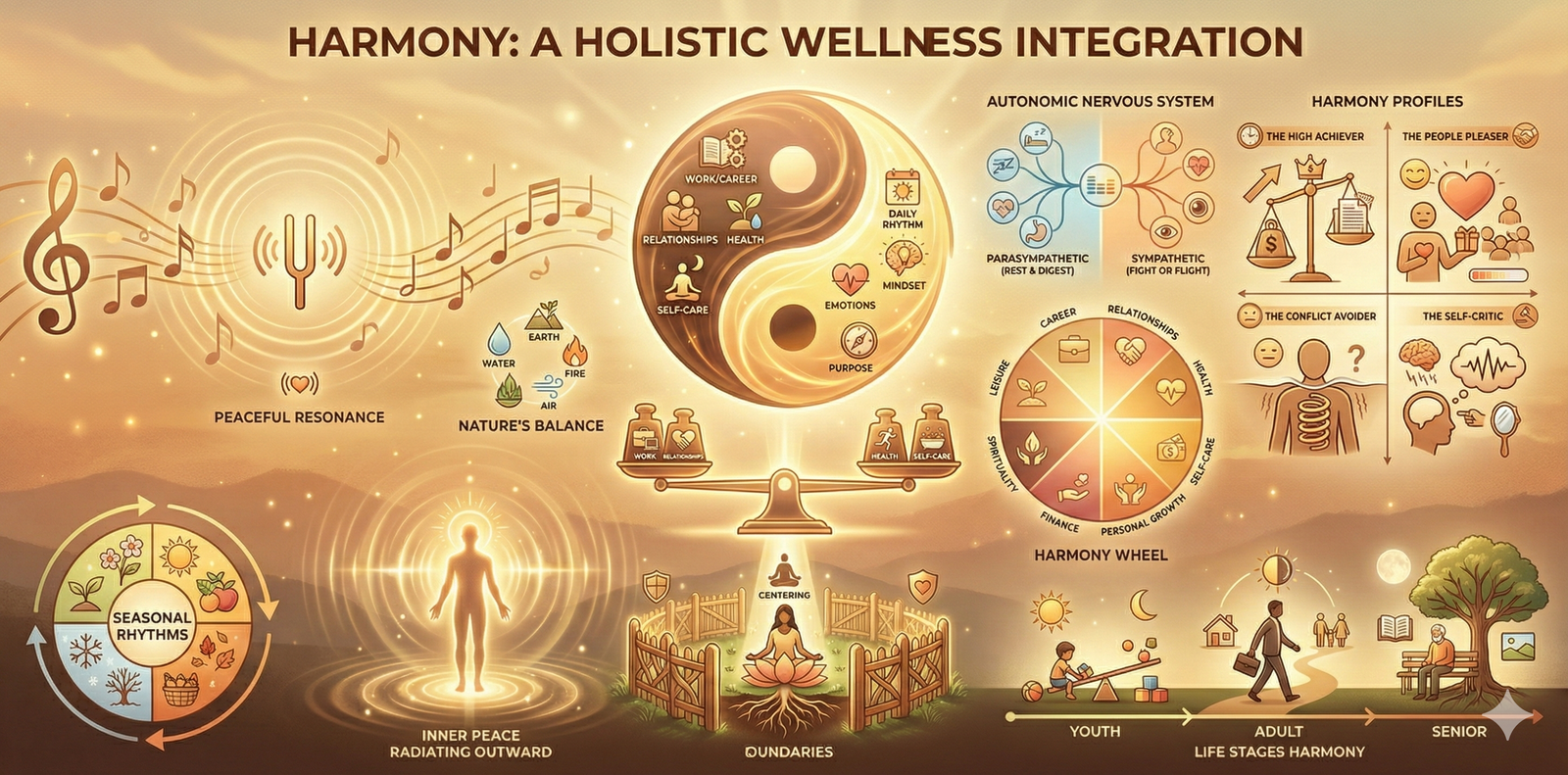
The Harmony Framework: Inner and Relational Integration
Shows how harmony integrates emotional stability, self-acceptance, and relational understanding into a cohesive state of being
🔍 Click to enlarge
Why Harmony Matters in 2026
In 2026, harmony has become increasingly essential as people face competing demands from work, relationships, social media, and personal aspirations. Modern life creates constant internal friction—conflicting priorities, fragmented attention, and pressure to maintain multiple personas across different contexts. Harmony offers an antidote by helping you integrate these fragmented parts into a coherent whole. When you achieve harmony, you experience less internal conflict, fewer emotional whiplashes, and greater resilience during stress.
Research now demonstrates that harmony predicts long-term wellbeing better than momentary happiness. A multinational study found that people who prioritize harmony report lower stress, anxiety, and general distress levels compared to those focused solely on pleasure-seeking. In relationships, harmony has become critical in diverse, cross-cultural contexts where people must maintain connection despite genuine differences. Rather than seeking agreement, harmony skills teach understanding—a more realistic foundation for lasting relationships.
Harmony also fuels personal growth. When you're not consumed by internal conflict or relational friction, mental energy becomes available for learning, creativity, and contribution. Organizations and communities with harmony cultures demonstrate better collaboration, innovation, and resilience. In 2026's complex environment, harmony is no longer optional—it's foundational to thriving.
The Science Behind Harmony
Neuroscience reveals that harmony activates your brain's parasympathetic nervous system—the 'rest and restore' network that counters stress activation. When you experience harmony, your amygdala (fear center) downregulates while your prefrontal cortex (reasoning center) becomes more active. This neurological shift enables calm clarity, better decision-making, and emotional regulation. Brain imaging shows that people high in harmony demonstrate greater synchronization between hemispheres and better integration between emotional and rational centers—literally a more coherent brain.
Psychologically, harmony emerges from Ryff's six dimensions of psychological wellbeing: positive relationships with others, environmental mastery, self-acceptance, autonomy, personal growth, and purpose in life. When these six dimensions align—when you feel capable in your environment, accepting of yourself, connected to others, independent yet purposeful—harmony naturally emerges. Research also shows that self-compassion significantly predicts harmony. People who treat themselves with kindness rather than harsh self-judgment experience greater internal balance and better relational harmony, as they extend that compassion to others.
Neural and Psychological Pathways to Harmony
Illustrates how brain activation patterns and psychological wellbeing dimensions create the state of harmony
🔍 Click to enlarge
Key Components of Harmony
Self-Acceptance
Self-acceptance is the foundation of inner harmony. This doesn't mean complacency or abandoning growth—it means acknowledging your full reality without harsh judgment. When you accept your strengths, limitations, past mistakes, and current struggles as part of your humanity, internal conflict dissolves. You stop wasting energy fighting reality or maintaining a false persona. Self-acceptance creates the psychological safety necessary for genuine growth because you're not defending against self-condemnation. Research shows that self-acceptance is one of the strongest predictors of both harmony and resilience.
Emotional Balance
Emotional balance means you experience the full spectrum of human emotions without being overwhelmed or suppressed by any single state. You can feel sadness without despair, anger without aggression, joy without manic excess. This balanced emotional life creates stability and enables wiser choices. Emotional balance doesn't mean emotional flatness—it means your emotions inform rather than dominate your decisions. When you develop emotional balance, you can acknowledge difficult feelings while maintaining your sense of direction and values.
Values Alignment
Values alignment occurs when your daily actions reflect your core beliefs and priorities. Internal conflict intensifies when you act against your values—when you pursue success at the cost of relationships, accumulate possessions while valuing simplicity, or sacrifice authenticity for approval. Harmony emerges when your choices align with what matters most to you. This alignment creates integrity (literal integration), coherence, and a sense of living authentically. Regular reflection on whether your time, energy, and resources match your stated values is essential to maintaining this component.
Relational Understanding
Relational harmony flows from genuine understanding, not agreement. This means you actively listen to understand another person's experience, perspective, and truth—even when you disagree. Understanding doesn't require validation of their position; it requires respect for their inner experience. People high in relational harmony can hold firm boundaries while maintaining compassion, disagree while preserving connection, and express themselves authentically while genuinely considering others. This capacity transforms conflict from win-lose battles into collaborative problem-solving.
| Component | Psychological Function | Life Domain Impact |
|---|---|---|
| Self-Acceptance | Reduces internal conflict and shame; enables authentic growth | Mental health, personal development, resilience |
| Emotional Balance | Enables wise decision-making; prevents emotional overwhelm | Emotional wellbeing, relationships, leadership |
| Values Alignment | Creates integrity and purpose; reduces existential anxiety | Life satisfaction, career fulfillment, meaning-making |
| Relational Understanding | Builds genuine connection; prevents relational friction | Relationship quality, conflict resolution, team dynamics |
How to Apply Harmony: Step by Step
- Step 1: Clarify your core values by listing five principles that matter most to you (e.g., family, integrity, growth, health, creativity). Write why each matters to you.
- Step 2: Audit your week by tracking where your time and energy actually go versus where you said they should go. Notice misalignments without judgment.
- Step 3: Practice self-acceptance by identifying one area where you judge yourself harshly. Reframe it with compassion: What would a kind friend say about this part of you?
- Step 4: Develop emotional awareness by checking in with your emotions three times daily. Name the emotion, notice where you feel it in your body, and observe it without trying to change it immediately.
- Step 5: Schedule regular values alignment reviews—monthly or quarterly—to consciously adjust your choices to reflect your priorities. Make one small change each month.
- Step 6: Practice understanding-focused listening in one key relationship. Next time you disagree, ask 'Can you help me understand your perspective?' instead of defending your position.
- Step 7: Create a harmony ritual—a 10-15 minute daily practice that integrates movement, reflection, or meditation to reconnect with your core values and your body.
- Step 8: Build boundaries that protect your values. Say no to commitments that conflict with what matters most to you, even when they seem important.
- Step 9: Cultivate gratitude for what's working. Weekly, list three areas where you're experiencing alignment and inner peace. This trains your brain toward harmony.
- Step 10: Seek feedback from trusted others about relational harmony. Ask how they experience your presence—do you seem present, authentic, and respectful? Use this to refine your approach.
Harmony Across Life Stages
Young Adulthood (18-35)
In young adulthood, harmony challenges center on identity formation and competing demands. You're establishing values while navigating family expectations, career pressures, and relationship formation. The harmony work here involves clarifying which beliefs are truly yours versus internalized from others, and beginning to align your choices with authentic values. Many young adults experience disharmony from people-pleasing—trying to be all things to all people. Harmony grows when you have the courage to disappoint some people to stay true to yourself. This stage is optimal for establishing the self-awareness and boundary-setting habits that prevent later burnout.
Middle Adulthood (35-55)
Middle adulthood brings harmony challenges from competing responsibilities—career advancement, parenting, aging parents, partnership dynamics. Many experience disharmony from trying to maintain the same identity and commitments that worked earlier while facing new realities. Harmony requires conscious recalibration: What matters most now? Which commitments still serve you? Middle adults often benefit from renegotiating relationships and roles rather than trying to do everything alone. This stage invites deeper relational harmony as you move beyond idealization of partners and family toward realistic, compassionate understanding. Many report their deepest harmony emerges when they release perfectionistic expectations.
Later Adulthood (55+)
Later adulthood can bring profound harmony as people integrate their life experiences and release younger-adult concerns. With time perspective, people often experience greater self-acceptance and clearer values. Harmony challenges here involve meaning-making—integrating life's joys and sorrows into a coherent narrative. Dealing with mortality, health changes, and relationship losses requires emotional resilience and the ability to find meaning even amid loss. Many report that later adulthood brings the deepest relational harmony because they've moved beyond competition or impression management to genuine connection with loved ones. The capacity to accept what cannot be changed while contributing meaningfully creates powerful late-life harmony.
Profiles: Your Harmony Approach
The High Achiever
- Permission to slow down without guilt
- Clear values beyond external achievement
- Regular reflection on what matters most
Common pitfall: Confuses busyness with meaning; sacrifices relationships for success, then feels hollow despite achievements
Best move: Quarterly values audit: Does your schedule reflect your actual priorities? Make one bold change to realign your time with what matters.
The People Pleaser
- Practice saying no without over-explaining
- Clarity that disappointing others is sometimes integrity
- Understanding that real relationships can handle disagreement
Common pitfall: Abandons authentic self to keep peace; builds resentment as internal and relational disharmony intensifies
Best move: Start small: Choose one boundary to set this week. Notice that the relationship survives disagreement.
The Conflict Avoider
- Recognition that harmony includes difficult conversations
- Skills for expressing needs without aggression
- Understanding that understanding requires vulnerability
Common pitfall: Suppresses real issues; relationships remain superficial and resentment builds silently
Best move: Practice expressing one concern in listening-focused way: 'I feel X when Y happens. Can we talk about this?' Focus on understanding, not winning.
The Self-Critic
- Intentional self-compassion practice
- Recognition that inner criticism blocks harmony
- Understanding that growth requires self-acceptance, not self-attack
Common pitfall: Internal conflict from harsh self-judgment; projects critical stance onto others, creating relational tension
Best move: When you notice self-criticism, pause and ask: 'Would I speak this way to a friend struggling with this?' Replace the criticism with kindness.
Common Harmony Mistakes
One common mistake is confusing harmony with agreement or constant smoothness. People sometimes avoid necessary conflict to maintain apparent harmony, creating false peace that masks real tension. True harmony includes the capacity for difficult conversations, disagreement, and collaborative problem-solving. Another mistake is pursuing harmony only in relationships while neglecting inner harmony. You can't create genuine relational harmony while experiencing internal conflict—you'll project your dissonance onto others. Similarly, some people achieve inner harmony but isolation from meaningful relationships, which is peace but not true harmony.
Many also mistake harmony for passivity or acceptance of harmful situations. True harmony includes wisdom about when to stay and work toward understanding versus when to leave unhealthy dynamics. Harmony isn't about tolerating disrespect or abuse; it's about clarity and boundaries. Another critical mistake is trying to achieve harmony through constant monitoring and control—effort that creates the opposite effect. Genuine harmony emerges through acceptance and integration, not force. You can't think your way into harmony through perfectionism or willpower alone.
Finally, people often expect harmony to feel like constant peace or happiness, then interpret difficult emotions as failure. True harmony includes sadness, anger, and grief—it's not the absence of difficult emotions but the ability to experience them without being fragmented by them. This misunderstanding leads people to abandon harmony practices during challenges, when those practices are most valuable.
Harmony Misconceptions vs. Reality
Compares common misunderstandings about harmony with what harmony actually entails
🔍 Click to enlarge
Science and Studies
Research on harmony has expanded significantly over the past decade, demonstrating its importance across cultures and its measurable impact on wellbeing. Recent international studies show that harmony correlates strongly with life satisfaction, reduced anxiety and depression, better physical health outcomes, and stronger relationship quality.
- Frontiers in Psychology (2025): 'The Relationship Between Marital Harmony and Trust' demonstrates that emotional reconciliation and non-defensive dialogue significantly predict trust restoration in relationships.
- International Journal of Wellbeing: Research on inner harmony during COVID-19 pandemic found that harmony predicted psychological resilience better than other wellbeing measures across 50+ countries.
- Psychology Today (2025): 'Harmony with Self, Others, and the World as Key to Happiness' reports that integration of inner and relational harmony predicts mature, lasting happiness across cultures.
- Journal of Psychological Wellbeing: 'The Predictive Power of Inner Harmony' found that inner harmony scores predicted stress levels, anxiety, and distress more accurately than happiness scores alone.
- Cross-Cultural Happiness Study (155 articles, 100+ countries): Identified three pillars of happiness: Health, Hope, and Harmony—with harmony being the most culturally consistent predictor of wellbeing.
Your First Micro Habit
Start Small Today
Today's action: Do a 2-minute values alignment check: List three areas of your life (work, relationships, health, etc.). For each, quickly note if your current time/energy matches your values (yes or misaligned). No judgment—just awareness.
This micro habit trains your brain toward awareness of harmony without requiring dramatic change. Small repeated awareness builds the self-knowledge necessary for lasting change. You'll begin noticing misalignments naturally, which fuels organic realignment.
Keep quitting habit apps after a missed day? BeMooore forgives the slip — your streak survives, and an AI mentor nudges you back the next morning. Free on iOS.
Quick Assessment
How do you currently experience your inner life?
Your response indicates your current inner harmony baseline. Those answering 'coherent' likely have strong foundations to build on. Those in conflict or fragmentation may benefit most from values clarification and self-acceptance work.
In your closest relationships, do you experience understanding or agreement as most important?
This reveals your relational harmony style. The first option suggests healthy relational harmony. Options two and three may indicate areas for developing deeper understanding skills and boundary clarity.
What feels most misaligned in your life right now?
This identifies your primary disharmony area. Use this to prioritize your harmony work: relationship harmony, values clarification, or life integration.
Take our full assessment to get personalized recommendations.
Discover Your Style →Next Steps
Your journey toward harmony begins with awareness. Start by noticing where you experience disharmony—whether in your internal world, your relationships, or your alignment with values. Notice without judgment. Awareness is the first step toward change. Choose one micro habit from this article and practice it daily for one week. Track what you notice about your inner experience and relationships.
Then, identify your primary harmony opportunity: inner harmony work (self-acceptance, emotional balance), relational harmony (understanding-focused communication, boundaries), or values alignment (reviewing how your time reflects what matters). You don't need to do everything at once. One focused area will create momentum and improvement. As you experience shifts in one domain, other areas naturally improve.
Get personalized guidance with AI coaching.
Start Your Journey →Research Sources
This article is based on peer-reviewed research and authoritative sources. Below are the key references we consulted:
Related Glossary Articles
Frequently Asked Questions
Is harmony the same as happiness?
No. Happiness is typically a high-arousal, joyful emotion. Harmony includes calm acceptance, emotional balance, and integration of all emotions—including sadness and anger. You can be happy without being harmonious, and you can be harmonious without constant happiness. Research shows harmony is a better predictor of lasting wellbeing than happiness alone.
Can I achieve harmony in a difficult relationship?
You can work toward relational harmony by practicing understanding, expressing your needs clearly, and setting respectful boundaries. However, true harmony requires both people's participation. If someone is unwilling to genuinely listen or respect your experience, you may need to accept limited harmony in that relationship or reevaluate it. Harmony isn't about tolerating disrespect.
How long does it take to develop harmony?
Harmony develops gradually. You may notice shifts in awareness within days or weeks of consistent practice. Deeper integration takes months and years. The good news: even small steps toward alignment create immediate psychological relief. Focus on progress rather than perfection.
Is harmony selfish if it means disappointing others?
No. True harmony includes serving others, but not at the cost of your integrity. Authentic connection grows when you're honest about your values and boundaries. Genuine relationships can handle disagreement and difference. Disappointing people occasionally to maintain your values often strengthens relationships long-term.
What if my life circumstances don't support harmony right now?
Even in difficult circumstances, you can cultivate inner harmony through self-acceptance, emotional awareness, and connection to purpose. Studies of people in crisis show that inner harmony actually increases resilience. You may not be able to control external circumstances, but you can choose your internal relationship to them.
Take the Next Step
Ready to improve your wellbeing? Take our free assessment to get personalized recommendations based on your unique situation.
- Discover your strengths and gaps
- Get personalized quick wins
- Track your progress over time
- Evidence-based strategies