What Is Accountability
Accountability is the willingness to take responsibility for your actions, decisions, and their consequences. It's the practice of owning your choices—both successful ones and mistakes—without shifting blame to external circumstances or other people. When you embrace accountability, you reclaim your power. Instead of being a passive victim of circumstances, you become an active architect of your life. This mindset transforms how you approach goals, relationships, and personal growth. Research shows that people with strong accountability practices experience higher self-esteem, greater life satisfaction, and more meaningful relationships.
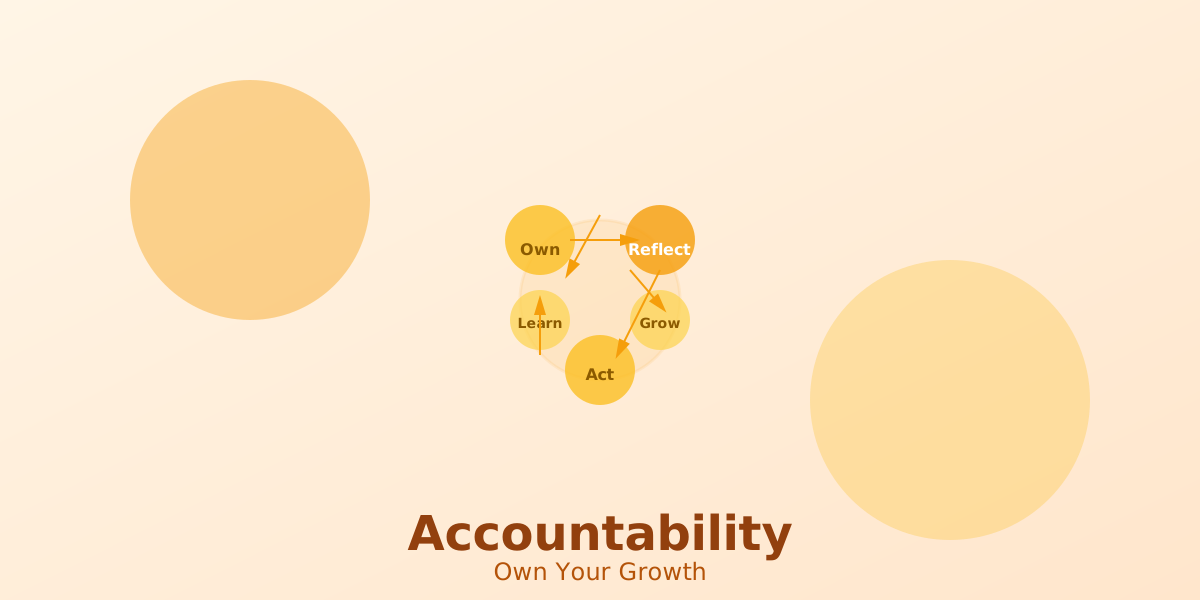
Here's what makes accountability powerful: it's the bridge between intention and action, between knowing what you should do and actually doing it.
Accountability isn't about perfection—it's about honest self-reflection and continuous improvement.
What Is Accountability?
Accountability refers to accepting responsibility for your behavior and its outcomes. Psychologically, it involves "psychological ownership"—an internal commitment to uphold high standards and contribute meaningfully to your goals and relationships. True accountability operates on two levels: internal (how you judge yourself) and external (how others perceive your reliability).
Not medical advice.
Accountability differs from blame. Blame focuses on fault and punishment. Accountability focuses on responsibility and growth. You can be accountable without being blamed, and you can experience blame without being accountable. The goal is to develop personal accountability—an inner commitment to excellence and responsibility.
Surprising Insight: Surprising Insight: Accountability combined with support and empathy drives behavior change more effectively than guilt or shame alone. Research shows that guilt experienced in a supportive context motivates reparative action and personal growth.
The Accountability Spectrum
How accountability ranges from avoidance to ownership
🔍 Click to enlarge
Why Accountability Matters in 2026
In today's world, accountability is more crucial than ever. With endless distractions, social media comparison, and complex relationships, it's easy to blame external factors for our struggles. Yet the people who thrive—whether in careers, relationships, or personal health—share one quality: they hold themselves accountable. They don't wait for perfect conditions. They start where they are, track their progress, and adjust when things don't work.
Accountability strengthens relationships. When you admit mistakes and follow through on commitments, others trust you more. This trust becomes the foundation for deeper connections, better teamwork, and more fulfilling partnerships. In the workplace, teams with strong accountability cultures report higher engagement, better communication, and greater innovation.
For personal well-being, accountability transforms how you experience life. Instead of feeling like you're at the mercy of circumstances, you recognize your agency. This sense of control and competence directly boosts self-esteem and mental health. You stop waiting for permission, motivation, or perfect timing—you start taking action now.
The Science Behind Accountability
Psychological research reveals that accountability activates neural pathways related to decision-making, self-reflection, and emotional regulation. When you practice accountability, you strengthen the prefrontal cortex—the brain region responsible for planning, impulse control, and evaluating consequences. Over time, this rewires your automatic responses and makes accountability feel natural rather than forced.
Studies on behavior change show that accountability increases follow-through by 65-90% depending on the context. One landmark study found that people who wrote down their goals and shared them with an accountability partner completed those goals at four times the rate compared to those who kept goals private. The mechanism: when you know someone will ask about your progress, your brain prioritizes that task differently.
How Accountability Activates Brain Regions
Neural pathways involved in accountability practice
🔍 Click to enlarge
Key Components of Accountability
Honesty and Self-Awareness
Accountability begins with honest self-assessment. You must see yourself clearly—acknowledging both strengths and areas for growth. This means examining why you made a choice, what factors influenced it, and what you could do differently. Self-awareness is the foundation. Without it, you're just repeating the same patterns.
Responsibility Without Shame
Healthy accountability separates the action from your self-worth. You can own a mistake without believing you're a bad person. This distinction is critical. Shame makes people defensive and shut down. Responsibility empowers them to learn and grow. The question shifts from "What's wrong with me?" to "What can I improve?"
Commitment to Change
Accountability requires more than awareness—it demands action. When you acknowledge a mistake or gap, you commit to specific changes. This might mean adjusting your approach, setting new boundaries, or seeking support. Commitment transforms insight into behavior.
Consistent Follow-Through
The final component is consistency. Accountability isn't a one-time event. It's an ongoing practice of showing up, tracking progress, and adjusting as needed. This rhythm builds trust—with yourself and others.
| Concept | Definition | Outcome |
|---|---|---|
| Accountability | Taking ownership of actions and outcomes with growth mindset | Empowerment, behavior change, stronger relationships |
| Blame | Assigning fault with focus on punishment | Defensiveness, disconnection, stagnation |
| Responsibility | Duty or obligation imposed externally | Compliance without ownership, limited growth |
| Guilt | Negative emotion about a past action | Can motivate change if combined with support |
How to Apply Accountability: Step by Step
- Step 1: Pause and observe: When something goes wrong, resist the urge to immediately explain it away. Pause for 10 seconds and observe what happened without judgment.
- Step 2: Ask clarifying questions: What choice did I make? What was I thinking or feeling at the time? What could I have done differently?
- Step 3: Name the pattern: Is this a one-time mistake or a recurring pattern? If it's recurring, what triggers it?
- Step 4: Acknowledge impact: Who was affected by my action or inaction? What was the actual consequence?
- Step 5: Make a specific commitment: Don't say 'I'll do better.' Say exactly what you'll do differently next time, including when and how.
- Step 6: Create a tracking method: Use a journal, app, or accountability partner to monitor your progress. What gets measured gets managed.
- Step 7: Schedule regular reviews: Weekly or monthly, review what you committed to and assess your follow-through. Adjust as needed.
- Step 8: Celebrate wins: When you notice yourself handling something differently—even small improvements—acknowledge it. This reinforces the new behavior.
- Step 9: Get support when needed: Share your commitment with someone you trust. Research shows public commitment increases follow-through significantly.
- Step 10: Practice self-compassion: If you slip up, return to step one. Accountability isn't perfection—it's honest, consistent effort toward growth.
Accountability Across Life Stages
Young Adulthood (18-35)
In early adulthood, accountability often means transitioning from external accountability (parents, teachers, coaches telling you what to do) to internal accountability (motivating yourself). This stage is about discovering your values, setting your own goals, and experiencing consequences of choices. Young adults who develop accountability now build stronger foundations for career success and relationship satisfaction.
Middle Adulthood (35-55)
Mid-life accountability often involves balancing competing responsibilities—career, family, health. Adults in this stage benefit from accountability partnerships and systems because life demands expand. Workplace accountability becomes critical for leadership roles. Family accountability (keeping promises to partners and children) deeply impacts well-being.
Later Adulthood (55+)
Later-life accountability shifts toward legacy and meaning. Seniors often reflect on whether their life choices aligned with their values. This stage emphasizes accountability for maintaining health habits, continuing learning, and nurturing relationships. Many find purpose in being accountable to younger generations or their communities.
Profiles: Your Accountability Approach
The Achiever
- Clear metrics and measurable progress
- Regular feedback and recognition
- Stretch goals with realistic timelines
Common pitfall: Can become perfectionistic and harsh with self-criticism when falling short
Best move: Track progress rather than perfection. Celebrate effort and improvement, not just outcomes.
The Connector
- Accountability partnerships and community
- Shared goals and collaborative projects
- Regular check-ins and relationship focus
Common pitfall: May avoid accountability to protect relationships or over-prioritize others' needs
Best move: Frame accountability as deepening relationships. Use accountability conversations to strengthen bonds.
The Independent
- Autonomy in how to achieve goals
- Self-directed tracking systems
- Flexibility in approach and timing
Common pitfall: May avoid external accountability and resist feedback from others
Best move: Create personal accountability systems that feel like growth, not control. Find accountability partners who respect autonomy.
The Reflective
- Time for deeper self-examination
- Written reflection and journaling practices
- Understanding the 'why' behind commitments
Common pitfall: Can overthink and delay action while analyzing
Best move: Set deadlines for reflection. Balance thinking with action. Use "reflect then act" rhythms.
Common Accountability Mistakes
Mistake One: Confusing accountability with perfection. People often abandon accountability when they make mistakes, thinking they've 'failed.' But accountability means acknowledging the mistake and adjusting—it's exactly when you need accountability most.
Mistake Two: Using accountability as a self-punishment tool. Harsh self-criticism masquerading as accountability actually reduces behavior change. The brain responds better to supportive accountability that emphasizes growth over guilt.
Mistake Three: Lack of specificity. Vague commitments don't work. 'I'll be healthier' won't stick. 'I'll do 20 minutes of walking three times this week' will, because it's specific, measurable, and trackable.
Accountability Mindset Shifts
Moving from resistance to embracing accountability
🔍 Click to enlarge
Science and Studies
Recent research highlights the transformative power of accountability in behavior change, mental health, and relationship quality. Multiple peer-reviewed studies confirm what practitioners have long known: accountability works, especially when combined with support, empathy, and growth-oriented feedback.
- Hall et al. (2015) conducted a meta-analysis of 92 studies on accountability and found consistent evidence that accountability significantly improves commitment to goals and follow-through rates.
- Research published in the Journal of Applied Psychology shows that accountability partners increase goal completion rates by 65-90% compared to individuals working alone.
- Guilt research (Tangney et al., 2007) demonstrates that guilt in a supportive context promotes empathy, corrective behavior, and relationship repair.
- Psychological safety research by Amy Edmondson reveals that accountability and psychological safety aren't opposites—they coexist and reinforce each other in high-performing teams.
- A 2024 study in Frontiers in Psychology found that personal accountability practices correlate with higher self-esteem, life satisfaction, and relationship quality.
Your First Micro Habit
Start Small Today
Today's action: Pick one small commitment today and track it for three days. Example: 'I will drink 2 liters of water daily' or 'I will text back within 4 hours.' Use your phone's notes app or a simple tally mark to track completion.
Tiny commitments build accountability muscle without overwhelming you. Three days is long enough to notice a pattern but short enough to feel achievable. Success here builds confidence for bigger commitments.
Keep quitting habit apps after a missed day? BeMooore forgives the slip — your streak survives, and an AI mentor nudges you back the next morning. Free on iOS.
Related guides: a habit tracker that forgives missed days, habit trackers without streaks and the best habit tracker approach for ADHD.
Quick Assessment
How do you typically respond when you realize you've made a mistake or missed a commitment?
Your response reveals your accountability style. Those who pause and reflect tend to learn from mistakes. Those who blame or avoid miss growth opportunities.
What motivates you to follow through on a commitment?
The strongest accountability comes from internal motivation—wanting to align actions with values. External motivation (fear, approval-seeking) is less sustainable.
In a situation where you didn't achieve a goal, what would help most?
Accountability works best with understanding and support. People who focus on learning and receiving encouragement develop sustainable accountability practices.
Take our full assessment to get personalized recommendations.
Discover Your Style →Next Steps
Your accountability journey begins with one small choice today. Not a dramatic resolution or elaborate system—just one honest commitment and tracking it. Notice how it feels to follow through. That feeling is your accountability foundation growing stronger.
Consider finding an accountability partner—someone who will ask about your progress without judgment. Research consistently shows that external accountability accelerates behavior change. This could be a friend, mentor, coach, or online community member.
Get personalized guidance with AI coaching.
Start Your Journey →Research Sources
This article is based on peer-reviewed research and authoritative sources. Below are the key references we consulted:
Related Glossary Articles
Frequently Asked Questions
Is accountability the same as responsibility?
Not quite. Responsibility is an obligation or duty. Accountability is taking ownership of how you handle that responsibility. You can feel responsible without being accountable, and accountability requires responsibility plus reflection and action.
How do I stay accountable without a partner or support system?
Create self-accountability systems: journal daily about your progress, use apps to track habits, set public goals on social media, or join online communities. Research shows that written tracking alone increases follow-through significantly.
What if I keep failing to meet my accountability commitments?
Start smaller. If you can't meet big commitments, reduce the scope. Success with small commitments builds confidence. Also, examine whether the commitment aligns with your values. Forced accountability rarely works—real accountability connects to things that matter to you.
Can accountability be too harsh?
Absolutely. Self-punishment masquerading as accountability backfires. It increases shame and avoidance. Healthy accountability includes self-compassion. When you slip up, you acknowledge it, adjust, and keep going—not berate yourself.
How long does it take for accountability to become a habit?
Research suggests 21-66 days depending on complexity. Simple habits like tracking take 21 days; deeper accountability mindset shifts take 8-12 weeks. Consistency matters more than duration—daily practice outweighs sporadic intense effort.
Take the Next Step
Ready to improve your wellbeing? Take our free assessment to get personalized recommendations based on your unique situation.
- Discover your strengths and gaps
- Get personalized quick wins
- Track your progress over time
- Evidence-based strategies